

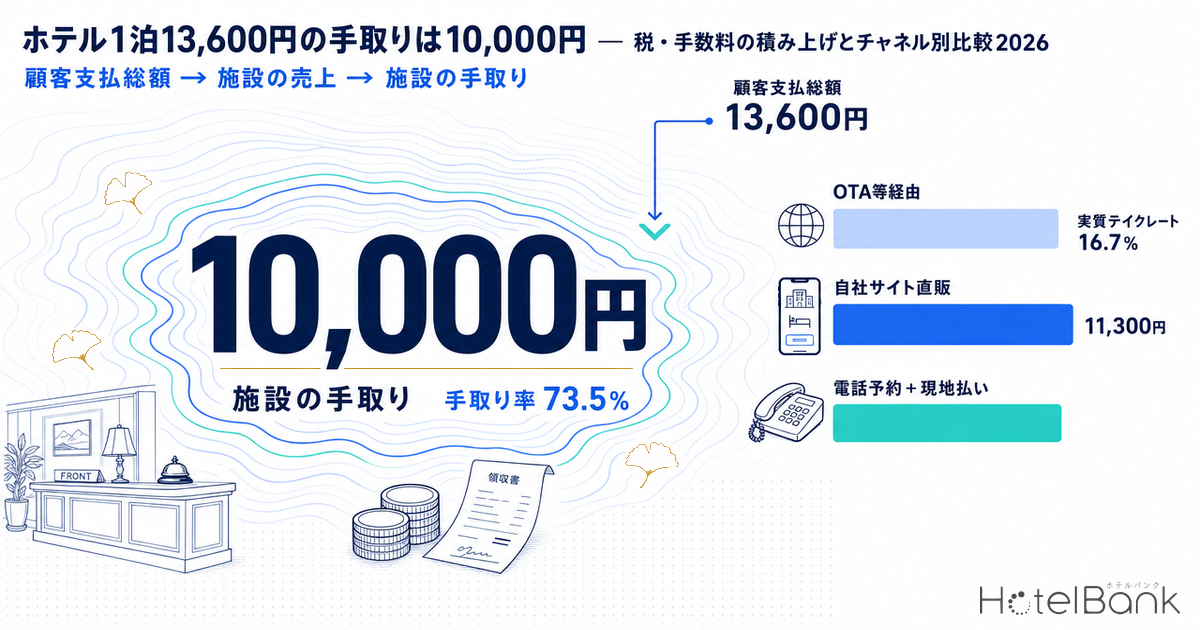
Suppose a room sells for ¥10,000 a night. How much of that actually stays with the property? Few lodging operators can answer on the spot. Consumption tax, lodging tax, bathing tax, booking commission, payment processing fees, the funding behind promotional programmes, the monthly charges for a channel manager and a booking engine — more than ten items come out, and each behaves differently. Is it money held in trust or a genuine cost? Does it scale with price or is it a flat amount? Does it arise on every channel or only on some? Until that is sorted out, even the claim that shifting to direct booking pays remains a matter of instinct.
This article breaks the per-room, per-night amount into three layers — what the guest pays → the property’s revenue → what the property keeps — and stacks up every item deducted in between using published sources only. It then compares net revenue and net-revenue ratios across three channels: major OTAs and similar intermediaries, the property’s own website (online payment), and phone booking with payment on arrival. Sensitivity is checked at three rate bands — ¥6,500, ¥12,000 and ¥30,000. Finally, it works backwards to what a shift of one percentage point in direct-booking share is worth per year.
Booking commission taken on its own — converted from a percentage into a yen figure per night — is a narrower question than the one taken up here. This article stays with the broader frame, the full stack of costs riding on a single night, and does not dig into the commission rates themselves.
Metric Definitions Used in This Article
- ADR (average daily rate): an estimated settled rate (tax-exclusive equivalent) calculated by applying property-type correction factors to the lowest published plan level each property lists on OTAs and similar channels (two guests per room, per-room price, tax-inclusive). Cross-checked against per-property results disclosed by listed hotel REITs (91 properties, most recent three months), the median error is approximately 7%. These are estimates and differ from each property’s actual transaction prices and accounting figures. Area-level ADR is the median across the properties covered (the level of a typical property in that area); the national figure is the weighted average of all 47 prefectures, weighted by the number of properties covered.
- Total guest payment: in this article, the per-room, per-night total of room charge (excluding tax) + consumption tax + lodging tax + bathing tax. Two guests per room are assumed, and because lodging tax and bathing tax are levied per person per night, two persons’ worth are counted.
- Net revenue: what remains of the total guest payment after deducting both the amounts held in trust (consumption tax, lodging tax, bathing tax) and the channel costs (booking commission, payment processing fees, promotional funding, allocated fixed costs). Operating expenses such as payroll, utilities and amenities are not included.
- Effective take rate: channel costs as a proportion of the property’s revenue (room charge, excluding tax). Amounts held in trust are excluded.
- Period covered: ADR figures cover the 12 confirmed months from September 2025 to August 2026. Months in which the number of properties covered falls below 60% of the period median are excluded.
- Data sources: MetroEngines Research (price data); municipal ordinances and published materials from the Ministry of Internal Affairs and Communications, the Japan Tourism Agency and industry associations (regulatory and cost data).
Key Takeaways
— The guest pays ¥13,600 and the property keeps ¥10,000. That is the model at an ADR (tax-exclusive equivalent) of ¥12,000, sold through an OTA or similar intermediary, with a 12% booking commission and 3% promotional funding assumed. The net-revenue ratio is 73.5% of the total guest payment and 83.3% of property revenue.
— The gap between channels is ¥1,300 a night. On the same model, the property’s own website (online payment) returns ¥11,300 and phone booking with card payment on arrival ¥11,538. Effective take rates are 16.7% for OTAs and similar intermediaries, 5.8% for direct web bookings and 3.9% for phone bookings.
— Lodging tax, consumption tax and bathing tax do not reduce net revenue by a single yen. All three are held in trust and are simply the difference between the total guest payment and property revenue. They do, however, push up what the guest pays.
— Flat-amount costs bite on scale, not on price. The net-revenue ratio measured against revenue is 83.2% at ¥6,500 and 83.4% at ¥30,000 — essentially unchanged. Allocated fixed costs per room-night, by contrast, run ¥123 at 20 rooms and ¥10 at 200 rooms, a 12.5-fold spread.
— +10pt of direct-booking share is worth ¥1.87M–¥9.07M a year. Assuming 100 rooms at 75% occupancy (an assumed value, anchored to the 75.3% recorded for business hotels in the Japan Tourism Agency’s Overnight Travel Statistics Survey, 2025 annual figures, published 27 February 2026): Model A (¥6,500) ¥1.87M, Model B (¥12,000) ¥3.56M, Model C (¥30,000) ¥9.07M.
Three layers to keep apart — what the guest pays, what the property books as revenue, what it keeps
Before the stack itself, three amounts that are easily conflated need separating. Debate about lodging tax so often talks past itself because “price increase” and “heavier burden” get used while this distinction stays blurred.
First, the total guest payment. This is what the guest actually pays at the front desk or online: the room charge plus consumption tax, lodging tax and bathing tax. Second, property revenue. Only the tax-exclusive equivalent of the room charge is booked as revenue for accounting purposes; consumption tax, lodging tax and bathing tax are not revenue. Lodging tax and bathing tax are collected as a special collecting agent and remitted to the municipality — money held in trust, which in principle never appears in the property’s profit and loss. Third, net revenue: what is left of revenue after the costs paid outside to win that booking — booking commission, payment processing fees, promotional funding, monthly system charges.
One conclusion follows directly. However far lodging tax rises, the property’s net revenue does not fall by a single yen. What falls is the guest’s available budget, and that works through only indirectly, via price elasticity on the demand side. Booking commission and payment processing fees, by contrast, come straight out of revenue. Two items that both look like “costs riding on one night” are in fact entirely different in kind.
The chart below draws those three layers in actual figures for a single night. The setup: an ADR (estimated settled rate, tax-exclusive equivalent) of ¥12,000, a municipality with a flat ¥200 per person per night lodging tax and no exemption threshold, and an OTA or similar channel with a 12% booking commission and 3% promotional funding.
Source: compiled by the HotelBank Editorial Team from published rates and public materials (a simplified calculation that includes assumed values)
Of the ¥13,600 the guest pays, ¥1,200 in consumption tax and ¥400 in lodging tax — ¥1,600, or 11.8% — passes through to the national and municipal governments. The remaining ¥12,000 is the property’s revenue, but out of that come ¥1,584 in booking commission, ¥396 of promotional programme funding and ¥20 of allocated channel manager and booking engine base fees, leaving ¥10,000 in hand. That is 73.5% of the total guest payment and 83.3% of revenue. Put another way, the effective take rate on this channel is 16.7%.
The twelve items in the stack — levels verifiable in published sources, and the values assumed here
How reliable the stack is depends on how far each item can be pinned to published sources. The table below separates explicitly what could be confirmed from published rates and official statistics from what is assumed in this article. The assumed values are revisited later as the subject of the sensitivity analysis.
Booking commission needs particular care. The official rates charged by individual booking sites are not published. Rates are set in individual contracts with each property and vary with size, listing tier and participation in promotional programmes. There is therefore no primary source that can state “which site charges what percent”. Rather than filling the gap with guesswork, this article uses only the band that can be reconciled backwards from industry-association financial statistics.
According to the FY2025 Business Conditions Survey published by the Japan Ryokan & Hotel Association on 5 December 2025 (based on FY2024 financial statements, 151 valid responses), selling expenses — sales promotion, advertising and sales commissions combined — reached 12.9% of total revenue, up 1.3 points year on year. The same survey gives the booking-channel mix: OTAs and similar intermediaries account for 46.9% on average, the property’s own website 11.5%, direct bookings other than the own website 11.5%, and travel agencies 30.1%. Putting the effective burden at 12%, 46.9% × 12% = 5.6% is the weight of booking commission against revenue; adding commission on the 30.1% booked through travel agencies and the property’s own advertising spend reaches 12.9% without strain. The band of “10–15% effective burden” therefore holds up when reconciled backwards from industry-association financial statistics.
| Item | Category | Level | Basis | Verified |
|---|---|---|---|---|
| Consumption tax | Held in trust | 10% | National Tax Agency (lodging is not eligible for the reduced rate) | 2026-09-15 |
| Lodging tax | Held in trust | ¥0–10,000 /person/night | Ordinances of the 62 local bodies with the Minister’s consent. Flat-rate 28, tiered flat-rate 22, percentage-rate 12 | 2026-09-15 |
| Bathing tax | Held in trust | Standard ¥150 /person/day | Ministry of Internal Affairs and Communications, “Local Tax System / Bathing Tax”. An earmarked tax levied by municipalities where mineral baths are located; each municipality sets the rate | 2026-09-15 |
| Booking commission | Variable cost | 8–20% midpoint 10–15% | Official per-company rates are unpublished. Band derived backwards from the Japan Ryokan & Hotel Association’s 12.9% selling-expense ratio and 46.9% OTA channel share | 2026-09-15 |
| Online payment processing fee | Variable cost | 3.60% | Domestic published rates of a major payment provider (3.6% for online payments, no monthly or set-up fee) | 2026-09-15 |
| Card-present payment processing fee | Variable cost | 2.50–3.25% | Same source (2.5% and up where annual cashless volume is under ¥30M, individually quoted above that; invoice payments 3.25%) | 2026-09-15 |
| QR code payment fee | Variable cost | 1.60–1.98% excl. tax | Published merchant rates of a major QR payment provider (the preferential plan is ¥1,980/month excl. tax) | 2026-09-15 |
| Booking engine transaction fee | Variable cost | 1.22% | Take rate disclosed by a listed vendor (1.22% for FY to October 2025, 1.24% in Q4; annual transaction volume ¥174.4bn, 3,586 domestic properties) | 2026-09-15 |
| Promotional programme funding | Variable cost | 0–5% assumed | Rates unpublished. Set in this article in light of the Japan Ryokan & Hotel Association survey noting that “participation costs for campaigns and the like have increased” | — |
| Channel manager | Fixed cost | ¥5,000–30,000/month | Band of published rates across vendors (set-up fee ¥0–100,000; many quote on request). Adoption rate in the Japan Ryokan & Hotel Association survey is 97.3% | 2026-09-15 |
| Booking engine base fee | Fixed cost | ¥30,000/month assumed | Set in this article because major vendors quote on request and do not publish rates | — |
| Search and metasearch advertising | Fixed cost | ¥100,000/month assumed | Set as a monthly budget including agency management fees. Charged to the direct channel only | — |
Source: compiled by the HotelBank Editorial Team from published rates, public materials and industry-association surveys (assumed marks values set in this article)
Four further calculation assumptions are set. (1) The base for booking commission and payment processing fees is the room charge including tax. Some contracts calculate on a tax-exclusive base, in which case the fee is about 9% smaller (¥1,584 → ¥1,440 on Model B). (2) Lodging tax and bathing tax are collected on site and fall outside online payment. (3) Fixed costs are allocated on a basis of 100 rooms at 75% occupancy (2,280 room-nights a month — a full-year assumed value anchored to the by-property-type levels published on 27 February 2026). That occupancy benchmark sits close to the 75.3% for business hotels and 74.2% for city hotels in the Japan Tourism Agency’s Overnight Travel Statistics Survey, 2025 annual figures (preliminary, published 27 February 2026). (4) Operating expenses such as payroll, cleaning and amenities are excluded from the stack, on the basis that they arise equally regardless of channel.
Net revenue by channel — the same ¥13,600 splits into ¥10,000, ¥11,300 and ¥11,538
Next, the same single night sold through three different channels. The channel settings are as follows.
(1) OTA or similar intermediary (prepaid): 12% booking commission, 3% promotional programme funding. Payment is completed on the platform side, so no payment processing fee arises for the property. (2) Own website, direct (online payment): no booking commission, 3.6% online payment processing fee, 1.22% booking engine transaction fee, plus the monthly allocation of search and metasearch advertising. (3) Phone booking with card payment on arrival: no booking commission and no booking engine transaction fee, 3.25% card-present payment processing fee. Because the full amount including lodging tax is settled on site, however, the base for the processing fee is the total guest payment.
The table below sets out the calculation across three rate bands, which were set with reference to actual market data. Aggregating MetroEngines Research estimated settled ADR over the 12 confirmed months from September 2025 to August 2026, the national all-property-type level is ¥10,925 (weighted average across 47 prefectures by number of properties covered, N=16,905 properties). By prefecture, Tokushima at ¥6,499, Kagoshima at ¥6,810 and Miyazaki at ¥6,895 sit in the ¥6,000s, while Nagano at ¥12,078 and Gunma at ¥12,083 sit in the ¥12,000s. By municipality, Hakone at ¥26,385 (N=181 properties) and Kutchan at ¥27,542 (N=21 properties) rank at the top; the ¥30,000 band is an assumed value set to represent higher-priced resorts and ryokan above that level.
| Item | Model A regional business band | Model B national standard band | Model C high-rate resort band |
|---|---|---|---|
| Room charge (excl. tax = revenue) | ¥6,500 | ¥12,000 | ¥30,000 |
| + Consumption tax 10% | ¥650 | ¥1,200 | ¥3,000 |
| + Lodging tax (¥200 × 2 guests) | ¥400 | ¥400 | ¥400 |
| = Total guest payment | ¥7,550 | ¥13,600 | ¥33,400 |
| (1) OTA and similar — net revenue | ¥5,408 | ¥10,000 | ¥25,030 |
| Net-revenue ratio (of total / of revenue) | 71.6% / 83.2% | 73.5% / 83.3% | 74.9% / 83.4% |
| (2) Own website direct — net revenue | ¥6,092 | ¥11,300 | ¥28,345 |
| Net-revenue ratio (of total / of revenue) | 80.7% / 93.7% | 83.1% / 94.2% | 84.9% / 94.5% |
| (3) Phone booking, pay on arrival — net revenue | ¥6,235 | ¥11,538 | ¥28,894 |
| Net-revenue ratio (of total / of revenue) | 82.6% / 95.9% | 84.8% / 96.2% | 86.5% / 96.3% |
| (2)−(1) difference per night | ¥684 | ¥1,300 | ¥3,315 |
Source: compiled by the HotelBank Editorial Team from published rates and public materials (simplified calculation assuming 12% booking commission, 3% promotional funding, flat ¥200 per person lodging tax, 100 rooms at 75% occupancy)
Source: compiled by the HotelBank Editorial Team from published rates and public materials (a simplified calculation that includes assumed values)
Ranked by effective take rate — channel costs as a proportion of revenue — OTAs and similar intermediaries come out at 16.6–16.8%, the own website at 5.5–6.3% and phone booking with payment on arrival at 3.7–4.1%. The gap between channels is roughly 10 to 13 points, and that is the theoretical headroom in a shift towards direct booking.
It would be premature, though, to read this table as “phone booking wins”. Channel (3) carries no allowance for the labour of taking the reservation. At five minutes of handling time per call and an hourly wage of ¥1,200, that is ¥100 a booking, and several hundred yen once back-and-forth exchanges and change requests are included. Model A’s ¥143 gap between (2) and (3) is all but wiped out by that labour. Because the relative weight of labour falls as the rate rises, Model C’s ¥549 gap is more likely to survive. In other words, the advantage of phone and direct booking becomes more solid the higher the rate band.
The 3% promotional programme funding in channel (1) is also an assumed value in this article, and swings between 0% and 5% depending on participation. That single item alone moves net revenue as follows.
| Assumption varied (Model B, ADR ¥12,000) | Net revenue | Of total payment | Effective take rate |
|---|---|---|---|
| Promotional funding 0% (commission 12%) | ¥10,396 | 76.4% | 13.4% |
| Promotional funding 3% (this article’s base case) | ¥10,000 | 73.5% | 16.7% |
| Promotional funding 5% (commission 12%) | ¥9,736 | 71.6% | 18.9% |
| Booking commission 8% (promotional funding 3%) | ¥10,528 | 77.4% | 12.3% |
| Booking commission 10% (same) | ¥10,264 | 75.5% | 14.5% |
| Booking commission 15% (same) | ¥9,604 | 70.6% | 20.0% |
| Booking commission 20% (same) | ¥8,944 | 65.8% | 25.5% |
Source: compiled by the HotelBank Editorial Team (simplified calculation with the assumed values varied)
Between a combination of 8% commission with 0% promotional funding and one of 20% commission with 5% promotional funding, net revenue on the same single night differs by about ¥2,200. More practical value lies in knowing where your own property sits within that band than in the band itself. Because contract terms are settled through individual negotiation, the place to start is dividing the most recent invoice by room-nights sold to get the actual yen figure per night. How much inventory is allocated to which channel is the question that logically comes first, and it is left outside the scope of this article.
Where percentage costs and flat costs part company — scale matters, not price
This is the most practical point in the article. The items stacked up split into those that scale with price (consumption tax, booking commission, payment processing fees, promotional funding, booking engine transaction fee) and those that are flat amounts (flat-rate lodging tax, bathing tax, the monthly charges for a channel manager or booking engine). The received wisdom is that flat costs weigh most heavily at the low end of the rate range — but once the numbers are in place, that only holds in part.
First, the net-revenue ratio measured against revenue barely moves. Model A (¥6,500) 83.2%, Model B (¥12,000) 83.3%, Model C (¥30,000) 83.4%. A 4.6-fold increase in rate improves it by just 0.2 points. The reason is simple: measured against revenue, lodging tax disappears as money held in trust, and the only flat cost left is the ¥20 allocation of fixed costs. Against ¥12,000 of revenue, ¥20 is a mere 0.17%.
Measured against the total guest payment, by contrast, the net-revenue ratio moves 3.3 points, from 71.6% to 74.9%. Almost all of that difference is created by flat-rate lodging tax. At ¥200 per person per night, the tax is 5.30% of the total guest payment in a room costing ¥3,250 per person and 1.20% in one costing ¥15,000. A 4.6-fold increase in rate cuts the burden ratio to a quarter and a bit. The chart below shows the shape of it.
Source: compiled by the HotelBank Editorial Team (lodging tax at a flat ¥200 per person per night with no exemption threshold, booking commission at a flat 12%, two guests per room assumed)
The booking-commission line runs almost flat from 11.2% to 11.9%, carrying a constant weight regardless of rate. The lodging-tax line, by contrast, climbs sharply at the left-hand end. The way those two lines cross is exactly the picture behind “percentage costs bite regardless of rate; flat costs bite at the low end”. But to repeat: lodging tax does not reduce the property’s net revenue. What it affects is the total the guest sees, and therefore price competitiveness.
So where are the flat costs that do bite directly into net revenue? The answer is not price but scale. Allocating the combined ¥45,000 monthly cost of a channel manager and a booking engine base fee across room-nights sold, the figure varies with property size and occupancy as follows.
Source: compiled by the HotelBank Editorial Team (allocation calculated on assumed values of ¥15,000/month for a channel manager plus ¥30,000/month for a booking engine base fee)
A property with 20 rooms at 60% occupancy (the size-band occupancy rates in this section are all assumed values, set with reference to the by-property-type levels published by the Japan Tourism Agency on 27 February 2026) sells only 365 room-nights a month, so the allocation comes to ¥123.4 per room-night (0.907% of a ¥13,600 total guest payment). At 200 rooms and 75% occupancy, 4,560 room-nights a month bring it to ¥9.9 (0.073%) — a 12.5-fold spread. For a small property, fixed system costs show up not as a question of rate band but as a question of room-nights sold. Put the other way round, the smaller the property and the lower its occupancy, the more worthwhile it is to convert any decision to add another monthly-fee tool into an actual yen figure per night. A ¥10,000-a-month tool costs ¥27.4 a night at 365 room-nights and ¥2.2 a night at 4,560.
By lodging-tax regime — the same rate, and the guest’s tax burden ranges from 0.0% to 5.7%
Lodging tax is designed differently in every municipality. At least 62 local bodies have obtained the consent of the Minister for Internal Affairs and Communications, and their tax structures divide into 28 flat-rate, 22 tiered flat-rate and 12 percentage-rate bodies (for the detail, see Lodging Tax in Japan 2026: Rates, Effective Dates and the Burden on Actual Room Rates Across 62 Municipalities). At the same model rate, the total guest payment changes with the regime where the property is located.
Note that the base for lodging tax is the room-only equivalent, excluding meal charges and excluding consumption tax. The ADR used here is a tax-exclusive equivalent and so sits close to that base, but for plans that include meals the meal component must be separated out. In the table below, the per-person rate at two guests per room (room rate ÷ 2) is applied as the tax base.
| Lodging-tax regime | Model A ¥3,250/person | Model B ¥6,000/person | Model C ¥15,000/person |
|---|---|---|---|
| No lodging tax | ¥0 (0.00%) | ¥0 (0.00%) | ¥0 (0.00%) |
| Flat ¥200, no exemption threshold Morioka, Kumamoto, Miyazaki and others | ¥400 (5.30%) | ¥400 (2.94%) | ¥400 (1.20%) |
| Tokyo, current exempt under ¥10,000; tiers ¥100/¥200 | ¥0 (0.00%) | ¥0 (0.00%) | ¥400 (1.20%) |
| Tokyo, from April 2027 exempt under ¥13,000; flat 3% | ¥0 (0.00%) | ¥0 (0.00%) | ¥900 (2.65%) |
| Osaka, current exempt under ¥5,000; tiers ¥200/¥400/¥500 | ¥0 (0.00%) | ¥400 (2.94%) | ¥800 (2.37%) |
| Kyoto City, current no exemption threshold; tiers ¥200–10,000 | ¥400 (5.30%) | ¥800 (5.71%) | ¥800 (2.37%) |
Source: compiled by the HotelBank Editorial Team from municipal published materials (figures in brackets are lodging tax as a share of the total guest payment; two guests per room, two persons’ worth counted)
The maximum is 5.71%, on Model B in Kyoto City; the minimum is 0.00%, where there is no lodging tax or the rate falls below the exemption threshold. For the same ¥12,000 room, the total the guest pays ranges from ¥13,200 to ¥14,000 depending on location — a spread of ¥800. That the design of the exemption threshold all but determines this difference will not change as percentage-rate regimes spread. The flat 3% Tokyo adopts from April 2027, combined with an exemption threshold of under ¥13,000, leaves the standard price band at two guests per room untaxed as before.
At onsen properties, bathing tax is added on top. According to the Ministry of Internal Affairs and Communications, bathing tax is an earmarked tax levied by municipalities where mineral baths are located, set by each municipality with a standard rate of ¥150 per person per day. Adding ¥300 for two guests at the standard rate, total tax as a share of the total guest payment (consumption tax + lodging tax + bathing tax) comes to ¥1,350 and 17.2% on Model A, ¥1,900 and 13.7% on Model B, and ¥3,700 and 11.0% on Model C. At a low-rate onsen inn, a little over one sixth of what the guest pays is tax. The property’s net revenue is unchanged here too, but this certainly affects the denominator against which a guest judges value for money.
What one point of direct-booking share is worth — ¥190,000 to ¥910,000 a year at 100 rooms
Finally, the stack is translated into a unit of decision-making. Once the per-night margin between channels is known, how much annual net revenue a given shift in direct-booking share adds is a matter of multiplication.
A property with 100 rooms at 75% occupancy (a full-year assumed value anchored to the by-property-type levels published on 27 February 2026) sells 27,375 room-nights a year. A one-point rise in direct-booking share means 273.75 of those room-nights moving from OTAs and similar intermediaries to the property’s own website. The per-night margin ((2)−(1)) was ¥684 on Model A, ¥1,300 on Model B and ¥3,315 on Model C.
| Rate band (100 rooms, 75% occupancy, 27,375 room-nights a year. Occupancy is a full-year assumed value anchored to the by-property-type levels published on 27 February 2026) | Margin per night | Direct +1pt annual effect | Direct +10pt annual effect | Per room at +10pt |
|---|---|---|---|---|
| Model A, regional business band (¥6,500) | ¥684 | ¥187,245 | ¥1,872,450 | ¥18,724 |
| Model B, national standard band (¥12,000) | ¥1,300 | ¥355,875 | ¥3,558,750 | ¥35,588 |
| Model C, high-rate resort band (¥30,000) | ¥3,315 | ¥907,481 | ¥9,074,812 | ¥90,748 |
Source: compiled by the HotelBank Editorial Team (simplified calculation assuming 12% booking commission, 3% promotional funding, 3.6% online payment processing and a 1.22% booking engine transaction fee)
Source: compiled by the HotelBank Editorial Team (simplified calculation assuming 100 rooms, 75% occupancy and 27,375 room-nights a year)
In the Japan Ryokan & Hotel Association survey, the average share booked through the property’s own website is 11.5%. Raising that by ten points, to 21.5%, gives the annual effect in the “+10pt” column above. On Model B at 100 rooms, that is ¥3.56M a year, or ¥35,588 per room. On the high-rate Model C it reaches ¥9.07M a year and ¥90,748 per room. Because the yen value of percentage-based costs grows with the rate, the return on a shift to direct booking grows in proportion to the rate as well.
Three assumptions sit behind this calculation, each of which needs testing in practice. First, the settled rate on direct bookings is held at the same level as on OTAs and similar intermediaries. Discounts limited to the property’s own site, or member benefits, lower the effective rate and narrow the margin accordingly. How much of the ¥1,300 margin is handed back to the guest determines the economics of the direct shift outright. Second, sales volume is assumed unchanged. Cutting back listings reduces exposure, and some bookings will be lost before they move to the direct channel. Third, advertising is set as a fixed cost of ¥100,000 a month, whereas spend on search and metasearch normally rises in the course of growing direct bookings, behaving in practice more like a semi-variable cost. Anything above ¥100,000 a month should be deducted directly from the effect shown in the table.
Even so, the direction this calculation points in is clear. The economic value of a direct shift is determined not by a percentage but by the per-night margin multiplied by room-nights. For the same ten-point shift, the effect at a property with a ¥6,500 rate and one with a ¥30,000 rate differs 4.8-fold. And the lower the rate, the smaller the per-night margin, so the more room-nights are needed to recover fixed investments such as advertising and labour. A property in the low-rate band taking on direct booking will reach its break-even point sooner by starting from a set-up with small monthly fixed costs.
Conclusion — three numbers to recalculate for your own property
Distilled, the stack in this article leaves three numbers worth having in hand.
First, the difference between the total guest payment and revenue. Consumption tax, lodging tax and bathing tax are all held in trust and do not reduce the property’s net revenue. There is no need to treat the introduction or revision of a lodging tax as a cost increase — but the total the guest sees certainly rises. In flat-rate municipalities in particular, the share of the total is higher the lower the rate: 5.30% on Model A, and 17.2% at an onsen inn once bathing tax is included. Price display and the way it is explained need to be designed around that total.
Second, the effective take rate. Channel costs as a proportion of revenue: on this article’s assumptions, 16.7% for OTAs and similar intermediaries, 5.8% for the property’s own website and 3.9% for phone booking with payment on arrival (all Model B). Your own figure comes out of dividing the most recent invoice by room-nights sold. Whether the gap between channels is larger or smaller than the 10 to 13 points here, once actual figures replace assumed ones, is what sets the priority of investing in direct booking.
Third, the per-night margin and the room-nights required. The effect of a direct shift is determined in yen, not in percentages. On Model B that is ¥1,300 a night, and at 100 rooms and 75% occupancy (a full-year assumed value anchored to the by-property-type levels published on 27 February 2026), ¥356,000 a year per point of direct-booking share. With that number in hand, how many months it takes to recover a tool at a given monthly fee can be judged immediately. At ¥100,000 a month of advertising, ¥1.2M a year ÷ ¥1,300 = 923 room-nights: moving 3.4% of annual room-nights sold to the direct channel brings the calculation to break-even.
Returning a debate conducted in percentages to actual amounts — that is the whole purpose of this article. A comparison of 8% against 15% only becomes material for an investment decision once it is restated as so many yen per night, so many room-nights a year, and so much in total.
A note on the calculations in this article: the net revenue and net-revenue ratios here are simplified calculations combining levels verifiable in published sources with values assumed in this article. Booking commission rates, promotional programme funding and monthly system fees are all settled in individual contracts, and the actual figures differ by property. Whether lodging tax and bathing tax apply, and at what amount, is determined by each municipality, and the treatment of the tax base (separating out meal charges, for example) likewise follows each municipality’s own rules. For practical decisions, please check each property’s contract terms and invoices along with the published materials of the municipality in which it is located.
Related reading
References and Sources
■ Data sources
Room rates are MetroEngines Research estimated settled ADR (12 confirmed months from September 2025 to August 2026, 47 prefectures weighted by number of properties covered, N=16,905 properties). Regulatory and cost items are taken from published materials of the responsible ministries and municipalities, industry-association statistical surveys, the published rate pages of payment and system vendors, and the earnings disclosures of listed vendors; category, level, basis and date verified are set out in the table in the body text.
■ Calculation assumptions
Calculated per room per night at two guests per room. (1) The base for booking commission and payment processing fees is the room charge including tax; (2) lodging tax and bathing tax are collected on site and fall outside online payment; (3) fixed costs are allocated on a basis of 100 rooms at 75% occupancy (2,280 room-nights a month); (4) operating expenses such as payroll and cleaning are common across channels and are excluded from the stack. The three rate bands are Model A ¥6,500, Model B ¥12,000 and Model C ¥30,000. Booking commission of 12% and promotional programme funding of 3% are the base case, varied to 8–20% and 0–5% respectively in the sensitivity analysis.
■ Limitations and caveats
Booking commission rates, promotional programme funding, booking engine base fees and advertising spend are values assumed in this article, because official per-company rates are not published (marked “assumed” in the table in the body text). The net revenue figures here therefore do not represent any particular operator’s actual rates; they are a simplified calculation within the band that published sources can confirm. Estimated settled ADR is an estimate and differs from each property’s actual transaction prices and accounting figures. The annual effect of a direct-booking shift assumes that the settled rate and sales volume are unchanged, and does not allow for direct-only discounts, bookings lost to reduced exposure, or increases in advertising spend.
■ Market data
- MetroEngines Research — estimated settled ADR (12 confirmed months from September 2025 to August 2026, N=16,905 properties, weighted average across 47 prefectures), ADR by prefecture and municipality
■ Government statistics and public materials
- Japan Tourism Agency, Overnight Travel Statistics Survey, 2025 annual figures (preliminary) (published 27 February 2026. Room occupancy: all types 61.8% / ryokan 38.4% / resort hotels 56.9% / business hotels 75.3% / city hotels 74.2%. Verified 15 September 2026)
- Ministry of Internal Affairs and Communications, “Local Tax System / Bathing Tax” (standard rate ¥150 per person per day; an earmarked tax of municipalities where mineral baths are located, collected by a special collecting agent. Verified 15 September 2026)
- Ministry of Economy, Trade and Industry and Japan Fair Trade Commission, “Publication of the Allocation Ratios of Credit Card Merchant Fees” (1 June 2023. Publication of the breakdown of merchant fees and interchange fees. The same release is also published by the Japan Fair Trade Commission. Verified 15 September 2026)
- Municipal lodging-tax ordinances and published materials (Tokyo Metropolitan Bureau of Taxation, Osaka Prefecture, Kyoto City and others) and Ministry of Internal Affairs and Communications press materials — tax amounts, effective dates and exemption thresholds for the 62 local bodies with the Minister’s consent (verified 15 September 2026)
■ Industry-association surveys and corporate disclosure
- Japan Ryokan & Hotel Association, FY2025 Business Conditions Survey (based on FY2024 financial statements) (published 5 December 2025, 151 valid responses. Selling-expense ratio 12.9%, OTA and similar channel share 46.9%, own-website share 11.5%, channel manager adoption 97.3%. Verified 15 September 2026)
- tripla Co., Ltd., FY October 2025 earnings briefing (logmi Finance transcript) (booking engine take rate 1.22% for the full year and 1.24% in Q4; annual transaction volume ¥174.4bn; 3,586 domestic properties. Verified 15 September 2026)
■ Published rates of payment and system vendors
- Square, “Square Pricing” (Japan) (card-present from 2.5% / online payments 3.6% / invoice payments 3.25%, no monthly or set-up fee. Verified 15 September 2026)
- PayPay merchant help, “Payment system usage rates” (1.60% or 1.98%, excluding tax. The preferential plan is ¥1,980/month excluding tax. Verified 15 September 2026)
- Published rate pages of channel manager vendors — ¥5,000 to the ¥30,000s per month, set-up fee ¥0–100,000 (including products quoted on request. Verified 15 September 2026)