

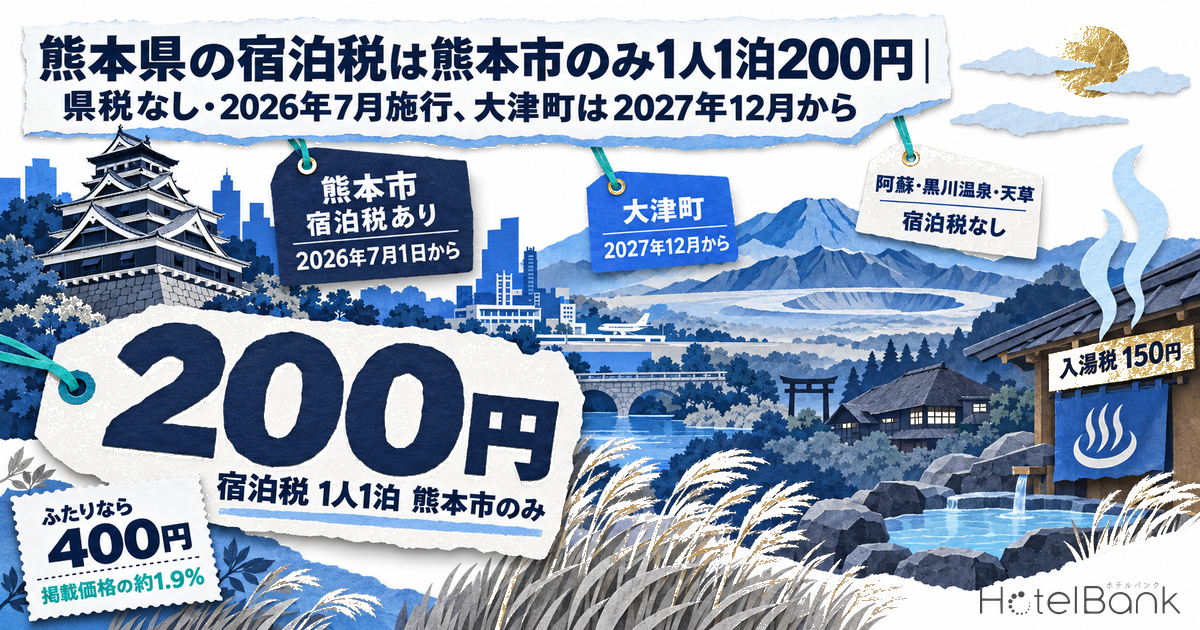
As of October 2026, Kumamoto Prefecture does not levy a prefectural lodging tax. The only municipality in the prefecture that charges one is Kumamoto City, at a flat ¥200 per guest per night, applied to check-ins from July 1, 2026 (the first in the prefecture, with no tax-exempt threshold and no age-based exemption). Ozu Town (大津町) will be the second: on September 18, 2026 it passed an ordinance to introduce a flat ¥200 per guest from December 2027. Aso City, Minamioguni Town (Kurokawa Onsen), Minamiaso Village, Amakusa City, Yamaga City and Hitoyoshi City have no lodging tax. In hot-spring areas, however, a separate bathing tax (nyuto-zei, standard ¥150 per person per night) is added.
This article is written for travelers themselves — anyone asking whether Kumamoto has a lodging tax, how much it is, and when it started — and answers how much the bill actually changes. A nationwide list of lodging taxes is available in Japan Lodging Tax 2026: ¥100–200 per Night, Kyoto Up to ¥10,000, so this piece focuses on Kumamoto only.
- — Kumamoto Prefecture has no prefectural lodging tax. As of October 2026, Kumamoto City is the only municipality in the prefecture that charges one.
- — Kumamoto City charges a flat ¥200 per guest per night. It applies to check-ins from July 1, 2026, with no tax-exempt threshold and no age-based exemption (children sharing a bed at no room charge are not taxed).
- — Two guests, one night: ¥400. That is about 1.9% of the listed price in Kumamoto City’s Chuo Ward (stays in October 2026, 45-property average, per room for two guests, tax included) of roughly ¥21,100.
- — Ozu Town will charge a flat ¥200 from December 2027 (ordinance passed September 18, 2026). Minamioguni Town (Kurokawa Onsen) is still at the study stage, and no lodging tax applies there today.
- — Hot-spring areas charge a separate bathing tax. Aso, Kurokawa and Amakusa have no lodging tax, but a bathing tax of ¥150 per person per night (standard rate) is added.
Kumamoto City’s Lodging Tax: ¥200 per Guest per Night, From Check-ins on July 1, 2026
Based on the “Outline of the Lodging Tax” published by Kumamoto City, we have summarized only the points that matter to guests. Unlike Tokyo or Osaka, where the tax amount rises in tiers with the room rate, Kumamoto City’s design is a flat ¥200 regardless of the rate.
| Item | Details |
|---|---|
| Tax amount | ¥200 per guest per night (flat, regardless of the rate) |
| Start date | From check-ins on July 1, 2026. For consecutive-night stays, taxed from the night of July 1 |
| Tax-exempt threshold | None (the same ¥200 even at inexpensive properties) |
| Children | No age-based exemption. However, children sharing a bed at no room charge are not subject to the tax (stays that incur no accommodation charge are not taxed) |
| Bookings made before the start date | Even if booked before July 1, nights from July 1 onward are taxed |
| Exemptions | Only stays by foreign ambassadors and similar officials on duty (under the Vienna Convention) |
| Covered properties | Ryokan, hotels, simple lodgings (hostels and guesthouses), private lodgings (minpaku) and similar within the city |
| How it is paid | The property collects it together with the room charge and remits it to the city. Guests do not need to file anything themselves |
Source: Kumamoto City, “Outline of the Lodging Tax” (checked October 10, 2026).
There are two practical points to note. First, even with a plan prepaid through an OTA, the lodging tax is often paid separately on site at check-in (whether it is included in the displayed price can be confirmed in the notes on the booking screen). Second, the tax amount within Kumamoto City is flat regardless of the grade of the property, so a more expensive hotel does not mean a higher tax.
How Much More? Quick Reference by Guests × Nights (Kumamoto City)
The tax is simply “guests × nights × ¥200,” so the calculation is straightforward. Here it is for typical family-trip and business-trip patterns.
| Guests \ Nights | 1 night | 2 nights | 3 nights | 5 nights |
|---|---|---|---|---|
| 1 guest (business trip) | ¥200 | ¥400 | ¥600 | ¥1,000 |
| 2 guests (couple) | ¥400 | ¥800 | ¥1,200 | ¥2,000 |
| 3 guests (parents and child) | ¥600 | ¥1,200 | ¥1,800 | ¥3,000 |
| 4 guests (family trip) | ¥800 | ¥1,600 | ¥2,400 | ¥4,000 |
Children sharing a bed at no room charge are not counted. If one member of a family of four is sharing a bed, use the “3 guests” row.
To see how heavy this is relative to actual rates, we look at OTA listed prices (as of October 2026, per room for two guests, tax included). The listed price in Kumamoto City’s Chuo Ward averages about ¥21,100 per night across 45 properties. For two guests the lodging tax is ¥400, equivalent to about 1.9% of the rate. Narrowing to business hotels across Kumamoto Prefecture, the 122-property average is about ¥14,300 (per room for two guests), and ¥400 is about 2.8%. Both are small compared with consumption tax (10%) or the bathing tax, and not enough to change which property you choose — but knowing in advance that “a few hundred yen is charged on site on top of the displayed price” avoids confusion at checkout.
By Area in Kumamoto Prefecture: Lodging Tax Status and Listed Prices
Trips to Kumamoto divide between travelers who base themselves in Kumamoto City (Kumamoto Castle, the Shimotori arcade) and those who head straight to Aso, Kurokawa Onsen or Amakusa. For the main areas, we set the lodging tax status alongside the listed price per night for one room with two guests (as of October 2026, tax included).
Planned from December 2027
No lodging tax
Figure 1. Lodging tax status and listed prices in major areas of Kumamoto Prefecture (per room for two guests, one night, tax included, October 2026)
Source: HotelBank Editorial Team research (OTA listed prices for stays in October 2026; tax-included price per room for two guests; average across the listed properties in each area; N = number of listed properties). Prices are averages that reflect each area’s mix of property grades, not differences caused by the presence or absence of a lodging tax.
For readers who prefer a table, the same figures are listed below. Yamaga City and Hitoyoshi City are added for reference.
| Area | Lodging tax | Listed price (per room, two guests) | Listed properties | Bathing tax (guide) |
|---|---|---|---|---|
| Kumamoto City Chuo Ward | Yes, ¥200 | ¥21,133 | 45 | Only at properties with hot springs |
| Ozu Town | ¥200 from December 2027 (planned) | ¥17,554 | 12 | Only at properties with hot springs |
| Aso City | None | ¥30,520 | 15 | ¥150 per person per night at hot-spring inns |
| Minamioguni Town (Kurokawa Onsen) | None (introduction under study) | ¥48,846 | 43 | ¥150 per person per night at hot-spring inns |
| Minamiaso Village | None | ¥35,100 | 19 | ¥150 per person per night at hot-spring inns |
| Amakusa City | None | ¥21,345 | 19 | ¥150 per person per night at hot-spring inns |
| Yamaga City | None | ¥26,630 | 19 | ¥150 per person per night at hot-spring inns |
| Hitoyoshi City | None | ¥20,193 | 15 | ¥150 per person per night at hot-spring inns |
Source: HotelBank Editorial Team research (OTA listed prices for stays in October 2026; tax-included price per room for two guests). Lodging tax status is based on information published by each municipality (checked October 10, 2026). The bathing tax shown is the standard rate; the actual amount and exemptions (children under 12 are exempt in many municipalities) are set by the ordinance of the municipality where the property is located.
If you stay in Kumamoto City, the tax applies equally in every ward, and properties are concentrated in Chuo Ward (Kumamoto Castle, Kamitori, Shimotori). Readers who want to compare specific urban properties with views of Kumamoto Castle can refer to From the Kumamoto Castle Town to Kamitori and Suizenji — Five Urban Premium Stays (wabistay, in Japanese). All of them are properties where ¥200 per guest per night has been added since July 2026.
Ozu Town: ¥200 From December 2027. Kurokawa Onsen (Minamioguni Town): Still Under Study
Ozu Town, which will be the second case in the prefecture, passed by majority vote a lodging tax ordinance bill to collect a flat ¥200 per guest on September 18, 2026, the final day of the town assembly’s regular session. It aims to introduce the tax in December 2027 (Kumamoto Nichinichi Shimbun, September 18, 2026). The report submitted to the mayor in July by an external review committee had set out a flat-amount design with no rate-based exemption. Ozu Town lies between Aso Kumamoto Airport and Aso, and is an area where lodging facilities are increasing against the backdrop of semiconductor plants moving into neighboring Kikuyo Town. No lodging tax applies to stays through November 2027.
In Minamioguni Town, home to Kurokawa Onsen, the mayor was reported to have told the town assembly in June 2025 that the town would begin studying the introduction of a lodging tax (Kumamoto Nichinichi Shimbun, June 11, 2025). As of October 10, 2026, no ordinance has been enacted, and no lodging tax applies at present. If this is a concern for future bookings, check the town’s official announcements.
As for a lodging tax at the Kumamoto Prefecture level (a prefectural tax), we found no announcement of introduction or study, including on the prefecture’s official website (checked October 10, 2026). A double layer in which both the prefecture and the city levy the tax, as in Fukuoka Prefecture, does not exist in Kumamoto as of October 2026.
In Hot-Spring Areas, the Bathing Tax Applies Even Where There Is No Lodging Tax
If you stay at a hot-spring inn in Aso, Kurokawa, Amakusa, Yamaga or Hitoyoshi, there is no lodging tax, but a bathing tax (nyuto-zei) is charged separately. The bathing tax is levied by municipalities on people who use hot springs (mineral-spring bathhouses), and the standard rate is ¥150 per person per day. Kumamoto City also sets it at ¥150 per bather per day. Children under 12 are exempt in many municipalities, and — like the lodging tax — it is often not included in the displayed room rate and is paid on site.
In other words, two guests staying two nights at Kurokawa Onsen pay ¥600 in bathing tax, while two guests staying two nights at a hotel with hot springs in Kumamoto City pay ¥800 in lodging tax + ¥600 in bathing tax = ¥1,400, on site and on top of the displayed price. Both are in the range of a few hundred yen and not enough to decide where to stay, but the notion that “Kumamoto’s hot-spring areas are a better deal because they have no lodging tax” is not accurate. At properties in Aso and Amakusa, whether the bathing tax applies depends on whether the property has a hot spring, so it is worth checking the rate notes when booking.
Where to Look for More Detail
For comparisons of specific properties, the following articles (in Japanese) go into detail.
Compares properties in Kumamoto City’s Chuo Ward, where the ¥200 lodging tax applies, by their view of the castle keep and their access to the castle, Kamitori and Shimotori, and Suizenji. It covers five properties, each with a guide price for two guests for one night: Hotel Nikko Kumamoto (ホテル日航熊本, 191 rooms), which looks down on the keep from its upper floors; Kumamoto Hotel Castle (熊本ホテルキャッスル), where the keep sits directly in front of the desk; Mitsui Garden Hotel Kumamoto (三井ガーデンホテル熊本), with a large public bath on the top floor; Kumamoto Wasuki Tsukasakan (熊本 和数奇 司館), with sukiya-style design; and Matsuya Bekkan (松屋別館), adjacent to Suizenji Jojuen Garden.
Introduces, with itineraries, three properties that make a good base for family trips in the Aso area, where no lodging tax applies. It compares Fairfield by Marriott Kumamoto Aso (フェアフィールド・バイ・マリオット・熊本阿蘇), in front of JR Aso Station for an easy trip to Kusasenri; Kyukamura Minami-Aso (休暇村南阿蘇), with nightly stargazing sessions and 48 kinds of play equipment on its lawn; and Aso Canyon Terrace & Lodge (阿蘇キャニオンテラス&ロッジ), with a terrace and open-air baths overlooking the outer rim of the caldera — with guide prices per room for two guests and notes on how each works for families with children.
Remember that a stay in Kumamoto City is “displayed price + ¥200 per guest per night,” and a hot-spring inn in Aso, Kurokawa or Amakusa is “displayed price + bathing tax of around ¥150,” and the bill will hold no surprises on a Kumamoto trip from 2026 through November 2027. Only those whose stay in Ozu Town falls in December 2027 or later need to keep the additional ¥200 in mind.
Frequently Asked Questions
Q. Does Kumamoto Prefecture have a lodging tax?
A. As of October 2026, there is no lodging tax at the Kumamoto Prefecture level (a prefectural tax). Kumamoto City is the only municipality in the prefecture that charges one, at a flat ¥200 per guest per night. Ozu Town passed an ordinance on September 18, 2026 to introduce a flat ¥200 per guest from December 2027.
Q. When did Kumamoto City’s lodging tax start, and how much is it?
A. It is ¥200 per guest per night, from check-ins on July 1, 2026. It is flat regardless of the room rate, and there is no tax-exempt threshold. Even if you booked before July 1, nights from July 1 onward are taxed.
Q. Are children charged the lodging tax?
A. Kumamoto City’s lodging tax has no age-based exemption, and children who incur an accommodation charge pay the same ¥200 per guest per night as adults. Children sharing a bed at no room charge are not subject to the tax.
Q. Is there a lodging tax if I stay in Aso, Kurokawa Onsen or Amakusa?
A. As of October 10, 2026, Aso City, Minamiaso Village, Minamioguni Town (Kurokawa Onsen) and Amakusa City have no lodging tax. Minamioguni Town has been reported to be studying its introduction, but no ordinance has been enacted. At hot-spring inns, a bathing tax (standard ¥150 per person per night) is charged separately.
Q. Is the lodging tax included in the price shown on booking sites?
A. Even with prepaid plans, the lodging tax is often paid separately on site at check-in. Whether it is included in the displayed price can be confirmed in the notes on the booking screen. Because the property collects it together with the room charge and remits it to the city, guests do not need to file anything themselves.
Methodology and Sources
- Lodging tax rules: Kumamoto City, “Outline of the Lodging Tax” (www.city.kumamoto.jp/kiji00368347/, checked October 10, 2026). Ozu Town: Kumamoto Nichinichi Shimbun, “Ozu Town to introduce lodging tax: flat ¥200 per guest from December 2027” (September 18, 2026), and “Ozu Town lodging tax ‘appropriate’: external review committee submits report” (July 8, 2026). Minamioguni Town: Kumamoto Nichinichi Shimbun, “Minamioguni Town to study introduction of lodging tax” (June 11, 2025). No announcement of introduction at the Kumamoto Prefecture level could be confirmed on the prefecture’s official website or elsewhere (checked October 10, 2026).
- Bathing tax: the standard rate under the Local Tax Act (¥150 per person per day) and Kumamoto City’s “Bathing Tax” guidance. Actual amounts and exemptions are set by each municipality’s ordinance.
- Listed prices: HotelBank Editorial Team research. Listed prices for stays in October 2026 compiled from public OTA data; the average across listed properties of the tax-included rate per room for two guests (Kumamoto City Chuo Ward N=45, Ozu Town N=12, Aso City N=15, Minamioguni Town N=43, Minamiaso Village N=19, Amakusa City N=19, Yamaga City N=19, Hitoyoshi City N=15, Kumamoto Prefecture business hotels N=122). Lodging tax and bathing tax are not included in listed prices. Actual booking rates vary by date and plan.
■ Data Sources
The lodging tax and bathing tax rules were checked on October 10, 2026 against the Kumamoto City materials and news reports listed above. Listed prices are for stays in October 2026, compiled by the HotelBank Editorial Team from public OTA data, on the basis of “one room, two guests, rate per room (tax included).” Area figures are averages across N=12–45 listed properties, and the Kumamoto Prefecture business hotel figure is an average across N=122 listed properties.
■ Calculation Assumptions
The lodging tax payable is calculated as “guests × nights × ¥200,” and children sharing a bed at no room charge are not counted. The ratio to the rate is the ¥400 lodging tax for two guests for one night divided by the listed price (¥21,133 for Kumamoto City Chuo Ward; about ¥14,300 for Kumamoto Prefecture business hotels). The bathing tax is estimated at the standard rate of ¥150 per person per night.
■ Limitations and Caveats
Listed prices are not actual transacted prices and vary by date and plan. Area averages reflect the mix of property grades, and areas with few listed properties are easily swayed by the prices of individual properties. The actual bathing tax amount and exemptions are set by the ordinance of the municipality where the property is located. The rules are as of October 10, 2026; the timing of Ozu Town’s introduction and the status of Minamioguni Town’s study may change.
Related Articles