

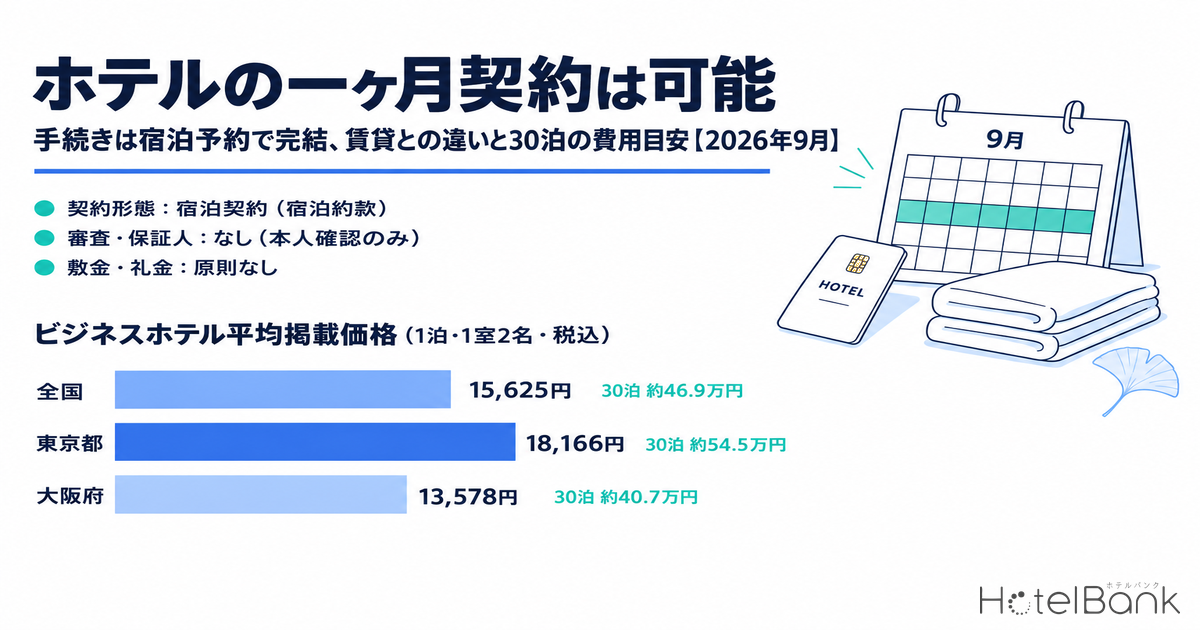
Yes, you can book a hotel in Japan for a full month. But that “contract” is not a real-estate lease. It is an accommodation contract with a facility licensed under the Hotel Business Act (its terms are set by each property’s terms and conditions of accommodation), and in practice it is completed simply by booking a “long-stay plan” or “monthly plan.” There is no contract to sign, no tenant screening, no guarantor, and no security deposit or key money; utilities, Wi-Fi, cleaning and linen changes are normally included in the room rate. As a cost baseline, the average OTA listed price for business hotels nationwide is about ¥15,600 per night (per room, 2 guests per room, tax included; N=7,900 properties; as of September 2026; HotelBank Editorial Team research). Thirty nights at that rate add up to roughly ¥470,000, and long-stay plans often quote a lower nightly rate than this. This article focuses on two things: how the contract works and how to apply.
- — A one-month hotel contract is possible. Legally it is an accommodation contract, not a lease, and it is completed by booking a long-stay or monthly plan. No tenant screening, guarantor, security deposit or key money.
- — Average listed business-hotel prices (September 2026, per room, 2 guests per room, tax included): Japan ≈ ¥15,600 / Tokyo ≈ ¥18,200 / Osaka ≈ ¥13,600. A simple 30-night total comes to about ¥469,000 / ¥545,000 / ¥407,000, and long-stay plans often quote lower nightly rates.
- — There are three ways to apply: OTA long-stay plans, monthly plans on a hotel’s official website, and specialist monthly-hotel booking services. Before booking, check the maximum number of nights, payment timing, cancellation policy and receipts.
What a “One-Month Contract” Really Is — An Accommodation Contract, Not a Lease
When you rent an apartment or a monthly apartment (a furnished “monthly mansion”) for a month, you sign a lease with the landlord (monthly apartments often use a fixed-term building lease). When you stay 30 nights at a hotel, however, the legal relationship is the same accommodation contract as for a single night, and the contract is formed the moment the booking is confirmed (Article 3 of the Japan Tourism Agency’s Model Terms and Conditions of Accommodation (in Japanese) states that an accommodation contract is formed when the facility accepts the application). There is no explanation of important matters and no contract to stamp; all that is required is identity verification at check-in. This difference is what makes the upfront costs and paperwork so much lighter.
| Item | Rental apartment | Monthly apartment | Hotel (long stay) |
|---|---|---|---|
| Contract type | Lease | Usually a lease, often fixed-term | Accommodation contract (terms and conditions of accommodation) |
| Screening / guarantor | Tenant screening + guarantor or guarantee company | Simple screening is common | None (identity check only) |
| Upfront costs | Security deposit, key money, agent’s fee | Cleaning fee, management fee, etc. | Generally none |
| Utilities / Wi-Fi | Contract and pay yourself | Often included at a flat rate | Included in the room rate |
| Cleaning / linen | Do it yourself | Cleaning at move-out is standard | Done by the property during the stay |
| Ending the stay early | Notice period required | Depends on the contract | Depends on the cancellation and change policy |
Terms for monthly apartments vary widely by operator, so the table above shows general tendencies; the hotel column, however, reflects a structure common to all hotels. Not having to worry about passing screening or how much to pay upfront is the biggest practical advantage of using a hotel on a monthly basis. Services such as cleaning, linen changes and front-desk support are also included in the room rate, which is worth factoring in when comparing the cost with renting.
Three Ways to Apply — Steps, Payment Timing and Receipts
Whichever route you take, the “contract” is in substance a hotel booking, but there are three main entry points.
| Route | How to apply | Payment timing | Receipt |
|---|---|---|---|
| 1. OTA multi-night / long-stay plans | Specify the number of nights in your search and book a long-stay plan such as “7 nights or more” or “30 consecutive nights” | Prepaid by card or paid at the property; varies by plan | Issued online or at check-out |
| 2. Long-stay / monthly plans on the hotel’s official website | Book from the long-stay page of the official website. For properties that do not publish rates: inquiry → quote → application | Prepayment is standard; for long stays some properties accept monthly or weekly installments | Issued directly by the property; easy to discuss the addressee and description |
| 3. Specialist monthly-hotel booking services | Apply online on a site that bundles monthly inventory | Card payment; many services support monthly billing | Issued via the service |
Route 1 is the easiest, but some properties and plans cap the number of nights per booking, in which case you split the stay into two bookings and link them. Route 2 ranges from fixed-price “monthly” plans to properties that do not publish rates and quote individually. Serviced-apartment-type properties with kitchens and laundry facilities in particular usually quote individually, so the safest approach is to confirm your length of stay and number of guests and then get a written quote (for rate structures by city, see our comparison of monthly plans at serviced apartments in five Japanese cities (in Japanese)). Route 3 lets you start hotel living like a monthly subscription, and because payment is split by month it suits people who are not sure whether their stay will be extended. If you plan to expense the stay, check before booking whether the route supports qualified invoices under Japan’s invoice system, whichever route you choose.
How Much Do 30 Nights Cost? — Measured in September 2026
The average listed business-hotel prices as of September 2026, compiled by the HotelBank Editorial Team from public OTA data (per room, 2 guests per room, tax included), and the simple 30-night totals are as follows.
| Area | Average listed price (1 night) | Simple 30-night total | Sample |
|---|---|---|---|
| Japan (nationwide) | ¥15,625 | ≈ ¥469,000 | N=7,900 properties |
| Tokyo | ¥18,166 | ≈ ¥545,000 | N=968 properties |
| Osaka | ¥13,578 | ≈ ¥407,000 | N=537 properties |
Source: HotelBank Editorial Team research (aggregated public OTA data, as of September 2026). Figures are averages based on listed prices for standard plans. They are per-room rates for 2 guests per room (tax included); rates for single occupancy differ.
This table is only an upper-end guide, showing what you would pay if you paid the regular one-night rate 30 times. In practice, long-stay plans with minimum-night conditions and prepaid plans often quote lower nightly rates. We have measured typical discounts by length of stay in Japan Hotel Long-Stay Discounts: 15% at 7 Nights, 20% at 30 Nights. How far you can lower the actual monthly outlay is covered in detail in A Month of Hotel Living in Japan, which measures the costs and the cheapest ways to choose.
If you are booking a month in Osaka, the average listed business-hotel price is about ¥13,600 (N=537 properties, as of September 2026), below the national average, and the 30-night guide is about ¥410,000, making it one of the easier major metropolitan areas to budget for. Around Namba, Shin-Osaka and Umeda there are also apartment-type and serviced-apartment-type options with kitchens and washer-dryers, which makes the area a good fit for a one-month stay where you want to cook for yourself to save on food. The application steps are the same three routes described above; there is no special procedure just because you are in Osaka.
Resident Registration and Mail — Check With Each Property
A hotel accommodation contract is not designed as a service for moving your principal place of residence. Whether you can register your address (juminhyo, the resident record) at a hotel depends on how you actually live there, the property’s policy and how the local municipal office handles it, so there is no blanket “yes” or “no.” If you plan to use a hotel as your home base for more than a month, it is safest to check with the property before booking and, if necessary, with the municipal office. Many properties accept mail and parcels at the front desk, but rules for long-stay guests (how long items are held and whether they can be forwarded) also vary by property, so confirm them at check-in.
Pre-Booking Checklist — 7 Things to Confirm for a One-Month Stay
- Maximum number of nights: Can you book 30 nights in a single reservation? If there is a cap, split the stay into linked bookings
- Payment timing: A single prepayment, or monthly or weekly installments? Is a deposit required?
- Cancellation and change policy: Cancellation fees for long bookings may start earlier. Also check refund terms if you shorten your stay
- Cleaning and linen-change frequency: Daily or a few times a week? How frequency relates to price varies by plan
- Laundry and cooking facilities: Is there an in-room washer-dryer or kitchen, or a coin laundry on site?
- Receipts and invoices: If you will expense the stay, confirm before booking how receipts are issued and whether qualified invoices are supported
- Rate basis: Is the displayed price per room or per person, and is tax included? Note that rates differ between 2-guest and single occupancy
If you want to find specific properties that meet these conditions, see also our long-stay and hotel-living articles, such as Business Hotels for Long Stays: 6 Checks and ¥16,722 a Night in Tokyo.
Where to Look Next
For a comparison of specific properties, these articles (in Japanese) go into detail.
Can You Stay for ¥200,000 a Month? Top 5 Serviced Apartments in Five Japanese Cities — Comparing Monthly Plan Rate Structures (innippon.news, in Japanese)
Compares five long-stay properties in Tokyo, Osaka, Nagoya, Fukuoka and Sapporo, including Citadines Namba Osaka and Amista Hotel Fukuoka, on whether rates are published, minimum stay and how cleaning fees are handled. It shows what to check before requesting a quote for a monthly plan, including Weekly Sapporo, which officially publishes rates for stays of 30 nights or more (from ¥95,700 for 30 nights in a single room with kitchen).
When a Business Trip Runs Past 3 Nights, Stop Booking “Hotels” — Top 5 Apartment-Style Stays With Kitchens and Washer-Dryers (HotelPicks, in Japanese)
Compares five properties in Tokyo, Osaka, Fukuoka and Sapporo with in-room kitchens and washer-dryers, including Tokyu Stay Hakata and MIMARU Tokyo Ueno East, by multi-night rate and facilities. A map helps you find concrete options for living-like long stays.
Frequently Asked Questions
Q. Do I need screening or a guarantor for a one-month hotel contract?
A. Generally, no. Your relationship with the hotel is an accommodation contract, not a lease, so there is no tenant screening, guarantor, security deposit or key money. It is common to register the guest’s name, address and contact details at check-in and to be asked to present a credit card or prepay as the method of payment.
Q. How much does a 30-night hotel stay cost?
A. As of September 2026, the average listed business-hotel price (per room, 2 guests per room, tax included) is about ¥15,600 nationwide, about ¥18,200 in Tokyo and about ¥13,600 in Osaka; 30 nights at the regular rate add up to about ¥469,000, ¥545,000 and ¥407,000 respectively. Single-occupancy rates differ, and long-stay plans often quote lower nightly rates than these.
Q. Can I extend or shorten my stay partway through?
A. Extensions are possible if rooms are available, but under the Japan Tourism Agency’s Model Terms and Conditions of Accommodation a request to extend during a stay is treated as an application for a new accommodation contract, so the rate or plan may change. Penalties for shortening a stay depend on the property’s terms and conditions of accommodation and the plan’s cancellation policy, so it is best to check before booking.
Q. Do I have to pay the full amount in advance?
A. It depends on the route and plan. Prepaid plans are charged at booking, while pay-at-property plans are paid during the stay or at check-out. For long-stay plans on official hotel websites, some properties accept monthly or weekly installments.
Q. Can I register my address at a hotel or receive mail there?
A. Resident registration is handled differently depending on how you actually live there, the property’s policy and the municipal office’s practice, so there is no blanket answer. Many properties accept mail and parcels at the front desk, but rules on how long items are held and whether they can be forwarded vary by property, so check before booking or at check-in.
Methodology and Sources
■ Data Sources
HotelBank Editorial Team research. Public listed prices on Japanese OTAs aggregated by property category (as of September 2026). Business hotels: N=7,900 properties nationwide, N=968 in Tokyo and N=537 in Osaka. How contracts are formed and extended is based on the Japan Tourism Agency’s Model Terms and Conditions of Accommodation (last amended December 13, 2023).
■ Calculation Assumptions
All prices are average listed per-room rates for 2 guests per room (tax included) for standard plans. The 30-night amounts are simple totals of the average listed price × 30 nights and do not reflect long-stay plans, multi-night discounts, prepayment discounts, or variation by day of week or season.
■ Limitations
Listed prices are not booked (transacted) prices. Prefecture and national figures are area-wide averages, and in higher-priced districts such as central locations near stations, individual property rates often exceed them. The Model Terms and Conditions of Accommodation are a template that facilities use when drafting their own terms; actual contract conditions (deposits, cancellation and extensions) depend on each property’s terms and conditions of accommodation and plan rules.
■ References
- Japan Tourism Agency, “Model Terms and Conditions of Accommodation (モデル宿泊約款)” (last amended December 13, 2023; in Japanese)
- e-Gov Law Search, “Hotel Business Act (旅館業法)” (Act No. 138 of 1948; in Japanese)
Related Reading