

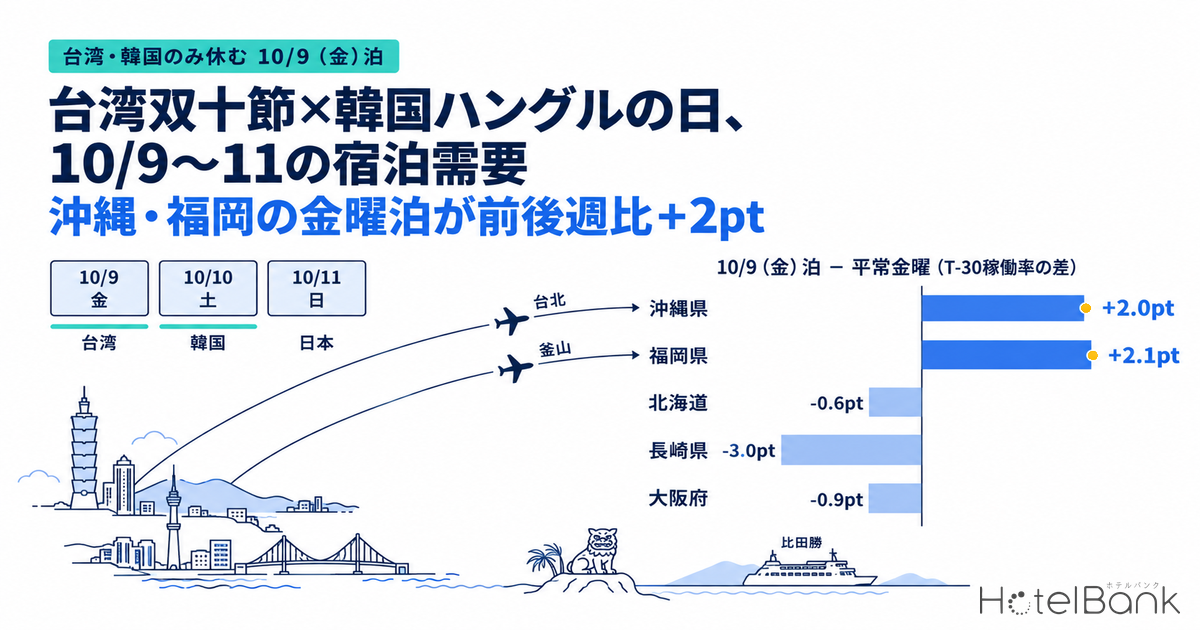
From Friday, October 9 to Sunday, October 11, 2026, Taiwan’s make-up holiday for National Day (Double Ten) and Korea’s Hangul Day fall on the same Friday, putting both markets into a three-day weekend at the same time. Japan also has a three-day weekend from Saturday, October 10 to Monday, October 12 (Sports Day), so the two nights of 10/10 and 10/11 overlap with domestic demand as well. This article isolates the night of Friday 10/9, when only Taiwan and Korea are on holiday, as the clearest cross-section of inbound demand, and compares inventory pickup 45 days (T-45) and 30 days (T-30) before the stay date against regular weekends in five prefectures: Okinawa, Fukuoka, Hokkaido, Nagasaki and Osaka.
Our analysis of mainland China’s National Day holiday (from October 1) is covered in China National Day 2026: 21pt Weekday OCC Gap Across 26 Prefectures. This article narrows the demand source to Taiwan and Korea and the period to the three nights of 10/9-11. As a follow-up to Double Ten x Sports Day: Japan’s Oct 9-12 Capacity at 76 Days Out, which looked at the same holiday weekend 76 days ahead, it summarizes pickup now that the stay dates are approaching.
Metric Definitions Used in This Article
- ADR (Average Daily Rate): An estimated settled rate (tax-excluded equivalent) calculated by applying property-type-specific adjustment factors to the lowest plan level each property publishes on OTAs (rate per room for 2 guests, tax included). Validated against property-level results disclosed by listed hotel REITs (91 properties, most recent 3 months), the median error is about 7%. This is an estimate and differs from each property’s actual settled prices and accounting figures. Area-level ADR is the median of covered properties (the level of a typical property in the area).
- OCC (Occupancy Rate): The share of rooms sold relative to total rooms in the area (an estimate based on OTA sales inventory). Shown in this article as “occupancy rate (OTA-listed inventory basis, estimated).” It is an estimate based on the depletion of inventory sold on OTAs and differs from the actual occupancy of each property. Coverage is limited to a fixed set of properties listing at least 30% of total rooms on OTAs and similar channels (the same properties for each stay date).
- Booking curve / LT: The change in remaining OTA rooms leading up to the check-in date. LT (lead time) = days until check-in. T-45 and T-30 are observation points 45 and 30 days before the stay date, respectively. Curves in this article use only observations within LT 45.
- Listed price: Rate per room for 2 guests (tax included), averaged across all plans. This is a separate metric from ADR.
- Data source: MetroEngines Research
- — The night of Friday 10/9 is a night when only Taiwan and Korea are off. Taiwan (National Day make-up holiday) and Korea (Hangul Day) both enter a three-day weekend on 10/9-11, one day offset from Japan’s three-day weekend (10/10-12).
- — At 30 days before the stay date (T-30), occupancy (OTA-listed inventory basis, estimated) for the 10/9 night was +2.0pt in Okinawa and +2.1pt in Fukuoka above the average of the surrounding Fridays. This matches the entry mix, with Taiwan weighted toward Naha and Korea toward Fukuoka.
- — The 10/10 (Sat) night beat a regular Saturday in all five prefectures, with Fukuoka at +15.4pt. Because it coincides with the first day of Japan’s three-day weekend and events in the city, it cannot be read as an inbound effect alone.
- — At T-30, Saturday listed prices are +7.5% to +31.1% above normal, while Friday prices are -0.6% to +1.8%, essentially normal. Okinawa resorts and urban hotels in Fukuoka, where occupancy is running ahead, have room to raise Friday rates.
- — As of September 21, remaining rooms for the 10/9 night totaled 50,265 across the five prefectures. Hokkaido, Osaka and Nagasaki have deep inventory and the capacity to absorb last-minute demand from Taiwan and Korea.
Holiday Calendars in Taiwan, Korea and Japan, October 2026
In Taiwan, the Directorate-General of Personnel Administration (DGPA) of the Executive Yuan published its 2026 (ROC year 115) government office calendar: because National Day on October 10 falls on a Saturday, the preceding Friday, October 9, is designated a make-up holiday, creating a three-day weekend from October 9 to 11. In Korea, the Korea AeroSpace Administration (KASA) announced in its 2026 almanac that the substitute holiday for National Foundation Day (Gaecheonjeol, Saturday October 3) is Monday October 5, and that Hangul Day on Friday October 9 plus the weekend forms another three-day weekend from October 9 to 11. In other words, Korea has two three-day weekends in October, and it is the second one that overlaps with Taiwan.
Japan, meanwhile, observes Sports Day on Monday October 12, according to the Cabinet Office list of national holidays, so October 10 to 12 is a three-day weekend. By stay date: the night of Friday 10/9 is when only the two markets of Taiwan and Korea go on holiday; the night of Saturday 10/10 is when all three markets are on holiday; and the night of Sunday 10/11 is the middle of Japan’s three-day weekend and the last night before returning home for Taiwanese and Korean travelers. The 10/9 night is the best cross-section for isolating inbound-specific demand, while the 10/10 night shows the size of the overlapping demand.
| Stay date | Taiwan | Korea | Japan | How to read this night |
|---|---|---|---|---|
| 10/3 (Sat) | Regular day | Gaecheonjeol (Day 1 of 3-day weekend) | Regular Saturday | Korea-only holiday |
| 10/4 (Sun) | — | Mid-holiday (substitute on 10/5) | Regular Sunday | Korea-only holiday |
| 10/9 (Fri) | National Day make-up holiday | Hangul Day | Weekday | Only Taiwan and Korea off |
| 10/10 (Sat) | National Day | Mid-holiday | Day 1 of 3-day weekend | All three markets overlap |
| 10/11 (Sun) | Last day of holiday | Last day of holiday | Middle of 3-day weekend | Middle of Japan’s holiday |
| 10/16-18 | — | — | Regular weekend | Regular weekend for comparison |
Source: Compiled by HotelBank Editorial Team from DGPA (Executive Yuan) “ROC 115 Government Office Calendar,” KASA “2026 Almanac,” and Cabinet Office “About National Holidays”
Size of the Source Markets: Korea at 7.42 Million and Taiwan at 5.40 Million Visitors in January-August
According to Japan National Tourism Organization (JNTO) estimates, visitor arrivals in August 2026 were 850,500 from Korea (+28.7% YoY) and 666,000 from Taiwan (+7.3% YoY), both record highs for the month of August. On a January-August cumulative basis, Korea reached 7,420,300 (+21.2%) and Taiwan 5,402,000 (+19.8%); with total arrivals (27,626,300, -2.7%) below the previous year, the growth of these two markets stands out. JNTO attributes the gains in both markets to continued popularity of travel to Japan, school holidays and increased airline seat capacity.
Through which airports and seaports do the two markets enter Japan? Immigration statistics on foreign entrants by port and nationality (October 2025) show that Korean entrants (885,380) arrived via Kansai Airport (25.6%), Fukuoka Airport (19.9%) and Narita Airport (17.0%), followed by New Chitose (7.3%) and Naha (5.0%). Hitakatsu Port on Tsushima (Nagasaki) also accounted for 2.5%, with the ferry route from Busan serving as a gateway into Nagasaki. Taiwanese entrants (581,849) arrived via Narita (21.5%) and Kansai (20.2%), with Naha third at 14.2%, followed by Fukuoka (8.8%) and New Chitose (7.0%). The gateways of the five prefectures covered in this article (Kansai, Fukuoka, New Chitose, Naha and Hitakatsu) together account for 60.3% of Korean and 50.2% of Taiwanese entrants.
Source: Compiled by HotelBank Editorial Team from Immigration Statistics “Foreign Entrants by Port and Nationality/Region” (October 2025). Foreign entrants include re-entrants
Although both are nearby East Asian markets, Korea is more concentrated in Fukuoka and Kansai, while Taiwan has a larger share in Naha. When reading inventory pickup for the 10/9 night, it is useful to assume that Okinawa is more strongly influenced by Taiwan and Fukuoka by Korea.
Inventory Pickup at T-30: The Friday 10/9 Night Beats Surrounding Fridays by +2.0pt in Okinawa and +2.1pt in Fukuoka
We compared the occupancy rate (OTA-listed inventory basis, estimated) of each prefecture for the nights of 10/9 (Fri) and 10/10 (Sat) against regular Fridays and Saturdays. The regular weekend is the average of the same weekday in the preceding and following weeks (Fridays 10/2 and 10/16; Saturdays 10/3 and 10/17), all measured 30 days before the stay date (T-30). Because baseline demand itself rises toward mid-October, we averaged the week before and the week after to cancel out the seasonal slope. Note that 10/3 (Sat) is Korea’s Gaecheonjeol, so the Saturday baseline contains a slight effect from Korea’s standalone holiday.
| Prefecture | Properties | Rooms | 10/9 T-45 | 10/9 T-30 | Regular Fri T-30 | Diff | 10/10 T-30 | Regular Sat T-30 | Diff | 10/9 Latest (T-18) |
|---|---|---|---|---|---|---|---|---|---|---|
| Okinawa | 923 | 37,131 | 75.8% | 80.9% | 78.9% | +2.0pt | 84.0% | 80.5% | +3.5pt | 85.6% |
| Fukuoka | 482 | 32,880 | 63.3% | 69.4% | 67.3% | +2.1pt | 91.4% | 76.0% | +15.4pt | 75.9% |
| Hokkaido | 800 | 55,330 | 67.6% | 72.5% | 73.1% | -0.6pt | 83.4% | 78.2% | +5.2pt | 76.0% |
| Nagasaki | 418 | 15,150 | 60.0% | 63.8% | 66.8% | -3.0pt | 80.6% | 73.2% | +7.4pt | 69.0% |
| Osaka | 441 | 60,513 | 53.5% | 60.4% | 61.3% | -0.9pt | 68.7% | 66.8% | +1.9pt | 68.5% |
Source: Compiled by MetroEngines Research and HotelBank Editorial Team. Covers properties listing at least 30% of total rooms on OTAs and similar channels (based on major booking site listings). Property and room counts are for the 10/9 night. Latest values observed on September 21
Source: Compiled by MetroEngines Research and HotelBank Editorial Team. Five prefectures, 3,064 properties / 201,004 rooms in total (based on major booking site listings)
On the 10/9 night, when only Taiwan and Korea are on holiday, Okinawa (+2.0pt) and Fukuoka (+2.1pt) exceeded the average of the surrounding Fridays, matching the entry patterns seen in the previous section (Taiwan via Naha, Korea via Fukuoka). Applied to the rooms covered, this is equivalent to roughly 740 additional rooms in Okinawa and 690 in Fukuoka. Individually, Okinawa’s 10/9 night (80.9%) was 5.1pt above the 10/2 night (75.8%) and 1.2pt short of the 10/16 night (82.1%). Fukuoka was also 4.1pt higher than the 10/2 night (65.3%) and on par with the 10/16 night (69.4%). The uplift of about 2pt is not large, but it effectively pulls the mid-October demand rise forward by a week. Hokkaido (-0.6pt) and Osaka (-0.9pt) were roughly in line with a regular Friday, and Nagasaki (-3.0pt) was slightly below, so these regions still have spare capacity for the 10/9 night.
On the 10/10 (Sat) night, all five prefectures exceeded a regular Saturday. Fukuoka stood out at +15.4pt, reaching 91.4% at T-30. However, this night is the first day of Japan’s three-day weekend, and several music events are scheduled in Fukuoka City on 10/10-11, including an arena concert at Marine Messe Fukuoka Hall A. Fukuoka’s Saturday surge largely reflects overlap with domestic demand and should not be read as a Taiwan/Korea effect alone.
By Property Type: Resorts Lead in Okinawa, Urban Hotels in Fukuoka on the Friday Night
We broke down the same comparison by property type. Types with too few properties to aggregate (city hotels and ryokan in Okinawa, city hotels in Nagasaki, resorts in Osaka) are excluded.
| Prefecture | Type | Properties | Rooms | 10/9 T-30 | vs. Regular Fri | 10/10 T-30 | vs. Regular Sat | 10/9 Latest (T-18) |
|---|---|---|---|---|---|---|---|---|
| Okinawa | Resort | 197 | 16,692 | 86.4% | +2.8pt | 87.7% | +2.4pt | 88.2% |
| Okinawa | Business | 138 | 12,909 | 80.6% | +0.3pt | 84.6% | +4.6pt | 87.5% |
| Fukuoka | Resort | 38 | 4,630 | 56.0% | +6.3pt | 88.5% | +13.5pt | 64.3% |
| Fukuoka | City | 29 | 6,071 | 78.2% | +1.6pt | 94.2% | +10.8pt | 81.5% |
| Fukuoka | Business | 122 | 16,401 | 68.3% | +2.0pt | 92.7% | +21.0pt | 76.4% |
| Fukuoka | Ryokan | 172 | 4,335 | 76.8% | -1.3pt | 87.8% | +5.4pt | 81.0% |
| Hokkaido | Resort | 93 | 9,802 | 70.9% | -1.3pt | 83.0% | +4.3pt | 74.3% |
| Hokkaido | City | 37 | 8,831 | 79.7% | -2.2pt | 87.5% | +5.0pt | 81.1% |
| Hokkaido | Business | 231 | 26,817 | 72.1% | -0.7pt | 82.7% | +4.4pt | 76.9% |
| Hokkaido | Ryokan | 172 | 7,116 | 74.0% | +2.0pt | 86.4% | +8.3pt | 74.7% |
| Nagasaki | Resort | 27 | 1,779 | 61.9% | -5.1pt | 82.1% | +4.4pt | 71.7% |
| Nagasaki | Business | 64 | 5,323 | 64.3% | -5.1pt | 76.6% | +3.4pt | 68.4% |
| Nagasaki | Ryokan | 150 | 5,843 | 66.4% | -2.4pt | 84.2% | +8.2pt | 72.6% |
| Osaka | City | 36 | 8,206 | 76.5% | -0.5pt | 84.6% | +1.8pt | 80.5% |
| Osaka | Business | 294 | 48,157 | 57.2% | -1.0pt | 65.3% | +1.6pt | 66.3% |
| Osaka | Ryokan | 24 | 662 | 63.3% | +5.9pt | 65.7% | +1.9pt | 71.8% |
Source: Compiled by MetroEngines Research and HotelBank Editorial Team. Covers properties listing at least 30% of total rooms on OTAs and similar channels (based on major booking site listings). Regular Friday = average of 10/2 and 10/16; regular Saturday = average of 10/3 and 10/17 (all at T-30)
In Okinawa, resorts reached 86.4% for the 10/9 night at T-30, 2.8pt above a regular Friday. This is consistent with Naha receiving nearly one-seventh of entrants from Taiwan, and the uplift appears more in resorts than in business hotels (+0.3pt). On the 10/10 night, by contrast, the uplift for business hotels (+4.6pt) exceeded that of resorts (+2.4pt), suggesting that domestic three-day-weekend demand is flowing heavily into limited-service hotels in Naha City.
In Fukuoka, resorts (+6.3pt), business hotels (+2.0pt) and city hotels (+1.6pt) all exceeded a regular Friday for the 10/9 night. Ryokan were roughly in line at -1.3pt, suggesting that Korean demand is building first in urban hotels. Note that Fukuoka resorts number only 38 properties, so a difference of a few points can arise from the movement of just a few properties.
The booking curves show how pickup has progressed. For Okinawa resorts, the 10/9 curve has run about 1pt above the regular Friday one week later (10/16) since T-45, and the 10/10 curve about 2pt above the regular Saturday (10/17); the gap has not narrowed after T-30. In other words, both nights have held a higher level than the following weekend, when seasonal demand is higher, since T-45.
Source: Compiled by MetroEngines Research and HotelBank Editorial Team. Okinawa resorts, 197 properties / 16,692 rooms (based on major booking site listings). LT 45 days or less, observations through September 21
Fukuoka as a whole shows a different shape. The 10/10 night was already high at 84.7% at T-45, more than 15pt above the regular Saturday (10/17). The 10/9 curve, by contrast, runs almost on top of the regular Friday one week later (10/16). Compared with the 10/2 night (65.3% at T-30) it is 4pt higher, meaning the 10/9 night is running at the mid-October booking pace one week early. This is not a sudden last-minute rush but a steady addition on top of the normal booking pace.
Source: Compiled by MetroEngines Research and HotelBank Editorial Team. Fukuoka Prefecture overall, 482 properties / 32,880 rooms (based on major booking site listings). LT 45 days or less, observations through September 21
Comparison with Korea’s Standalone Holiday (10/3-5)
Korea also has a three-day weekend from October 3 to 5 that does not overlap with Taiwan. Comparing the 10/4 (Sun) night, the middle of that holiday, with a regular Sunday two weeks later (10/18) at T-30, only Fukuoka (69.3%, +3.1pt) came out ahead; the other four prefectures did not exceed a regular Sunday. Even allowing for the fact that a comparison with a Sunday two weeks later is conservative because baseline demand rises toward mid-October, Fukuoka’s outperformance is notable. Korean holiday demand is most visible in Fukuoka, which receives about 20% of Korean entrants. When Taiwanese demand is added on 10/9-11, the uplift spreads from Fukuoka to Okinawa as well.
Korea also has its Chuseok holiday from September 24 to 27, meaning the Korean market sees three consecutive holiday periods from late September to mid-October. How Kyushu and Kansai absorb Chuseok demand is covered in Chuseok Sep 24-27: Only Fukuoka, Saga, Kyoto Hold After Silver Week.
Pricing: Friday Listed Prices Are at Normal Levels, Leaving Room to Convert the Occupancy Uplift into Rate
We checked how the inventory uplift shows up in pricing, using listed prices at T-30 (average of all plans, tax included). For the 10/10 (Sat) night, all five prefectures were above a regular Saturday: Fukuoka +31.1%, Osaka +13.9%, Hokkaido +12.7%, Okinawa +10.5% and Nagasaki +7.5%. For the 10/9 (Fri) night, by contrast, the difference from a regular Friday stayed within -0.6% to +1.8% in every region.
Source: Compiled by MetroEngines Research and HotelBank Editorial Team. Listed price = rate per room for 2 guests (tax included), average of all plans, at T-30. Regular Friday = average of 10/2 and 10/16; regular Saturday = average of 10/3 and 10/17
For Okinawa resorts, the listed price for the 10/9 night at T-30 was about ¥50,000, almost identical to about ¥50,600 for a regular Friday. Since occupancy is 2.8pt above a regular Friday, the 10/9 night has the most room to raise rates. For the 10/10 night, prices were already about ¥59,600, 16.5% above a regular Saturday (about ¥51,100), indicating that the market has begun pricing in the overlapping Saturday demand. For the Friday night, one option is to confirm that bookings from Taiwan and Korea are coming in, then shift close-in pricing closer to Saturday levels.
In Fukuoka, resorts on the 10/9 night show occupancy +6.3pt and listed prices +7.2%, so rates are already being lifted even on the Friday. Business hotels (occupancy +2.0pt, listed price +1.9%) and city hotels (+1.6pt, +3.6%), on the other hand, are still priced close to a regular Friday, leaving more headroom on Friday pricing compared with the Saturday uplift.
Next, we compare the estimated settled ADR with the previous year. Because October stay dates have not yet arrived and current values are provisional estimates based on listings, we compare the average of the most recent three finalized months (June-August 2026) with the same period a year earlier, and also show last October’s level.
| Prefecture | Type | Jun-Aug 2025 | Jun-Aug 2026 | YoY | N (properties) | Oct 2025 (reference) |
|---|---|---|---|---|---|---|
| Okinawa | All | ¥12,301 | ¥13,249 | +7.7% | 513 | ¥10,852 |
| Okinawa | Resort | ¥18,123 | ¥19,785 | +9.2% | 282 | ¥14,780 |
| Okinawa | Business | ¥8,654 | ¥9,331 | +7.8% | 196 | ¥8,091 |
| Fukuoka | All | ¥10,902 | ¥10,835 | -0.6% | 476 | ¥11,229 |
| Fukuoka | City | ¥16,443 | ¥17,033 | +3.6% | 41 | ¥18,258 |
| Fukuoka | Business | ¥10,014 | ¥10,416 | +4.0% | 341 | ¥10,450 |
| Hokkaido | All | ¥11,733 | ¥11,573 | -1.4% | 960 | ¥9,708 |
| Hokkaido | Business | ¥10,353 | ¥10,676 | +3.1% | 438 | ¥8,688 |
| Nagasaki | All | ¥7,707 | ¥7,543 | -2.1% | 258 | ¥7,712 |
| Nagasaki | Ryokan | ¥9,255 | ¥10,079 | +8.9% | 71 | ¥8,390 |
| Osaka | All | ¥12,672 | ¥8,630 | -31.9% | 653 | ¥13,392 |
Source: Compiled by MetroEngines Research and HotelBank Editorial Team. Estimated settled ADR (tax-excluded equivalent), 3-month average of monthly medians of covered properties. N is the number of covered properties in August 2026
Source: Compiled by MetroEngines Research and HotelBank Editorial Team. Estimated settled ADR, YoY change of the June-August 2026 average
Okinawa is ahead of last year, with rates up across all property types: overall +7.7% (about ¥13,200), resorts +9.2% (about ¥19,800) and business hotels +7.8% (about ¥9,300). In Fukuoka, city hotels (+3.6%) and business hotels (+4.0%) rose; in Hokkaido, business hotels (+3.1%); and in Nagasaki, ryokan (+8.9%). Osaka overall (-31.9%) is compared against a period that coincided with Expo 2025 Osaka, Kansai (April 13 to October 13, 2025), and is best read as a normalization from the elevated Expo baseline.
Last October’s estimated settled ADR was about ¥14,800 for Okinawa resorts, about ¥10,500 for Fukuoka business hotels and about ¥8,700 for Hokkaido business hotels. Property types that kept a pace above last year through the summer are positioned to target rates above these levels over the 10/9-11 three-day weekend as well.
Remaining Capacity: More Than 50,000 Rooms Available for the 10/9 Night Across Five Prefectures as of September 21
As of the September 21 observation, remaining rooms for the 10/9 night were 5,364 in Okinawa (occupancy 85.6%, observed September 21, 2026), 7,912 in Fukuoka (75.9%), 13,265 in Hokkaido (76.0%), 4,690 in Nagasaki (69.0%) and 19,034 in Osaka (68.5%), for a total of 50,265 rooms across covered properties in the five prefectures. For the 10/10 night, remaining rooms were 4,636 in Okinawa (87.5%), 2,192 in Fukuoka (93.3%), 7,203 in Hokkaido (87.0%), 2,249 in Nagasaki (85.1%) and 13,833 in Osaka (77.1%), showing that Saturday inventory is being absorbed, led by Fukuoka.
| Prefecture | 10/9 (Fri) remaining | 10/10 (Sat) remaining | 10/11 (Sun) remaining |
|---|---|---|---|
| Okinawa | 5,364 rooms (85.6%) | 4,636 rooms (87.5%) | 6,848 rooms (81.6%) |
| Fukuoka | 7,912 rooms (75.9%) | 2,192 rooms (93.3%) | 5,007 rooms (84.8%) |
| Hokkaido | 13,265 rooms (76.0%) | 7,203 rooms (87.0%) | 13,212 rooms (76.1%) |
| Nagasaki | 4,690 rooms (69.0%) | 2,249 rooms (85.1%) | 4,513 rooms (70.0%) |
| Osaka | 19,034 rooms (68.5%) | 13,833 rooms (77.1%) | 18,833 rooms (68.9%) |
Source: Compiled by MetroEngines Research and HotelBank Editorial Team. Remaining rooms as of the September 21 observation (occupancy rate, OTA-listed inventory basis, estimated, in parentheses). Covers properties listing at least 30% of total rooms on OTAs and similar channels (based on major booking site listings)
Fukuoka has only 2,192 rooms left for the 10/10 night, so demand is likely to spill over into the adjacent 10/9 and 10/11 nights. If more travelers try to secure the 10/9 night in Fukuoka, that will also support Friday rates. Hokkaido and Osaka have ample inventory on all three nights and can absorb demand even if Taiwanese and Korean travelers book later than usual. Nagasaki’s pickup for the 10/9 and 10/11 nights is at normal levels, leaving room to capture Korean visitors arriving via Hitakatsu and Taiwanese travelers touring Kyushu.
Summary
Breaking the 10/9-11 three-day weekend down by stay date, on the 10/9 (Fri) night, when only Taiwan and Korea are on holiday, Okinawa and Fukuoka were about 2pt above a regular Friday at T-30, an uplift consistent with the entry patterns of the two markets (Taiwan weighted toward Naha, Korea toward Fukuoka). The 10/10 (Sat) night overlaps with Japan’s three-day weekend and is above a regular Saturday in all five prefectures.
On pricing, Saturday listed prices are already 7-31% above normal, while Friday prices remain at normal levels. For Okinawa resorts and urban hotels in Fukuoka, where the occupancy uplift is already visible, the 10/9 night is one where rates can be pushed in the close-in period. Hokkaido, Nagasaki and Osaka have ample Friday inventory and the capacity to absorb last-minute demand from Taiwan and Korea. For all property types in Okinawa, business hotels in Fukuoka and Hokkaido, and ryokan in Nagasaki, where estimated settled ADR beat last year over the summer, conditions support considering rates above last October’s levels.
⚠ Note on forward-looking data: October occupancy rates, remaining rooms and listed prices in this article are estimates based on sales inventory and prices publicly available on OTAs and similar channels as of the September 21, 2026 observation, and will change as check-in approaches. The estimated settled ADR for October 2026 is also an estimate based on listing levels at the time of research and is not a final figure.
Frequently Asked Questions
Q. Why are Taiwan and Korea both on holiday from October 9 to 11, 2026?
A. In Taiwan, National Day on October 10 falls on a Saturday, so the DGPA’s 2026 (ROC year 115) government office calendar designates the preceding Friday, October 9, as a make-up holiday, creating a three-day weekend from October 9 to 11. In Korea, Friday October 9 is Hangul Day, which combines with the weekend for a three-day weekend. In Japan, Monday October 12 is Sports Day and October 10 to 12 is a three-day weekend, so the night of Friday 10/9 is when only the two markets of Taiwan and Korea go on holiday.
Q. How does inventory pickup for the 10/9 (Fri) night compare with a regular Friday?
A. Comparing the occupancy rate (OTA-listed inventory basis, estimated) 30 days before the stay date (T-30) with the average of the surrounding Fridays (10/2 and 10/16), Okinawa was ahead by +2.0pt at 80.9% and Fukuoka by +2.1pt at 69.4%. Hokkaido (-0.6pt) and Osaka (-0.9pt) were at normal levels and Nagasaki (-3.0pt) slightly below, so these regions still have spare capacity for the 10/9 night.
Q. Through which airports and seaports do Taiwanese and Korean travelers enter Japan?
A. According to port-level immigration statistics for October 2025, Korean entrants arrived mainly via Kansai Airport (25.6%), Fukuoka Airport (19.9%) and Narita Airport (17.0%), and Taiwanese entrants via Narita (21.5%), Kansai (20.2%) and Naha (14.2%). Taiwan is weighted toward Naha and Korea toward Fukuoka, which is consistent with the 10/9 uplift appearing in Okinawa and Fukuoka.
Q. How should hotels think about room rates for the 10/9 (Fri) night?
A. At T-30, listed prices (average of all plans, tax included) for the 10/10 (Sat) night are 7.5-31.1% above a regular Saturday, while the 10/9 (Fri) night differs from a regular Friday by only -0.6% to +1.8%. Okinawa resorts are 2.8pt above a regular Friday in occupancy for the 10/9 night, yet their listed price of about ¥50,000 is at a normal level, making this the night with the most room to revisit rates in the close-in period. One option is to confirm how bookings from Taiwan and Korea are coming in, then shift Friday pricing closer to Saturday levels.
Q. Is estimated settled ADR up from last year?
A. Comparing the finalized June-August 2026 average with the same period last year, Okinawa rose across all property types: overall +7.7% (about ¥13,200), resorts +9.2% and business hotels +7.8%. City hotels (+3.6%) and business hotels (+4.0%) in Fukuoka, business hotels in Hokkaido (+3.1%) and ryokan in Nagasaki (+8.9%) were also above last year. Osaka’s overall -31.9% reflects a comparison with a period that coincided with Expo 2025 Osaka, Kansai.
Related Articles
- Double Ten x Sports Day: Japan’s Oct 9-12 Capacity at 76 Days Out
- China National Day 2026: 21pt Weekday OCC Gap Across 26 Prefectures
- Chuseok Sep 24-27: Only Fukuoka, Saga, Kyoto Hold After Silver Week
- Korea’s Mini-Holiday Moves Kyushu ADR: Testing Inbound “Routinization”
References and Sources
■ Data Sources
Occupancy rate (OTA-listed inventory basis, estimated), remaining rooms, listed prices, booking curves and estimated settled ADR are aggregated by MetroEngines Research (five prefectures: Okinawa, Fukuoka, Hokkaido, Nagasaki and Osaka; covers properties listing at least 30% of total rooms on OTAs and similar channels, totaling 3,064 properties and 201,004 rooms for the 10/9 night). Visitor arrivals are from JNTO “Visitor Arrivals (August 2026 Estimates)” (published September 16, 2026); entry airport/port mix is from Immigration Statistics “Foreign Entrants by Port and Nationality/Region” (October 2025). Holiday calendars are based on publications by the DGPA (Taiwan), the Korea AeroSpace Administration and the Cabinet Office (Japan).
■ Assumptions
The regular weekend is the average of the same weekday in the preceding and following weeks (Friday = 10/2 and 10/16; Saturday = 10/3 and 10/17), which cancels out the seasonal rise in demand toward mid-October. All comparisons use the cross-section 30 days before the stay date (T-30); latest values are observed on September 21, 2026 (T-18 for the 10/9 night). The additional room counts (about 740 in Okinawa and about 690 in Fukuoka) are approximations calculated by multiplying the difference from normal (pt) by the number of covered rooms. Estimated settled ADR applies property-type-specific adjustment factors to the lowest plan level published by each property (rate per room for 2 guests, tax included) to estimate a settled rate (tax-excluded equivalent), and averages the monthly medians of covered properties over three months.
■ Limitations
October occupancy, remaining rooms and listed prices are estimates based on sales inventory at the time of observation and will change before the stay date. Occupancy data does not distinguish guest nationality, so attributing the uplift to Taiwanese and Korean demand is an inference based on consistency with the entry mix. 10/3 (Sat) is Korea’s Gaecheonjeol, so the regular Saturday baseline includes a slight effect from Korea’s standalone holiday. In property types with small samples, such as Fukuoka resorts (38 properties), differences of a few points can arise from the movement of just a few properties. Osaka’s YoY comparison includes a period that coincided with Expo 2025 Osaka, Kansai.
■ Sources
- Directorate-General of Personnel Administration, Executive Yuan (Taiwan): “Revised ROC 114 and Approved ROC 115 Government Office Calendars”
- Korea AeroSpace Administration: “2026 Almanac” announcement
- Cabinet Office (Japan): “About National Holidays”
- Japan National Tourism Organization (JNTO): “Visitor Arrivals (August 2026 Estimates)” (September 16, 2026)
- Immigration Statistics: “Foreign Entrants by Port and Nationality/Region” (e-Stat)
- Live event listings in Fukuoka City (October 2026)
- MetroEngines Research — booking curves, occupancy rate (OTA-listed inventory basis, estimated), listed prices and estimated settled ADR (five prefectures; covers properties listing at least 30% of total rooms on OTAs and similar channels)