

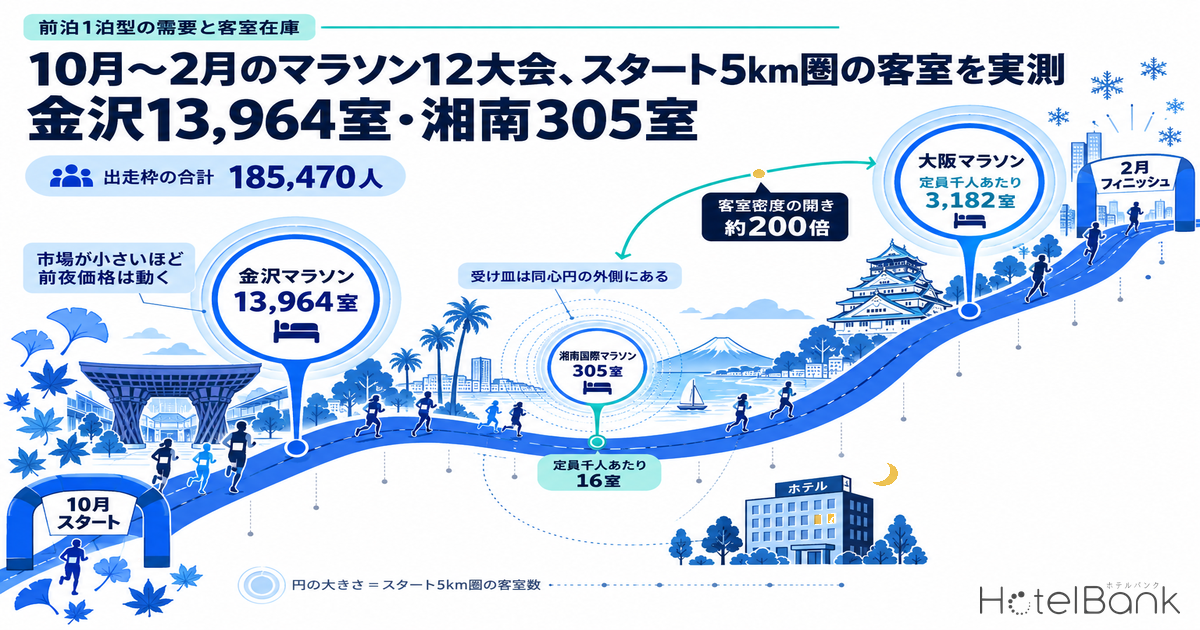
Between October 2026 and February 2027, 12 city marathons with a full-marathon field of more than 10,000 runners will be held across Japan — 185,470 race places in total. Most travelling runners follow a “one-night pre-race stay” pattern: they arrive the evening before and head to the start the next morning. So how many hotel rooms are there around each start line? For each race we drew a 5km radius around the start point’s coordinates and counted the properties, and their rooms, that were confirmed as listed on OTAs and similar channels. Measured as rooms per 1,000 runners, the result ranges from 3,182 for Osaka Marathon 2027 to 16 for the Shonan International Marathon — a gap of roughly 200x.
Metric Definitions Used in This Article
- Listed price: the average price of all plans published on OTAs and similar channels (per room for 2 guests, tax-inclusive, from room-only to plans with meals). Day-level analysis uses this listed price; area values are the median of each property’s daily average.
- ADR (average daily rate): an estimated transacted rate (tax-exclusive equivalent), calculated by applying a segment-specific adjustment factor to each property’s cheapest plan published on OTAs and similar channels (per room for 2 guests, tax-inclusive). Checked against property-level results disclosed by listed hotel REITs (91 properties, latest 3 months), the median error is about 7%. It is an estimate and differs from each property’s actual transacted prices and accounting figures. Area-level ADR is the median of the properties covered (the level of a typical property in the area).
- Rooms within 5km: total rooms at properties located within a 5km radius of each race’s start point and confirmed as listed on OTAs and similar channels in June–August 2026. Properties whose room count could not be confirmed are counted as 0 rooms.
- Rooms per 1,000 runners: rooms within 5km ÷ full-marathon field × 1,000. It compares the density of supply between races; it does not mean those rooms are available on race day.
- Data sources: MetroEngines Research (lodging supply and listed prices); each race’s official website and municipal announcements (race dates, fields, start and finish points)
- — From October 2026 to February 2027, 12 races have a full-marathon field above 10,000, adding up to 185,470 race places.
- — Rooms within 5km of the start range from 90,428 in Osaka to 305 at Shonan. Per 1,000 runners that is 3,182 rooms versus 16, a gap of about 200x.
- — The thinner the supply at the venue, the more the overflow sits in the outer rings. Shonan International has 305 rooms within 5km but 10,254 within 20km; Aoshima Taiheiyo has 646 within 5km but 6,781 within 15km.
- — The race-eve lift in listed prices runs inversely to market size: Takaoka +76.1%, Nara +49.0% and Okayama +44.2%, against Osaka +1.4%, Kyoto +2.6% and Fukuoka −5.6%.
- — On the eve of the Fukuoka Marathon (November 7), the Tenjin 5km zone is at its cheapest Saturday of November. The 13,000 race places are absorbed by a 40,364-room market and do not show up in prices.
From autumn into winter: 12 races and 185,470 race places in five months
First, the basic facts for the 12 races. Each has a full-marathon field of at least 10,000, and every race date, field size and start/finish point comes from the race’s official website or the host municipality’s announcement. No estimates or extrapolations from past results are used.
What stands out is that the start and finish are not always in the centre of the prefectural capital. Toyama Marathon 2026 starts in front of Takaoka City Hall and finishes at Fugan Canal Kansui Park in Toyama City. The 21st Shonan International Marathon starts at the Oiso-nishi IC on the Seisho Bypass and finishes at the Oiso Prince Hotel. Fukuoka Marathon 2026 starts in Tenjin and finishes at Shimahajime in Itoshima City. For pre-race lodging demand, the place to look at is not the city in the race’s name but the start point, where thousands to tens of thousands of people gather early in the morning.
| Race | Race day | Full-marathon field | Start | Finish | Race eve |
|---|---|---|---|---|---|
| Kanazawa Marathon 2026 | Sun, Oct 25 | 15,000 | Shiinoki Geihinkan | Ishikawa Seibu Ryokuchi Park Athletic Stadium | Sat, Oct 24 |
| 11th Mito Komon Manyu Marathon | Sun, Oct 25 | 10,000 | Minamimachi 2-chome intersection | Ibaraki Prefecture Sannomaru Government Building, main gate | Sat, Oct 24 |
| Toyama Marathon 2026 | Sun, Nov 1 | 13,000 | Takaoka City Hall | Fugan Canal Kansui Park (Toyama City) | Sat, Oct 31 |
| Okayama Marathon 2026 | Sun, Nov 8 | 15,000 | Okayama Prefectural Sports Park Gymnasium | JFE Harenokuni Stadium | Sat, Nov 7 |
| Fukuoka Marathon 2026 | Sun, Nov 8 | 13,000 | Tenjin (Chuo Ward, Fukuoka City) | Shimahajime, Itoshima City | Sat, Nov 7 |
| Kobe Marathon 2026 | Sun, Nov 15 | 20,000 | Kobe City Hall | Kobe Harborland (Kobe Gaslight Street) | Sat, Nov 14 |
| 21st Shonan International Marathon | Sun, Dec 6 | 19,500 | Oiso-nishi IC, Seisho Bypass | Oiso Prince Hotel | Sat, Dec 5 |
| Nara Marathon 2026 | Sun, Dec 13 | 11,750 | Rohto Field Nara | Rohto Field Nara | Sat, Dec 12 |
| Aoshima Taiheiyo Marathon 2026 | Sun, Dec 13 | 10,800 | Miyazaki Prefectural Sports Park | Miyazaki Prefectural Sports Park | Sat, Dec 12 |
| Kyoto Marathon 2027 | Sun, Feb 21, 2027 | 16,000 | Takebishi Stadium Kyoto | Heian Jingu Shrine | Sat, Feb 20 |
| Kumamoto Castle Marathon 2027 | Sun, Feb 21, 2027 | 13,000 | Central Kumamoto (around Hanabata Plaza) | Kumamoto Castle Ninomaru Plaza | Sat, Feb 20 |
| Osaka Marathon 2027 | Sun, Feb 28, 2027 | 28,420 | Osaka Prefectural Government Office | Osaka Castle Park | Sat, Feb 27 |
Field = full marathon (for Osaka Marathon, the number of general runners recruited). Source: compiled by HotelBank Editorial Team from each race’s official website and host-municipality announcements
Simply adding up the 12 fields gives 185,470 runners. Not every runner stays overnight, and the share of local participants varies widely from race to race, but city-marathon places are settled early by lottery or first-come entry, so the size of the demand pool is already fixed several months before race day. From the lodging side, this is one of the few events where the volume of demand is known in advance.
Measuring rooms within 5km of the start — 90,428 versus 305
Next, we extracted the lodging properties inside a 5km-radius circle centred on each start point’s coordinates and summed the rooms of those confirmed as listed on OTAs and similar channels in June–August 2026. Properties without a confirmed listing are excluded so that properties with no current sales activity are not counted as supply.
Source: MetroEngines Research; compiled by HotelBank Editorial Team
Note that the horizontal axis is logarithmic. On a linear scale the gap is so wide that the lower-ranked races would be invisible. The densest is Osaka Marathon 2027 at 3,182 rooms per 1,000 runners; the thinnest is the 21st Shonan International Marathon at 16 — a gap of about 200x.
| Race (start point) | Full-marathon field | Properties within 5km | Rooms within 5km | Rooms per 1,000 runners |
Rooms within 10km |
|---|---|---|---|---|---|
| Osaka Marathon 2027 (Osaka Prefectural Government Office) | 28,420 | 807 | 90,428 | 3,182 | 111,563 |
| Fukuoka Marathon 2026 (Tenjin) | 13,000 | 540 | 40,364 | 3,105 | 42,407 |
| Kyoto Marathon 2027 (Takebishi Stadium Kyoto) | 16,000 | 1,330 | 46,770 | 2,923 | 58,354 |
| Kanazawa Marathon 2026 (Shiinoki Geihinkan) | 15,000 | 283 | 13,964 | 931 | 14,623 |
| Kumamoto Castle Marathon 2027 (Central Kumamoto) | 13,000 | 110 | 10,066 | 774 | 10,935 |
| Kobe Marathon 2026 (Kobe City Hall) | 20,000 | 99 | 12,918 | 646 | 14,199 |
| Okayama Marathon 2026 (Okayama Prefectural Sports Park) | 15,000 | 85 | 8,087 | 539 | 8,505 |
| Nara Marathon 2026 (Rohto Field Nara) | 11,750 | 132 | 5,026 | 428 | 5,378 |
| 11th Mito Komon Manyu Marathon (Minamimachi 2-chome) | 10,000 | 48 | 3,913 | 391 | 5,092 |
| Toyama Marathon 2026 (Takaoka City Hall) | 13,000 | 22 | 2,122 | 163 | 2,713 |
| Aoshima Taiheiyo Marathon 2026 (Miyazaki Prefectural Sports Park) | 10,800 | 33 | 646 | 60 | 1,722 |
| 21st Shonan International Marathon (Oiso-nishi IC) | 19,500 | 1 | 305 | 16 | 1,881 |
Radius = straight-line distance from each race’s start point. Room counts are totals for properties confirmed as listed in June–August 2026, within the scope tracked by MetroEngines Research. Source: MetroEngines Research; compiled by HotelBank Editorial Team
The top three and the bottom three races mean completely different things for lodging demand. Within 5km of the Osaka Prefectural Government Office, the start of Osaka Marathon 2027, there are 807 properties and 90,428 rooms, so a field of 28,420 is extra demand of only a few percent for this market. Takebishi Stadium Kyoto, the start of Kyoto Marathon 2027, sits at the western edge of the city, yet 1,330 properties and 46,770 rooms still fall within 5km.
The 21st Shonan International Marathon is the opposite case. Within 5km of its start at the Oiso-nishi IC on the Seisho Bypass (near Kokufuhongo, Oiso Town), only 1 property with 305 rooms was confirmed as listed. Against a field of 19,500, that works out to 64 runners per room. Of course runners do not each take a room, and many share with a companion. Even so, it is clear that the area around this venue alone is not set up to absorb pre-race demand.
Aoshima Taiheiyo Marathon 2026 is similar: within 5km of Miyazaki Prefectural Sports Park there are just 33 properties and 646 rooms, or 60 rooms per 1,000 runners. The start of Toyama Marathon 2026 in front of Takaoka City Hall is also thin, with 22 properties and 2,122 rooms, or 163 per 1,000 runners. However, Toyama’s start and finish are 17.5km apart, and within 5km of the finish at Fugan Canal Kansui Park (Toyama City) there are another 6,201 rooms that do not overlap with the start zone. For point-to-point races like this, lodging options split between “near the start” and “near the finish”.
Circle size = rooms within 5km of the start. Source: MetroEngines Research; compiled by HotelBank Editorial Team
The overflow sits in the outer rings — stacking rooms by distance band
Does that mean pre-race stays do not work at thinly supplied venues? No. Widening the radius shows clearly in which distance band the rooms pile up. For the three venues with thin supply, we counted the cumulative listed rooms within 5km, 10km, 15km and 20km.
Source: MetroEngines Research; compiled by HotelBank Editorial Team
For the 21st Shonan International Marathon, rooms go from 305 within 5km to 1,881 within 10km and 3,861 within 15km, and only reach 10,254 within 20km, where the urban areas of Hiratsuka, Odawara and Chigasaki come in. In other words, Shonan International’s pre-race demand is structured to disperse across the string of cities along Sagami Bay rather than around the venue.
Aoshima Taiheiyo Marathon 2026 jumps from 646 rooms within 5km to 6,781 within 15km — the band that takes in central Miyazaki City. Within 20km it is 7,635, and growth levels off there. Miyazaki’s pre-race demand is taken by the city centre, with a small number of properties covering the Aoshima area around the venue.
The Toyama Marathon 2026 start in front of Takaoka City Hall climbs gently from 2,122 rooms within 5km to 2,713 within 10km and 3,447 within 15km, then reaches 10,452 within 20km as Imizu City and western Toyama City come in. Shin-Takaoka Station on the Hokuriku Shinkansen and Toyama Station are linked by both conventional rail and the Shinkansen, so lodging choices can extend beyond municipal boundaries.
Race-eve listed prices — the smaller the market, the bigger the move
So far this has been about supply. Next, listed prices show whether that supply already prices in the demand. For each race eve (all Saturdays), we matched listed prices at the same properties against normal Saturdays in the same month. Excluded from the baseline were Saturdays that are the eve of any of the races, Saturdays that start a three-day weekend (October 10 and November 21), and December 26, at year-end.
At the time of writing (September 19, 2026), even the nearest races — Kanazawa Marathon 2026 and the 11th Mito Komon Manyu Marathon — are 36 days away. Because all 12 races are at least 30 days out, we do not assess inventory drawdown or sell-outs, and limit the analysis to the level of listed prices — “the terms the supply side is offering now”.
Source: MetroEngines Research; compiled by HotelBank Editorial Team
| Race (race eve) | N | Race eve | Normal Saturday, same month | Level gap | Property-level median | Properties raising >5% |
|---|---|---|---|---|---|---|
| Toyama Marathon 2026 (Oct 31, Takaoka) | 17 | ¥23,900 | ¥13,600 | +76.1% | +36.2% | 88.2% |
| Nara Marathon 2026 (Dec 12) | 90 | ¥53,100 | ¥35,600 | +49.0% | +15.9% | 62.2% |
| Okayama Marathon 2026 (Nov 7) | 54 | ¥34,600 | ¥24,000 | +44.2% | +36.2% | 87.0% |
| Kobe Marathon 2026 (Nov 14) | 76 | ¥42,200 | ¥32,900 | +28.1% | +23.4% | 77.6% |
| Kumamoto Castle Marathon 2027 (Feb 20) | 70 | ¥34,400 | ¥27,100 | +27.2% | +14.3% | 75.7% |
| Kanazawa Marathon 2026 (Oct 24) | 186 | ¥51,100 | ¥41,100 | +24.2% | +18.9% | 64.5% |
| 11th Mito Komon Manyu Marathon (Oct 24) | 39 | ¥25,200 | ¥20,900 | +20.6% | +16.1% | 71.8% |
| Kyoto Marathon 2027 (Feb 20) | 450 | ¥38,000 | ¥37,000 | +2.6% | ±0.0% | 29.6% |
| Osaka Marathon 2027 (Feb 27) | 481 | ¥27,700 | ¥27,300 | +1.4% | ±0.0% | 20.2% |
| Aoshima Taiheiyo Marathon 2026 (Dec 12) | 24 | ¥40,500 | ¥40,500 | ±0.0% | ±0.0% | 37.5% |
| Fukuoka Marathon 2026 (Nov 7) | 399 | ¥56,100 | ¥59,500 | −5.6% | ±0.0% | 19.5% |
Median listed price (all-plan average, 2 guests per room, tax-inclusive). “Level gap” compares the area-wide medians; “property-level median” is the median of each property’s race-eve / normal-Saturday ratio. The 21st Shonan International Marathon is excluded because no property within 5km of the start had prices observed on both the race eve and the baseline dates. Source: MetroEngines Research; compiled by HotelBank Editorial Team
The order of the table is the reverse of Chart 1. The thinner the supply at a venue, the bigger the race-eve price lift; the thicker the supply, the less prices move. Takaoka (Toyama Marathon 2026) is +76.1%, Nara Marathon 2026 +49.0% and Okayama Marathon 2026 +44.2%. With only 22 properties within 5km of the Takaoka start, 15 of the 17 compared properties are adding more than 5% — a strikingly uniform move.
Osaka Marathon 2027, by contrast, is only +1.4% and Kyoto Marathon 2027 +2.6%. The share of properties adding more than 5% is also low, at 20.2% in Osaka and 29.6% in Kyoto. These two races, however, are more than five months away at the time of writing, and listings have not yet reached every property. For the Kyoto Marathon 2027 race eve, fewer than 60% of the 1,330 properties listed within 5km show prices on both the race eve and the baseline date. Rather than prices not moving, it is more natural to read this as many properties not yet having reached the stage of setting prices.
Kumamoto Castle Marathon 2027 is interesting in this respect. Although it is held on the same day, February 21, 2027, central Kumamoto is at +27.2%, with 75.7% of properties adding more than 5% — already priced in five months ahead. In a market of 110 properties and 10,066 rooms within 5km, a field of 13,000 is demand that cannot be ignored.
The Fukuoka Marathon eve is the cheapest Saturday in November
Of the 12 races, Fukuoka Marathon 2026 is the only one where the race-eve listed price is below a normal Saturday. The median within 5km of Tenjin on the race eve (November 7) was ¥56,100, −5.6% against ¥59,500 on the baseline date of November 28.
To check that this is not an accident of the baseline choice, we lined up the median listed prices for all four November Saturdays within 5km of Tenjin: ¥55,900 on November 7, ¥63,900 on November 14, ¥58,800 on November 21 and ¥59,500 on November 28 (Table 3 is a same-property comparison limited to properties with prices observed on both the race eve and the baseline date, so its levels differ slightly from these single-day medians). November 7, the marathon eve, is the lowest of November’s Saturdays. Running the same check within 5km of Okayama Prefectural Sports Park gives ¥34,600 on November 7, ¥23,300 on November 14, ¥24,700 on November 21 and ¥22,800 on November 28 — the race eve stands out as the highest. The contrast shows that the result is driven by the difference in market size, not by the choice of baseline date.
Within 5km of Tenjin there are 540 properties and 40,364 rooms. Even if all 13,000 Fukuoka Marathon runners stayed two to a room, that would be 6,500 rooms, around 16% of this market. In practice, the share of runners from Fukuoka City and Fukuoka Prefecture is high, so pre-race demand is smaller still. For the Tenjin market, it is more consistent to assume that factors other than the marathon set lodging demand on this date. The same pattern — the depth of an area’s room inventory, not the size of the event, shaping how supply and demand play out — was also observed in our arena-catchment analysis, B.League Premier Arenas: 103x Gap in 2km Rooms, Kobe Rates +32.6%.
The “one-night pre-race stay” demand pattern and inventory design on the receiving side
Travel demand for city marathons has three features that clearly set it apart from other event demand.
First, the stay tends to be a single night. Races start between 8 and 9 a.m. on Sunday and finish between noon and the afternoon. Most runners arrive on Saturday and head home on Sunday afternoon, so demand concentrates in a “Saturday one-night” shape. It rarely generates multi-night stays, but the one night of occupancy is reliable.
Second, check-out is extremely early. Runners need to be at the venue one to two hours before the start, so they leave between 5 and 6 a.m. — before normal breakfast service. Conversely, rooms free up early that morning, which gives housekeeping a long lead time.
Third, the total volume of demand is fixed months in advance. All 12 races have published their fields, and most confirm runners by lottery or first-come entry. Unlike other tourism demand, it is unlikely to overshoot or undershoot.
Converting race places into required rooms — three stay-rate scenarios and a two-axis sensitivity
Because the total volume of demand is fixed in advance, the required number of rooms can also be estimated in advance. Multiplying the full-marathon field by the stay rate of travelling runners and dividing by guests per room gives a rough range for the rooms each race needs. The stay rate varies widely with each race’s share of local participants, so we set three scenarios — low 30%, mid 50% and high 70% — and used 1.5 guests per room as the mid case, reflecting the mix of runners sharing with a companion and staying alone.
| Race (start point) | Full-marathon field | Low stay rate 30% | Mid stay rate 50% | High stay rate 70% | Rooms within 5km | Mid vs 5km stock | Mid vs 20km stock |
|---|---|---|---|---|---|---|---|
| Osaka Marathon 2027 (Osaka Prefectural Government Office) | 28,420 | 5,684 | 9,473 | 13,263 | 90,428 | 10.5% | — |
| Kyoto Marathon 2027 (Takebishi Stadium Kyoto) | 16,000 | 3,200 | 5,333 | 7,467 | 46,770 | 11.4% | — |
| Fukuoka Marathon 2026 (Tenjin) | 13,000 | 2,600 | 4,333 | 6,067 | 40,364 | 10.7% | — |
| Toyama Marathon 2026 (Takaoka City Hall) | 13,000 | 2,600 | 4,333 | 6,067 | 2,122 | 204% | 41.5% |
| Aoshima Taiheiyo Marathon 2026 (Miyazaki Prefectural Sports Park) | 10,800 | 2,160 | 3,600 | 5,040 | 646 | 557% | 47.2% |
| 21st Shonan International Marathon (Oiso-nishi IC) | 19,500 | 3,900 | 6,500 | 9,100 | 305 | 2,131% | 63.4% |
Required rooms = full-marathon field × stay rate ÷ 1.5 guests per room. The comparison with rooms in each ring is a simple one that assumes all of that inventory is vacant and ignores other demand. Source: compiled by HotelBank Editorial Team from MetroEngines Research and each race’s official website and host-municipality announcements
For the three races with thick supply, even the mid scenario needs only 10–12% of the rooms within 5km. Osaka Marathon 2027 needs 9,473 rooms against 90,428 within 5km, and Fukuoka Marathon 2026 needs 4,333 against 40,364. Even the high scenario only reaches 15–16%, consistent with race-eve listed prices barely moving (Osaka +1.4%, Kyoto +2.6%, Fukuoka −5.6%).
By contrast, the 21st Shonan International Marathon’s mid-scenario 6,500 rooms are 21 times the 305 rooms within 5km. For Aoshima Taiheiyo Marathon 2026 the multiple is 5.6x, and for Toyama Marathon 2026 (Takaoka) 2.0x. Widen the ring to 20km, however, and the mid-scenario requirement falls to 63.4% of the rooms in the ring at Shonan, 47.1% at Aoshima and 41.5% at Takaoka. Seen from the side of required volume, the earlier observation — that the overflow sits in the outer rings — reaches the same conclusion.
These ratios, however, depend on two assumptions: the stay rate and guests per room. For the most constrained race, the Shonan International Marathon, we varied both to see which ring the required rooms fit into.
| Stay rate \ guests per room | 1.0 guests | 1.5 guests | 2.0 guests |
|---|---|---|---|
| 30% | 5,850 rooms Fits within 20km | 3,900 rooms Fits within 20km | 2,925 rooms Fits within 15km |
| 40% | 7,800 rooms Fits within 20km | 5,200 rooms Fits within 20km | 3,900 rooms Fits within 20km |
| 50% | 9,750 rooms Fits within 20km | 6,500 rooms Fits within 20km | 4,875 rooms Fits within 20km |
| 60% | 11,700 rooms Needs beyond 20km | 7,800 rooms Fits within 20km | 5,850 rooms Fits within 20km |
| 70% | 13,650 rooms Needs beyond 20km | 9,100 rooms Fits within 20km | 6,825 rooms Fits within 20km |
Each cell shows the required rooms and the smallest ring that could hold them (within 5km of the start: 305 rooms / 10km: 1,881 / 15km: 3,861 / 20km: 10,254). All comparisons assume the inventory is entirely vacant. Source: MetroEngines Research; compiled by HotelBank Editorial Team
If single occupancy dominates (1.0 guest per room) and the stay rate reaches 60% or more, the required rooms exceed the 10,254 within 20km. Conversely, if two-to-a-room dominates (2.0 guests), even a 70% stay rate needs just 6,825 rooms, which fits within 20km. How far Shonan International’s pre-race demand actually spreads therefore depends on how many runners travel with a companion. Note that the table assumes all inventory is vacant and does not account for other demand already booked on the first Saturday of December.
Putting these three points together, the design on the receiving side can be summarised as follows. At thinly supplied venues (Shonan, Aoshima and Takaoka, below 200 rooms per 1,000 runners), demand is already structured to flow to cities further out. For properties 10–20km from the venue, this is a day when “travelling runners are within reach”, and support for early departures (settling the bill the night before, early key drop-off, transport guidance toward the venue) has value. Across the 182 properties within 20km of the Shonan International start, the median race-eve listed price is ¥42,400, +6.7% against ¥39,700 on a normal Saturday, and only 23.1% of properties are adding more than 5%. Across a population as wide as 20km, demand is diluted — but that also means there is still room to compete on price as an overflow destination.
Running the same count for Aoshima Taiheiyo Marathon 2026, the 87 properties within 20km show ¥34,400 on the race eve against ¥27,200 on a normal Saturday, +26.5%, with 55.2% adding more than 5%. Whereas prices did not move within 5km, they move clearly within 20km, which takes in central Miyazaki City. This is a reversal: properties in the city, where runners actually stay, price in the demand more than those near the venue.
At thickly supplied venues (Osaka, Fukuoka and Kyoto), a race alone has little room to move prices. What works here is not price but operations designed around the early start. Race-eve listed prices matching a normal Saturday also means travelling runners have plenty of choice, so the opportunity lies with properties that can give them a reason to choose them.
How event demand spreads beyond municipal boundaries is covered at municipality level, including price spillover, in Japan’s Autumn Marathons 2026: Race-Eve Hotel Rates Up to +49.1%. This article includes the same four races, but because its population is re-drawn as “within 5km of the start”, its figures do not match the municipality-level totals there. For how large-scale events use a region’s entire room inventory, see also World Masters Games 2027 Kansai: 164,707 Rooms Across 50 Venue Cities.
Methodology and Caveats
Race dates, fields and start/finish points are all taken from each race’s official website or the host municipality’s announcement. The Kumamoto Castle Marathon 2027 official site gives the finish (Kumamoto Castle Ninomaru Plaza) but does not specify the start, so we used central Kumamoto (around Hanabata Plaza), the race’s main venue, as the reference point. The Fukuoka Marathon 2026 start is taken from Fukuoka Prefecture’s official tourism site (Tenjin).
Lodging supply is measured with a great-circle radius centred on each start point’s coordinates, summing the rooms of properties inside the circle that were confirmed as listed on OTAs and similar channels in June–August 2026. MetroEngines Research tracks about 168,000 properties in Japan, of which about 27,000 properties and about 1.26 million rooms with confirmed activity on OTAs form the analysis universe; ryokan, minshuku and simple lodgings not listed on OTAs are not included. Properties whose room count could not be confirmed are counted as 0 rooms, so actual room counts may be slightly higher than shown here.
Listed prices are the all-plan average per room for 2 guests (tax-inclusive), in a same-property comparison limited to properties with prices observed on both the race eve and the baseline date. November and December each have only one usable normal Saturday as a baseline (November 28 and December 19), so for November the result was cross-checked against the other Saturdays, as described above.
This article does not use occupancy (OCC). Our estimated OCC is based on how sales inventory is drawn down, and for dates more than a month before check-in, inventory is still being loaded, so the figures do not reflect demand. All 12 races are at least 36 days from the time of writing, so we make no firm statements about sell-outs or inventory progress.
⚠ Note on listed prices for future dates: the listed prices in this article are averages of the sales prices published on OTAs and similar channels at the time of the survey (mid-September 2026), and will change as check-in approaches. In particular, many properties have only just started listing for the three races held in February 2027, so levels may change with new plans and price revisions.
Summary
In the five months from October 2026 to February 2027, 12 city marathons with full-marathon fields above 10,000 put 185,470 race places into motion. Where that demand goes, however, is decided not by the size of the race but by the depth of room inventory around the start point.
In Osaka, Fukuoka and Kyoto, with more than 3,000 rooms per 1,000 runners, race demand is absorbed by the market and does not show up in prices. The Fukuoka Marathon eve being the cheapest Saturday in November is the extreme example. Conversely, at Shonan, Aoshima and Takaoka, below 200 rooms, the area around the venue cannot absorb demand, and it flows to cities 10–20km away. And the Aoshima Taiheiyo Marathon figures show that prices actually move not at the few properties near the venue, but in the market where the demand ends up.
The one-night pre-race stay calls for a different design from multi-night tourism demand: handling early check-outs, pricing that assumes a single night, and knowing where your own property sits in terms of “how many km from the venue”. Demand whose size is fixed months in advance is also one of the few kinds of demand the lodging industry can plan for.
Frequently Asked Questions (FAQ)
Q. How many marathons with a full-marathon field above 10,000 are held from October 2026 to February 2027?
A. Twelve. They run over five months, from Kanazawa Marathon 2026 and the 11th Mito Komon Manyu Marathon (both October 25) to Osaka Marathon 2027 (February 28, 2027), and their full-marathon fields add up to 185,470 runners. The largest is Osaka Marathon 2027 at 28,420 and the smallest is the 11th Mito Komon Manyu Marathon at 10,000.
Q. Which races have the most and the fewest rooms around the start point?
A. Within 5km of the start, Osaka Marathon 2027 (Osaka Prefectural Government Office) has the most, with 807 properties and 90,428 rooms, and the 21st Shonan International Marathon (Oiso-nishi IC, Seisho Bypass) the fewest, with 1 property and 305 rooms. Per 1,000 runners that is 3,182 rooms in Osaka versus 16 at Shonan, a gap of about 200x.
Q. Where do travelling runners stay for races with few rooms around the start?
A. In the outer rings. For the 21st Shonan International Marathon, rooms build from 305 within 5km to 1,881 within 10km, 3,861 within 15km and 10,254 within 20km, where the urban areas of Hiratsuka, Odawara and Chigasaki take the overflow. For Aoshima Taiheiyo Marathon 2026, 646 rooms within 5km grow to 6,781 within 15km (central Miyazaki City); for Toyama Marathon 2026, 2,122 rooms within 5km of Takaoka City Hall grow to 10,452 within 20km (Imizu City and western Toyama City).
Q. How much do hotel rates rise on the race eve?
A. The lift runs inversely to market size. Comparing the same properties within 5km of the start, Toyama Marathon 2026 (Takaoka) was ¥23,900 on the race eve against ¥13,600 on a normal Saturday in the same month, +76.1%; Nara Marathon 2026 was +49.0% and Okayama Marathon 2026 +44.2%. By contrast, Osaka Marathon 2027 was +1.4%, Kyoto Marathon 2027 +2.6% and Fukuoka Marathon 2026 −5.6%.
Q. Why is the Fukuoka Marathon 2026 eve the cheapest Saturday in November?
A. Because there are 540 properties and 40,364 rooms within 5km of the start in Tenjin, and the full-marathon field of 13,000 is absorbed by this market. The median listed prices for November Saturdays within 5km of Tenjin are ¥55,900 on November 7 (race eve), ¥63,900 on November 14, ¥58,800 on November 21 and ¥59,500 on November 28, so the race eve is the lowest. The same comparison within 5km of Okayama Prefectural Sports Park shows November 7 standing out at ¥34,600, which shows that market size, not the choice of baseline date, drives the result.
Q. How big are the 12 races’ fields when converted into rooms?
A. With a mid case of a 50% stay rate and 1.5 guests per room, Osaka Marathon 2027 needs 9,473 rooms, Kyoto Marathon 2027 5,333 and the 21st Shonan International Marathon 6,500. As a share of rooms within 5km that is 10.5% for Osaka and 11.4% for Kyoto, but 2,131% for Shonan, which only falls to 63.4% once the ring is widened to 20km (10,254 rooms). All are simple comparisons assuming every room in the ring is vacant.
Related Articles
- Japan’s Autumn Marathons 2026: Race-Eve Hotel Rates Up to +49.1%
- B.League Premier Arenas: 103x Gap in 2km Rooms, Kobe Rates +32.6%
- World Masters Games 2027 Kansai: 164,707 Rooms Across 50 Venue Cities
- Exam-Night Hotels: 2,203 Rooms Near Kyoto Univ, Zero at Osaka Toyonaka
- 6 Japan Exhibition Venues: 87x Room Gap in 5km, Show Lift Max +5.8pt
- Japan Wedding Peak Nov 2026: Taian Saturdays Flat, Holidays +89%
References and Sources
■ Data sources
Race dates, full-marathon fields and start/finish points are from each race’s official website or the host municipality’s announcement (list below). Property and room counts within 5–20km of each start point (properties confirmed as listed in June–August 2026), and listed prices on race eves and normal Saturdays in the same month, are aggregated by MetroEngines Research. The company tracks about 168,000 properties in Japan, of which about 27,000 properties and about 1.26 million rooms with confirmed activity on OTAs and similar channels form the analysis universe.
■ Calculation assumptions
Rooms in each ring are measured with a great-circle radius centred on each start point’s coordinates, summing the rooms of properties inside the circle that were confirmed as listed in June–August 2026. “Rooms per 1,000 runners” = rooms within 5km ÷ full-marathon field × 1,000. Listed prices are the all-plan average per room for 2 guests (tax-inclusive), in a same-property comparison limited to properties with prices observed on both the race eve and a normal Saturday in the same month (N = 17–481 properties). Excluded from the baseline were the eves of the other races, the first days of three-day weekends (October 10 and November 21) and year-end (December 26). Required rooms in Tables 4 and 5 = full-marathon field × stay rate ÷ guests per room, with stay rates of 30% (low), 50% (mid) and 70% (high), and 1.5 guests per room as the mid case.
■ Limitations and caveats
The required-room estimates are mechanical, field-based calculations; the share of local participants, the number of companions and actual choice of lodging location differ by race. Comparisons with rooms in each ring assume the inventory is entirely vacant and ignore other lodging demand on the same date. Ryokan, minshuku and simple lodgings not confirmed as listed on OTAs and similar channels are not included in room counts, and properties whose room count could not be confirmed are counted as 0 rooms, so actual room counts may be slightly higher than shown. Listed prices are levels at the time of the survey (mid-September 2026); all 12 races are at least 36 days away, so prices will change before check-in. This article does not use estimated occupancy (OCC) based on inventory drawdown, and makes no firm statements about sell-outs or inventory progress.
■ Race official websites and host-municipality announcements (race dates, fields, start and finish points)
- Kanazawa Marathon 2026, “Race Outline” (in Japanese)
- 11th Mito Komon Manyu Marathon, “Race Information” (in Japanese)
- Toyama Marathon 2026, “Race Outline” (in Japanese)
- Okayama Marathon 2026, “Race Guidelines” (in Japanese)
- Fukuoka City, “FUKUOKA MARATHON 2026 Runner Recruitment” (city newsletter, in Japanese)
- Fukuoka Prefecture Tourism Association, “Fukuoka Marathon 2026” (course information, in Japanese)
- Kobe Marathon 2026, “Marathon Entry Guidelines” (in Japanese)
- 21st Shonan International Marathon, “Race Guidelines” (in Japanese)
- Nara Marathon 2026, “Race Guidelines” (in Japanese)
- Miyazaki City Tourism Association, “Aoshima Taiheiyo Marathon 2026” (in Japanese)
- Kyoto Marathon 2027, “Race Guidelines” (in Japanese)
- Kumamoto Castle Marathon 2027, “Race Outline” / “Course” (in Japanese)
- Osaka City, “Recruiting Runners for Osaka Marathon 2027 (15th Osaka Marathon)” (in Japanese)
■ Lodging supply and listed prices
- MetroEngines Research — nationwide lodging property data (location, room count) and listed prices on OTAs and similar channels