

In the three years since it opened in March 2023, Hokkaido Ballpark F Village has become a magnet drawing 4.59 million visitors a year. Seen from the lodging market, however, this is still a “game-day town.” Room stock within a 5km radius stands at just 481 rooms, and 90% of that sits in two existing properties. A 182-room hotel joins them in autumn 2027. Then, in 2028, a new rail station, a university campus, rental offices and a residential tower all come on line at once. This article narrows the lens to this single location and tests, against real pricing, day-of-week and supply data, whether “game-day demand” can become “year-round demand.”
How this differs from our earlier coverage
Among our earlier articles on supply in central Hokkaido, Chitose & Tomakomai Worker Lodging covered semiconductor-related business demand, Sapporo Hotel Supply 2026-2029 covered stock inside Sapporo, and NPB Postseason 2026 compared the 12 ballpark markets nationwide. This piece overlaps with none of them: it is limited to the single F Village location in Kitahiroshima and focuses on how the complex development clustered in 2027-2028 changes the day-of-week structure of lodging demand.
Metric Definitions Used in This Article
- ADR (estimated settled ADR): an estimated transacted rate (tax-excluded equivalent) derived by applying a property-type correction factor to the lowest published plan rate each property lists on major booking sites. Cross-checked against property-level results disclosed by listed hotel REITs (91 properties, most recent three months), the median error is about 7%. It is an estimate and differs from each property’s actual contracted rates or accounting figures. Area-level ADR is the median across the covered properties (the level of a typical property in the area).
- Published price: the per-room rate for double occupancy (tax-included), averaged across all plans. This is a separate metric from estimated settled ADR, and the two are never compared as if they were the same number.
- OCC (occupancy): sold rooms as a share of total rooms in the area (an estimate based on inventory published on major booking sites).
- Data source: MetroEngines Research & Consulting
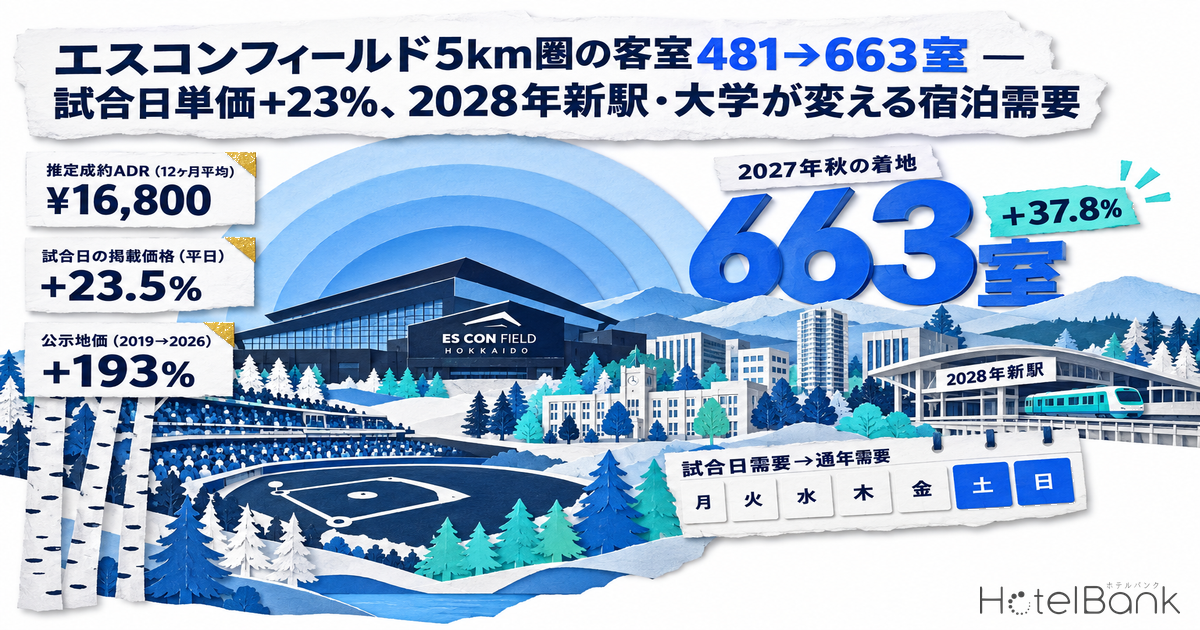
- — 481 rooms within 5km — for the 11 years from 2012 to 2022 the figure was frozen at 2 properties and 287 rooms. In the three years after the ballpark opened in March 2023 it grew to 7 properties and 481 rooms (+67.6%).
- — 663 rooms by autumn 2027 — DHAWA’s 182 rooms lift the total 37.8%. A single building turns over 27% of the rooms within 5km, shifting the price-tier mix itself.
- — Game-day premium of +23.5% — the published-price gap at the 272-room property on Mondays through Thursdays. Right by the ballpark the gap runs +80% to +234%; around Sapporo Station and Odori it is only +11.0%.
- — Estimated settled ADR swings 1.87x — against a 12-month average of ¥16,800, the low is ¥12,300 (April 2026) and the high ¥23,000 (August 2026). Filling the thin months is the real question.
- — The white space is 20-150 rooms at mid-tier rates — filling 663 rooms at 70% year-round OCC would require roughly 30% of out-of-prefecture visitors to stay a night every day. Ballpark demand alone does not get there.
Rooms within 5km sat at 287 for 11 years — the shift came in the three years after the ballpark opened
Tracking year-end room stock within a 5km radius of Es Con Field HOKKAIDO (42.9905°N, 141.5497°E) in the MetroEngines Research & Consulting property master, the figure did not move at all from 2012 through 2022, staying at 2 properties and 287 rooms. Change began the moment the ballpark opened: 5 properties and 316 rooms in 2023, 6 properties and 323 rooms in 2024, then 7 properties and 481 rooms in 2025. That is +67.6% versus 2022.
The growth is lopsided, though. What arrived in 2023 were small properties inside the ballpark and F Village — three buildings totalling just 29 rooms. The jump to 481 rooms came from a 158-room lodging-focused hotel that opened in front of Kitahiroshima Station in March 2025, and 90% of the rooms within 5km (430) are concentrated in two buildings.
Room stock around Es Con Field HOKKAIDO (year-end; 5km radius = bars / 15km radius = line)
Source: MetroEngines Research & Consulting (year-end aggregation based on opening and closing years in the property master). 2027 is an estimate that adds the announced plan (182 rooms)
Widen the lens to 15km and the count rises from 42 properties and 1,797 rooms in 2022 to 53 properties and 2,165 rooms in 2026 — but that increment sits mainly outside Kitahiroshima (Eniwa and the southeastern edge of Sapporo including Kaminopporo), which only sharpens the scarcity of rooms right beside the ballpark.
| Property | Rooms | Opened | Location |
|---|---|---|---|
| Sapporo Kitahiroshima Classe Hotel (札幌北広島クラッセホテル) | 272 | 1991 | Central Kitahiroshima |
| Es Con Field HOKKAIDO Hotel Kitahiroshima Station (エスコンフィールドHOKKAIDOホテル 北広島駅前) | 158 | March 2025 | In front of Kitahiroshima Station |
| Takeyama Kogen Hotel (竹山高原ホテル) | 15 | Before 1970 | Southern Kitahiroshima |
| tower eleven hotel | 12 | March 2023 | Inside the ballpark |
| VILLA BRAMARE | 9 | March 2023 | Inside F Village |
| BALLPARK TAKIBI TERRACE ALLPARK | 8 | March 2023 | Inside F Village |
| KITAHIROSHIMA NEVER END LEO | 7 | June 2024 | Eastern Kitahiroshima |
| Total | 481 | 7 properties | |
Source: MetroEngines Research & Consulting (N=7 properties, based on listings on major booking sites)
DHAWA brings 182 rooms in autumn 2027 — then a station, a university, offices and housing all land in 2028
According to a release issued by Es-Con Japan Ltd., a hotel under DHAWA — a brand operated by Singapore’s Banyan Group — is scheduled to open inside F Village in autumn 2027. The release describes a reinforced-concrete and steel-frame building of eight storeys with 182 rooms, guest rooms of roughly 20 to 100 square metres, and a site area of 4,537.60 square metres. It faces the outfield stands and is said to include a restaurant, fitness room, spa, and indoor and open-air public baths. Operation, per the release, will be handled by a joint venture between Banyan Group’s Japanese entity and a domestic hotel operator.
Adding those 182 rooms takes stock within 5km to 663 rooms (+37.8%) — 2.3 times the 287 rooms of 2022. A single building accounts for 27% of the rooms within 5km, a scale large enough to move the price-tier composition of the stock itself.
| Timing | Project | Scale (as announced) | Source |
|---|---|---|---|
| Autumn 2027 | DHAWA (hotel) | 8 storeys, 182 rooms, 4,537.60 m² site, guest rooms approx. 20-100 m² | Es-Con Japan release |
| Spring 2028 | Retail and office complex | 11-storey steel frame, approx. 17,000 m² gross floor area (completion scheduled January 2028), F Village’s first rental office | Club release / news reports |
| April 2028 | Health Sciences University of Hokkaido, new campus | 12-storey university building plus 4-storey public building, site of approx. 21,000 m² | University announcement / news reports |
| 2028 (same) | Student dormitory “Dormitory F Village” (provisional name) | 242 rooms (144 for university students), public bath, sauna, lounge | University announcement |
| Around summer 2028 | New JR station “F Village Station” (Chitose Line, between Kaminopporo and Kitahiroshima) | About 300m from the ballpark, roughly a 4-minute walk; 3-storey station building; two side platforms and four tracks for 6-car trains; total cost approx. ¥9.0bn. The name “F Village Station” (station number H06-1) was decided on 4 September 2026 | JR Hokkaido / news reports |
| 2028 | Es Con Field Tower (condominiums) | 35 storeys, 508 units, about 200m in a straight line from the new station | Es-Con Japan property site |
Source: compiled by MetroEngines Research & Consulting from figures announced by each developer and reported in the press. All scales and timings are planned values as of announcement, not confirmed figures. Note that the relocation of the university hospital has been reported as deferred for the time being
What matters is that these five projects come on line at almost the same time (autumn 2027 to autumn 2028). The hotel opens first, in autumn 2027, while the university, offices, housing and station — the sources of weekday demand — cluster in 2028. Structurally, the first year of operation is “a year of dependence on the ballpark,” and how that year is designed is where business plans diverge.
Ballpark, new station and existing hotels — development clustered within walking distance
The new station sits about 300m from the ballpark, the residential tower about 200m in a straight line from the station, and the retail-office complex midway along the pedestrian deck linking station and ballpark. Both existing large properties are on the Kitahiroshima Station side, so rooms within walking distance of the ballpark currently number just 36 (four properties inside F Village). DHAWA is positioned to fill exactly that gap.
Source: MetroEngines Research & Consulting (property locations) and materials published by each developer. Positions of the new station and DHAWA are approximate, based on published information
Game-day published prices run +23.5% on weekdays, +11.0% in Sapporo — demand closes within a few kilometres of the ballpark
The Kitahiroshima City ballpark website lists 81 game days for the 2026 season (including nine pre-season games): 10 in March, 13 in April, 11 in May, 12 in June, 11 in July, 14 in August and 10 in September. We matched that calendar against daily published prices at each property within 5km (all-plan average, double occupancy, tax included).
The window is the 92 days from 1 June to 31 August 2026, of which 37 were game days. To strip out the day-of-week skew (games cluster on weekends), the chart below compares Mondays through Thursdays only. As a benchmark, it also shows the daily median for 17 properties of 150+ rooms around Sapporo Station and Odori.
Median published price, game days vs non-game days (Mon-Thu only, June-August 2026)
Source: MetroEngines Research & Consulting (published price = all-plan average, double occupancy, tax included. Of Mondays through Thursdays, 17 were game days and 36 were not. Only tower eleven hotel has a thin sample, with 5 game days observed)
The closer to the ballpark, the wider the gap. The 158-room property in front of Kitahiroshima Station shows a game-day median of about ¥88,100 against ¥26,400 on non-game days — 3.3 times. The small properties inside F Village show gaps of +80% to +88%. The city’s largest property, at 272 rooms, stays at a moderate +23.5%, and the Sapporo Station and Odori area is +11.0%. Ballpark demand does reach central Sapporo, but at a fraction of the magnitude seen in Kitahiroshima.
How to read this: published price here is the average across every plan listed that day. On game days the cheaper plans sell out first, so the remaining listed price band shifts upward — a mix effect. The multiples above should therefore be read not as “how much the same room was marked up” but as a supply-demand signal: demand is concentrated enough that only the higher-priced inventory is left. Consistent with that, the lowest published plan at the same property rises from about ¥6,800 on non-game days to about ¥26,400 on game days — the same direction.
Estimated settled ADR swings 1.9x month to month — the question is how to fill the thin months
Kitahiroshima’s estimated settled ADR (September 2025 to August 2026) averages ¥16,800 over 12 months. The low is ¥12,300 in April 2026 and the high ¥23,000 in August 2026 — a swing of 1.87x. Over the same period Chitose runs ¥13,100 (24-28 properties covered), Chuo-ku in Sapporo ¥14,400 (130-139), and Eniwa ¥7,600 (3).
Kitahiroshima sits above Chuo-ku in Sapporo because several of the five properties covered are small, high-rate properties inside F Village. With so few properties, one or two of them can move the monthly average, and that must be discounted when reading these figures (7-8 properties listed, 4-5 covered by the estimate).
Monthly estimated settled ADR (September 2025 – August 2026)
Source: MetroEngines Research & Consulting (estimated settled ADR. Properties covered: Kitahiroshima 4-5 / Chitose 24-28 / Chuo-ku, Sapporo 130-139 / Eniwa 3. All on a verified-history basis for settled months)
August peaks because 14 game days — the most of any month — coincide with summer leisure demand. April, by contrast, hits the annual low while carrying 13 game days. That the rate can differ 1.9x on a near-identical game count shows the number of games is not what sets the rate. What sets it is whether other demand — summer tourism, events — happens to land at the same time.
| Property type | Properties | Rooms covered | Est. OCC, July | Est. OCC, August |
|---|---|---|---|---|
| All properties | 665→671 | 52,729→52,816 | 89.9% | 89.6% |
| Business | 219→215 | 25,665→25,537 | 92.6% | 90.9% |
| City | 35 | 8,550 | 91.3% | 91.4% |
| Resort | 85→86 | 9,075→9,218 | 84.6% | 86.6% |
| Ryokan | 160→165 | 7,156→7,213 | 85.2% | 86.4% |
Source: MetroEngines Research & Consulting (estimates based on listings on major booking sites. Property and room counts are shown July→August. Because municipal-level samples are too small, these are Hokkaido-wide reference figures)
Business-type properties across Hokkaido ran 92.6% in July and 90.9% in August — a high level. Lodging demand in the prefecture is genuinely strong. The question for Kitahiroshima is therefore not “is there demand” but whether that demand stays in Kitahiroshima or stays in Sapporo and makes a day trip.
Half of the 4.59 million annual visitors come on non-game days — but that has not converted into room nights
The club reported F Village’s 2025 attendance at 4,591,357 (+10% year on year): 2,232,364 across 71 home regular-season games (+7%) and 2,358,993 for other events (+12%). That non-game-day visitors outnumber game-day visitors shows this is not merely a ballpark but a year-round attraction. Average dwell time also lengthened, from 4 hours 6 minutes in 2023 to 4 hours 52 minutes in 2025. Visitors from outside Hokkaido accounted for 24% of the total, or 1.12 million, and overseas visitors roughly 36,000 — double the prior year.
Yet non-game-day lodging demand is weak, as the previous section showed. Even on non-game days the site draws about 8,000 people on an average day, but most of them are day trippers from Sapporo, 30 minutes away — and published prices bear that out. A large conversion loss still sits between visitor counts and room nights.
| Assumed OCC | Rooms sold per day | Guests per day | Share of F Village visitors | Share of out-of-prefecture visitors |
|---|---|---|---|---|
| 60% | 398 | 796 | 6.3% | 25.9% |
| 70% | 464 | 928 | 7.4% | 30.3% |
| 80% | 530 | 1,061 | 8.4% | 34.6% |
Assumptions: 663 rooms within 5km (as of autumn 2027), double occupancy; F Village visitors from 2025 actuals of 4,591,357 ÷ 365 days = 12,579 per day on average; out-of-prefecture visitors at 24% of that (1.12 million) ÷ 365 days = 3,068 per day. Source: estimated by MetroEngines Research & Consulting from figures published by the club
The implication is plain. Filling 663 rooms at 70% annual OCC (year-round, an assumption for this estimate) would require roughly 30% of out-of-prefecture visitors to stay a night every single day. Reaching that on ballpark demand alone is not realistic. Filling DHAWA alone (182 rooms) at 70% OCC (same basis) needs 255 guests a day, or 8.3% of out-of-prefecture visitors — that is within reach. One building can work on ballpark demand; filling the whole catchment needs demand from elsewhere — and that is the yardstick for judging the 2028 complex development.
The weekday demand pool is 8,544 workers — one office building is enough to change the structure
Looking at the trade area within a 3km radius of the ballpark through public statistics: 740 establishments and 8,544 workers, of which office-type workers number 493, just 5.8% of the total (Economic Census). Note, however, that this survey dates from 2021, before the ballpark opened in March 2023, so employment created at F Village since then is not reflected.
Even so, a pool of 493 office workers is consistent with how thin weekday lodging demand currently is. Into that lands, in spring 2028, a complex of roughly 17,000 square metres gross that includes F Village’s first rental office. If the rental-office portion is taken at half the gross floor area — about 8,500 square metres — and 10 square metres per person, that is roughly 850 workplaces. It is a rough calculation built on assumptions, but it shows the scale: one building could nearly double the office-type workforce within 3km.
The residential side moves too. On 250m-mesh estimates, the resident population within 3km is 24,948 in 2025 and shrinks 14.1% by 2040 (to about 21,400), with an ageing rate already at 38.0% in 2025. Adding a 508-unit condominium tower at 2.2 people per household gives roughly 1,100 people, or +4.5% of the 3km population. Not enough to reverse the decline, but a single building backfills about a third of the losses to 2040.
Source: Ministry of Land, Infrastructure, Transport and Tourism, National Land Numerical Information (projected population by 250m mesh, R6 National Institute estimate). These are resident populations (census basis), not daytime or through traffic
| Indicator (3km radius) | Value | Notes |
|---|---|---|
| Resident population (2025 estimate) | 24,948 | Sum of 187 250m mesh cells |
| Resident population (2040 estimate) | 21,426 | -14.1% vs 2025 |
| Ageing rate (2025) | 38.0% | 9,478 aged 65 and over |
| Working-age population (2025) | 13,151 | 52.7% |
| Establishments | 740 | Economic Census, as of 2021 |
| Workers | 8,544 | Same source |
| of which office-type workers | 493 (5.8%) | Same source; pre-ballpark figure |
Source: compiled by MetroEngines Research & Consulting from the Ministry of Land, Infrastructure, Transport and Tourism’s National Land Numerical Information (projected population by 250m mesh) and the Ministry of Internal Affairs and Communications / Ministry of Economy, Trade and Industry “Economic Census” (2021)
Published land prices up 193% in seven years — the +30.0% of the opening year was the peak
Using published land price data from the Ministry of Land, Infrastructure, Transport and Tourism’s Real Estate Information Library, the benchmark point in central Kitahiroshima (Kitahiroshima-1) went from ¥26,600 per square metre in 2019 to ¥78,000 in 2026, up 193% in seven years. Year-on-year: +16.5% in 2020, +17.7% in 2021, +26.0% in 2022, then a peak of +30.0% in 2023, the year the ballpark opened, followed by +12.0% in 2024, +7.5% in 2025 and +8.3% in 2026.
Nearby points follow suit: Kitahiroshima-6 rose from ¥19,200 in 2019 to ¥45,200 in 2026 (+135%), and Kitahiroshima-12 from ¥21,700 to ¥46,000 (+112%). But Kitahiroshima-6 has been flat for three straight years since 2024, and Kitahiroshima-12 managed only +2.2% in 2026 — the increases are becoming selective by location. A point added in 2025 (Kitahiroshima-17) reached ¥74,000 in 2026, up 10.4% year on year, suggesting room for further gains at points closer to the new station and F Village.
Published land prices in Kitahiroshima (2019-2026, ¥/m²)
Source: compiled by MetroEngines Research & Consulting from the Ministry of Land, Infrastructure, Transport and Tourism’s Real Estate Information Library (published land prices)
On zoning, the ballpark site is a commercial district with a floor-area ratio of 400% and a building coverage ratio of 80%. The same tile also contains Category 1 and Category 2 mid-to-high-rise exclusive residential districts and a Category 1 residential district (all at 200% FAR and 60% coverage), plus an exclusive industrial district, so parcels where a high-density hotel is feasible are limited. That DHAWA stops at eight storeys while the 35-storey residential tower sits closer to the new station is consistent with this zoning pattern.
Source: compiled by MetroEngines Research & Consulting from the Ministry of Land, Infrastructure, Transport and Tourism’s Real Estate Information Library (city planning decisions and use districts)
The white space is 20-150 rooms at mid-tier rates — room for a format that fills weekdays
Map each property within 5km by room count (horizontal axis) against median non-game-day published price (vertical axis) and the market splits cleanly in two. The 272-room and 158-room buildings sit in the ¥28,000-¥37,000 range, while the 8-12 room properties inside F Village sit in a high band of ¥62,000-¥108,000. In between, there is no property at all in the 20-to-150-room range.
Room count × median non-game-day published price (June-August 2026, within 5km)
Source: MetroEngines Research & Consulting (N=5 properties. Published price = all-plan average, double occupancy, tax included; median across 55 non-game days. Takeyama Kogen Hotel is excluded, as no listings were observed during the window)
For a new entrant in that band, where returns land is determined almost entirely by two variables: estimated settled ADR and year-round OCC. The grid below flexes both to show annual room revenue per room.
| Est. settled ADR \ year-round OCC | 55% | 60% | 65% | 70% | 75% |
|---|---|---|---|---|---|
| ¥12,000 | 241 | 263 | 285 | 307 | 328 |
| ¥15,000 | 301 | 328 | 356 | 383 | 411 |
| ¥18,000 | 361 | 394 | 427 | 460 | 493 |
| ¥21,000 | 422 | 460 | 498 | 537 | 575 |
| ¥24,000 | 482 | 526 | 569 | 613 | 657 |
Estimate: annual room revenue per room = estimated settled ADR × year-round OCC × 365 days. The shaded cell is the mid case (¥18,000 × 65%). The ADR range follows Kitahiroshima’s actual estimated settled ADR range (September 2025 – August 2026, ¥12,286-¥22,997). Year-round OCC values are assumptions set as a business-plan range for a new entrant, on a different basis from the property-type estimated OCC used elsewhere in this article (listed-inventory basis, Hokkaido-wide). Costs, NOI and yields are outside the scope of this article.
Applying these two axes to the supply and demand structure described above gives three scenarios.
Downside — ballpark dependence persists
If the 2028 station, university and offices slip and weekday demand never forms. At an estimated settled ADR of ¥15,000 and 55% year-round OCC, annual room revenue is ¥3.01m per room. Revenue concentrates on game days and non-game-day inventory goes unsold as a matter of course.
Mid case — the complex development lands on schedule
If the station, university, rental offices and residential tower all come on line in 2028 and a weekday pool forms. At ¥18,000 and 65% year-round OCC, ¥4.27m per room — slightly above Kitahiroshima’s 12-month average of ¥16,800.
Upside — weekdays and game days both captured
If weekdays are filled by university and office demand while the game-day premium is captured in full. At ¥21,000 and 75% year-round OCC, ¥5.75m per room — 1.91x the downside. The same site and the same room count can produce nearly double the revenue.
Of the 1.91x gap between downside and upside, ADR contributes 1.40x and OCC 1.36x — near parity. The game-day premium that ballpark demand alone can capture works on the ADR side, but only the weekday demand arriving in 2028 can move year-round OCC. For an operator opening ahead of that, in autumn 2027, that year is the only window in which the price elasticity of weekday inventory can actually be measured.
DHAWA (182 rooms) sits at the right-hand edge of this white space and lands, in scale terms, in the same band as the two existing large properties. What remains is a 50-to-120-room format targeting an estimated settled ADR of ¥15,000-¥25,000. Three things make that band viable as an investment opportunity.
Opportunity 1 — extended-stay / apartment format
The 2028 university campus, rental offices and residential tower all generate construction-worker demand while they are being built, and after opening they generate medium-stay demand from clinical placements, conferences, training and pre-relocation stays. A stay-oriented format with kitchens and laundry is one of the few that can flatten the game-day peak.
Opportunity 2 — mid-size, weekday business focus
Office-type workers within 3km currently number 493 (as of 2021), and a single office building could nearly double that. Land costs are lower than in central Sapporo, and once the new station improves access toward Sapporo Station from 2028, the conditions exist to offer “the option of not staying in Sapporo.”
Opportunity 3 — small, high-rate, productising the ballpark experience
Small properties inside F Village hold published prices of ¥62,000-¥108,000 even on non-game days. The ballpark experience itself supports the rate, and they have already demonstrated a revenue structure that does not depend on the game-day premium.
In central Sapporo, foreign-brand supply builds up from 2026 through 2029. On the Hyatt side, Hyatt Centric Sapporo (2026, 216 rooms) and Park Hyatt Sapporo (2029, 157 rooms) have been announced as scheduled openings (source: Hyatt Japan K.K., “Press Materials, April 2026”). On the Hilton side, Hilton Sapporo Park Hotel (approx. 350 rooms) is listed as a scheduled opening, though the materials state the timing as undecided (source: Hilton, “Company Profile,” updated 25 August 2026). Rather than competing on the same ground as these, Kitahiroshima holds product value on a different axis — the ballpark experience and new-station access, and that is the differentiator in any decision to enter the central Hokkaido market.
Conclusion — how 2027 is navigated decides the revenue structure from 2028 on
The structure the data shows comes down to three points.
First, Kitahiroshima today is a market where rates spike on game days and demand flows to Sapporo on every other day. Measured Monday to Thursday, the game-day published-price premium reaches +80% to +234% at properties right by the ballpark and +23.5% at the city’s largest property, while the Sapporo Station and Odori area stays at +11.0%. Demand is tightly closed within a few kilometres of the ballpark, and the drop on non-game days is correspondingly steep. More than half of the 4.59 million annual visitors come on non-game days, yet that has not converted into room nights — which is exactly what the 1.87x monthly swing in estimated settled ADR reflects.
Second, the 2028 complex development creates a weekday demand pool for the first time. The rental office is large enough to nearly double office-type workers within 3km, the university campus generates year-round weekday visits, and the 508-unit residential tower backfills about a third of the population decline to 2040 in a single building. The new station, though, cuts both ways: better access toward Sapporo Station also makes day trips easier, so the station itself does not necessarily increase lodging demand. What increases it is not the station but the university, offices and housing built around it.
Third, the supply gap remains at 20-150 rooms in the mid price tier. After DHAWA opens, the 663 rooms within 5km consist of two large properties, DHAWA, and small high-rate properties — leaving white space for extended-stay and weekday-focused formats of 50 to 120 rooms targeting an estimated settled ADR of ¥15,000-¥25,000. Filling the whole catchment at 70% annual OCC (same basis) would require 30% of out-of-prefecture visitors to stay a night every day, which ballpark demand alone cannot deliver. Put the other way round, the upside in this catchment is concentrated precisely in formats that go after demand other than the ballpark.
There is a roughly one-year lag between DHAWA’s opening in autumn 2027 and the arrival of the station, university, offices and housing in 2028. That year is when dependence on the ballpark is at its highest — and, at the same time, the only window in which to experiment with how weekday inventory is sold. For operators weighing an entry in central Hokkaido, Kitahiroshima in 2027 is where the market data arrives first.
⚠ Note on forward-looking figures: the 2027 and 2028 property scales and opening dates cited here are all planned values as published by the relevant developers and authorities at the time of announcement. The 663-room stock figure for 2027 is an estimate that adds announced plans and is not a confirmed number. Supply aggregation is based on properties confirmed as listed on major booking sites, so properties not yet listed are excluded.
Related reading
- Chitose & Tomakomai Worker Lodging — 7 New Hotels, 738 Rooms in 2026
- Sapporo Hotel Supply 2026-2029: Hyatt Opens a New High-ADR Tier
- NPB Postseason 2026: October Rates Flat in 8 of 11 Ballpark Markets
- Hokkaido Business Hotels Aren’t Weekend-Led: Thu 95.4% Ties Sat 95.4%
- Hyatt Centric Sapporo Opens: Foreign Brands Reshape Hokkaido ADR
References and Sources
■ Data sources
The supply time series is a year-end aggregation based on opening and closing years in our property master (N=7 properties within 5km / N=53 within 15km). Estimated settled ADR applies property-type correction factors to the lowest published plan on major booking sites; cross-checked against property-level results disclosed by listed hotel REITs (91 properties, most recent three months), the median error is about 7%. Published price is the daily median of the all-plan average for double occupancy, tax included; the game-day comparison covers the 92 days from 1 June to 31 August 2026 (of Mondays through Thursdays, 17 game days and 36 non-game days). Estimated OCC by property type is an estimate based on inventory listed on major booking sites (Hokkaido-wide, July and August 2026). Population and trade-area figures come from projected population by 250m mesh (3km radius, 187 cells) and the Economic Census (2021); land prices from published land price data.
■ Estimate assumptions
The 663 rooms within 5km in 2027 is an estimate adding the announced 182-room plan to the 2026 actual of 481 rooms. The lodging-conversion estimate assumes double occupancy, F Village visitors of 4,591,357 in 2025 ÷ 365 days = 12,579 per day on average, and out-of-prefecture visitors at 24% of that (1.12 million) ÷ 365 days = 3,068 per day. The sensitivity grid uses annual room revenue per room = estimated settled ADR × year-round OCC × 365 days, with year-round OCC set as an assumed business-plan range for a new entrant. Office workplaces are approximated at half the gross floor area and 10 square metres per person, and the residential tower at 2.2 people per household.
■ Limitations and caveats
Kitahiroshima’s estimated settled ADR covers only 4-5 properties, so a change in one or two of them moves the monthly average. Published price is the average of all plans listed that day and therefore includes the mix effect of cheaper plans selling out first; it is not “how much the same room was marked up.” Estimated OCC is a listed-inventory estimate and differs from actual occupancy; because municipal samples are too small, Hokkaido-wide reference figures were used. The Economic Census dates from 2021 and does not reflect employment created after the ballpark opened in March 2023. Property scales and opening dates for 2027 and 2028 are planned values as published at the time of announcement, not confirmed figures. Costs, NOI, yields and investment judgements are outside the scope of this article.
■ Market data
- MetroEngines Research & Consulting — supply time series from the property master (N=7 properties within 5km / N=53 within 15km), estimated settled ADR, daily published-price aggregation, estimated OCC by property type
■ Government statistics and public data
- Ministry of Land, Infrastructure, Transport and Tourism, Real Estate Information Library — published land prices and use districts
- Ministry of Land, Infrastructure, Transport and Tourism, National Land Numerical Information, “Projected population by 250m mesh (R6 National Institute estimate)”
- Ministry of Internal Affairs and Communications / Ministry of Economy, Trade and Industry, “Economic Census” (2021)
- Kitahiroshima City ballpark website, “2026 season Es Con Field game days”
■ Corporate announcements and IR
- Es-Con Japan Ltd. news release (DHAWA, 182 rooms, scheduled to open autumn 2027)
- Es Con Field Tower official property site (35 storeys, 508 units)
- Hokkaido Nippon-Ham Fighters, “Construction begins on the Hokkaido Ballpark F Village retail and office complex”
- Health Sciences University of Hokkaido, new campus site (2028 relocation to F Village, 242-room dormitory)
- Kitahiroshima City and Hokkaido Railway Company, “Joint release: name decided for the new Chitose Line station” (4 September 2026)
- Kitahiroshima City and Hokkaido Railway Company, “Joint release: start of construction on the new Chitose Line station” (11 July 2024; station structure, total cost, target opening)
- Hyatt Japan K.K., “Press Materials, April 2026”
- Hilton, “Company Profile” (updated 25 August 2026)
■ News coverage
- Nikkei, “Nippon-Ham’s F Village draws a record 4.59 million visitors in 2025, up 10%”
- UHB Hokkaido Bunka Hoso, “4.59 million visited F Village in 2025” (breakdown by games and events)
- TRAICY, “JR Hokkaido begins construction on a new station next to Es Con Field, scheduled to open around summer 2028”
- UHB Hokkaido Bunka Hoso, “Health Sciences University of Hokkaido holds a safety ceremony for its new campus” (12-storey university building and more)
- UHB Hokkaido Bunka Hoso, “Health Sciences University of Hokkaido releases renderings of its new campus — university hospital relocation deferred on material costs”
Source: Hyatt Japan K.K., “Press Materials, April 2026”
Source: Hilton, “Company Profile” (updated 25 August 2026)