

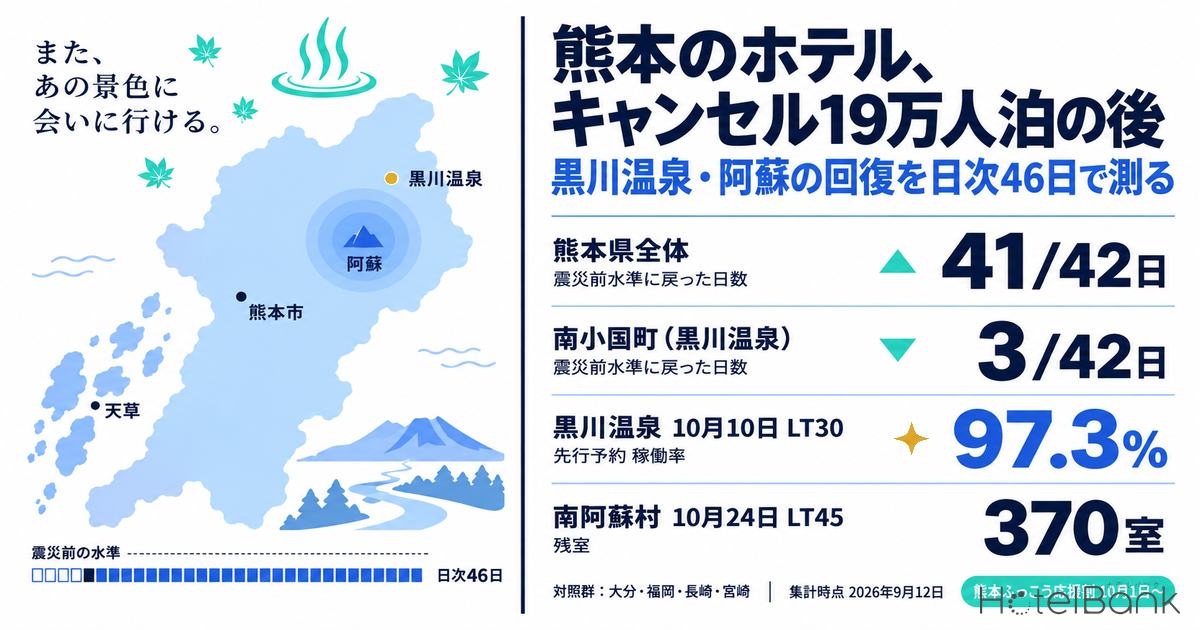
Forty-six days had passed since the 2026 Kumamoto Earthquake as of this article’s data cutoff (September 12, 2026). Lodging cancellations reported by Kumamoto Prefecture come to roughly 190,000 person-nights and about ¥2.7 billion (provisional). What matters is not how much was lost, but how many days it took, and where, for demand to come back. Using daily lodging inventory data, this article strips out seasonality by differencing against four control prefectures in Kyushu, then measures the recovery curve for each area within Kumamoto Prefecture.
Metric Definitions Used in This Article
- Occupancy (estimated, OTA-listed inventory basis): The share of rooms sold against the total listed rooms in an area (an estimate based on inventory sold through OTAs). Because it is derived from how listed inventory is taken up, it differs from a property’s actual overall occupancy.
- LT (lead time): Days remaining until the check-in date. LT0 = same day. This article uses only observations within LT45.
- Control group: Four prefectures — Oita, Fukuoka, Nagasaki and Miyazaki. The simple average of their estimated occupancy on each day is used.
- Recovery day: A day on which the occupancy gap between an area in Kumamoto Prefecture and the control group returned to at least the average gap recorded before the earthquake (June 1 – July 27, 2026). Seasonal factors are offset against the control group before this is judged.
- Data source: MetroEngines Research
On the shifting listed base: The estimated occupancy in this article is based on how OTA-listed inventory is taken up. When a temporarily closed property drops off the listings, the denominator itself — the properties and rooms covered — moves. For Kumamoto Prefecture as a whole, coverage was 301 properties / 13,041 rooms in June 2026, 270 properties / 12,433 rooms in July, 312 properties / 13,262 rooms in August and 284 properties / 12,706 rooms in September (1st–12th), so comparisons of levels need to account for that. It is precisely to limit the effect of this moving denominator that the article’s primary measure is the change in the gap against the control group rather than absolute levels between areas. How closures entering and leaving the listings show up in inventory data is set out in detail in Kumamoto Quake 2026, 72 Hours On: 6 Closures vs 17.9% Inventory Loss.
- — Lodging cancellations reported by the prefecture total roughly 190,600 person-nights and about ¥2.7 billion (cutoff 10:00, August 21; provisional). Aso at 31.6% and Amakusa at 18.1% account for almost half of the total between them.
- — Once seasonality is stripped out by differencing against the four control prefectures, Kumamoto Prefecture as a whole was back at or above its pre-quake relative level on 41 of the 42 days after the earthquake.
- — What came back, however, was a change in the composition of demand. Business hotels went from 81.4% in July 2026 to 95.4% in August, while resort hotels and ryokan were flat.
- — Split by municipality, recovery days range from 3 to 42 out of 42: 42 days for Chuo Ward in Kumamoto City, against 3 for Minamioguni Town, 5 for Aso City and 5 for Amakusa City.
- — In forward bookings the prefecture-level gap has all but vanished (Kumamoto at 79.4% at 30 days’ lead time for October 10). The room left to fill is concentrated on ordinary weekends in Minamiaso Village (370 rooms), Amakusa City (188), Aso City (179) and Kamiamakusa City (169).
Prefecture-Reported Cancellations: 190,000 Person-Nights, ¥2.7bn — Half of It in Aso and Amakusa
Start with the primary source. Through its disaster response headquarters meetings, Kumamoto Prefecture has been publishing a running survey of cancellations at lodging facilities in the prefecture, collected via industry bodies and municipalities. According to the Tourism and Culture Department report submitted to the 29th headquarters meeting on August 31, cancellations captured as of 10:00 on August 21 stood at roughly 190,600 person-nights and about ¥2.7 billion (both provisional). At the 20th meeting on August 10 the figures were about 146,000 person-nights and ¥2.06 billion, so the totals have been building as the survey progresses.
The same report puts physical damage to lodging-industry buildings and equipment at about ¥6.2 billion (excluding the value of cancellations). All of these are figures from a survey still in progress, which the prefecture explicitly labels provisional rather than final.
The breakdown by area is what stands out. The Aso area accounts for 60,206 person-nights, or 31.6% of the total, and the Amakusa area for 34,451, or 18.1% — nearly half the total (49.7%) between those two areas alone. Kumamoto City, the prefectural capital, recorded 29,854 person-nights, or 15.7%.
| Area | Canceled person-nights | Share | Cancellation value (¥mn) |
|---|---|---|---|
| Aso | 60,206 | 31.6% | 981 |
| Amakusa | 34,451 | 18.1% | 588 |
| Kumamoto City | 29,854 | 15.7% | 333 |
| Tamana | 14,758 | 7.7% | 200 |
| Kuma | 12,608 | 6.6% | 163 |
| Kikuchi | 10,490 | 5.5% | 94 |
| Kamoto | 9,775 | 5.1% | 158 |
| Ashikita | 6,047 | 3.2% | 77 |
| Yatsushiro | 5,462 | 2.9% | 48 |
| Kamimashiki | 4,673 | 2.5% | 39 |
| Uki | 2,300 | 1.2% | 12 |
| Total | 190,624 | 100.0% | 2,693 |
Source: Kumamoto Prefecture, “2026 Kumamoto Earthquake Disaster Response Headquarters Meeting (29th session, August 31, 2026) — departmental reports [Tourism and Culture Department]” (cutoff 10:00, August 21; provisional); compiled by the HotelBank Editorial Team
Mapped out, the cancellations cluster in two leisure catchments — the area around the Aso caldera and the Amakusa islands — while Uki and Yatsushiro, closer to the epicenter, post relatively small figures. The physical center of the damage and the places where lodging demand was lost do not coincide.
Source: Kumamoto Prefecture, “2026 Kumamoto Earthquake Disaster Response Headquarters Meeting (29th session) — departmental reports [Tourism and Culture Department]”; compiled by the HotelBank Editorial Team
How Recovery Is Measured — Differencing Against a Control Group to Strip Out Seasonality
August is a month when lodging demand rises nationwide, so comparing July and August occupancy directly cannot separate a genuine recovery from the arrival of the summer holidays. This article therefore computes, day by day, the occupancy gap between each area in Kumamoto Prefecture and four control prefectures in Kyushu that were relatively less directly affected by the earthquake (Oita, Fukuoka, Nagasaki and Miyazaki), and counts as a recovery day any day on which that gap returned to the average gap recorded before the earthquake (June 1 – July 27, N=57 days).
With this approach, seasonal factors common to Kyushu as a whole — Obon, long weekends — show up on the control side as well and cancel out in the difference. What remains is movement specific to Kumamoto. The post-quake observation window is the 42 days (six weeks) from July 29 to September 8. For the baseline across Kyushu’s seven prefectures at the time of the quake and the 2016 recovery curve, see also Kumamoto Quake 2026: 2016 Recovery Curve as Kyushu’s 7-Pref Benchmark.
Prefecture-Wide, 41 of 42 Days Were At or Above Pre-Quake Levels — But the Demand Mix Has Changed
To lead with the conclusion: estimated occupancy for Kumamoto Prefecture as a whole returned to a level above the control group almost immediately after the earthquake, and has widened the gap since. The pre-quake average gap was +0.5pt; in the six weeks after the quake, 41 days out of 42 came in at or above that level. The weekly average deviation was +6.2pt in week 1, +6.3pt in week 3 (Obon) and +10.4pt in week 6 — widening, if anything, as time passed.
Source: MetroEngines Research; compiled by the HotelBank Editorial Team
Reading that number as tourism demand having returned, however, would be a mistake. Broken down by category, what is moving is business hotels and city hotels; resort hotels and ryokan, which absorb leisure demand, remain flat.
| Category (Kumamoto Pref.) | June | July | August | Sept (1–12) | July → Sept |
|---|---|---|---|---|---|
| Business hotel | 77.1% | 81.4% | 95.4% | 92.8% | +11.4pt |
| City hotel | 85.6% | 87.5% | 95.1% | 94.1% | +6.6pt |
| Resort hotel | 75.8% | 78.0% | 76.8% | 74.5% | -3.5pt |
| Ryokan | 75.5% | 76.7% | 78.7% | 78.1% | +1.4pt |
Source: MetroEngines Research; compiled by the HotelBank Editorial Team
Business hotels rose 14.0pt from 81.4% in July to 95.4% in August and have held 92.8% into September (coverage: 59 properties / 7,399 rooms, August). City hotels are also high at 95.1% in August. Resort hotels, by contrast, went from 78.0% in July to 74.5% in September and ryokan from 76.7% to 78.1% — essentially flat.
Behind this movement is an initiative the prefecture itself has disclosed. According to Tourism and Culture Department reports, the prefecture has been lining up host properties — largely hotels in Yatsushiro, Minamata–Ashikita and Hitoyoshi–Kuma near the affected areas — securing 204 properties in the prefecture as of 14:00 on August 31, against 1,478 applications for hotel-based evacuation, of which 554 covering 1,202 people had been matched. In other words, stays by people working on the recovery and by evacuees are what is actually filling limited-service rooms.
High occupancy across the prefecture is therefore a fact, but it has to be read as the result of one kind of demand replacing another, not of leisure demand returning.
By Municipality, Recovery Days Range From 3 to 42 Out of 42
Running the same calculation at municipality level brings out the differences the prefecture-wide average was hiding. Of the 42 days, the count that returned to the pre-quake relative level ranges widely — from 42 days (100%) in Chuo Ward, Kumamoto City, down to 3 days (7.1%) in Minamioguni Town.
Source: MetroEngines Research; compiled by the HotelBank Editorial Team
Chuo Ward was already well above the control group at +12.7pt in week 1, immediately after the quake, and had widened the gap to +15.6pt by week 6. Even though Kumamoto City ranked third in the prefecture’s cancellation figures at 29,854 person-nights, rooms were filled by other demand that more than offset the bookings lost.
In Aso City, Amakusa City, Minamioguni Town and Minamiaso Village, by contrast, the deviation that opened to around −17 to −21pt in week 1 has narrowed over the following six weeks but has not fully returned to the pre-quake level. The sharp temporary narrowing across these areas in week 3 (August 12–18) reflects Obon, when Kyushu as a whole approaches full occupancy; that week structurally compresses the gap against the control group and should be discounted accordingly.
Source: MetroEngines Research; compiled by the HotelBank Editorial Team
| Area | Pre-quake gap vs control | Week 1 7/29–8/4 | Week 2 8/5–8/11 | Week 3 8/12–8/18 | Week 4 8/19–8/25 | Week 5 8/26–9/1 | Week 6 9/2–9/8 | Recovery days |
|---|---|---|---|---|---|---|---|---|
| Kumamoto Pref. (total) | +0.5 | +6.2 | +6.1 | +6.3 | +7.7 | +9.1 | +10.4 | 41/42 days |
| Chuo Ward, Kumamoto City | +2.4 | +12.7 | +11.2 | +9.2 | +13.4 | +14.1 | +15.6 | 42/42 days |
| Yamaga City | -3.8 | +0.4 | +5.7 | +7.8 | +5.8 | +7.9 | — | 30/34 days |
| Hitoyoshi City | -8.8 | +4.4 | +6.3 | +6.3 | +3.4 | +9.7 | — | 25/34 days |
| Kamiamakusa City | -15.0 | -4.7 | +3.6 | +0.3 | -0.4 | +7.9 | +25.2 | 28/42 days |
| Minamiaso Village | -5.6 | -13.9 | -16.1 | +2.9 | -8.8 | -4.8 | -9.7 | 8/42 days |
| Aso City | +3.3 | -17.1 | -15.1 | -5.2 | -7.0 | -5.2 | -7.6 | 5/42 days |
| Amakusa City | -0.8 | -17.3 | -13.9 | -3.7 | -9.4 | -6.4 | -1.2 | 5/42 days |
| Minamioguni Town (Kurokawa Onsen) | +3.1 | -21.5 | -18.5 | -1.9 | -18.4 | -17.4 | -10.6 | 3/42 days |
Weekly figures are deviations (pt) from the pre-quake gap vs the control group, set at zero. Yamaga City and Hitoyoshi City have 34 observation days. Source: MetroEngines Research; compiled by the HotelBank Editorial Team
Looked at more closely, the shape of the recovery is not uniform across areas.
- Yamaga City (30/34 days) and Hitoyoshi City (25/34 days): Both were already in positive territory from week 1. Each sits near Yatsushiro, Minamata–Ashikita and Hitoyoshi–Kuma, where the prefecture lined up host properties.
- Kamiamakusa City (28/42 days): From −4.7pt in week 1 to +7.9pt in week 5 and +25.2pt in week 6 — a clear upturn. Coverage is small at 24 properties / 445 rooms, so the swings are wide, but the direction is consistent.
- Amakusa City (5/42 days): Steadily closing the gap over six weeks, from −17.3pt in week 1 to −1.2pt in week 6. Judged by the slope, it is mid-recovery.
- Aso City (5/42 days), Minamiaso Village (8/42 days) and Minamioguni Town (3/42 days): The deviation is narrowing only slowly, and all three were still in negative territory in the first week of September. That is consistent with the Aso area accounting for 31.6% of the prefecture’s reported cancellations.
October Forward Bookings — Where the Room to Fill Is, and How Many Rooms It Amounts To
Everything so far concerns stay dates that have already passed. What about the months ahead? Take Saturday, October 10 (the first day of a three-day weekend that includes Sports Day on October 12) and Saturday, October 24, and look at the rooms left at LT45 and LT30.
| Area | Properties | Rooms | LT45 occ. | LT45 rooms left | LT30 occ. | LT30 rooms left |
|---|---|---|---|---|---|---|
| Minamioguni Town (Kurokawa Onsen) | 44 | 574 | 83.3% | 96 rooms | 97.3% | 15 rooms |
| Aso City | 30 | 819 | 72.6% | 224 rooms | 86.9% | 107 rooms |
| Amakusa City | 31 | 483 | 63.8% | 175 rooms | 77.2% | 110 rooms |
| Kamiamakusa City | 24 | 445 | 53.9% | 205 rooms | 68.5% | 140 rooms |
| Minamiaso Village | 39 | 831 | 53.8% | 384 rooms | 64.1% | 298 rooms |
| Chuo Ward, Kumamoto City | 40 | 5,493 | 65.9% | 1,875 rooms | 79.7% | 1,115 rooms |
Check-in Saturday, October 10, 2026. Source: MetroEngines Research; compiled by the HotelBank Editorial Team
Minamioguni Town (Kurokawa Onsen), where realized demand came back most slowly, is close to sold out in forward bookings for October 10: 97.3% at LT30 with 15 rooms left (coverage: 44 properties / 574 rooms). Set against realized occupancy of 70.0% in August 2026, autumn weekends look like an entirely different picture. Strong demand for Kurokawa Onsen in the foliage season is returning from the peak dates first. For autumn demand and rate levels in Aso and Kurokawa Onsen immediately after the quake, see Aso & Kurokawa Onsen Are Open: Autumn ADR Flat, Sept Holiday 1.5% Left.
Saturday, October 24 — an ordinary Saturday rather than part of a long weekend — sharpens the outline further.
| Area | LT45 occ. | LT45 rooms left |
|---|---|---|
| Minamioguni Town (Kurokawa Onsen) | 92.2% | 42 rooms |
| Aso City | 77.7% | 179 rooms |
| Amakusa City | 61.1% | 188 rooms |
| Kamiamakusa City | 62.0% | 169 rooms |
| Minamiaso Village | 55.2% | 370 rooms |
| Chuo Ward, Kumamoto City | 73.0% | 1,495 rooms |
Check-in Saturday, October 24, 2026; LT45 = observation as of September 9, 2026. Source: MetroEngines Research; compiled by the HotelBank Editorial Team
Minamioguni Town is high here too, at 92.2% with 42 rooms left. Minamiaso Village, by contrast, is at 55.2% with 370 rooms left, Amakusa City 61.1% with 188, Kamiamakusa City 62.0% with 169 and Aso City 77.7% with 179. Chuo Ward is at 73.0%, but on a much larger base, leaving 1,495 rooms — the largest block in absolute terms.
Prefecture-wide, occupancy at LT30 for check-in on October 10, 2026 is 79.4% (coverage: 364 properties / 14,128 rooms) — broadly level with Oita at 83.5%, Fukuoka at 80.2%, Nagasaki at 77.6% and Miyazaki at 76.5%. For check-in on Saturday, September 26, Kumamoto was at 89.6% at LT21 against Oita’s 69.2% and Nagasaki’s 65.5%, so in some cases Kumamoto is running ahead. In terms of booking pace at prefecture level, almost no gap against the control group remains.
The room to fill, then, does not sit across the prefecture as a whole. As of now it is concentrated in specific areas — Minamiaso Village, Amakusa and Kamiamakusa — and, within those, on ordinary weekends and weekdays rather than long weekends.
How the Discount Program Starting October 1 Overlaps With That Room
Kumamoto Prefecture is running the Kumamoto Fukko Ouen-wari recovery discount program. Per the prefecture’s official site, sales open at 10:00 on Tuesday, September 15, 2026, cover stays from Thursday, October 1 to Friday, December 25, and discount travel and lodging charges by 60%. The discount caps are ¥20,000 per person per trip for lodging only and for lodging with transport (one night), ¥30,000 for lodging-with-transport trips of two nights or more, and ¥35,000 for multi-area trips staying in two or more prefectures. The prefecture states explicitly that travel products already booked are not eligible.
According to Japan Tourism Agency materials, the Kyushu-wide recovery discount is set at 50%, with Kumamoto and Kagoshima at 60%. Booking start dates differ by prefecture and by operator. Note that the Kyushu Fukko-wari run after the 2016 Kumamoto earthquake was a separate, earlier program, with a different discount rate, eligible period and funding framework — a distinction worth keeping.
The program’s eligible stay window (October 1 to December 25) contains exactly the October weekends where this article finds rooms left. The 370 rooms in Minamiaso Village, 188 in Amakusa City, 169 in Kamiamakusa City and 179 in Aso City shown in the tables above all fall inside it. The relationship is that the areas whose realized demand came back most slowly are the ones carrying unsold inventory in the window where the program applies.
Conclusion — What Came Back in 46 Days, and What Has Not
The measurements in this article come down to three points.
First, take-up of lodging inventory across Kumamoto Prefecture was back at its pre-quake relative level on 41 of the 42 days in the six weeks after the earthquake. That owes far more to a change in the mix of demand, led by business hotels (81.4% in July to 95.4% in August), than to any recovery in leisure demand. Stays connected with the recovery effort — starting with the hotel-based evacuation program for which the prefecture secured 204 properties — are what is filling the rooms.
Second, split by municipality, recovery days range from 3 to 42 out of 42. Chuo Ward in Kumamoto City recovered on every day, Yamaga City on 30, Hitoyoshi City on 25 and Kamiamakusa City on 28, against 5 days for Aso City, 5 for Amakusa City, 8 for Minamiaso Village and 3 for Minamioguni Town. The concentration of reported cancellations in Aso (31.6%) and Amakusa (18.1%) maps cleanly onto how fast or slow the realized data came back.
Third, the prefecture-level gap has all but closed in forward bookings, and the room that remains is concentrated on ordinary weekends in specific areas. Minamioguni Town (Kurokawa Onsen) is effectively sold out for October 10 at 97.3% and 15 rooms left at LT30 — a completely different face from its realized data. For Saturday, October 24, meanwhile, LT45 leaves 370 rooms in Minamiaso Village, 188 in Amakusa City, 169 in Kamiamakusa City, 179 in Aso City and 1,495 in Chuo Ward, Kumamoto City.
How much was lost is already on the record in the prefecture’s own disclosures. What carries meaning from here is tracking, day by day, how these remaining rooms move during the program window from October 1 to December 25. The measurements in this article are as of September 12, 2026, and the figures will shift with later observations.
Related Articles
- Kumamoto Subsidy: Amakusa, Minamata Aid Runs Into Oct; Minamiaso 63.1%
- Kyushu Subsidy Excludes Existing Bookings: 524–2,096 Rooms May Return
- After Kyushu’s 2016 Subsidy Ended: +8.7% in 2017, 3 Scenarios for 2027
- Kumamoto Business Hotels Absorb 1,619 New Rooms: ADR Holds at +2.5%
- Kyushu ¥15.5bn Subsidy: Kumamoto Lasts 15.7 Days, Kagoshima 28.8
- Kumamoto Quake 2026, 72 Hours On: 6 Closures vs 17.9% Inventory Loss
- Kumamoto Quake 2026: 2016 Recovery Curve as Kyushu’s 7-Pref Benchmark
- Aso & Kurokawa Onsen Are Open: Autumn ADR Flat, Sept Holiday 1.5% Left
Sources and References
■ Data sources
Daily observation of OTA-listed inventory at hotels and ryokan (MetroEngines Research). Estimated occupancy is the share of rooms sold against listed rooms in each area, using only observations within 45 days’ lead time. Coverage for Kumamoto Prefecture was 301 properties / 13,041 rooms in June 2026, 270 / 12,433 in July, 312 / 13,262 in August and 284 / 12,706 in September (1st–12th). The control group comprises 380 properties in Oita, 381 in Fukuoka, 211 in Nagasaki and 121 in Miyazaki (all as of August 2026). Canceled person-nights, damage values and program details come from disclosures by Kumamoto Prefecture and the Japan Tourism Agency.
■ Calculation assumptions
Seasonal factors are offset by differencing against the simple average of daily estimated occupancy across the control group (Oita, Fukuoka, Nagasaki and Miyazaki). A recovery day is defined as a day on which the gap between the area in question and the control group returned to at least the average gap before the earthquake (June 1 – July 27, 2026; N=57 days). The post-quake observation period is the 42 days from July 29 to September 8, 2026 (34 observation days for Yamaga City and Hitoyoshi City). Forward bookings use observations at 45 and 30 days’ lead time for check-in on Saturday, October 10 and Saturday, October 24, 2026.
■ Limitations and caveats
Estimated occupancy is an estimate based on how OTA-listed inventory is taken up and differs from a property’s actual overall occupancy. Because the denominator itself moves when temporarily closed properties drop off the listings, the primary measure is the change in the gap against the control group rather than absolute levels between areas. Areas with few covered properties (Kamiamakusa City, at 24 properties / 445 rooms, for example) show wider swings. Canceled person-nights and damage values are figures from a survey still in progress that Kumamoto Prefecture explicitly labels provisional, not final. The measurements here are as of September 12, 2026, and will shift with later observations.
■ Kumamoto Prefecture disclosures (primary sources)
- Kumamoto Prefecture, “2026 Kumamoto Earthquake Disaster Response Headquarters Meetings” — from the 29th session (August 31, 2026) departmental reports [Tourism and Culture Department]: the cancellation survey (cutoff 10:00, August 21; roughly 190,600 person-nights and about ¥2.7 billion, with the breakdown by area), about ¥6.2 billion in damage to lodging-industry buildings and equipment, and 204 host properties with 1,478 applications for hotel-based evacuation. From the 20th session (August 10, 2026) departmental reports: about 146,000 person-nights and ¥2.06 billion as of 10:00 on August 10. All figures provisional.
- Kumamoto Prefecture, “About the Kumamoto Fukko Ouen-wari recovery discount” — sales start date, eligible stay period, discount rate and discount caps
- Kumamoto Prefecture, “Damage information related to the 2026 Kumamoto Earthquake”
■ National government disclosures
- Japan Tourism Agency, “2026 Kumamoto Earthquake information (including the Kyushu Fukko Ouen-wari discount)” — discount rates (50% generally; 60% for Kumamoto and Kagoshima), eligible period (stays from October 1 onward), discount caps, and booking start dates set by each prefecture
- Japan Tourism Agency, “2026 Kumamoto Earthquake information” — operating status of lodging and tourism facilities
- Japan Meteorological Agency, “2026 Kumamoto Earthquake portal” — date and time, magnitude and seismic intensity
■ Market data
- MetroEngines Research — daily and monthly estimated occupancy (OTA-listed inventory basis) and rooms-left data by lead time. Coverage within Kumamoto Prefecture was 312 properties / 13,262 rooms as of August 2026. The control group comprises 380 properties in Oita, 381 in Fukuoka, 211 in Nagasaki and 121 in Miyazaki (same month).