

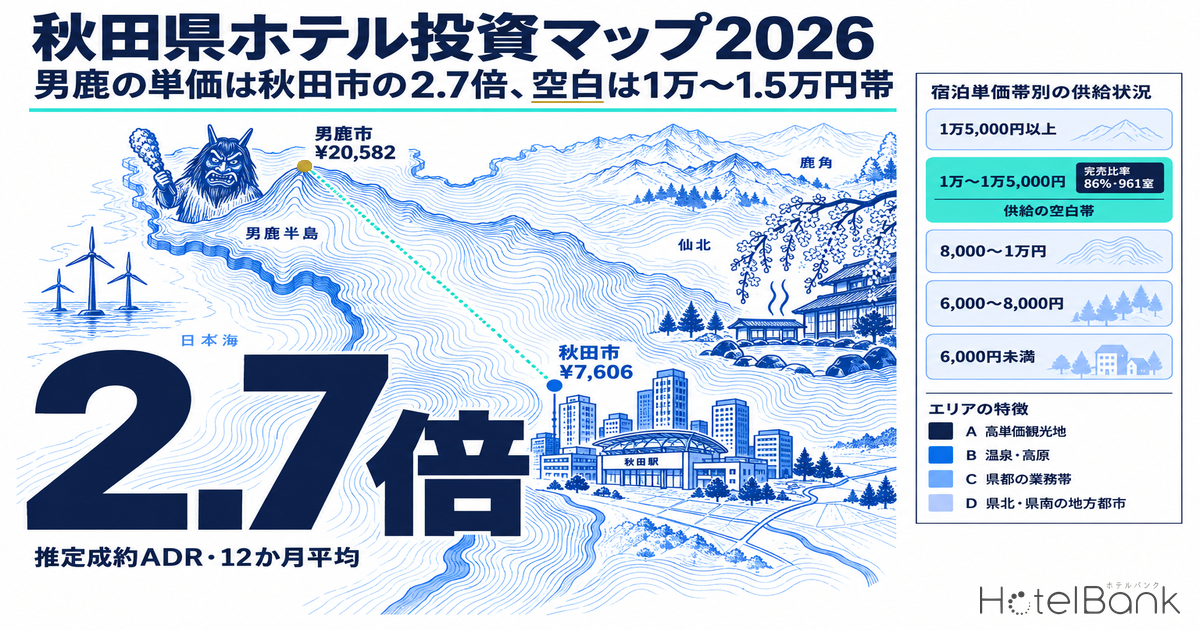
Where you build in Akita Prefecture changes hotel and ryokan room rates by a factor of about four. MetroEngines Research’s estimated settled ADR (12-month average, September 2025–August 2026) ranges from ¥20,600 in Oga City down to ¥5,300 in Kitaakita City, with the prefectural capital, Akita City, sitting in the middle at ¥7,600. This article splits the 13 municipalities with five or more properties into four tiers, then overlays which tiers absorbed the 2025–26 new supply, which price bands sold out over Golden Week (GW) 2026, and how estimated occupancy (OCC) builds up toward the stay date, to pinpoint the price band where investment opportunity remains in Akita.
Where this article fits: This is the Akita edition of our prefecture-level investment map series (also covering Iwate, Toyama, Ishikawa, Nagasaki and others). Our earlier piece, “North Tohoku’s 2,079 New Rooms”, compared Aomori, Akita and Yamagata side by side to diagnose how well each can absorb new supply; the focus here is the municipal price hierarchy within Akita. Business demand from offshore wind has already been measured against room stock in our survey of the seven offshore-wind base ports, so it is not recalculated here. Where our count of low-supply prefectures in 2026 tallied the number of openings, this article looks at the same supply from the price-band side.
Metric Definitions Used in This Article
- ADR (Average Daily Rate): An estimated settled rate (pre-tax equivalent), derived by applying property-type correction factors to the lowest-plan rate each property publishes on OTAs (per room, two guests, tax included). Checked against property-level results disclosed by listed hotel REITs (91 properties, most recent three months), the median error is about 7%. These are estimates and differ from each property’s actual transaction prices and accounting figures. Area-level ADR is the median of the properties covered (the level of a typical property in the area). The 12-month average weights each monthly value by the number of days.
- OCC (Occupancy): Rooms sold as a share of total rooms in the area (an estimate based on OTA sales inventory; consistency checks against monthly REIT disclosures confirm accuracy within a few points). It reflects how OTA-listed inventory is consumed and differs from a property’s actual overall occupancy.
- LT (Lead Time): Days until check-in. The curves in this article run from 45 days before the stay date to the day before (LT45→1). Early sell-out LT: the lead time at which remaining rooms first hit zero (the larger the value, the earlier the property sold out).
- Listed price: Where mentioned, the per-room rate for two guests (tax included), averaged across all plans. Rates in the main text are standardized on estimated settled ADR; listed prices appear only in footnotes.
- Data source: MetroEngines Research & Consulting (based on listings on major booking sites)
- — 3.9x: Estimated settled ADR (12-month average, September 2025–August 2026) spans a 3.9x hierarchy across the 13 municipalities with five or more properties, from ¥20,582 in Oga City to ¥5,326 in Kitaakita City.
- — 42.5%: 42.5% of the prefecture’s 9,786 rooms are concentrated in the capital, Akita City (¥7,606), while the top-rate municipalities, Oga and Kosaka, hold just 6.8% of rooms.
- — +5.5%: Even after three hotels with 548 rooms opened in Akita City in 2025, the city’s estimated settled ADR rose 5.5% YoY on a 12-month average, and 18.8% in August 2026.
- — 6 of 7 properties: On GW 2026 (May 3 check-in), six of the seven properties in the ¥10,000–15,000 band sold out, yet the entire prefecture has only 7 properties and 961 rooms in that band.
- — 5.8% GOP yield: A 100-room new build in Akita City yields 5.8% (5.4% after inflation), and a 30-room ryokan renovation in Semboku City 4.0%. Even with ADR −10% and occupancy −5pt, they hold 4.5% / 3.3%.
Over 40% of Rooms Sit in the Capital; the Top Rate Tier Holds 7%
In the third week of August 2026, MetroEngines Research confirmed published rates for 165 lodging properties with 9,786 rooms in Akita Prefecture. Splitting them into four tiers by rate level and location type reveals a structure in which volume and price are concentrated in opposite places.
The largest room count is in the prefectural capital, Akita City (Tier C): 32 properties and 4,163 rooms, or 42.5% of the prefecture. Seventy percent of that is business hotels, and the estimated settled ADR is ¥7,600. Next, the regional cities of northern and southern Akita—Odate, Yokote, Daisen, Yurihonjo, Noshiro and others (Tier D)—hold 67 properties and 3,446 rooms (35.2%), with ADRs lined up in the ¥5,300–7,700 range. By contrast, Oga City and Kosaka Town (Tier A), which command the highest rates, have 13 properties and 670 rooms—just 6.8% of the prefecture’s rooms. The onsen and highland areas (Tier B)—Semboku City (Lake Tazawa, Kakunodate), Kazuno City (Lake Towada, Hachimantai) and Yuzawa City (Akinomiya, Oyasukyo)—have 53 properties and 1,507 rooms, of which ryokan account for 1,023.
| Tier | Main municipalities | Properties | Rooms | Share | Of which business | Of which ryokan | Est. settled ADR (12 mo.) |
|---|---|---|---|---|---|---|---|
| A High-rate tourist areas | Oga, Kosaka | 13 | 670 | 6.8% | 207 | 366 | ¥17,041–¥20,582 |
| B Onsen & highlands | Semboku, Kazuno, Yuzawa, Higashinaruse | 53 | 1,507 | 15.4% | 128 | 1,023 | ¥10,805–¥12,632 |
| C Capital business zone | Akita City | 32 | 4,163 | 42.5% | 2,963 | 131 | ¥7,606 |
| D Regional cities (north & south) | Odate, Yokote, Daisen, Yurihonjo, Noshiro, Nikaho, Kitaakita, etc. | 67 | 3,446 | 35.2% | 2,165 | 536 | ¥5,326–¥7,738 |
| Prefecture total | 165 | 9,786 | 100% | 5,463 | 2,056 | ¥8,003 |
| Prefecture avg., all uses | +0.9% |
| Prefecture avg., residential | +0.7% |
| Highest commercial point | Nakadori 2-chome, Akita City |
| Same: price / change | ¥204,000/㎡, +6.25% |
| Akita City avg. change | +2.3% |
The Municipal ADR Hierarchy — Oga ¥20,600, Akita City ¥7,600, Kitaakita ¥5,300
Ranking municipalities by 12-month average estimated settled ADR, the hierarchy splits cleanly into four levels. At the top are Oga City (¥20,600, N=13) and Kosaka Town (¥17,000, N=5), more than double the prefectural average of ¥8,000. Rates are pushed up by the ryokan cluster on the Oga Peninsula and by the upper-tier properties in Kosaka, a gateway to Lake Towada. The second level comprises the onsen and highland areas of Semboku City (¥12,600, N=25), Yuzawa City (¥10,800, N=12) and Kazuno City (¥10,800, N=14), lined up in the ¥10,000–13,000 band.
The third level is the ¥7,000 band, where Nikaho City (¥7,700), Akita City (¥7,600), Noshiro and Yokote (¥7,300 each) and Yurihonjo City (¥7,100) are separated by only a few hundred yen. That the prefectural capital sits in almost the same rate band as the regional cities of northern and southern Akita is a defining feature of the prefecture’s price structure. At the bottom, Daisen City (¥6,800), Odate City (¥6,300) and Kitaakita City (¥5,300) are markets centered on business hotels and small ryokan.
Compared with the prior-year period (September 2024–August 2025), the fastest growth was actually in the lower levels. Daisen rose 14.6%, Noshiro 13.6% and Kitaakita 10.8%—double-digit gains for the regional cities of northern and southern Akita. In Daisen, the Omagari Fireworks in August supports rates; in Noshiro, it is offshore-wind-related business demand at the port. Business demand around Noshiro Port and the rooms available to absorb it are covered in detail in our measurement of the seven base ports. Akita City rose 5.5%, above the prefectural average (+3.6%), while Oga (+0.5%) and Yokote (−3.4%) stayed roughly flat. The upper-tier tourist areas already command high rates and should be judged on their level rather than their growth rate.
| Municipality | Tier | Est. settled ADR (12 mo.) | YoY | Properties in ADR calc. (N) | Room stock (rooms) |
|---|---|---|---|---|---|
| Oga City | A | ¥20,582 | +0.5% | 13 | 484 |
| Higashinaruse Village | B | ¥19,263 | Ref. | 2 | 42 |
| Kosaka Town | A | ¥17,041 | -1.9% | 5 | 186 |
| Semboku City | B | ¥12,632 | +4.9% | 25 | 649 |
| Yuzawa City | B | ¥10,826 | +6.5% | 12 | 194 |
| Kazuno City | B | ¥10,805 | +4.6% | 14 | 622 |
| Fujisato Town | D | ¥10,262 | Ref. | 1 | 21 |
| Ogata Village | D | ¥8,539 | Ref. | 1 | 81 |
| Nikaho City | D | ¥7,738 | -2.4% | 7 | 137 |
| Akita City | C | ¥7,606 | +5.5% | 31 | 4,163 |
| Noshiro City | D | ¥7,270 | +13.6% | 7 | 430 |
| Yokote City | D | ¥7,258 | -3.4% | 12 | 623 |
| Yurihonjo City | D | ¥7,138 | +3.6% | 9 | 448 |
| Daisen City | D | ¥6,805 | +14.6% | 14 | 494 |
| Gojome Town | D | ¥6,578 | Ref. | 1 | — |
| Odate City | D | ¥6,344 | +7.8% | 16 | 1,002 |
| Happo Town | D | ¥6,098 | Ref. | 1 | 2 |
| Mitane Town | D | ¥5,368 | Ref. | 2 | 49 |
| Kitaakita City | D | ¥5,326 | +10.8% | 8 | 131 |
| Ugo Town | D | ¥3,880 | Ref. | 1 | 14 |
| Misato Town | D | — | — | — | 14 |
Prefecture-wide by property type, business hotels average ¥7,400 (+5.0% YoY, N=61), city hotels ¥9,100 (+3.2%, N=16), resort hotels ¥16,500 (+6.2%, N=7) and ryokan ¥9,100 (+1.9%, N=93). Differences by type are large even within a single municipality: in Oga City, ryokan average ¥24,600 (N=9) versus ¥9,700 for business hotels (N=3); in Akita City, city hotels average ¥11,500 (N=5) versus ¥7,700 for business hotels (N=19)—two price bands coexisting in the same town. Monthly ADR trends by property type in Akita are tracked in our separate settled-ADR coverage.
2025–26 New Supply: 548 Rooms in the Capital and 161 in Oga
Within MetroEngines Research’s coverage, Akita saw 11 new openings in 2025 and 4 in 2026 (as of September). By room count, supply concentrated in essentially two places. One is Akita City, where three hotels totaling 548 rooms opened in 2025—Daiwa Roynet Hotel Akita Ekimae (ダイワロイネットホテル秋田駅前; 214 rooms, February), EN HOTEL Akita (221 rooms, July) and Quintessa Hotel Akita (クインテッサホテル秋田; 113 rooms, October)—now about 13% of the city’s stock. The other is Oga City, where Hotel Kinoshita Akita Oga Ekimae (ホテル木下 秋田男鹿駅前; 161 rooms) opened on March 5, 2026.
| Opened | Property | Municipality | Type | Rooms |
|---|---|---|---|---|
| Feb 2025 | Daiwa Roynet Hotel Akita Ekimae (ダイワロイネットホテル秋田駅前) | Akita City | City hotel | 214 |
| Apr 2025 | HOTEL 7’s anchorage Noshiro (HOTEL 7’s anchorage能代) | Noshiro City | Business hotel | 40 |
| Apr 2025 | Oyado Onn Omagari no Hanabi (お宿Onn大曲の花火) | Daisen City | Business hotel | 50 |
| Apr 2025 | HOTEL Reise Basis | Akita Prefecture | Business hotel | 20 |
| May 2025 | Yamabito -Oga- (山人-Oga-) | Oga City | Ryokan | 16 |
| Jun 2025 | Hotel Kazemachi Minato (ホテルかぜまちみなと) | Akita Prefecture | Business hotel | 14 |
| Jul 2025 | EN HOTEL Akita | Akita City | Business hotel | 221 |
| Oct 2025 | Quintessa Hotel Akita (クインテッサホテル秋田) | Akita City | Business hotel | 113 |
| Mar 2026 | Hotel Kinoshita Akita Oga Ekimae (ホテル木下 秋田男鹿駅前) | Oga City | Business hotel | 161 |
The capital’s 548 rooms are being absorbed without eroding rates. After the string of large openings, Akita City’s estimated settled ADR adjusted slightly in February–April 2026 (−1.0% to −3.4% YoY), but regained momentum toward summer: +8.5% in May, +15.7% in July and +18.8% in August. The 12-month average is also up 5.5%, meaning the phase in which new supply pushed down existing price bands was short-lived. The new properties are selling a notch above existing rates, which is lifting the area median.
Oga’s 161 rooms added a price band distinct from the existing stock. From March to August 2026, after the opening, Oga City’s overall estimated settled ADR stayed within −2.6% to +1.6% YoY. Because the Oga median is set by 12–13 mostly ryokan properties, a single business hotel opening barely moves it. Hotel Kinoshita Akita Oga Ekimae’s own estimated settled ADR rose from ¥7,700–8,700 in March–June, just after opening, to ¥11,700–12,300 in July–August. Oga’s dual character—a base of business demand layered with peak-season tourism—shows up in the rate movement.
The hotel is the first hotel project of Kinoshita Real Estate Development, part of the Kinoshita Group: a seven-story steel-frame building with 161 rooms (113 doubles, 36 twins, 10 long-stay doubles and 2 barrier-free rooms), plus separate men’s and women’s large baths and saunas also open to non-guests. According to Nikkei reporting, the investment was about ¥2.5 billion, and the plan factored in business demand from offshore wind power off the prefecture’s coast. That works out to about ¥15.5 million per room, which the development scenarios below use as a benchmark for regional limited-service hotels.
Every GW 2026 Sell-Out Was in the ¥6,000–15,000 Band — the Gap Is ¥10,000–15,000
To see which price bands attract demand, we examine the inventory trajectory for May 3 check-in, the peak day of GW 2026. The stay date has passed, so this is finalized data. Of the 162 properties in Akita with data, we tracked the 64 whose OTA allotment is at least 30% of total rooms. Twelve (18.8%) were observed at zero remaining rooms by the day before check-in, or 14 including same-day sell-outs. The earliest sold out 34 days before the stay date.
| Category | Tracked | Sell-outs observed | Ratio |
|---|---|---|---|
| City hotels | 6 | 4 | 66.7% |
| Business hotels | 20 | 5 | 25.0% |
| Resort hotels | 4 | 1 | 25.0% |
| Ryokan | 15 | 2 | 13.3% |
| Other (minshuku, guesthouses, lodges, etc.) | 19 | 0 | 0.0% |
| C Capital business zone (Akita City) | 11 | 5 | 45.5% |
| B Onsen & highlands | 21 | 3 | 14.3% |
| D Regional cities (north & south) | 27 | 4 | 14.8% |
| A High-rate tourist areas | 5 | 0 | 0.0% |
| Total | 64 | 12 | 18.8% |
By type, city hotels stand out with 4 of 6 selling out; by tier, Akita City is highest at 5 of 11. In the middle of GW, the capital combines demand as a touring base with homecoming travel, and it fills from the top price band down. The scatter plot below overlays this with each property’s estimated settled ADR (12-month average).
| Est. settled ADR band | Properties | Rooms | Sell-outs observed | Sell-out ratio |
|---|---|---|---|---|
| Under ¥6,000 | 6 | 122 | 0 | 0% |
| ¥6,000–8,000 | 16 | 868 | 3 | 19% |
| ¥8,000–10,000 | 10 | 1,046 | 3 | 30% |
| ¥10,000–15,000 | 7 | 961 | 6 | 86% |
| ¥15,000 and above | 7 | 125 | 0 | 0% |
All 12 properties that sold out fall in the ¥6,000–15,000 estimated settled ADR band, and within it, 6 of the 7 properties in the ¥10,000–15,000 band sold out. That band consists of city hotels in the capital, resort hotels and mid-sized ryokan in onsen areas, and urban hotels in southern Akita, averaging a substantial 137 rooms per property. By contrast, the seven properties at ¥15,000 and above are mainly small ryokan totaling 125 rooms; because they use price to select their clientele, they still have rooms left even on peak days. No sell-outs were observed in the under-¥6,000 band either.
The takeaway is that demand in Akita concentrates most on “properties priced at 1.3–1.9 times the prefectural average with around 100 rooms,” and that the entire prefecture has only 7 properties and 961 rooms in that band. The upper tier (above ¥15,000) and the lower tiers are well populated by property count, but substantial properties in the upper-middle band are missing. Compared with the national picture of price-band white space, Akita’s gap sits one band higher than the national gap.
Estimated OCC — 86.3% in August, with Business Hotels Gaining Most at the Last Minute
Estimated OCC is an area-level occupancy rate calculated from how sales inventory on major booking sites is consumed. For Akita as a whole it rose into summer: 79.3% in May 2026 (92 properties / 4,569 rooms), 84.3% in July (91 properties / 4,554 rooms) and 86.3% in August (87 properties / 4,381 rooms). By type, August business hotels landed at 84.7% (22 properties / 1,831 rooms) and ryokan at 84.2% (37 properties / 1,338 rooms)—nearly the same level. City and resort hotels are not calculated because too few properties are covered.
| Category | May 2026 | Jul 2026 | Aug 2026 | August coverage |
|---|---|---|---|---|
| All properties | 79.3% | 84.3% | 86.3% | 87 properties / 4,381 rooms |
| Business hotels | 77.9% | 83.0% | 84.7% | 22 properties / 1,831 rooms |
| Ryokan | 77.9% | 81.0% | 84.2% | 37 properties / 1,338 rooms |
The difference lies in how occupancy builds. Averaging estimated OCC from 45 days out to the day before for August stay dates, ryokan are already at 67.7% at 45 days out and add only +16.5pt by the day before. Business hotels start lower at 58.1% and add +26.6pt close in. Demand driven by business trips and short-notice leisure supports limited-service occupancy, so for limited-service development in the capital or in front of Oga Station, pricing that captures last-minute demand is where revenue upside lies. For a concrete example of a summer demand date, see our analysis of the booking curve on the day of the Omagari Fireworks.
Three Investment Opportunities — the Capital’s Upper Band, Mid-Priced Onsen Stock, and Oga’s Dual Character
Layering the rate hierarchy, absorption of new supply, the price band that sold out on peak days, and how occupancy builds, Akita’s investment opportunities can be organized into three.
1. The capital’s upper price band
Akita City, ¥10,000–15,000 band, 100–200 rooms
City hotels’ estimated settled ADR is ¥11,500 (N=5), and 4 of 6 sold out over GW. After absorbing 548 rooms in 2025, summer rates were up 15–19% YoY. Just above the business hotel band, which accounts for 70% of rooms, there are few substantial properties.
2. Mid-priced renovations in onsen areas
Semboku, Kazuno, Yuzawa; ¥12,000–15,000 band; 20–50 rooms
Ryokan estimated settled ADR: Semboku ¥12,900 (N=19), Yuzawa ¥13,400 (N=10), Kazuno ¥12,100 (N=12). In onsen areas where soaring construction costs make new builds difficult, acquiring and renovating existing ryokan is the realistic entry route and can also absorb succession deals.
3. The Oga Peninsula’s dual character
Oga City, combined business and leisure
Ryokan at ¥24,600 (N=9) coexist with business hotels at ¥9,700 (N=3). Even after the 161-room station-front opening, citywide rates held at prior-year levels. Demand can be captured on two fronts: limited-service hotels with long-stay rooms, and upper-tier ryokan serving peninsula tourism.
What all three opportunities share is that they are not about pushing top-end rates even higher, but about placing properties of meaningful scale in the band at 1.3–1.9 times the prefectural average. Onsen ryokan succession is shaped by the business succession tax deadline (end of 2027) and share valuation, and the appropriate scale can be gauged from how ADR and inventory absorption vary by room-count band.
Development Scenarios — a 100-Room New Build in Akita City and a 30-Room Ryokan Renovation in Semboku
We model opportunities 1 and 2 with two simplified scenarios. ADR is based on the estimated settled ADR (pre-tax equivalent) calculated in this article, and occupancy is set conservatively from the summer peak in estimated OCC (business hotels 84.7%, ryokan 84.2%), allowing for year-round leveling. Construction cost is based on ¥2.0 million per tsubo, rounded from the 2025 all-structure average in MLIT’s Building Construction Starts statistics (¥1.952 million per tsubo), with the steel-frame figure of ¥2.405 million treated as upside risk. The GOP margin references the results of MHM-operated hotels disclosed by Invincible Investment Corporation (38.9% across 91 properties for the period ended December 2024), adjusted for differences in profit structure by property type.
| Item | A. Akita City limited-service new build Recommended | B. Semboku City ryokan acquisition & renovation |
|---|---|---|
| Rooms / scale | 100 rooms (20㎡ each, approx. 3,080㎡ GFA) | 30 rooms (existing ryokan) |
| Construction / renovation cost | ¥1.86bn (931 tsubo × ¥2.0m) | ¥0.30bn (¥10m per room) |
| Land / acquisition cost | ¥0.10bn (1,000㎡ × ¥100,000/㎡) | ¥0.24bn (¥8m per room) |
| Ancillary costs | ¥0.19bn (10% of construction) | ¥0.03bn |
| Total investment | ¥2.15bn (¥21.5m per room) | ¥0.57bn (¥19m per room) |
| Assumed ADR | ¥10,500 | ¥12,900 → ¥14,500 |
| Assumed occupancy | 72% | 60% → 65% |
| Room revenue (annual) | ¥276m | ¥85m → ¥103m |
| GOP margin | 45% | 12% → 22% |
| GOP (annual) | ¥124m | ¥10m → ¥23m |
| GOP yield (on total investment) | 5.8% | 4.0% |
| After construction-period inflation (+7.6%) | Total investment ¥2.30bn, 5.4% | — |
For Scenario A (100 rooms in Akita City), ADR is set at ¥10,500, between the city’s city hotels (¥11,500) and business hotels (¥7,700)—the lower end of the ¥10,000–15,000 band in which 6 of 7 properties sold out over GW. On total investment of ¥2.15 billion, the GOP yield is 5.8%, or 5.4% after factoring in price increases during construction. Total investment per room is ¥21.5 million, set higher than the reported figure for the 161-room Oga station-front hotel (about ¥15.5 million) to leave some headroom for construction cost overruns.
Scenario B (30 rooms in Semboku City) assumes a renovation that lifts estimated settled ADR from the level of Semboku’s ryokan (¥12,900) to ¥14,500—kept within the ¥10,000–15,000 band where sell-outs concentrated. Raising the GOP margin from 12% to 22% through separating room and meal charges and staffing matched to room count lifts GOP about 2.2x. The yield on total investment, 4.0%, is lower than the urban scenario, but the value of the acquisition route lies in inheriting existing rooms and hot-spring rights in onsen areas where new builds rarely pencil out.
| Sensitivity (GOP yield) | Base | ADR −10% | Occupancy −5pt | Both |
|---|---|---|---|---|
| A. Akita City, 100 rooms | 5.8% | 5.2% | 5.4% | 4.8% |
| A. Same, after inflation | 5.4% | 4.9% | 5.0% | 4.5% |
| B. Semboku City, 30 rooms (post-renovation) | 4.0% | 3.6% | 3.7% | 3.3% |
To check the upside as well as the downside, we show three scenarios and a two-axis grid for Scenario A. The pessimistic case applies ADR −10% and occupancy −5pt (with A at its post-inflation total investment of ¥2.30 billion); the optimistic case sets A’s ADR at the city’s city-hotel level (¥11,500) and B’s at the top of the band where sell-outs concentrated (¥15,000).
| Scenario | A assumed ADR | A occupancy | A total investment | A GOP yield | B assumed ADR | B occupancy | B GOP yield |
|---|---|---|---|---|---|---|---|
| Pessimistic | ¥9,450 | 67% | ¥2.30bn | 4.5% | ¥13,050 | 60% | 3.3% |
| Middle (base) | ¥10,500 | 72% | ¥2.15bn | 5.8% | ¥14,500 | 65% | 4.0% |
| Optimistic | ¥11,500 | 77% | ¥2.15bn | 6.8% | ¥15,000 | 70% | 4.4% |
| ADR \ Occupancy | 62% | 67% | 72% | 77% | 82% |
|---|---|---|---|---|---|
| ¥9,000 | 4.3% | 4.6% | 5.0% | 5.3% | 5.6% |
| ¥9,750 | 4.6% | 5.0% | 5.4% | 5.7% | 6.1% |
| ¥10,500 | 5.0% | 5.4% | 5.8% | 6.2% | 6.6% |
| ¥11,250 | 5.3% | 5.8% | 6.2% | 6.6% | 7.0% |
| ¥12,000 | 5.7% | 6.1% | 6.6% | 7.1% | 7.5% |
Even with both rate and occupancy one step below base, at ¥9,750 and 67%, the yield holds at about 5%; it falls into the low 4% range only at the combination of ADR ¥9,000 and occupancy 62% (full-year, modeling assumption). In the optimistic scenario, A reaches 6.8% and B 4.4%, so A has more upside. Whether rates can be held in the ¥10,000–15,000 band matters more to feasibility than occupancy does.
Even when ADR and occupancy move down together, A secures 4.5–4.8% and B 3.3%. A is more sensitive to rate than to occupancy, so whether it can stay in the ¥10,000–15,000 band determines feasibility. Given that business hotels’ estimated OCC builds by +26.6pt in the run-up to the stay date, post-opening pricing also has considerable room to push yields higher. Construction cost levels per room by property type, and the ADR needed to break even, are covered in our separate construction-cost analysis.
Summary
Lodging rates in Akita form a 3.9x hierarchy, from ¥20,600 in Oga City to ¥5,300 in Kitaakita City. The capital, Akita City, which holds 42.5% of rooms, sits in the middle at ¥7,600, and after absorbing 548 rooms of new supply in 2025 its summer rates rose as much as 15–19% YoY. The 161 rooms in front of Oga Station added capacity for business demand to a ryokan-centered market, and citywide rates have held at prior-year levels.
The 12 properties that sold out on the peak day of GW 2026 all fell in the ¥6,000–15,000 band, and 6 of 7 in the ¥10,000–15,000 band sold out. Yet that band has only 7 properties and 961 rooms prefecture-wide. The three opportunities—the capital’s upper price band, mid-priced onsen renovations, and the Oga Peninsula’s mix of business and leisure—share a common direction: placing properties of meaningful scale in this band. Our estimates of a 5.8% GOP yield (5.4% after inflation) for a 100-room new build in Akita City and 4.0% for a 30-room ryokan renovation in Semboku indicate that, in a prefecture where land prices are still rising only gently, investment opportunity remains in this price band.
*Reference: Listed prices (all-plan average, tax included, two guests per room) as of September 2026 were ¥30,600 in Semboku City (20 properties, +14.5% YoY) and ¥16,300 in Akita City (19 properties, +8.0% YoY). Rates in the main text are standardized on estimated settled ADR and differ in level from listed prices.
⚠ Note on future-date prices: The September 2026 listed prices in the footnote are based on sales prices published on major booking sites at the time of the survey and will change as the stay date approaches. The estimated settled ADR and estimated OCC in the main text cover stay dates through August 2026, which are finalized.
Related Articles
- North Tohoku’s 2,079 New Rooms: Which Segments Can Absorb the Supply
- Omagari Fireworks: Akita 97.8% OCC 45 Days Out, Only 2.2pt Headroom
- Iwate Hotel Market 2026: 2.2x ADR Gap, Morioka ¥200 Lodging Tax
- Toyama’s 14 Municipalities 2026: 3.3x ADR Gap, Four Price Tiers
- Snow as Cost or Asset: Winter RevPAR 53% vs Winter ADR 2.66x
- 94.5% Sold 45 Days Out: Omagari Fireworks vs a Normal Akita Weekend
References and Sources
■ Data sources
Listed-price and inventory data observed on major booking sites by MetroEngines Research & Consulting (165 properties and 9,786 rooms in Akita Prefecture, with published rates confirmed August 17–23, 2026). Estimated settled ADR is the 12-month average of monthly values weighted by days, September 2025–August 2026 (prior-year period: September 2024–August 2025); estimated OCC covers stay dates in May, July and August 2026; the inventory trajectory covers May 3, 2026 check-in (N=64 properties). Land prices are from MLIT’s Official Land Price Publication, construction costs from MLIT’s Building Construction Starts statistics, GOP margins from Invincible Investment Corporation’s disclosures, and opening information from Kinoshita Group’s official announcements and press reports.
■ Modeling assumptions
A (new 100-room limited-service hotel in Akita City): ADR ¥10,500, occupancy 72% (full-year, modeling assumption), GOP margin 45%, total investment ¥2.15bn (construction ¥2.0m per tsubo × 931 tsubo; land 1,000㎡ × ¥100,000/㎡; ancillary costs 10% of construction). B (acquisition and renovation of a 30-room ryokan in Semboku City): post-renovation ADR ¥14,500, occupancy 65% (full-year, modeling assumption), GOP margin 22%, total investment ¥0.57bn. Revenue is room revenue only, excluding F&B and other ancillary revenue; GOP yield = annual GOP ÷ total investment. Post-inflation figures factor about 1.5 years of +5% per year into construction cost. The sensitivity analysis and two-axis grid hold the GOP margin fixed.
■ Limitations
ADR and OCC are estimates based on OTA listing information and differ from each property’s actual results and accounting figures. Towns and villages with two or fewer properties are treated as reference values and not ranked. Land unit prices, acquisition prices and GOP margins are assumptions; in ryokan with a high share of fixed costs, the GOP margin itself falls when ADR or occupancy declines, so downside yields may be lower than shown. This simplified estimate does not account for costs below GOP such as property taxes, insurance, repair reserves and interest; individual investment decisions require a property-specific feasibility study.
■ Market data
- MetroEngines Research & Consulting — Estimated settled ADR (13 Akita municipalities with 5+ properties, September 2024–August 2026), room stock (165 properties, 9,786 rooms), inventory trajectory (May 3, 2026 check-in, N=64 properties), estimated OCC (May, July and August 2026), new openings (based on confirmed OTA listings)
■ Government statistics and public data
- MLIT, Official Land Price Publication (地価公示)
- Diamond Real Estate Research Institute, “Akita Prefecture Official Land Prices and Per-Tsubo Rankings (2026)” (Japanese)
- MLIT, Building Construction Starts Statistics (建築着工統計調査)
- Japan Tourism Agency, Overnight Travel Statistics Survey (宿泊旅行統計調査)
■ REIT and industry materials
- Invincible Investment Corporation (インヴィンシブル投資法人), Hotel Portfolio (GOP results for MHM-operated hotels)
- Relo Hotel Solutions, “What Is GOP?” (Japanese)
- archi-book, “Construction Cost per Tsubo (2025 Edition)” (Japanese)
- Turner & Townsend, “Trends shaping Japan’s construction market in 2026” (forecast construction cost inflation in Japan: 5.3% in 2026, 5.0% in 2027)
■ News and press releases
- Kinoshita Group, “Hotel Kinoshita Akita Oga Ekimae Grand Opening, Thursday, March 5, 2026” (Japanese)
- Kinoshita Group, “Kinoshita Real Estate Development Holds Groundbreaking for Its First Hotel in Oga, Akita” (November 2024, Japanese)
- Nikkei, “Business Hotel Planned in Oga, Akita, Eyeing Offshore Wind Operations” (November 13, 2024, Japanese)
- Akita Sakigake Shimpo, “Groundbreaking at Hotel Site in Front of Oga Station, by Kinoshita Group Subsidiary” (November 12, 2024, Japanese)