

When you read hotel demand from a tourist map alone, some locations fall through the gaps — the places where footfall is set not by the travel calendar but by an organisation’s operating calendar. HotelBank has counted the relationship between business-driven demand and room stock around advanced treatment hospitals, at data-centre construction sites, and during scheduled turnarounds at petrochemical complexes. This article applies the same method to a population we have never covered before: the camps of the Japan Ground Self-Defense Force (JGSDF) and the air bases of the Japan Air Self-Defense Force (JASDF).
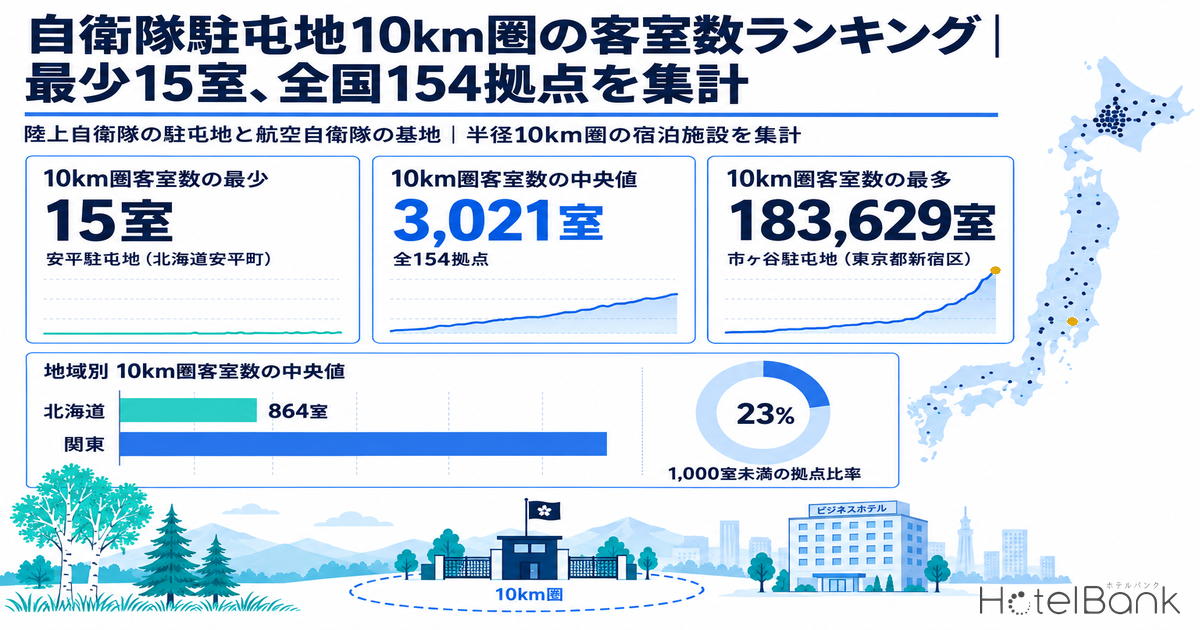
The headline finding is a gap at the extremes. Of the 154 sites in scope, the one with the fewest hotel rooms within a 10km radius is Camp Abira in Hokkaido, with 15 rooms across 3 properties. The median is 3,021 rooms, while the largest — Camp Ichigaya in Shinjuku, Tokyo — reaches 183,629. Thirty-five sites fall short of 1,000 rooms, 23% of the total.
Metric Definitions Used in This Article
- ADR (average daily rate) = an estimated settled rate (tax-excluded equivalent) derived by applying a property-type correction factor to the lowest published plan level on major booking sites (two guests in one room, per-room rate, tax included). Cross-checked against property-level results disclosed by listed hotel REITs (91 properties, trailing three months), the median error is about 7%. These are estimates and differ from each property’s actual transacted rates and accounting figures. Area-level ADR is the median of the properties in scope (the level of a typical property in that area). Where listed prices are referenced, they are the per-room rate for two guests in one room (tax included), averaged across all plans.
- Rooms within 10km = the total room count of lodging properties located within a 10km radius of each site’s coordinates and confirmed as listed on major booking sites for check-in dates from 12 September to 30 November 2026. Properties with a known room count in the property master account for 99% of the total.
- Data sources = MetroEngines Research (room stock and prices); the Ministry of Defense, the Japan Self-Defense Forces and the individual service websites (site locations); the Geospatial Information Authority of Japan (matching coordinates to municipalities)
- — Median 3,021 rooms: rooms within a 10km radius were counted for 154 sites in total — 133 JGSDF camps and 21 JASDF air bases. The fewest is Camp Abira (Abira, Hokkaido) with 15 rooms; the most is Camp Ichigaya with 183,629.
- — 35 sites (23%) have fewer than 1,000 rooms. In Hokkaido, 14 of 28 sites qualify, and the region’s median of 864 rooms is one-sixth of Kanto’s 5,555.
- — Estimated settled ADR is about ¥6,700: the median across the 7 municipalities for which it could be calculated among the 16 thinnest sites (June-August 2026 average), clustering in the business-travel price band.
- — Movement on the demand side: the relocation of the V-22 fleet to Camp Saga was completed in August 2025; F-35B deployment began at Nyutabaru Air Base the same month; and Chitose Air Base is scheduled to begin receiving F-35As from FY2030.
- — At Mageshima, Nishinoomote City reported in January 2026 that lodging had become hard to book because construction work on the defence facilities had increased visitor numbers to the island. Completion of temporary accommodation has since eased the crunch, particularly at weekends.
How the Population Was Defined
Start by fixing what is being counted. According to the JGSDF’s official website, its camps and sub-camps comprise 162 installations across 46 prefectures (all but Nara). According to the JASDF’s official website, its air bases and sub-bases number 73 nationwide.
Of these, the scope of this analysis is 133 JGSDF camps and 21 JASDF air bases, 154 sites in total. Three things were excluded from the population.
First, sub-camps and sub-bases were left out. Many are small installations attached to mountaintop radar sites or firing ranges, and they are a different kind of unit for discussing site-level lodging demand. Second, at four locations — Ichigaya, Meguro, Jujo and Naha — a JGSDF camp and a JASDF base are listed on the same premises, so each was treated as a single site to avoid double counting. Third, three sites whose coordinates could not be confirmed from published sources (Camps Zama, Kasugai and Ishigaki) were excluded from the tally.
Japan Maritime Self-Defense Force bases are not part of this population. Major bases such as Yokosuka, Kure, Sasebo, Maizuru and Ominato are all located in port cities, where surrounding room stock is shaped by several demand sources at once — shipbuilding, port operations and tourism — so they do not fit a design built to read the correspondence between a site and its room stock. United States Forces Japan facilities were excluded for the same reason.
Site coordinates were compiled from published sources and then matched one by one to their municipality using reverse geocoding from the Geospatial Information Authority of Japan. That step revealed that the coordinates for Camp Yufuin and Camp Kusu in Oita had been transposed, and they were corrected. In the match, coordinates disagreed with the published location for 13 of 218 sites; in 11 of those, as at Yokota Air Base (Fussa and Mizuho) and Komaki Air Base (Komaki and Toyoyama), the premises straddle more than one municipality.
Room Stock per Site: Median 3,021, Fewest 15
For each of the 154 sites, we counted the lodging properties within a 10km radius that were confirmed as listed on major booking sites: 22,848 property-site pairs (including duplicates, because site catchments overlap), or 13,379 distinct properties.
The distribution has a long right tail. The median is 3,021 rooms, with a lower quartile of 1,020 and an upper quartile of 6,193. Camp Abira (Abira, Hokkaido) has 15 rooms at the bottom; Camp Ichigaya has 183,629 at the top, four orders of magnitude apart. Sites in central Tokyo enclose the entire Tokyo lodging market within their radius, so the comparison itself has limits. What matters is the lower half of the distribution.
Source: MetroEngines Research; compiled by the HotelBank Editorial Team
Twenty-four sites have fewer than 500 rooms and 35 fewer than 1,000. That means 23% of all 154 sites have only as many rooms within 10km as two or three mid-sized hotels.
By Region: Hokkaido’s Median Is One-Sixth of Kanto’s
Kanto (31 sites) and Kyushu-Okinawa (32) hold the most sites, but room stock per site varies widely by region.
| Region | Sites | Median rooms within 10km | Sites under 1,000 rooms | Share |
|---|---|---|---|---|
| Hokkaido | 28 | 864 | 14 | 50% |
| Tohoku | 15 | 3,131 | 3 | 20% |
| Kanto | 31 | 5,555 | 2 | 6% |
| Chubu | 18 | 3,776 | 1 | 6% |
| Kinki | 17 | 3,046 | 3 | 18% |
| Chugoku & Shikoku | 13 | 1,771 | 3 | 23% |
| Kyushu & Okinawa | 32 | 1,850 | 9 | 28% |
Source: MetroEngines Research; compiled by the HotelBank Editorial Team
Source: MetroEngines Research; compiled by the HotelBank Editorial Team
Hokkaido stands out. The median across its 28 sites is 864 rooms, one-sixth of Kanto’s 5,555, and half of those sites — 14 of 28 — fall below 1,000 rooms. Site density is high because forces were concentrated in the north during the Cold War, while the surrounding municipalities are small in population and lodging stock has not followed. Even within Hokkaido, though, areas carrying industrial and logistics business demand have been adding supply: we track that in worker lodging building up in central Hokkaido. In Kyushu-Okinawa, 9 of 32 sites are below 1,000 rooms, the island sites among them.
The 16 Thinnest Sites — 6 of the 10 Thinnest Are in Hokkaido
The table below ranks sites from the fewest rooms within 10km. Estimated settled ADR shows the level for the municipality in which the site sits; municipalities with fewer than 4 properties in scope are marked "—".
| Rank | Site / municipality | Properties | Rooms within 10km | Estimated settled ADR | Listed price |
|---|---|---|---|---|---|
| 1 | Camp Abira (安平駐屯地) JGSDF · Abira, Hokkaido | 3 | 15 | — | ¥28,700 |
| 2 | Camp Betsukai (別海駐屯地) JGSDF · Betsukai, Hokkaido | 2 | 27 | ¥9,400 (N=5) | ¥17,900 |
| 3 | Camp Shikaoi (鹿追駐屯地) JGSDF · Shikaoi, Hokkaido | 3 | 36 | — | ¥36,200 |
| 4 | Camp Iwate (岩手駐屯地) JGSDF · Takizawa, Iwate | 5 | 74 | — | ¥24,200 |
| 5 | Camp Engaru (遠軽駐屯地) JGSDF · Engaru, Hokkaido | 2 | 78 | ¥6,100 (N=7) | ¥21,200 |
| 6 | Camp Kusu (玖珠駐屯地) JGSDF · Kusu, Oita | 7 | 89 | — | ¥15,100 |
| 7 | Hyakuri Air Base (百里基地) JASDF · Omitama, Ibaraki | 7 | 102 | — | ¥10,300 |
| 8 | Camp Bihoro (美幌駐屯地) JGSDF · Bihoro, Hokkaido | 4 | 123 | — | ¥12,200 |
| 9 | Camp Bibai (美唄駐屯地) JGSDF · Bibai, Hokkaido | 5 | 131 | — | ¥27,800 |
| 10 | Camp Nihonbara (日本原駐屯地) JGSDF · Nagi, Okayama | 8 | 133 | — | ¥49,600 |
| 11 | Camp Yonaguni (与那国駐屯地) JGSDF · Yonaguni, Okinawa | 12 | 141 | — | ¥25,600 |
| 12 | Camp Shiraoi (白老駐屯地) JGSDF · Shiraoi, Hokkaido | 11 | 151 | ¥12,000 (N=7) | ¥39,400 |
| 13 | Camp Rumoi (留萌駐屯地) JGSDF · Rumoi, Hokkaido | 7 | 223 | ¥6,700 (N=5) | ¥13,000 |
| 14 | Camp Takikawa (滝川駐屯地) JGSDF · Takikawa, Hokkaido | 8 | 264 | ¥6,300 (N=4) | ¥17,300 |
| 15 | Camp Shizunai (静内駐屯地) JGSDF · Shinhidaka, Hokkaido | 7 | 277 | ¥9,400 (N=7) | ¥19,600 |
| 16 | Camp Ebino (えびの駐屯地) JGSDF · Ebino, Miyazaki | 13 | 290 | ¥5,600 (N=11) | ¥21,300 |
Estimated settled ADR is the June-August 2026 average for the municipality in which the site sits. Listed price is the all-plan average (two guests in one room, tax included). Source: MetroEngines Research; compiled by the HotelBank Editorial Team
Source: MetroEngines Research; compiled by the HotelBank Editorial Team
Six of the 10 thinnest sites are in Hokkaido, and widening the list to 16 makes it 10. The 15 rooms at Camp Abira, 27 at Camp Betsukai and 36 at Camp Shikaoi mean there are only two or three places to stay within 10km. Outside Hokkaido, the next thinnest are Camp Iwate (Takizawa, Iwate) with 74 rooms, Camp Kusu (Kusu, Oita) with 89, and Hyakuri Air Base (Omitama, Ibaraki) with 102.
Hyakuri Air Base shares its runway with Ibaraki Airport, yet only 7 properties and 102 rooms sit within 10km. For a location where an airport and an air base coexist, that level shows that lodging stock in the surrounding municipalities was never built out along the airport’s passenger flows. HotelBank’s own count of rooms within the same radius of Japan’s privatised airports found the same disconnect: at regional airports, rooms within 10km did not scale with passenger numbers.
Price levels are worth a look too. Across the 7 municipalities for which estimated settled ADR could be shown, the median is about ¥6,700, with a range from roughly ¥5,600 (Ebino, Miyazaki) to about ¥12,000 (Shiraoi, Hokkaido). Municipalities carrying tourism demand, such as Shiraoi, come out higher; the rest cluster in the business-travel price band.
Control Group — Sites With Thick Room Stock Hold a City Inside the Radius
| Rank | Site / municipality | Properties | Rooms within 10km |
|---|---|---|---|
| 1 | Camp Ichigaya Shinjuku, Tokyo | 1,976 | 183,629 |
| 2 | Camp Meguro Meguro, Tokyo | 1,372 | 153,347 |
| 3 | Camp Mishuku Meguro, Tokyo | 1,147 | 133,579 |
| 4 | Camp Jujo Kita, Tokyo | 1,467 | 116,266 |
| 5 | Camp Katsura Minami-ku, Kyoto City, Kyoto | 1,890 | 58,314 |
| 6 | Camp Yoga Setagaya, Tokyo | 616 | 57,234 |
| 7 | Camp Nerima Nerima, Tokyo | 569 | 43,176 |
| 8 | Camp Fukuoka Kasuga, Fukuoka | 577 | 41,098 |
| 9 | Camp Kasuga Kasuga, Fukuoka | 569 | 40,615 |
| 10 | Kasuga Air Base Kasuga, Fukuoka | 563 | 40,390 |
Source: MetroEngines Research; compiled by the HotelBank Editorial Team
The top of the table is held by sites in Tokyo’s 23 wards — Ichigaya, Meguro, Mishuku, Jujo, Yoga and Nerima — followed by Camp Katsura in Kyoto City and the three sites clustered in Kasuga, Fukuoka. Because these sites enclose an entire urban lodging market within 10km, almost nothing can be read about how site-driven demand shapes room stock. Put the other way round, the relationship between a site and its rooms is visible only below the median.
Distribution Map of All 154 Sites
Circle size shows rooms within 10km; blue marks sites with fewer than 1,000 rooms.
Source: MetroEngines Research; compiled by the HotelBank Editorial Team
Blue circles run through inland and eastern Hokkaido and from southern Kyushu down through the Nansei Islands. Sites in Kanto, Tokai and Kinki are almost all grey, absorbed into existing urban stock.
What Is Moving on the Demand Side — Saga, Nyutabaru, Komatsu and Mageshima
Thin room stock is not, on its own, a basis for an investment decision. It acquires meaning only when laid over the question of whether traffic at the site itself is set to increase. Within what published sources confirm, here are the sites that have recently moved, or are about to.
Camp Saga (Saga City, Saga) opened on 9 July 2025, and the relocation of all 17 V-22 aircraft — previously stationed provisionally at Camp Kisarazu — was completed on 12 August that year. Saga City’s official page documents the sequence based on information provided by the Ministry of Defense. In this tally, Camp Saga has 11 properties and 364 rooms within 10km, the 21st thinnest of the 154 sites. That it sits at that level despite being inside a prefectural capital is because the camp lies away from the city centre on the Ariake Sea side, leaving the lodging stock around Saga Station on the outer edge of the 10km radius.
At Nyutabaru Air Base (Shintomi, Miyazaki), F-35B deployment began on 7 August 2025. The Kyushu Defense Bureau published the deployment schedule on 25 July that year, and a provisional F-35B squadron was newly formed on 24 March 2025 to receive the aircraft. Nyutabaru has 13 properties and 603 rooms within 10km; Shintomi itself has too few properties in scope for a municipality-level estimated settled ADR to be shown.
At Komatsu Air Base (Komatsu, Ishikawa), an F-35A deployment ceremony was held on 26 April 2025. According to JASDF published material, the operating unit is the 303rd Squadron; the initial deployment was 3 aircraft, with a further 4 scheduled within the same fiscal year. In addition, for Chitose Air Base (Chitose, Hokkaido), material published by the Ministry of Defense in December 2025 indicates that F-35A deployment will begin in FY2030.
The clearest documented link to lodging demand, however, is Mageshima (Nishinoomote City, Kagoshima). In a notice dated 29 January 2026, Nishinoomote City reported that "the increase in visitors to the island accompanying construction work on Self-Defense Force facilities on Mageshima has made lodging (hotels, guesthouses and the like) hard to book," adding that "with the completion of temporary accommodation on Mageshima, the lodging crunch has been easing gradually, particularly at weekends." It is a case in which a municipality recorded, in its own words, how construction-driven visitor growth actually hit an island lodging market and then eased once on-island temporary accommodation was built.
This article deals with the relationship between lodging demand and room stock. It does not describe unit deployments or personnel numbers beyond what published sources state, and it makes no security assessment.
Investment Implications — A Gap in the Business Band and Extended-Stay Requirements
Read through an investment lens, the figures so far say three things.
First, sites where rooms are thin and rates also sit in the business band may have room left for a new property in the ¥7,000-10,000 per night range. Across the 16 sites in the table, the median for the 7 municipalities with a showable estimated settled ADR is about ¥6,700 — close to the bottom of the standard band for limited-service hotels. In a market with only a handful of existing properties, a single new supply effectively remakes the choice set for the area.
Sensitivity Table — What Share of Rooms Within 10km One New Property Would Represent
To give a sense of scale to "a single new supply remakes the choice set," the table sets existing rooms within 10km (rows) against the room count of a new hotel (columns). Each value is new rooms ÷ (existing + new).
| Site / municipality | Existing rooms | New: 50 rooms | New: 80 rooms | New: 120 rooms |
|---|---|---|---|---|
| Camp Abira Abira, Hokkaido | 15 | 77% | 84% | 89% |
| Camp Engaru Engaru, Hokkaido | 78 | 39% | 51% | 61% |
| Hyakuri Air Base Omitama, Ibaraki | 102 | 33% | 44% | 54% |
| Camp Rumoi Rumoi, Hokkaido | 223 | 18% | 26% | 35% |
| Camp Ebino Ebino, Miyazaki | 290 | 15% | 22% | 29% |
| Camp Saga Saga City, Saga | 364 | 12% | 18% | 25% |
| Nyutabaru Air Base Shintomi, Miyazaki | 603 | 8% | 12% | 17% |
Existing rooms are this article’s own 10km counts. The shares are arithmetic on supply scale, not a forecast of demand or occupancy. Source: MetroEngines Research; compiled by the HotelBank Editorial Team
Within Camp Abira’s radius, a single 50-room hotel would account for 77% of the rooms in the catchment; even at Nyutabaru Air Base, with roughly 600 rooms, a 120-room property reaches 17%. The thinner the site, the more a single property’s sizing decision sets price formation in the catchment almost single-handedly.
Second, the design has to assume demand takes an extended-stay form. Stays around these sites tend to be medium-term — unit training and education, or construction work on facilities — and what those guests want differs from a one-night tourist. Coin laundry, breakfast and enough parking spaces become live requirements. In fact, an analysis of guest reviews confirms that in regional markets where guests arrive by car, whether parking is available feeds directly into the experience rating (differences in how often parking is mentioned by review language are covered in detail in how inbound rental-car travellers choose lodging).
Third, in regions where a new site or an upgrade has been announced, a different wave arrives first: medium-term stays by construction workers. As Mageshima shows, that wave temporarily tightens existing lodging stock and then subsides once temporary accommodation is built. Distinguishing permanent demand from the temporary demand of a construction period is essential in supply planning.
At the same time, a constraint common to these markets is equally clear. Having only two or three properties within 10km means there is no competitive set to benchmark against, and demand seasonality is hard to estimate from existing data. In markets with a small base, the number of properties behind an estimated settled ADR is correspondingly small. The 9 sites marked "—" in the table are the flip side of markets that are simply small. These figures should not be read alone; they need to be set against the published plans for the site itself.
Summary
Counting the 10km radius around 154 sites — 133 JGSDF camps and 21 JASDF air bases — gives a median room stock of 3,021, a minimum of 15, and 35 sites below 1,000 rooms. The thin side is concentrated in inland and eastern Hokkaido and in the island parts of Kyushu and Okinawa, and in most of them estimated settled ADR sits in the business band.
Even these municipalities, which look blank on a tourist map, carry stay demand that moves on an organisational operating calendar. As with hospitals, data centres and petrochemical complexes, identifying where the source of demand sits and then drawing a radius and counting rooms makes visible a market that tourism statistics alone cannot show. Self-Defense Force sites are one such population, and they had not been counted before.
Related reading
- Data Center Construction Needs 364-725 Hotel Rooms per 50MW in Japan
- Japan’s 50 Smart Interchanges: Median 1,130 Hotel Rooms Within 10km
- Chitose & Tomakomai Worker Lodging — 7 New Hotels, 738 Rooms in 2026
- Rental-Car Inbound: Parking Mentioned 2.9x More in Traditional Chinese
- 43% of Chiba’s 75,065 Rooms Sit in 25 Disaster-Relief Municipalities
References and Sources
■ Data sources
Property locations, room counts and listed prices come from MetroEngines Research lodging data (properties confirmed as listed for check-in dates from 12 September to 30 November 2026). Site locations were compiled from the lists on the official JGSDF and JASDF websites, and coordinates were matched to municipalities using reverse geocoding from the Geospatial Information Authority of Japan. Demand-side developments are limited to material published by the Ministry of Defense, the Kyushu Defense Bureau and the municipalities concerned.
■ Calculation assumptions
The 10km radius is straight-line distance from each site’s coordinates. Properties falling in overlapping catchments are counted once for each site (22,848 property-site pairs; 13,379 distinct properties). Estimated settled ADR is the simple average of monthly values for June-August 2026 in the municipality concerned; municipalities with fewer than 4 properties in scope are marked "—" in the tables. The shares in the sensitivity table are arithmetic: new rooms ÷ (existing + new).
■ Limitations and caveats
Sub-camps and sub-bases, Japan Maritime Self-Defense Force bases, and the three sites whose coordinates could not be confirmed are out of scope. Rooms within 10km are limited to properties listed on booking sites and exclude staff dormitories, government quarters, temporary accommodation and unlisted guesthouses. Estimated settled ADR is an estimate and differs from a property’s actual transacted rates. Unit deployments and personnel numbers are not treated beyond what published sources state.
■ Site locations and published plans
- JGSDF, "Camps and Organisation" (in Japanese) (camps and sub-camps total 162 installations across 46 prefectures, all but Nara)
- JASDF, "Bases by Area" (in Japanese) (air bases and sub-bases total 73 nationwide)
- Saga City, "On the Relocation of the JGSDF V-22 (Osprey) to Camp Saga" (in Japanese) (camp opened 9 July 2025; relocation of all 17 aircraft completed 12 August 2025)
- Kyushu Defense Bureau, "On the Deployment of the F-35B to JASDF Nyutabaru Air Base" (in Japanese)
- JASDF, "On Holding the F-35A Deployment Ceremony at Komatsu Air Base" (in Japanese) (held 26 April 2025)
- Ministry of Defense, "On the Deployment of the F-35A to JASDF Chitose Air Base," December 2025 (in Japanese) (published on the Tomakomai City website)
- Nishinoomote City, "Lodging" (in Japanese) (notice dated 29 January 2026 on the lodging situation arising from construction work on Mageshima)
- Kyushu Defense Bureau, "On Facility Construction on Mageshima" (in Japanese)
- Ministry of Defense, "Progress on the Fundamental Reinforcement of Defense Capabilities and the Budget: Overview of the FY2026 Budget" (in Japanese)
■ Room stock and prices
- MetroEngines Research — lodging property master and listed-price data (properties and rooms within 10km; municipality-level estimated settled ADR and listed prices)
- HotelBank Editorial Team research — analysis of guest reviews (rate at which parking is mentioned)
■ Geographic information
- Geospatial Information Authority of Japan, GSI Maps (in Japanese) — matching coordinates to municipalities