

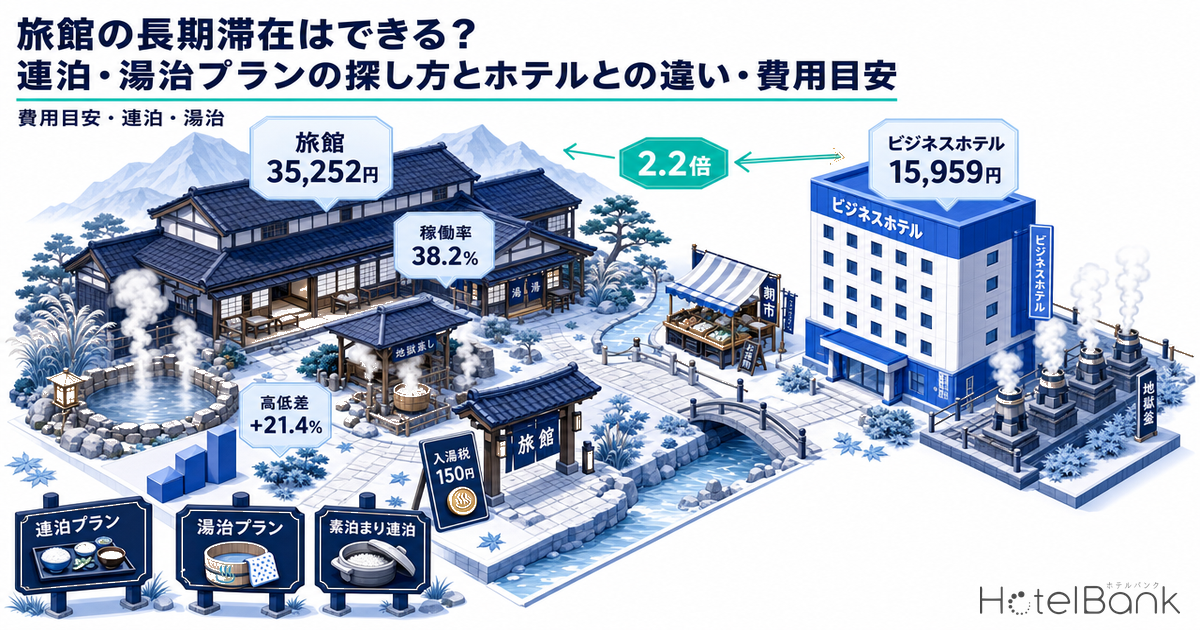
Yes, you can stay long-term at a ryokan (traditional Japanese inn). Many hot spring ryokan offer multi-night plans or toji (therapeutic hot spring stay) plans, and once you know how to find them, you can build a stay that is nothing like a long hotel stay: a way of “living” at the inn built around hot springs and meals. This article explains, from the guest’s point of view, how to find ryokan that accept multi-night stays, how the setup differs from a long hotel stay, and what it costs (based on tax-inclusive listed prices per room for two guests sharing one room).
- — Long ryokan stays come in three forms: multi-night plans, toji plans, and room-only multi-night stays. Toji rates often do not appear on booking sites, so the official website’s rate table or a phone call is usually the way to find them.
- — The national average listed price is ¥35,252 for ryokan and ¥15,959 for business hotels (August 2026; per night, per room, two guests, tax included). Ryokan sit at 2.2 times the business hotel level.
- — Ryokan prices swing widely by season: ¥31,911 in June → ¥38,751 in December (+21.4%), versus +8.9% for business hotels. For a 14-night stay, shifting the month alone moves the total by about ¥96,000.
- — The annual room occupancy rate for ryokan was 38.2% (Japan Tourism Agency, final figures for full-year 2025), far below 75.3% for business hotels. That gap is why there is room to ask for multi-night rates that are not in the published plans.
- — The bathing tax is normally ¥150 per person per day, charged separately for each day. A toji stay does not automatically qualify for the medical expense deduction; eligibility is limited to facility fees at the 23 hot-spring-type health promotion facilities certified by the Ministry of Health, Labour and Welfare.
Three Ways to Stay Long at a Ryokan
Long ryokan stays fall broadly into three types. Which one you choose makes a big difference to both what you pay and how you spend your days.
1. Multi-Night Plans (for 2–4 nights)
These plans adapt the standard stay with dinner and breakfast for consecutive nights. Common features include a dinner menu that changes each day and a lower rate from the second night onward. The quickest way to find them is to set the number of nights to “2 or more” on an OTA (online travel agency) search screen, or to look for plans with “連泊” (renpaku, multi-night) in the name. Even when no such plan is listed, many ryokan will quote a multi-night rate if you contact them directly.
2. Toji Plans (about a week or longer)
In hot spring towns that keep the culture of long therapeutic stays alive, some inns still post toji rates that assume room-only stays or self-catering. Representative examples include Hijiori Onsen in Yamagata, Kannawa in Beppu (Oita), and the Hakkoda area in Aomori, and some inns still publish official rates in the low thousands of yen per person per night. Some require a minimum of two nights and get cheaper again from seven nights. Toji plans are often not listed on OTAs, so checking the official rate table or calling is the standard approach. For a concrete picture of how a toji inn works, an in-depth article on a self-catering toji inn in Beppu Kannawa is a useful reference.
3. Room-Only Multi-Night Stays (for maximum flexibility)
Here you book a no-meals plan for consecutive nights. You use the ryokan’s large communal bath and your room, and cover meals at nearby restaurants or with cooking facilities. Some inns in toji towns still maintain shared kitchens or self-catering rooms, and the longer you stay, the more you benefit from controlling your own food costs. If you are choosing a base for a self-catering long stay, our guide to hotels close to convenience stores and supermarkets, which ranks areas by how easy it is to buy groceries, is also helpful.
How It Differs from a Long Hotel Stay: Meals, Cleaning and Check-In
Most people weighing a ryokan against a hotel for a long stay want to understand how the two types of accommodation actually work. Neither is better; they are designed differently. Laid out as neutral facts, the differences look like this.
| Item | Ryokan (hot spring inn) | Hotel (including extended-stay types) |
|---|---|---|
| Meals | Dinner and breakfast included is the standard format. At toji inns, room-only and self-catering are the norm | Room-only is standard. Breakfast-only plans are common; dinner is eaten out or self-prepared |
| Cleaning | Staff typically enter the room every day (including laying out and putting away futons) | Long-stay plans sometimes clean only every few days |
| Check-in and house hours | Check-in around 3 p.m. and check-out around 10 a.m. are common; some inns set hours for the communal bath or front entrance | Many have a 24-hour front desk, so coming and going is relatively unrestricted |
| In-stay facilities | Communal baths and hot springs. Some toji inns have shared kitchens or self-catering rooms | Mainly everyday facilities such as coin laundries, microwaves and kitchenettes |
The key point is the direction of each: a long ryokan stay means “leaving the hot springs and meals to the inn,” while a long hotel stay means “running your own daily life.” If work or recuperation means you want to manage your own routine, the hotel model fits; if you want to hand over daily meals and baths to the inn and focus purely on rest, the ryokan model fits. Toji plans sit in between, using the ryokan’s hot springs while running daily life through self-catering, much like a hotel stay. For how to handle meals on the hotel side, our guide to the three meal patterns for long hotel stays (eating out, takeout and in-room) goes as far as measuring the price gap versus breakfast-included plans.
Cost Guide: Ryokan and Business Hotel Listed Prices on the Same Basis
The national average listed prices as of August 2026, compiled by the HotelBank Editorial Team from public OTA data (per night, per room, two guests sharing, tax included), are shown below. These are the prices actually displayed on booking screens, i.e. the level guests pay.
| Category | Average listed price per night | Simple 7-night total | Sample |
|---|---|---|---|
| Ryokan | ¥35,252 | approx. ¥247,000 | N=6,559 |
| Business hotel | ¥15,959 | approx. ¥112,000 | N=7,792 |
Source: HotelBank Editorial Team research (aggregated public OTA data, as of August 2026). Average tax-inclusive listed price per room with two guests sharing. Actual rates vary by season, plan and room type.
On standard plans, a multi-night ryokan stay costs a little over twice as much as a business hotel. However, this average is a selling price centered on plans with two meals, so remember that you will not have to pay separately for the dinner and breakfast it includes. Over a long stay, the three forms described above also come into play. Switching to a room-only multi-night stay cuts the per-night payment considerably, and at inns that post toji rates it can fall to the low thousands of yen per person per night. Before concluding that “ryokan are expensive,” the practical first step is to compare the same inn’s room-only and multi-night plans side by side. For where the per-night rate starts to drop as you add nights, our measured analysis of how many nights it takes for long-stay discounts to kick in (market rates for 7, 14 and 30 nights) is a useful benchmark.
Prices Move 20% by Season — For Ryokan, “When” Changes the Rate
For a long stay, which month you book matters more than the cheapest single night. Laying out the same data month by month, ryokan prices move 21.4%, from ¥31,911 in June 2026 to ¥38,751 in December. Business hotels over the same period range from ¥14,686 to ¥15,996, a spread of 8.9%, so ryokan swing more than twice as much. Ryokan prices track seasonal demand such as autumn foliage and the New Year holidays closely, so the volatility is simply different by accommodation type.
| Month | Ryokan | Business hotel | Ryokan ÷ business hotel | Ryokan properties counted |
|---|---|---|---|---|
| June 2026 | ¥31,911 | ¥14,686 | 2.17× | 6,370 |
| July 2026 | ¥32,481 | ¥14,860 | 2.19× | 6,633 |
| August 2026 | ¥35,252 | ¥15,959 | 2.21× | 6,559 |
| September 2026 | ¥34,041 | ¥15,741 | 2.16× | 6,339 |
| October 2026 | ¥35,422 | ¥15,996 | 2.21× | 5,939 |
| November 2026 | ¥36,859 | ¥15,913 | 2.32× | 5,300 |
| December 2026 | ¥38,751 | ¥15,831 | 2.45× | 4,448 |
The Longer the Stay, the More the Seasonal Gap Adds Up
Seasonal differences in the nightly rate accumulate with every night you stay. Using a simple calculation that multiplies the national average by the number of nights, the gap between June and December is about ¥21,000 for 3 nights, but about ¥48,000 for 7 nights and about ¥96,000 for 14 nights. The per-night difference is the same, yet on a long stay the choice of season has a real effect on the total. Put the other way, the more flexible your dates, the more it pays to shift a long stay toward the off-season.
| Month | 3 nights | 7 nights | 14 nights |
|---|---|---|---|
| June 2026 | ¥95,733 | ¥223,377 | ¥446,754 |
| September 2026 | ¥102,123 | ¥238,287 | ¥476,574 |
| November 2026 | ¥110,577 | ¥258,013 | ¥516,026 |
| December 2026 | ¥116,253 | ¥271,257 | ¥542,514 |
| December minus June | ¥20,520 | ¥47,880 | ¥95,760 |
Note, however, that this table multiplies the average standard selling price (including two-meal plans) by the number of nights, so it is an upper-bound guide that factors in neither multi-night discounts nor toji rates. In practice, two further factors push the amount you actually pay downward.
Toji Plans Get Cheaper per Night the Longer You Stay — An Example of Official Rates
Some inns use toji rates that step down with the number of nights. Nishimotoya Ryokan (西本屋旅館) at Hijiori Onsen in Okura Village, Yamagata Prefecture, lists its no-meals (self-catering allowed) toji plan on the rate table on its official website at ¥6,000 for 1–2 nights, ¥5,800 for 3–6 nights and ¥5,600 for 7 nights or more (all per person per night, including consumption tax and service charge). Choosing 7 nights or more comes to ¥39,200 per person, or about ¥40,000 even after adding the bathing tax discussed below. The same 7 nights at the national ryokan average (June 2026, two guests per room) works out to about ¥112,000 per person, so the toji plan comes in at just over one-third of that level. Keep in mind that the average includes two-meal plans while the toji rate has no meals, so food costs need to be budgeted separately. This rate structure is only one example; each inn sets its own steps and minimum number of nights.
Bathing Tax Is Charged Separately for Every Day You Stay
Staying in a hot spring town incurs the bathing tax (nyuto-zei). According to the Ministry of Internal Affairs and Communications’ explanation of the local tax system, it is an earmarked tax that municipalities with mineral spring baths levy on bathers, with a standard rate of ¥150 per person per day. Because it is charged for each day, two guests staying 7 nights pay ¥2,100, and 14 nights adds ¥4,200, on top of the accommodation charge. The amount itself is not large, but some inns include it in the displayed price while others list it separately, and each municipality sets its own rate, so the longer the stay, the more worthwhile it is to confirm how it is handled before booking.
Why Multi-Night Requests Tend to Succeed — Ryokan Room Occupancy Was 38.2% (Full-Year 2025)
We noted above that inns will often quote a multi-night rate even when it is not in their plan list. This is backed by the supply-and-demand structure of the sector. According to the Japan Tourism Agency’s Accommodation Survey (annual figures for January–December 2025, final, published July 6, 2026), overall room occupancy was 61.6%. By facility type, business hotels were at 75.3%, city hotels at 74.1% and resort hotels at 56.9%, while ryokan were at 38.2%. Ryokan improved by 2.1 points from the previous year, but their level is still very different from that of hotels.
This is a nationwide annual average; it does not mean popular inns sit at this level on weekends or holidays. Still, the tendency for rooms to remain unsold on weekdays and in the off-season is common across the sector, and that is where there is room to negotiate multi-night or toji rates that are not published. A long stay that can be shifted toward weekdays and the off-season is arguably the easiest way to make use of that room.
| Facility type | Room occupancy | YoY change |
|---|---|---|
| All types | 61.6% | +2.0pt |
| Business hotels | 75.3% | +1.6pt |
| City hotels | 74.1% | +1.8pt |
| Resort hotels | 56.9% | +2.8pt |
| Ryokan | 38.2% | +2.1pt |
| Simple lodging (hostels, guesthouses, etc.) | 29.6% | +0.6pt |
Do Toji Costs Qualify for the Medical Expense Deduction?
When planning a long toji stay, many people wonder whether the medical expense deduction applies if the purpose is recuperation. The system exists, but the conditions are quite narrow. Because this is easy to misunderstand, we have gone to the primary sources to lay it out.
Eligibility is limited to the use of a “hot-spring-type health promotion facility” certified under the Ministry of Health, Labour and Welfare’s Health Promotion Facility Certification System. The Ministry’s page on the system states that “when hot spring therapy is undertaken for treatment at a hot-spring-type health promotion facility based on a physician’s instructions (omitted), under certain conditions the facility usage fee is eligible for the medical expense deduction provided for in Article 73 of the Income Tax Act.” As shown in the list published by the Ministry, there are only 23 certified facilities nationwide (including 4 of the partnership type, as of August 3, 2026).
On the procedural side, the National Tax Agency’s Individual Taxation Division Information (No. 7, June 24, 2016) sets out that facility usage fees are eligible for the medical expense deduction when a physician has the patient undergo hot spring therapy for treatment and certifies this with a “hot spring therapy certificate.” The same document also makes clear that fees for using only exercise facilities are not eligible (except when used on the same day as the hot spring facility and a hot spring therapy certificate is issued).
In other words, a long toji stay does not by itself qualify for the medical expense deduction. The facility must be certified, and there must be a physician’s instruction and a hot spring therapy certificate; even then, what the published materials identify as eligible is the facility usage fee. The system does not apply automatically to ordinary toji inns, so the realistic approach is to plan your budget without counting on the deduction, and check with your doctor and the facility in advance only if it looks likely to apply.
Six Things to Check Before Booking
1. Does the Dinner Menu Change?
If you are staying three or more nights with two meals, check the plan description or call to confirm whether the menu changes on consecutive nights. Inns that explicitly offer multi-night plans have usually already designed for this.
2. Minimum Nights and Rate Thresholds
Many inns require “2 nights or more” for toji rates, and some lower the per-night rate further from 7 nights. It is easier to compare if you decide the length of your stay first and then check it against the rate table.
3. Cleaning and Futons
Some inns clean every day, while others, like toji inns, leave daily life to the guest. If you are bringing work, ask when staff enter the room so you can plan your days.
4. Laundry and Cooking Facilities
For stays longer than a week, confirming whether there is a washing machine is essential. For self-catering, check the kitchen equipment and where to buy groceries (nearby shops, morning markets, etc.) so you are not caught out on arrival.
5. Internet Access
In mountain hot spring towns, in-room Wi-Fi varies from inn to inn. If you plan to combine the stay with remote work, check before booking.
6. Bathing Tax and Other Separate Charges
In hot spring towns, the bathing tax is charged per day on top of the accommodation charge, and some inns also list heating fees or special surcharges separately. Whether these are included in the displayed price can make a difference of several thousand yen over a two-week stay. Rather than relying only on what the booking site shows, confirm the total amount you will pay.
To Explore Further
For detailed comparisons of specific inns, these articles (in Japanese) go into depth.
Introduces five inns at Hijiori Onsen in Yamagata, a toji town with more than 1,200 years of history, including Ebisuya Ryokan, which still maintains a self-catering room and toji rooms, and Yuyado Motokawarayu, which uses two hot spring sources for its view bath and private baths, with approximate prices for one night for two guests.
An in-depth look at Yokoso (入湯貸間 陽光荘), a rented-room bathing inn that preserves the self-catering toji style in Beppu Kannawa. It explains how guests can stay on multi-night toji rates with free use of 27 jigoku steam ovens for all 27 rooms and free-flowing chloride spring water, down to guideline steaming times.
Frequently Asked Questions
Can I stay at a ryokan for a week or a month?
Yes. There are three forms: multi-night plans, toji plans and room-only multi-night stays. In hot spring towns where toji culture survives, some inns require a minimum of two nights and lower the per-night rate further from seven nights. However, toji rates are often not shown on booking sites, so checking the official rate table or calling is the standard approach.
How much does a multi-night ryokan stay cost per night?
The national average listed price in August 2026 was ¥35,252 per night (per room, two guests, tax included; 6,559 properties; HotelBank Editorial Team research). That is about 2.2 times the ¥15,959 for business hotels (7,792 properties). However, this is the average standard selling price including plans with dinner and breakfast; switching to room-only or toji rates brings the level down considerably.
When is the cheapest time for a long ryokan stay?
In the same data, ryokan prices were lowest in June 2026 at ¥31,911 and highest in December at ¥38,751. The difference is 21.4%, which amounts to about ¥48,000 over 7 nights and about ¥96,000 over 14 nights. Business hotels varied by only 8.9% over the same period, so if your dates are flexible, choosing the right season has a bigger effect for ryokan.
Which is better for a long stay, a ryokan or a hotel?
On price alone, the hotel model is cheaper. However, a ryokan’s dinner-and-breakfast rate includes food, while the hotel model assumes you handle meals yourself. If you want to leave hot springs and meals to the inn and focus on rest, choose a ryokan; if you want to manage your own routine, a hotel fits better. Toji plans sit in between, using the ryokan’s hot springs while you cook for yourself.
Are the bathing tax and other charges separate from the room rate?
Hot spring towns charge a bathing tax. According to the Ministry of Internal Affairs and Communications, it is an earmarked tax levied on bathers by municipalities with mineral spring baths, with a standard rate of ¥150 per person per day. Because it is charged per day, two guests pay ¥2,100 for 7 nights and ¥4,200 for 14 nights. Some inns also charge heating fees or special surcharges separately, so check before booking whether they are included in the displayed price.
Do toji costs qualify for the medical expense deduction?
They can if the conditions are met, but the scope is narrow. When a hot-spring-type health promotion facility certified by the Ministry of Health, Labour and Welfare (23 nationwide as of August 3, 2026) is used for treatment on a physician’s instructions and a “hot spring therapy certificate” is issued, that facility’s usage fee is eligible for the medical expense deduction under Article 73 of the Income Tax Act. The system does not apply automatically to ordinary toji inns.
Methodology and Sources
■ Data Sources
Prices are from public OTA data compiled by the HotelBank Editorial Team (by accommodation category, nationwide, monthly). Tables 2–4 all show the average tax-inclusive listed price per room per night with two guests sharing, with the target month and number of properties stated in each table. Room occupancy rates are from the Japan Tourism Agency’s “Accommodation Survey,” 2025 annual figures (final, published July 6, 2026). The bathing tax is based on the Ministry of Internal Affairs and Communications’ local tax system materials, and the medical expense deduction on the Ministry of Health, Labour and Welfare’s “Health Promotion Facility Certification System” and the National Tax Agency’s Individual Taxation Division Information (No. 7, June 24, 2016). The example toji rates refer to the rate table on the inn’s official website.
■ Calculation Assumptions
Totals in Tables 2 and 4 are simple calculations multiplying that month’s average per-night listed price by the number of nights. They do not factor in multi-night discounts, toji rates, switching to room-only or day-of-week differences. Per-person amounts assume two guests per room and divide the per-room price by two. The bathing tax estimate is the standard rate of ¥150 × guests × nights and does not reflect differences in rates between municipalities.
■ Limitations and Notes
Listed prices are the prices displayed on booking screens, not actual transaction amounts. From September 2026 onward the data covers prices for future dates, so the number of properties counted falls by the number of inns that have not yet released prices (right-hand column of Table 3), and month-to-month comparisons include differences in the sample. The example toji rate is the official rate of a single inn and does not represent the level of toji inns nationwide. Room occupancy rates are nationwide annual averages and do not indicate availability at individual inns or on specific dates. The description of the medical expense deduction explains the system based on published materials and is not tax advice; please confirm individual eligibility with your doctor and your local tax office.
■ References
- Japan Tourism Agency, “Accommodation Survey (2025, annual final figures),” published July 6, 2026 — Published report (PDF) / Survey page
- Ministry of Internal Affairs and Communications, “Local Tax System: Bathing Tax” — System overview
- Ministry of Health, Labour and Welfare, “Health Promotion Facility Certification System” and list of hot-spring-type health promotion facilities (as of August 3, 2026) — System page / List of certified facilities
- National Tax Agency, “Treatment of Usage Fees at Hot-Spring-Type Health Promotion Facilities under the Medical Expense Deduction (Information),” Individual Taxation Division Information No. 7, June 24, 2016 — Statutory interpretation information
- Hijiori Onsen Nishimotoya Ryokan (西本屋旅館) official website, “Toji plan for enjoying the hot springs” — Rate table
Related Articles