

Under Appended Table 1, Item (5)(a) of Japan’s Fire Service Act Enforcement Order, “inns, hotels, lodging houses and similar facilities” are classified as designated fire-prevention properties (tokutei bouka taishoubutsu). The practical meaning of that classification is that technical standards for firefighting equipment apply retroactively to existing buildings. This is a decisive difference from the Building Standards Act, which as a rule grandfathers non-conforming existing structures. Fire equipment is therefore not a cost that ends at “it was legal when it was built”: it carries the possibility of additional investment every time the standards are revised, throughout the holding period.
This article quantifies that fire-safety cost item in four steps: (1) at what scale the installation obligation is triggered (the regulatory threshold); (2) how many guest rooms that threshold corresponds to (translation into room counts); (3) where in Japan’s room stock that band sits (distribution); and (4) how much capital expenditure is triggered when the threshold is crossed (Capex). The internal-data universe is the operating properties tracked by MetroEngines Research: N=27,162 properties and 1,266,933 rooms (as of September 1, 2026).
How this differs from our earlier cost-structure articles
- Hotel fire insurance: a ¥1.01 million annual gap in flood zones covers insurance premiums and collateral valuation. This article is not about insurance but about the installation obligation itself and the resulting Capex.
- Hotel capex of ¥134,000–¥624,000 per room a year covers the total cost of major renovation. This article isolates the portion that is unavoidable because it is mandated by law.
- our analysis of hotel parking requirements, which vary 2.5-fold between cities, belongs to the same “regulations that determine scale” series, but that one concerns municipal ordinances and the site; this one concerns fire-service law and the building interior.
Metric Definitions Used in This Article
- ADR (average daily rate): an estimated settled rate (tax-exclusive equivalent) calculated by applying a category-specific adjustment factor to the lowest published plan level each property lists on OTAs (double occupancy, per-room rate, tax-inclusive). Cross-checked against property-level results disclosed by listed hotel REITs (91 properties, most recent three months), the median error is about 7%. These are estimates and differ from each property’s actual transacted prices and accounting figures. Area-level ADR is the median of the target properties (the level of a typical property in the area).
- OCC (occupancy): sold rooms as a share of total rooms in the area (an estimate based on OTA-listed inventory; consistency checks against REIT monthly disclosures confirm accuracy within roughly a few percentage points). It is an estimate based on the sell-through of inventory listed on OTAs and differs from a property’s actual overall occupancy.
- Converting gross floor area to room counts: gross floor area = number of rooms × floor area per room ÷ the share of gross floor area occupied by guest rooms. This article shows a range using combinations of 20/25/30/35 m² per room and guest-room ratios of 60/70/80%.
- Data sources: MetroEngines Research & Consulting (OTA-confirmed operating basis) / Fire Service Act, its Enforcement Order and Enforcement Regulations (e-Gov Law Search) / Fire and Disaster Management Agency, Ministry of Internal Affairs and Communications
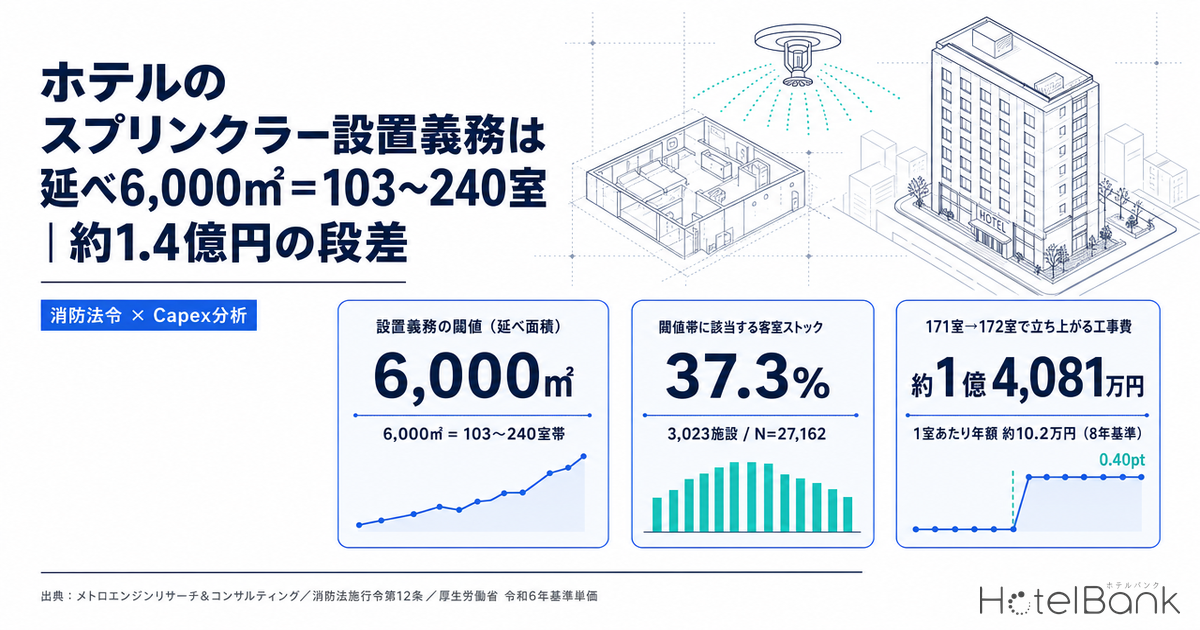
- — 6,000 m² of gross floor area is the threshold for mandatory sprinkler installation. The rule is not written in room counts, so depending on the guest-room ratio and floor area per room it appears as a band of 103 to 240 rooms.
- — Of Japan’s operating stock of N=27,162 properties and 1,266,933 rooms, 3,023 properties and 472,568 rooms fall in this threshold band — 37.3% of all rooms.
- — Using official standard unit costs (¥23,000/m² plus ¥2,350,000 for the fire pump unit and related equipment), a step of about ¥140.81 million appears all at once between 171 and 172 rooms.
- — The annual per-room burden is about ¥102,000 on the 8-year statutory useful life and about ¥41,000 on a 20-year replacement cycle — a range of 2.8% to 9.3% of GOP across the three prefectures examined.
- — The impact on yield on construction cost is 0.40pt on the 8-year basis and 0.16pt on the 20-year basis. What matters is not the level itself but the discontinuity that appears when a room-count plan lands just above the threshold.
Hotels are designated fire-prevention properties — standards reach back to existing buildings
Article 17-2-5(1) of the Fire Service Act provides that when standards for firefighting equipment are revised, the revised provisions do not apply to equipment in buildings already in existence when the revision takes effect (the previous standards continue to apply) — the principle of non-retroactivity. Paragraph 2, item 4 of the same article, however, expressly carves out an exception for “department stores, inns, hospitals, underground malls, mixed-use fire-prevention properties … and other properties designated by Cabinet Order as being entered by large numbers of people (hereinafter ‘designated fire-prevention properties’).” Because “inns” are named in the statute itself, revised standards apply directly to firefighting equipment in hotels and ryokan.
This single point is why fire equipment should be managed separately from other construction-related costs. Floor-area ratios and setback restrictions are fixed at the standards in force when the building was erected; firefighting equipment is not. For anyone reading an engineering report during due diligence, “is it compliant with current law?” must be treated not as a snapshot at acquisition but as a condition that can be updated during the holding period. The same question — how far to intervene in an existing building — also arises on the seismic side, and Japan’s pre-1981 hotel stock of 236,000 rooms — 19.1% of all guest rooms lays out the retrofit-versus-rebuild decision point.
The main installation requirements for firefighting equipment applying to hotels and ryokan (Appended Table 1, Item (5)(a)) can be organized on a statutory basis as follows. The room-count conversion shows the range produced by combinations of 20–35 m² per room and guest-room ratios of 60–80%.
| Equipment | Statutory basis | Requirement for Item (5)(a) | Gross floor area | Approximate room-count equivalent |
|---|---|---|---|---|
| Automatic fire alarm system | Order Art. 21(1)(i)(a) | No floor-area threshold (use classification alone triggers it) | — | All properties |
| Fire alarm system reporting to the fire department | Order Art. 23(1)(ii) | Gross floor area of 500 m² or more. Not eligible for the exemption in paragraph 3 of the same article for premises with a telephone permitting notification at all times | 500 m² | approx. 9–20 rooms |
| Indoor fire hydrant system | Order Art. 11(1)(ii) | Gross floor area of 700 m² or more. Relaxed threefold (to 2,100 m²) where principal structural parts are fire-resistant and interior finishes are flame-retardant (paragraph 2 of the same article) | 700 m² (2,100 m² if relaxed) | approx. 12–28 rooms (approx. 36–84 rooms if relaxed) |
| Sprinkler system | Order Art. 12(1)(iv) | Non-single-storey buildings where the total floor area, excluding parts specified by ministerial ordinance, is 6,000 m² or more | 6,000 m² | approx. 103–240 rooms |
| Sprinkler system (high-rise) | Order Art. 12(1)(iii) | 11 or more storeys above ground (no floor-area threshold) | — | All buildings of 11+ storeys |
| Inspection and reporting | Act Art. 17-3-3 / Regulations Art. 31-6 | Inspections at intervals set by the Commissioner of the Fire and Disaster Management Agency within one year (by public notice: equipment inspection every 6 months, comprehensive inspection annually); reporting for Item (5)(a) is once a year | — | All properties |
Source: Compiled by MetroEngines Research & Consulting from the Fire Service Act, its Enforcement Order and Enforcement Regulations (e-Gov Law Search)
The first practical point is that the top three rows of the table are fixed obligations applying to virtually every hotel, unaffected by scale. The automatic fire alarm system is triggered by use classification alone, with no floor-area floor. The alarm system reporting to the fire department kicks in at 500 m², which — even assuming a generous 35 m² per room and a 60% guest-room ratio — is only about nine rooms. Article 23(3) of the Order does grant an exemption where “a telephone permitting notification at all times is installed,” but a parenthetical excludes Item (5)(a) from it. Having a telephone at the front desk is not a ground for exemption.
The only cost item that therefore appears discontinuously with scale is, in practice, the sprinkler system. The rest of this article translates that 6,000 m² figure into room counts.
How many rooms is 6,000 m²? Anywhere from 103 to 240, depending on the guest-room ratio
To make the threshold usable in investment decisions, the gross-floor-area figure has to be restated in rooms. Gross floor area can be approximated as “number of rooms × floor area per room ÷ the share of gross floor area occupied by guest rooms.” At 35.0 m² per room and a 100% guest-room ratio, 6,000 m² equals 171 rooms — but in practice, the more full-service the property (banquet halls, restaurants, large communal baths), the lower the guest-room ratio and the larger the gross floor area for the same number of rooms. Conversely, limited-service properties have smaller rooms and higher guest-room ratios, so the same 6,000 m² accommodates more rooms.
| Floor area per room | Guest-room ratio 60% | Guest-room ratio 70% | Guest-room ratio 80% | Likely property type |
|---|---|---|---|---|
| 20.0 m² | 180 rooms | 210 rooms | 240 rooms | Limited-service business hotel |
| 25.0 m² | 144 rooms | 168 rooms | 192 rooms | Business to upper-midscale |
| 30.0 m² | 120 rooms | 140 rooms | 160 rooms | City hotel standard room |
| 35.0 m² | 103 rooms | 120 rooms | 137 rooms | Full-service / resort |
Source: Compiled by MetroEngines Research & Consulting from the floor-area requirement in Article 12(1)(iv) of the Fire Service Act Enforcement Order
The room count at which the sprinkler obligation is triggered is 103 rooms in the combination with the lowest guest-room ratio and the largest rooms (35 m², 60%), and 240 rooms in the combination with the highest ratio and the smallest rooms (20 m², 80%). A single “6,000 m²” threshold, measured in rooms, thus appears as a band running from 103 to 240 rooms. Two 150-room hotels can fall on opposite sides: a full-service property with banquet space is already covered, while a limited-service one is not. That is what distinguishes this from regulations such as parking-space requirements, which are written directly in room counts.
The threshold band holds 3,023 properties and 473,000 rooms — 37.3% of Japan’s room stock
How much stock actually sits in that 103–240 room band? The chart below shows the room-count distribution of the operating properties tracked by MetroEngines Research: N=27,162 properties and 1,266,933 rooms as of September 1, 2026.
Source: MetroEngines Research & Consulting (OTA-confirmed operating basis, N=27,162 properties and 1,266,933 rooms, as of September 1, 2026)
| Room-count band | Properties | Share of properties | Rooms | Share of rooms | Relation to the sprinkler obligation |
|---|---|---|---|---|---|
| Under 103 rooms | 23,417 | 86.2% | 525,338 | 41.5% | Unlikely to reach 6,000 m² unless 11+ storeys |
| 103–240 rooms (threshold band) | 3,023 | 11.1% | 472,568 | 37.3% | Coverage depends on the guest-room ratio and floor area per room |
| 241 rooms or more | 722 | 2.7% | 269,027 | 21.2% | Exceeds 6,000 m² under any assumption |
| Total | 27,162 | 100.0% | 1,266,933 | 100.0% | — |
Source: MetroEngines Research & Consulting (OTA-confirmed operating basis, N=27,162 properties, as of September 1, 2026)
By property count the threshold band is only 11.1%, but by room count it is 37.3% — larger than the 241-plus-room segment (21.2%). Just over a third of Japan’s room stock is concentrated in a zone where the way the building is designed determines which equipment category applies. Note that room counts in our property master are OTA-published figures and may not match each property’s registered room count or gross floor area. We treat distribution and counts only, and make no judgment about any individual property’s room count or compliance status.
Geographically, the band is led by Tokyo with 428 properties (67,377 rooms), followed by Osaka with 211 (33,471 rooms) and Hokkaido with 190 (30,498 rooms). Among the three prefectures used as examples in this article: Kanagawa 108 properties (17,581 rooms), Chiba 79 (12,215 rooms) and Okinawa 76 (12,362 rooms).
Source: MetroEngines Research & Consulting (N=3,023 properties and 472,568 rooms, as of September 1, 2026). Circle size represents the number of qualifying properties; position is the median coordinate of those properties in each prefecture
The compliance mark runs one year in silver, three in gold — no national total published; Yokohama reports 70
Separate from the installation obligation, there is a scheme under which fire authorities examine compliance and authorize a property to display a mark: the fire-prevention property compliance display scheme, commonly called the “teki mark.” The Tokyo Fire Department explains that the scheme was created “in light of the factors that amplified the damage in the hotel fire in Fukuyama, Hiroshima Prefecture, in May 2012.”
According to the Fire and Disaster Management Agency, the scheme covers lodging facilities with a capacity of 30 or more people and three or more storeys above ground (fire authorities may set their own criteria to reflect local conditions). The examination extends beyond fire-service law to three Building Standards Act items: building structure, fire compartmentation and staircases. A silver mark is issued when the fire authority finds the property compliant with the display standards, and a gold mark when it has been found compliant for three consecutive years. The Fukuoka City Fire Bureau sets the validity period at one year for silver and three years for gold.
From an investment and operating perspective, the mark carries two meanings. First, it signals externally that the property has been examined not only for fire-service compliance but for building structure as well — third-party confirmation that lowers the cost of explanation when inbound group tours or corporate accounts are selecting accommodation. Second, because the gold mark requires three consecutive years of compliance, it evidences continuous maintenance rather than a one-off, single-year fix.
On the number of marks issued, the Fire and Disaster Management Agency’s site provides only a set of links to fire headquarters by prefecture; we could not confirm any published national total. We therefore make no national estimate. Among individual headquarters, the Yokohama City Fire Bureau publishes 70 marks as of April 1, 2026. For reference, we track 134 operating properties in Yokohama, of which 109 have 30 or more rooms (as of September 1, 2026) — but the eligible universe for the mark is defined by occupant capacity and storey count and includes properties not listed on OTAs, so the two figures are not directly comparable.
Sources: Fire and Disaster Management Agency, “Building Fire-Safety Information: Display Scheme” / Tokyo Fire Department, “Fire-Prevention Property Compliance Display Scheme” / Fukuoka City Fire Bureau / City of Yokohama, “Compliance Mark Issuance Status” (as of April 1, 2026)
Capex estimate — a ¥163 million gap between a 100-room and a 200-room model
For sprinkler construction costs there is an official unit cost available as primary source material: the standard unit cost for the “sprinkler installation project for clinics with beds” presented by the Ministry of Health, Labour and Welfare in materials for its medical policy training session of October 10, 2024. A standard sprinkler is costed at ¥23,000/m², with ¥2,350,000 per facility added where a fire pump unit and related equipment are installed. This is a national standard unit cost assuming retrofit work on existing buildings that became newly subject to the obligation under the 2014 revision of the Fire Service Act Enforcement Order. Hotels are not eligible for that subsidy programme, but the figure can be referenced as an official unit cost for retrofitting sprinklers into an existing building. Where the system is designed in from the start of a new build, there is room for the cost to come in lower.
Using that unit cost, we compare two models assuming 35.0 m² of gross floor area per room.
| Item | Model A: 100 rooms, 3,500 m² GFA | Model B: 200 rooms, 7,000 m² GFA |
|---|---|---|
| Automatic fire alarm system | Required | Required |
| Fire alarm system reporting to the fire department | Required (not eligible for the telephone exemption) | Required (not eligible for the telephone exemption) |
| Indoor fire hydrant system | Required | Required |
| Sprinkler system | Not required (under 6,000 m², 10 storeys or fewer) | Required (Order Art. 12(1)(iv)) |
| Sprinkler construction cost (official standard unit cost basis) | — | ¥163,350,000 |
| Construction cost per room | — | ¥817,000 |
| Annual cost per room (8-year statutory useful life) | — | ¥102,000 |
| Annual cost per room (spread over a 20-year replacement cycle) | — | ¥41,000 |
| Inspection and reporting obligations | Equipment inspection every 6 months, comprehensive inspection annually Reporting once a year | Equipment inspection every 6 months, comprehensive inspection annually Reporting once a year (more equipment in scope) |
Source: Compiled by MetroEngines Research & Consulting from the standard unit costs in the Ministry of Health, Labour and Welfare’s “Sprinkler and Related Installation for Clinics with Beds” (FY2024 First Medical Policy Training Session, Material 7, October 10, 2024); the Ministerial Ordinance on Useful Lives of Depreciable Assets, Appended Table 1; and Article 31-6 of the Fire Service Act Enforcement Regulations
The eight years used to annualize the cost is the statutory useful life assigned by Appended Table 1 of the Ministerial Ordinance on Useful Lives of Depreciable Assets to building fixtures for “fire extinguishing, smoke exhaust or disaster alarm systems and retractable evacuation equipment.” That is a tax depreciation period, distinct from the physical replacement cycle, so we also show the figure on a practical 20-year replacement cycle. The annual per-room cost is about ¥102,000 on the 8-year basis and about ¥41,000 on the 20-year basis.
We assign no figure to inspection costs, because we could not confirm a primary-source unit cost for buildings of hotel scale. What can be confirmed as regulatory fact is that under Article 17-3-3 of the Fire Service Act and Article 31-6 of the Enforcement Regulations, inspections are carried out at intervals set by the Commissioner of the Fire and Disaster Management Agency within one year (by public notice: equipment inspection every 6 months, comprehensive inspection annually), that reporting for Item (5)(a) is once a year, and that inspection costs rise in proportion as more equipment falls within scope. Installing sprinklers raises not only the initial investment but the baseline for inspection costs thereafter.
More important is that this cost is not continuous in room count. At 35.0 m² of gross floor area per room, 6,000 m² is reached at 171.4 rooms. At 171 rooms (5,985 m²) there is no obligation; at 172 rooms (6,020 m²) roughly ¥140.81 million of construction cost appears all at once. Adding a single room takes the annual per-room cost (8-year basis) from zero to about ¥102,000. Past the threshold, the per-room burden thins as room count grows, flattening to about ¥101,000 even at 600 rooms. The heaviest burden falls on properties that clear the threshold by a hair.
Source: MetroEngines Research & Consulting estimate based on the standard unit costs in the Ministry of Health, Labour and Welfare’s “Sprinkler and Related Installation for Clinics with Beds” (October 10, 2024), assuming 35.0 m² of gross floor area per room and annualization over the 8-year statutory useful life
Reducing this step to a single point estimate hides the spread created by the annualization period and by the earnings level of the location. Holding the just-over-threshold case constant — 172 rooms, 6,020 m² GFA, ¥140.81 million of construction cost — we show the range across three scenarios combining the annualization period with GOP levels in the three prefectures.
| Scenario | Assumptions | Annual cost per room | Share of GOP per room | Impact on yield on construction cost |
|---|---|---|---|---|
| Optimistic | 20-year replacement cycle / Kanagawa level (GOP per room ¥1.454 million) | ¥40,900 | 2.8% | −0.16pt |
| Base | 8-year statutory useful life / Okinawa level (GOP per room ¥1.365 million) | ¥102,300 | 7.5% | −0.40pt |
| Pessimistic | 8-year statutory useful life / Chiba level (GOP per room ¥1.104 million) | ¥102,300 | 9.3% | −0.40pt |
Source: Estimated from the standard unit costs in the Ministry of Health, Labour and Welfare’s “Sprinkler and Related Installation for Clinics with Beds” (October 10, 2024) together with MetroEngines Research & Consulting’s estimated settled ADR and estimated OCC (May–July 2026). Construction cost is set at ¥2.40 million per tsubo, rounded from the ¥2.405 million per tsubo for steel-frame construction in the 2025 Statistics on Building Construction Starts
The range is 3.3-fold, from 2.8% to 9.3%. The main driver is the annualization period: viewing the cost over the 8-year statutory life versus a practical 20-year replacement cycle changes the apparent burden by a factor of 2.5. The difference by location (Okinawa 7.5% versus Chiba 9.3%) is smaller.
The other variable is gross floor area per room. Because the room count at which 6,000 m² is reached depends on that figure, the same construction cost is spread over a different number of rooms. The table below shows the annual per-room cost for a property landing exactly at the 6,000 m² threshold, across two axes.
| Gross floor area per room | Minimum room count triggering the obligation (GFA) | Construction cost (total) | Annual cost per room (8-year basis) | Annual cost per room (20-year basis) | Likely property type |
|---|---|---|---|---|---|
| 20.0 m² | 300 rooms (6,000 m²) | ¥140,350,000 | ¥58,500 | ¥23,400 | Limited-service business hotel |
| 25.0 m² | 240 rooms (6,000 m²) | ¥140,350,000 | ¥73,100 | ¥29,200 | Business to upper-midscale |
| 30.0 m² | 200 rooms (6,000 m²) | ¥140,350,000 | ¥87,700 | ¥35,100 | City hotel standard room |
| 35.0 m² | 172 rooms (6,020 m²) | ¥140,810,000 | ¥102,300 | ¥40,900 | Full-service / resort |
Source: MetroEngines Research & Consulting estimate based on the standard unit costs in the Ministry of Health, Labour and Welfare’s “Sprinkler and Related Installation for Clinics with Beds” (October 10, 2024) — ¥23,000/m² for a standard sprinkler plus ¥2,350,000 per facility for the fire pump unit and related equipment
Total construction cost is determined by gross floor area and is therefore nearly identical across rows (¥140.35–140.81 million), but the number of rooms it is spread over differs by a factor of 1.74 between 300 and 172. The annual per-room cost ranges from ¥59,000 to ¥102,000. The more full-service the property — the larger its rooms — the heavier the per-room burden the moment it crosses the threshold. Conversely, a limited-service property that packs more rooms into the same gross floor area spreads this cost more thinly.
The recovery side — NOI impact seen through estimated OCC and ADR in Okinawa, Chiba and Kanagawa
To see how this equipment cost affects viability, we use prevailing occupancy and rates in three prefectures with concentrations of large and high-rise properties — Okinawa, heavy in resorts; Chiba, where large-format properties cluster around the bay area; and Kanagawa, heavy in urban city hotels — as the recovery assumptions. Estimated settled ADR and estimated OCC are both averages for May to July 2026 (months with confirmed results).
| Item | Okinawa | Chiba | Kanagawa |
|---|---|---|---|
| Estimated settled ADR (May–July 2026 average) | ¥12,100 | ¥9,800 | ¥13,200 |
| Properties in ADR calculation | N=501–508 | N=413–421 | N=576–584 |
| Estimated OCC (May–July 2026 average) | 88.2% | 88.5% | 86.1% |
| Properties in OCC calculation | N=1,003–1,136 | N=653–699 | N=607–672 |
| Estimated annual room revenue per room | ¥3,900,000 | ¥3,154,000 | ¥4,154,000 |
| GOP per room (assuming a 35% GOP margin) | ¥1,365,000 | ¥1,104,000 | ¥1,454,000 |
| Annual sprinkler cost as a share of GOP (8-year basis) | 7.5% | 9.2% | 7.0% |
| Same, on a 20-year basis | 3.0% | 3.7% | 2.8% |
Source: MetroEngines Research & Consulting (estimated settled ADR and estimated OCC, May–July 2026). The GOP margin is set at 35% as a conservative figure below the 38.9% actual result disclosed by Invincible Investment Corporation for its 91 MHM-operated properties (fiscal period ended December 2024)
Costing Model B (200 rooms, 7,000 m² GFA) at ¥2.40 million per tsubo — rounded from the ¥2.405 million per tsubo for steel-frame construction in 2025 per the Ministry of Land, Infrastructure, Transport and Tourism’s Statistics on Building Construction Starts — gives roughly ¥5.082 billion over 2,117.5 tsubo, or about ¥25.41 million per room. That per-room construction cost reads more precisely alongside hotel construction cost of ¥20.67 million per room, which back-calculates the figure from the per-room floor area of 31 planned projects. The ¥163.35 million sprinkler cost is 3.2% of that. Viewing GOP as a yield on construction cost gives 5.37% in Okinawa, 4.34% in Chiba and 5.72% in Kanagawa. Deducting the annual sprinkler cost lowers those yields by 0.40pt on the 8-year basis and 0.16pt on the 20-year basis.
Source: MetroEngines Research & Consulting (estimated settled ADR and estimated OCC, May–July 2026; assuming a 35% GOP margin)
To avoid misreading the figure: that 0.40pt is the decline when construction cost is the denominator. Take total investment including land as the denominator and the impact is smaller still. In other words, the sprinkler obligation itself is not heavy enough to determine viability. Where the equipment cost does bite is when the room-count plan lands just above the threshold. In the 172-room case, the additional room generates about ¥1.45 million of annual GOP at Kanagawa levels, while the equipment cost it triggers is ¥140.81 million — about ¥17.6 million a year even spread over eight years, nowhere near coverable by one room’s GOP. It can be covered only by stacking rooms well past the threshold, or by staying inside 6,000 m² at the design stage.
Implications for room-count planning — stay clear of the threshold, or clear it decisively
Translated into investment and development decisions, the above comes down to three points.
| Point | Substance | Where it applies in practice |
|---|---|---|
| 1. It reaches existing buildings | Hotels and ryokan are designated fire-prevention properties, so firefighting-equipment standards apply retroactively to existing buildings (Act Art. 17-2-5(2)(iv)) | In due diligence, price in not only compliance at acquisition but the risk of standards being revised during the holding period |
| 2. The threshold is not written in room counts | The sprinkler threshold is 6,000 m² of gross floor area. Depending on the guest-room ratio and floor area per room this equals 103–240 rooms, so two properties with the same room count can fall on opposite sides depending on type | At the basic-planning stage, check the 6,000 m² line by gross floor area rather than by room count |
| 3. The burden peaks just above the threshold | At 35 m² of GFA per room, a step of about ¥140.81 million falls between 171 and 172 rooms; past that point the per-room burden thins as room count grows | A plan landing just above the threshold is worth revisiting — either trim the room count or add substantially more |
Sources: Fire Service Act and its Enforcement Order (e-Gov Law Search) / MetroEngines Research & Consulting estimates
Room-count planning for mid-scale developments already accounts for several “steps”: floor-area ratios, mandatory parking provision, accommodation-tax brackets. The 6,000 m² line in fire-service law is one more — but because it is written in gross floor area rather than room count, it is easy to miss when only room counts are in view. With 37.3% of the room stock sitting in this band, it is a threshold worth checking not only in new development but in conversion and room-addition feasibility work as well.
Note also that buildings with 11 or more storeys above ground require sprinklers regardless of floor area (Order Art. 12(1)(iii)). In central-city schemes that go tall on a tight site, the storey-count requirement can bite before 6,000 m² is reached. Checking both conditions — area and storeys — at the same time is the minimum needed to avoid misreading which equipment category applies.
Note on the estimates: The Capex figures in this article are a simplified estimate based on published standard unit costs and our estimated ADR and OCC. Actual investment decisions require a detailed feasibility study reflecting the specific design conditions and consultation with the fire headquarters having jurisdiction. The sprinkler standard unit cost comes from a programme for medical facilities and differs from actual hotel construction costs. When determining whether the installation obligation applies, always check the exclusion for “parts specified by ministerial ordinance” in Article 12 of the Order, as well as the practice of the fire headquarters having jurisdiction (including the special exception in Article 32 of the Order).
Related reading
- Hotel Capex: ¥134k–¥624k per Room a Year — 5 REITs’ IR Disclosures
- Hotel Fire Insurance: ¥1.01M Flood-Zone Gap, PML Moves LTV and IRR
- Japan Lodging Capex Is 1.51x Depreciation — ¥431k per Room a Year
- Japan’s Pre-1981 Hotel Stock: 236k Rooms, 19.1% — Retrofit or Rebuild
- Hotel Construction Cost ¥20.67M/Room: 35.0m² Floor Area in 31 Plans
References and Sources
■ Data sources
Fire Service Act, Fire Service Act Enforcement Order, Fire Service Act Enforcement Regulations, and the Ministerial Ordinance on Useful Lives of Depreciable Assets (e-Gov Law Search) / published materials from the Fire and Disaster Management Agency, Tokyo Fire Department, Fukuoka City Fire Bureau and Yokohama City Fire Bureau / standard unit costs in the Ministry of Health, Labour and Welfare’s “Sprinkler and Related Installation for Clinics with Beds” (October 10, 2024) / Ministry of Land, Infrastructure, Transport and Tourism, Statistics on Building Construction Starts / MetroEngines Research & Consulting (OTA-confirmed operating basis, N=27,162 properties and 1,266,933 rooms, as of September 1, 2026; estimated settled ADR and estimated OCC are May–July 2026 averages).
■ Estimation assumptions
Gross floor area is approximated as “number of rooms × floor area per room ÷ the share of gross floor area occupied by guest rooms,” with the room-count range shown across combinations of 20–35 m² per room and guest-room ratios of 60–80%. Capex adds ¥2,350,000 per facility for the fire pump unit and related equipment to ¥23,000/m² for a standard sprinkler. Annual figures are shown on both the 8-year statutory useful life and a practical 20-year replacement cycle. The GOP margin is 35% (a conservative figure below the 38.9% disclosed by Invincible Investment Corporation for its 91 MHM-operated properties in the fiscal period ended December 2024). Construction cost is set at ¥2.40 million per tsubo, rounded from the ¥2.405 million per tsubo for steel-frame construction in 2025 per the Statistics on Building Construction Starts.
■ Limitations and caveats
The sprinkler standard unit cost comes from a subsidy programme for medical facilities and differs from actual hotel construction costs. Room counts in our property master are OTA-published figures and may not match each property’s registered room count or gross floor area. Estimated settled ADR and estimated OCC are estimates based on OTA-listed inventory and are defined differently from actual transacted prices and actual occupancy. Determining whether the installation obligation applies requires checking the exclusion for “parts specified by ministerial ordinance” in Article 12 of the Order and the practice of the fire headquarters having jurisdiction (including the special exception in Article 32 of the Order). No figure is assigned to inspection costs, because we could not confirm a primary-source unit cost for buildings of hotel scale. No national total of compliance marks issued could be confirmed as published, so no national estimate is made.
■ Legislation (e-Gov Law Search)
- Fire Service Act (Act No. 186 of 1948) — Articles 17-2-5 and 17-3-3
- Fire Service Act Enforcement Order (Cabinet Order No. 37 of 1961) — Articles 11, 12, 21, 23 and Appended Table 1
- Fire Service Act Enforcement Regulations (Ministry of Home Affairs Ordinance No. 6 of 1961) — Article 31-6 (inspection and reporting)
- Ministerial Ordinance on Useful Lives of Depreciable Assets, Appended Table 1 (building fixtures)
■ Government and municipal publications
- Fire and Disaster Management Agency, “Building Fire-Safety Information: Display Scheme — Overview”
- Fire and Disaster Management Agency, “Issuance Criteria for the Compliance Mark”
- Tokyo Fire Department, “Fire-Prevention Property Compliance Display Scheme” (background to the scheme)
- Fukuoka City Fire Bureau, “Fire-Safety Standards Compliance Display Scheme” (silver 1 year, gold 3 years)
- City of Yokohama, “Compliance Mark Issuance Status” (70 marks as of April 1, 2026)
- Ministry of Health, Labour and Welfare, “Sprinkler and Related Installation for Clinics with Beds” (FY2024 First Medical Policy Training Session, Material 7, October 10, 2024) — standard unit cost ¥23,000/m²
- Ministry of Land, Infrastructure, Transport and Tourism, Statistics on Building Construction Starts (construction cost per tsubo)
■ Market data and REIT disclosures
- MetroEngines Research & Consulting — estimated settled ADR, estimated OCC (OTA-listed inventory basis) and room-count distribution (N=27,162 properties and 1,266,933 rooms, as of September 1, 2026)
- Invincible Investment Corporation — GOP results for MHM-operated hotels (fiscal period ended December 2024; 91 properties, 38.9%)