

In autumn 2026, Aomori Prefecture hosts the 80th National Sports Games (Kokusupo) and the 25th National Sports Games for Persons with Disabilities (Shosupo). What makes this event unusual for hotel operators is that participants’ accommodation is neither individually booked nor dynamically priced through OTAs: rooms are allocated through a Joint Lodging Assignment Headquarters established by the organising committee, and the rate is fixed in advance by published Lodging Guidelines. Price is set by guidelines rather than negotiation, and rooms are allocated at the discretion of the public authorities — this pocket of demand sits outside ordinary revenue management. This article works from the original text of the official guidelines, sets out the rate rules, assignment procedure and cancellation terms, then places them alongside market price and inventory data for Aomori’s municipalities over the same period, to read quantitatively what a property is actually trading away.
Metric Definitions Used in This Article
- ADR (average daily rate): an estimated settled rate (tax-excluded equivalent) calculated by applying category-specific adjustment coefficients to the cheapest plan level each property publishes (two guests per room, per-room rate, tax-included). Cross-checked against property-level results disclosed by listed hotel REITs (91 properties, most recent three months), the median error is roughly 7%. It is an estimate and differs from each property’s actual transacted rates and accounting figures. Area-level ADR is the median of the properties covered (the level of a typical property in that area).
- Remaining-inventory rate: the share of rooms listed as sellable at the time of observation, against total rooms in the area. Its inverse, occupancy (OCC), is the share of sold rooms against total rooms in the area (an estimate based on listed inventory).
- LT (lead time): days remaining until the check-in date. LT0 = same day.
- Rates in the Lodging Guidelines: every event lodging rate quoted in this article is stated per person, per night, a different unit from market ADR (per room). Wherever the two are placed side by side, the conversion assumptions are stated at that point.
- Data sources: market prices and inventory from MetroEngines Research. Rules and rates from each event’s official guidelines (cited individually in the text).
- — The guest does not choose the hotel.For Kokusupo and high school baseball, participant accommodation is allocated by the organising committee’s Joint Lodging Assignment Headquarters, and the rate is fixed by published Lodging Guidelines. A property’s counterparty is not the guest but the assignment headquarters.
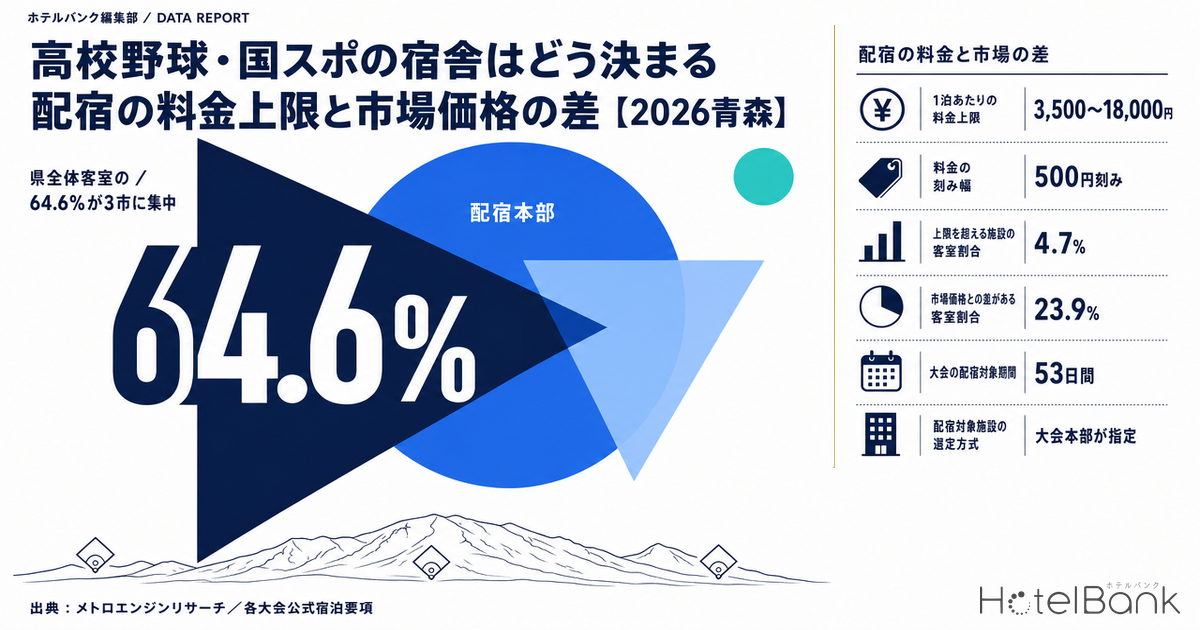
- — ¥3,500–18,000 per person per night with two meals (tax-excluded).A single rate in ¥500 increments, from which bed-and-breakfast follows automatically at 80% and room-only at 70%. The rate cannot vary by day of week, room type or number of guests in the room.
- — The break-even point is about ¥5,900.Against Aomori Prefecture’s October 2025 estimated settled ADR of ¥8,293 (N=182 properties), the single lodging rate that breaks even on a two-guests-per-room, room-only basis is roughly ¥5,900 — only one third of the ¥18,000 ceiling set by the guidelines.
- — What bites is not the ceiling but the number of guests per room.At one guest per room, no rate within the guidelines matches the event-year market level (Aomori City ¥21,205); in Japanese-style rooms taking three to four guests, the normal-year level falls below the ¥3,500 floor. The constraint is not the height of the ceiling but the single-rate design itself.
- — Inventory is pinned to the main competition period.The average remaining-inventory rate for the main period of 10–19 October is 4.7% (lead time 50–59 days), against 23.9% for 27 October–6 November (LT 67–77). Rooms remaining build up in the opposite direction to the way bookings progress.
- — What a property gives up is not price but the freedom to move price.In exchange it receives a 53-day application window, consecutive nights including weekdays, rooms held only for the number of teams still winning under the loss-departure provisions covering 10 sports, and cancellation terms fixed uniformly by the guidelines.
What Centralized Lodging Assignment Is — the Headquarters, Not the Guest, Picks the Hotel
The “Ao no Kirameki Aomori Kokusupo Lodging Guidelines” (adopted 12 December 2024 at the third FY2024 National Sports Games Committee) provide that the prefectural organising committee and the host-municipality organising committees establish a Joint Lodging Assignment Headquarters, which selects, secures and assigns accommodation in coordination with the sports federations, related bodies such as the Aomori Prefecture Ryokan and Hotel Sanitation Business Association, and the lodging properties themselves. Mediation and arbitration of any dispute is also the headquarters’ responsibility. Seen from a property, then, the counterparty is not the individual guest but the assignment headquarters, and the contract rests on a common set of rules — the guidelines.
Those eligible for lodging are divided into “athletes and coaches, prefectural delegation headquarters officials, event officials, special invitees, competition officials, technical officials and observers” and “press members and others taking part in running the event whom the prefectural committee deems to require accommodation.” General supporters and parents fall outside this framework. Each category has a designated applicant of record (the lodging application representative): athletes and coaches together with headquarters officials and observers apply through the president of each prefectural sports association; technical officials based in the prefecture through the head of each prefectural sports federation; those from outside the prefecture through the head of the relevant national federation; press members through their organisation’s representative. Applications flow through organisations, not individuals.
The design philosophy of the assignment is also written into the guidelines. Accommodation for athletes and coaches is allocated with regard to travel conditions and the environment on the way to competition and practice venues, taking prefecture, sport, division and gender into account. Athletes and coaches are in principle housed separately from prefectural delegation headquarters officials, event officials and technical officials. Event officials and technical officials are grouped into the same or nearby accommodation as far as possible. And the space required per person is at least 3.3 m² (two tatami mats) — this single clause underpins both the capacity calculation for Japanese-style rooms and the per-person rate design.
The operational flow is set out in the Lodging Administration Implementation Procedures (adopted 17 March 2026 at the eighth Lodging Subcommittee, partially amended in May of the same year). The lodging application representative submits the final application through an online lodging application system, the Joint Lodging Assignment Headquarters determines the accommodation, and a lodging decision notice goes to the application representative while the property receives an assignment decision notice combined with a confirmation reply form. Assignment results are also shared with the host-municipality organising committees. Final application deadlines are split in two by sport: for athletes, coaches and technical officials, swimming, rowing, hockey, beach volleyball, gymnastics, sailing, handball, cycling, sumo, rifle shooting, canoe, clay target shooting, bowling, golf and triathlon close on 10 August 2026, and all other sports on 3 September. Headquarters officials, observers, press members and event officials have deadlines of 30 July and 20 August respectively; no applications are accepted after those dates.
The headquarters also operates over a long horizon. Aomori Prefecture’s annual schedule puts the assignment centre in place from September 2025 through December 2026 including the preparatory phase, while the basic lodging policy and basic lodging plan were drafted starting seven years before the event. A survey of lodging facilities, a lodging rate survey and provisional assignment rounds (first, second, third and final) precede the final assignment — a build-up running over several years.
| Participant category | Lodging application representative | Expected assignment area and conditions |
|---|---|---|
| Athletes and coaches / technical officials | President of each prefectural sports association / head of each sports federation | Inside and outside the prefecture, including a maximum travel time of about 150 minutes (expected assignment area: around Morioka City, Iwate Prefecture). Two meals secured where possible, but bed-and-breakfast or room-only is possible |
| Event officials / special invitees | Representative of each organisation requesting accommodation | Because athletes and coaches are prioritised, currently expected to be outside the prefecture (northern Iwate and northern Akita). Assigned to single rooms as a priority, all bed-and-breakfast or room-only |
| Prefectural headquarters officials / observers | President of each prefectural sports association and others | For the main competition period, expected to be outside the prefecture (northern Iwate and northern Akita). Room changes, split accommodation and shared rooms are possible |
| Press members / other event-related personnel | Representative of each company or organisation requesting accommodation | Under the guidelines, only bed-and-breakfast and room-only are set as rate categories |
Source: Compiled by the HotelBank Editorial Team from the “Ao no Kirameki Aomori Kokusupo Lodging Guidelines,” the “Lodging Administration Implementation Procedures (draft amendment)” and “On the Handling of the Lodging Guidelines” (materials for the first FY2026 Kokusupo Committee meeting)
The Guidelines Set the Rate — ¥3,500–18,000 with Two Meals, in ¥500 Steps, Fixed Across Days of the Week
At the core of the Lodging Guidelines is the rate table. For the Aomori Kokusupo main games, lodging rates across the categories from athletes and coaches through observers are ¥3,500–18,000 per person per night with two meals (tax-excluded), ¥2,800–14,400 for bed-and-breakfast and ¥2,450–12,600 for room-only. For press members and similar categories, only bed-and-breakfast and room-only are set. The design is thoroughly mechanical: the two-meal rate moves in ¥500 increments, and bed-and-breakfast is set at 80% of the two-meal rate and room-only at 70%. In effect a property decides only one number — the per-person two-meal rate — and every other meal condition follows automatically.
What matters here is that this rate does not vary by day of week or room type. The guidelines define “lodging” as use of a room from 15:00 on the day of arrival to 10:00 on the day of departure, state that it includes standard service and gratuity charges and heating/cooling charges, and then present the rate range as a single band. A lodging rate survey the organising committee ran three years before the event (FY2023) across roughly 500 properties in the prefecture collected room-only, bed-and-breakfast and two-meal rates for weekdays and pre-holiday nights in September and October — but the rate range subsequently adopted by the Japan Sport Association makes no distinction by day of week. Raising the price because it is a Saturday, or cutting it because check-in is imminent, has no place in this framework. Bathing tax and accommodation tax (in areas that levy it) are collected separately as external taxes.
There is a deduction rule for skipped meals. It applies only where notice is given at least four days in advance for either breakfast or dinner: skipping dinner deducts 20% from the lodging rate, skipping breakfast deducts 10%. Where the progress of competition makes a late dinner cancellation unavoidable, it is settled in consultation with the property. Lunch is in principle arranged by the prefectural committee or the host-municipality committee at participants’ request, and the boxed lunch (including tea) is capped at ¥1,100 excluding tax.
The guidelines also cap cancellation charges. Nothing is due up to nine days before the scheduled stay; 20% of the lodging rate (tax-excluded) from eight to four days before; 50% from three days before to the day before; 100% on the day itself. Where a guest simply does not show up without any change or cancellation notice, the full amount applies. A relief clause is also in place: if the competition is cancelled due to disaster, or the schedule is shortened due to severe weather, only one night’s cancellation charge per person is due regardless of how many nights are cancelled.
Within the same framework, the numbers differ by event. The Lodging Guidelines for the winter games of the same 80th National Sports Games — the skating and ice hockey competitions held in Hachinohe City from 29 January to 9 February 2026 — set two meals at commercial lodging properties at ¥6,000–18,000 (tax-excluded) and room-only at ¥4,200–12,600, a higher floor than the main games. Settlement also differs: for the winter games each prefectural sports association pre-paid the assignment centre before arrival, with the balance settled after the event. The main games are in principle settled by the lodging representative through the method each property specifies.
National high school events run on the same assignment model. The FY2026 National High School Athletic Meet (Kinki Inter-High 2026, 22 July–21 August 2026, 30 summer sports) is handled by a Joint Lodging Assignment Center operated by JTB Corp.’s Special Events Sales Department. Lodging rates are ¥7,000–17,000 with two meals, ¥5,500–15,500 for bed-and-breakfast and ¥4,500–14,500 for room-only (all per person, tax and service included), and here too the documentation states explicitly that the rate is “uniform regardless of day of week, room type or number of guests in the room.” Japanese-style rooms are counted in principle at a minimum of two tatami mats per person, Western rooms at one guest per bed, and a double bed also counts as one guest. Note that the Kokusupo guidelines quote rates excluding tax while Kinki Inter-High quotes them tax- and service-inclusive, so the figures are not directly comparable.
Source: Compiled by the HotelBank Editorial Team from the “Ao no Kirameki Aomori Kokusupo Lodging Guidelines,” the “80th National Sports Games Winter Games Skating and Ice Hockey Competitions Lodging Guidelines,” and the National High School Athletic Meet Joint Lodging Assignment Center “Briefing Materials for Lodging Properties” (prepared January 2026)
| Item | Aomori Kokusupo main games | Aomori Kokusupo winter games (Hachinohe) | Kinki Inter-High 2026 |
|---|---|---|---|
| Two meals (per person) | ¥3,500–18,000 (tax-excluded) | ¥6,000–18,000 (tax-excluded) | ¥7,000–17,000 (tax and service included) |
| Bed-and-breakfast (per person) | ¥2,800–14,400 (80% of two meals) | No such category | ¥5,500–15,500 |
| Room-only (per person) | ¥2,450–12,600 (70% of two meals) | ¥4,200–12,600 (70% of two meals) | ¥4,500–14,500 |
| Rate increments and variability | ¥500 increments, one rate per property | ¥500 increments | Uniform regardless of day of week, room type or guests per room |
| Skipped-meal deduction | Dinner −20% / breakfast −10% (up to four days before) | Dinner −20% / breakfast −10% | Dinner −20% / breakfast −10% (up to two days before) |
| Cancellation-free window | Up to nine days before | Up to nine days before | Up to six days before |
| Same-day cancellation charge | 100% of the lodging rate (tax-excluded) | 100% of the lodging rate (tax-excluded) | 100% of the lodging charge (tax excluded) |
| Commission | Not specified in the guidelines | Not specified in the guidelines | 13% of the lodging rate (tax-included) and similar items, plus a ¥330 administrative fee per person per night |
| Rate application window | 15:00 on 30 Aug 2026 – 10:00 on 21 Oct 2026 | 15:00 on 29 Jan 2026 – 10:00 on 9 Feb 2026 | Competition period 22 Jul – 21 Aug 2026 |
Source: Compiled by the HotelBank Editorial Team from each event’s official lodging guidelines and briefing materials for lodging properties. Because the tax basis of the quoted figures differs by event, the amounts are not directly comparable
Check the numbers event by event. Even within Aomori Prefecture and within the same 80th National Sports Games, the rate floor and the settlement method differ between the main games and the winter games. The figures in this article cannot be carried across to other events or other years. If you are considering participating, always check the official guidelines for that event.
Venues Span 24 Municipalities While Over 60% of Rooms Sit in Three Cities — Why Assignment Crosses the Prefectural Border
According to the General Rules for the Games, venues for official and special competitions span 24 municipalities in total: 11 cities, 11 towns and 2 villages (including Hokuto City, Yamanashi Prefecture). Of these, the main competition period (10–20 October 2026, 11 days) is hosted by 10 cities, 8 towns and 2 villages within Aomori Prefecture plus Hokuto City in Yamanashi. The remainder are municipalities added by pre-period competitions I (3–13 September: Aomori, Hirosaki, Towada, Misawa, Mutsu, Hiranai, Nishimeya, Noheji, Rokkasho, and Rifu Town in Miyagi Prefecture) and pre-period competitions II (2–7 October: Aomori and Hirosaki, archery and the high school baseball competition). The lodging-rate application window runs from 15:00 on 30 August 2026 to 10:00 on 21 October — 53 days in all.
Lodging capacity, however, is not dispersed. Citing the Ministry of Health, Labour and Welfare’s “FY2024 Report on Public Health Administration and Services,” the prefectural organising committee’s materials put Aomori’s ryokan and hotels at 556 properties and 19,137 rooms — 34th nationally by property count and 31st by room count — and state explicitly that the prefecture has “very few properties and rooms relative to its land area,” at “roughly 70% of the room count of Kagoshima Prefecture, which is comparable in area (host in FY2023, 847 properties and 27,134 rooms).” Within the scope MetroEngines Research tracks, 240 properties and 14,426 rooms in Aomori can be confirmed as operating.
The distribution within the prefecture is skewed further. Across the host municipalities in Aomori, tracked rooms total 13,101, of which Aomori City’s 4,064 rooms, Hachinohe’s 3,107 and Hirosaki’s 2,141 — 9,312 rooms in three cities alone — account for 64.6% of the prefecture total. At the other end sit host municipalities with tracked room counts of 38 in Tohoku Town, 30 in Tsugaru City, 28 in Nanbu Town, 16 in Gonohe Town and 9 in Oirase Town, while in Fujisaki, Shichinohe, Rokunohe and Hashikami no operating properties could be confirmed at all. The price and inventory profile of each host municipality is set out individually in Aomori’s First National Sports Games in 49 Years: Prices and Inventory.
Source: MetroEngines Research (properties whose operation can be confirmed; N=240 properties and 14,426 rooms in Aomori Prefecture); compiled by the HotelBank Editorial Team
This asymmetry pushes Article 5 of the guidelines — “where accommodating participants at ryokan and similar properties within the host municipality is difficult, properties in neighbouring municipalities inside or outside the prefecture, and facilities such as training centres convertible to lodging use, shall be used according to local circumstances” — into the operational foreground. Materials the prefectural organising committee submitted to the Japan Sport Association’s Kokusupo Committee in June 2026 spell out the expected assignment areas. For athletes, coaches and technical officials: “inside and outside the prefecture, including a maximum travel time of about 150 minutes (expected assignment area: around Morioka City, Iwate Prefecture).” For event officials and special invitees, and for prefectural headquarters officials and observers, because athletes and coaches take priority, the materials state that assignment is “currently expected to be outside the prefecture (northern Iwate and northern Akita).”
The same materials, acknowledging that assignment within the prefecture is proving harder than anticipated, set out a proposal to allow members of the Aomori delegation who can commute from home or a dormitory to take part without applying for accommodation, freeing those in-prefecture rooms for delegations from other prefectures. Members of the prefectural delegation competing in team sports covered by the “loss-departure” provisions are nevertheless required to apply for accommodation like everyone else. That the authorities are adjusting the rules themselves in response to a hard cap on rooms is telling.
Source: MetroEngines Research; compiled by the HotelBank Editorial Team. Circle size indicates tracked room count; position is the mean coordinate of tracked properties within each municipality
Where Market ADR and the Guideline Rate Meet — What Single Rate Breaks Even
Guideline rates are per person while market ADR is per room, so the two cannot simply be placed side by side. We therefore convert, with the assumptions stated. Because assignment works from a minimum of two tatami mats per person in Japanese-style rooms and one guest per bed in Western rooms, we assume here two guests per room. Since the guidelines set room-only at 70% of the two-meal rate, per-room revenue on a room-only basis is “single lodging rate × 0.7 × 2 guests.” The single lodging rate at which this equals the estimated settled ADR for the same area and period (two guests per room, tax-excluded equivalent) is simply ADR divided by 1.4.
For Aomori Prefecture as a whole, the confirmed estimated settled ADR for October 2025 is about ¥8,300 (N=182 properties). The single two-meal lodging rate that breaks even against that level is roughly ¥5,900, or ¥6,000 rounded to the nearest ¥500 step — exactly one third of the ¥18,000 ceiling. By municipality, the break-even rate runs high in Aomori City at about ¥8,600 and Towada at about ¥8,100, while Misawa sits at about ¥4,600 and Hirosaki and Mutsu at roughly ¥4,900–5,000: close to a twofold spread within one prefecture. ADR also moves very differently between ryokan and business hotels within Aomori, a divergence tracked in detail in Aomori Settled ADR July 2026: Ryokan +19.1%, Business Hotels +0.6%.
| Area | October 2025 Estimated settled ADR (confirmed) |
Break-even single lodging rate (two meals, per person) |
October 2026 Estimated settled ADR (listed-price estimate) |
Break-even single lodging rate (two meals, per person) |
|---|---|---|---|---|
| Aomori Prefecture total (N=182 / 162) | ¥8,300 | ¥6,000 | ¥14,900 | ¥10,500 |
| Aomori City (N=38 / 37) | ¥12,100 | ¥8,500 | ¥21,200 | ¥15,000 |
| Hachinohe City (N=32 / 29) | ¥7,000 | ¥5,000 | ¥11,800 | ¥8,500 |
| Hirosaki City (N=23 / 20) | ¥6,900 | ¥5,000 | ¥13,700 | ¥10,000 |
| Towada City (N=18 / 16) | ¥11,400 | ¥8,000 | ¥14,800 | ¥10,500 |
| Misawa City (N=12 / 9) | ¥6,400 | ¥4,500 | ¥13,300 | ¥9,500 |
| Mutsu City (N=9 / 8) | ¥6,900 | ¥5,000 | ¥12,200 | ¥8,500 |
Source: MetroEngines Research; compiled by the HotelBank Editorial Team. N is the number of properties covered by the estimated settled ADR (October 2025 / October 2026). The “break-even single lodging rate” is a calculation based on the conversion assumptions in the text (two guests per room, room-only basis, room-only = 70% of the two-meal rate), rounded to the nearest ¥500, and does not account for each property’s cost structure. Kuroishi City and Goshogawara City are excluded for small sample size
Two things follow. First, the ¥18,000 ceiling in the guidelines is not a “suppressed” price. Measured against Aomori’s normal-year October market level, the ceiling sits at roughly three times the break-even point. What actually determines the terms of trade is not the height of the ceiling but the single lodging rate a property files, together with the operating constraints discussed below.
Second, the market in the event year is plainly at a different level. Estimated from currently published selling prices, the October 2026 estimated settled ADR is about ¥14,900 for Aomori Prefecture as a whole and about ¥21,200 in Aomori City. The break-even single lodging rate against that level is about ¥15,000 in Aomori City — more than 80% of the ¥18,000 ceiling. In other words, in areas such as Aomori City where event demand concentrates, there is room to set a rate close to the market level even within the guidelines, while a rate set below the ceiling can leave an opportunity cost on weekends during the competition period — that is the structure at work.
Source: MetroEngines Research; compiled by the HotelBank Editorial Team (Aomori Prefecture, estimated settled ADR, N=135–190 properties per month). Figures from August 2026 onward are estimates based on selling prices published at the time of observation and will change
Note, however, that the 2025 confirmed values and the 2026 estimates are computed on different bases, so the gap between them cannot be treated as a year-on-year comparison. Confirmed months are fixed on an actuals basis, whereas the current month onward is estimated from listed prices at the time of observation and is structurally biased upward. The table and chart treat them as separate columns and separate lines.
How Far the Break-Even Point Moves with Occupancy Assumptions — Three Scenarios and Guests-per-Room Sensitivity
The “break-even single lodging rate” in the previous section rests on one set of assumptions: two guests per room, room-only basis. In practice the number of guests a property can place in a room varies, and the market level being compared moves month to month. Here we test how far the break-even point swings when those assumptions move, staying within the range of Aomori’s confirmed values already used in this article. No new assumptions are introduced: only the 70% room-only conversion the guidelines set, and the observed range of Aomori’s monthly estimated settled ADR.
Three market-level scenarios (two guests per room, room-only basis)
Aomori’s estimated settled ADR varies by a factor of 1.7 across the months of 2025 on confirmed values. Applying the lowest month, the month matching the event, and the highest month directly as pessimistic, central and optimistic cases, the break-even single lodging rate moves as follows.
| Scenario | Reference month | Estimated settled ADR | Break-even single lodging rate (two meals, per person) |
Ratio to the guideline ceiling | How to read it |
|---|---|---|---|---|---|
| Pessimistic | Normal-year trough = March 2025 confirmed | ¥6,240 N=180 | ¥4,500 | 25% | Event demand does not reach price, and break-even lands at the weakest month of a normal year. |
| Central | Same month as the event = October 2025 confirmed | ¥8,293 N=182 | ¥6,000 | 33% | The base case in this article. Break-even against the same month in a year without the event. |
| Optimistic | Normal-year peak = August 2025 confirmed | ¥10,606 N=184 | ¥7,500 | 42% | Event demand lifts the level to the prefecture’s strongest month. |
Source: MetroEngines Research; compiled by the HotelBank Editorial Team. ADR is Aomori Prefecture’s estimated settled ADR (confirmed values). The break-even single lodging rate is a calculation based on the conversion assumptions in the text (two guests per room, room-only = 70% of the two-meal rate), rounded to the nearest ¥500, and does not account for each property’s cost structure or food costs
The three scenarios span ¥4,500–¥7,500, all of which sit inside the ¥3,500–18,000 range the guidelines allow. Even benchmarking against the strongest month of a normal year reaches only 42% of the ceiling: however the month-to-month variation in market level is estimated, the guideline ceiling never becomes a binding constraint at normal-year levels. For reference, feeding the event-year listed-price estimate for October 2026 (¥14,931) into the same formula gives a break-even rate of ¥10,500 — the first point at which it reaches 60% of the ceiling.
Guests per room × market level: a two-axis grid
What bites harder than the meal condition is how many guests go into a room. The guidelines require only at least 3.3 m² (two tatami mats) per person and do not fix the headcount, so three to four guests works in a Japanese-style room. Because per-room revenue on a room-only basis is “single lodging rate × 0.7 × guests,” the break-even rate is inversely proportional to headcount. Putting market level on the vertical axis and guests per room on the horizontal gives the following.
| Reference market level | Estimated settled ADR | 1 per room | 2 per room | 3 per room | 4 per room |
|---|---|---|---|---|---|
| Normal-year trough (March 2025, confirmed) | ¥6,240 N=180 | ¥9,000 | ¥4,500 | ¥3,000 below floor | ¥2,000 below floor |
| Same month as the event, confirmed (October 2025) | ¥8,293 N=182 | ¥12,000 | ¥6,000 | ¥4,000 | ¥3,000 below floor |
| Normal-year peak (August 2025, confirmed) | ¥10,606 N=184 | ¥15,000 | ¥7,500 | ¥5,000 | ¥4,000 |
| Aomori City, confirmed (October 2025) | ¥12,074 N=38 | ¥17,000 | ¥8,500 | ¥5,500 | ¥4,500 |
| Aomori Prefecture, event year (October 2026, listed-price estimate) | ¥14,931 N=162 | ¥21,500 above ceiling | ¥10,500 | ¥7,000 | ¥5,500 |
| Aomori City, event year (October 2026, listed-price estimate) | ¥21,205 N=37 | ¥30,500 above ceiling | ¥15,000 | ¥10,000 | ¥7,500 |
Source: MetroEngines Research; compiled by the HotelBank Editorial Team. Red cells exceed the ¥18,000 guideline ceiling; amber cells fall below the ¥3,500 floor. N is the number of properties covered by the estimated settled ADR. October 2026 is estimated from selling prices published at the time of observation and will change
Three things follow. First, at one guest per room, no rate within the guidelines matches the event-year market level. Even at Aomori Prefecture’s October 2026 level the break-even rate reaches ¥21,500, and in Aomori City ¥30,500 — both above the ¥18,000 ceiling. For a single-room business hotel putting competition-period weekends into the assignment scheme, that gap stays on the books as opportunity cost.
Second, in the opposite direction, in Japanese-style rooms taking three to four guests, normal-year levels press against the guideline floor. At the normal-year trough, break-even is ¥3,000 at three guests per room and ¥2,000 at four — both below the ¥3,500 floor. This is the zone where the floor works as support from below, and where a ryokan able to take large groups may earn more per guest through assignment than at normal-season market levels.
Third, the band that touches neither ceiling nor floor is the one centred on two guests per room. Centralized assignment works most naturally in this band, where market levels and the guideline range overlap — which is why properties of different types within the prefecture take such different views of it. Everything shown here is arithmetic to align per-room revenue with market ADR; food costs, labour and cleaning are not included. In an actual decision, the variable costs attached to serving meals must be netted off before comparing.
Reading the 53-Day Application Window Through Inventory — Weekdays in the Main Period Are Tighter Than November Weekends
Rooms held under the assignment scheme leave general-sale inventory. Rooms a property offers to the organising committee are fixed once the assignment decision notice is issued, and those rooms no longer appear as listed inventory. In the inventory data, therefore, rooms secured through assignment look exactly like rooms filled by individual bookings. With that in mind, the chart below lines up Aomori Prefecture’s remaining-inventory rate as observed on 21 August 2026, by check-in date from 1 September to 20 November.
Source: MetroEngines Research; compiled by the HotelBank Editorial Team (Aomori Prefecture, 173–189 properties covered, 12,700–13,300 total rooms, observed as of 21 August 2026). The further right, the longer the lead time at the time of observation (LT11 → LT90), so the remaining-inventory rate reads structurally higher
Read it with care. The further right along the horizontal axis, the more days remain until check-in, so bookings have progressed less and the remaining-inventory rate naturally rises. Mid-November sitting in the 30% range does not mean demand is weak; it means observation is still mid-course at a lead time in the 80-day range. Put the other way round, the stretches where this upward-sloping baseline bends downward are where the event shows its outline. For the normal-time baseline of how rooms remaining decline along the lead time, Booking Curves Across 47 Prefectures: +4.1pt Median Pickup from T-45 is a useful reference.
For the main period, 10–19 October, the average remaining-inventory rate is 4.7% (lead time 50–59 days). Comparing like Tuesdays, Wednesdays and Thursdays, 13–15 October inside the main period runs at 6.9% (LT53–55), while 27–29 October after the period runs at 20.5% (LT67–69) and 10–12 November at 31.8% (LT81–83): rooms remaining accumulate in the opposite direction to the lengthening lead time. Individually, on 10 October (Saturday), the day of the grand opening ceremony, 82 rooms remain out of 12,900 total; 122 remain on the 11th (Sunday), 222 on 16 October (Friday) and 215 on the 17th (Saturday). All of these still sit more than 50 days from check-in and are mid-course observations — worth stressing.
Pre-period competitions I, 3–13 September, are also low at an average 5.0% (LT13–23). Pre-period competitions II (2–7 October, archery and the high school baseball competition), by contrast, run at 17.9% prefecture-wide (LT42–47), barely different from the post-period level. The venues are limited to two cities, Aomori and Hirosaki, and the scale of participation is smaller than the main period; even Aomori City alone runs at 14–20% and Hirosaki at 8–18%. Even within one event, some combinations of sports leave no mark on inventory at the market-wide level — a point easily missed when assessing event demand.
One more distinctive feature is 20 October (Tuesday), the final day of the main period, at a remaining-inventory rate of 17.7% (LT60, 2,268 rooms remaining) — a step up from 11.2% the previous day. The structure of delegations not staying on the final day once their competition is over shows directly in inventory. It is consistent with the guidelines setting the rate application window to end at 10:00 on 21 October and, for athletes and coaches, running “from 15:00 four days before the start of the sport they compete in, until 10:00 the day after that competition ends.”
| Segment | Days | Observed lead time | Average remaining-inventory rate | Average rooms remaining |
|---|---|---|---|---|
| Pre-period competitions I (3–13 Sep) | 11 | LT13–23 | 5.0% | 667 rooms |
| Following normal week (14–18 Sep) | 5 | LT24–28 | 19.3% | 2,560 rooms |
| Pre-period competitions II (2–7 Oct) | 6 | LT42–47 | 17.9% | 2,320 rooms |
| Main period (10–19 Oct) | 10 | LT50–59 | 4.7% | 609 rooms |
| Final day of main period (20 Oct) | 1 | LT60 | 17.7% | 2,268 rooms |
| Shosupo (23–26 Oct) | 4 | LT63–66 | 7.6% | 980 rooms |
| After the period (27 Oct – 6 Nov) | 11 | LT67–77 | 23.9% | 3,054 rooms |
Source: MetroEngines Research; compiled by the HotelBank Editorial Team (Aomori Prefecture, observed as of 21 August 2026). Because the observed lead time differs by segment, the level of the remaining-inventory rate is not a like-for-like comparison metric; look instead at movements that run counter to the lengthening lead time
What Is Traded Is Not Price but Variability — the Nature of Assignment for an Operator
Pulling the threads together, what a property gives up under the assignment scheme is not “a high rate” but “the right to move the rate.” No change by day of week, no change close in, no change by room type. What it receives in return is length, weekdays, certainty and attached meals.
Length. The rate application window runs 53 days, from 15:00 on 30 August 2026 to 10:00 on 21 October. Athletes and coaches are covered in principle “from 15:00 four days before the start of the sport they compete in, until 10:00 the day after that competition ends,” so consecutive nights rather than single nights are the norm. Adding the four days of Shosupo, demand runs — intermittently but at length — from September into October. Aomori’s estimated settled ADR ranges by a factor of 1.7 across the confirmed months of 2025, from about ¥6,200 at the March low to about ¥10,600 at the August high. September into October falls in the stretch after the summer peak, and placing consecutive-night demand including weekdays into that window is no small thing.
Certainty. This is the most carefully engineered part of the design. The guidelines and implementation procedures address head-on the problem of “loss departure” in team sports — rooms falling vacant when a defeated team cancels the following nights. The provisions cover 10 sports: swimming (water polo), football, hockey, volleyball (six-a-side), basketball, handball, rubber-ball baseball, softball, rugby football and high school baseball (hard-ball and rubber-ball). For these, assignment includes housing opposing teams together and moving teams between properties, and rooms are held only for the number of teams still winning, which suppresses the creation of unneeded rooms by elimination in the first place. Where no unneeded rooms arise from elimination, no cancellation charge is due either.
Kinki Inter-High 2026 applies a different solution to the same problem. The Joint Lodging Assignment Center’s briefing materials state plainly that “where one property houses one school, that school may stop staying from the following day if it is eliminated,” and then add an exception waiving cancellation charges for subsequent nights where notice is given by 20:00 the day before, for registered athletes and coaches only. On rate setting, the materials encourage properties to price in the levelling of weekend and weekday rates, the levelling of below-capacity occupancy, loss-departure risk, larger meal portions and added menu items, amenity preparation and daily room cleaning, as “setting a single lodging rate that anticipates the risks.” A rate that does not move is a rate that carries the risk of not moving — and that thinking comes from the guidelines’ side.
The cancellation design is also fixed uniformly by the guidelines. For Aomori Kokusupo: free up to nine days before, 20% from eight to four days, 50% from three days to the day before, 100% on the day. For Kinki Inter-High: free up to six days before, 20% from five to three days, 30% two days before, 40% up to 20:00 the day before, 70% after 20:00 the day before, 100% on the day. Not having to negotiate property by property, with the caps published, is light in terms of administrative cost. On the other hand Kinki Inter-High carries a commission provision — 13% of the lodging rate (tax-included) and similar items, plus a ¥330 (tax-included) administrative fee per person per night — while the Aomori Kokusupo guidelines contain no such provision. That difference cannot be ignored when comparing net receipts.
Meals. The Aomori Kokusupo guidelines set two meals as the default and, on ingredients, provide that properties “shall select what is readily available during the event period and usable in light of the meal rate, and shall actively use ingredients produced in Aomori Prefecture.” Lunch is arranged by the prefectural committee or the host-municipality committee, with the boxed lunch (including tea) capped at ¥1,100 excluding tax. For a property that has run on a room-only model, this brings a decision about whether to stand up a meal operation temporarily. Note, though, that in the team sports covered by the loss-departure provisions, because rooms are held only for the number of teams still winning, meal conditions must be uniform so that whoever survives can be served — which means skipped-meal deductions cannot be applied. Meal counts are easier to forecast, but the freedom to change conditions is lower.
National Events That Use Centralized Lodging Assignment — the Calendar from 2026 Onward
This model is not unique to Kokusupo. Where participants gather from across the country and venues are spread over multiple municipalities, an organiser-run lodging scheme is standard. For properties in regional cities, it is an element that can be built into the annual demand calendar.
| Event | Dates and host areas | Lodging coordinated by | Scale |
|---|---|---|---|
| FY2026 National High School Athletic Meet (Kinki Inter-High 2026) | 2026/7/22–8/21 Shiga, Kyoto, Osaka, Hyogo, Nara, Wakayama, Fukushima and others | Joint Lodging Assignment Center (operated by JTB Corp. Special Events Sales Department) | 30 summer sports. Lodging applications for athletes and coaches numbered 41,963 (FY2025 Chugoku Inter-High actual) |
| 80th National Sports Games (Ao no Kirameki Aomori Kokusupo) | Main period 10–20 Oct 2026 Pre-period competitions 3–13 Sep and 2–7 Oct 22 municipalities in Aomori Prefecture and others | Joint Lodging Assignment Headquarters (established by the prefectural and host-municipality organising committees) | 37 official sports, 7 demonstration sports, 1 special sport (high school baseball) |
| 25th National Sports Games for Persons with Disabilities (Ao no Kirameki Aomori Shosupo) | 2026/10/23–10/26 Aomori Prefecture | Lodging and Transport Center (Yasukata, Aomori City) | Application deadlines: 30 Jun for delegations, 21 Aug for others |
| 38th National Health and Welfare Festival (Nenrinpic Sai-no-Kuni Saitama 2026) | 2026/11/7–11/10 24 municipalities in Saitama Prefecture | Lodging and Transport Center (Urawa Ward, Saitama City) | 26 sports and 4 cultural events, 30 in total; roughly 600,000 attendances including spectators |
| 81st National Sports Games (Nihon no Hinata Miyazaki Kokusupo) | 2027/9/26–10/6 Miyazaki Prefecture | Host prefecture organising committee (preparatory stage) | Main period of 11 days |
| FY2027 National High School Athletic Meet | Summer 2027 Kanagawa, Yamanashi, Chiba, Tokyo, Fukushima, Wakayama (South Kanto block) | Joint Lodging Assignment Center (as in other years) | — |
Source: Compiled by the HotelBank Editorial Team from each event’s official website and official guidelines, and from published materials of the Japan Sport Association and the All Japan High School Athletic Federation. Rates and conditions differ by event, so check the official guidelines for the event in question when considering participation
Miyazaki Prefecture has already been confirmed as host of the 81st National Sports Games, with a main period of 11 days from 26 September to 6 October 2027. The 82nd (2028) is confirmed for Nagano Prefecture and the 83rd (2029) for Gunma Prefecture (decided by the Japan Sport Association board in July 2025 and July 2026 respectively). Given Aomori’s annual schedule — a basic lodging policy, basic lodging plan, survey of lodging facilities and lodging rate survey progressing in sequence from several years before the event — for properties in those prefectures the preparatory stage has already begun.
Conclusion — How to Position Demand That Is Set by Guidelines
The ¥3,500–18,000 band (tax-excluded, per person, two meals) set by the Aomori Kokusupo Lodging Guidelines is by no means a low ceiling measured against Aomori’s normal-year October market level. The single lodging rate that breaks even against the prefecture-wide estimated settled ADR (October 2025 confirmed, about ¥8,300) is roughly ¥5,900 — one third of the ceiling. What constrains a property is not the height of the ceiling but the design itself: a single rate in ¥500 steps, unchanged by day of week, unchanged by room type.
Set against that design are a 53-day window, consecutive nights including weekdays, the structural absorption of vacancy risk through holding rooms only for the number of teams still winning, and cancellation terms fixed uniformly by the guidelines. The supply-demand asymmetry — venues spread across 24 municipalities while 64.6% of tracked rooms sit in Aomori, Hachinohe and Hirosaki — is what stretches the expected assignment area into northern Iwate and northern Akita, up to about 150 minutes of travel time. This pattern is not unique to Aomori: it recurs in the next host prefecture, and in the national events for high school students, junior high school students and older adults that move from block to block each year.
What the inventory data shows is the gap between an average remaining-inventory rate of 4.7% for the main period, 10–19 October (lead time 50–59 days), and 23.9% for 27 October–6 November (LT 67–77). Rooms remaining accumulate in the opposite direction to the progress of bookings — that is where the outline of event demand appears. Because rooms secured through assignment leave listed inventory, this observation contains both assigned rooms and individual bookings. Judging the value of the competition period from market price levels alone leaves this structure out of view.
⚠ Note on forward-dated ADR and inventory: ADR and remaining-inventory rates in this article from August 2026 onward are estimates based on selling prices and inventory published at the time of observation, and will change as check-in approaches. Prices currently set high may fall through last-minute adjustment, and additional inventory may be released. The content of the Lodging Guidelines may also be amended by the organising committee. Always check the official site for the latest version.
Frequently Asked Questions
Q. Who decides where Kokusupo and high school baseball teams stay, and how?
A. The Joint Lodging Assignment Headquarters established by the event’s organising committee decides (for Inter-High, the Joint Lodging Assignment Center). Participants and schools do not choose their own accommodation: the president of each prefectural sports association or the head of each sports federation applies in bulk as the “lodging application representative,” and the headquarters allocates rooms taking into account travel conditions to the competition venue and the prefecture, sport, division and gender of the participants. The outcome is communicated as a lodging decision notice to the application representative and as an assignment decision notice to the property.
Q. Is the list of which school stays where made public?
A. The Aomori Kokusupo Lodging Guidelines and Lodging Administration Implementation Procedures contain no provision for publishing assignment results. Lodging decision notices are shared through the application system with the lodging application representative, the property concerned and the host-municipality organising committee. The briefing materials for properties at Kinki Inter-High 2026 likewise ask properties not to contact participants directly before the designated web-disclosure date, since notification to participants happens then.
Q. Can a property set its lodging rate freely?
A. It sets a rate within the range the guidelines define. For the Aomori Kokusupo main games that is ¥3,500–18,000 with two meals (tax-excluded, per person) in ¥500 increments; bed-and-breakfast follows automatically at 80% of that and room-only at 70%. Varying the rate by day of week, room type or number of guests in the room is not contemplated. Note that under the annual schedule, the framework for Kokusupo lodging rates is “determined by the Japan Sport Association.”
Q. Can rooms held under assignment be sold to the general public?
A. Rooms fixed at the assignment-decision-notice stage are for event participants. The briefing materials for properties at Kinki Inter-High 2026 explain that approving the assignment decision notice is the final “settling of the book,” and that offered rooms not used are released back, so they may be sold to other bookings. Properties hosting multiple sports are also warned not to cancel bookings before the decision notice for a later sport arrives.
Q. What happens to cancellation charges when a team is eliminated and no longer needs the rooms?
A. For Aomori Kokusupo, the 10 team sports covered by the loss-departure provisions (including hard-ball and rubber-ball high school baseball) are designed so that rooms are held only for the number of teams still winning, and where no unneeded rooms arise from elimination, no cancellation charge is due. At Kinki Inter-High 2026, an exception waives cancellation charges for subsequent nights where notice is given by 20:00 the day before, for registered athletes and coaches only. The provisions differ from event to event.
Related reading
- Aomori’s First National Sports Games in 49 Years: Prices and Inventory
- Aomori Settled ADR July 2026: Ryokan +19.1%, Business Hotels +0.6%
- Booking Curves Across 47 Prefectures: +4.1pt Median Pickup from T-45
- Saga Balloon Fiesta 2026: 2,567 Rooms Within 10km, 12,157 Within 30km
- Aomori Nebuta 2026: 97.4% Sold 45 Days Out, Post-Festival +14pt
- NPB Postseason 2026: October Rates Flat in 8 of 11 Ballpark Markets
References and Sources
■ Data sources
Rules, rates and assignment procedures are taken from the original text of each event’s official guidelines and the organising committees’ published materials (primary sources), with the relevant passages cited individually in the text. On the market side, estimated settled ADR, remaining-inventory rates and total room counts come from MetroEngines Research aggregates: ADR monthly for Aomori Prefecture and its municipalities, inventory by check-in date as observed on 21 August 2026. Property and room counts are aggregated from properties whose operation MetroEngines Research could confirm (240 properties and 14,426 rooms in Aomori Prefecture); the prefecture-wide property total is quoted from the Ministry of Health, Labour and Welfare’s “FY2024 Report on Public Health Administration and Services” via the prefectural organising committee’s materials.
■ Calculation assumptions
The “break-even single lodging rate” is a calculation that aligns the unit difference between guideline rates (per person per night) and market ADR (per room). Using the 70% room-only conversion the guidelines set, per-room revenue is taken as single lodging rate × 0.7 × guests per room, and the rate at which this equals the estimated settled ADR for the same area and period is derived and rounded to the nearest ¥500. The base case in the text is two guests per room on a room-only basis (divisor 1.4); the sensitivity analysis varies guests per room from one to four and market level across the observed range of Aomori’s monthly confirmed values (March 2025 to August 2025) plus the October 2026 listed-price estimate. The pessimistic, central and optimistic scenarios each apply an actual observed month from Aomori’s confirmed values directly, with no new assumptions introduced.
■ Limitations and caveats
Estimated settled ADR is an estimate derived by applying category-specific adjustment coefficients to listed prices, and differs from each property’s actual transacted rates and accounting figures (see the metric definitions at the top for the definition and accuracy). Confirmed values for 2025 are on a historical basis while figures from August 2026 onward are on a snapshot basis derived from listed prices at the time of observation, so the gap between them cannot be treated as a year-on-year comparison. The calculations are arithmetic aligning per-room revenue with market ADR and exclude food costs, labour, cleaning costs and commissions. The remaining-inventory rate is an estimate based on rooms listed as sellable; because rooms secured through assignment leave listed inventory, they cannot be distinguished from individual bookings. Because the observed lead time differs by segment, remaining-inventory rate levels are not a like-for-like comparison metric. The content of the Lodging Guidelines may be amended by the organising committee, and the descriptions here reflect the version available at the time of citation.
■ Official event guidelines and materials (primary sources)
- “Ao no Kirameki Aomori Kokusupo Lodging Guidelines” (adopted 12 December 2024 at the third FY2024 National Sports Games Committee)
- Ao no Kirameki Aomori Kokusupo / Shosupo Organising Committee, “9th Lodging Subcommittee, Written Proceedings” (27 May 2026) — handling of the Lodging Guidelines, assignment approach, Lodging Administration Implementation Procedures (draft amendment), annual lodging-operations schedule
- “Ao no Kirameki Aomori Shosupo Lodging Administration Implementation Procedures” (adopted 10 February 2026 at the sixth National Sports Games for Persons with Disabilities Subcommittee)
- “80th National Sports Games Main Games General Rules” — dates, host areas, sports
- “80th National Sports Games Winter Games Skating and Ice Hockey Competitions Lodging Guidelines” (Hachinohe City)
- National High School Athletic Meet Joint Lodging Assignment Center, “Briefing Materials for Lodging Properties” (prepared January 2026; operated by JTB Corp. Special Events Sales Department)
- Ao no Kirameki Aomori Kokusupo / Shosupo official site
- All Japan High School Athletic Federation, “FY2026 National High School Athletic Meet (Kinki Inter-High 2026)”
- Saitama Prefecture, “Nenrinpic Sai-no-Kuni Saitama 2026” / Same, “Guide to Lodging, Boxed Lunches and Transport”
- Japan Sport Association, “Miyazaki Prefecture confirmed as host of the 81st National Sports Games main games (2027); Gunma Prefecture provisionally selected for the 83rd (2029)”
- Same, “Nagano Prefecture confirmed as host of the 82nd National Sports Games winter and main games (2028); Shimane Prefecture provisionally selected for the 84th National Sports Games main games (2030)” — the 83rd (2029, Gunma Prefecture) was formally confirmed at the board meeting of 15 July 2026
■ Government statistics
- Ministry of Health, Labour and Welfare, “FY2024 Report on Public Health Administration and Services” (556 ryokan and hotels with 19,137 rooms in Aomori Prefecture; quoted via the Aomori Prefecture organising committee’s materials)
■ Market data
- MetroEngines Research — estimated settled ADR (Aomori Prefecture and its municipalities, monthly), remaining-inventory rate and total room counts (daily, observed as of 21 August 2026), room-count aggregation for properties whose operation can be confirmed (240 properties and 14,426 rooms in Aomori Prefecture)