

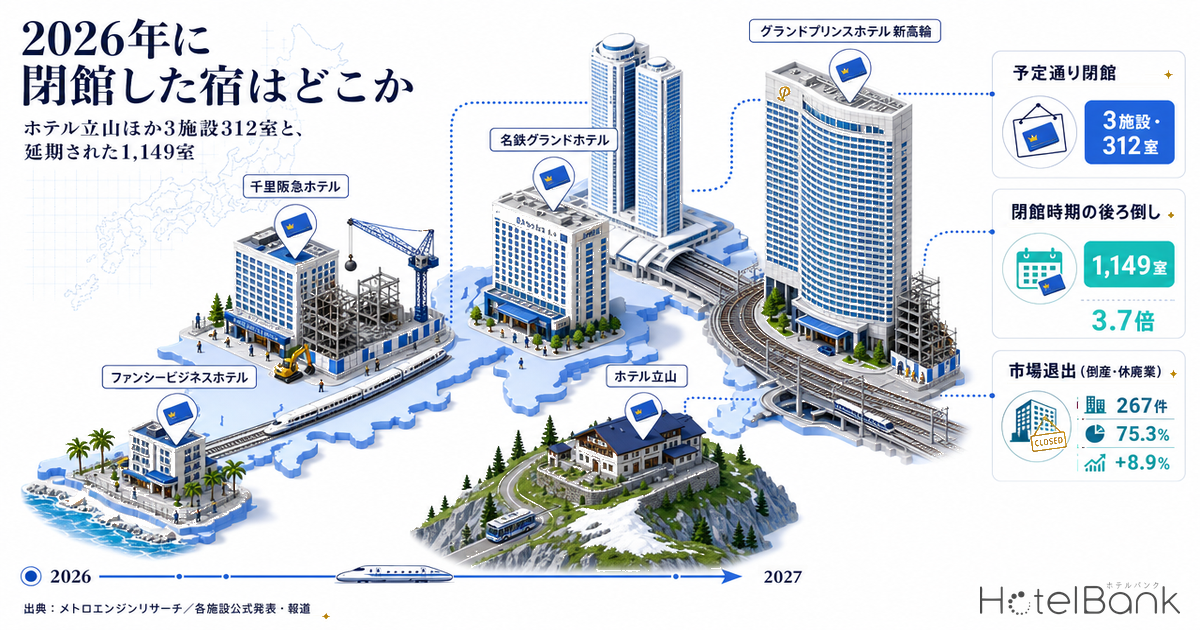
“Why did that hotel close?” “Which Japanese hotels shut down in 2026?” — these questions keep flowing into search engines. Yet when each case is checked against the official announcements one by one, many of the properties people believe closed had in fact ended operations years earlier, while several properties reported as closing are still accepting reservations today. This article lists only those lodging facilities whose 2026 closure was publicly announced and verifiable through official releases or press reports, and sets out how many rooms were actually lost and where that capacity went.
Metric Definitions Used in This Article
- ADR (average daily rate): An estimated transacted rate (tax-excluded equivalent) calculated by applying a segment-specific adjustment coefficient to the lowest published plan rate each property lists on OTAs and other channels (two guests per room, per-room price, tax included). Cross-checked against property-level actuals disclosed by listed hotel REITs (91 properties, most recent three months), the median error is approximately 7%. These are estimates and differ from each property’s actual transacted prices and accounting figures. Area-level ADR is the median of the target properties (the level of a typical property in that area).
- Occupancy rate (OTA-listed-inventory basis, estimated): The share of sold rooms against total rooms in the area, estimated from OTA sales inventory. It is an estimate based on how listed inventory is consumed on OTAs and differs from a property’s full actual occupancy.
- Last listed check-in date: The furthest check-in date for which the property could be confirmed to be accepting future bookings as of the survey date.
- Data sources: MetroEngines Research (property-level pricing and inventory); official announcements and press reports from each property (closure information)
- — Five properties totalling 1,465 rooms were announced as closing in 2026, but only three properties with 316 rooms actually end (or have ended) lodging operations within the year.
- — The remaining two properties with 1,149 rooms stay open because their redevelopment schedules were revised. Rooms that stayed on the market through delay outnumber rooms that disappeared on schedule by 3.6 times.
- — A property vanishing from listings is useful for shortlisting candidates but is not evidence of closure. Meitetsu Grand Hotel (名鉄グランドホテル) is taking bookings roughly 12 months beyond its originally announced closing date, and Grand Prince Hotel Takanawa (グランドプリンスホテル新高輪) four months beyond (as of August 13, 2026).
- — The real contraction in room stock shows up in the statistics. In 2025, Japan’s lodging industry saw 89 bankruptcies and 178 voluntary closures or dissolutions — 267 exits in total — and 75.3% of them occurred outside the three major metropolitan areas.
- — Exits on the scale of a few dozen rooms do not move area-level metrics. Estimated transacted ADR rose +8.9% in Nakamura Ward, Nagoya and +9.0% in Atami City (January–July 2026 average, year on year).
Most of the “closures” people search for did not happen in 2026
Let us first establish the baseline. When the property names that rank highest in closure-related search demand are actually traced, a striking number turn out to have closed far earlier than assumed.
Hotel Heidi (ホテル ハイジ) in the Tateshina highlands ended operations in 2019 due to building deterioration; on the same site, the same operating company opened a new 12-room property under a different brand in March 2024. The property that ceased operations through bankruptcy in Itako City, Ibaraki was Itako Fujiya Hotel (潮来富士屋ホテル), and that happened in March 2020. Hotel Kisoji (ホテル木曽路) in Nagiso Town, Nagano was not closed at all: it suspended operations from December 2023 and reopened in April 2024 under a different brand. In other words, a substantial share of the events remembered as “closures” were in fact the end of operations several years ago, or a change of operator across a temporary suspension.
That time lag matters for anyone counting supply. A property disappearing from OTAs and other booking sites is not the same thing as that property closing. What follows makes that distinction explicit as a procedure before building the list.
Lodging facilities whose 2026 closure was publicly announced
Only properties whose end of operations could be confirmed through an official website, an operating-company release or press coverage are listed. Candidates that could not be confirmed were excluded from the list even where sales had ceased in the listing data.
| Property | Location | Rooms | Opened | Announced end of operations | Current status / aftermath |
|---|---|---|---|---|---|
| Senri Hankyu Hotel (千里阪急ホテル) | Shin-Senri Higashimachi, Toyonaka City, Osaka | 203 rooms | March 1970 | March 30, 2026 (final night of lodging) | Demolition began on August 3, 2026, running roughly 18 months. Part of the Senri-Chuo district redevelopment |
| Fancy Business Hotel (ファンシービジネスホテル) | Atami City, Shizuoka (about a 3-minute walk from Atami Station) | 28 rooms | 1983 | April 30, 2026 | Closed after 43 years. No successor use announced |
| Hotel Tateyama (ホテル立山) | Murodo, Tateyama Town, Nakaniikawa District, Toyama | 85 rooms | September 1972 | August 31, 2026 (lodging business) | Restaurant and shop continue. The building was acquired by Hoshino Resorts (星野リゾート) in March 2024 |
| Meitetsu Grand Hotel (名鉄グランドホテル) | Meieki, Nakamura Ward, Nagoya City, Aichi | 243 rooms | October 1967 | March 22, 2026 (original plan) | Still operating as a hotel. With the redevelopment schedule changed to undetermined, it continues to operate except for banquet halls and some restaurants |
| Grand Prince Hotel Takanawa (グランドプリンスホテル新高輪) | Takanawa, Minato Ward, Tokyo | 906 rooms | April 1982 | Within fiscal 2026 (original plan) | Reported to remain open beyond April 2027. After demolition, a 31-storey mixed-use complex is planned (targeted for completion in fiscal 2032) |
Source: official announcements and press reports from each property and operating company (per-property URLs are listed under “References and Sources” at the end of this article) / room counts are based on published materials
The properties that actually end (or ended) lodging operations within 2026 number three, totalling 316 rooms. Meanwhile, the two properties with 1,149 rooms originally announced for closure in 2026 remain open because their redevelopment plans were revised. In pure counts, the rooms that stayed on the market through delay outnumber the rooms that disappeared on schedule by 3.6 times.
That gap changes how supply and demand look. Had all five properties closed within 2026 as originally announced, 1,465 rooms would have left the market — 4.6 times the 316 rooms that actually did. Anyone who priced closures into their supply forecast is therefore living with 1,149 more rooms of inventory than assumed, and 906 of those sit in a single location in front of Shinagawa Station.
Source: compiled by the HotelBank Editorial Team from MetroEngines Research
A listing disappearing does not mean the hotel closed — testing the decision procedure
The easiest way to handle changes in supply is to count the properties whose sales have vanished from booking sites. But that method errs in both directions: some properties keep operating while sales are suspended, and others keep selling even after closure has been decided.
So for each property on the list, the “furthest check-in date for which future bookings can be confirmed” was checked against the sales data held by MetroEngines Research. The results split cleanly into two groups.
| Property | Announced end of operations | Last listed check-in date | Sales observed in the past 90 days | Assessment |
|---|---|---|---|---|
| Senri Hankyu Hotel (千里阪急ホテル) | March 30, 2026 | April 30, 2026 | None | Listing disappearance matches the announcement |
| Hotel Tateyama (ホテル立山) | August 31, 2026 | August 28, 2026 | Yes (up to just before the end date) | Selling continued right up to the closing date |
| Meitetsu Grand Hotel (名鉄グランドホテル) | March 22, 2026 (original) | March 30, 2027 | Yes | Taking bookings roughly 12 months beyond the original date |
| Grand Prince Hotel Takanawa (グランドプリンスホテル新高輪) | Within fiscal 2026 (original) | July 31, 2027 | Yes | Taking bookings four months beyond the original window |
Source: MetroEngines Research (sales data as of August 13, 2026) / N=4 properties
Source: compiled by the HotelBank Editorial Team from MetroEngines Research
Meitetsu Grand Hotel and Grand Prince Hotel Takanawa are both accepting reservations for check-in dates well past their originally announced end of operations. What that reveals is a simple fact: the closing date of a large property is subordinate to the redevelopment schedule, and when that schedule moves, the room inventory stays on the market. In the Nagoya Station district the schedule was changed to undetermined on the grounds of labour availability, and in front of Shinagawa Station the redevelopment plan is still being reviewed. Anyone who built a supply-demand estimate around the announced closures needs to update that assumption.
The opposite error is worth noting too. Among properties whose listings ceased in the sales data are some that temporarily suspended operations for renovation, and others that shifted their booking channels toward their own websites. In this exercise, candidates whose end of operations could not be confirmed through an official announcement, an operating-company release or press coverage were left off the list. The disappearance of a listing is usable for shortlisting candidates, but on its own it is not evidence of closure — that is the practical conclusion this verification yields.
Bigger than individual closures: the market exits that show up in the statistics
Large, individually named cases attract attention, but when it comes to subtracting from room stock, the exits of small properties that never make the news are far larger in number. According to Teikoku Databank, lodging-industry bankruptcies in 2025 totalled 89 cases (up 14.1% from 78 the previous year, a second consecutive annual increase), and voluntary closures and dissolutions totalled 178, for a combined 267 exits from the market over the year. Of those, 75.3% occurred outside the three major metropolitan areas.
The breakdown of causes mirrors the structure of supply. Bankruptcies citing building deterioration, repairs or equipment failure among their causes numbered 58 over the past five years, 14.6% of the total, and the share is trending upward. Lodging is a capital-intensive business that assumes refurbishment every five to ten years, and whether an operator can secure that investment capacity is becoming the axis that separates properties that survive from those that do not. The absence of successors and the capital structures behind those 89 bankruptcies are examined in detail in Ryokan Succession Crisis: 89 Bankruptcies & 30% Without Heirs in 2025.
Source: compiled by the HotelBank Editorial Team from Teikoku Databank, “Bankruptcy, Voluntary Closure and Dissolution Trends in the Lodging Industry (2025)”
Against the five properties and 1,465 rooms on this list, the statistics record 267 exits in a single year. The closure of a well-known property is symbolic, but the real contraction in room stock is accumulating through small and mid-sized properties in regional Japan.
Did the closures move local prices and inventory absorption?
Next, how did the remaining properties fare in the areas where closures and end-of-operations occurred? The measures used here are estimated transacted ADR and the estimated occupancy rate on an OTA-listed-inventory basis.
Nakamura Ward, Nagoya — the area where 243 rooms stayed
Nakamura Ward in Nagoya, home to Meitetsu Grand Hotel, was supposed to lose 243 rooms from the market in March 2026 under the original plan. Because the hotel is still operating, supply has not fallen. The number of target properties MetroEngines Research tracks in Nakamura Ward was 71 in July 2026 against 73 in July 2025 — essentially flat.
Estimated transacted ADR averaged about ¥10,500 over January–July 2026, against roughly ¥9,600 in the same period a year earlier, or +8.9%. The estimated occupancy rate for Aichi Prefecture as a whole (OTA-listed-inventory basis) stood at a high 85.8% in July 2026 (518 properties, 54,338 rooms), but it is more natural to read that as demand-side growth and area-wide repricing rather than inventory contraction from closures. It is an unsurprising confirmation that an announced closure produces no effect on either price or inventory until it is actually carried out.
Source: compiled by the HotelBank Editorial Team from MetroEngines Research (N=71–73 properties)
Atami City — an area with continuing small-property exits
In Atami City, a 28-room business hotel ended operations in April 2026. Yet the number of target properties MetroEngines Research tracks in Atami rose from 100 in July 2025 to 106 in July 2026 — an increase, because small-property exits and new openings or new listings are running in parallel.
Estimated transacted ADR averaged about ¥23,700 over January–July 2026 against roughly ¥21,800 a year earlier, or +9.0%. The estimated occupancy rate for Shizuoka Prefecture as a whole was 84.9% in July 2026 (1,127 properties, 45,208 rooms). An exit of a few dozen rooms is simply too small to move the metrics of an area with around 100 properties. An individual closure only affects area pricing in small markets where a single property accounts for a meaningful share of total rooms.
Source: compiled by the HotelBank Editorial Team from MetroEngines Research (N=99–106 properties)
Toyonaka City — an area where a decline in tracked properties was observed
In Toyonaka City, home to the 203-room Senri Hankyu Hotel, the number of target properties tracked by MetroEngines Research fell from six in March 2026 to five in April, matching the timing of the closure. However, this is an area with a single-digit property count, and the median moves sharply whenever the property mix changes. A before-and-after comparison of price levels does not hold at this sample size, so this article limits itself to noting the change in property count.
| Area | Tracked properties (July 2025 → July 2026) | Estimated transacted ADR, Jan–Jul average (YoY) | Prefectural estimated occupancy (July 2026) |
|---|---|---|---|
| Nakamura Ward, Nagoya | 73 → 71 | approx. ¥10,500 (+8.9%) | Aichi 85.8% |
| Atami City | 100 → 106 | approx. ¥23,700 (+9.0%) | Shizuoka 84.9% |
| Toyonaka City | 6 → 4 | Not adopted — insufficient sample | Osaka 86.5% |
Source: compiled by the HotelBank Editorial Team from MetroEngines Research / estimated occupancy is the average of daily observations within the month (observed property counts vary daily: Aichi 518–547 properties, Shizuoka 1,127–1,326 properties, Osaka 696–722 properties)
What the three areas share is that estimated occupancy sits at 84–87% regardless of whether a closure occurred (July 2026, OTA-listed-inventory basis). Whether demand can sustain that level matters far more to area price formation than a supply-side swing of a few dozen to a few hundred rooms. Before reading a closure as a supply shock, the absorptive capacity on the demand side has to be checked.
Where the vacated rooms go — five patterns
What becomes of the rooms of a property that closes? Placing the 2026 cases alongside earlier ones, the destinations fall broadly into the following five patterns.
| Pattern | Description | Examples around 2026 | Effect on room stock |
|---|---|---|---|
| 1. Rebuild / redevelopment | Rebuilt as a mixed-use building after demolition. The hotel often returns under a new brand | Senri Hankyu Hotel / Meitetsu Grand Hotel / Grand Prince Hotel Takanawa | Recovers after a gap of several years. Grade tends to move upward |
| 2. Building succession | Building and land transfer to another operator and are revived while staying in lodging use | Hotel Tateyama (building acquired by Hoshino Resorts in March 2024) | Recovers over the medium term if the use is maintained |
| 3. Rebrand succession | The operator changes and the property reopens under a different brand after a suspension and renovation | Hotel Kisoji (suspended December 2023 → reopened under a different brand in April 2024) | Room count is largely maintained. The rate band is reset |
| 4. Conversion to non-lodging use | The site becomes a public space, housing, offices and so on, and does not return to lodging use | The former Senri Hankyu Hotel site (open plaza and community functions under consideration) | A permanent reduction |
| 5. Postponed closing date | Operations continue past the planned closing date because the redevelopment schedule was revised | Meitetsu Grand Hotel / Grand Prince Hotel Takanawa | The largest destination in the short term, though the timing remains fluid |
Source: compiled by the HotelBank Editorial Team from official announcements and press reports from each property and operating company
For 2026 specifically, the largest destination by volume is pattern 5, the postponed closing date: 1,149 rooms of inventory stayed on the market longer than originally assumed. With construction costs and labour costs rising, redevelopment schedules are being revised cautiously, and as a side effect the operating life of existing rooms is being extended. How many years it takes from demolition to reopening is quantified from the record of 67 planned projects in Hotel Build Times: 2.80-Year Median, 1.96 Solo vs 4.00 Mixed-Use.
Pattern 3, rebrand succession, is by contrast the most efficient destination from a stock perspective, because it preserves the room count while resetting the rate band. As the Hotel Kisoji case shows, a sound structure can be relaunched with nothing more than an interior and equipment refresh. Kasumigaseki Capital’s recent move into ryokan rebranding — acquiring a property in Uji through a share-purchase scheme, with room to reset rates upward — is a current example of how the path from acquisition to repricing actually runs. Among the cases already flagged for 2027 and beyond — Kyoto Shin-Hankyu Hotel (京都新阪急ホテル) in Shimogyo Ward, Kyoto (325 rooms, opened July 1981, closing January 17, 2027 on expiry of its fixed-term lease) and Hyatt Regency Kyoto (ハイアット リージェンシー 京都) in Higashiyama Ward, Kyoto (187 rooms, opened March 2006, ending operations May 9, 2027) — how the sites are ultimately used will be the substantive question for Kyoto’s room stock.
Summary
Lodging facilities whose 2026 closure was publicly announced and confirmable through official releases or press reports number five, totalling 1,465 rooms. Of these, three properties with 316 rooms actually end (or have ended) lodging operations within 2026, while the remaining two properties with 1,149 rooms continue to operate because their redevelopment schedules were revised.
Three points matter in practice when handling changes in supply. First, a listing disappearing from booking sites is effective for shortlisting candidates but is not on its own evidence of closure. Second, the closing date of a large property is subordinate to the redevelopment schedule, so putting the announced date straight into a supply-demand assumption will miss. Third, the real contraction in room stock is progressing through the 267 statistical market exits per year — 75.3% of them outside the three major metropolitan areas — rather than through the large, well-covered cases.
And viewed from the destination side, rebrand succession of structurally sound properties still holds considerable room for revival. Rather than counting the names of hotels that have closed, following who takes those rooms and how they are put back to work is the more useful way to read supply from here.
⚠ Note on forward-dated data: For months from August 2026 onward, the estimated transacted ADR in this article is based on sales prices published on OTAs and other channels as of the survey date, and will shift as the check-in date approaches. Closure and end-of-operations dates may also change according to each operator’s decisions and redevelopment schedules. This article is based on publicly available information confirmed as of August 13, 2026.
Related Reading
- Ryokan Succession Crisis: 89 Bankruptcies & 30% Without Heirs in 2025
- Frozen Pipeline & the Supply Gap: Cancelled Hotel Projects and Investor Implications
- Hotel Build Times: 2.80-Year Median, 1.96 Solo vs 4.00 Mixed-Use
References and Sources
■ Data sources
MetroEngines Research property-level published pricing and sales inventory data (estimated transacted ADR, estimated occupancy on an OTA-listed-inventory basis, last listed check-in date). Facts on closures and ends of operations come from official announcements and press reports for each property and operating company. Market-exit counts come from Teikoku Databank, “Bankruptcy, Voluntary Closure and Dissolution Trends in the Lodging Industry (2025).”
■ Calculation assumptions
Area-level estimated transacted ADR is the simple average of monthly medians of the target properties over January–July 2026, compared with the same series for the same months a year earlier (Nakamura Ward, Nagoya N=71–73 properties; Atami City N=99–106 properties). Estimated occupancy is the within-month daily average of the share of sold rooms against total rooms in the area (July 2026). The last listed check-in date and the sales observations for the past 90 days are based on sales data as of August 13, 2026.
■ Limitations and caveats
Estimated transacted ADR applies segment-specific coefficients to the lowest published plan and is an estimate that differs from each property’s actual transacted amounts and accounting figures. Areas with single-digit property counts, such as Toyonaka City, are not used for before-and-after price comparison because the median moves sharply when the property mix changes. The aggregation population (observed property count) varies daily and can move for reasons other than closure, such as changes in listing channels or the start of new listings. Closure and end-of-operations timing may change according to operators’ decisions and redevelopment schedules.
■ Official announcements and press reports on closures and ends of operations
- Hotel Tateyama, “Regarding the end of Hotel Tateyama’s lodging service” (July 31, 2025)
- Travel Voice, “Hotel Tateyama on the Tateyama Kurobe Alpine Route to end its lodging business at the end of August 2026; restaurant and shop to continue” (August 4, 2025)
- Shinano Mainichi Shimbun, “Hotel Tateyama to end lodging business in August 2027; building acquired by Hoshino Resorts” (Note: the headline states August 2027, but the article body and the official announcement give the end of August 2026. This article adopts the officially announced date of August 31, 2026.)
- Hankyu Hanshin Properties, “Demolition of the former Senri Hankyu Hotel to begin on August 3, 2026” (PR TIMES)
- LIFULL HOME’S PRESS, “The Senri-Chuo area redevelopment plan gets under way”
- Meitetsu Grand Hotel, “Notice regarding the end of operations of Meitetsu Grand Hotel”
- Nagoya TV, “With the redevelopment plan under review, Meitetsu Grand Hotel to continue lodging beyond next March”
- Meitetsu Grand Hotel (confirmation of opening date and room count)
- Kenbiya, “Grand Prince Hotel Takanawa in front of Shinagawa Station to end operations within fiscal 2026; a 31-storey redevelopment building to be constructed” (August 17, 2025)
- Kensetsu Tsushin Shimbun, “Seibu Holdings’ Grand Prince Takanawa to end operations and begin demolition in fiscal 2026”
- Nihon Keizai Shimbun, “Grand Prince Hotel Takanawa to stay open beyond April 2027 as redevelopment is reviewed”
- Gogai NET Ito, Izu & Atami, “[Atami City] The long-established Fancy Business Hotel closed on April 30”
- Toshi Shogyo Kenkyusho, “Kyoto Shin-Hankyu Hotel to close on January 17, 2027 — a Hankyu Hanshin Daiichi Hotel Group city hotel in front of Kyoto Station, on expiry of its fixed-term lease”
- Lmaga.jp, “Kyoto luxury hotel ‘Hyatt’ to close — Osaka closed in 2023; what remains?”
- Shinano Mainichi Shimbun, “Hotel Kisoji to reopen as ‘TAOYA’ in April 2024, Kiso Town”
- GENSEN HOLDINGS, “Hotel Kisoji and Yamashiro Onsen Yamashitaya to suspend operations ahead of a new phase in April 2024” (PR TIMES)
- Hotel de l’Alpage official website (successor property to the former Hotel Heidi)
- HotelBank, “Fujiya Hotel, a ryokan operator in Itako City, Ibaraki, goes bankrupt” (2020, Japanese)
■ Statistics and research
- Teikoku Databank, “Bankruptcy, Voluntary Closure and Dissolution Trends in the Lodging Industry (2025)” (February 6, 2026)
- Hyatt Regency Kyoto (confirmation of opening date and room count)
- MetroEngines Research — property-level published pricing and sales inventory data, area-level estimated transacted ADR and estimated occupancy