

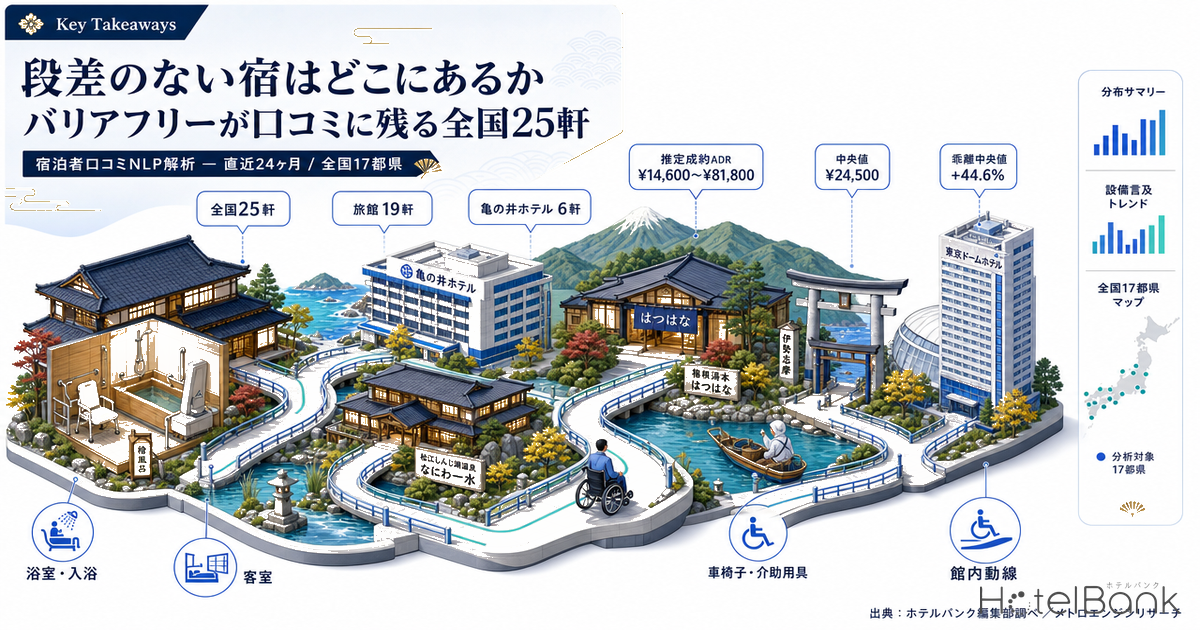
Filter Japan’s guest reviews down to only those posts that mention a property’s accessibility features, and the list narrows to just 25 properties nationwide. That is the number of properties that collected five or more references to physical, hardware-side accessibility — phrases such as “there were no steps” or “I could get into the bath in a wheelchair” — in an NLP semantic analysis of 24 months of guest reviews. Read the other way round, these 25 properties offer facilities that people who actually stayed there felt were worth writing down.
This article maps out where those 25 properties are, what guests actually talk about, and how they are distributed across price bands, all on measured data. September 2026 brings Japan’s first five-day holiday run in 11 years — a period when travel with elderly family members tends to increase.
Metric Definitions Used in This Article
- Mentions / mention rate: The number of guest reviews posted in the past 24 months that refer to a property’s accessibility features, and that number as a share of the property’s total review count. The population is limited to properties with 20 or more total reviews, and the extraction threshold is five or more mentions. The mention rate expresses “how often the topic came up,” not a “rating score” — the two are different metrics.
- ADR (average daily rate): An estimated settled rate (tax-exclusive equivalent) calculated by applying category-specific adjustment coefficients to the lowest published plan rate each property lists on OTAs (double occupancy, per-room rate, tax included). Cross-checked against property-level actuals disclosed by listed hotel REITs (91 properties, most recent three months), the median error is approximately 7%. These are estimates and differ from each property’s actual settled rates or accounting figures. This article uses the average of the most recent 12 months (August 2025 to July 2026).
- Prefecture peer benchmark: The median estimated settled ADR (12-month average) for properties in the same prefecture and the same category (ryokan / resort hotel / city hotel) as the property in question. It indicates the standard level for properties in that area.
- Data sources: Review analysis = HotelBank Editorial Team research / pricing = MetroEngines Research
- — 25 properties across 17 prefectures — Only 25 properties nationwide collected five or more guest-review mentions of accessibility. Nineteen of them are ryokan, and not a single urban business hotel makes the list.
- — Kamenoi Hotels account for six — About a quarter of the 25 come from a single brand. The July 2022 rebranding of the former “Kanpo no Yado” chain left accessible-room specifications standardized across the brand.
- — Bathing dominates the 43 specific mentions — Guest rooms 17, wheelchairs and assistive equipment 17, bathrooms 15. What gets written about is not abstract “accessibility” but a single concrete measure: a wash-area wheelchair, or a bath lift.
- — The price range is broad — Estimated settled ADR spans roughly ¥14,600 to ¥81,800, a 5.6x range, with a median of about ¥24,500. Seven properties fall below ¥20,000, so this is not a set of options confined to the luxury tier.
- — But they sit high within their own areas — Against the median for the same category in the same prefecture, 22 of 24 properties price higher, with a median gap of +44.6%. Accessibility and a rate premium can coexist.
25 Properties Nationwide — Where Accessibility Shows Up in Reviews
Start with the distribution. The 25 qualifying properties are spread across 17 prefectures, with no concentration in any one region. Mie leads with three (the Ise-Shima and Toba areas), followed by Shizuoka, Nagano, Hyogo, Ibaraki, Yamagata and Kanagawa with two each, and the remaining 10 prefectures with one apiece. From Tsuchiyu Onsen in Fukushima in the north to Nichinan in Miyazaki in the south, they are scattered thinly and widely, mostly across hot spring destinations.
Source: HotelBank Editorial Team research (NLP analysis of guest reviews)
What stands out numerically is that 19 of the 25 are ryokan. Three are resort hotels, two are city hotels, and the remaining one is classified as a corporate/organizational lodging facility — with not a single urban business hotel in the set. This does not mean that only ryokan provide accessibility; if anything it points to the opposite structure. Japanese ryokan have historically been built around level changes: tatami rooms, raised entry sills, staircases. In that context, “there were no steps” becomes an unexpected experience for a guest — which is precisely why it ends up in the text of a review. In urban hotels, where flat floors are the norm, the same design rarely merits comment.
The other striking feature is the presence of a single brand. Kamenoi Hotels occupies six slots — Oarai and Itako (Ibaraki), Ako (Hyogo), Toba (Mie), Kamogawa (Chiba) and Atami (Shizuoka) — roughly a quarter of the 25. The brand was created in July 2022 when the former “Kanpo no Yado” chain was rebranded, and the accessible rooms and ceiling-track lifts installed during its predecessor era carried over intact. Standardized accessible-room specifications across the brand are likely why the chain surfaces in reviews at several locations simultaneously.
Source: HotelBank Editorial Team research (NLP analysis of guest reviews)
Sort by mention rate instead and the ranking shifts somewhat. Hotel Tamanoyu at Asama Onsen (浅間温泉 ホテル玉之湯, Nagano, 36 rooms) leads at 4.78%, followed by Naniwa Issui in Matsue at 3.12% and Hotel Oyanagi in Niigata at 2.23%. All are small to mid-sized ryokan. Large properties with more than 1,000 total reviews have a big denominator and therefore tend to show low rates: Tokyo Dome Hotel (1,006 rooms) has five mentions, or 0.18%. The right reading, then, is that the mention rate captures “how concentrated the buzz is relative to scale,” while the mention count captures “absolute volume of discussion.”
| # | Property | Prefecture | Type | Rooms | Total reviews | Mentions | Mention rate | Est. settled ADR | Prefecture peer | Gap |
|---|---|---|---|---|---|---|---|---|---|---|
| 1 | Hotel Tamanoyu, Asama Onsen (浅間温泉 ホテル玉之湯) | Nagano | Ryokan | 36 | 272 | 13 | 4.78% | ¥25,583 | ¥13,440 | +90% |
| 2 | Kamenoi Hotel Oarai (亀の井ホテル 大洗) | Ibaraki | Corporate/organizational lodging | 52 | 1,616 | 13 | 0.80% | — | — | — |
| 3 | Naniwa Issui (なにわ一水) | Shimane | Ryokan | 25 | 256 | 8 | 3.12% | ¥24,418 | ¥16,031 | +52% |
| 4 | Suimeikan, Gero Onsen (下呂温泉 水明館) | Gifu | Ryokan | 264 | 2,812 | 8 | 0.28% | ¥21,803 | ¥15,012 | +45% |
| 5 | Todaya, Toba Onsen, Ise-Shima (伊勢志摩 鳥羽温泉郷 戸田家) | Mie | Ryokan | 160 | 1,035 | 7 | 0.68% | ¥26,805 | ¥17,018 | +58% |
| 6 | Tateshina Grand Hotel Takinoyu (蓼科グランドホテル滝の湯) | Nagano | Ryokan | 160 | 1,111 | 7 | 0.63% | ¥18,914 | ¥13,440 | +41% |
| 7 | Kamenoi Hotel Ako (亀の井ホテル 赤穂) | Hyogo | Ryokan | 49 | 570 | 6 | 1.05% | ¥26,445 | ¥22,330 | +18% |
| 8 | Kamenoi Hotel Toba (亀の井ホテル 鳥羽) | Mie | Ryokan | 62 | 709 | 6 | 0.85% | ¥24,510 | ¥17,018 | +44% |
| 9 | Satoyama no Kyujitsu Kyoto Kemurikawa (里山の休日 京都・烟河) | Kyoto | Ryokan | 41 | 391 | 6 | 1.53% | ¥29,219 | ¥24,489 | +19% |
| 10 | Kamenoi Hotel Kamogawa (亀の井ホテル 鴨川) | Chiba | Ryokan | 103 | 1,001 | 6 | 0.60% | ¥23,180 | ¥13,893 | +67% |
| 11 | Hohoemi no Sora Yubune Tsuruya (ほほえみの空湯舟 つるや) | Yamagata | Ryokan | 24 | 308 | 6 | 1.95% | ¥35,694 | ¥13,388 | +167% |
| 12 | Hatsuhana (はつはな) | Kanagawa | Ryokan | 35 | 294 | 6 | 2.04% | ¥81,766 | ¥21,421 | +282% |
| 13 | Hotel New Akao (ホテルニューアカオ) | Shizuoka | Resort hotel | 351 | 2,990 | 6 | 0.20% | ¥26,552 | ¥18,546 | +43% |
| 14 | Hotel Tenbo (ホテル天坊) | Gunma | Ryokan | 183 | 583 | 5 | 0.86% | ¥24,465 | ¥15,860 | +54% |
| 15 | Asagiriso (あさぎり荘) | Hyogo | Ryokan | 35 | 349 | 5 | 1.43% | ¥27,273 | ¥22,330 | +22% |
| 16 | Hotel Parlance Onoya (ホテルパーレンス小野屋) | Fukuoka | City hotel | 72 | 530 | 5 | 0.94% | ¥35,701 | ¥17,887 | +100% |
| 17 | Kamenoi Hotel Itako (亀の井ホテル 潮来) | Ibaraki | Ryokan | 58 | 855 | 5 | 0.58% | ¥14,645 | ¥8,104 | +81% |
| 18 | Kamenoi Hotel Atami (亀の井ホテル 熱海) | Shizuoka | Ryokan | 159 | 1,561 | 5 | 0.32% | ¥31,543 | ¥18,896 | +67% |
| 19 | Tokyo Dome Hotel (東京ドームホテル) | Tokyo | City hotel | 1006 | 2,795 | 5 | 0.18% | ¥29,381 | ¥27,905 | +5% |
| 20 | Tendo Hotel (天童ホテル) | Yamagata | Ryokan | 114 | 626 | 5 | 0.80% | ¥19,122 | ¥13,388 | +43% |
| 21 | Resort Hills Toyohama Soranokaze (リゾートヒルズ豊浜 蒼空の風) | Mie | Ryokan | 38 | 558 | 5 | 0.90% | ¥16,982 | ¥17,018 | -0% |
| 22 | Hinata no Yado Nichinan Miyazaki (天然温泉 ひなたの宿 日南宮崎) | Miyazaki | Resort hotel | 46 | 424 | 5 | 1.18% | ¥15,203 | ¥12,042 | +26% |
| 23 | Sansuiso (山水荘) | Fukushima | Ryokan | 69 | 459 | 5 | 1.09% | ¥22,406 | ¥11,004 | +104% |
| 24 | EN RESORT Re-Cave Hakone (EN RESORT リ・カーヴ箱根) | Kanagawa | Resort hotel | 122 | 1,793 | 5 | 0.28% | ¥19,411 | ¥23,583 | -18% |
| 25 | Hotel Oyanagi (ホテル小柳) | Niigata | Ryokan | 60 | 224 | 5 | 2.23% | ¥18,144 | ¥13,875 | +31% |
Ranked in descending order of mentions (ties broken by total review count). Room counts come from the MetroEngines Research master database and may differ in places from figures published by the properties themselves. Kamenoi Hotel Oarai falls outside the property categories validated for estimated settled ADR, so its price columns are shown as “—”. N=25 properties; population is properties with 20 or more total reviews over the past 24 months, with five or more mentions.
Source: HotelBank Editorial Team research (review analysis) / MetroEngines Research (pricing)
What Guests Write About Is “A Bathroom I Could Enter in a Wheelchair” — Breakdown of Mentions
So what exactly are guests recording? Classifying the 152 review excerpts extracted from the 25 properties, 43 referred to a specific facility or service. The rest were general impressions such as “we could relax with peace of mind” or “we want to come again” — cases where satisfaction is expressed without naming any equipment.
Source: HotelBank Editorial Team research (NLP analysis of guest reviews)
At the top of the breakdown, guest rooms (the existence of accessible rooms, spacious layouts) and wheelchairs and assistive equipment tie at 17 excerpts each, followed by bathrooms and bathing at 15. Those three account for most of the specific mentions. What deserves attention is the quality of the writing about bathrooms. Guests do not simply say “there is a large communal bath.” They write things like “the large bath has a wheelchair for the wash area on hand as standard,” “the bathroom also had a shower chair,” and “we were even able to use a lift to get him into the bath in our room” — specifying which piece of equipment was placed where. At a hot spring ryokan, bathing is the main purpose of the stay, and whether the property reaches that far appears to be the dividing line for the guest experience.
Mentions of in-house circulation, level changes and elevators number only four, but the content is concrete. Alongside blunt statements such as “almost no steps anywhere in the building,” there are examples praising coverage through operations rather than hardware — for instance, “they even offered to move us to a room near the elevator.” On toilets and washbasins, we found comments such as “the washroom and toilet were wide enough to use in a wheelchair” and “the accessible room, bath and toilet were a huge relief.”
Cross-checking against each property’s official information makes the picture sharper still. Naniwa Issui in Matsue has fitted 10 of its 23 rooms (official published figure) to accessible/universal-design specifications, with toilets, washbasins and bathrooms a wheelchair can turn in, plus support for installing a bath lift (property’s official website). The ryokan was the first Japanese property to win the top international award at the UK’s Blue Badge Access Awards, and also took a Gold Award at the IAUD International Design Award 2020. Its efforts go beyond hardware: the property has also been reported on for a scheme serving dysphagia-friendly meals alongside standard meals at the same table. Asagiriso in Kinosaki Onsen has an accessible Japanese-Western room on its fourth floor, equipped with a height-adjustable bed, an in-tub lift (bath lift), and a toilet and washbasin usable from a wheelchair (property’s official website). It is also certified under the Japan Tourism Agency’s “Barrier-Free Mindset Certification” scheme. Kamenoi Hotel Ako reopened after renovation in July 2025 and, in addition to accessible guest rooms, lists bathroom equipment including a shower chair, tub grab bars and a bath step.
In other words, the elements that surface in reviews broadly match the elements the properties themselves promote. Guests are not rating an abstract idea called “accessibility” — they are rating the single measure that gets someone into the bathtub.
Spanning the Price Bands — “The Pricier, the Better Equipped” Is Only Half True
Next, the relationship with price. Accessibility requires renovation capital, so intuition says the higher the price band, the better equipped the property. The measured data partly supports that intuition and partly contradicts it.
Start with absolute levels. Across the 24 properties for which an estimated settled ADR is available, the distribution runs from roughly ¥14,600 at Kamenoi Hotel Itako, the lowest, to roughly ¥81,800 at Hatsuhana in Hakone, the highest — a 5.6x spread. The median is about ¥24,500 and the mean about ¥26,600.
Source: Compiled by HotelBank Editorial Team from MetroEngines Research data
By price band, ¥25,000–29,999 has the most properties at seven, but seven properties also fall below ¥20,000. Only one property sits at ¥40,000 or above. Properties where accessibility shows up in reviews are therefore not concentrated in the luxury tier; they are scattered across a wide band from the ¥14,000s to the ¥35,000s. In terms of a traveler’s budget, these options are not restricted to special high-end inns.
Compare each property against the standard level for the same prefecture and the same category, however, and a different picture emerges.
Source: Compiled by HotelBank Editorial Team from MetroEngines Research data
Twenty-two of the 24 price above the median for their category within their prefecture. The largest gap belongs to Hatsuhana in Hakone (roughly ¥81,800 against a Kanagawa ryokan median of ¥21,400, or +282%), followed by Hohoemi no Sora Yubune Tsuruya in Yamagata (+167%), Sansuiso in Fukushima (+104%) and Hotel Parlance Onoya in Fukuoka (+100%). Only two came in below: Resort Hills Toyohama Soranokaze in Mie (essentially level, at −0%) and EN RESORT Re-Cave Hakone (−18%).
The reading that follows is this: in absolute terms these properties span the price bands, but within their local peer group they cluster toward the upper price zone. Put the other way, they are able to achieve rates above the standard for their own area — evidence that accessibility and a price premium can coexist. Kamenoi Hotel Itako is a telling case: its estimated settled ADR of about ¥14,600 is the lowest of the 25, yet it stands +81% above the Ibaraki ryokan median of ¥8,100. It is not a “cheap inn” but “an inn that commands a decent rate for its area.”
That said, these gaps blend several factors — scale, location, meal offering and more — so it cannot be asserted that accessibility alone lifts the rate. At a minimum, though, the data shows that accessibility is not a feature that has to be discounted to sell.
The First Five-Day September Holiday in 11 Years, and Universal Tourism
September 2026 brings a five-day holiday run from Saturday, September 19 through Wednesday, September 23 (Autumnal Equinox Day). Tuesday, September 22 becomes a citizens’ holiday because it is sandwiched between Respect for the Aged Day (Monday, September 21) and Autumnal Equinox Day — an alignment last seen in 2015, 11 years ago. Because the run includes Respect for the Aged Day, it is a period when travel accompanied by elderly family members tends to rise. Our separate review-based analysis of what multigenerational parties value when choosing accommodation for that holiday drew on 2,426 guest reviews, and found that the conditions for being chosen for a family trip with parents center on meals, bathing and room layout rather than on headline facilities.
Policy is also a tailwind. The Japan Tourism Agency positions universal tourism — travel in which anyone can take part without hesitation — as one pillar of its strategy for expanding domestic exchange, and in March 2026 it published a casebook of exemplary universal tourism promotion projects along with a product-development and sales manual (March 2026 edition). The agency’s “Barrier-Free Mindset Certification” scheme, created in 2020, covers accommodation, restaurants, tourist information centers and museums, and its certification requirements include hospitality and service practices, not just physical infrastructure. The related budget lines, and how they connect to review scores and revenue, are covered in our analysis of the Japan Tourism Agency’s FY2026 budget for labor-saving and accessibility investment.
Room to Grow — Priorities for Renovation and Communication
The data so far also implies an order of operations for properties preparing to address accessibility.
First, the bathroom. Fifteen of the 43 specific mentions concern bathing, and those were the most detailed descriptions of all. At a hot spring inn, bathing is an experience with no substitute; solve it and the rating for the entire stay changes. Even where a full renovation is out of reach, a property can start with portable equipment: keeping a wash-area wheelchair (shower carrier) on hand, plus shower chairs, tub grab bars and bath steps. In fact, the items guests named in reviews were mostly this kind of movable equipment. An in-tub lift (bath lift) requires installation work, but limiting accessible rooms to one or two keeps the investment contained.
Second, toilets and washbasins. Mentions number only two, but that is largely because these go unwritten when they are adequate. The requirements are a door opening wide enough to enter in a wheelchair and enough floor area to turn around inside. Widening the wet areas of existing guest rooms tends to be a heavier job than circulation work, so the realistic approach is to handle it in one go when creating or converting accessible rooms.
Third, the entrance and in-house circulation. As the one-line comment “almost no steps anywhere in the building” shows, guests are rating continuous ease of movement rather than individual fixtures. What matters is whether the entrance ramp, the route from the front desk to the elevator, and the routes from the elevator to guest rooms, baths and dining areas all join up. There is also room here to fill gaps partially with temporary ramps and step lifts.
And what looks most likely to pay off in terms of getting into reviews is “making equipment visible” and “creating a channel for advance consultation.” The data shows that what guests actually write is the experience of “it was there” and “we could borrow it.” At EN RESORT Re-Cave Hakone we found “we were able to borrow a wheelchair and both my mother and I are grateful,” and at Tokyo Dome Hotel, “the wheelchair could be used within Dome City, so we could also use it to go out for a meal outside the hotel.” Listing loan items explicitly in plan descriptions and on the property page, and providing a path to consult at the time of booking, are moves that can be executed without any renovation. The fact that the circulation comments included an operational response — “the staff offered to move us to a room near the elevator” — likewise confirms that hardware is not the only thing being assessed.
Read the other way, the figure of 25 properties means there is still a great deal of room to grow relative to Japan’s accommodation market as a whole. Loosening the threshold from five mentions to four raises the count to 46, but even that remains a tiny fraction of the population. With the September five-day run and other periods of increased travel by families with elderly members ahead, this is an area with substantial room for differentiation.
Converting the Gap vs. the Local Benchmark into Per-Room, Per-Night Yen — A Unit Conversion
The analysis above showed that 22 of 24 properties price above the median for their category within their prefecture. Because that “gap” is expressed as a percentage, it is hard to get a feel for the scale at an individual property. So we multiply the two figures already presented in this article — the prefecture peer benchmark and the gap rate — to express the result as a per-room, per-night amount. This is not a revenue forecast; it is a unit conversion of figures already published above. No occupancy rate, cost or payback assumption is introduced.
| Scenario | Gap rate | Per room-night | 2 accessible rooms | 10 accessible rooms |
|---|---|---|---|---|
| Low case | −17.7% | −¥2,925 | −¥5,850 | −¥29,249 |
| Mid case | +44.6% | ¥7,370 | ¥14,740 | ¥73,702 |
| High case | +281.7% | ¥46,551 | ¥93,102 | ¥465,509 |
The three gap levels are measured values from Table 1 above (minimum −17.7% / median of the 24 properties +44.6% / maximum +281.7%). The two-room case corresponds to the statement above that “limiting accessible rooms to one or two keeps the investment contained”; the 10-room case corresponds to the number of accessible rooms at Naniwa Issui (the property’s own published figure).
In the mid case, the difference is +¥7,370 per room-night; with two accessible rooms, +¥14,740; and at the same 10-room scale as Naniwa Issui, +¥73,702. Even in the low case (−17.7%), the shortfall is only −¥2,925 per room, and that position is exceptional within the distribution of the 24 properties.
Benchmarks themselves vary widely by area, so we also lay this out on two axes. The vertical axis uses five prefecture peer benchmark levels that actually appear in Table 1, and the horizontal axis uses five gap rates likewise taken from the article.
| Prefecture peer benchmark | −17.7% | ±0.0% | +44.6% | +99.6% | +281.7% |
|---|---|---|---|---|---|
| ¥8,104 Ibaraki, ryokan | −¥1,434 | ¥0 | ¥3,614 | ¥8,072 | ¥22,829 |
| ¥13,440 Nagano, ryokan | −¥2,379 | ¥0 | ¥5,994 | ¥13,386 | ¥37,860 |
| ¥17,018 Mie, ryokan | −¥3,012 | ¥0 | ¥7,590 | ¥16,950 | ¥47,940 |
| ¥22,330 Hyogo, ryokan | −¥3,952 | ¥0 | ¥9,959 | ¥22,241 | ¥62,904 |
| ¥27,905 Tokyo, city hotel | −¥4,939 | ¥0 | ¥12,446 | ¥27,793 | ¥78,608 |
Source: Compiled by HotelBank Editorial Team from MetroEngines Research data. Both the benchmarks and the gap rates are measured values published in Table 1 above; no extrapolation beyond those ranges has been applied.
The same +44.6% is worth +¥3,614 per room-night against the ¥8,104 benchmark for Ibaraki ryokan, but +¥12,446 against the ¥27,905 benchmark for Tokyo city hotels — a 3.4x difference. The lower the local benchmark, the smaller the yen difference, even at a large gap rate. Put the other way, the sequence for an investment decision is set by “what level is the benchmark in this area?” before “how much of a gap can we capture?” The bathroom-toilet-circulation priority order set out above is a statement about renovation cost; the return side has to be re-read area by area using this unit conversion.
Conclusion
Extracting accessibility mentions from guest reviews narrows the field to 25 properties nationwide. They are spread across 17 prefectures, and 19 are ryokan. The reason lies in the structure: precisely because the category has historically been built around level changes, “there were no steps” is what gets written down. As a single brand, Kamenoi Hotels accounts for six.
What guests talk about is not abstract “accessibility” but specifics: a wheelchair for the wash area, a shower chair, a lift for the bathtub, a toilet wide enough to use in a wheelchair. In estimated settled ADR, the price range spans roughly ¥14,600 to ¥81,800, with seven properties below ¥20,000. Yet against the standard for the same category in the same prefecture, 22 of 24 price higher — so accessibility and rate can indeed be achieved together.
Ahead of the five-day holiday run in September 2026, the priority order of bathroom, toilet and entrance circulation — plus the communication-side move of spelling out what equipment can be borrowed — is where properties tackling this area should begin.
Related Reading
References and Sources
■ Data sources
Mentions of physical facility features were extracted from an NLP analysis of guest reviews (most recent 24 months; population is properties with 20 or more total reviews), and the 25 properties with five or more mentions form the subject set. Pricing is the 12-month average of each property’s monthly estimated settled ADR from August 2025 to July 2026; the prefecture peer benchmark is the median estimated settled ADR for the same period, the same prefecture and the same category (ryokan / resort hotel / city hotel). All figures were re-pulled during the quality review of this article, confirming that the 25 properties’ total review counts, mention counts and mention rates (75 values), the 24 properties’ estimated settled ADRs, and the 19 sets of prefecture peer benchmarks all matched.
■ Calculation assumptions
Tables 2 and 3 in “Converting the Gap vs. the Local Benchmark into Per-Room, Per-Night Yen” are a unit conversion multiplying the prefecture peer benchmarks and gap rates published in Table 1; no occupancy rate, cost or payback period is introduced. The five benchmark levels (¥8,104–¥27,905) and the five gap rates (−17.7% to +281.7%) are used exactly as measured in Table 1, with no extrapolation beyond those ranges. The two-room case corresponds to the statement in the body text and the 10-room case to Naniwa Issui’s published figure. This is not a revenue forecast.
■ Limitations and caveats
Estimated settled ADR is an estimate derived by applying category-specific adjustment coefficients to OTA-listed rates, and differs from each property’s actual settled rates or accounting figures. The mention rate is the frequency with which a topic came up, not a rating score, and larger properties with more total reviews tend to show lower rates. Gaps against the prefecture peer group mix multiple factors including scale, location and meal offering, so it cannot be asserted that accessibility alone lifts the rate. Loosening the extraction threshold to four or more mentions raises the count to 46 properties, so the figure of 25 is a set that depends on the “five or more mentions” threshold. Kamenoi Hotel Oarai falls outside the property categories validated for estimated settled ADR and is therefore excluded from all price-related aggregations.
■ Review and pricing data
- HotelBank Editorial Team research — NLP analysis of guest reviews (most recent 24 months; population is properties with 20 or more total reviews; the 25 properties with five or more accessibility mentions were extracted)
- MetroEngines Research — estimated settled ADR (12-month average from August 2025 to July 2026; by property and by prefecture × category median)
■ Policy and public information
- Japan Tourism Agency, “Promotion of Universal Tourism”
- Japan Tourism Agency, “Barrier-Free Mindset Certification for Tourism Facilities”
- EY Strategy and Consulting, “Support for the Japan Tourism Agency’s ‘Universal Tourism Promotion Project Casebook'” (March 24, 2026)
■ Property official sites and press coverage
- Naniwa Issui official website (Matsue Shinjiko Onsen, Matsue, Shimane)
- Nikkei, “Matsue ryokan Naniwa Issui wins UK international award for accessibility, a first for Japan”
- Kinosaki Onsen Asagiriso official website, “Barrier-Free Rooms”
- Hyogo Tourism Navi, “Kinosaki Onsen Asagiriso (universal tourism)”
- “Kamenoi Hotel Ako: a travel base for the many charms of the Seto Inland Sea. Renovation reopening on July 19” (July 2, 2025)
- HotelBank, “Kanpo no Yado rebrands as ‘Kamenoi Hotel’ from July 1”
- Travel Voice, “Kanpo no Yado rebranded as ‘Kamenoi Hotel’, with an unlimited-stay subscription plan, from July 1”
■ Calendar and holidays