

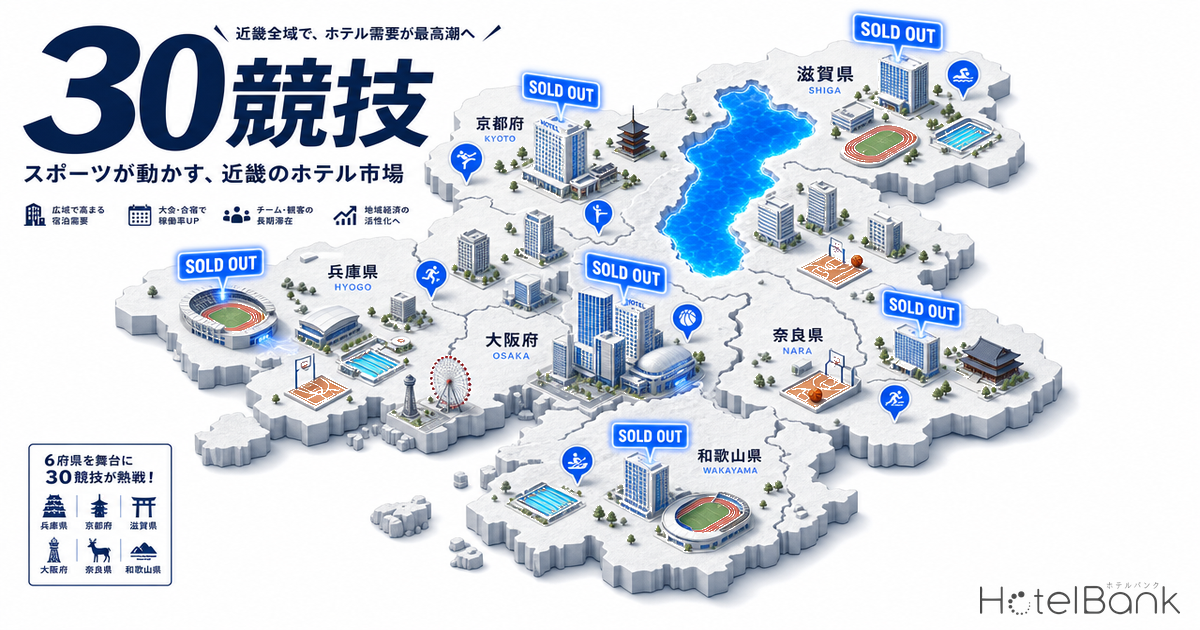
The 2026 National High School Athletic Meet — branded “Dream Leap: Summer of Youth, Kinki Inter-High 2026” — runs from July 22 to August 21, 2026, with Shiga Prefecture as host, staging 30 sports across the six Kinki prefectures plus Hokkaido and Fukushima (for a few events). Shiga alone hosts 9 sports; across the six Kinki prefectures, the roughly 30,000 athletes and coaches — together with accompanying teachers, supporting families, and media — mean that on peak days lodging demand on the order of tens of thousands of people flows into the Kinki region over a 31-day span.
In this article, drawing on the OTA-published price and remaining-inventory data that MetroEngines Research tracks for the six Kinki prefectures, we read the booking pace, category-level ADR trends, and lodging “gaps” during the meet — focusing on August 1 onward, which as of this writing (June 28) is more than 30 days ahead.
Metric Definitions Used in This Article
- ADR (Average Daily Rate): The average of sale prices published on OTAs and similar channels. This differs from actual transaction prices (cross-checked against REIT disclosure data, published ADR tends to run about +25–30% above realized ADR). Per-room rate for double occupancy (tax included), averaged across all plans (from room-only to meal-inclusive plans).
- LT (Lead Time): Number of days until the check-in date. LT0 = same day.
- Early sell-out LT: The lead time at which remaining rooms first reached zero (a larger value means an earlier sell-out).
- OCC (Occupancy): The share of sold rooms against total rooms in the area (an estimate based on OTA sale inventory).
- Data source: MetroEngines Research. Sell-out is judged using room-based remaining inventory only, aggregated over hotels whose OTA-published allotment is at least 30% of total rooms.
- — Over the 31 days from July 22 to August 21, 2026, 30 sports are held across the six Kinki prefectures plus Hokkaido and Fukushima. Shiga (the host) runs 9 sports, and both the opening and closing ceremonies take place within Shiga.
- — By category, business hotels in host-prefecture Shiga hold at ¥15,000–18,000, while city/tourist-type hotels jump sharply into the ¥33,000 range and resort-type properties are observed above ¥55,000.
- — In the early part of the meet (the Aug 1–5 week), early sell-outs at lead times above LT80 are already underway, peaking in Shiga. A mid-sized business hotel in Hikone sold out at LT90, then showed a short-lived cancellation return at LT75–70.
- — Lodging gaps appear as dispersal beyond a 30 km radius of the venues (Konan, Koka, and Kosei in Shiga; southern Kyoto; northern Nara) and on the trough days between events within the meet. The mid-August trough is the target for re-absorbing demand.
Meet Overview — 30 Sports, 31 Days, Lodging Demand Cutting Across the Six Kinki Prefectures
Kinki Inter-High 2026 is the 2026 National High School Athletic Meet organized by the All Japan High School Athletic Federation. Its competition block spans the six Kinki prefectures — Shiga (host), Kyoto, Osaka, Hyogo, Nara, and Wakayama — and, counting some events such as sailing (Hyogo), venues extend to both flanks. The meet runs 31 days, from Wednesday, July 22 to Friday, August 21, with the opening and closing ceremonies held within Shiga.
There are 30 sports. Within Shiga alone, 9 are hosted: athletics, swimming (diving, water polo, swimming), women’s volleyball, rowing, hockey, weightlifting, and fencing. Because the host prefecture cannot absorb all of them on its own, events are distributed across the wider Kinki region: men’s volleyball (Kyoto City); basketball (Osaka City, Sakai, Habikino); table tennis, men’s softball, and archery (Osaka City); gymnastics and rhythmic gymnastics (Kobe City); mountaineering (Toyooka and others); karate (Himeji City); handball (Tenri, Sakurai, Gojo, Uda); kendo (Nara City); tennis (Kashihara, Asuka); badminton (Wakayama City); and more.
Consider the scale. The typical meet participation the federation publishes is around 30,000 athletes; adding coaches and accompanying teachers, families and alumni coming to cheer, and media, the peak week (roughly the last week of July through the first week of August) generates daily lodging demand on the order of tens of thousands across the whole Kinki region. Venues are distributed by sport, but lodging spills out broadly not only around the venues but also to transport hubs (Kyoto Station, Shin-Osaka, Otsu Station), so the impact reaches beyond the host cities.
| Sport | Host | Venue | Dates | In-scope dates |
|---|---|---|---|---|
| Athletics | Shiga | Hikone · Heiwado HATO Stadium | 7/25-7/29 | 7/28-29 |
| Swimming / Diving / Water Polo | Shiga | Kusatsu · Infroneer Kusatsu Aquatics Center | 8/1-8/3 | 8/1-8/3 |
| Rowing | Shiga | Otsu · Kansai Mirai Rowing Center | 8/1-8/4 | 8/1-8/4 |
| Women’s Volleyball | Shiga | Otsu · Kusatsu · Moriyama | 8/2-8/5 | 8/2-8/5 |
| Hockey | Shiga | Maibara · Nagahama | 7/26-7/30 | 7/28-30 |
| Weightlifting | Shiga | Takashima | 8/1-8/3 | 8/1-8/3 |
| Fencing | Shiga | Otsu · Shiga Daihatsu Arena | 7/28-7/31 | 7/28-31 |
| Men’s Volleyball | Kyoto | Kyoto City | 7/26-7/29 | 7/28-29 |
| Cycling (Road) | Kyoto | Nantan · Miyama Special Road Course | 8/20 | 8/20 |
| Boxing | Kyoto | Uji | 7/27-7/31 | 7/28-31 |
| Basketball | Osaka | Osaka City · Sakai · Habikino | 7/26-8/1 | 7/28-8/1 |
| Table Tennis | Osaka | Osaka City | 8/5-8/9 | 8/5-8/9 |
| Softball (Men’s) | Osaka | Osaka City | 8/1-8/4 | 8/1-8/4 |
| Archery | Osaka | Osaka City | 8/10-8/12 | 8/10-8/12 |
| Karate | Hyogo | Himeji | 7/27-7/28 | 7/28 |
| Canoe | Hyogo | Toyooka | 7/26-7/28 | 7/28 |
| Handball | Nara | Tenri · Sakurai · Gojo · Uda | 7/27-8/2 | 7/28-8/2 |
| Kendo | Nara | Nara City | 7/27-7/28 | 7/28 |
| Tennis | Nara | Kashihara · Asuka | 7/25-7/30 | 7/28-30 |
| Badminton | Wakayama | Wakayama City | 7/26-7/30 | 7/28-30 |
| Sumo / Judo / Wrestling / others | Wakayama | Various cities | 7/25-8/3 | 7/28-8/3 |
Source: All Japan High School Athletic Federation, official “Kinki Inter-High 2026” announcement (as of May 2026); compiled by the HotelBank Editorial Team.
The “In-scope dates” column extracts July 28 onward — more than 30 days ahead of this writing (June 28). In the immediate period (within 30 days), the signals in published prices and remaining inventory are less settled and observation error grows, so this article’s lodging-demand analysis is limited to July 28–August 21.
Category-Level ADR — Host-Prefecture Shiga’s Business Hotels Hold at ¥15–18k, but City Hotels Climb to ¥33k
Comparing category-level ADR for August 2026 across the six Kinki prefectures, the mix of categories absorbing lodging demand splits clearly by prefecture. In Kyoto, ryokan, machiya townhouses, and city hotels lead, distributed in the ¥34,000–¥55,000 range, factoring in the summer on-season. Host-prefecture Shiga, by contrast, has a bipolar structure of business-hotel types (ADR around ¥15,000) and ryokan/resort types (¥53,000–¥58,000), with a thin mid-priced city/business tier that would be easy for Inter-High athletes and chaperone parties to use. This is what produces the “business hotels near the venue fill first” phenomenon discussed below. The everyday price structure of the Shiga / Lake Biwa area and how demand spills over from Kyoto is a related dynamic worth noting in its own right.
Source: MetroEngines Research; compiled by the HotelBank Editorial Team.
Looking at year-over-year (YoY) for host cities, price increases appear first in the cities where venues concentrate. In particular, Hikone in Shiga (athletics, hockey) posts an August 2026 ADR of ¥67,700 (N=11), +112.9% YoY; Uda in Nara (one of the handball venues) is ¥84,700, +146.4%; and Moriyama in Shiga (women’s volleyball venue) is ¥102,800, +61.7% — all showing marked upside in cities around the meet venues. Cities with small sample sizes (N=2–3) are strongly influenced by a single property’s pricing and should be read as a range, but clear upside is also confirmed in cities with ample samples such as Hikone (N=11), Otsu (N=11, +35.3%), Himeji (N=22, +43.3%), and Nara (N=23, +21.1%).
Source: MetroEngines Research (August 2026 ADR vs. August 2025); compiled by the HotelBank Editorial Team.
Booking Pace by Main Venue — Early Sell-Out LT Above 80 in the Aug 1–5 Week, Peaking in Shiga
For August 1–5 (the five-day stretch when major events such as swimming, rowing, women’s volleyball, men’s softball, and the tail end of handball concentrate), we aggregated hotel-level remaining-inventory data across the six Kinki prefectures. The aggregation is limited to properties whose OTA-published allotment secures at least 30% of total rooms (properties with an extremely small published allotment lower the confidence of the estimate), giving 893 properties across the six Kinki prefectures as the analysis set.
Ranking the early-sell-out LT for the early-meet week by prefecture average, host-prefecture Shiga stands out on top, followed by Osaka, Hyogo, and Kyoto. At the top hotels in each prefecture, early-sell-out LT exceeds 80, and several properties were already at zero remaining rooms on OTAs as of early May (LT85–90).
Source: MetroEngines Research (August 1–5, 2026; OTA-published allotment ≥30% of total rooms); compiled by the HotelBank Editorial Team.
The top properties by prefecture are organized below. Mid-sized properties (30–100 rooms) with early-sell-out LT of 80 or more, in lodging locations with good venue access, line up.
| Prefecture | Property | Rooms | Category | Avg early sell-out LT | Sell-out days observed |
|---|---|---|---|---|---|
| Shiga | Family Lodge Hatagoya Hikone (ファミリーロッジ旅籠屋・彦根店) | 14 | Lodge | 89 | 4 of 5 |
| Green Park Omoide-no-Mori Bungalows (グリーンパーク想い出の森 バンガロー) | 23 | Vacation rental | 89 | 5 of 5 | |
| Biwako Hanakaido (びわ湖花街道) | 43 | Ryokan | 88 | 1 of 5 | |
| Kyoto | Santoan (三塔庵) | 6 | Machiya | 88 | 5 of 5 |
| Ryokan Suzuran (旅館すずらん) | 7 | Ryokan | 88 | 1 of 4 | |
| LiVEMAX Resort Yuhigaura Kizu Onsen (リブマックスリゾート夕日ヶ浦木津温泉) | 15 | Ryokan | 88 | 1 of 5 | |
| Osaka | Toyoko Inn Abeno Tennoji (東横INNあべの天王寺) | 417 | Business hotel | 90 | 1 of 5 |
| Hotel Awina Osaka (ホテルアウィーナ大阪) | 111 | City hotel | 90 | 1 of 5 | |
| Richmond Hotel Namba Daikokucho (リッチモンドホテルなんば大国町) | 202 | Business hotel | 90 | 2 of 3 | |
| Hyogo | Kaisen-no-Yado Minshuku Misaki (海鮮の宿 民宿みさき) | 6 | Guesthouse | 90 | 1 of 5 |
| Ariston Hotel Kobe (アリストンホテル神戸) | 121 | City hotel | 90 | 1 of 5 | |
| Sunrise Awaji (サンライズ淡路) | 16 | Corporate / group lodge | 90 | 1 of 4 | |
| Nara | Business Ryokan Yamabe (ビジネス旅館やまべ) | 12 | Ryokan | 90 | 3 of 5 |
| Bakery Hotel Château d’Or (ベーカリーホテルシャトードール) | 48 | Hostel | 90 | 2 of 5 | |
| Iroha Grand Hotel Kintetsu Nara Ekimae (いろはグランホテル近鉄奈良駅前) | 143 | Business hotel | 89 | 3 of 5 | |
| Wakayama | Shukubo Jokiin (宿坊 常喜院) | 23 | Other | 90 | 1 of 4 |
| Daiwa Roynet Hotel Wakayama (ダイワロイネットホテル和歌山) | 219 | City hotel | 90 | 1 of 5 | |
| Farm Guesthouse Haru (農家民宿はる) | 2 | Farm guesthouse | 90 | 1 of 5 |
Source: MetroEngines Research (August 1–5, 2026; OTA-published allotment ≥30% of total rooms; analysis set = 705 properties); compiled by the HotelBank Editorial Team.
Case Study — A Mid-Sized Business Hotel in Hikone: Sold Out at LT90, with a Short-Lived Return at LT75–70
As a concrete example, take a mid-sized business hotel A (52 rooms) within walking distance of the athletics venue (Hikone · Heiwado HATO Stadium, July 25–29), and its remaining-room trajectory for check-in date August 2, 2026 (a Sunday overlapping the first day of women’s volleyball). Over 56 observation points, it was already at 0 remaining rooms at LT90 (early May); the sell-out held through LT80 (mid-May); around LT75 a short-lived 2–4 rooms of inventory returned; then from LT65–50 it pinned back at 0. Even at the most recent LT35 (late June), inventory stood at just 8 rooms, indicating that the demand peak is continuing.
Source: MetroEngines Research (check-in August 2, 2026; 56 observation points); compiled by the HotelBank Editorial Team.
Such “short-lived inventory returns” in the LT70–50 band could stem from several causes — the cancellation cycle of group bookings, the possibility that the hotel is releasing OTA allotment in small batches, or operations that adjust direct-sale/corporate-contract blocks against OTA blocks according to supply and demand. Readers trying to grab a room again at the last minute should target the intermittent returning inventory in the LT30–14 band (two weeks to a month before check-in). Where the area around a venue has already sold out early, the realistic approach is a two-pronged one: give up on it for now and shift your view to a wider area, or keep checking intermittently for returning inventory. The same structure — thin lodging near a venue forcing wide-area dispersal at a summer sporting event — recurs at events such as the Koshien high-school baseball tournament, where remaining-inventory data shows demand rippling out to Nishinomiya, Amagasaki, and western Osaka.
Lodging Gaps — Dispersal Beyond a 30 km Radius and Reading the Trough Days Within the Meet
When the area around a venue sells out early, the choice is either to spread lodging across a wider area or to pinpoint trough days within the meet. On wide-area dispersal first: within a 30 km radius of Shiga’s main venues (Hikone, Otsu, Kusatsu, Moriyama), business hotels are scattered across Maibara, Omihachiman, Higashiomi, Konan, and Koka. In these municipalities, business-hotel ADR as of August 2026 all runs in the ¥15,000–¥19,000 range, making them a realistic “fallback” once the closest lodging fills up. Maibara is about 30 minutes from Otsu and about 10 minutes from Hikone on the JR Special Rapid, so it is practical even for hockey and athletics athletes and their chaperone parties.
| Municipality | Category | ADR (Aug 2026) | Properties |
|---|---|---|---|
| Konan | Business hotel | ¥16,163 | 5 |
| Koka | Business hotel | ¥15,510 | 7 |
| Kusatsu | Business hotel | ¥17,068 | 5 |
| Omihachiman | Business hotel | ¥18,838 | 6 |
| Higashiomi | Business hotel | ¥16,229 | 6 |
| Hikone | Business hotel | ¥15,129 | 11 |
| Otsu | Business hotel | ¥18,205 | 9 |
Source: MetroEngines Research (August 2026, business hotels within Shiga); compiled by the HotelBank Editorial Team.
Next, focus on the trough days within the meet. Looking at August’s event layout, Shiga’s main events (swimming, rowing, women’s volleyball) concentrate on August 1–5; Kyoto’s men’s volleyball and boxing end in late July; Osaka’s table tennis runs August 5–9 and archery August 10–12; meanwhile the Obon week of August 13–20 thins out in terms of Inter-High events. The road cycling event held in Wakayama on August 21 is the final day, but the week before it may see Inter-High lodging demand ease temporarily. Note, however, that August 13–16 overlaps the maximum peak of the Obon holiday, when tourism demand unrelated to the Inter-High competes for the same lodging inventory, so prices stay elevated on a separate axis.
As a result, when you cannot book the lodging closest to a venue, the approaches fall into three patterns: (1) shift one day before or after the event day to catch returning inventory near the venue; (2) if you must stay on the event day, switch to wide-area dispersal within a 30 km radius (mid-priced business hotels in Maibara, Koka, Omihachiman, Higashiomi); or (3) for events whose schedule can be shifted to after Obon — August 17–20 (table tennis, road cycling, etc.) — target the relative demand trough after the Obon peak.
Summary — Sports-MICE Lodging Demand Moves in Two Layers: “Dispersed Peaks” and a “Hard-to-Read Trough”
Because Kinki Inter-High 2026 is so large — 30 sports across six prefectures over 31 days — lodging demand builds in two layers: the “August first-week peak in host Shiga” and “sub-peaks scattered across the prefectures.” Our aggregation likewise found that the top tier of mid-sized business hotels and ryokan in host Shiga is the sharpest, at early-sell-out LT85–90, and that top-tier hotels in the neighboring prefectures (Kyoto, Osaka) also posted early-sell-out LT85–90. On price too, host cities such as Hikone, Moriyama, Uda, and Himeji show +30% to +146% YoY upside.
From the receiving hotel’s side, the Inter-High should be seen not as a one-off high-demand event but as a “distributed MICE” whose peak keeps moving from July 22 to August 21. The impact of multi-day continuous events on lodging demand and ADR can be seen in cases such as the 15-day Grand Sumo tournaments, where demand stays quantitatively elevated across the full run. Even prefectures whose venues are far away can find opportunity once they fall within athletes’ and chaperones’ lodging radius. Conversely, for users making bookings, the realistic solution is to not fixate on the closest lodging and instead combine mid-priced properties within a 30 km radius with the trough days inside the meet.
The remaining-inventory and price data covered here are estimates based on OTA-published prices that MetroEngines Research tracks across the six Kinki prefectures. Because direct sales, corporate contracts, and group-only blocks move separately, it is worth adding that actual on-the-ground supply and demand are likely even tighter.
⚠ A note on ADR for future dates: The ADR and remaining-inventory data in this article are the averages of sale prices and inventory published on OTAs as of June 28, 2026, and change as check-in dates approach. This article’s analysis targets July 28 onward (more than 30 days ahead of writing), but actual figures will vary due to returning inventory, last-minute price cuts, and possible added supply.
References & Sources
- All Japan High School Athletic Federation — Official “Dream Leap: Summer of Youth, Kinki Inter-High 2026” site
- Kinki Inter-High 2026 — Full list of sports, venues, and schedules (all prefectures)
- Kinki Inter-High 2026 — List of sports, venues, and schedules (Shiga Prefecture)
- Shiga Prefectural Board of Education — “The 2026 National High School Athletic Meet (Inter-High) will be held across the Kinki block!”
- All Japan High School Athletic Federation — “Inter-High Information”
- MetroEngines Research — OTA-published price data, remaining-inventory curves, and booking-pace signals (six Kinki prefectures; N = analysis set specified within the article)
■ Data Sources
This article combines OTA-published price data and remaining-inventory curves for the six Kinki prefectures aggregated by MetroEngine Research & Consulting (as of May–June 2026; target properties as described in the text) with public materials from the All Japan High School Athletic Federation and the Shiga Prefectural Board of Education. Price and inventory data are based on a snapshot as of June 28, 2026.
■ Estimation Assumptions
Category-level ADR is based on the area-aggregated median. Booking pace (LT) is expressed as days from the check-in date, and the cumulative sell-out rate is the combined basis of target properties within a set radius of the venue’s nearest station. The estimates primarily target inventory more than 30 days ahead of this writing (June 28); the most recent 30 days are described separately in the text because short-term cancellation returns have a large effect.
■ Limitations & Caveats
The figures in this article are aggregations of OTA-published prices and inventory and do not include group or direct bookings, so they may understate total real demand. Operator arrangements during the meet (priority blocks for school groups and athlete delegations) are often not reflected in displayed prices, and apparent vacancies on trough days do not necessarily negate the existence of real demand. Because prices and inventory are updated daily, they will change after this article is published.