

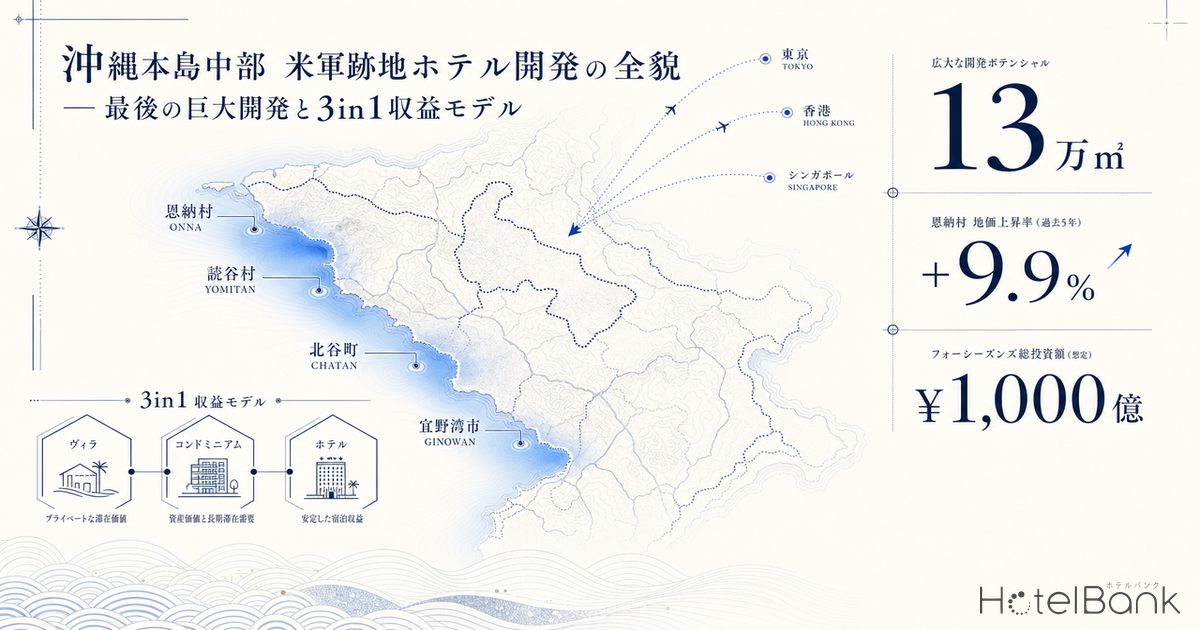
Central Okinawa Island — Onna Village, Yomitan Village, Chatan Town, and Ginowan City. Across these four areas, former US military base sites that have shaped Okinawa’s tourism for the past half-century are now becoming the stage for the “final wave of mega-scale hotel development.” Leading the way is the Four Seasons Resort in Onna Village (total project cost approx. ¥100 billion, on the 130,000+ m² former Onna Communication Site), which broke ground in March 2024. April 2026 sees the opening of Rihga Royal Resort Okinawa Chatan (former Ferris wheel site, 209 rooms), followed by BLISSTIA SUITES & RESORT Okinawa Onnason (139 rooms) in July 2026. Within just three years, more than 1,000 high-ADR resort rooms will be added to the market across these four central areas alone. Drawing on OTA published price data from MetroEngines Research (メトロエンジンリサーチ) and public disclosures, this article systematically organizes the scale, price structure, 3-in-1 (villa, condominium, hotel) revenue model, and Cap Rate positioning of this “final development opportunity.”
Metric Definitions Used in This Article
- ADR (Average Daily Rate): Average of publicly listed sale prices on OTAs and similar channels. This differs from actual transacted rates (when cross-referenced with REIT disclosure data, OTA prices tend to be +25-30% higher than transacted ADR). Per-room rate (tax included) for double occupancy, averaged across all plans (room-only through meal-inclusive).
- OCC (Occupancy Rate): Ratio of sold rooms to total area room inventory (estimated value based on OTA sales inventory).
- Cap Rate (Capitalization Rate): Expected yield for real estate investment. Calculated as NOI (Net Operating Income) ÷ property acquisition price. Lower values indicate higher investor valuation (= higher price).
- Data Source: MetroEngines Research & Consulting
Executive Summary
The US military site hotel developments in central Okinawa Island are dubbed “the final mega-development” because three structural shifts are progressing simultaneously. First, under the Kadena-and-south return plan, the former Onna Communication Site is effectively the last contiguous 130,000+ m² flat parcel; future returns such as the Kishaba Housing District of Camp Foster (5 ha scheduled for return within FY2026) will shift toward smaller, dispersed parcels. Second, the scale of a foreign capital investment (Berjaya Group) of ¥100 billion single-handedly is exceptional in Japan, ranking alongside Rosewood Miyakojima (Mitsubishi Estate, 55 villas, opened March 2025) as one of the largest projects in the country. Third, the “3-in-1 revenue model” — combining villa sales, condominium owner programs, and hotel operations in a single property — is gaining economic rationality, backed by site scarcity and high ADR (winter peak ¥168,200).
2026 Central 4-Area US Military Site Hotel Development Timeline
Below are the major projects announced over the past few years in the central 4 areas, organized by opening date. Rihga Royal Resort Okinawa Chatan (April 1, 2026, 209 rooms, former Ferris wheel site) leads the wave, followed by BLISSTIA SUITES & RESORT Okinawa Onnason (July 15, 2026, 139 rooms). Then in summer 2027, the Four Seasons Resort and Private Residences Okinawa (former US Onna Communication Site, comprising 127 hotel rooms + 124 condominiums + 28 villas = 279 rooms+) will open. The total project cost of ¥100 billion borne solely by Berjaya Group ranks among the largest luxury resort investments in Japanese history, alongside Rosewood Miyakojima (55 villas, opened March 2025).
| Opening | Hotel Name | Location (former site / characteristics) | Rooms | Main Features |
|---|---|---|---|---|
| 2026/4/1 | Rihga Royal Resort Okinawa Chatan | Mihama, Chatan Town (former Ferris wheel site) | 209 | Condominium-type, 18 floors |
| 2026/4/3 | Hotel Monterey La Soeur Naha | Naha City (reference, southern) | 223 | City hotel |
| 2026/5/5 | Kanehide Onna Marine View Palace | Onna Village | 39 | Resort |
| 2026/5/23 | Southgate Hotel Okinawa | (Okinawa Prefecture) | 216 | City |
| 2026/7/15 | BLISSTIA SUITES & RESORT Okinawa Onnason | Onna Village | 139 | Suite-type resort |
| 2026/7/3 | PGM Hotel Resort Okinawa | (Okinawa Prefecture) | 201 | Resort |
| 2027/Summer | Four Seasons Okinawa | Onna Village (former US Onna Communication Site, 130,000 m²) | 279+ | 3-in-1 (Hotel 127 + Condo 124 + Villa 28) |
Distribution of Former US Military Sites and Geographic Relationship of Central 4 Areas
US military facilities and zones south of Kadena Air Base — approximately 1,048 hectares (roughly 220 Tokyo Domes) — are subject to return. However, the Kadena-and-south return plan has three categories: (I) immediate return upon procedural completion, (II) return after alternative facility construction within Okinawa Prefecture, and (III) return after Marine Corps relocation abroad — a phased schedule. For Futenma Air Base (Ginowan City, approx. 481 ha), Henoko relocation delays (pile-driving progress at 6.6%, struggling with soft seabed), combined with US DoD’s additional condition of a longer runway, have pushed back the return timing repeatedly over 30 years. In other words, the core area of Ginowan City is unlikely to become a target for tourism development in the medium term.
As a result, the realistically active “mega-development” sites are concentrated in three areas: Onna Village, Chatan Town, and Yomitan Village. Onna Village is the center of west-coast resort clustering (Rizzan Sea-Park Hotel Tancha Bay 826 rooms, ANA InterContinental Manza 400 rooms, The Busena Terrace 410 rooms, Halekulani Okinawa 360 rooms, and others), and the Four Seasons will add a new luxury top-tier property to this belt. Chatan Town is an urban-style resort area centered on American Village (Hilton Okinawa Chatan 346 rooms, Vessel Hotel Campana Okinawa 324 rooms, The Beach Tower Okinawa 280 rooms). Yomitan Village hosts Hotel Nikko Alivila (396 rooms) and The Uza Terrace Beach Club Villas (48 rooms) — compact yet high-ADR. Ginowan City has Moon Ocean Ginowan (177 rooms) and Laguna Garden Hotel (303 rooms), serving primarily convention and business demand.
Land Prices, Zoning Regulations, and Disaster Risk in the Central 4 Areas
Okinawa Prefecture’s 2025 official land prices rose +7.3% in residential areas — ranking first nationwide for the second consecutive year. In the 2025 benchmark land prices, Onna Village leads all municipalities in growth rate at +9.9%, with Chatan Town in second place at +9.4% — the central group dominates. Chatan Town’s residential land published price is ¥205,600/m² (rate of change +9.19%); Ginowan City is ¥140,687/m² (+8.28%). This rise is not driven by housing demand alone, but by mixed demand from hotels, condominiums, and second homes pushing land prices up. Since post-return use of former US military sites passes through land readjustment projects before release to the private sector, scarcity is extremely high.
| Area | Benchmark Land Price Change | Residential Land Published Price | Main Use Designation | Tsunami/Flood Risk | Hotel Development Suitability |
|---|---|---|---|---|---|
| Onna Village (west coast) | +9.9% | — | Urbanization control / tourism district | Medium (coastal tsunami) | Highest (west coast view) |
| Chatan Town (Mihama) | +9.4% | ¥205,600/m² | Commercial / quasi-industrial | Medium (low elevation) | High (urban-style) |
| Yomitan Village (Cape Zanpa) | ~+8% (est.) | — | Urbanization control area | Low (mostly elevated) | High (scenery) |
| Ginowan City | +8.3% | ¥140,687/m² | Commercial / residential | Medium (coastal) | Medium (Futenma return undetermined) |
On the regulatory side, most of Onna Village’s west coast is designated urbanization control, but large-scale development is possible under district plans (Article 12-4 of the City Planning Act) for resort purposes. The Four Seasons’ 130,000 m² is extremely large as a single contiguous parcel, and securing an equivalent site elsewhere in the central area going forward will be effectively impossible. Mihama in Chatan Town is mostly designated commercial, suitable for high-rise hotel developments like Rihga Royal Resort Okinawa Chatan (18 floors, 209 rooms). Coastal tsunami and storm surge are common disaster risks, but Halekulani Okinawa and Manza Beach Resort have operated successfully for years, demonstrating that the risk is manageable through design.
ADR Positioning of Existing Luxury Resorts (Winter Peak)
To assess the economic rationality of new developments, we must first understand the actual ADR of existing luxury resorts. Looking at the top ADRs across the central 4 areas plus Nago City for December 2025 to February 2026 (winter peak, 90 days), compiled by MetroEngines Research: The Uza Terrace Beach Club Villas (Yomitan, 48 rooms) stands out at ¥168,200, followed by Hoshinoya Okinawa (Yomitan, 100 rooms) at ¥107,800, Halekulani Okinawa (Onna, 360 rooms) at ¥107,200, and The Ritz-Carlton Okinawa (Nago, 97 rooms) at ¥117,700 — forming a luxury tier above ¥100,000. Notably, villa-type and villa-attached properties (Uza Terrace, Hoshinoya, Ritz-Carlton) occupy the top spots despite being small-scale with fewer than 100 rooms.
WS① Villa & Small-Scale Luxury
Above ¥100K × 48-100 rooms. Only three properties: Uza Terrace, Hoshinoya, Ritz-Carlton. Four Seasons’ 28 villas + 124 condominiums enter here — the demand-overflowing top tier.
WS② Upper-Mid Mid-Scale (127-room tier)
¥60-100K × 100-300 rooms. HIYORI Ocean Resort, Hilton Chatan, Hyatt Seragaki. Four Seasons’ 127-room hotel block targets the upper segment of this tier.
Established Layer Mid- to Large-Scale Resorts
¥30-60K × 300-800 room tier. Kariyushi Beach Resort, Renaissance, Rizzan Sea-Park. Main battleground for existing properties — new entrants need clear differentiation.
Beyond winter peak ADR, summer peak (July-August) prices also tend to match or exceed (this article’s data is winter-peak only, but Hoshinoya, Halekulani, etc. maintain ¥100K-level rates year-round). Estimated May 2026 OCC for Okinawa Prefecture overall is 84.7% (N=1,109 properties, 51,396 rooms), with business hotels at 87.0% and resort/city upper tiers also in the high 80s%, indicating already-tight demand. The 279+ rooms Four Seasons adds in 2027 will ease this tightness, but the high villa and condominium ratio limits any “dilution effect that lowers ADR.” Beyond Okinawa, 2026 sees a concentration of new luxury supply nationwide. For market impact across regions, see our detailed analysis in Six Luxury Hotels Opening in 2026: Investor-Perspective Market Impact Analysis.
Supply-Demand Balance — Estimated May 2026 OCC (Okinawa Prefecture Overall)
MetroEngines Research estimates Okinawa Prefecture’s May 2026 OCC at an all-property average of 84.7% (N=1,109 properties, 51,396 rooms, 8-day observation average). This methodology differs from JTA’s official accommodation statistics, but is effective for indicating the direction of supply-demand tightness. Daily trends show a typical pattern: ¥26,600/night at month start → bottoming out in the ¥22,000s mid-month → rebounding to ¥25,000s by the post-Golden Week weekend. As inventory builds, prices slip slightly while OCC rises from low 80s% to high 80s% — a structure that leaves room for price cuts while approaching a ceiling just below 90%.
3-in-1 Revenue Model — Mutual Subsidization Across Villa Sales, Condominium Ownership, and Hotel Operations
The Four Seasons Okinawa configuration — “127 hotel rooms + 124 condominiums + 28 villas” — is more than just room-type diversification. The “3-in-1 model” combines three revenue streams on a single site, gaining economic rationality on the premise that site scarcity and luxury demand exist simultaneously. A comparable model was pioneered domestically by Rosewood Miyakojima (Mitsubishi Estate, 55 villas, opened March 2025, 95,000 m² site, from ¥194,700/night). QUILL RESORT OKINAWA in Motobu Town (jointly developed by Nippon Steel Kowa Real Estate, Mitsubishi Estate Residence, Cosmos Initia, and Yugaf HD; sales began August 2025) also adopts a similar sectional-ownership condominium hotel structure.
| Revenue Source | Scale | Revenue Timing | Estimated Price Range | Role |
|---|---|---|---|---|
| Villa Sales | 28 units | Lump-sum around opening (capital recovery) | ¥300M-1B per unit (Japan luxury estimate) | Early recovery of project cost / construction cost sharing |
| Condominium Owner Program | 124 rooms | Sales + ongoing management fees | ¥50M-200M per room + annual operating fee | Transfers part of vacancy risk to owners / continuous revenue |
| Hotel Operation | 127 rooms | Tied to occupancy (daily) | ADR ¥80,000-200,000/night | Brand maintenance / securing staff utilization |
| Shared Infrastructure | Spa / Restaurants / Pool / Chapel | Owner fees + guest use + external use | — | Three parties share fixed costs (mutual subsidization of management costs) |
The 3-in-1 model has three strategic advantages. First, initial capital recovery through villa sales significantly reduces the risk of a ¥100B-scale project. At 28 units × average ¥500M each = ¥14B, with upside reaching ¥28B in front-loaded recovery. Second, the condominium owner program uses an “operating-when-not-in-use” model (similar to Anabuki Kosan DUAL LIFE or QUILL RESORT operated by Maeda Sangyo Hotels), sharing vacancy risk with owners. Third, fixed costs of the spa, chapel, and restaurants are distributed across three user segments (villa owners, condominium owners, hotel guests), lowering the property’s break-even point.
Cap Rate Tier Comparison — Naha 5.0%, Niseko in Low Range, Four Seasons Okinawa Estimated at 3.5%
Hotel investment cap rates (Cap Rate = NOI / acquisition price) diverge widely by market maturity and future expectations. Naha hotel transaction cap rates as of 2025 are around 5%; Niseko premium resorts are in the 1-2% range (based on transaction/development levels for Aman, Six Senses, Capella, etc.). For the Four Seasons Okinawa, the residual hotel block after villa and condominium sales would likely transact in the 3.5-4.0% range. Lower cap rates mean higher investor valuation = higher price. According to JLL, domestic hotel investment in 2024 reached ¥1.0613 trillion — the first time exceeding the ¥1 trillion mark — and H1 2025 luxury RevPAR was +15% vs. 2019, remaining robust.
For the Four Seasons Okinawa to transact at a 3.5% cap rate, the hotel block would require ADR of ¥80,000-120,000 (maintaining winter-peak levels year-round), annual OCC above 75%, and GOP margin of 35-40%. Given existing performance at The Ritz-Carlton Okinawa (winter-peak ADR ¥117,700, 97 rooms) and Halekulani Okinawa (¥107,200, 360 rooms), the Four Seasons brand strength puts this level within reach. That said, this is a simplified estimate — actual investment decisions require detailed feasibility studies. For a similar case cross-referencing DBJ estimates with OTA actuals to verify luxury supply-demand, see The Turning Point in Kansai Luxury Hotel Supply-Demand.
Full Picture of 2026 Okinawa Hotel Development & New Openings (Including Outside Central Area)
New hotels opening in Okinawa Prefecture in 2026 tracked by MetroEngines Research (based on OTA listing verification) total 46 properties with an estimated 1,000+ cumulative rooms — ranking #1 among all prefectures nationwide. However, the breakdown skews heavily toward rental villas and small-scale villas; mid- to large-scale properties with 20+ rooms total about 20. Focusing on central Okinawa Island (Onna, Chatan, Yomitan, Ginowan, Nago, etc.), there are 7 properties with 20+ rooms totaling 430+ rooms. Adding the Four Seasons’ 279+ rooms in summer 2027 brings the 3-year addition in the central 4 areas to about 1,000-1,500 rooms — equivalent to a 10-15% increase over existing central room inventory, a scale that clearly impacts supply-demand. For the northern market (Nakijin Village, Nago City), where seasonality is shifting in parallel with Junglia Okinawa’s opening, see our separate analysis: Will Junglia Okinawa’s Opening Shift the Northern Market to a “Year-Round” Model?
Exit Strategy — Prince Hotels 31-Property / GIC ¥150B Portfolio Sale Scenario
The most-discussed exit scenario for large hotel developments in recent years has been Seibu Holdings’ bulk sale of 31 Prince Hotels properties to GIC (Government of Singapore Investment Corporation) — agreed in 2022, with a transfer price of approximately ¥150 billion and transfer gain of approximately ¥80 billion. This transaction, which signaled “a shift from holding to turnover-based real estate business,” has become emblematic of the separation of development, operation, and ownership. For Berjaya Group’s Four Seasons Okinawa, after recouping initial investment via villa and condominium sales, a realistic scenario is to sell the hotel block to pension funds, REITs, or overseas sovereign funds at a 3.5-4.0% cap rate.
| Scenario | Transaction Target | Estimated Amount | Example Acquirers | Notes |
|---|---|---|---|---|
| A. Hotel block sale only | 127 hotel rooms + shared facility operating rights | ¥35-50B (Cap 3.5-4.0%) | Overseas sovereigns, pension funds | Operation continues under Four Seasons |
| B. Whole-resort sale | Hotel + remaining condominium quota | ¥60-90B | Overseas PE funds | Owner program continues |
| C. Continued villa sales + long-term hotel ownership | Phased cash flow recovery | Cumulative ¥100-150B (10 years) | — | Likely main scenario (early recovery + operating revenue) |
| D. Seibu HD 31-property bulk model | Berjaya Japan portfolio | — | GIC and other sovereign funds | Reference case (2022, ¥150B) |
Scarcity Behind the Label “Final Mega-Development”
The article’s title — “the final mega-development” — is supported by three reasons. First, of the Kadena-and-south return plan, single-site parcels exceeding 130,000 m² are near-final at the former Onna Communication Site. Future returns such as Kishaba Housing District of Camp Foster (5 ha within FY2026) are all in the single- to low-double-digit hectare range, not directly convertible to mega-resort developments. Second, the return of Futenma Air Base (481 ha, Ginowan City) is timed uncertainly due to Henoko relocation delays, and even when returned, area available for tourism development will likely be limited by residential land readjustment and prioritization of public uses. Third, the southern return sites including Naha Military Port (conditional on Urasoe Wharf alternative facility construction) are envisioned for port and logistics use — not luxury resort land.
In short, “unutilized, scenic, contiguous parcels of 130,000+ m² capable of accepting solo foreign capital investment at the ¥100B scale” — the former Onna Communication Site is effectively the last such opportunity on the central west coast. This is the fundamental reason Okinawa Prefecture’s land price growth has ranked first nationally for two consecutive years: with no equivalent future supply visible, the scarcity premium on existing large parcels and existing resorts is rapidly rising. For investors, evaluating this scarcity premium is at the core of 2026-2030 decision-making.
SDGs / ESG Certification Trends — Linkage Between Investor Needs and Local Society
In recent years, ESG investors increasingly weigh SDGs/ESG-related certifications when acquiring hotels. In Okinawa Prefecture, Okinawa Prince Hotel Ocean View Ginowan obtained “Sakura Quality An ESG Practice” (known as Sakura Quality Green) at the “4 Gyoiko-Zakura” tier — the fourth accommodation property in the prefecture to do so. Hotel JAL City Naha is also advancing ESG-related certifications. If new openings such as Four Seasons Okinawa and Rihga Royal Resort Okinawa Chatan pursue ESG certifications, this directly contributes to cap rate compression (= higher acquisition price) from overseas institutional investors — a critical lever expanding exit strategy options. For an empirical analysis of the ADR/review premium of ESG-certified hotels, see Do ESG-Certified Hotels Earn a Premium in Reviews and ADR?
Conclusion — Implications for Investors and Developers
Central Okinawa Island’s US military site hotel developments rest on five structural factors: (1) site scarcity, (2) the +9.9%/year land price growth trend, (3) winter-peak luxury demand above ¥100K, (4) the economic rationality of the 3-in-1 revenue model, and (5) a domestic hotel investment market exceeding ¥1 trillion. The ¥100 billion Four Seasons Okinawa investment becomes feasible only when all factors align, and similar projects are unlikely to emerge again in the central 4 areas. Meanwhile, 100-200 room condominium and serviced-apartment style developments such as Rihga Royal Resort Okinawa Chatan (April 2026, condominium type, 209 rooms) and BLISSTIA SUITES & RESORT Okinawa Onnason (July 2026, 139 rooms) remain a tier where upside can still be expected. For investors, three options will surface in sequence over the next 5 years: (a) participation in new luxury developments, (b) acquisition + rebranding of existing luxury properties, and (c) participation in condominium owner programs.
⚠ Disclaimer on Future-Date ADR and Investment Estimates: ADR figures in this article are averages of publicly listed OTA prices at the time of research and will fluctuate as check-in dates approach. Cap Rate estimates, villa sales prices, and exit scenario amounts are simplified estimates based on reference values from comparable luxury resorts; actual investment decisions require detailed feasibility studies. US military site return schedules may change significantly due to political and diplomatic factors, and development plans may also be modified pending city planning and district planning procedures.
Related Reading
- Six Luxury Hotels Opening in 2026: Investor-Perspective Market Impact Analysis
- Will Junglia Okinawa’s Opening Shift the Northern Market to a “Year-Round” Model? — Verification via 6-Area ADR and Sell-Out Rates
- The Turning Point in Kansai Luxury Hotel Supply-Demand — Reading 2026 with DBJ Estimates and OTA Actuals
- Do ESG-Certified Hotels Earn a Premium in Reviews and ADR? — Field Analysis of 35 Properties vs. 397 Control Group
- [Interview] “Bise Enpu,” a Single-Building Villa Nestled in the Fukugi Forest of Okinawa’s Bise, Opens
- Hotel Investment in the Era of 80% Nankai Trough Risk — Disaster Risk × ADR × Risk-Adjusted Yield Analysis Across 10 Pacific Coast Destinations
- Mandarin Oriental Setouchi: Reshaping the Regional Luxury Market | The Background of Kagawa ADR +17% and Opening Impact
References & Sources
■ Market Data
- MetroEngines Research & Consulting — OTA published price data (N=65 properties across the central 4 areas, ADR, December 2025-February 2026); estimated occupancy (OCC, May 2026, N=1,109 properties); new opening data (2026 Okinawa Prefecture N=573)
■ Government Statistics & Public Data
- Ministry of Defense “Consolidated Plan for US Military Facilities and Areas in Okinawa”
- Ministry of Defense “Futenma Replacement Facility”
- Cabinet Office Okinawa General Bureau “Guide to Return Sites and Return-Agreed Facilities”
- Okinawa Prefecture “Land Price Surveys and Land Price Publication”
- Okinawa Times “Okinawa Published Land Prices 2026: Growth Rate Rankings”
■ Industry Reports
- JLL “Japan’s Hotel Investment Market to Reach New Heights in 2025”
- Travel Voice “Latest Trends in Japan’s Hotel Market: Attractive on Global Comparison” (December 2025, JLL survey)
- Travel Voice “Seibu HD Transfers 31 Prince Hotel Properties to GIC, Transfer Price ¥150B”
- GIC “Announcement of Acquisition of 31 Hotel and Leisure Assets from Seibu Holdings”
■ News & Press Releases (per project)
- Hoteres “Four Seasons Okinawa Holds Groundbreaking Ceremony for 2027 Opening with Condominiums and Villas”
- Okinawa Times “Four Seasons Hotel Breaks Ground at Former Okinawa US Onna Communication Site, Scheduled to Open Summer 2027”
- Kansai Sanpo “Four Seasons Resort and Private Residences Okinawa Opening Summer 2027, Total Project Cost ¥100B”
- Royal Hotel Press Release “Rihga Royal Resort Okinawa Chatan Opening April 2026”
- Nikkei “Rihga Royal Resort Okinawa Chatan Opening April 1 as Condominium-Type”
- Miyako Shimpo “Rosewood Miyakojima Opens with 55 Villa-Type Buildings at the Southern Tip of Oura Bay”
- Nippon Steel Kowa Real Estate “QUILL RESORT OKINAWA condominium hotel: Phase 1 Sales Begin August 20, 2025”
- Hoteres “Okinawa Prince Hotel Ocean View Ginowan Obtains International SDGs Accommodation Certification”