

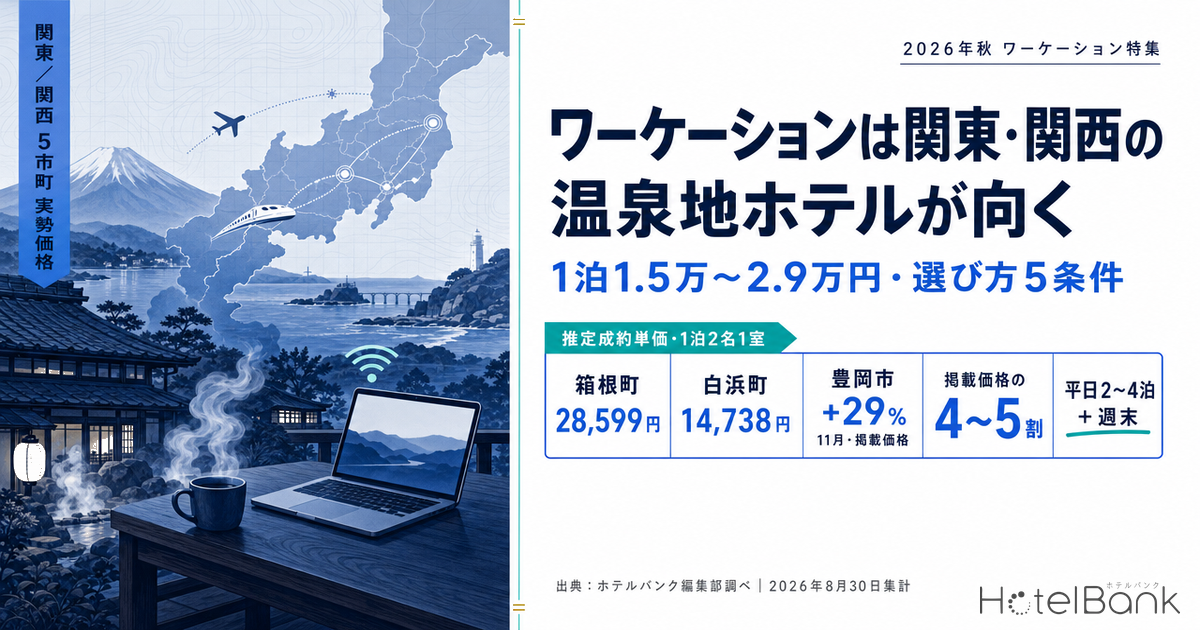
A workation in Japan works best as two to four weekday nights at an onsen or resort town outside the big cities. In the Kanto area the candidates are Hakone, Atami and Karuizawa; in Kansai they are Shirahama, Kinosaki (Toyooka) and the Lake Biwa area. For October 2026, estimated transacted rates derived from advance inventory fall between ¥14,700 and ¥28,600 per night for two people in one room (Shirahama ¥14,700 to Hakone ¥28,600). This article covers where to go, what to check before booking, and what it costs, using the latest data for five municipalities across Kanto and Kansai.
• Listed price = the monthly average of daily averages across all plans published by each property on OTAs, aggregated at the municipal level (two people in one room, per-room rate, tax included).
• Estimated transacted rate = an indication of the transaction level estimated from how advance inventory is selling (tax-excluded equivalent). It is an estimate and differs from the actual transacted price at any individual property.
• Note: all prices are per-room rates for two people in one room. For single occupancy, please check each property’s listed price individually.
• Aggregated as of August 30, 2026 / Source: HotelBank Editorial Team research (OTA public data)
- — Two to four weekday nights plus a weekend is the standard shape. One night does not repay the travel time, and beyond a week the balance between work and daily life becomes heavy.
- — Estimated transacted rates for October 2026 run from ¥14,738 in Shirahama to ¥28,599 in Hakone per night for two. To start on a smaller budget, the Kansai coast is the entry point.
- — Listed prices are ¥58,579 in Hakone and ¥32,421 in Shirahama, but estimated transacted rates sit at 40-50% of that level. Do not build a budget from the displayed price alone.
- — The five selection criteria are an explicit statement about the internet line, a desk and chair, a multi-night plan, flexibility around meals, and travel time within three hours. Verify each on the official site, not in reviews.
- — In Toyooka (Kinosaki), November listed prices are 29% above October. Avoid the crab season, or if you go in November, build the stay around weekdays only.
Who it suits, and what kind of stay
A workation works most easily when you pick a week with few meetings and treat two to four weekday nights plus a weekend as one set. A single night does not repay the travel time, and past a week, carrying both your work equipment and your daily life becomes a burden. At two to four nights, the switch between working in the room or lounge during weekday afternoons and spending evenings and the weekend at the onsen or sightseeing runs comfortably.
There are two reasons to head for an onsen or resort town outside the cities. First, a morning and evening bath and the change of scene are themselves the reason to go. Second, as shown below, weekday transacted prices in resort areas run well below listed prices in October and November, and a weekday-centred workation is the stay pattern best placed to capture that gap. If you are instead considering month-long hotel living in Tokyo or another big city, that is a different subject; see Remote Work Hotel Living in Japan: 3 Options, ¥502,000 a Month.
Five criteria for choosing a hotel, and how to verify them on the official site
Whether a property suits a workation is best confirmed by the facts written on its official site, not by the impression left by reviews. There are five things to look at.
- An explicit statement about the internet line — not just “Wi-Fi in all rooms,” but concrete detail such as fibre, wired LAN, measured speeds, or an access point in each room. If video calls are a given, prefer a property that specifies the line over one that says only “shared Wi-Fi in the building.” If you are unsure, the fastest route is to call before booking and ask directly whether the guest-room line supports video conferencing.
- Desk and chair — check the guest-room photos for a desk with real depth and a chair with a back. A Japanese-style room with only a low table and a legless chair does not suit long working hours, so if you want a washitsu, also check the facilities page for a workspace, lounge or coworking space.
- Multi-night and long-stay plans — properties that offer plans named “consecutive nights,” “long stay” or “workation” are used to running multi-night stays, including adjusted housekeeping intervals and late check-out. Search the accommodation plans page for them.
- Flexibility around meals — a fixed half-board arrangement collides easily with a working timetable. Check whether breakfast-only or room-only is available, whether you can choose the dinner start time, and whether there are restaurants or a supermarket nearby. A fridge and microwave in the room make weekday meals easier to arrange still.
- Travel time — three hours door to door is the guideline. Hakone, Atami and Karuizawa are one to two hours from Tokyo by shinkansen or limited express, and Shirahama, Kinosaki and Lake Biwa are one to two and a half hours from Osaka or Kyoto. All are close enough that “travel Monday morning, work from the afternoon” holds together.
Comparing candidate areas in Kanto and Kansai — actual prices for October and November 2026
The table below shows October and November 2026 prices for five municipalities, aggregated by the HotelBank Editorial Team from OTA public data. Listed price is the monthly average, representing the area, of each property’s daily average across all plans (two people in one room, tax included). Estimated transacted rate is an indication of “the level at which rooms actually sell,” estimated from how advance inventory is selling (tax-excluded equivalent); note that it is not a confirmed figure. Both are aggregated as of August 30, 2026.
| Area | Oct listed price | Oct est. transacted rate | Nov listed price | Nov est. transacted rate | N (Oct, listed / estimated) |
|---|---|---|---|---|---|
| Hakone, Kanagawa (Kanto) | ¥58,579 | ¥28,599 | ¥63,767 | ¥31,139 | 361 / 178 |
| Atami, Shizuoka (greater Kanto) | ¥53,827 | ¥22,406 | ¥56,945 | ¥22,743 | 247 / 104 |
| Karuizawa, Nagano (greater Kanto) | ¥53,896 | ¥24,608 | ¥58,724 | ¥23,647 | 164 / 49 |
| Shirahama, Wakayama (Kansai) | ¥32,421 | ¥14,738 | ¥35,726 | ¥16,185 | 137 / 51 |
| Toyooka, Hyogo — Kinosaki Onsen (Kansai) | ¥42,059 | ¥19,065 | ¥54,271 | ¥25,285 | 146 / 94 |
Source: HotelBank Editorial Team research (OTA public data, two people in one room, tax included, all plans; aggregated August 30, 2026). The estimated transacted rate is an indication derived from advance inventory (tax-excluded equivalent) and is not a confirmed figure. November N values are Hakone 341/166, Atami 234/97, Karuizawa 149/47, Shirahama 121/46, Toyooka 128/81.
Figure 1. Estimated transacted rates for October 2026 (per night for two, five municipalities)
¥28,599
¥24,608
¥22,406
¥19,065
¥14,738
Source: HotelBank Editorial Team research (aggregated August 30, 2026; estimated from advance inventory)
There are three things to read from this. First, Kansai has the lower entry point. Shirahama’s October estimated transacted rate is ¥14,700 (N=51 properties), about half of Hakone’s. If you want to start while keeping the budget down, the Kansai coast is the easier way in. Second, Hakone and Karuizawa cost more but offer more depth of choice. Hakone had 361 properties on sale in October (N=361), so candidates remain even after filtering on the line and desk conditions. Third, Kinosaki jumps in November for the crab season. Toyooka’s listed price rises about 29%, from ¥42,100 in October to ¥54,300 in November. A workation in Kinosaki is smarter in October, or built around weekdays only if it has to be November. For how autumn onsen and ryokan prices are moving against last year, Autumn Onsen Ryokan ADR 2026: Hakone, Kusatsu & Yufuin YoY Trends compares Hakone, Kusatsu and Yufuin and is a useful reference for the autumn market.
The Lake Biwa area has a different character from the onsen towns in the table above: it is a “city-adjacent” option, using the station-front hotels of Otsu and Kusatsu as a base from which you can also commute into Kyoto. At roughly ¥8,000 to ¥20,000 per night for two (an indication of the listed price band in Otsu and Kusatsu), its entry point is lower still.
Figure 2. Change in listed price from October to November (per night for two, five municipalities)
¥58,579
¥63,767
¥53,827
¥56,945
¥53,896
¥58,724
¥32,421
¥35,726
¥42,059
¥54,271
Source: HotelBank Editorial Team research (OTA public data, two people in one room, tax included; aggregated August 30, 2026)
Figure 3. Estimated transacted rate as a share of listed price (October 2026, five municipalities)
48.8%
45.7%
45.5%
45.3%
41.6%
Source: HotelBank Editorial Team research (aggregated August 30, 2026). Note that this is not a discount rate. The listed price is a daily average across all plans including half-board, tax included, while the estimated transacted rate is an indication of the transaction level derived from advance inventory, tax-excluded equivalent — the definitions and the plans covered are different to begin with. It does not mean the same plan at the same property sells for half price; read it as a measure of the gap between “the level of displayed prices in the area” and “the level actually being paid.”
Two ways to build the week — two to four weekday nights plus a weekend
The prices above are monthly averages for each area, and what you actually pay changes considerably with which days of the week you choose. Prices in onsen and resort areas peak at weekends, so the more the stay is centred on weekdays, the easier it is to pick up days below the average. Here are two ways to build it.
- Tuesday to Friday, three nights — the work-first pattern — work from home on Monday, travel Tuesday morning, and stay Tuesday, Wednesday and Thursday. Work until Friday midday, sightsee in the afternoon and head home in the evening. Every night falls on a weekday, which keeps the total spend lowest.
- Thursday to Sunday, three nights — the weekend-joining pattern — travel Thursday morning, work Thursday and Friday, and have family or a partner join on Saturday for the weekend. Thursday and Friday are secured at weekday prices, and only one night falls in the higher weekend band.
When booking, combining a multi-night plan with an early-booking plan changes the per-night rate for the same dates. For where multi-night discounts actually start to bite, Japan Hotel Long-Stay Discounts: 15% at 7 Nights, 20% at 30 Nights sets out measured rates at 7, 14 and 30 nights. In Shirahama in October, an estimated transacted rate of ¥14,700 across three nights puts accommodation at roughly ¥44,000; in Hakone, ¥28,600 across three nights comes to roughly ¥86,000. Add return transport — roughly ¥12,000 for Tokyo to Hakone and roughly ¥12,000 for Osaka to Shirahama, as a rough return estimate based on standard-season fares on the main operators as of September 2026, varying by route, seat class and travel period — and that is the approximate budget for one workation.
Frequently asked questions
Q. Can workation accommodation costs be expensed?
A. For company employees it depends on the employer’s rules; where a company has a workation scheme or subsidy, the cost may be borne by the company within the terms of that scheme. For sole proprietors the treatment also varies with the connection to the business, so rather than assuming either way, check your employer’s rules or ask a tax accountant.
Q. What is the rate for staying alone?
A. Every price in this article is per room for two people in one room, tax included. Single occupancy in the same room is often around 50-70% of the room rate, so check the listed prices of single and one-person plans individually.
Q. Can I check the internet speed before booking?
A. A growing number of properties state the line type (fibre, wired LAN and so on) on the guest-room or facilities page of their official site. If you cannot find it, the surest approach is to call or email and ask whether the guest-room line can be used for video conferencing — for a multi-night booking, most will answer carefully.
Related reading
- Remote Work Hotel Living in Japan: 3 Options, ¥502,000 a Month
- Business Hotels for Long Stays: 6 Checks and ¥16,722 a Night in Tokyo
- Autumn Onsen Ryokan ADR 2026: Hakone, Kusatsu & Yufuin YoY Trends
- Japan Hotel Long-Stay Discounts: 15% at 7 Nights, 20% at 30 Nights
- Kinosaki 52 Inns vs Shibu 30: Sotoyu Onsen Town ADR Gap Hits 2.3x
- Kanagawa Hotel Market 2026: Four Tiers and a ¥15,400 Autumn ADR Gap
- One Week of Hotel Living in Tokyo: ¥88,200 for 7 Nights, Any Start Day