

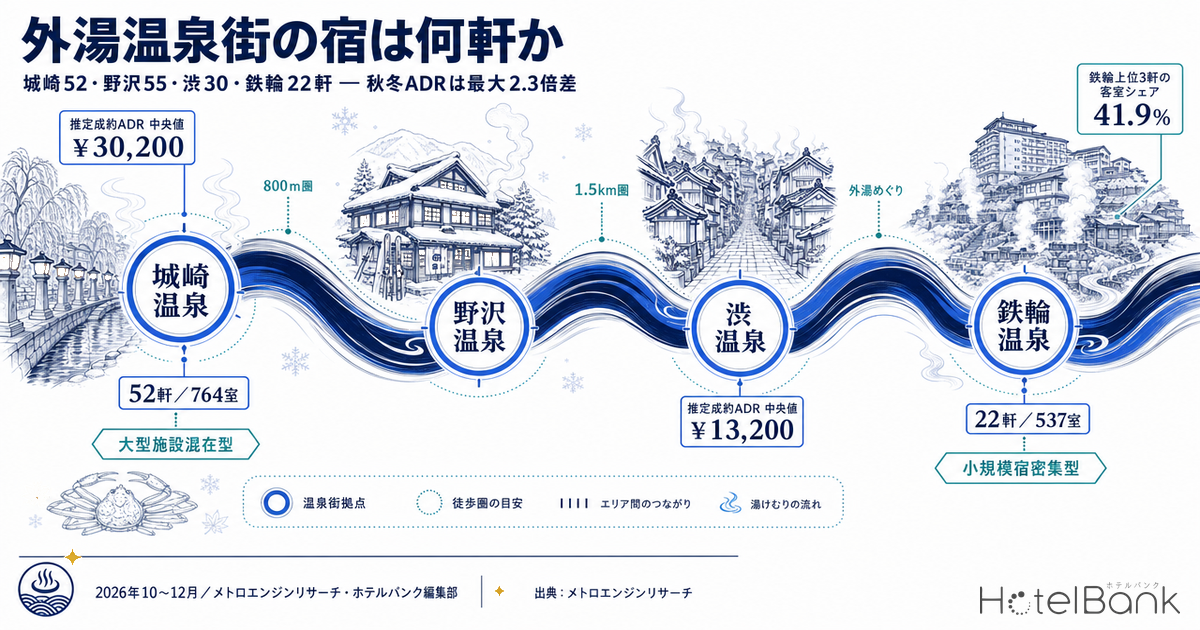
In onsen towns built around sotoyu — the circuit of public bathhouses shared by the whole town — an inn is not designed as a self-contained box with its own large bath, but as a base from which guests walk out to the town’s baths. That structure shows up in the shape of the room stock. This article covers four sotoyu towns — Kinosaki (城崎), Nozawa (野沢), Shibu (渋) and Kannawa (鉄輪) — counting the number of properties, total rooms and average size per property within 800m and 1.5km of the centroid of each town’s bathhouses, and comparing their autumn-winter 2026 rate tiers.
Metric Definitions Used in This Article
- ADR (Average Daily Rate): An estimated transacted rate (tax-excluded equivalent) derived by applying a property-type correction factor to the lowest advertised plan level published on OTAs and similar channels (per room, two guests per room, tax included). Cross-checked against property-level results disclosed by listed hotel REITs (91 properties, most recent three months), the median error is approximately 7%. These are estimates and differ from each property’s actual transacted prices or accounting figures. ADR at the onsen-town level is the median of the properties covered — the level of a typical property in that town.
- Advertised price: The per-room rate averaged across all plans listed on OTAs and similar channels (room-only through meal-inclusive; two guests per room, tax included). Because this uses a different basis from the ADR above, it applies only where the text explicitly says “advertised price.”
- Operating property: A property registered as in business in the accommodation master database that also has at least one observed selling price around the survey date (check-in dates from 120 days before to 240 days after). Properties listed as in business but with no observable selling activity are excluded from the tallies.
- Radius: Straight-line distance from the centroid of each town’s sotoyu (described below). It is not walking-route distance.
- Data source: MetroEngines Research
- — Within an 800m radius of each bathhouse centroid, operating inns number 52 properties / 764 rooms in Kinosaki, 55 / 656 in Nozawa, 30 / 350 in Shibu and 22 / 537 in Kannawa. The ranking flips between property count and room count.
- — Kinosaki, Shibu and Nozawa have zero properties of 40+ rooms inside 800m, with a median of 10–12 rooms: a dense cluster of small inns. Only Kannawa mixes in large properties, at a median of 15.5 rooms and a maximum of 96.
- — For October–December 2026, the median estimated transacted ADR is ¥30,200 in Kinosaki, ¥20,300 in Kannawa, ¥14,200 in Nozawa and ¥13,200 in Shibu — a 2.3x spread between top and bottom.
- — Kinosaki and Shibu have almost identical supply structures (nearly all ryokan, zero properties of 40+ rooms), yet their rates differ by 2.3x. The size profile does not determine the rate tier.
- — In Nozawa, 43 of the 98 registered properties (44%) inside 800m show no observable selling price, so public information alone cannot capture the town’s true capacity.
Where to Put the Centre Point — Taking the Centroid of the Bathhouse Coordinates
The extent of an onsen town does not line up with administrative boundaries. Cut by “Beppu City” and the seven onsen districts other than Kannawa get mixed in; cut by “Yamanouchi Town” and Shibu, Yudanaka and Ajiro end up together. So this article takes the coordinates of the sotoyu (public bathhouses) themselves and measures distance from their centroid. Because shifting the centre point by a few hundred metres changes the property count wholesale, the number and names of the bathhouses were first confirmed against official information from onsen associations and municipalities, then individual coordinates were pulled from a machine-readable public geographic database and the two were reconciled.
| Onsen town | Location | Bathhouses | Coordinates obtained | Centre point (lat, lon) |
|---|---|---|---|---|
| Kinosaki Onsen | Kinosakicho Yushima, Toyooka, Hyogo | 7 | 7 / 7 | 35.62577, 134.80908 |
| Nozawa Onsen | Nozawaonsen Village, Shimotakai, Nagano | 13 | 11 / 13 | 36.92303, 138.44662 |
| Shibu Onsen | Hirao, Yamanouchi, Shimotakai, Nagano | 9 | 9 / 9 | 36.73427, 138.43203 |
| Kannawa Onsen | Kannawa, Beppu, Oita | approx. 9 | 2 / approx. 9 | 33.31638, 131.47807 |
Bathhouse names and counts from the official sites of each onsen tourism association and municipality; coordinates from a public geographic database. Table compiled by the HotelBank Editorial Team
Kinosaki has seven baths — Konoyu, Mandarayu, Gosho-no-yu, Ichi-no-yu, Yanagiyu, Jizoyu and Sato-no-yu (Toyooka City official tourism site) — running about 830m in a straight line from Sato-no-yu at the eastern end to Konoyu at the western end, strung out along the Otani River. Nozawa’s 13 baths (Nozawa Onsen Tourism Association) are spread across the village as an area rather than a line, while Shibu’s nine baths of the “nine-bath circuit” (Shinshu Shibu Onsen official site) are packed into roughly 370m square along the town’s stone-paved street.
For Kannawa, only two of the communal baths published by Beppu City had machine-readable coordinates: the municipally run Kannawa Mushiyu and Tani-no-yu. Since Sujiyu, Shibu-no-yu, Netsu-no-yu, Shonin-yu and the others cluster within roughly 150m of Mushiyu along Ideyu-zaka slope, this article adopts the location of the municipal Kannawa Mushiyu as the centre point. Given the subject, the scope is limited to Kannawa’s bathhouse district rather than all of Beppu City.
52, 55, 30 and 22 Inns Within 800m — Property Count and Room Count Do Not Move Together
Counting operating inns with recent observable selling activity within 800m of the centre point gives 52 properties in Kinosaki, 55 in Nozawa, 30 in Shibu and 22 in Kannawa. On property count alone, Nozawa and Kinosaki are neck and neck and Kannawa has less than half of Kinosaki. Total rooms, however, reorder the list. Against Kinosaki’s 764 rooms, Kannawa holds 537 across just 22 properties — close behind the 656 rooms of Nozawa’s 55. That property count and room count do not move together is the first sign of how differently these four towns are supplied.
Source: MetroEngines Research; compiled by the HotelBank Editorial Team (operating properties within 800m. Kinosaki N=52, Nozawa N=55, Shibu N=30, Kannawa N=22)
Widening the radius to 1.5km gives 58 properties / 1,065 rooms in Kinosaki, 60 / 719 in Nozawa, 46 / 623 in Shibu and 25 / 560 in Kannawa. What matters is that the increment differs by town. In Kinosaki, larger properties outside the 800m ring (up to 103 rooms) add 301 rooms, whereas Nozawa gains only five properties / 63 rooms and Kannawa three / 23. For Nozawa and Kannawa, room stock barely accumulates once you step outside the bathhouse district. Shibu, by contrast, gains 16 properties / 273 rooms, because inns on the neighbouring Yudanaka and Ajiro side enter the radius — which is why, when discussing Shibu as a bathhouse district, cutting at 800m is the appropriate choice.
| Onsen town | Properties, 800m | Rooms, 800m | Properties, 1.5km | Rooms, 1.5km | Median rooms |
Mean rooms |
Max rooms |
Excluded, no selling activity (800m) |
|---|---|---|---|---|---|---|---|---|
| Kinosaki Onsen | 52 | 764 | 58 | 1,065 | 12.0 | 14.7 | 37 | 8 |
| Nozawa Onsen | 55 | 656 | 60 | 719 | 10.0 | 11.9 | 29 | 43 |
| Shibu Onsen | 30 | 350 | 46 | 623 | 10.5 | 11.7 | 29 | 3 |
| Kannawa Onsen | 22 | 537 | 25 | 560 | 15.5 | 24.4 | 96 | 7 |
Source: MetroEngines Research; compiled by the HotelBank Editorial Team (median, mean and max are based on operating properties within 800m. Kinosaki N=52, Nozawa N=55, Shibu N=30, Kannawa N=22)
The rightmost column — properties excluded for no selling activity — cannot be skipped. In Nozawa, 43 of the 98 properties registered inside 800m had not a single observable OTA selling price around the survey date. That 44% exclusion rate stands out among the four towns. It does not mean those inns have closed: a substantial share are likely minshuku that take bookings only direct or by phone, and inns that operate only during the ski season. Please read what follows on the assumption that Nozawa’s real capacity is probably larger than the 656 rooms shown here. In Kinosaki (8 excluded), Shibu (3) and Kannawa (7), the bias is small.
Three Towns at a Median of 10–12 Rooms, Kannawa Alone at 15.5 — Dense-Small vs Large-Mixed
By size per property, the four towns split cleanly into two patterns. Kinosaki (median 12.0 rooms), Shibu (10.5) and Nozawa (10.0) each have not one property of 40 or more rooms inside 800m; the largest is 37 rooms in Kinosaki and 29 in Shibu and Nozawa. Kannawa, in contrast, has a median of 15.5 rooms, a maximum of 96, and four properties of 40+ rooms.
Source: MetroEngines Research; compiled by the HotelBank Editorial Team (share by room-size band among operating properties within 800m. Kinosaki N=52, Nozawa N=55, Shibu N=30, Kannawa N=22)
That difference feeds straight into how concentrated the room stock is. In Kannawa the top three properties alone account for 41.9% of all rooms within 800m, and the four properties of 40+ rooms — Ooedo Onsen Monogatari Premium Hotel Fugetsu (大江戸温泉物語Premium ホテル風月, 96 rooms), Hotel Sansuikan (ホテル山水館, 74), Yukemuri no Yado Hanamizuki (湯けむりの宿 はなみずき, 55) and Oniyama Hotel (おにやまホテル, 48) — hold 273 rooms, or 50.8% of the 537. Four properties own half the town’s rooms. In Kinosaki, by contrast, the top three hold 13.9% and in Nozawa 12.8%. Kinosaki’s 764 rooms are shared among 52 properties, and even the largest does not reach 5% of the town.
| Onsen town | Up to 15 rooms | 16–39 rooms | 40+ rooms | Room share of top 3 |
Supply pattern |
|---|---|---|---|---|---|
| Kinosaki Onsen | 35 | 17 | 0 | 13.9% | Dense cluster of small inns |
| Nozawa Onsen | 45 | 10 | 0 | 12.8% | Dense cluster of small inns (most dispersed) |
| Shibu Onsen | 25 | 5 | 0 | 21.1% | Dense cluster of small inns (most compact) |
| Kannawa Onsen | 11 | 7 | 4 | 41.9% | Mixed with large properties |
Source: MetroEngines Research; compiled by the HotelBank Editorial Team (operating properties within 800m. Kinosaki N=52, Nozawa N=55, Shibu N=30, Kannawa N=22)
The mix of property types backs up that classification. In Kinosaki 49 of 52 properties are ryokan, in Shibu 29 of 30 and in Kannawa 20 of 22. Nozawa alone is split almost evenly — 24 minshuku (family-run guesthouses) and 23 ryokan — plus three pensions, two lodges, one hostel, one guesthouse and one farm-stay. As a village with a ski area, the mountain-hut and boarding-house forms of lodging survive intact inside its bathhouse district. Both are “dense clusters of small inns,” but where Kinosaki and Shibu are ryokan through and through, Nozawa’s property types are layered.
Rooms per Bathhouse — 109 in Kinosaki, 39 in Shibu
In a town built around a bathhouse circuit, the ratio of total rooms to the number of baths expresses the town’s design philosophy well. Dividing rooms within 800m by the number of baths gives 109 rooms per bath in Kinosaki (764 rooms across seven baths), roughly 60 in Kannawa (537 across about nine), roughly 50 in Nozawa (656 across 13) and roughly 39 in Shibu (350 across nine).
Source: MetroEngines Research; compiled by the HotelBank Editorial Team (total rooms within 800m divided by number of bathhouses. Kinosaki N=52, Nozawa N=55, Shibu N=30, Kannawa N=22 properties. Bathhouse counts from the official sites of each onsen tourism association and municipality)
Kinosaki’s 109 rooms is roughly double the other three towns. Relative to its seven baths, it is the town where inns have stacked up the most. Kinosaki has a long history of treating the bathhouse circuit as the product of the town as a whole, and the design of keeping in-house baths modest and sending guests out to the sotoyu has been widely shared. The large number of rooms each bath serves can be read as the result of that pooled model working. Shibu’s 39 rooms, at the other end, is the lowest density of inns per bath: nine baths packed into 370m square, with only 30 properties and 350 rooms. It is a scale at which handing each guest a key to the public baths remains workable.
This metric is a supply-side ratio, however, and does not indicate actual crowding. Bath size, whether day visitors are admitted, and whether a bath is reserved for overnight guests all differ by town. Kinosaki sells a day-use bathing pass and admits outside visitors, while eight of Shibu’s nine baths are for overnight guests only (Oyu alone opens to visitors during limited hours) — so the same ratio can mean different things.
Two Patterns on the Map — Kinosaki in a Line, Kannawa Scattered Across a Slope
Plotting the two extremes — Kinosaki and Kannawa — on a map shows the difference in supply structure directly as spatial arrangement. Circle size is room count; blue is inns and red is sotoyu (public bathhouses).
Kinosaki Onsen — 52 properties, 764 rooms, 7 bathhouses (within 800m)
Kannawa Onsen — 22 properties, 537 rooms, 2 bathhouses with confirmed coordinates (within 800m)
Source: MetroEngines Research; compiled by the HotelBank Editorial Team (bathhouse coordinates from a public geographic database. Map tile attribution is shown within the map)
In Kinosaki the seven baths line up along the Otani River and the inns cling to both sides. The path from inn to bath is the street itself, and from any inn several baths are a few minutes’ walk away. The circles are also visibly of similar size. Kannawa is the reverse: a two-tier structure in which large circles (96, 74, 55 and 48 rooms) sit apart along a fan-shaped slope while small circles cluster around Ideyu-zaka. The division of roles is legible — large properties work as stay-put resorts with their own large baths and views, while the small inns on Ideyu-zaka sit close to the everyday world of communal baths and jigoku-mushi steam cooking.
The Autumn-Winter Rate Tiers — ¥30,200 in Kinosaki vs ¥13,200 in Shibu, a 2.3x Gap
Taking the monthly average of each property’s estimated transacted ADR within 800m for October–December 2026 and looking at the distribution, the rate tiers separate clearly by town. The medians are ¥30,200 in Kinosaki, ¥20,300 in Kannawa, ¥14,200 in Nozawa and ¥13,200 in Shibu — a 2.3x gap between top-ranked Kinosaki and bottom-ranked Shibu.
Source: MetroEngines Research; compiled by the HotelBank Editorial Team (October–December 2026, within 800m. Kinosaki N=44, Nozawa N=17, Shibu N=27, Kannawa N=15 properties)
| Onsen town | Properties covered | 25th percentile | Median | 75th percentile | 75th / 25th ratio |
|---|---|---|---|---|---|
| Kinosaki Onsen | 44 | ¥20,300 | ¥30,200 | ¥37,300 | 1.84x |
| Kannawa Onsen | 15 | ¥13,700 | ¥20,300 | ¥25,600 | 1.87x |
| Nozawa Onsen | 17 | ¥12,300 | ¥14,200 | ¥16,300 | 1.33x |
| Shibu Onsen | 27 | ¥9,700 | ¥13,200 | ¥21,900 | 2.25x |
Source: MetroEngines Research; compiled by the HotelBank Editorial Team (estimated transacted ADR, calculated from per-property monthly averages for October–December 2026. Kinosaki N=44, Nozawa N=17, Shibu N=27, Kannawa N=15 properties)
What matters here is that Kinosaki and Shibu are all but identical in supply structure. In both, ryokan account for nearly every property, there is nothing of 40+ rooms, and the median is 10–12 rooms: a dense cluster of small inns. Even so, their rate tiers sit 2.3x apart. Size profile is not what sets the rate.
The width of the distribution differs too. Shibu is the widest, its 75th percentile 2.25x its 25th, with inns in the ¥9,700 range standing alongside inns in the ¥21,900 range — the result of mixing historic-architecture inns typified by Kanaguya (金具屋, 29 rooms) with small room-only ryokan. Nozawa is the narrowest at 1.33x, concentrated in a ¥12,300–¥16,300 band; rates are strongly aligned and the town effectively shares one price range. Kinosaki sits at 1.84x, with a floor of ¥20,300 and an upper end running past ¥37,300. What characterises Kinosaki is that its floor alone exceeds the other towns’ medians.
On the coverage of these rate tiers. Because estimated transacted ADR relies on property-type correction factors, it covers ryokan, business, city, resort and capsule properties, and excludes minshuku, pensions, lodges, guesthouses and the like. Coverage is high in Kinosaki, Shibu and Kannawa, where most operating properties within 800m are ryokan. In Nozawa, however, 24 minshuku, three pensions and others among the 55 properties within 800m fall outside scope, so the Nozawa figures above represent the level of 17 ryokan. The average amount actually paid across Nozawa as a whole may run lower than these figures.
Seasonal Amplitude Is 2.0x in Kinosaki and Nozawa, 1.4x in Kannawa
Annual swing defines a town’s character as much as rate level does. Comparing each town’s highest and lowest monthly medians over the actuals period from December 2025 to July 2026, Kinosaki swings 2.02x — from ¥39,700 in December 2025 to ¥19,600 in July 2026 — and Nozawa 2.02x, from ¥20,800 in January 2026 to ¥10,300 in June 2026. Shibu comes in at 1.60x and Kannawa at 1.43x. For the same swing measured on a common yardstick nationwide, Japan Hotel ADR Swings Up to 4.9x by Season lists all 633 municipalities.
Source: MetroEngines Research; compiled by the HotelBank Editorial Team (monthly median of per-property estimated transacted ADR within 800m. Kinosaki N=44, Nozawa N=17, Shibu N=27, Kannawa N=15 properties. From August 2026 onward, figures are estimates based on advertised levels as of the survey date)
Kinosaki’s peak tracks snow crab. On current advertised levels the shape is already visible: ¥19,300 in August 2026 rising about 1.8x to ¥34,600 in December. It is a curve common to port towns on the Sea of Japan side, and the way the price band shifts in a step at the season opening is covered in detail in Crab Season Opens Nov 6: Echizen Room Rates Jump 3.2x in One Month. Nozawa peaks in January — the ski season — where snow demand rather than the bathhouse circuit lifts rates. Shibu peaks in February, timed with winter inbound demand aimed at the snowscape of the Jigokudani Monkey Park.
Kannawa, by contrast, is the flattest at 1.43x, tracing a gentle annual curve from ¥14,900 in July to ¥21,300 in December. Beppu is both an onsen destination and a year-round urban tourism city, so its seasonal dependence is structurally small — consistent with a supply structure in which large properties hold half the rooms. Where the occupancy trough is shallow, a 40-plus-room box can be run all year. In towns with a 2x swing such as Kinosaki and Nozawa, by contrast, large properties carrying heavy fixed costs through the off-season are hard to sustain. The fact that there are zero properties of 40+ rooms can be read as the flip side of seasonal amplitude.
What Emerges When the Four Towns Are Placed Side by Side
Pulling this together, the room stock of onsen towns with public bathhouses falls into three patterns. First, the Kinosaki type: small inns densely clustered and a high rate tier. Its 52 properties and 764 rooms line up at a median of 12 rooms, and even the 25th percentile holds ¥20,300. The bathhouse circuit is shared as the town’s product, and inns take their rate through cuisine and furnishing rather than by adding rooms. Second, the Shibu and Nozawa type: small inns densely clustered with rates in the ¥13,000–¥14,000 range. Shibu offers walkable density with nine baths inside 370m square; Nozawa has 13 baths and a layered mix of property types including minshuku. Both have many baths relative to the size of the town. Third, the Kannawa type: large properties holding half the rooms, with small seasonal amplitude.
The most suggestive finding is surely the 2.3x rate gap between Kinosaki and Shibu, two towns that are structurally almost identical. Even with the same conditions — zero properties of 40+ rooms, nearly all ryokan, a median of 10–12 rooms — the rate tier is set by the town’s product design and the quality of its demand. Supply structure does not cap the rate, and being small is no constraint on moving upmarket. That Kinosaki’s 25th percentile sits close to Shibu’s 75th (¥21,900) shows that even small properties have room to lift their rate tier, depending on how the town designs itself as a whole.
One more point no practitioner should overlook is Nozawa’s 44% exclusion rate. Of the 98 properties registered within 800m, 43 had no observable selling price. That so many inns still put no inventory on OTAs and similar channels means the town’s full capacity cannot be captured from public information. Any discussion of total supply has to start from the premise that there is stock beyond the 656 visible rooms.
⚠ Note on ADR for future dates: ADR figures for August 2026 onward in this article are estimates calculated from selling prices published on OTAs and similar channels as of the survey date, and they move as the check-in date approaches. Please note that rates set high at present may fall through last-minute adjustment, and that levels may change as new plans are added. From January 2027 onward the number of listed properties is not yet sufficient, so those months are excluded from the tallies here.
Methodology and Scope
The scope is accommodation within 800m and 1.5km of the centroid of each town’s bathhouses (for Kannawa, the location of the municipal Kannawa Mushiyu), limited to properties registered as in business in the accommodation master database that also have at least one observed selling price for check-in dates between 26 April 2026 and 21 April 2027. Properties present in the master but with no observable selling activity are excluded uniformly, because closure, direct-only booking and seasonal operation cannot be told apart. Room counts use the values registered in the property master (for some properties these may not match the room counts each publishes on OTAs and similar channels).
Estimated transacted ADR is an estimated transacted rate derived by applying a property-type correction factor to the lowest advertised plan level each property publishes on OTAs and similar channels. Figures through July 2026 are values for settled actual months; from August 2026 onward they are estimates based on listing information as of the survey date. The monthly median series was built after excluding any month in which the number of properties covered fell below 60% of the series median (this criterion excludes November 2025 and January 2027). MetroEngines Research tracks approximately 168,000 properties in Japan, of which approximately 27,000 properties and 1.26 million rooms with confirmed activity on OTAs form the analysis universe. Ryokan, minshuku and simple lodging houses not listed on OTAs and similar channels are not included.
Related Reading
- Crab Season Opens Nov 6: Echizen Room Rates Jump 3.2x in One Month
- Tottori’s 3-Tier Hotel Market: Onsen ADR 2.16x the City Average
- Japan’s Largest Hotel: Shinagawa Prince, 2,384 Rooms — Top 30 Ranking
- Japan’s New Ryokan 2026: 39 Openings, Median 9 Rooms, 1.34x Rates
- Aso & Kurokawa Onsen Are Open: Autumn ADR Flat, Sept Holiday 1.5% Left
- Japan Hotel ADR Swings Up to 4.9x by Season: 633 Municipalities Ranked
- Who Owns the Hot Spring? Water Rights and Ryokan Valuation
References and Sources
■ Data sources
The accommodation master database (property counts, room counts, property-type classification), estimated transacted ADR and advertised-price observations come from MetroEngines Research. Bathhouse names and counts come from the official sites of each onsen tourism association and municipality; individual bathhouse coordinates come from a public geographic database (ODbL).
■ Calculation assumptions
The scope is a straight-line radius of 800m and 1.5km from the centroid of each town’s bathhouses (for Kannawa, the location of the municipal Kannawa Mushiyu). Operating properties are limited to those with at least one observed selling price for check-in dates between 26 April 2026 and 21 April 2027. Estimated transacted ADR is an estimated transacted rate (tax-excluded equivalent) derived by applying a property-type correction factor to each property’s lowest advertised plan level; at the onsen-town level the median of the covered properties is used.
■ Limitations and caveats
Room counts are the values registered in the property master and may not match the room counts each property publishes on OTAs and similar channels. Estimated transacted ADR covers only the verified property types — ryokan, business, city, resort and capsule — and does not include minshuku, pensions, lodges, guesthouses and the like (Nozawa’s rate reflects the level of 17 ryokan out of the 55 properties within 800m). Figures from August 2026 onward are estimates based on listing snapshots and move as the check-in date approaches. Because only two of Kannawa’s bathhouses had confirmed coordinates, the municipal Kannawa Mushiyu is used as the representative centre point. Radii are straight-line distances, not walking-route distances.
■ Bathhouse names, counts and locations (primary sources)
- Toyooka City official tourism site: “Kinosaki Onsen, birthplace of the sotoyu circuit” (7 baths)
- Nozawa Onsen Tourism Association: onsen guide — 13 sotoyu and bathing map
- Shinshu Shibu Onsen official site: guide to each bathhouse (nine-bath circuit)
- Beppu City: communal hot springs/Beppu City: Kannawa Mushiyu
- Beppu Hatto Onsendo official site: local communal baths
■ Coordinates and maps
- Public geographic database (locations of sotoyu and communal baths, ODbL)
- Map tile provider credit is shown in the attribution box within each map
■ Accommodation supply and price data
- MetroEngines Research — accommodation master database (property counts, room counts, property-type classification), estimated transacted ADR and advertised-price observations