

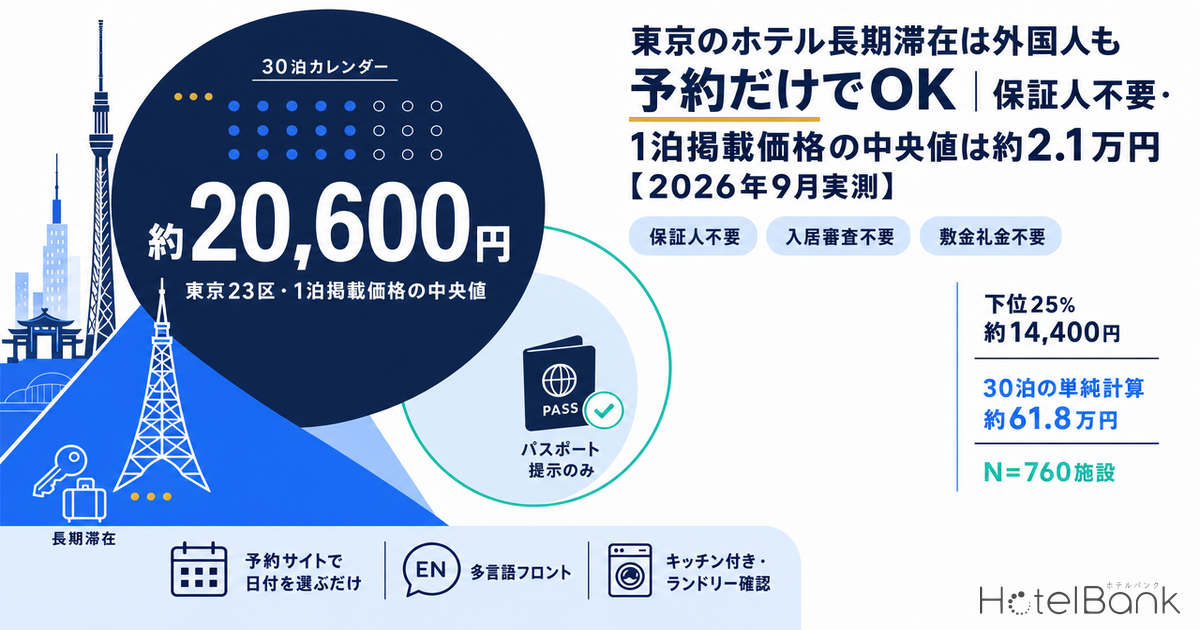
You want to stay a month or more at a Tokyo hotel — whether for yourself as a foreign visitor or resident, or for family and friends looking for somewhere to base themselves. The answer is simple: a long hotel stay needs nothing more than a booking. There is no guarantor, no tenant screening and no key money or deposit the way a rental apartment demands. All that is required is filling in the guest register at check-in (plus showing your passport if you have no address in Japan). This article covers what you are asked for at check-in, how to confirm English and multilingual service before you book, and what a month actually costs based on measured listed prices across Tokyo’s 23 wards.
- — No guarantor, no tenant screening. A long hotel stay is an accommodation contract, so foreign guests can stay on a booking alone.
- — Foreign guests without an address in Japan enter their nationality and passport number in the guest register, and cooperate with presenting the passport and having a copy taken (Ministry of Health, Labour and Welfare).
- — Listed prices across Tokyo’s 23 wards run to a median of about ¥20,600 a night (September 2026, single occupancy, tax included, N=760 properties). Thirty nights works out to roughly ¥618,000, or about ¥430,000 at the lower-quartile level.
- — Medians across the ten main wards span about ¥16,300 in Ota to about ¥41,000 in Shibuya — a wide enough gap that your choice of ward changes the monthly total.
- — For a month-long stay, look at consecutive-night and monthly plans, and consider apartment hotels with a kitchen and washing machine.
No guarantor, no screening — what you are asked for at check-in
Staying at a hotel or ryokan in Japan is an “accommodation contract” under the Inns and Hotels Act, not a lease. That is why you can stay any number of nights — months, at the extreme — simply by picking your dates on a booking site or the hotel’s own site and reserving. There is no guarantor, no proof of income and no residence-card screening, and a long booking is not treated differently because of your nationality.
At check-in, however, every guest is asked to fill in the guest register. Published guidance from Japan’s Ministry of Health, Labour and Welfare states that when a foreign national without an address in Japan stays, the guest register must record their nationality and passport number, and the guest is asked to cooperate in presenting their passport (Source: Ministry of Health, Labour and Welfare, “Identity verification measures at inns and hotels for foreign nationals without an address in Japan”). That is why the front desk may take a photocopy of your passport; unless you have a reason to decline, it takes a couple of minutes. Foreign residents who do have an address in Japan only fill in name, address and contact details — exactly the same procedure as for Japanese guests.
In short, the worry that “they might turn me away for a long stay because I’m a foreigner” is, as a rule, unfounded. What you need to prepare is a passport (or, for residents, something showing your address) and a means of payment.
Check English and multilingual service here before you book
The longer the stay, the more often you deal with the front desk. Three things are worth checking before you book.
Language switching on the official site
Hotels whose official site has an English or Chinese toggle usually have multilingual systems in place for in-house signage and front-desk service too. Toyoko Inn (東横イン), for instance, lets you switch the official site to English and book straight through, and the procedure is identical at every branch nationwide, so a first stay is hard to get wrong. APA Hotel (アパホテル) attaches member benefits and points to bookings made through its official site and app, which brings the rate down. Comfort Hotel (コンフォートホテル) includes free breakfast as standard, which makes the cost of a long stay easier to predict.
The notes field when you book
Writing something like “English-language guidance preferred” or “long stay — would like to discuss cleaning frequency” in the notes field of the booking form lets the hotel prepare in advance. How quickly and how carefully they reply is also a useful measure of how well that hotel handles foreign guests.
Front-desk hours
A hotel with a 24-hour front desk can handle a late-night arrival or a sudden problem. On a long stay, the front desk also matters for receiving parcels while you are out and for handling mail, so check whether it is staffed around the clock on the hotel’s FAQ or access page.
What does a month in Tokyo cost? Listed prices measured across 760 properties
The HotelBank Editorial Team aggregated listed prices from public OTA data for 760 hotels across Tokyo’s 23 wards (per room, single occupancy, tax included). The result: a median of about ¥20,600 a night for September 2026 (1–30 September) (N=760 properties). The lower quartile sits at about ¥14,400 and the upper quartile at about ¥28,900; narrowing to business hotels, the median is about ¥19,700 (N=524 properties).
Thirty nights in a median-class room works out to roughly ¥618,000 on a simple calculation. To hold costs down, choosing properties at the lower-quartile level (about ¥14,400 a night) brings 30 nights to about ¥430,000. On top of that, OTAs often carry separate consecutive-night plans labelled “7 nights or more,” and hotels run their own weekly and monthly plans, so the per-night equivalent has room to fall below these listed prices. For how many nights it takes before discounts start to bite, see Japan Hotel Long-Stay Discounts: 15% at 7 Nights, 20% at 30 Nights. Note also that Tokyo levies a separate accommodation tax depending on the room rate. As of September 2026 it is ¥100 per person per night for rates from ¥10,000 to under ¥15,000 and ¥200 from ¥15,000 up (rates under ¥10,000 are exempt); from 1 April 2027 it changes to 3% of the rate for stays of ¥13,000 or more per person per night (Source: Tokyo Metropolitan Government Bureau of Taxation, “Accommodation Tax”). For a long stay that spans April 2027, budget for that change too.
Levels vary widely by ward. Medians for the main wards are as follows (all September 2026, single occupancy, tax included, HotelBank Editorial Team research).
| Ward | Median per night (listed price) | 30 nights, simple calculation | N (properties) |
|---|---|---|---|
| Ota (大田区) | approx. ¥16,300 | approx. ¥490,000 | 41 |
| Toshima (豊島区) | approx. ¥16,500 | approx. ¥500,000 | 57 |
| Shinagawa (品川区) | approx. ¥18,300 | approx. ¥550,000 | 30 |
| Taito (台東区) | approx. ¥18,900 | approx. ¥570,000 | 117 |
| Shinjuku (新宿区) | approx. ¥19,000 | approx. ¥570,000 | 74 |
| Koto (江東区) | approx. ¥21,400 | approx. ¥640,000 | 27 |
| Chiyoda (千代田区) | approx. ¥23,000 | approx. ¥690,000 | 68 |
| Chuo (中央区) | approx. ¥25,400 | approx. ¥760,000 | 100 |
| Minato (港区) | approx. ¥25,500 | approx. ¥770,000 | 94 |
| Shibuya (渋谷区) | approx. ¥41,000 | approx. ¥1,230,000 | 29 |
Source: HotelBank Editorial Team research (OTA listed prices, as of September 2026). Listed prices may differ from the rate you actually pay when booking.
Ota, Toshima and Taito are dominated by properties under ¥20,000 a night, which makes them natural starting points for a cost-conscious long stay.
How to find long-stay plans, apartment types and rooms with a kitchen
For a month-long stay, picking a hotel equipped on the assumption that you will be living there — rather than a standard guest room — raises both satisfaction and cost efficiency. Three ways to search.
Filter by plan name
In OTA search results, plans carrying words such as “consecutive nights” (連泊), “weekly” (ウィークリー), “monthly” (マンスリー) or “7 nights or more” (7泊以上) usually price lower per night than standard plans. Some hotels also keep a dedicated long-stay plan page on their own site.
Learn the “apartment hotel” and “residence” categories
There is a long-stay-focused category of property whose rooms come with a kitchen, washer-dryer and microwave, and which holds rates down by cutting cleaning to a few times a week instead of daily. Being able to cook for yourself saves a great deal on eating out, so over 30 nights the total often lands below a conventional hotel.
Check the laundry situation first
It is fair to say that laundry decides how comfortable a long stay is. For whether a property has coin laundry on site, what it costs and how to dry clothes in the room, see Hotel Laundry in Japan: Free–¥600 a Wash, 5 Room-Drying Steps before you book.
Properties worth knowing
A few Tokyo properties illustrate what the multilingual, live-in end of the market looks like.
Multilingual front desk, built for families staying three to six months
Ascott Marunouchi Tokyo (アスコット丸の内東京) has a front desk staffed in English and Chinese around the clock and connects directly to Otemachi Station. MIMARU SUITES Tokyo Nihombashi (MIMARU SUITES 東京日本橋) runs every room at 60 square metres, so a family of six can share a single unit. Properties in this bracket typically pair a multilingual front desk with a kitchen, and many quote monthly rates on request.
Apartment types with a kitchen and washer-dryer in the room
Tokyu Stay Shinjuku Eastside (東急ステイ新宿イーストサイド) is a three-minute walk from Higashi-Shinjuku Station. MIMARU Tokyo Ueno EAST (MIMARU東京 上野EAST) comes with a kitchen and dining area and sleeps four to eight. Once a trip runs past three nights, this category tends to beat a conventional hotel on both per-night rate and day-to-day living.
Frequently asked questions
Q. Can a foreign national stay a month at a Tokyo hotel without a guarantor?
Yes. A hotel stay is an accommodation contract rather than a lease, so no guarantor, tenant screening, deposit or key money is required, and a long stay needs only a booking. Caps on consecutive nights and conditions for long stays vary by property, so it is worth confirming with the hotel’s official site or front desk before you book.
Q. Is a passport required at check-in?
Foreign nationals without an address in Japan record their nationality and passport number in the guest register, and are asked to cooperate in presenting the passport at the front desk and having a copy taken (Ministry of Health, Labour and Welfare). Foreign residents with an address in Japan complete the same procedure as Japanese guests — name, address and contact details.
Q. How much does a month at a Tokyo hotel cost?
The median listed price across Tokyo’s 23 wards is about ¥20,600 a night (September 2026, single occupancy, tax included, N=760 properties), which puts 30 nights at roughly ¥618,000 on a simple calculation. At the lower-quartile level (about ¥14,400) it comes to about ¥430,000, and consecutive-night plans leave room for the per-night equivalent to fall further.
Q. Which wards make it easier to keep a long stay affordable?
By median listed price in September 2026, Ota (about ¥16,300), Toshima (about ¥16,500), Shinagawa (about ¥18,300) and Taito (about ¥18,900) all sat under ¥20,000 a night — more than a twofold gap from Shibuya (about ¥41,000).
Q. Is there a way to confirm English will be understood before booking?
Three signals serve as a guide: whether the official site offers a language toggle including English, how the hotel replies when you request English-language guidance in the booking notes field, and whether the front desk is staffed 24 hours.
Methodology and sources
Listed prices were aggregated by the HotelBank Editorial Team from public OTA data: per-room rates at single occupancy (tax included, averaged across all plans) for 760 hotels in Tokyo’s 23 wards. The period covered is 1–30 September 2026; only properties with confirmed listings on 10 or more days in that period were included, and the median of each property’s period average was taken (N=760 properties; business hotels N=524 properties). Listed prices are as of the aggregation date and may differ from the rate and availability you actually find when booking. The description of the guest register is based on published material from the Ministry of Health, Labour and Welfare. For conditions specific to your own stay, check with the individual hotel or the relevant public health centre.
■ Data sources
Prices: OTA listed prices aggregated by the HotelBank Editorial Team (hotels in Tokyo’s 23 wards, stay dates 1–30 September 2026). Regulation: Ministry of Health, Labour and Welfare, “Identity verification measures at inns and hotels for foreign nationals without an address in Japan”; Tokyo Metropolitan Government Bureau of Taxation, “Accommodation Tax.”
■ Calculation assumptions
Per-room listed prices at single occupancy (tax included, averaged across all plans) were averaged over the period for each property, and the median of those figures was used. The 30-night amounts are a simple median × 30 calculation and exclude consecutive-night discounts, accommodation tax and extras such as cleaning or meals.
■ Limitations and caveats
Listed prices are the public prices at the time of aggregation and may differ from the rate and availability you actually find when booking. Rates for two people sharing a room are generally higher than at single occupancy. Some ward-level figures rest on around 30 properties, which makes them liable to swing with the price range of individual properties. The handling of the guest register is a general procedure grounded in law; check conditions specific to your case with each hotel.
Related reading
- Japan Hotel Long-Stay Discounts: 15% at 7 Nights, 20% at 30 Nights
- Monthly Hotels in Japan: No Lease, 20% Off at 30 Nights (Aug 2026)
- Business Hotels for Long Stays: 6 Checks and ¥16,722 a Night in Tokyo
- Hotel Long-Stay Meals in Japan: 3 Patterns & ¥565–2,174 Breakfast Gap
- Hotel Laundry in Japan: Free–¥600 a Wash, 5 Room-Drying Steps