

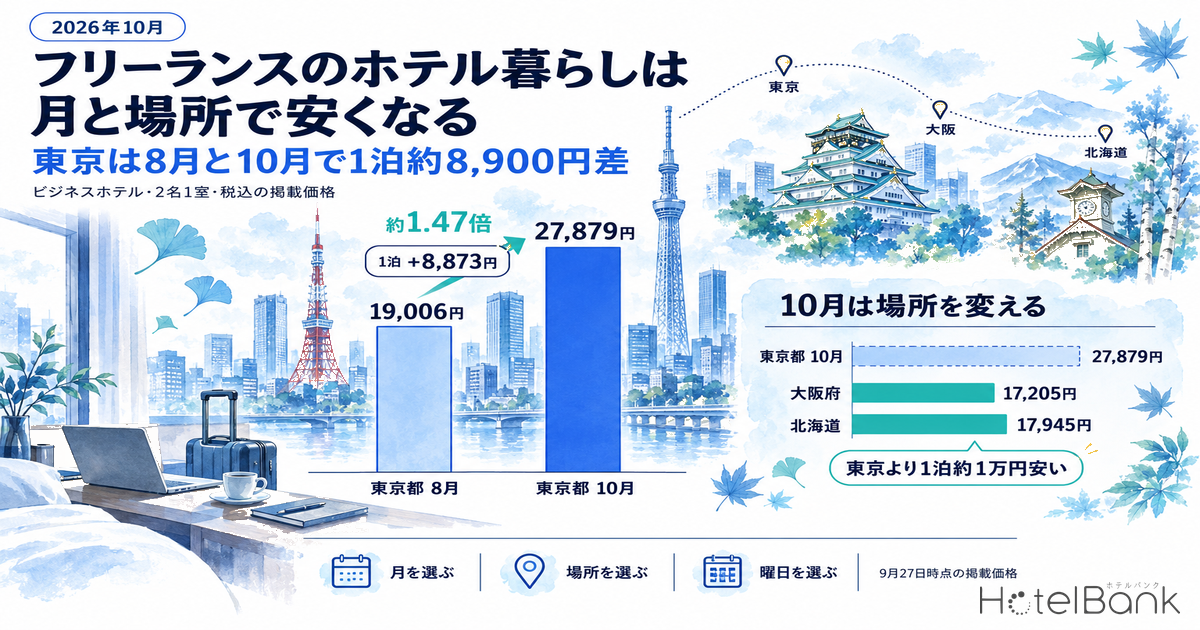
For freelancers, hotel living is easy to make cheaper because you choose the month and the place you stay. The listed price of business hotels in Tokyo (one room for two guests, tax included) was ¥19,006 per night in August 2026 (N=991 properties) and ¥27,879 for October (N=987 properties, listed prices as of September 27), a gap of about 1.47x, or roughly ¥8,900 per night. If your work does not tie you to a commute, that gap works directly in your favor.
This article uses measured prices to show three choices – month, place and day of the week – and then sorts out what to check on residence registration, mail and work environment when you live on the move.
All prices in this article are OTA listed prices (business hotels, one room for two guests, tax included; compiled by the HotelBank Editorial Team). For each property we average all of its plans, take the median across properties, and average that by month. Because this is an average across all plans, picking the cheapest plan will come in below it. Use the figures as a guide to the differences between months and places.
- — About 1.47x: listed business hotel prices in Tokyo were ¥19,006 in August 2026 and ¥27,879 for October (as of September 27). The gap is ¥8,873 per night, or about ¥266,000 over 30 nights.
- — January and June to August are Tokyo’s low months: over the past 12 months they sat together in the ¥19,000-¥20,000 range, while April and October-November rose to the ¥25,000-¥26,000 range.
- — In October, Osaka, Hokkaido and Kanagawa are about ¥10,000 cheaper: Osaka ¥17,205, Hokkaido ¥17,945, Kanagawa ¥17,243. Against Tokyo, Osaka saves about ¥320,000 over 30 nights.
- — Put your Tokyo nights on Sunday to Thursday: a separate tally for Tokyo’s 23 wards shows about ¥31,400 for a Sunday night and about ¥49,300 for a Saturday night, so how you arrange five nights changes the total by about ¥23,000.
- — Fix your residence registration, mail and business address in one place: decide them separately from where you stay, and confirm with a tax accountant or the tax office how lodging costs are treated as expenses.
Choosing the Month — Tokyo Is About ¥20,000 in Jun-Aug and January, ¥25,000-¥28,000 in Oct-Nov
First, how much changes just by choosing the months you spend in Tokyo. Monthly listed prices for Tokyo over the past 12 months are as follows.
| Stay month | Listed price (per night) | Difference vs Aug 2026 | Properties (N) |
|---|---|---|---|
| Oct 2025 | ¥25,511 | +¥6,505 | 889 |
| Nov 2025 | ¥26,712 | +¥7,706 | 890 |
| Dec 2025 | ¥23,821 | +¥4,815 | 903 |
| Jan 2026 | ¥19,960 | +¥954 | 905 |
| Feb 2026 | ¥21,638 | +¥2,632 | 916 |
| Mar 2026 | ¥24,200 | +¥5,194 | 923 |
| Apr 2026 | ¥26,414 | +¥7,408 | 946 |
| May 2026 | ¥24,279 | +¥5,273 | 945 |
| Jun 2026 | ¥19,995 | +¥989 | 994 |
| Jul 2026 | ¥20,368 | +¥1,362 | 990 |
| Aug 2026 | ¥19,006 | — (baseline) | 991 |
| Sep 2026 | ¥21,609 | +¥2,603 | 992 |
Source: HotelBank Editorial Team (aggregation of OTA listed prices, compiled September 27, 2026). Values are the monthly average of the median of each property’s all-plan average; actual booking screens vary by date and plan.
The gap between the lowest month, August 2026 (¥19,006), and the highest, November 2025 (¥26,712), is ¥7,706 per night, or about 1.41x. January, June, July and August line up in the ¥19,000-¥20,000 range, while April and October-November climb to the ¥25,000-¥26,000 range. Tokyo’s shape is calm at the start of the year and from the rainy season through midsummer, with peaks in spring and autumn.
The same shape is visible going forward. In listed prices as of September 27, 2026, October stands at ¥27,879 (N=987 properties), November at ¥27,839 (N=971) and December at ¥26,122 (N=940), before falling to ¥21,382 (N=908) in January 2027. Prices for future months move as the stay date approaches, so read them as a guide.
The ¥8,873 per-night gap between August and October comes to about ¥266,000 over 30 nights. What an office worker has decided for them by their workplace, a freelancer can adjust by choosing the months spent in Tokyo. A realistic yearly plan is to bring in-person meetings and events into January or June-August, and to spend autumn somewhere else, focused on production work.
Source: HotelBank Editorial Team (OTA listed prices, business hotels, one room for two guests, tax included). Solid lines are October 2025 to September 2026; dotted lines are October 2026 to February 2027, based on listed prices as of September 27, 2026.
Choosing the Place — Some Areas Stay Calm in the Months Tokyo Rises
Next is place. Here is how other areas move in October-November, when Tokyo rises.
| Area | Aug 2026 | Oct 2026 | Nov 2026 | Jan 2027 | Difference vs Tokyo, Oct | Properties (N, Oct) |
|---|---|---|---|---|---|---|
| Tokyo | ¥19,006 | ¥27,879 | ¥27,839 | ¥21,382 | — | 987 |
| Kanagawa | ¥15,849 | ¥17,243 | ¥17,169 | ¥15,980 | -¥10,636 | 216 |
| Chiba | ¥14,705 | ¥15,399 | ¥15,400 | ¥14,886 | -¥12,480 | 168 |
| Saitama | ¥13,896 | ¥13,846 | ¥13,967 | ¥13,809 | -¥14,033 | 150 |
| Osaka | ¥14,524 | ¥17,205 | ¥17,720 | ¥16,085 | -¥10,674 | 548 |
| Aichi | ¥14,757 | ¥18,842 | ¥16,752 | ¥15,437 | -¥9,037 | 326 |
| Fukuoka | ¥18,287 | ¥21,385 | ¥22,303 | ¥18,888 | -¥6,494 | 351 |
| Hokkaido | ¥20,389 | ¥17,945 | ¥16,028 | ¥18,132 | -¥9,934 | 414 |
| Kyoto | ¥16,370 | ¥30,814 | ¥35,257 | ¥18,724 | +¥2,935 | 363 |
Source: HotelBank Editorial Team (aggregation of OTA listed prices). August 2026 is a past-month value; October 2026 to January 2027 are listed prices as of September 27, 2026. Property counts are N=151 to 991 for August, N=146 to 971 for November and N=120 to 908 for January 2027. Prices for future months move as the stay date approaches.
Tokyo is ¥27,879 in October, while Osaka is ¥17,205, Hokkaido ¥17,945 and Kanagawa ¥17,243 – each about ¥10,000 lower per night. The gap between Tokyo and Osaka is ¥10,674 per night, or about ¥320,000 over 30 nights.
Seasonal Peaks Fall at Different Times by Area — Summer in Tokyo and Kyoto, Autumn in Osaka and Hokkaido
Seasonal peaks are offset from one area to the next. Hokkaido has its summer peak in July-August (¥20,389 in August) and settles to ¥16,028 in November. Kyoto is affordable in summer and winter, at ¥16,370 in August and ¥18,724 in January, but reaches ¥35,257 in November during the autumn foliage season. Spending summer and the New Year period in Tokyo or Kyoto and autumn in Osaka or Hokkaido is a pattern only a location-flexible way of working allows.
If You Have Many In-Person Jobs in Greater Tokyo: Kanagawa, Chiba and Saitama
For people with a lot of in-person work in Greater Tokyo, Kanagawa, Chiba and Saitama are easy to use. All three prefectures show little price movement through the year (Saitama: ¥13,896 in August, ¥13,846 in October), so you can keep monthly lodging costs stable while staying within commuting distance of Tokyo.
If you want to compare month-long stays across cities, Can You Reach ¥200,000 a Month? Top 5 Serviced Apartments in Five Japanese Cities, Comparing Monthly Plan Pricing (in Japanese) lays out the long-stay pricing structure and housekeeping terms for five properties in Tokyo, Osaka, Nagoya, Fukuoka and Sapporo.
Choosing the Day of the Week — Put Your Tokyo Nights on Sunday to Thursday
On top of month and place, the day of the week also brings the price down. A separate HotelBank measurement of listed prices by day of the week in Tokyo’s 23 wards found about ¥31,400 for a Sunday check-in night and about ¥49,300 for a Saturday (as of September 16, 2026; 733 properties in 14 wards; one room for two guests, tax included). Five nights from Sunday to Thursday total about ¥167,800, while five nights from Wednesday to Sunday total about ¥191,300 – a difference of about ¥23,000. Because the sample differs, the price level does not match the tables in this article, but the size of the day-of-week gap is a useful reference.
For continuous stays of seven nights or more, every day of the week is included once, so the starting day stops mattering. What freelancers can use instead is a weekly split: Tokyo from Sunday to Thursday, with Friday and Saturday spent at a home base or in the suburbs. If you set your own meeting and delivery days, simply moving your Tokyo nights to the weekday side changes the monthly total.
The Practicalities of Living on the Move — Residence Registration, Mail and Work Environment
When you change places month by month, things get easier if you first decide what does not move. There are four points to check.
| Item | Decide first | Where to confirm |
|---|---|---|
| Residence registration (juminhyo) | The deciding question is your “principal place of living.” Decide whether to keep it at a base such as your family home or own home while you move around, or to move it to where you stay | Your municipal office. For how to think about it, see our guide to residence registration for hotel living |
| Fix one place to receive it. If you file a change-of-address notice, mail sent to the old address is forwarded to the new one free of charge for one year from the filing date. Post office hold (poste restante) items can be picked up at the counter for 10 days from the day after arrival | Japan Post’s change-of-address and forwarding service and post office hold. If you want to receive parcels at your hotel, check with the front desk in advance | |
| Business address | Settle on one address for invoices, contracts and your business commencement notice, separate from where you stay | Tax office or tax accountant |
| Work environment | Wi-Fi (measure the speed after arrival), desk and chair, a place where you can take video calls, and whether there is a coin laundry | The property’s official information and an inquiry before booking |
Can Lodging Costs Be Treated as Expenses?
Whether lodging costs can be treated as expenses depends on the nature of the spending. Japan’s National Tax Agency states that, of household-related expenses, the portion that counts as a necessary expense is the part that “can be clearly identified as having been directly necessary for carrying out the business” (National Tax Agency Tax Answer No. 2210). Lodging as a business trip and lodging as the place where you live can be treated differently, so keep receipts and a record of the purpose, and confirm with a tax accountant or the tax office.
One more practical advantage: a hotel stay involves no tenant screening and no guarantor, so a freelancer can start without the paperwork a lease demands.
The Full Cost Picture Is Covered in a Separate Article
This article focused on the freelancer’s advantage of being able to choose the month, place and day of the week. How to bring the cost of a month down to the minimum is covered in A Month of Hotel Living in Japan: ¥554,900 in Tokyo, or ¥100,000.
Where to Look for Specific Properties
For comparisons of specific properties, these articles go into detail.
Can You Reach ¥200,000 a Month? Top 5 Serviced Apartments in Five Japanese Cities, Comparing Monthly Plan Pricing (Innippon, in Japanese)
One property each from Tokyo, Osaka, Nagoya, Fukuoka and Sapporo – including Citadines Namba Osaka, with a kitchen and washer-dryer in every unit; Amistad Hotel Fukuoka, a six-minute walk from Hakata Station with an induction kitchen in every room; and Weekly Sapporo, which officially publishes its rates for 30 nights or more – compared by long-stay pricing structure, minimum-night conditions and housekeeping terms.
Lakeside Workation at Lake Yamanaka and Lake Kawaguchi, Top 5 — A One-Week Stay Working With Mt. Fuji in the Window (HotelPicks, in Japanese)
Three properties at Lake Kawaguchi and two at Lake Yamanaka – including Fuji Lake Hotel, with a guest-only workation lounge and a terrace over the lake, and Fuji Marriott Hotel Lake Yamanaka, where every room is 41 square meters or larger and there is a 24-hour fitness room and coin laundry – chosen for Wi-Fi, work spaces and the hot spring or sauna after work. You can plan a week of working in the highlands about two hours from Shinjuku.
Frequently Asked Questions
Q. How can a freelancer bring down the cost of hotel living?
A. By choosing three things: the month, the place and the day of the week. The listed price of business hotels in Tokyo (one room for two guests, tax included) was ¥19,006 per night in August 2026 and ¥27,879 for October (as of September 27), a gap of about 1.47x. In the same October, Osaka is ¥17,205, and moving your Tokyo nights to Sunday through Thursday lowers the cost further.
Q. Which months are business hotels in Tokyo cheapest?
A. In the 12 months from October 2025 to September 2026, August 2026 was lowest at ¥19,006, and January (¥19,960), June (¥19,995) and July (¥20,368) were also around ¥20,000. The highest was November 2025 at ¥26,712, and April was also ¥26,414.
Q. Where is it cheaper to stay in autumn, when Tokyo is expensive?
A. For October 2026 (listed prices as of September 27), Osaka is ¥17,205, Kanagawa ¥17,243, Hokkaido ¥17,945, Chiba ¥15,399 and Saitama ¥13,846 – roughly ¥10,000 or more per night below Tokyo’s ¥27,879. Kyoto, in its autumn foliage season, is higher than Tokyo at ¥30,814.
Q. What should I do about residence registration while living in hotels?
A. The deciding question is your “principal place of living.” First decide whether to keep it at a base such as your family home or own home while you move around, or to move it to where you stay, and check with your municipal office if you are unsure. Fixing your mail and business address in one place, separate from where you stay, also makes the paperwork easier.
Q. Can hotel lodging costs be treated as expenses?
A. Japan’s National Tax Agency states that, of household-related expenses, the portion that counts as a necessary expense is the part that can be clearly identified as having been directly necessary for carrying out the business. Lodging as a business trip and lodging as the place where you live can be treated differently, so keep receipts and a record of the purpose, and confirm with a tax accountant or the tax office.
References and Sources
■ Data source
Aggregation of OTA listed prices by the HotelBank Editorial Team (business hotels, one room for two guests, tax included, all plans). Values are the area median of each property’s all-plan average, averaged by stay month. October 2025 to September 2026 are values for months already stayed; October 2026 to February 2027 are listed prices as of September 27, 2026. Property counts are N=889 to 994 for Tokyo (varies by month); for the other prefectures, see the note to Table 2.
■ Calculation assumptions
“Over 30 nights” amounts are a simple conversion that multiplies the per-night difference by 30; they do not include multi-night discounts, cleaning fees or accommodation tax. Day-of-week amounts come from a separate tally (733 properties in 14 of Tokyo’s 23 wards, as of September 16, 2026), whose sample differs from the prefecture-level values in this article.
■ Limitations and caveats
Listed prices are an average across all plans, not the cheapest bookable price or the amount actually paid. Prices for future months move as the stay date approaches. Because the values are at prefecture level, price levels differ by city and station even within the same prefecture. The descriptions of residence registration, mail and tax are general information; confirm individual treatment with the relevant office or a tax accountant.
■ Market data
HotelBank Editorial Team (aggregation of OTA listed prices, compiled September 27, 2026)
■ Public information
Related Reading