

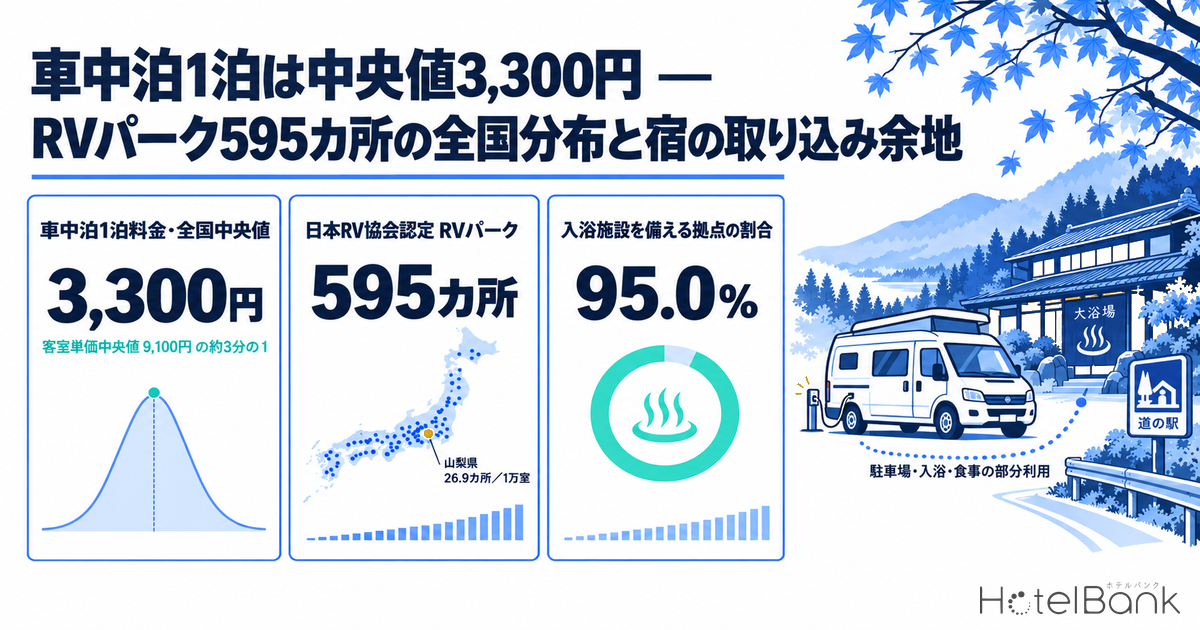
Campervans and car camping have long been filed outside the room-demand conversation. Yet overlay the national distribution of certified parking sites on room supply and the regions where car camping is growing turn out to coincide, to a considerable degree, with the regions where rooms are thinnest. This is not a contest for the same guest. The question is where, and how much, a hotel can capture through partial use — parking, bathing and meals — and we work through it with primary sources and our own data.
Metric Definitions Used in This Article
- ADR (average daily rate) = an estimated settled rate (tax-excluded equivalent) calculated by applying a segment-specific adjustment coefficient to the lowest published plan level each property lists on major booking sites (two guests per room, per-room price, tax included). Cross-checked against property-level results disclosed by listed hotel REITs (91 properties, most recent three months), the median error is approximately 7%. These are estimates and differ from each property’s actual settled prices and accounting figures. Area-level ADR is the median across the target properties (the level of a typical property in that area).
- OCC (occupancy rate) = sold rooms as a share of total rooms in the area (an estimate based on sales inventory on major booking sites). In this article it is used at prefecture level only.
- Room and property counts = a listing-based tally of those properties, among the roughly 168,000 domestic properties tracked by MetroEngines Research, whose operation can be confirmed on major booking sites. Ryokan, minshuku and simple lodging businesses not listed on booking sites are excluded.
- Breakfast premium = the price gap where the same hotel sells both a room-only plan and a plan with breakfast (paired comparison). It is not a comparison between different hotels.
- Data sources = MetroEngines Research / Japan RV Association “RV Park” official search system / Ministry of Land, Infrastructure, Transport and Tourism “Roadside Station (Michi-no-Eki)” list
- — The Japan RV Association’s certified parking sites number 595 on its official search system (queried 11 September 2026); the Ministry of Land, Infrastructure, Transport and Tourism’s roadside stations number 1,234 (as of 4 September 2026). Both are counted from registers published by the governing body and the ministry themselves.
- — Density per 10,000 rooms runs 26.9 sites in Yamanashi, 25.5 in Ibaraki and 24.9 in Shiga, against 0.1 in Tokyo and 1.0 in Osaka. Car camping capacity is thickest where room supply is thinnest.
- — The nightly fee per vehicle has a median of ¥3,300 (N=580). That is about 36% of the ¥9,139 median estimated settled ADR across the 47 prefectures (October 2025), but it carries almost none of the cleaning, bedding and linen cost a room does.
- — 95.0% of sites have bathing facilities on the premises or nearby. A hotel’s existing assets — large communal baths, power hookups, toilets — line up almost exactly with what car camping requires.
- — Stack the breakfast premium (+¥1,014 to +¥2,647) on top of the pitch fee and roughly 40% to 70% of a room rate can be assembled from partial-use products alone. The Rikuzentakata and Hakone cases both cap intake at one to three vehicles.
Fixing the Numbers at Source: 595 Certified Parking Sites, 1,234 Roadside Stations
Start by pinning down where the numbers come from. The two schemes routinely discussed side by side as car camping venues have different governing bodies and different registers.
The “RV Parks” certified by the Japan RV Association stood at 595 sites published on the association’s official search system (each of the 47 prefectures was queried individually on 11 September 2026 and the prefecture counts summed; the result matched the unfiltered total of 595). The association separately reports 686 certified sites as of the end of August 2026, and the 595 carried on the official search system are those with booking and detail information published. The population used in this article for prefecture distribution and pricing is those 595 sites.
The Ministry of Land, Infrastructure, Transport and Tourism’s roadside stations, meanwhile, number 1,234 as of 4 September 2026 (as of the 65th registration round). Aggregating the ministry’s published list of station names, registration rounds and locations (XLS format) by prefecture yields registrations in all 47 prefectures and a total matching 1,234. A roadside station is a rest facility rather than a lodging facility, so whether car camping is permitted differs station by station. That difference in character has to be kept in view whenever the counts are set side by side.
No figures from secondary aggregator sites are used. Both counts come from registers the governing body and the ministry publish themselves.
Prefectures Where Site Density Tracks Room Supply, and Where It Diverges
Ranked by raw count of certified parking sites, the leaders are Hokkaido with 42, Shizuoka with 41, Chiba with 37, Hyogo with 31 and Nagano with 27. But raw counts are pulled along by prefecture area and tourism scale. What carries meaning for an accommodation operator is sites per 10,000 rooms — the density of car camping capacity relative to existing room supply.
Source: Japan RV Association “RV Park” official search system / compiled by MetroEngines Research (room counts are listing-based from major booking sites)
On density the order changes sharply. Yamanashi is highest at 26.9 sites per 10,000 rooms, followed by Ibaraki at 25.5 and Shiga at 24.9. All three hold between roughly 5,000 and 9,000 rooms in absolute terms — thin next to the major metropolitan areas. At the other end are Okinawa at 0.0 (no certified sites at all), Tokyo at 0.1, Osaka at 1.0, Kanagawa at 2.2 and Aichi at 2.4. Where rooms are concentrated, car camping capacity has barely formed.
That pattern does not square with the reading that car camping is eating room demand. If anything, car camping sites stand where room supply is thin and public transport is hard to travel on. On an itinerary where the mode of travel is a private car, skipping the hotel becomes a realistic alternative — that is the order of things. How the strength of rail connectivity shapes the way hotel parking is judged is analysed in detail in Hotel Parking: Where Guests Notice It.
| Prefecture | Certified sites | Roadside stations | Properties | Rooms | Per 10,000 rooms | Est. settled ADR |
|---|---|---|---|---|---|---|
| Hokkaido | 42 | 128 | 671 | 52,816 | 8.0 | ¥9,708 |
| Shizuoka | 41 | 27 | 711 | 29,451 | 13.9 | ¥12,627 |
| Chiba | 37 | 29 | 305 | 23,124 | 16.0 | ¥9,461 |
| Hyogo | 31 | 37 | 396 | 18,766 | 16.5 | ¥13,326 |
| Nagano | 27 | 54 | 557 | 19,508 | 13.8 | ¥11,708 |
| Yamanashi | 24 | 22 | 258 | 8,911 | 26.9 | ¥11,072 |
| Ibaraki | 23 | 16 | 164 | 9,019 | 25.5 | ¥6,825 |
| Mie | 23 | 18 | 242 | 13,649 | 16.9 | ¥10,405 |
| Fukushima | 22 | 37 | 224 | 11,539 | 19.1 | ¥7,413 |
| Kyoto | 18 | 18 | 575 | 31,489 | 5.7 | ¥19,243 |
| Tochigi | 16 | 25 | 329 | 13,520 | 11.8 | ¥11,350 |
| Wakayama | 15 | 36 | 180 | 7,684 | 19.5 | ¥8,866 |
| Gunma | 14 | 33 | 306 | 13,223 | 10.6 | ¥11,709 |
| Shiga | 14 | 20 | 101 | 5,614 | 24.9 | ¥9,014 |
| Fukuoka | 14 | 17 | 381 | 28,550 | 4.9 | ¥11,229 |
| Gifu | 13 | 55 | 250 | 10,824 | 12.0 | ¥12,327 |
| Saitama | 12 | 21 | 100 | 7,279 | 16.5 | ¥7,973 |
| Miyagi | 11 | 19 | 167 | 13,007 | 8.5 | ¥9,132 |
| Niigata | 10 | 42 | 240 | 11,947 | 8.4 | ¥9,007 |
| Okayama | 10 | 17 | 134 | 7,797 | 12.8 | ¥8,246 |
Top 20 prefectures by certified parking site count. Property and room counts are listing-based from major booking sites as of August 2026; estimated settled ADR is our estimate for October 2025, a finalised month. Source: Japan RV Association / MLIT “Roadside Station” list / compiled by MetroEngines Research
Lined up by estimated settled ADR, the high-density prefectures mostly sit between roughly ¥10,000 and the ¥13,000s. Some fall below ¥7,000 — Ibaraki at ¥6,800 — and it is worth noting that in those areas the room rate level itself narrows the gap against car camping.
Where the 595 Sites Are
Plotted on a map, the certified parking sites form bands along the national highways and expressways of the Pacific side, and along the inland routes running from the central highlands into southern Tohoku. Blue dots are sites with bathing facilities on the premises; grey dots are sites without them on site.
All 595 sites. Source: compiled by MetroEngines Research from the Japan RV Association “RV Park” official search system
That Okinawa has not a single certified site reads less as car camping failing to work as a way of travelling the island than as a reflection of a market where movement is rental-car based and lodging is secured first. Tokyo has just one.
A Car Camping Night Has a Median of ¥3,300 — About a Third of a Room Rate
Published nightly fees (per vehicle) have a median of ¥3,300 (N=580, excluding the 15 sites that do not publish a fee). The interquartile range is ¥2,500 to ¥4,000 — a fairly narrow band as price ranges go.
Source: compiled by MetroEngines Research from the Japan RV Association “RV Park” official search system (N=580, excluding the 15 sites that do not publish a fee)
The ¥3,000s account for 230 sites (39.7%) and the ¥2,000s for 176 (30.3%), together 70% of the total. Only 76 sites (13.1%) charge ¥5,000 or more.
Set that against room rates. The median estimated settled ADR across the 47 prefectures was ¥9,100 as of October 2025. At ¥3,300 per vehicle per night, car camping sits at about 36% of that. A lower unit price is only to be expected when a parking pitch is sold in place of a room — but the point that matters is that this ¥3,300 carries almost none of a room’s cost. No cleaning, no bedding, no linen changes; what gets used is the car park and the common areas.
| Product | Price band | Notes |
|---|---|---|
| RV park nightly fee (national median) | ¥3,300 / vehicle | Published fees at Japan RV Association certified sites, N=580 |
| Day-use bathing (standard rate at the case properties) | ¥600-¥1,400 / person | Published rates at the two properties discussed below |
| Breakfast premium (paired comparison within the same hotel, national examples) | +¥1,014-¥2,647 / room | September 2026, gap against room-only |
| Estimated settled ADR (median of 47 prefectures, October 2025) | ¥9,139 / room | Our estimate, tax-excluded equivalent |
Source: Japan RV Association “RV Park” official search system / information published by each property / compiled by MetroEngines Research
What Partial Use Consists Of — Bathing at 95%, Power at 97%
Tally what the 595 sites actually offer, from their facility listings, and the overlap with the assets accommodation businesses already hold is striking.
Source: compiled by MetroEngines Research from the Japan RV Association “RV Park” official search system (N=595 sites)
24-hour toilets and power hookups are each at 576 sites (96.8%), waste disposal at 548 (92.1%) and running water at 508 (85.4%). And bathing facilities are on the premises at 317 sites (53.3%) and nearby at 433 (72.8%), so 565 sites (95.0%) offer one or the other. On a car camping itinerary bathing is in practice a requirement, and the sites have not missed it.
This is where an accommodation business holds the advantage. A large communal bath, shared toilets, washing machines, power and a lounge are all facilities a hotel already has. The products it can offer with no additional investment line up almost exactly with what car camping demand requires.
Meals can be stacked on top of that. Comparing in pairs the properties that sell both a room-only plan and a plan with breakfast within the same hotel, the breakfast premium as of September 2026 runs to +¥2,600 in Yamanashi (+9.9%, N=63 properties), +¥2,400 in Chiba (+10.3%, N=122 properties) and +¥2,300 in Hokkaido (+9.2%, N=351 properties). Add a breakfast in the ¥2,000s to a ¥3,300 pitch and the stack of partial-use products reaches around 60% of a room rate.
| Prefecture | Certified sites | Breakfast premium | Premium rate | Paired properties |
|---|---|---|---|---|
| Yamanashi | 24 | +¥2,647 | +9.9% | 63 |
| Chiba | 37 | +¥2,441 | +10.3% | 122 |
| Hokkaido | 42 | +¥2,296 | +9.2% | 351 |
| Hyogo | 31 | +¥2,213 | +9.5% | 130 |
| Nagano | 27 | +¥1,588 | +5.6% | 170 |
| Kanagawa | 7 | +¥1,583 | +6.2% | 165 |
| Mie | 23 | +¥1,553 | +8.3% | 95 |
| Iwate | 7 | +¥1,508 | +9.3% | 64 |
| Shizuoka | 41 | +¥1,184 | +5.3% | 216 |
| Ibaraki | 23 | +¥1,014 | +6.2% | 103 |
September 2026, two guests per room, all segments. A paired comparison limited to properties selling both room-only and breakfast-included plans within the same hotel. Source: compiled by MetroEngines Research
Breakfast premium for September 2026, two guests per room, all segments (paired comparison within the same hotel; paired properties per prefecture N=63-351). The dashed line marks the ¥3,300 median car camping night. Source: compiled by MetroEngines Research
Stacking Pitch Fee and Breakfast — 27% to 73% of a Room Rate
Combining the two figures so far gives an estimate of how far partial-use products alone reach against a room rate. The pitch fee uses the quartiles of published fees (25th percentile ¥2,500, median ¥3,300, 75th percentile ¥4,000); the breakfast premium uses the minimum (Ibaraki, +¥1,014) and the maximum (Yamanashi, +¥2,647) among the ten prefectures in the table above. No new assumptions have been introduced.
| Pitch fee | Pitch only | + breakfast (min +¥1,014) | + breakfast (max +¥2,647) |
|---|---|---|---|
| Pitch fee, 25th percentile ¥2,500 | ¥2,500 (27.4%) | ¥3,514 (38.5%) | ¥5,147 (56.3%) |
| Pitch fee, median ¥3,300 | ¥3,300 (36.1%) | ¥4,314 (47.2%) | ¥5,947 (65.1%) |
| Pitch fee, 75th percentile ¥4,000 | ¥4,000 (43.8%) | ¥5,014 (54.9%) | ¥6,647 (72.7%) |
Pitch fees are the quartiles of published RV park fees (N=580); the breakfast premium uses the minimum and maximum from Table 3. Source: Japan RV Association “RV Park” official search system / compiled by MetroEngines Research
The ¥5,947 from a median pitch plus the largest breakfast premium is 65.1% of a room rate — that cell is the “around 60%” referred to above. A 25th-percentile pitch with no breakfast stops at 27.4%, so pricing and the way ancillaries are assembled open a gap of nearly 2.7x in revenue per vehicle. Note that the breakfast premium is a simple addition, applying the per-room gap for two guests directly to one vehicle (two occupants), and excludes options such as bathing fees, power and laundry. Where bathing is folded into the pitch fee, as at the two case properties, no separate bathing uplift arises.
Hotels Already Doing It: Two Cases in Rikuzentakata and Hakone
Not concepts — two cases that can be checked against terms published right now.
Capital Hotel 1000 (Rikuzentakata, Iwate; 40 rooms)
A resort hotel on high ground overlooking the Pacific. It has set aside three pitches in its car park, taking vehicles from ¥4,000 per night per vehicle. The pitch fee includes the large communal bath, normally ¥600, with no limit on the number of visits. A welcome drink (all-you-can-drink) voucher is included as well. Hotel toilets are open 24 hours, and dinner, breakfast and lunch can be arranged through the front desk. Options are laid out in fine detail — external power ¥500 (before tax), washing machine rental ¥500 per hour (before tax), electric-assist bicycle ¥500 per hour — a design built to stack partial-use products. Check-in is 13:00 and check-out is by 11:00 the following day.
Terms published as of 11 September 2026. The fee moves with the date: ¥4,000 on weekdays, ¥4,950 on Sundays and ¥6,600 across the 19-22 September holiday run. Source: Japan RV Association “RV Park” official search system, property detail, property official site
Sengokuhara Shinanoki Ichinoyu (Hakone, Kanagawa)
In an announcement on 4 June 2026, Ichinoyu Co., Ltd. said it would accept a car camping plan using the car park at its property, limited to one vehicle per day, over the period 10 June to 30 September 2026 (planned). Fees per vehicle are ¥5,500 on weekdays, ¥6,600 in peak periods and ¥7,700 on days before holidays (all tax included). The large communal bath, normally ¥1,400, may be used any number of times, and 24-hour toilets, use of a microwave and towels handed out at check-in are included. Portable power rental at ¥1,100, free lobby drinks at ¥1,100 per person, and — where rooms are free — upsells to a room stay or the sauna are also on offer. The company describes the initiative as michi-no-yu, a play on michi-no-eki, the roadside station.
A time-limited initiative; as of 11 September 2026 it does not appear in the standard plan list on the company’s official site. Source: Ichinoyu Co., Ltd. press release (4 June 2026), property official site
What the two share is plain: bathing is folded in free or within the fee, and paid options are stacked on top. Bundling the bath with a parking pitch lifts spend per guest more than selling the bath on its own at a day-use rate. In Rikuzentakata a ¥600 bath sits inside a ¥4,000 pitch fee; in Hakone a ¥1,400 bath sits inside ¥5,500. Measured against the bathing fee, the pitch fee is four to seven times higher.
Intake in both cases is one to three vehicles, held to a scale that does not squeeze room sales — a notable feature in itself. A 40-room hotel putting out three pitches makes the position explicit: monetise idle car park capacity without sacrificing room inventory.
The Autumn Driving Season — November 2025 Room Rates Up 22% Year on Year
Seasonality is worth holding onto as well. Overlay monthly estimated settled ADR for Yamanashi, where driving demand concentrates, year by year, and the November rise has strengthened with each passing year.
Source: compiled by MetroEngines Research (September 2026 onward is not shown, as no finalised-month data exists for it yet)
Yamanashi’s estimated settled ADR for November 2025 was ¥12,900, up 22.1% year on year (N=285 properties). Nagano came to ¥12,400, up 16.1% (N=773 properties), and Shizuoka to ¥14,400, up 13.7% (N=805 properties). The pattern of autumn-foliage driving demand pushing room rates up shows clearly in our estimates too. The gap between peak foliage and peak hotel pricing is tested across ten major locations in Autumn Leaves 2026: Hotel Price Peaks Land 14 Days Early.
Autumn, in other words, is when rooms sell high. Which is precisely why car camping intake in this season makes sense designed not to compete with rooms, but as incremental revenue beyond the point where rooms approach full. Estimated occupancy on a listing-inventory basis from major booking sites as of August 2026 was 86.7% in Yamanashi (258 properties, 8,911 rooms) and 92.5% in Nagano (557 properties, 19,508 rooms) — at peak, room inventory is already thin. The parking pitch is a product that rides on top of that.
The Question for Local Government: Dividing Roles Between Roadside Stations and Hotels
Compared prefecture by prefecture, the 1,234 roadside stations and the 595 certified parking sites do not necessarily move in step. Roadside stations per 10,000 rooms run high in Akita at 77.6, Shimane at 54.4 and Kochi at 52.4, while certified parking density in those prefectures is 6.8 to 13.1 sites. One reading: rest facilities are in place, but development of venues where people can actually stay the night has not followed.
Roadside stations are rest facilities, and many were not designed for long parking or overnight stops. If local accommodation businesses take on the role of closing that gap, three things follow at once: parking-etiquette problems at roadside stations are dispersed; hotels earn revenue from bathing, meals and power; and visitors have somewhere safe to stay. On the density data, wide room remains in regional areas for tourism departments to work with accommodation operators and design intake capacity across an area as a whole.
Summary
The distribution of the 595 certified parking sites is thickest where rooms are thin. Against the density leaders — Yamanashi 26.9, Ibaraki 25.5 and Shiga 24.9 sites per 10,000 rooms — Tokyo has 0.1 and Osaka 1.0. Car camping is not displacing rooms; travel demand that rooms are not capturing is being met in another form.
The median night per vehicle is ¥3,300 — about 36% of the ¥9,100 median room rate, but without the cleaning, bedding and linen cost. That 95% of sites offer bathing states plainly the advantage a hotel with a large communal bath already holds. Stack on options — breakfast (a premium of +¥1,000 to the +¥2,600s depending on prefecture), power, washing machines, bicycles — and around 60% of a room rate can be assembled from partial-use products.
What the Rikuzentakata and Hakone cases show is a workable implementation: hold intake to one to three vehicles and it does not collide with room sales. Even through the high-priced foliage season, a parking pitch stands up as an additional revenue opportunity riding on top of room inventory. The autumn driving season is a reasonable moment to test that design.
Related Reading
- Pet-Friendly Hotels in Japan: 81-Property Review Ranking, Autumn 2026
- Autumn Leaves 2026: Hotel Price Peaks Land 14 Days Early in 10 Cities
- Hotel Parking: Where Guests Notice It — Tokyo 2.0% vs Kochi 11.2%
- Japan’s 50 Smart Interchanges: Median 1,130 Hotel Rooms Within 10km
- Autumn Onsen Ryokan ADR 2026: Hakone, Kusatsu & Yufuin YoY Trends
References and Sources
Data sources
Certified parking sites are the 595 sites (fees, facilities, locations) obtained by querying the Japan RV Association “RV Park” official search system individually for each of the 47 prefectures on 11 September 2026; roadside stations are the Ministry of Land, Infrastructure, Transport and Tourism list (1,234 stations as of 4 September 2026) aggregated by prefecture. Property and room counts are listing-based from major booking sites as of August 2026; estimated settled ADR covers finalised months from January 2024 to August 2026; the breakfast premium is a paired comparison within the same hotel for September 2026 (all from MetroEngines Research).
Calculation assumptions
Density converts the certified parking site count to a figure per 10,000 rooms. The median and quartiles of nightly fees are calculated over the 580 sites that publish a fee (per vehicle). The stacking estimate (Table 4) simply adds the minimum and maximum breakfast premium from Table 3 to the quartiles of the pitch fee, applying the per-room gap for two guests to one vehicle (two occupants). Fees and terms for the two case properties are as published on 11 September 2026.
Limitations and caveats
The listings on the official search system are a subset of the certified total the association publishes (686 as of the end of August 2026), limited to sites with booking and detail information published. Roadside stations are rest facilities, and whether car camping is permitted differs station by station. Room counts exclude ryokan, minshuku and simple lodging businesses not listed on booking sites. Estimated settled ADR is an estimate derived from published plan levels and differs from actual settled prices and accounting figures. The stacking estimate is a guide to revenue only; it excludes how many nights a pitch is occupied and any operating costs.
Primary sources (governing body and ministry)
- Japan RV Association “RV Park” official search system (47 prefectures queried individually on 11 September 2026; 595 sites)
- Japan RV Association, “RV Park: car camping facilities certified by the Japan RV Association”
- Japan RV Association press release, “RV Park car camping facilities reach 676 nationwide” (7 August 2026, as of the end of July 2026)
- Japan RV Association press release, “RV Park car camping facilities reach 686 nationwide” (4 September 2026, as of the end of August 2026)
- Ministry of Land, Infrastructure, Transport and Tourism, “Roadside Station (Michi-no-Eki) list” (1,234 stations as of 4 September 2026; XLS list aggregated by prefecture)
- MLIT press release, “On the registration of Roadside Stations”
Published information on the case properties
- RV Park Capital Hotel 1000, property detail (Japan RV Association official search system) / Capital Hotel 1000 official site
- Ichinoyu Co., Ltd. press release, “Hakone’s long-established ryokan Ichinoyu declares a michi-no-yu: the unlimited-onsen car camping beginner plan returns” (4 June 2026) / Sengokuhara Shinanoki Ichinoyu official site
Market data
- MetroEngines Research — properties and rooms by prefecture (as of August 2026, listing-based from major booking sites), estimated settled ADR (finalised months, January 2024 to August 2026), estimated occupancy, breakfast premium (September 2026, paired comparison within the same hotel)