


SQUEEZE, operator of the apartment hotel brand Minn, opened Minn Naha Miebashi (Minn 那覇美栄橋), the brand’s first property in Okinawa, on October 24, 2026. All 42 rooms are 41㎡ and sleep up to six guests, each with a kitchen and a washer-dryer. Within a 1km radius of Miebashi Station on the Yui Rail monorail there are 110 active lodging properties with 10,435 rooms, and Naha City’s estimated settled ADR stood at about ¥10,200 in October 2026. This article maps the room stock and rate levels of the catchment these 42 rooms join, and explains how to evaluate multi-occupancy rooms on a per-person basis.
• ADR (average daily rate) = estimated settled rate (tax-excluded equivalent), calculated by applying segment-specific adjustment factors to the lowest-plan rate each property publishes on OTAs (two adults in one room, per-room rate, tax included). Checked against property-level results disclosed by listed hotel REITs (91 properties, most recent 3 months), the median error is about 7%. These are estimates and differ from each property’s actual transaction prices and accounting figures.
• ADR at the area level (prefecture / municipality) is the median of the estimated settled rates of the properties covered (the level of a typical property in the area).
• Where listed prices are mentioned, they are per-room rates for two adults in one room (tax included).
• OCC (occupancy) = rooms sold as a share of total rooms in the area (an estimate based on OTA sales inventory).
• Source: MetroEngines Research (continuous tracking of OTA published prices for approx. 168,000 properties, of which approx. 27,000 are confirmed active)
Room stock in this article covers lodging properties with 10 or more rooms (excluding leisure/love hotels) within a 1,000m radius of Miebashi Station. “Active” means properties whose selling prices were observed on major booking sites in the most recent three months (September–November 2026) (as of November 12, 2026, compiled by MetroEngines Research).
- — Minn Naha Miebashi, with 42 rooms, all 41㎡ and sleeping up to six, opened on October 24, 2026. It is the first project of a partnership with GLC GROUP, and is operated by its subsidiary GLC COMPASS under a franchise agreement with SQUEEZE.
- — Active stock within 1km of Miebashi Station is 110 properties / 10,435 rooms, 62.0% of them in business hotels. The 42 new rooms add only about 0.4%.
- — Rooms in the catchment grew from 8,412 in 2017 to 11,749 in 2026, +39.7% (properties with a known opening year). Growth picked up again in 2025→2026, at +566 rooms.
- — Naha City’s estimated settled ADR was ¥10,214 in October 2026 (+7.0% YoY), the lowest of the five areas compared and a little under 60% of Fukuoka’s Chuo Ward and Tokyo’s Taito Ward.
- — At around ¥30,000 per room for six guests, the per-person cost matches three standard double-occupancy rooms in the city (¥30,642). In February 2027 this benchmark rises to ¥39,348–¥42,648.
Minn Naha Miebashi at a Glance — All 42 Rooms Are 41㎡ and Sleep up to Six
First, the published facts. According to Travel Voice (October 27, 2026), Minn Naha Miebashi is about a 4-minute walk from Miebashi Station on the Yui Rail and within walking distance of Kokusai-dori. It has 42 rooms of 41㎡ each, and each room can accommodate up to six guests. Every room has a kitchen, microwave, washer-dryer and a bathroom with a bathtub, and the property targets family and group travel, long stays and workations.
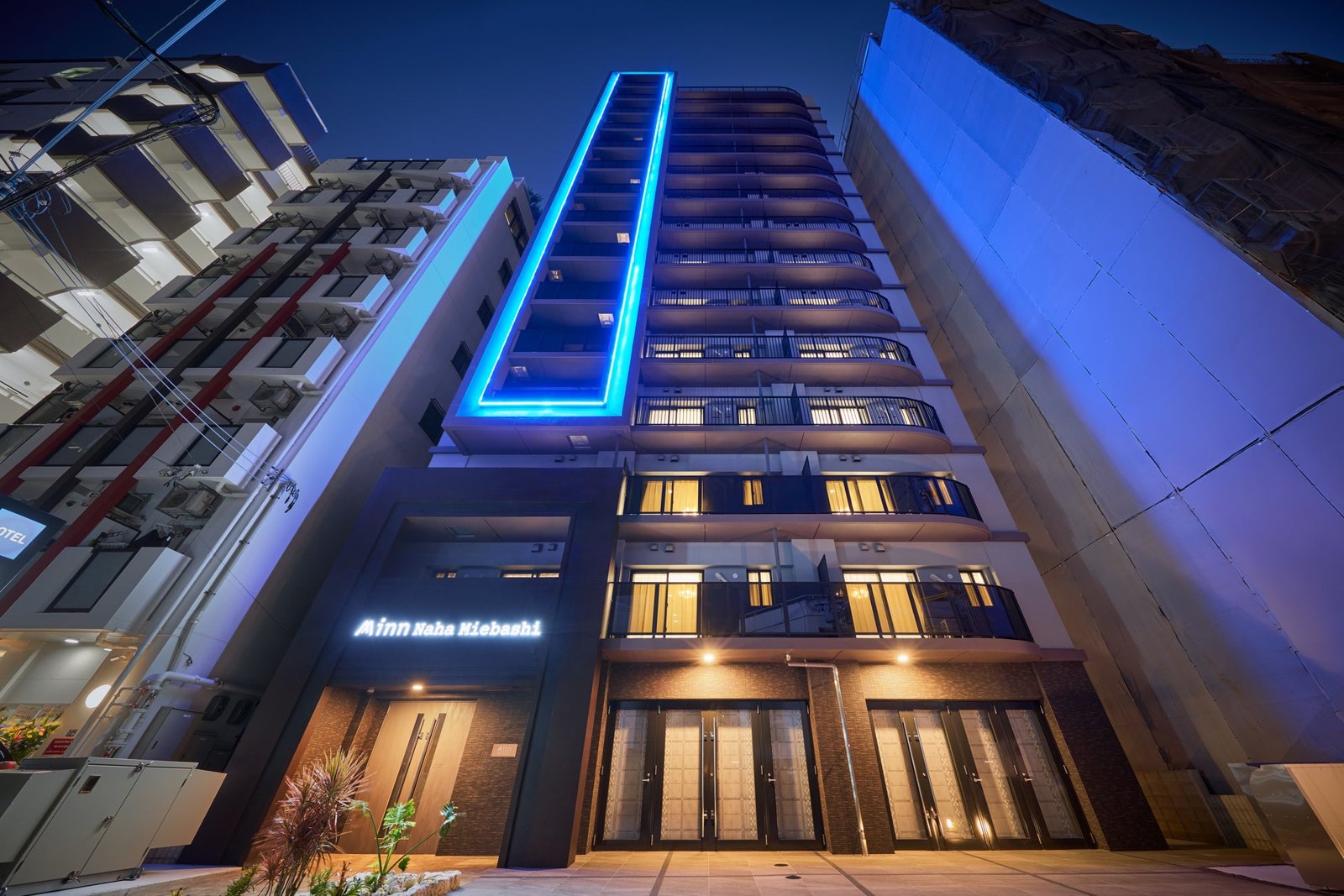
The operating structure is also distinctive. The property is the first project of a partnership with real estate developer GLC GROUP, and its wholly owned subsidiary GLC COMPASS operates it under a franchise agreement with SQUEEZE. SQUEEZE’s June 23, 2026 release gives the address as Maejima 2-chome, Naha, with every room for six and a total capacity of 252 guests, and the property runs on the company’s “suitebook” platform. Combining mobile check-in with remote support through an online concierge, it is designed to minimize front-desk staffing.
| Item | Details |
|---|---|
| Opening date | Saturday, October 24, 2026 |
| Location / access | Maejima 2-chome, Naha / approx. 4-min walk from Yui Rail Miebashi Station |
| Rooms | 42 rooms, all 41㎡, up to 6 guests per room (252 guests max.) |
| In-room facilities | Kitchen, microwave, washer-dryer, bathtub |
| Operator | GLC COMPASS (GLC GROUP subsidiary) under a franchise agreement with SQUEEZE |
| Operating system | suitebook (mobile check-in, remote support) |
Source: Compiled by HotelBank Editorial Team from Travel Voice (October 27, 2026) and SQUEEZE press release (June 23, 2026)
Travel Voice reports that the partnership’s second project is scheduled to open in spring 2028 in Haruyoshi, Chuo Ward, Fukuoka. The plan is to expand from Naha to other major regional cities, and a key question is how far this division-of-labor model — the developer supplies the building, the brand supplies operating know-how and systems — can be replicated.
Openings continue in Tokyo as well. In December 2026 the company plans to open Minn Ueno Iriya East (40 rooms) and Minn Asakusa Hanayashiki North (20 rooms) in Taito Ward, bringing Minn to 22 properties in Tokyo and 10 in Taito Ward. Multi-occupancy rooms on the Tokyo side are covered in our article on Minn Ryogoku, so this article focuses on the Naha catchment.
Room Stock within 1km of Miebashi Station — 110 Active Properties, 10,435 Rooms, 60% Business Hotels
So what does the catchment these 42 rooms join look like? According to MetroEngines Research, there are 179 listed properties with 14,210 rooms within a 1km radius of Miebashi Station, of which 110 properties with 10,435 rooms are active, with selling prices observed in the most recent three months (the figures below are existing stock, before adding Minn Naha Miebashi’s 42 rooms). The 42 rooms equal about 0.4% of active rooms — not enough to move supply and demand across the catchment.
Source: Compiled by HotelBank Editorial Team from MetroEngines Research (as of November 2026, N=179 properties. Circle size = room count; blue = active, grey = listed only; dashed line = 1km radius from Miebashi Station)
By segment, business hotels account for 6,474 rooms, or 62.0% of active rooms, followed by city hotels with 1,908 rooms (18.3%). Befitting a location that spans the business district from the Prefectural Office area through Kumoji and Matsuyama as well as Kokusai-dori, the stock is weighted toward rooms designed for two guests.
| Segment (active) | Properties | Rooms | Share of rooms |
|---|---|---|---|
| Business hotel | 56 | 6,474 | 62.0% |
| City hotel | 9 | 1,908 | 18.3% |
| Hostel | 28 | 701 | 6.7% |
| Resort hotel | 6 | 695 | 6.7% |
| Guesthouse | 6 | 110 | 1.1% |
| Dormitory | 2 | 108 | 1.0% |
| Capsule hotel | 2 | 249 | 2.4% |
| Deluxe hotel | 1 | 190 | 1.8% |
| Total | 110 | 10,435 | 100.0% |
Source: Compiled by HotelBank Editorial Team from MetroEngines Research (as of November 2026, active N=110 properties / 10,435 rooms)
Slicing by size changes the picture. Properties with 50 rooms or fewer number 47, over 40% of active properties, but hold only 1,109 rooms, or 10.6%. The 42-room Minn Naha Miebashi falls into this small-property band and lifts its room count by 3.8%. What defines this opening is a block of large 41㎡, six-guest rooms arriving in a band with many properties but few rooms each.
| Property size (active) | Properties | Rooms | Share of rooms |
|---|---|---|---|
| 50 rooms or fewer | 47 | 1,109 | 10.6% |
| 51–100 rooms | 24 | 1,752 | 16.8% |
| 101–200 rooms | 22 | 3,301 | 31.6% |
| 201 rooms or more | 17 | 4,273 | 40.9% |
Source: Compiled by HotelBank Editorial Team from MetroEngines Research (as of November 2026, active N=110 properties / 10,435 rooms)
Note that we have not quantified how many rooms in the catchment sleep four or more guests or have kitchens, because public information is not available in a form that can be compared across properties. Here we limit ourselves to reading, from the segment and size mix, that this is a catchment centered on rooms designed for two guests.
Room Count Trend in the Catchment — 8,412 Rooms in 2017, +39.7% over Nine Years
Next, the build-up of supply over time. Based on the annual trend for properties with a known opening year, rooms within 1km of Miebashi Station rose from 8,412 at 87 properties in 2017 to 11,749 at 139 properties in 2026 — an increase of 3,337 rooms (+39.7%) over nine years. The largest increases were +792 rooms from 2019 to 2020 and +566 rooms (+5.1%) from 2025 to 2026.
Source: Compiled by HotelBank Editorial Team from MetroEngines Research (based on confirmed OTA listings, as of November 2026. Year-end figures for properties with a known opening year; 21 properties / 484 rooms with an unknown opening year are excluded, and closed properties are removed from their closing year onward. 2026 is as of November and may rise as further listings appear)
Supply was flat from 2023 to 2024, a temporary plateau. Then, in 2025–2026, a series of roughly 200-room hotels opened and growth resumed — that is where the market stands now. By opening decade, properties opened in the 2020s account for 37 active properties and 3,287 rooms, about 30% of active rooms, confirming that this catchment has a high share of new rooms. With large-scale supply continuing, an opening of 42 rooms reads as a bid for demand through a different room type rather than a contest of volume. Supply from converting existing buildings elsewhere in Naha is covered in our article on the conversion of two existing buildings into 342 rooms in Asahibashi, Naha.
Naha City Estimated Settled ADR — ¥10,214 in October, +7.0% YoY
What about rate levels? Naha City’s estimated settled ADR was ¥10,200 in August 2026 (−5.3% YoY), ¥9,700 in September (+8.6%) and ¥10,200 in October (+7.0%). After running below the prior year in summer, rates moved back above last year from early autumn, and October — the opening month — landed about ¥700 above the prior year.
Source: Compiled by HotelBank Editorial Team from MetroEngines Research (Naha City, all segments, N=136–144 properties. November–December 2026 are estimates based on listed rates at the time of the survey)
Overlaying the years makes Naha’s seasonality clear. There are two peaks, in February and August, and February 2026 marked the year’s high at ¥14,200. It coincides with professional baseball spring training camps, a month when rates tend to rise even for double-occupancy rooms.
| Month | Est. settled ADR | Prior year | YoY | Properties | Status |
|---|---|---|---|---|---|
| Aug 2026 | ¥10,216 | ¥10,791 | -5.3% | 143 | Final |
| Sep 2026 | ¥9,709 | ¥8,942 | +8.6% | 144 | Final |
| Oct 2026 | ¥10,214 | ¥9,547 | +7.0% | 144 | Final |
| Nov 2026 | ¥11,084 | ¥9,618 | +15.2% | 143 | Estimate (listed rates at survey) |
| Dec 2026 | ¥10,760 | ¥9,680 | +11.2% | 142 | Estimate (listed rates at survey) |
| Jan 2027 | ¥9,573 | ¥9,925 | -3.5% | 143 | Estimate (listed rates at survey) |
| Feb 2027 | ¥13,116 | ¥14,216 | -7.7% | 142 | Estimate (listed rates at survey) |
| Mar 2027 | ¥10,396 | ¥11,150 | -6.8% | 136 | Estimate (listed rates at survey) |
| Apr 2027 | ¥10,215 | ¥9,581 | +6.6% | 113 | Estimate (listed rates at survey) |
Source: Compiled by HotelBank Editorial Team from MetroEngines Research (Naha City, all segments, as of November 11, 2026)
Looking ahead, estimates based on listed rates at the time of the survey put November 2026 at ¥11,100 (+15.2% YoY) and December at ¥10,800 (+11.2%), both above the prior year. January–March 2027, however, are running 3–8% below the same months a year earlier, leaving considerable room for movement depending on booking pace and price adjustments. With February the first peak season after opening, the price range at which multi-occupancy rooms are accepted will be the property’s first real test.
October Occupancy — Saturday at 76.4% 45 Days Out, Weekdays Catch Up Late
The depth of demand also shows in booking pace. Naha City’s October 2026 occupancy (OTA inventory-based, estimated) averaged 92.8% for the month (183 properties / 15,686 rooms, based on major booking site listings). The chart below compares booking curves from 45 days before arrival to the day before for opening day, Saturday October 24, and Wednesday October 28 the following week (178 properties / 15,186 rooms, based on major booking site listings).
Source: Compiled by Metro Engines Inc. and HotelBank Editorial Team (Naha City, all segments, 178 properties / 15,186 rooms, based on major booking site listings. LT = days before arrival)
Saturday, October 24 had already reached 76.4% 45 days out, 16.1 points ahead of weekday October 28 (60.3%). By the day before, however, the two were nearly level, at 91.2% for Saturday and 91.3% for Wednesday. Weekends fill early, while weekdays catch up in roughly the final two weeks — a clear difference in lead time.
*Occupancy (OTA inventory-based, estimated) is an estimate based on how inventory sold on OTAs is taken up, and differs from each property’s actual overall occupancy.
This difference has implications for selling multi-occupancy rooms. Family and group trips are generally said to be planned early, so weekends and holidays tend to be booked well ahead. Weekdays, by contrast, lean more on last-minute demand, and building a base with multi-night demand such as long stays and workations is an effective approach. Rooms with a kitchen and a washing machine are well suited to absorbing these weekday multi-night stays.
Thinking in Per-Person Rates — For Six Guests, the Benchmark Is Three Double-Occupancy Rooms
The rates so far assume two guests per room. How, then, should a room for up to six be evaluated? As a general rule, a useful method is the per-person rate: the room rate divided by the number of guests. The table below calculates the per-person amount for each combination of room rate and occupancy (a simple calculation excluding meals, cleaning fees and taxes).
| Room rate | 2 guests | 4 guests | 5 guests | 6 guests |
|---|---|---|---|---|
| ¥24,000 | ¥12,000 | ¥6,000 | ¥4,800 | ¥4,000 |
| ¥30,000 | ¥15,000 | ¥7,500 | ¥6,000 | ¥5,000 |
| ¥36,000 | ¥18,000 | ¥9,000 | ¥7,200 | ¥6,000 |
| ¥42,000 | ¥21,000 | ¥10,500 | ¥8,400 | ¥7,000 |
| ¥48,000 | ¥24,000 | ¥12,000 | ¥9,600 | ¥8,000 |
Source: Compiled by HotelBank Editorial Team (simple calculation of room rate ÷ number of guests; does not represent the selling price of any specific property)
Naha City’s ADR serves as the yardstick. October’s estimated settled ADR of about ¥10,200 divided by two gives about ¥5,100 per person, and a group of six using three double-occupancy rooms would pay about ¥30,600 in total (about ¥10,200 × 3 rooms). In other words, if a six-guest room is priced at around ¥30,000, the per-person cost matches the city’s standard double-occupancy room, and even a higher price can be justified by the added value of “everyone staying in the same room” and “having a kitchen and washing machine.”
From the operator’s side, this structure is also a revenue opportunity. A single room can earn close to the revenue of three, while cleaning and linen work does not triple, so per-room profitability tends to improve as occupancy per room rises. With four guests or fewer, however, the per-person rate goes up, so pricing by number of guests and multi-night discounts are effective ways to capture smaller-party and long-stay demand as well. Note that Minn Naha Miebashi’s actual selling prices could not be confirmed from official information as of the survey date (November 11, 2026), so all amounts here are illustrative estimates.
In addition, Okinawa Prefecture plans to introduce a lodging tax of 2% of the room charge (capped at ¥2,000 per person per night) from February 1, 2027; an outline of the scheme is available on the Okinawa Prefecture official page. For the impact on multi-occupancy rooms, see our explainer on Okinawa’s lodging tax.
Area Comparison and Sensitivity — Naha’s “Three-Room Equivalent” Is About ¥31,000, Under 60% of Fukuoka and Tokyo
Applying the per-person yardstick to other areas shows that the “three double-occupancy rooms” equivalent for the same six-guest room varies widely by area. The table below converts October 2026 estimated settled ADR into a three-room equivalent for Miyakojima City and Ishigaki City — Okinawa’s main tourist cities — plus Chuo Ward, Fukuoka, where Minn’s second partnership project is planned, and Taito Ward, Tokyo, where the brand is concentrating its openings.
| Area | Est. settled ADR | Prior year | YoY | Properties | 3 double rooms equivalent |
|---|---|---|---|---|---|
| Naha City | ¥10,214 | ¥9,547 | +7.0% | 144 | ¥30,642 |
| Miyakojima City | ¥14,017 | ¥13,228 | +6.0% | 77 | ¥42,051 |
| Ishigaki City | ¥12,021 | ¥10,593 | +13.5% | 59 | ¥36,063 |
| Chuo Ward, Fukuoka | ¥18,452 | ¥16,431 | +12.3% | 85 | ¥55,356 |
| Taito Ward, Tokyo | ¥17,886 | ¥15,802 | +13.2% | 176 | ¥53,658 |
Source: Compiled by HotelBank Editorial Team from MetroEngines Research (October 2026, all segments, estimated settled ADR for each area. Three-room equivalent = estimated settled ADR × 3)
Naha City’s ¥10,214 is the lowest of the five areas, giving a three-room equivalent of ¥30,642. Miyakojima City (¥42,051) and Ishigaki City (¥36,063) are 20–40% higher than Naha, while Chuo Ward, Fukuoka (¥55,356) and Taito Ward (¥53,658) reach about 1.8 times Naha. On YoY growth too, Naha’s +7.0% trailed Ishigaki (+13.5%), Taito Ward (+13.2%) and Chuo Ward, Fukuoka (+12.3%). The six-guest rooms have entered a market where both rate level and growth are restrained, so even identical rooms cannot simply carry over Fukuoka or Tokyo price bands.
So at what level should a six-guest room be priced within Naha? Table 7 shows, on two axes — room rate and month — the per-person rate with six guests as a percentage of the per-person rate for a standard double-occupancy room in the city (estimated settled ADR ÷ 2). Below 100%, six guests sharing one room is cheaper per person than using three double-occupancy rooms in the city.
| Room rate (6 guests) | Oct 2026 ADR ¥10,214(Final) | Nov 2026 ADR ¥11,084 (est.) | Jan 2027 ADR ¥9,573 (est.) | Feb 2027 ADR ¥13,116 (est.) | Mar 2027 ADR ¥10,396 (est.) |
|---|---|---|---|---|---|
| ¥24,000 | 78.3% | 72.2% | 83.6% | 61.0% | 77.0% |
| ¥30,000 | 97.9% | 90.2% | 104.5% | 76.2% | 96.2% |
| ¥36,000 | 117.5% | 108.3% | 125.4% | 91.5% | 115.4% |
| ¥42,000 | 137.1% | 126.3% | 146.2% | 106.7% | 134.7% |
| ¥48,000 | 156.6% | 144.4% | 167.1% | 122.0% | 153.9% |
Source: Compiled by HotelBank Editorial Team from MetroEngines Research (Naha City, all segments, estimated settled ADR. Formula = (room rate ÷ 6) ÷ (estimated settled ADR ÷ 2). Green = below 100%, i.e. cheaper per person than three double-occupancy rooms in the city. November 2026 onward are estimates based on listed rates at the time of the survey)
At ¥30,000 per room, the ratio is 97.9% in October 2026 and 90.2% in November, slightly below the city benchmark, but 104.5% in the off-season month of January 2027, above it. In February, by contrast, the city’s ADR is high, so even ¥36,000 per room comes in at 91.5%, below 100%, and ¥42,000 at 106.7%. Since the same room rate can look cheap or expensive depending on the month, prices for multi-occupancy rooms need to move in line with the city’s monthly ADR.
Finally, for January–March 2027, which includes the first peak season after opening, we set three scenarios for where Naha’s ADR lands and estimated the “three double-occupancy rooms” equivalent (Table 8). The pessimistic case lands at listed rates as of the survey, the optimistic case returns to prior-year levels, and the middle case sits between the two.
| Scenario | Jan 2027 | Feb 2027 | Mar 2027 |
|---|---|---|---|
| Pessimistic (lands at listed rates as of survey) | ¥28,719 ADR ¥9,573 | ¥39,348 ADR ¥13,116 | ¥31,188 ADR ¥10,396 |
| Middle (midpoint of listed rates and prior year) | ¥29,247 ADR ¥9,749 | ¥40,998 ADR ¥13,666 | ¥32,319 ADR ¥10,773 |
| Optimistic (returns to prior-year level) | ¥29,775 ADR ¥9,925 | ¥42,648 ADR ¥14,216 | ¥33,450 ADR ¥11,150 |
Source: Compiled by HotelBank Editorial Team from MetroEngines Research (Naha City, all segments. Listed rates are estimates as of November 11, 2026; prior year is the estimated settled ADR for January–March 2026. Not a forecast of Minn Naha Miebashi’s selling prices)
In every scenario, February’s equivalent is ¥39,348–¥42,648, roughly ¥10,000 above October 2026 (¥30,642). January, at ¥28,719–¥29,775, and March, at ¥31,188–¥33,450, stay close to October. For first-year pricing, the numbers suggest treating February alone as a separate price band. Note that these amounts are guides derived from the city-wide, all-segment estimated settled ADR and do not forecast the property’s selling prices.
Summary — 42 Rooms That Differentiate on Room Type, Not Volume
To sum up, the catchment Minn Naha Miebashi has entered is a supply-rich area: business hotels make up 60% of its 110 active properties and 10,435 rooms, and room count has grown about 40% in nine years. The 42 new rooms add just 0.4% in volume, but their specification — all 41㎡, six guests, with kitchens — targets a different demand segment from the existing stock, which is built mainly for two guests.
Naha City’s estimated settled ADR was about ¥10,200 in October, 7.0% above the prior year, and October 2026 occupancy (OTA inventory-based, estimated) averaged a high 92.8%. In a market with a solid demand base, the per-person yardstick makes multi-occupancy rooms fully comparable with booking several double-occupancy rooms. Naha’s ADR is, however, the lowest of the five areas compared, so pricing for six-guest rooms should be anchored not to Fukuoka or Tokyo levels but to three double-occupancy rooms in the city (about ¥31,000 in October, about ¥39,000–¥43,000 in February), adjusted month by month. As a regional expansion model built on a division of labor between a real estate developer and a brand operator, we will be watching how it develops, including the link to Haruyoshi, Fukuoka in spring 2028.
⚠ Note on ADR for future dates: ADR for November 2026 onward in this article is an estimate based on selling prices published on OTAs at the time of the survey and will change as check-in dates approach. Please note that prices currently set high may fall with last-minute adjustments.
Related Articles
References and Sources
■ Data sources
Continuous tracking data on OTA published prices and inventory (MetroEngines Research). Room stock covers properties within a 1,000m radius of Miebashi Station with 10 or more rooms, excluding leisure/love hotels (as of November 12, 2026; 179 listed, 110 active). Estimated settled ADR is aggregated at the municipal level for Naha City and four comparison areas (Naha City: July 2024–April 2027, N=113–144 properties). Occupancy and booking curves cover Naha City, all segments (October 2026, 183 and 178 properties). The property overview is based on Travel Voice (October 27, 2026) and SQUEEZE’s press release (June 23, 2026).
■ Calculation assumptions
Per-person rate is a simple calculation of room rate ÷ number of guests and excludes meals, cleaning fees and taxes. The “three double-occupancy rooms” equivalent is estimated settled ADR × 3. Table 7 is (room rate ÷ 6) ÷ (estimated settled ADR ÷ 2). The three scenarios in Table 8 are listed rates for January–March 2027 at the time of the survey (pessimistic), the prior-year estimated settled ADR (optimistic), and the midpoint of the two (middle).
■ Limitations
Estimated settled ADR is an estimate applying segment-specific adjustments to the lowest plan for two adults in one room, not the selling price of multi-occupancy rooms. November 2026 onward is estimated from listed rates at the time of the survey and will change. Occupancy is an OTA inventory-based estimate and is defined differently from the Japan Tourism Agency’s Overnight Travel Statistics Survey. The annual trend of rooms in the catchment covers only properties with a known opening year, and closed properties are removed from their closing year onward. Minn Naha Miebashi’s selling prices could not be confirmed at the time of the survey, and the amounts in this article are illustrative estimates.
■ References
| Travel Voice, article on the opening of Minn Naha Miebashi (October 27, 2026) (Japanese) |
| SQUEEZE, “Partnership with GLC GROUP in the lodging business” (PR TIMES, June 23, 2026) (Japanese) |
| Okinawa Prefecture, “About the Lodging Tax” (Japanese) |
| Japan Tourism Agency, Overnight Travel Statistics Survey (official occupancy statistics; the occupancy in this article is an inventory-based estimate defined differently from this survey) |
| MetroEngines Research — room stock within 1km of Miebashi Station (N=179 properties, 110 active), Naha City estimated settled ADR (N=136–144 properties), occupancy (OTA inventory-based, estimated) and booking curves |