

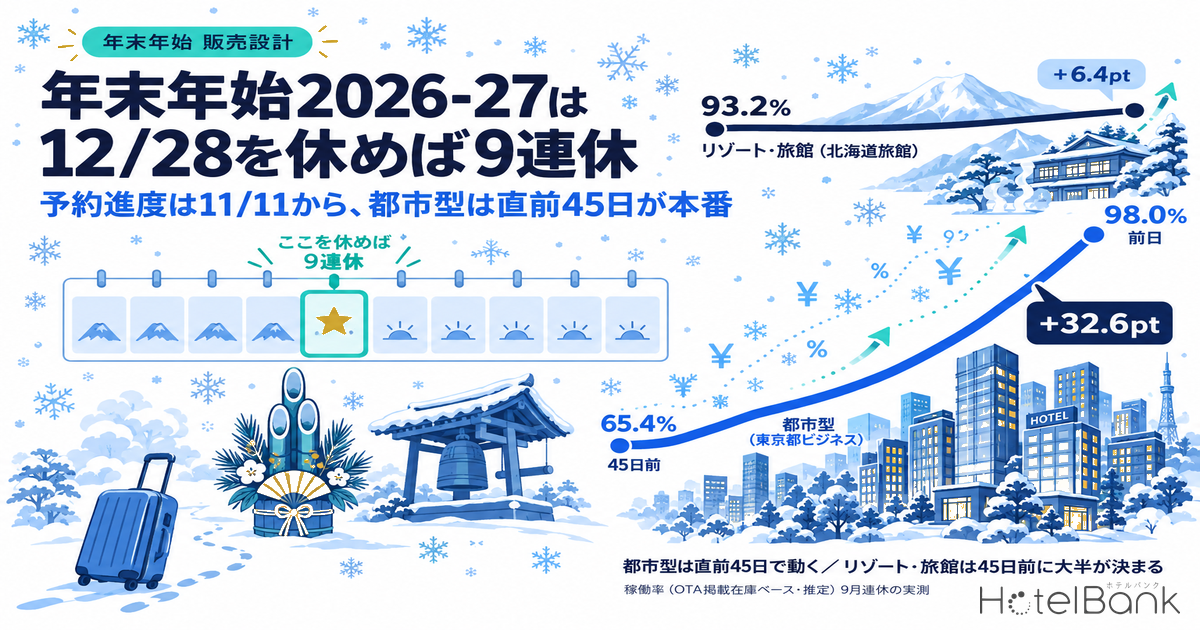
Under the official government calendar, Japan’s 2026-27 year-end and New Year holiday runs six days, from Tuesday, December 29 to Sunday, January 3. The two days before it, Saturday, December 26 and Sunday, December 27, fall on a weekend, leaving just one working day in between: Monday, December 28. In other words, anyone who takes December 28 off gets a nine-day break from December 26 to January 3. Last time (2025-26), the holiday ran nine days from Saturday, December 27 to Sunday, January 4 with no leave required. This time, whether travelers take “one day off or not” splits the break into six days or nine — and that is the starting point for demand planning.
This article takes a snapshot as of October 4, 83 days before the December 26 stay date (T-83), and lays out year-end sales planning for hotel and ryokan operators. There are three key points. First, booking pace on inventory can only be read from 45 days before the stay date, i.e. from November 11. Second, over the most recent major holidays (Obon and the five-day September holiday), city hotels added 27–38pt of occupancy in the final 45 days, whereas resorts and ryokan had already reached the 60–70% range 45 days out for Obon and 80–90% for the September holiday. Third, at current listed prices, city hotels are pricing Monday, December 28 at roughly normal levels, while resorts and ryokan are pricing it 10–20% higher. From these three points, we work out “when, and which nights” each segment should plan for.
Metric Definitions Used in This Article
ADR (Average Daily Rate) = an estimated settled rate (tax-exclusive equivalent), calculated by applying a segment-specific adjustment factor to the lowest-plan price level each property publishes on OTAs (per room, two guests per room, tax-inclusive). Checked against property-level results disclosed by listed hotel REITs (91 properties, most recent three months), the median error is about 7%. These are estimates and differ from each property’s actual transaction prices and accounting figures. Area-level ADR is the median of the properties covered (the level of a typical property in the area).
OCC (Occupancy Rate) = the share of rooms sold out of total rooms in the area (an estimate based on OTA sales inventory). In the body text it is referred to as “occupancy (estimated, based on OTA-listed inventory)”. It is an estimate based on how inventory sold on OTAs is being absorbed, and differs from a property’s actual overall occupancy. Coverage is limited to properties listing at least 30% of their total rooms on major booking sites.
Booking curve / LT (lead time) = a booking curve is the change in OTA remaining room counts leading up to the check-in date. LT is the number of days until check-in. This article uses only the range from 45 days before the stay date to the day before.
Listed price = the average price of all plans listed on OTAs and similar channels (per room, two guests per room, tax-inclusive; includes room-only through meal-inclusive plans). This is a separate metric from estimated settled ADR. Data source: MetroEngines Research
- — Take Monday, Dec 28 off and get nine days: the official calendar gives a six-day break from Dec 29 to Jan 3. The nine-day break from Dec 26 to Jan 3 depends on taking leave, so demand in the first half of the break is more sensitive to travelers’ decisions.
- — Inventory becomes readable from Nov 11: using the window from 45 days out to the day before, reading starts on Nov 11 for the Dec 26 night, Nov 16 for the Dec 31 night and Nov 19 for the Jan 3 night.
- — City hotels add 27–38pt in the final 45 days: measured on the nights of September 20 and August 14, 2026, business hotels in Tokyo, Osaka and Kyoto built up from 50–70% at 45 days out (estimated, based on OTA-listed inventory).
- — Resorts and ryokan are 60–90% full 45 days out: the 45-day level was 81.3–93.2% for the September holiday and 65.6–78.9% for Obon. Both times they filled earlier than city hotels, but how much earlier varies.
- — Dec 28 listed-price index (Dec 25 = 100): 103.4 for Tokyo city hotels and 100.0 for Osaka city hotels. Shizuoka resorts and ryokan are at 122.1 and Nagano at 115.1, 10–20% higher (as of the Oct 4 survey).
A Calendar Where “One Day Off Makes Nine” — Inventory Becomes Readable in Sequence from Nov 11 to Nov 19
Let us first confirm the calendar and the observation schedule worked back from it. By law, government administrative holidays run from December 29 to January 3, so the last government working day is Monday, December 28, and work resumes on Monday, January 4. Private-sector leave varies by company, but this calendar is the basic shape of the year-end holiday.
However, inventory movements earlier than 45 days before the stay date include periods before properties have finished loading their sales allotments, so they may not reflect actual booking progress. This article therefore limits its reading of inventory absorption to the window from 45 days out to the day before. Applying that rule, inventory for the December 26 night becomes readable on November 11, New Year’s Eve (December 31) on November 16, and the final night of the break (January 3) on November 19.
| Stay date | Position in the calendar | Days from Oct 4 | Inventory readable from (45 days out) |
|---|---|---|---|
| Sat, Dec 26 | First day of the nine-day break (weekend) | 83 days | Wed, Nov 11 |
| Sun, Dec 27 | Weekend; next day is a weekday | 84 days | Thu, Nov 12 |
| Mon, Dec 28 | Weekday (last government working day). Take it off for a nine-day break | 85 days | Fri, Nov 13 |
| Tue, Dec 29 | First day of the six-day break | 86 days | Sat, Nov 14 |
| Wed, Dec 30 | Year-end holiday | 87 days | Sun, Nov 15 |
| Thu, Dec 31 | New Year’s Eve | 88 days | Mon, Nov 16 |
| Fri, Jan 1 | New Year’s Day (national holiday) | 89 days | Tue, Nov 17 |
| Sat, Jan 2 | Weekend | 90 days | Wed, Nov 18 |
| Sun, Jan 3 | Last day of the break; work resumes next day | 91 days | Thu, Nov 19 |
| Mon, Jan 4 | Weekday (first working day) | 92 days | Fri, Nov 20 |
Source: Compiled by HotelBank Editorial Team from Cabinet Office, “National Holidays” and the Act on Holidays of Administrative Organs
Put differently, the current T-83 position is the stage where “booking progress on inventory cannot yet be read, but prices and plans are coming onto the market.” Whether year-end booking pace is fast or slow can only be discussed from mid-November; the roughly five weeks until then are best treated as the time to prepare the yardstick you will compare against once reading begins. Note that inventory observation began in March 2026, so a comparison with last year’s year-end holiday at the same lead times is not possible. This article therefore uses the two most recent major holidays, observed to completion on the same basis, as yardsticks.
Yardstick 1: The September Five-Day Holiday — City Hotels at 60–70% 45 Days Out, Resorts and Ryokan at 80–90%
The first yardstick is the five-day holiday of September 2026 (Sep 19–23). For the night of Sunday, September 20, the second night of the break, we lined up occupancy (estimated, based on OTA-listed inventory) from 45 days out to the day before, by segment, across seven prefectures.
Figure 1: Booking curve for the night of Sun, Sep 20 (45 days out → day before, occupancy, estimated)
Coverage: Tokyo business 553 properties / 80,405 rooms, Osaka business 293 properties / 48,402 rooms, Nagano resorts 62 properties / 4,256 rooms, Hokkaido ryokan 174 properties / 7,234 rooms (based on listings on major booking sites). Source: MetroEngines, Inc.; compiled by HotelBank Editorial Team
Tokyo business hotels (553 properties / 80,405 rooms, based on listings on major booking sites) were at 65.4% 45 days out, rising to 74.8% at 30 days out and 88.6% at 14 days out, and reaching 98.0% the day before. That is a 32.6pt gain over 45 days. Osaka business hotels (293 properties / 48,402 rooms) climbed 38.4pt from 61.6% to 100.0%, and Kyoto business hotels (197 properties / 19,892 rooms) added 27.2pt from 72.8% to 100.0%.
By contrast, Nagano resort hotels (62 properties / 4,256 rooms) were already at 90.2% 45 days out and Hokkaido ryokan (174 properties / 7,234 rooms) at 93.2% — above 90% at the start of the observation window. Their gains through the day before were only 8.5pt and 6.4pt respectively. Even on the same night of the same holiday, city hotels were a market where “around 30% moves in the final 45 days,” while resorts and ryokan were a market where “most of it is settled by 45 days out.”
| Area / segment | Properties / rooms | 45 days out | 30 days out | 14 days out | 7 days out | Day before | 45 days out → day before |
|---|---|---|---|---|---|---|---|
| Tokyo / business | 553 / 80,405 | 65.4% | 74.8% | 88.6% | 92.9% | 98.0% | +32.6pt |
| Osaka / business | 293 / 48,402 | 61.6% | 71.2% | 86.8% | 93.8% | 100.0% | +38.4pt |
| Kyoto / business | 197 / 19,892 | 72.8% | 80.6% | 96.2% | 99.4% | 100.0% | +27.2pt |
| Hokkaido / resort | 92 / 9,762 | 90.0% | 93.9% | 96.5% | 96.9% | 98.1% | +8.1pt |
| Hokkaido / ryokan | 174 / 7,234 | 93.2% | 97.7% | 99.6% | 99.3% | 99.6% | +6.4pt |
| Nagano / resort | 62 / 4,256 | 90.2% | 96.0% | 99.7% | 99.3% | 98.7% | +8.5pt |
| Nagano / ryokan | 280 / 6,631 | 87.0% | 93.9% | 99.1% | 99.2% | 99.7% | +12.7pt |
| Shizuoka / resort | 111 / 6,201 | 85.8% | 93.2% | 99.8% | 99.9% | 94.5% | +8.7pt |
| Shizuoka / ryokan | 321 / 8,617 | 81.3% | 91.0% | 99.5% | 99.8% | 94.8% | +13.5pt |
| Okinawa / resort | 197 / 16,681 | 84.7% | 88.9% | 93.0% | 93.5% | 96.5% | +11.8pt |
Properties / rooms are based on listings on major booking sites (properties listing at least 30% of total rooms). In Shizuoka, some inventory came back between 7 days out and the day before. Source: MetroEngines, Inc.; compiled by HotelBank Editorial Team
Yardstick 2: Obon — City Hotels’ “About 30% in the Final 45 Days” Holds Across Holidays
With the September holiday alone, it remains possible that the pattern was peculiar to that particular break. So as a second yardstick, we lined up the Obon night of Friday, August 14 in the same way. As a period when homecoming trips and leisure travel overlap, it is the holiday closest in character to the year-end break.
| Area / segment | Properties / rooms | 45 days out | 30 days out | 14 days out | 7 days out | Day before | 45 days out → day before |
|---|---|---|---|---|---|---|---|
| Tokyo / business | 534 / 78,226 | 59.6% | 67.1% | 77.6% | 81.7% | 91.6% | +32.0pt |
| Osaka / business | 287 / 48,207 | 54.6% | 60.0% | 68.6% | 74.2% | 86.4% | +31.8pt |
| Kyoto / business | 194 / 19,851 | 60.4% | 66.2% | 74.0% | 79.0% | 89.3% | +28.9pt |
| Hokkaido / resort | 85 / 9,135 | 74.8% | 78.0% | 84.4% | 86.5% | 93.4% | +18.6pt |
| Hokkaido / ryokan | 168 / 7,281 | 74.8% | 79.5% | 84.7% | 87.9% | 93.8% | +19.0pt |
| Nagano / resort | 59 / 4,084 | 78.9% | 83.0% | 91.3% | 91.5% | 96.2% | +17.3pt |
| Nagano / ryokan | 242 / 5,730 | 74.3% | 80.7% | 88.9% | 92.1% | 96.9% | +22.6pt |
| Shizuoka / resort | 106 / 5,899 | 68.2% | 74.7% | 83.9% | 87.8% | 96.5% | +28.3pt |
| Shizuoka / ryokan | 278 / 7,767 | 65.6% | 70.2% | 80.9% | 84.9% | 95.2% | +29.6pt |
| Okinawa / resort | 181 / 16,334 | 75.6% | 81.0% | 85.2% | 88.2% | 92.3% | +16.7pt |
Properties / rooms are based on listings on major booking sites (properties listing at least 30% of total rooms). Source: MetroEngines, Inc.; compiled by HotelBank Editorial Team
Gains for city business hotels were +32.0pt in Tokyo, +31.8pt in Osaka and +28.9pt in Kyoto. These fall in almost the same band as the September holiday’s +32.6pt, +38.4pt and +27.2pt, so the pattern that “city hotels move 27–38pt in the final 45 days” held across both holidays.
Resorts and ryokan, on the other hand, looked different depending on the holiday. Levels that were 81.3–93.2% 45 days out for the September holiday stood at only 65.6–78.9% for Obon, and the gains in the final 45 days were larger, at 16.7–29.6pt. Resorts and ryokan filled earlier than city hotels both times, but how much earlier varies. Which of the two patterns the year-end holiday resembles will have to be checked once inventory becomes readable in mid-November.
Figure 2: Occupancy gain from 45 days out to the day before (pt) — Obon night of Aug 14 vs. September holiday night of Sep 20
Properties and room counts are the same as in Tables 2 and 3 (based on listings on major booking sites). Source: MetroEngines, Inc.; compiled by HotelBank Editorial Team
The Holiday’s “Shoulder Nights” — The Eve and the Final Night Fill in the Last Two Weeks
Looking only at the middle of a holiday makes it easy to overlook the nights with the most room for sales planning. Laying out the September five-day holiday night by night, the eve (Friday, Sep 18) and the final night (Wednesday, Sep 23, a national holiday) were a step lower in day-before occupancy than the mid-holiday night of Sep 20.
Figure 3: Seven nights around the September five-day holiday — day-before occupancy (estimated, based on OTA-listed inventory)
Coverage (Sep 20 night): Tokyo business 553 properties / 80,405 rooms, Osaka business 293 properties / 48,402 rooms, Nagano ryokan 280 properties / 6,631 rooms, Hokkaido resorts 92 properties / 9,762 rooms (based on listings on major booking sites). Source: MetroEngines, Inc.; compiled by HotelBank Editorial Team
| Area / segment | Eve, Sep 18 14 days out | Eve, Sep 18 Day before | Mid-holiday, Sep 20 Day before | Final night, Sep 23 14 days out | Final night, Sep 23 Day before | Final-night gain in last 2 weeks | Gap vs. mid-holiday |
|---|---|---|---|---|---|---|---|
| Tokyo / business | 72.8% | 86.7% | 98.0% | 66.9% | 81.0% | +14.1pt | 17.0pt |
| Osaka / business | 58.9% | 75.7% | 100.0% | 52.7% | 66.2% | +13.5pt | 33.8pt |
| Kyoto / ryokan | 60.9% | 80.4% | 100.0% | 63.7% | 85.0% | +21.3pt | 15.0pt |
| Hokkaido / resort | 70.5% | 79.7% | 98.1% | 72.2% | 81.8% | +9.6pt | 16.3pt |
| Nagano / ryokan | 65.2% | 80.3% | 99.7% | 69.1% | 84.0% | +14.9pt | 15.7pt |
| Shizuoka / ryokan | 58.4% | 71.6% | 94.8% | 63.5% | 78.3% | +14.8pt | 16.5pt |
Same population as Table 2 (based on listings on major booking sites). Kyoto ryokan: 119 properties / 2,261 rooms for the Sep 20 night. Source: MetroEngines, Inc.; compiled by HotelBank Editorial Team
Tokyo business hotels were at 98.0% on the mid-holiday night versus 81.0% on the final night, a 17.0pt gap; for Osaka business hotels the gap widened to 33.8pt, at 100.0% versus 66.2%. Shoulder nights, however, are simply slower to start moving — they still have room to grow close in. Over the two weeks from 14 days out to the day before, the final night of Sep 23 gained 21.3pt for Kyoto ryokan, 14.9pt for Nagano ryokan and 14.1pt for Tokyo business hotels.
Mapping this structure onto this year’s year-end holiday, the shoulder nights are Sunday, December 27, Monday, December 28, and Sunday, January 3. December 28 in particular is two-sided: for those taking leave it is the third night of the break, and for those who are not, it is the night of a working day. Whether to sell it the same way as the mid-holiday nights or to design it as a “bridge” for multi-night stays looks set to decide whether a property can capture nine-day-break travelers.
Listed Prices at T-83 — City Hotels Price Dec 28 at Normal Levels, Resorts and Ryokan 10–20% Higher
Inventory cannot be read yet, but prices are already on the market. Limiting the sample to properties with a listed price on all 11 nights from Friday, December 25 to Monday, January 4, we took each property’s December 25 listed price as 100 and calculated the median index, split into city hotels (business and city hotels) and resorts and ryokan. This is an interim snapshot of how the market currently views each night.
Figure 4: Year-end listed-price index (Dec 25 = 100, listed levels as of the Oct 4 survey)
N = Tokyo city hotels 942 properties, Osaka city hotels 568, Nagano resorts & ryokan 265, Shizuoka resorts & ryokan 268. Median of property-level indices of listed price (all-plan average, tax-inclusive). Source: MetroEngines Research; compiled by HotelBank Editorial Team
| Area / segment | N | Dec 26 (Sat) | Dec 27 (Sun) | Dec 28 (Mon) | Dec 31 (Thu) | Jan 1 (Fri) | Jan 2 (Sat) | Jan 3 (Sun) | Peak night |
|---|---|---|---|---|---|---|---|---|---|
| Tokyo / city | 942 | 116.5 | 100.6 | 103.4 | 130.1 | 104.3 | 93.8 | 70.1 | 12/31 |
| Osaka / city | 568 | 124.9 | 100.0 | 100.0 | 133.8 | 117.2 | 108.7 | 84.7 | 12/31 |
| Kyoto / city | 366 | 133.6 | 123.8 | 125.7 | 172.3 | 158.0 | 140.3 | 97.5 | 12/31 |
| Hokkaido / city | 364 | 107.7 | 99.9 | 100.0 | 102.7 | 101.8 | 100.2 | 88.6 | 12/26 |
| Okinawa / city | 199 | 106.6 | 102.1 | 102.9 | 118.4 | 118.4 | 111.9 | 93.2 | 12/31 |
| Nagano / city | 137 | 115.1 | 103.6 | 105.2 | 116.3 | 118.8 | 115.3 | 97.8 | 1/1 |
| Shizuoka / city | 204 | 125.0 | 106.6 | 109.4 | 129.8 | 129.6 | 128.9 | 103.1 | 12/31 |
| Kyoto / resorts & ryokan | 116 | 111.9 | 111.6 | 115.9 | 126.9 | 124.0 | 121.4 | 107.4 | 12/31 |
| Hokkaido / resorts & ryokan | 235 | 109.9 | 107.5 | 110.7 | 132.2 | 128.7 | 122.9 | 107.0 | 12/31 |
| Okinawa / resorts & ryokan | 271 | 112.8 | 112.7 | 116.9 | 144.0 | 143.4 | 129.2 | 102.6 | 12/31 |
| Nagano / resorts & ryokan | 265 | 113.9 | 111.7 | 115.1 | 131.2 | 131.1 | 125.7 | 108.5 | 12/31 |
| Shizuoka / resorts & ryokan | 268 | 120.1 | 114.4 | 122.1 | 159.8 | 159.8 | 151.7 | 124.8 | 12/31 |
N is the number of properties with a listed price on all 11 nights. City = business hotels and city hotels; resorts & ryokan = resort hotels and ryokan. Resorts & ryokan in Tokyo and Osaka are omitted because N is small. Source: MetroEngines Research; compiled by HotelBank Editorial Team
City hotels show a single concentrated peak on New Year’s Eve. Tokyo (N=942) is at 130.1 on December 31, then falls to 104.3 on New Year’s Day, 93.8 on January 2 and 70.1 on January 3. Osaka (N=568) likewise peaks at 133.8 on December 31 and drops back to 84.7 by January 3. In contrast, Shizuoka resorts and ryokan (N=268) sit on a plateau, at 159.8 on both December 31 and New Year’s Day and 151.7 on January 2, and still hold 124.8 on January 3. Resorts and ryokan in Nagano (N=265), Hokkaido (N=235) and Okinawa (N=271) also show a sustained peak from December 31 through January 2.
The point to watch is how Monday, December 28 is treated. City hotels are pricing it at roughly the December 25 level: 103.4 in Tokyo and 100.0 in Osaka. Kyoto city hotels (N=366), however, are at 125.7, relatively high for the city segment. Resorts and ryokan, meanwhile, have already set levels 10–20% higher: 122.1 in Shizuoka, 115.9 in Kyoto and 115.1 in Nagano. The reading is that resorts and ryokan see December 28 as part of the year-end holiday, while city hotels treat it as an ordinary Monday. Note that this index is not day-of-week adjusted, so it captures how each night is priced relative to December 25 rather than the full daily price structure.
Monthly Estimated Settled ADR — December Above Last Year in Tokyo and Hokkaido, January Positive in All Seven Areas
For an overall sense of price levels, we look at monthly estimated settled ADR. December 2026 and January 2027 are estimates based on listed levels at the time of the survey, while the prior-year months are settled figures. Because the bases differ, year-on-year changes are best read as a directional reference.
| Area | Dec 2025 (settled) | Dec 2026 (estimate at survey) | YoY | N (last year / this year) | Jan 2026 (settled) | Jan 2027 (estimate at survey) | YoY | N (last year / this year) |
|---|---|---|---|---|---|---|---|---|
| Tokyo | ¥15,814 | ¥17,483 | +10.6% | 1,074 / 1,066 | ¥13,192 | ¥13,750 | +4.2% | 1,111 / 1,019 |
| Osaka | ¥11,120 | ¥10,687 | -3.9% | 627 / 629 | ¥9,513 | ¥10,074 | +5.9% | 640 / 600 |
| Kyoto | ¥17,918 | ¥17,426 | -2.7% | 580 / 568 | ¥13,203 | ¥13,605 | +3.0% | 580 / 541 |
| Hokkaido | ¥9,421 | ¥12,337 | +31.0% | 875 / 822 | ¥10,339 | ¥13,048 | +26.2% | 885 / 730 |
| Okinawa | ¥10,890 | ¥11,692 | +7.4% | 482 / 502 | ¥11,047 | ¥11,188 | +1.3% | 485 / 476 |
| Nagano | ¥14,112 | ¥14,193 | +0.6% | 810 / 698 | ¥13,787 | ¥14,472 | +5.0% | 810 / 608 |
| Shizuoka | ¥15,546 | ¥14,123 | -9.2% | 802 / 797 | ¥14,515 | ¥15,062 | +3.8% | 822 / 722 |
N is the number of properties included in the estimated settled ADR calculation. December 2026 and January 2027 are estimates based on listed levels as of the survey (Oct 4) and will change. Source: MetroEngines Research; compiled by HotelBank Editorial Team
In December, Tokyo at ¥17,500 (+10.6% YoY) and Hokkaido at ¥12,300 (+31.0%) are above last year, while Osaka at ¥10,700 (−3.9%), Kyoto at ¥17,400 (−2.7%) and Shizuoka at ¥14,100 (−9.2%) are below. In Hokkaido the number of properties covered changed from 875 to 822 for December and from 885 to 730 for January, so these figures should be read as including differences in which properties keep listing through winter. In January, all seven areas are up year on year, in a range of +1.3% (Okinawa) to +26.2% (Hokkaido). On a monthly view, prices for the two months spanning the year-end holiday are coming in at or above last year’s levels.
Implications for Operators — Different “Make-or-Break Periods” by Segment, and Three Shoulder Nights
Putting this together, the timing on which year-end sales planning should focus differs by segment. What follows is a framework built using measurements from two holidays as yardsticks; it does not indicate that the year-end holiday will behave the same way. We have arranged it so it can serve as a benchmark when you begin reading your own inventory in mid-November.
| Period | City hotels (business & city) | Resorts & ryokan |
|---|---|---|
| Until Nov 10 (T-83 to T-46) | Assuming concentration on Dec 31, review the price steps on Sat, Dec 26 and Jan 1–2. Dec 28 is mostly priced at normal levels, leaving room to offer multi-night plans for nine-day-break travelers | In the recent holidays, 65.6–93.2% was already filled 45 days out. Designing prices, multi-night conditions and meal plans may effectively be the main event in this period |
| Nov 11 to Nov 20 (reading begins) | Compare the 45-day level with the recent holidays’ 54.6–72.8%. If it falls in this band, it is easier to build a stepped pricing plan on the assumption that around 30% will move in the remaining 45 days | Check whether the 45-day level matches the September-holiday pattern (80–90%) or the Obon pattern (60–70% range). If it is Obon-like, there is more room to build up close in |
| December (final 30 days) | The main event. Tokyo business hotels added 23.2pt from 30 days out to the day before in the September holiday and 24.5pt at Obon | Final adjustments on the shoulder nights (Dec 27, Dec 28, Jan 3). Also plan to resell inventory that comes back close in |
Source: MetroEngines, Inc.; compiled by HotelBank Editorial Team
For city hotels, the effective approach is to capture the movement in the final 45 days without rushing. In the last two holidays, occupancy that was 50–70% 45 days out grew to around 90% or full by the day before. Rather than moving rates all the way early, checking inventory progress at each milestone — 30, 14 and 7 days out — and adjusting prices in steps creates the opportunity to turn the New Year’s Eve concentration into even more revenue. In addition, December 28, currently priced at normal levels by many properties, is worth considering as upside from welcoming nine-day-break travelers on multi-night stays.
For resorts and ryokan, now — before inventory becomes readable — is the core of the planning work. The plateau from December 31 to January 2 is already priced in, so the room for growth is likely at both ends of the plateau: December 27–28 and January 3. In the September holiday, some ryokan areas saw the final night gain about 15–21pt in the last two weeks. Pricing the shoulder nights separately from the mid-holiday nights and preparing plans that build them in as the last night of a multi-night stay should make it easier to absorb close-in demand.
One more thing to keep in mind is policy milestones. In Kyushu, the cutoff of the period covered by the lodging discount program affects travelers’ net costs from December 26 onward. In ski areas, the total daily cost of lift tickets plus lodging becomes travelers’ basis for comparison. And because Christmas Eve 2026 falls on a Thursday, pricing around Christmas is also worth checking against the regular weekday pattern.
Summary — In a Period You Cannot Read Yet, Prepare the Yardstick for When You Can
The 2026-27 year-end holiday splits into six or nine days depending on whether travelers take Monday, December 28 off. Compared with years like last time, when the calendar alone produced a nine-day break, demand in the first half of the break (December 26–28) is more dependent on travelers taking leave. Even in current listed prices, city hotels and resorts/ryokan read December 28 differently.
Booking pace on inventory becomes readable from November 11 to November 19. As yardsticks for that moment, we have presented measurements from the two most recent major holidays. City hotels consistently sat at 50–70% 45 days out and built up 27–38pt from there, while resorts and ryokan filled earlier than city hotels, at the 60–70% range 45 days out for Obon and 80–90% for the September holiday. Shoulder nights have room to grow substantially in the final two weeks. T-83 is not the time to draw conclusions but the time to get the plan in order. When the observation window opens in mid-November, hold your own property’s progress up against these yardsticks.
Note on ADR and listed prices for future dates: The December 2026 and January 2027 ADR figures and the year-end listed-price index in this article are estimates and aggregates based on selling prices published as of the survey date (October 4, 2026), and will change as check-in approaches due to new plans being added and price adjustments. Occupancy for the September holiday and Obon are completed measurements, but they do not indicate that the year-end holiday will follow the same path.
Frequently Asked Questions
Q. How long is the 2026-27 year-end and New Year holiday?
A. Government administrative holidays run six days, from Tuesday, December 29 to Sunday, January 3. Because Saturday, December 26 and Sunday, December 27 fall on the weekend just before, taking Monday, December 28 off creates a nine-day break from December 26 to January 3. Last time (2025-26), the break ran nine days from Saturday, December 27 to Sunday, January 4 without taking any leave.
Q. From when can year-end booking pace be read?
A. This article reads inventory absorption only from 45 days before the stay date to the day before. On that basis, reading can begin on November 11 for the December 26 night, November 16 for the December 31 night and November 19 for the January 3 night. As of October 4 (T-83), prices and plans are still coming onto the market.
Q. How do city hotels and resorts/ryokan differ in how they fill?
A. Measured on the nights of September 20 and August 14, 2026, business hotels in Tokyo, Osaka and Kyoto added 27–38pt in the final 45 days. Resorts and ryokan were at 81.3–93.2% 45 days out for the September holiday and 65.6–78.9% for Obon, filling earlier than city hotels (estimates based on OTA-listed inventory). This does not indicate that the year-end holiday will follow the same path.
Q. How is Monday, December 28 priced right now?
A. In the listed-price index as of the October 4 survey (each property’s December 25 = 100, median), Tokyo city hotels are at 103.4 and Osaka city hotels at 100.0, roughly normal levels. Resorts and ryokan are 10–20% higher: 122.1 in Shizuoka, 115.9 in Kyoto and 115.1 in Nagano. Listed prices will change with future price adjustments.
Related Articles
References and Sources
■ Data sources
Occupancy (estimated, based on OTA-listed inventory), listed prices and estimated settled ADR were compiled by MetroEngines Research from public information on major booking sites. Occupancy covers properties listing at least 30% of their total rooms, aggregated from 45 days before the stay date to the day before for the nights of August 14 and September 18–24, 2026. The calendar is based on Cabinet Office holiday information and the Act on Holidays of Administrative Organs.
■ Calculation assumptions
The date inventory becomes readable is calculated as 45 days before each stay date. The listed-price index is the median of indices with each property’s December 25 set to 100, limited to properties with a listed price on all 11 nights from December 25, 2026 to January 4, 2027 (as of the October 4 survey). Estimated settled ADR is the area median after applying segment-specific adjustment factors to the lowest-plan price level; December 2026 and January 2027 are estimates based on listed levels at the time of the survey, and the prior-year months are settled figures.
■ Limitations and caveats
Occupancy is an estimate based on sales inventory on major booking sites and differs from a property’s actual overall occupancy. The September holiday and Obon measurements are yardsticks for comparison and do not indicate that the year-end holiday will follow the same path. Year-on-year changes compare settled figures with survey-time estimates and are only a directional reference. Prices for future dates will change with plan additions and price adjustments.
| Cabinet Office, “National Holidays” — national holidays in 2026 and 2027 |
| Act on Holidays of Administrative Organs (e-Gov Law Search) — designates December 29 to January 3 as administrative holidays |
| Japan Tourism Agency, “Overnight Travel Statistics Survey” — official monthly statistics on room occupancy and guest nights |
| MetroEngines Research — occupancy (estimated, based on OTA-listed inventory; stay dates in August and September 2026; seven prefectures), listed prices (December 25, 2026 to January 4, 2027; as of the October 4 survey), estimated settled ADR (December 2025 to January 2027) |