

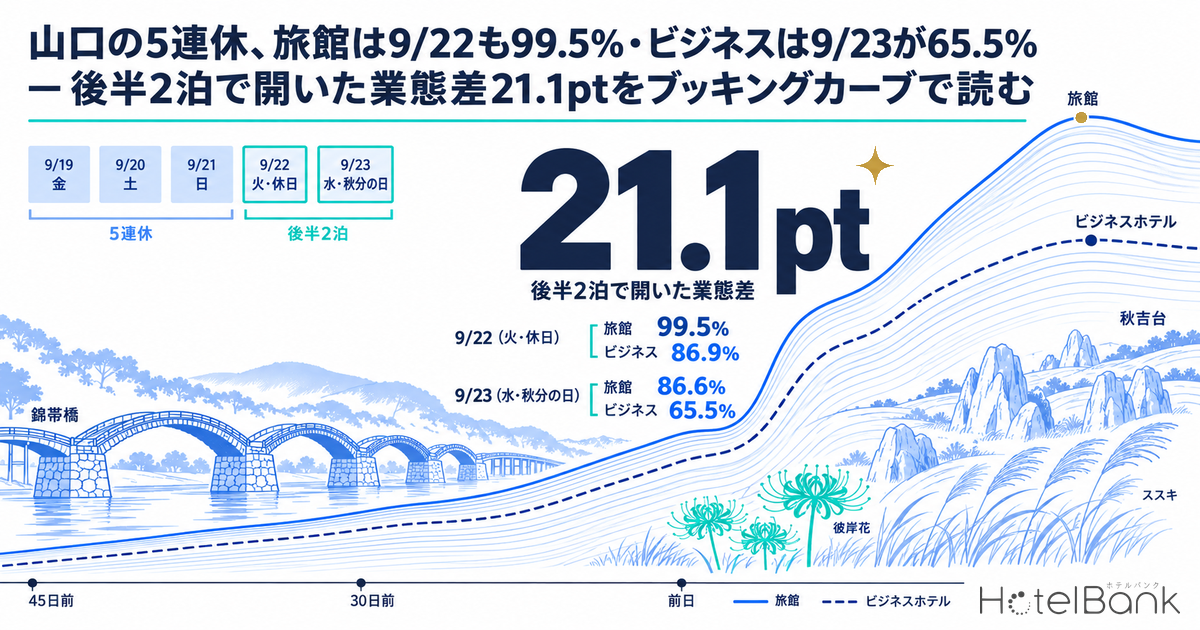
In 2026, Silver Week became a five-day holiday running from Saturday, September 19 to Wednesday, September 23, because September 22, sandwiched between Respect for the Aged Day (September 21) and Autumnal Equinox Day (September 23), became a national holiday. Lining up booking progress for these five nights at ryokan (traditional Japanese inns) and business hotels in Yamaguchi Prefecture shows that the first three nights (9/19–9/21) filled to 96.7–100.0% in both segments by the day before arrival, while a gap remained over the last two nights. On 9/22 (Tue, holiday), ryokan reached 99.5% (51 properties / 1,599 rooms) versus 86.9% for business hotels (41 properties / 3,988 rooms). On the final night, 9/23 (Wed, Autumnal Equinox Day), ryokan stood at 86.6% (52 properties / 1,603 rooms) versus 65.5% for business hotels (42 properties / 4,341 rooms), widening the segment gap to 12.6pt and 21.1pt respectively. This article traces how that gap formed at three checkpoints — 45 days out, 30 days out and the day before arrival — and considers how to revisit inventory and selling conditions for the back half of a holiday in the final weeks before arrival.
Coverage: ryokan (50–52 properties, 1,589–1,603 rooms) and business hotels (39–42 properties, 3,960–4,341 rooms) in Yamaguchi Prefecture. Each stay date uses a fixed cohort, so property counts differ slightly by date. This article does not cover pricing metrics; occupancy is an estimate based on OTA-listed inventory (estimated OCC). Definitions are at the end of the article. Data as of October 15, 2026 (observations for each stay date run through the day before arrival).
- — The first three nights (9/19–21) landed at 96.7–100.0% in both segments by the day before arrival. Ryokan locked in early at 80.5–97.9% 45 days out, while business hotels caught up in the final two weeks from 74.4–87.4% at 30 days out.
- — A segment gap remained over the last two nights: day-before estimates were ryokan 99.5% (51 properties / 1,599 rooms) vs. business 86.9% (41 properties / 3,988 rooms) on 9/22, a 12.6pt gap, and ryokan 86.6% vs. business 65.5% on 9/23, a 21.1pt gap.
- — At 45 days out, the segment gap was actually larger for the first three nights (+14.7 to +30.1pt, vs. +10.8 to +13.7pt for the last two). Business hotels’ late surge closed the gap only on the front-half dates, where total demand was sufficient.
- — On the final night (9/23), ryokan added +7.9pt in the last three days (78.7% → 86.6%), while business hotels gained only +2.7pt. Business hotels still had 1,496 rooms available the day before arrival.
- — For business hotels, the last night of the holiday behaved like a Sunday: 65.5% on 9/23 was in line with the Sunday nights of 9/6 and 9/13 (66.5–66.6%). Ryokan simply returned to around their September average of 86.3%.
First Three Nights — Ryokan Were Largely Set 45 Days Out; Business Hotels Caught Up in the Final Two Weeks
We start with the first three nights, which filled completely. Estimated OCC for ryokan (based on OTA-listed inventory; 50 properties / 1,589 rooms) was already 97.9% for 9/20 (Sun) and 93.2% for 9/21 (Mon, Respect for the Aged Day) at 45 days out — the outcome was largely decided a month and a half before the holiday. By 30 days out, 9/20 had reached 99.6% and 9/21 99.2%; by the day before arrival both were at 100.0%, with a sold-out property rate (estimated share of properties with no listed inventory found on OTAs and similar channels) of 100.0%. Only the first night, 9/19 (Sat), started somewhat later at 80.5% 45 days out, but it built steadily to 91.0% at 30 days out and 99.2% the day before, with a sold-out property rate of 92.0%.
Business hotels (39–40 properties / 3,960–4,019 rooms), by contrast, filled the same three nights in a completely different way. At 45 days out they stood at 65.8% for 9/19, 76.9% for 9/20 and 63.1% for 9/21 — 14.7 to 30.1pt below ryokan — and were still only at 74.4–87.4% at 30 days out. Yet by the day before arrival, 9/19 reached 96.7% and both 9/20 and 9/21 hit 100.0%. 9/21 in particular added +25.6pt, from 74.4% at 30 days out to 100.0% the day before, passing 95.9% at 14 days out and 99.4% at 7 days out, which shows bookings concentrated in the final two weeks. For the first three nights, ryokan were the segment that “sells early” and business hotels the segment that “catches up at the end.”
Figure 1: Booking curves for ryokan in Yamaguchi Prefecture (each night of the five-day holiday, 45 days out → day before). Coverage: 50–52 properties / 1,589–1,603 rooms.
Source: Compiled by HotelBank Editorial Team from MetroEngines Research data
Figure 2: Booking curves for business hotels in Yamaguchi Prefecture (each night of the five-day holiday, 45 days out → day before). Coverage: 39–42 properties / 3,960–4,341 rooms.
Source: Compiled by HotelBank Editorial Team from MetroEngines Research data
| Stay date | Segment | Coverage | 45 days out | 30 days out | Latest (day before) | Gain: 30 days out → latest | Sold-out property rate (latest) |
|---|---|---|---|---|---|---|---|
| 9/19 (Sat) | Ryokan | 50 properties / 1,589 rooms | 80.5% | 91.0% | 99.2% | +8.2pt | 92.0% |
| Business | 40 properties / 4,019 rooms | 65.8% | 76.5% | 96.7% | +20.2pt | 50.0% | |
| 9/20 (Sun) | Ryokan | 50 properties / 1,589 rooms | 97.9% | 99.6% | 100.0% | +0.4pt | 100.0% |
| Business | 39 properties / 3,960 rooms | 76.9% | 87.4% | 100.0% | +12.6pt | 100.0% | |
| 9/21 (Mon, Respect for the Aged Day) | Ryokan | 50 properties / 1,589 rooms | 93.2% | 99.2% | 100.0% | +0.8pt | 100.0% |
| Business | 39 properties / 3,960 rooms | 63.1% | 74.4% | 100.0% | +25.6pt | 100.0% | |
| 9/22 (Tue, holiday) | Ryokan | 51 properties / 1,599 rooms | 66.2% | 80.8% | 99.5% | +18.7pt | 96.1% |
| Business | 41 properties / 3,988 rooms | 52.5% | 59.7% | 86.9% | +27.2pt | 24.4% | |
| 9/23 (Wed, Autumnal Equinox Day) | Ryokan | 52 properties / 1,603 rooms | 55.4% | 63.5% | 86.6% | +23.1pt | 46.2% |
| Business | 42 properties / 4,341 rooms | 44.6% | 50.0% | 65.5% | +15.5pt | 7.1% |
Source: Compiled by HotelBank Editorial Team from MetroEngines Research data
Last Two Nights — Ryokan Neared Sellout on 9/22, and the Gap Widened to 21.1pt on 9/23
This is the core of the article. On the fourth night, 9/22 (Tue, holiday), ryokan (51 properties / 1,599 rooms) started from clearly lower levels than the first three nights: 66.2% at 45 days out and 80.8% at 30 days out. They then added +18.7pt between 30 days out and the day before, reaching 99.5% with just 8 rooms left and a sold-out property rate of 96.1% — in the end, a level comparable to the front half. Business hotels (41 properties / 3,988 rooms) went from 52.5% at 45 days out to 59.7% at 30 days out and 86.9% the day before. Their +27.2pt gain from 30 days out exceeded that of ryokan, but it could not make up for the low starting point: 521 rooms remained the day before arrival, and the sold-out property rate was only 24.4%.
On the final night, 9/23 (Wed, Autumnal Equinox Day), the gap widened further. Ryokan (52 properties / 1,603 rooms) went from 55.4% at 45 days out to 63.5% at 30 days out and 86.6% the day before; their +23.1pt gain from 30 days out was the largest of the five nights. With 215 rooms left and a sold-out property rate of 46.2%, nearly half of the properties had sold all their listed inventory by the day before. Business hotels (42 properties / 4,341 rooms) went from 44.6% at 45 days out to 50.0% at 30 days out and 65.5% the day before — a gain of +15.5pt, with 1,496 rooms left and a sold-out property rate of 7.1%. Despite falling within the holiday, the night looked much like a weekday in terms of unsold inventory.
Summarizing the gap over time in Table 2 makes the pattern clear. At 45 days out, the gap between ryokan and business hotels was large on the first three nights (+14.7 to +30.1pt) and smaller on the last two (+10.8 to +13.7pt). By the day before arrival, however, the gap on the first three nights had all but disappeared (±0.0 to +2.5pt), while on the last two nights it persisted at +12.6pt and +21.1pt. In other words, business hotels’ late surge in the final two weeks only worked on “dates with enough total demand”; on dates where overall demand thins out, such as the last night of a holiday, the gap with ryokan carried straight through to the final result. Our analysis of the same five-day holiday in Ibaraki, taken as a snapshot around 35 days before arrival (as of August 22, 2026) — Ibaraki Silver Week: Ryokan-Business Gap Hits 21.9pt, Back Half Flat — also found the widest gap on the middle night, 9/21 (21.9pt). The pattern seen at 45 and 30 days out, where the segment gap is larger on the front-half dates, is shared with Yamaguchi (the observation dates differ, so the final day-before results cannot be compared directly).
| Stay date | Gap (ryokan − business): 45 days out | 30 days out | 14 days out | Latest |
|---|---|---|---|---|
| 9/19 (Sat) | +14.7pt | +14.5pt | +7.7pt | +2.5pt |
| 9/20 (Sun) | +21.0pt | +12.2pt | +0.2pt | ±0.0pt |
| 9/21 (Mon, Respect for the Aged Day) | +30.1pt | +24.8pt | +4.0pt | ±0.0pt |
| 9/22 (Tue, holiday) | +13.7pt | +21.1pt | +19.1pt | +12.6pt |
| 9/23 (Wed, Autumnal Equinox Day) | +10.8pt | +13.5pt | +20.4pt | +21.1pt |
Source: Compiled by HotelBank Editorial Team from MetroEngines Research data
The Final Two Weeks — On the Last Night, Ryokan Gained +7.9pt in the Final Three Days vs. +2.7pt for Business Hotels
So how did bookings for the last two nights move in the final weeks? Table 3 shows four checkpoints: 14 days, 7 days and 3 days out, and the day before. For 9/22, ryokan had already reached 95.1% at 14 days out, so their gain over the final two weeks was small at +4.4pt — mainly because there was little room left to fill. Business hotels on 9/22 added +10.9pt, from 76.0% at 14 days out to 86.9% the day before, a movement consistent with demand spilling over to business hotels as ryokan approached full occupancy.
The last three days before 9/23 deserve attention. Ryokan rose +7.9pt from 78.7% at 3 days out to 86.6% the day before, including +4.1pt in a single day from 82.5% two days out. For ryokan, whose first three nights were set 45 days out and whose 9/22 was set 14 days out, the final night was the one date that “moved at the last minute.” Business hotels on 9/23 rose only +2.7pt, from 62.8% at 3 days out to 65.5% the day before — roughly one-third of the ryokan gain over the same three days.
| Stay date | Segment | 14 days out | 7 days out | 3 days out | Latest (day before) | Gain: 14 days out → latest | Gain: 3 days out → latest | Rooms remaining (latest) |
|---|---|---|---|---|---|---|---|---|
| 9/22 (Tue, holiday) | Ryokan (51 properties / 1,599 rooms) | 95.1% | 96.2% | 97.5% | 99.5% | +4.4pt | +2.0pt | 8 rooms |
| Business (41 properties / 3,988 rooms) | 76.0% | 80.3% | 84.7% | 86.9% | +10.9pt | +2.2pt | 521 rooms | |
| 9/23 (Wed, Autumnal Equinox Day) | Ryokan (52 properties / 1,603 rooms) | 74.0% | 76.5% | 78.7% | 86.6% | +12.6pt | +7.9pt | 215 rooms |
| Business (42 properties / 4,341 rooms) | 53.6% | 58.4% | 62.8% | 65.5% | +11.9pt | +2.7pt | 1,496 rooms |
Source: Compiled by HotelBank Editorial Team from MetroEngines Research data
In the Context of September — For Business Hotels, the Last Night of the Holiday Followed the Sunday Pattern
Placing business hotels’ 65.5% on the last night of the holiday within the daily trend for all of September (Figure 3) reveals what it means. Business hotels in Yamaguchi averaged 81.4% in September (38–44 properties), but Sunday nights dropped sharply: 66.6% on 9/6, 66.5% on 9/13 and 74.0% on 9/27. These are the “troughs” before weekday business-travel demand returns at the start of the week, and 65.5% on 9/23 (Wed, Autumnal Equinox Day) landed at almost the same level as those Sunday nights, even though it fell on a Wednesday. The last night of a holiday, with work resuming the next day, appears to have the same demand structure for business hotels as a Sunday night.
Ryokan show the opposite. Their September average was 86.3% (39–52 properties), and Sunday nights did not deviate much from it: 82.9% on 9/6, 84.0% on 9/13 and 86.4% on 9/27. The 86.6% on the last night of the holiday was simply a return to a “normal day” for ryokan, with no trough like the one at business hotels. On the same final night, ryokan returned to a normal day while business hotels fell to a Sunday — this difference in pattern is what the 21.1pt segment gap really represents. In Wakayama, where we tracked the final night of the same holiday through the day before arrival, business hotels alone landed at 67.0%, 15.5pt below a normal Wednesday and overlapping with that month’s Sunday nights (66.1–71.2%). The pattern shown in Wakayama Silver Week Recap: Resorts 99% at D-14, Sep 23 Lags matches Yamaguchi.
Figure 3: Daily estimated OCC in Yamaguchi Prefecture, September 2026 (as of the day before each stay date, based on OTA-listed inventory). Property counts vary by date (see legend).
Source: Compiled by HotelBank Editorial Team from MetroEngines Research data
For Revenue Managers at Ryokan and Business Hotels in Yamaguchi — Implications and Action Plan
Operational Insights
1. Manage the holiday not as “five nights” but as “the first three nights” and “the last two nights.” The first three nights were dates when the whole market filled up: ryokan were at 80.5–97.9% 45 days out, and even business hotels reached 96.7–100.0% by the day before. Compare your own booking pace against these three checkpoints, and if your front-half dates are filling in line with the market, the starting point is not to let that sense of security carry over to the back-half dates. The last two nights started more than 10pt lower than the front half at 45 days out: 55.4–66.2% for ryokan and 44.6–52.5% for business hotels.
2. Gains on the back-half dates are concentrated between 30 days out and the day before. From 30 days out to the day before, ryokan gained +18.7 to +23.1pt and business hotels +15.5 to +27.2pt — more than between 45 and 30 days out (+5.4 to +14.6pt). If you are going to revise selling conditions for the back-half dates (multi-night conditions, minimum length of stay, treatment of the final night), 30 days out is likely the last decision point.
3. For ryokan, demand remains on “the day next to a sold-out day.” Ryokan on 9/22 filled to just 8 rooms left with a sold-out property rate of 96.1% by the day before, and 9/23 moved +7.9pt in the last three days. By restructuring front-half multi-night conditions to span into 9/22 or 9/23, or by deciding in advance when to open the final night to single-night stays, there is room to carry demand turned away on sold-out days over to the back-half dates.
4. Business hotels should treat the last night of a holiday as a “Sunday.” The 65.5% on 9/23 was on par with the Sunday nights of 9/6 and 9/13 (66.5–66.6%). Reading demand by “the day before weekdays resume” rather than by day of week, consider both a design that pulls guests in from the front-half dates via multi-night stays and a design that captures short-lead demand at the last minute for the 1,496 rooms remaining on the final night (42 properties / 4,341 rooms).
| Time horizon | Action | Decision trigger (tied to figures in this article) | Objective |
|---|---|---|---|
| T-45 to T-30 | Review booking pace for each of the five nights as a separate stay date, and set different selling conditions for the front-half and back-half dates | Your progress on the back-half dates (Tue/Wed) is below the market level at 45 days out (ryokan 66.2% / 55.4%, business 52.5% / 44.6%) | Spot lagging back-half dates early, and don’t neglect them out of comfort with a “full house” on the front-half dates |
| T-45 to T-30 | Restructure front-half multi-night and minimum-stay conditions so they span into the back-half dates (9/21→9/22, 9/22→9/23) | At your property, too, there is a widening gap between the back-half dates and front-half levels at 45 days out (ryokan 80.5–97.9%, business 63.1–76.9%) | Extend front-half demand into the back half and build a base for the back-half dates through multi-night stays |
| T-30 to T-14 | Decide when to release remaining back-half inventory under single-night / short-stay conditions | At 30 days out, your back-half dates have not reached market levels (ryokan 80.8% / 63.5%, business 59.7% / 50.0%) | Don’t miss the window from 30 days out to the latest observation, when the largest gains occur (ryokan +18.7 to +23.1pt, business +15.5 to +27.2pt) |
| T-14 to T-7 | Ryokan: check for demand turned away on near-full dates like 9/22. Business hotels: treat the last night of the holiday as a Sunday-type date | Ryokan are above 95% on 9/22; business hotels on 9/23 remain at the level of the Sundays of 9/6 and 9/13 (66.5–66.6%) | Decide how to handle the last few rooms on sold-out dates, and align selling conditions with final-night guest mix (pre-return-trip stays, the transition back to business travel) |
| T-7 to day before | Review operations to keep inventory available for same-day and day-before sales in preparation for last-minute demand on the final night (9/23) | Your last-minute gain is small in a market where ryokan on 9/23 rose +7.9pt from 3 days out to the latest observation (78.7% → 86.6%) | Capture last-minute demand (pre-return-trip stays at ryokan, short-lead demand from nearby areas) |
| After the holiday | Record three checkpoints (45 days out, 30 days out, latest) for each of the five nights and compare with the pattern of the next holiday (New Year, Golden Week) | At the latest observation, the final night stood at 86.6% for ryokan / 65.5% for business hotels — a sharp drop from 100.0% on the front-half dates | Identify in advance the dates where a gap will persist for each holiday, and finish designing selling conditions before the holiday |
Source: Compiled by HotelBank Editorial Team from MetroEngines Research data
Summary — Three Yardsticks for Reading a Holiday Period
Looking back at Yamaguchi’s five-day holiday, booking progress was split from the outset into “dates that fill” and “dates with rooms left,” and that split showed up differently by segment. We offer three reusable yardsticks.
First, separate front-half and back-half dates by their starting point 45 days out. The first three nights started at 80.5–97.9% for ryokan and 63.1–76.9% for business hotels, while the last two nights started lower, at 55.4–66.2% and 44.6–52.5% respectively. The difference at this stage carried directly into the day-before results (96.7–100.0% in the front half vs. 65.5–99.5% in the back half).
Second, interpret the gain from 30 days out to the day before differently by segment. Business hotels surged +25.6pt on 9/21 and +27.2pt on 9/22, but gained only +15.5pt on 9/23. Ryokan, conversely, posted their largest gain on 9/23 at +23.1pt. The same “late surge” works on different dates depending on the segment.
Third, read the last night of a holiday by “what kind of day follows,” not by day of week. Business hotels on 9/23 (Wed) fell to 65.5%, on par with the Sunday nights of 9/6 and 9/13 (66.5–66.6%), while ryokan on 9/23 returned to 86.6%, in line with their September average (86.3%). Inventory and selling conditions for the last night of a holiday should be built on this difference in pattern. For Yamaguchi’s next holiday, the November 21–23 autumn-foliage three-day weekend, we have summarized booking progress at 52 days before arrival in Nov 21-23 Foliage Weekend: Oita Ryokan 10.9% Left, Hiroshima 52.2%.
Frequently Asked Questions
Q. Is estimated OCC (based on OTA-listed inventory) the same as actual room occupancy?
A. No. It is an estimate back-calculated from the number of rooms remaining on OTAs and similar channels, and because unlisted rooms are counted as sold, it runs higher than actual occupancy. Use it to read the shape of booking curves and to make relative comparisons across segments and stay dates, and avoid comparing its absolute values directly with published occupancy rates.
Q. Why did the segment gap widen to 21.1pt on 9/23, the last night of the holiday?
A. Business hotels in Yamaguchi follow a pattern of sharp drops on Sunday nights in September (66.6% on 9/6, 66.5% on 9/13), and 9/23 (Wed, Autumnal Equinox Day), after which weekdays resumed, also stayed at a Sunday-like 65.5% as of the day before. Ryokan on 9/23, meanwhile, returned to 86.6%, in line with their September average (86.3%). The difference in pattern — ryokan returning to a “normal day” and business hotels falling to a “Sunday” — explains most of the segment gap.
Q. When should selling conditions be revised ahead of the next holiday?
A. For the last two nights covered here, the gain from 30 days out to the day before (ryokan +18.7 to +23.1pt, business hotels +15.5 to +27.2pt) was larger than from 45 to 30 days out (+5.4 to +14.6pt). If you plan to restructure multi-night conditions or the treatment of the final night, a practical approach is to use 30 days out as a decision point and compare your back-half progress against the market checkpoints. Note that the figures in this article are a snapshot based on observations as of October 15, 2026.
About the Data
| Estimated OCC (based on OTA-listed inventory) | Occupancy based on OTA-listed inventory = 100 − 100 × rooms remaining on OTAs ÷ total rooms. Coverage is a fixed cohort of properties listing at least 30% of their total rooms on OTAs (the same set of properties for each stay date; N= in the text is the property count). It is an estimate based on how inventory sold on OTAs is being absorbed, and its definition differs from actual room occupancy (it runs higher because unlisted rooms are counted as sold). |
| Booking curve | Based on observations from 45 days before the stay date to the latest available. Checkpoints are 45 days out, 30 days out and the latest (day before); same-day observations are not used. Each point in Figures 1 and 2 has 96–100% observation coverage. |
| Sold-out property rate | Share of properties in the cohort with no listed inventory found on OTAs and similar channels (estimate). |
| Pricing metrics | This article does not cover pricing metrics (such as estimated transacted ADR). |
| Coverage N= | Yamaguchi Prefecture (based on listings on major booking sites). Ryokan: 9/19–9/21 50 properties / 1,589 rooms; 9/22 51 properties / 1,599 rooms; 9/23 52 properties / 1,603 rooms. Business hotels: 9/19 40 properties / 4,019 rooms; 9/20–9/21 39 properties / 3,960 rooms; 9/22 41 properties / 3,988 rooms; 9/23 42 properties / 4,341 rooms. The September daily trend in Figure 3 covers 39–52 ryokan / 1,237–1,603 rooms and 38–44 business hotels / 3,943–4,480 rooms. City hotels are not covered because the number of eligible properties in Yamaguchi does not meet the threshold. |
| Public holidays | September 21, 2026 (Respect for the Aged Day), September 22 (national holiday) and September 23 (Autumnal Equinox Day) are based on the Cabinet Office’s “National Holidays” publication. |
| Data timing | Data as of October 15, 2026. The booking curve for each stay date aggregates observations through the day before arrival. Because sales status and inventory change daily, the figures in this article are a snapshot as of the time of retrieval. |
References and Sources
■ Data source
MetroEngines Research aggregated data. Daily observations of rooms remaining on OTAs from 45 days before to the day before each stay date from September 19 to 23, 2026, for fixed cohorts of ryokan and business hotels in Yamaguchi Prefecture (properties listing at least 30% of total rooms on OTAs), retrieved October 15, 2026. Reference values for all of September (Figure 3 and the September averages and Sunday nights in the text) are daily values as of the day before each stay date in September 2026, using the same cohort definition.
■ Calculation assumptions
The segment gap is “ryokan estimated OCC − business hotel estimated OCC” (pt); gains are differences between checkpoints for the same stay date (pt); rooms remaining are the total rooms remaining on OTAs as of the day before. Checkpoints are 45, 30, 14, 7 and 3 days out and the day before; same-day observations are not used. Pricing metrics (such as estimated transacted ADR) are not covered.
■ Limitations and caveats
Estimated OCC is based on OTA-listed inventory and counts withdrawn listings (stop-sells) as sold, so part of the late-stage growth may include stop-sells. Property counts vary by stay date — 50–52 ryokan and 39–42 business hotels — so comparisons across stay dates include small changes in the population. Comparisons with other prefectures (Ibaraki, Wakayama) differ in observation timing and segment mix and are limited to comparing patterns. City hotels are not covered because the number of eligible properties in Yamaguchi does not meet the threshold.
■ External sources
Cabinet Office, “National Holidays” (CSV of national holidays from 1955 to 2027): https://www8.cao.go.jp/chosei/shukujitsu/gaiyou.html
Related Articles
- Nov 21-23 Foliage Weekend: Oita Ryokan 10.9% Left, Hiroshima 52.2%
- Ibaraki Silver Week: Ryokan-Business Gap Hits 21.9pt, Back Half Flat
- Wakayama Silver Week Recap: Resorts 99% at D-14, Sep 23 Lags
- Ehime Silver Week: Sep 21 Ryokan 99.9%, Business 91.9%, Sep 23 Flat
- Akita 3-Day Weekend: Day 1 at 99%, Final Day & Sundays Dip to 63–79%