

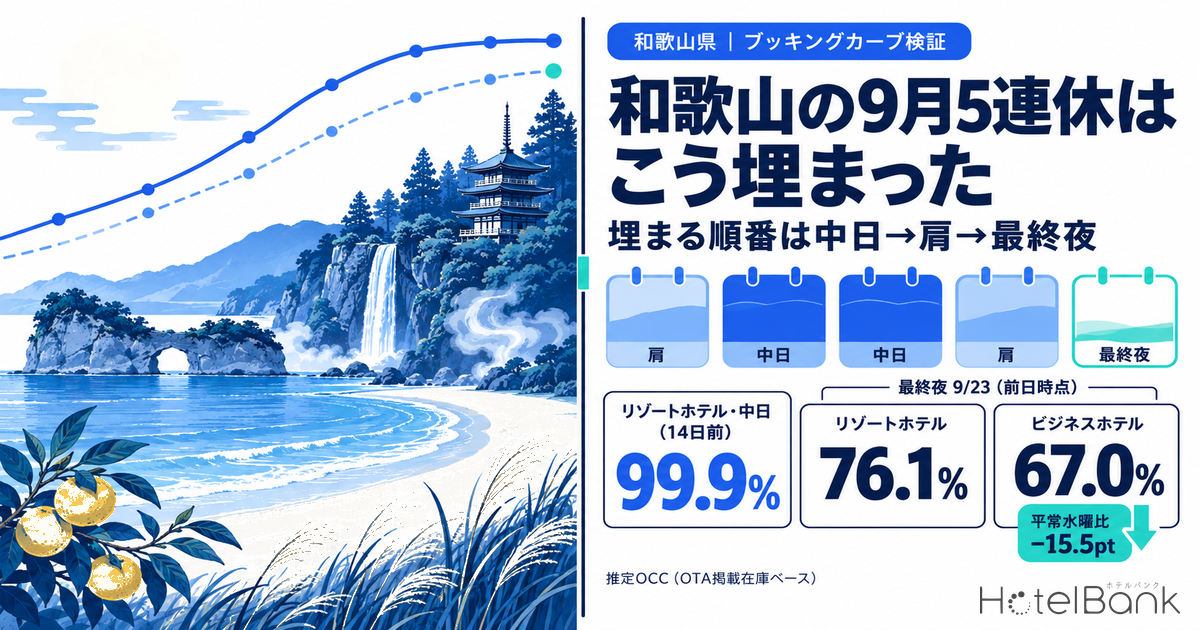
We retraced booking progress for Wakayama Prefecture lodging over the five-day Silver Week holiday of September 2026 (September 19-23), from 45 days before each stay date to the day before. At resort hotels (N=25 properties, 1,657 rooms), the two middle nights (September 20 and 21) had already reached the 99% range in estimated OCC (OTA-listed inventory basis) 14 days out, while the final night, September 23, was still at only 76.1% on the day before. Ryokan (N=72-73 properties) and business hotels (N=32-33 properties) filled in the same order, but on the final night only business hotels, at 67.0%, landed 15.5 points below a normal Wednesday in the same month (three-day average of 82.5%). This article rereads the completed booking curves at four checkpoints (45 days, 30 days, 14 days and one day before the stay) and considers how to move final-night inventory in the next holiday.
Coverage: Wakayama Prefecture resort hotels N=25-26 properties (1,657-1,683 rooms), ryokan N=65-73 properties (2,468-2,684 rooms) and business hotels N=32-36 properties (2,408-2,732 rooms), all based on listings on major booking sites and varying by stay date. The price metric in this article is estimated transacted ADR (the transacted price level estimated from OTA and other sales data, tax-exclusive equivalent); occupancy is an estimate based on OTA-listed inventory. Both are defined at the end of the article. Data as of October 6, 2026.
- — Middle nights in the 99% range 14 days out: In the September 2026 five-day holiday, Wakayama resort hotels (N=25 properties, 1,657 rooms) reached estimated OCC (OTA-listed inventory basis) of 99.9% and 99.3% for the nights of September 20 and 21 at 14 days out.
- — The fill order was middle nights, then shoulders, then the final night: For resort hotels, the biggest pickup came between 45 and 30 days out for the middle nights (+22.0pt and +24.4pt), between 30 and 14 days out for the first and fourth nights (+17.9pt and +23.6pt), and in the last 14 days for the final night (+15.6pt).
- — The final night, September 23, was around 70% even on the day before: It landed at 76.1% for resort hotels, 73.8% for ryokan and 67.0% for business hotels, and all three categories came in below the following Thursday, September 24.
- — The gap between categories is concentrated in business hotels: Against a normal Wednesday (three-day average for September), the final night landed +8.8pt for resort hotels, +1.2pt for ryokan and -15.5pt for business hotels, overlapping with the three Sundays of the same month (66.1-71.2%).
- — The next holiday is starting from the same position: As observed on October 5, the final night of the October three-day weekend, October 12, stood at 63.6-65.1% seven days out, in the same 60% range as September 23 seven days out (60.3-63.7%).
How the Five Days Landed — The Three Inner Nights Filled, the Two Edge Nights Stayed at Ordinary-Day Levels
We start with the outcome. According to the list of national holidays published by the Cabinet Office, in 2026 September 21 was Respect for the Aged Day, September 22 a public holiday and September 23 Autumnal Equinox Day, making a five-day holiday counting from Saturday, September 19. The table below lists, by category, estimated OCC and the sold-out property share as of the day before the stay for nine nights, from the Thursday before the holiday to the Friday after it.
Table 1: Final results for stays of September 17-25 (as of the day before the stay, Wakayama Prefecture)
| Stay date | Resort Est. OCC | Resort Sold-out share | Ryokan Est. OCC | Ryokan Sold-out share | Business Est. OCC | Business Sold-out share |
|---|---|---|---|---|---|---|
| Sep 17 (Thu) | 71.7% | 23.1% | 68.6% | 34.7% | 85.3% | 14.7% |
| Sep 18 (Fri), holiday eve | 65.8% | 24.0% | 72.4% | 37.5% | 70.4% | 0.0% |
| Sep 19 (Sat), night 1 | 98.7% | 68.0% | 96.4% | 72.2% | 97.5% | 78.8% |
| Sep 20 (Sun), night 2 | 100.0% | 100.0% | 99.7% | 95.9% | 100.0% | 100.0% |
| Sep 21 (Mon), night 3 (Respect for the Aged Day) | 100.0% | 100.0% | 100.0% | 100.0% | 99.5% | 93.8% |
| Sep 22 (Tue), night 4 (public holiday) | 99.9% | 92.0% | 97.5% | 84.9% | 88.9% | 42.4% |
| Sep 23 (Wed), final night (Autumnal Equinox Day) | 76.1% | 24.0% | 73.8% | 37.5% | 67.0% | 9.1% |
| Sep 24 (Thu), after the holiday | 79.7% | 34.6% | 77.7% | 50.7% | 82.4% | 27.3% |
| Sep 25 (Fri) | 71.7% | 26.9% | 74.0% | 39.7% | 84.5% | 12.1% |
Coverage: resort hotels N=25-26 properties, 1,657-1,683 rooms; ryokan N=72-73 properties, 2,662-2,684 rooms; business hotels N=32-34 properties, 2,408-2,558 rooms (based on listings on major booking sites). The sold-out property share is the share of properties for which no listed inventory could be confirmed on OTAs and similar channels (estimate).
Source: MetroEngines Research; compiled by the HotelBank Editorial Team
On the second night, September 20, all three categories were at 99.7-100.0%, and on the third night, September 21, at 99.5-100.0%, meaning listed inventory was almost entirely consumed. The first night, September 19, also reached 96.4-98.7%, leaving almost no difference between categories across the first three nights.
From the fourth night onward, however, the picture differs by category. On September 22, resort hotels were at 99.9% and ryokan at 97.5%, while business hotels were about 10 points lower at 88.9%; their sold-out property share was only 42.4%, against 92.0% and 84.9%. On the final night, September 23, the figures fell to 76.1% for resort hotels, 73.8% for ryokan and 67.0% for business hotels, and on the following Thursday, September 24, all three categories came in above the 23rd. Even on a public holiday, a night followed by a working day behaved more like the outside of the holiday than the inside.
The eve of the holiday, Friday, September 18, has the same character. Resort hotels at 65.8%, ryokan at 72.4% and business hotels at 70.4% all landed below the Fridays before and after (September 11 and 25). In other words, what the five-day holiday lifted was the three inner nights, plus the fourth night for the leisure categories; the two nights at either end are better judged against an ordinary-day yardstick. The interim picture as of August is summarized in Wakayama Silver Week Peaks Midway, and the shape, with the middle nights as the peak, did not change in the final results.
Checkpoints at 45, 30 and 14 Days Out — Middle Nights, Then Shoulders, Then the Final Night
Next, we trace the order in which that outcome was reached. The chart below overlays estimated OCC from 45 days before the stay date to the day before for each of the five nights at resort hotels (N=25 properties, 1,657 rooms).
Figure 1: Resort hotel booking curves (stays of September 19-23, from 45 days before the stay date to the day before)
Source: MetroEngines Research; compiled by the HotelBank Editorial Team
At 45 days out, the two middle nights were already ahead, at 74.4% for September 20 and 67.3% for September 21. Over the 15 days to the 30-day mark, the 20th added +22.0pt and the 21st +24.4pt, reaching 96.4% and 91.7% at 30 days out. For the middle nights, the decisive window can be read as the period between 45 and 30 days out.
By contrast, the first night (September 19) and the fourth night (September 22) were still at only 75.3% and 72.1% at 30 days out. These two nights moved in earnest between 30 and 14 days out, with pickup of +17.9pt for the 19th and +23.6pt for the 22nd. Once the middle nights had filled, demand looking for somewhere to go flowed to the “shoulders” on either side. The final night, the 23rd, was later still: of the 35.5pt gained between 40.6% at 45 days out and 76.1% on the day before, 15.6pt came in the last 14 days.
The next table lists the checkpoints for all three categories.
Table 2: Checkpoint comparison for the five-day holiday (estimated OCC, Wakayama Prefecture)
| Category | Stay date | 45 days out | 30 days out | 14 days out | Day before | 45 to 30 days out | 30 to 14 days out | 14 days out to day before |
|---|---|---|---|---|---|---|---|---|
| Resort hotels | Sep 19 (Sat) | 54.9% | 75.3% | 93.2% | 98.7% | +20.4pt | +17.9pt | +5.5pt |
| Sep 20 (Sun) | 74.4% | 96.4% | 99.9% | 100.0% | +22.0pt | +3.5pt | +0.1pt | |
| Sep 21 (Mon) | 67.3% | 91.7% | 99.3% | 100.0% | +24.4pt | +7.6pt | +0.7pt | |
| Sep 22 (Tue) | 54.1% | 72.1% | 95.7% | 99.9% | +18.0pt | +23.6pt | +4.2pt | |
| Sep 23 (Wed) | 40.6% | 45.7% | 60.5% | 76.1% | +5.1pt | +14.8pt | +15.6pt | |
| Ryokan | Sep 19 (Sat) | 67.9% | 79.0% | 91.4% | 96.4% | +11.1pt | +12.4pt | +5.0pt |
| Sep 20 (Sun) | 84.1% | 92.2% | 99.6% | 99.7% | +8.1pt | +7.4pt | +0.1pt | |
| Sep 21 (Mon) | 80.4% | 90.2% | 98.4% | 100.0% | +9.8pt | +8.2pt | +1.6pt | |
| Sep 22 (Tue) | 62.7% | 72.7% | 89.5% | 97.5% | +10.0pt | +16.8pt | +8.0pt | |
| Sep 23 (Wed) | 48.1% | 54.3% | 62.0% | 73.8% | +6.2pt | +7.7pt | +11.8pt | |
| Business hotels | Sep 19 (Sat) | 73.9% | 82.0% | 92.7% | 97.5% | +8.1pt | +10.7pt | +4.8pt |
| Sep 20 (Sun) | 73.8% | 86.8% | 98.9% | 100.0% | +13.0pt | +12.1pt | +1.1pt | |
| Sep 21 (Mon) | 70.0% | 81.6% | 96.8% | 99.5% | +11.6pt | +15.2pt | +2.7pt | |
| Sep 22 (Tue) | 55.7% | 62.6% | 75.6% | 88.9% | +6.9pt | +13.0pt | +13.3pt | |
| Sep 23 (Wed) | 50.0% | 52.7% | 57.7% | 67.0% | +2.7pt | +5.0pt | +9.3pt |
Coverage: resort hotels N=25 properties, 1,657 rooms; ryokan N=72-73 properties, 2,662-2,684 rooms; business hotels N=32-33 properties, 2,408-2,438 rooms (based on listings on major booking sites). Pickup is the difference between checkpoints.
Source: MetroEngines Research; compiled by the HotelBank Editorial Team
Ryokan had the earliest start on the middle nights, already at 84.1% for September 20 and 80.4% for September 21 at 45 days out. Pickup after that was correspondingly gentle, at around 10pt per interval, with none of the steep climb seen at resort hotels. The order was the same, though: the fourth night, the 22nd, gained +16.8pt between 30 and 14 days out, and the final night, the 23rd, gained +11.8pt in the last 14 days. The later the night, the later the interval in which its peak pickup came.
At business hotels, the middle nights did reach 98.9% and 96.8% at 14 days out, but the fourth night, the 22nd, was at 75.6% at that point. It then added +13.3pt by the day before to land at 88.9%, a different timeline from resort hotels, which were already at 95.7% at 14 days out. Even in the same prefecture and the same holiday, whether the fourth night was a night that would no longer move or one that still would depended on the category.
One more point concerns the last few days before the middle nights. At resort hotels, September 20 reached 99.9% at 14 days out, dipped to 98.6% three days out, and returned to 100.0% on the day before. The sold-out property share followed the same path, from 96.0% to 84.0% and then to 100.0%. Inventory that came back shortly before the stay appears to have been consumed again within a short period, suggesting there was a small sales opportunity for the middle nights in the final three days as well.
The Final Night, September 23 — Leisure Categories Like a Normal Wednesday, Business Hotels Like a Sunday
From here we dig into the final night, where the most inventory was left. Because September 23 fell on a Wednesday, we use as the yardstick the average of the three normal Wednesdays in the same month (September 9, 16 and 30). The chart below overlays the curve for the 23rd on the average normal-Wednesday curve for business hotels and resort hotels.
Figure 2: Booking curves for the final night, September 23, and a normal Wednesday (business hotels and resort hotels)
The normal Wednesday is the simple average of the three days September 9, 16 and 30. Coverage: business hotels N=33-36 properties, 2,433-2,732 rooms; resort hotels N=25-26 properties, 1,657-1,683 rooms (based on listings on major booking sites).
Source: MetroEngines Research; compiled by the HotelBank Editorial Team
Table 3: The final night, September 23, compared with a normal Wednesday (three-day average)
| Category | Sep 23 14 days out | Sep 23 Day before | Sep 23 Last-14-day pickup | Normal Wed 14 days out | Normal Wed Day before | Normal Wed Last-14-day pickup | Gap on day before (Sep 23 minus normal Wed) |
|---|---|---|---|---|---|---|---|
| Resort hotels | 60.5% | 76.1% | +15.6pt | 59.0% | 67.3% | +8.3pt | +8.8pt |
| Ryokan | 62.0% | 73.8% | +11.8pt | 63.4% | 72.6% | +9.2pt | +1.2pt |
| Business hotels | 57.7% | 67.0% | +9.3pt | 66.5% | 82.5% | +16.0pt | -15.5pt |
Coverage: resort hotels N=25-26 properties, ryokan N=71-72 properties, business hotels N=33-36 properties (based on listings on major booking sites).
Source: MetroEngines Research; compiled by the HotelBank Editorial Team
At resort hotels, the 23rd stood at 60.5% at 14 days out, almost the same position as a normal Wednesday (59.0%). The gap opened in the last 14 days: where a normal Wednesday picked up +8.3pt, the 23rd gained +15.6pt, nearly double. As a result, it was 8.8pt above a normal Wednesday on the day before. Ryokan moved in the same direction, with last-14-day pickup of +11.8pt against +9.2pt for a normal Wednesday, and the final gap came to +1.2pt. For the two leisure categories, the final night was a night on a par with, or slightly above, a normal Wednesday.
Business hotels, however, took the opposite shape. The 23rd was already 8.8pt below a normal Wednesday at 14 days out, its last-14-day pickup of +9.3pt fell short of the normal Wednesday (+16.0pt), and the gap widened to 15.5pt on the day before. The final 67.0% overlaps with the 66.1-71.2% of the three Sundays in the same September (the 6th, 13th and 27th; N=32-34 properties). Behind this is probably a double factor: the business-travel demand that lifts a normal Wednesday shortly before the stay is unlikely to come in on a public-holiday night, and holiday tourists also head home on this day.
The sold-out property share shows the same tendency. On the 23rd it was 37.5% for ryokan and 24.0% for resort hotels, against 9.1% for business hotels. In the leisure categories a certain number of properties had exhausted their listed inventory even on the final night, whereas at business hotels most properties still had inventory left. The final-night challenge is common to all three categories, but it weighed most heavily on business hotels.
September Estimated Transacted ADR — On a Monthly Basis, Resort Hotels Were Well Above the Same Month Last Year
Having confirmed the shape of occupancy, we also check prices on a monthly basis. Estimated transacted ADR for September has switched to finalized values, so a comparison with the same month of the previous year is possible. Note that what is shown here is a monthly level and does not indicate prices on individual days during the holiday.
Table 4: Estimated transacted ADR in Wakayama Prefecture (September, YoY between finalized months)
| Category | Sep 2025 | Sep 2026 | YoY | Basis |
|---|---|---|---|---|
| Resort hotels | ¥13,233 (N=37) | ¥18,064 (N=35) | +36.5% | Finalized (past) months, both years |
| Ryokan | ¥13,096 (N=104) | ¥13,612 (N=106) | +3.9% | Finalized (past) months, both years |
| Business hotels | ¥6,054 (N=71) | ¥6,140 (N=69) | +1.4% | Finalized (past) months, both years |
Source: MetroEngines Research; compiled by the HotelBank Editorial Team
Resort hotels came in at about ¥18,100 (N=35) in September 2026, up +36.5% from about ¥13,200 (N=37) in the same month a year earlier. Compared with +10.9% for the same resort hotels in August (about ¥24,000, N=34; about ¥21,600 a year earlier, N=36), the increase in September is large. By contrast, the change from a year earlier was small for ryokan (+3.9%) and business hotels (+1.4%). In September 2025 the calendar had a three-day weekend including Respect for the Aged Day and, separately, Autumnal Equinox Day on a Tuesday, so this was likely a month in which the difference in the shape of the holidays readily showed up in the monthly level.
Figure 3: Estimated transacted ADR for resort hotels and ryokan (year-over-year overlay, finalized months only)
Finalized values for January 2025 to September 2026. Resort hotels N=34-38 properties, ryokan N=97-112 properties.
Source: MetroEngines Research; compiled by the HotelBank Editorial Team
In the year-over-year overlay, the 2026 line for resort hotels sits consistently above 2025 from January through September, with the gaps in January and September especially wide. Ryokan were only slightly above the previous year except in June, and the September gap was also small. Taken together with the occupancy shape seen in the earlier sections, in which the three inner nights almost filled, the holiday supported the price level for the month as a whole at resort hotels, while final-night inventory remained as a separate issue.
Where the Next Holidays Stand — The Final Night Is in the 60% Range a Week Out, Whether Three Days or Five
This pattern is not unique to September. Lining up progress for the October three-day weekend (October 10-12) and the days around Culture Day (November 3), as observed on October 5, the same shape is already visible.
Table 5: Estimated OCC for upcoming holidays (as observed on October 5, 2026, Wakayama Prefecture)
| Stay date | Position | Days out at observation | Resort | Ryokan | Business |
|---|---|---|---|---|---|
| Oct 10 (Sat) | October three-day weekend, first night | 5 days out | 90.6% | 88.3% | 92.3% |
| Oct 11 (Sun) | October three-day weekend, middle night | 6 days out | 81.8% | 77.2% | 81.5% |
| Oct 12 (Mon) | October three-day weekend, final night (Sports Day) | 7 days out | 65.1% | 63.6% | 64.1% |
| Oct 31 (Sat) | Weekend before Culture Day | 26 days out | 76.2% | 76.2% | 79.5% |
| Nov 1 (Sun) | Same weekend, Sunday | 27 days out | 77.2% | 72.4% | 63.0% |
| Nov 2 (Mon) | Weekday before the holiday | 28 days out | 65.7% | 63.2% | 57.4% |
| Nov 3 (Tue) | Culture Day | 29 days out | 55.9% | 57.4% | 54.8% |
Coverage: resort hotels N=25 properties, 1,657 rooms; ryokan N=65-67 properties, 2,468-2,651 rooms; business hotels N=34-35 properties, 2,619-2,636 rooms (based on listings on major booking sites). Values are based on sales conditions at the time of observation and may change with future bookings and inventory movements.
Source: MetroEngines Research; compiled by the HotelBank Editorial Team
The final night of the October three-day weekend, Monday, October 12 (Sports Day), stood at 65.1% for resort hotels, 63.6% for ryokan and 64.1% for business hotels seven days out. September 23 seven days out was at 63.7%, 63.4% and 60.3%; even though a three-day and a five-day holiday differ in length, the final night sits at the same position, in the 60% range one week out. For reference, September 23 then added +12.4pt at resort hotels, +10.4pt at ryokan and +6.7pt at business hotels by the day before.
Culture Day, Tuesday, November 3, was at 54.8-57.4% as observed 29 days out. Ryokan and business hotels are at almost the same position as September 23 at the same point (55.4% and 53.2%), while resort hotels are starting from a higher position than September 23, which was at 47.0%. Monday, November 2, the day before the holiday, is higher at 57.4-65.7%; here too, the difference between a night followed by a day off and a public-holiday night followed by a working day has appeared early. Further ahead, the three-day weekend of November 21-23 reaches its 45-day checkpoint between October 7 and 9. Because the middle nights of the September five-day holiday moved between 45 and 30 days out, early October onward is a suitable time to compare a property’s own booking pace against the prefectural curve.
For Revenue Managers Running Resort Hotels, Ryokan and Business Hotels in Wakayama — Implications and Action Plan
Here we translate the data so far into terms of running one’s own property. Since the September five-day holiday is already over, what follows is organized with a view to the multi-day holidays still ahead, such as the November three-day weekend and the year-end and New Year period.
Implication 1: Treat a holiday not as a single peak but as three segments that sell in different order. The peak pickup came between 45 and 30 days out for the middle nights, between 30 and 14 days out for the shoulders (the first and fourth nights), and in the last 14 days for the final night. When checking your own booking pace, lining it up against the prefectural curve night by night, rather than using the average for the whole holiday, makes it easier to see which nights are ahead and which are behind.
Implication 2: There is room to move final-night inventory before the middle nights fill. The middle nights at resort hotels were above 90% at 30 days out. If the middle nights are filled entirely with one-night bookings, no inventory is left to connect with the final night. Deciding how to accept multi-night stays that include the fourth and final nights while the middle nights are still moving is likely to help lift the back half.
Implication 3: For the leisure categories, last-minute demand for the final night did exist. September 23 at resort hotels gained +15.6pt in the last 14 days, more than the pickup on a normal Wednesday (+8.3pt). This is thought to include short-haul guests who decide their plans in the back half of the holiday and extended stays by guests already in-house or already booked. It is well worth not giving up on the final night at an early stage and instead designing the last two weeks as a sales period.
Implication 4: At business hotels, view a public-holiday night not by its day of the week but as “a night like a Sunday.” September 23 landed 15.5pt below a normal Wednesday and overlapped with the level of the three Sundays. Operating a public-holiday night with a weekday mindset tends to mean waiting for business-travel demand that would normally arrive at the last minute. There is room to prepare, early on, a presentation aimed at tourists moving in the back half of the holiday and at local guests and guests from neighboring prefectures.
The table below sets these on a timeline. The decision triggers use the prefectural figures shown in this article, but they are meant strictly as a yardstick to compare against your own property’s progress.
Table 6: Action plan for multi-day holidays (45 days out / 30-14 days out / last 14 days)
| Timing | Action | Decision trigger (figures in this article) | Aim |
|---|---|---|---|
| 45 days out | Split the nights of the holiday into middle, shoulder and final nights, and line up your own booking pace against the prefectural curve | Whether middle-night bookings are ahead of or behind the 45-day level for resort hotels (74.4% for Sep 20, 67.3% for Sep 21) or the same level for ryokan (84.1%, 80.4%) | Identify which nights are moving ahead of the market and use that as the starting point for later decisions |
| 45 days out | Review how you accept one-night bookings for a middle night only versus multi-night bookings that include a middle night | When you enter the same phase in which middle nights at the prefecture’s resort hotels moved +22.0 to +24.4pt over the 15 days from 45 to 30 days out | Keep room to direct middle-night inventory toward stays that connect with the first, fourth and final nights |
| 30 to 14 days out | Recheck inventory and multi-night conditions for the first and fourth nights | If the middle nights have reached around 90% and the two shoulder nights are in the 70% range (the prefecture’s resort hotels were at 75.3% and 72.1% at 30 days out) | Be ready to propose stays extended through the final night during the period when the two shoulder nights move (+17.9pt and +23.6pt between 30 and 14 days out) |
| 30 to 14 days out | Prepare stay-extension offers (an extra night at the end) for guests with existing bookings | When the fourth night reaches around 90% at 14 days out (the prefecture’s resort hotels 95.7%, ryokan 89.5%) | Before looking for new guests, move the final night through extended stays by guests who are already coming |
| Last 14 days | For the final night, strengthen the appeal to short-haul guests who can travel at the last minute | If the final night is around 60% at 14 days out (the prefecture: 60.5%, 62.0%, 57.7%) and demand other than holiday tourists is hard to expect | Go after the last-minute final-night pickup seen at the prefecture’s resort hotels and ryokan (+15.6pt and +11.8pt) |
| Last 14 days | At business hotels, treat the public-holiday night as “a night like a Sunday” and consider a presentation aimed at tourism and leisure | If final-night progress remains below the normal-Wednesday level at 14 days out (66.5%) | Position inventory on a night when business-travel demand does not return as a landing place for tourists moving in the back half of the holiday |
The three measures (multi-night stays, stay extensions and short-haul demand) each work at a different time. Multi-night stays coincide with 45 to 30 days out, when the middle nights are still moving; stay extensions with 30 to 14 days out, when the fourth night begins to fill; and short-haul demand with the last 14 days, when the final night moves. More than the measures themselves, deciding in advance what to place in which segment is likely to be the shortcut to moving back-half inventory.
Summary — Three Yardsticks: Order, Edges and Category Differences
Looking back at Wakayama Prefecture’s September five-day holiday through the completed curves, three points remain as yardsticks.
The first is order. The peak pickup came between 45 and 30 days out for the middle nights, between 30 and 14 days out for the first and fourth nights, and in the last 14 days for the final night. The two middle nights at resort hotels reached the 99% range at 14 days out, and the time to place measures differed night by night.
The second is how to treat the two edge nights. The eve of the holiday, September 18, and the final night, the 23rd, landed close to ordinary-day levels even though they were a public holiday or part of the holiday period, and the 23rd came in below the following Thursday, the 24th, in all three categories. The starting point is not to view them on the same assumptions as the inside of the holiday.
The third is the difference between categories. On the final night, resort hotels landed 8.8pt above a normal Wednesday and ryokan at almost the same level, whereas business hotels were 15.5pt below. The final night of the October three-day weekend was also in the 60% range seven days out, and the same pattern is repeating. Ahead of the November three-day weekend and the year-end and New Year period, these three yardsticks are worth applying to your own property’s booking pace.
Frequently Asked Questions
Q. Which nights filled earliest in Wakayama’s five-day holiday of September 2026 (September 19-23)?
The two middle nights (September 20 and 21). At resort hotels (N=25 properties), estimated OCC (OTA-listed inventory basis) was already ahead at 74.4% and 67.3% at 45 days out, and reached 96.4% and 91.7% at 30 days out and 99.9% and 99.3% at 14 days out. Ryokan were at 84.1% and 80.4% at 45 days out, the earliest start on the middle nights among the three categories.
Q. How far had the final night, September 23, filled as of the day before?
Estimated OCC for the night of September 23, 2026, as of the day before, was 76.1% for resort hotels, 73.8% for ryokan and 67.0% for business hotels. The sold-out property share was 37.5% for ryokan, 24.0% for resort hotels and 9.1% for business hotels, and all three categories came in below estimated OCC for the following Thursday, the 24th.
Q. Why did only business hotels fall below a normal Wednesday on the final night?
What the data confirms is that the result for September 23, 2026 was 15.5 points below the normal Wednesday of the same month (three-day average of 82.5%) and at a level overlapping with the three Sundays (66.1-71.2%). The likely background is a double factor: the business-travel demand that lifts a normal Wednesday shortly before the stay is unlikely to come in on a public-holiday night, and holiday tourists also head home on this day.
Q. For the next holiday, what should be checked and when?
In the September five-day holiday, the peak pickup came between 45 and 30 days out for the middle nights, between 30 and 14 days out for the first and fourth nights, and in the last 14 days for the final night. The starting point is to compare your own property’s booking pace with the prefectural curve night by night, rather than using the average for the whole holiday. The three-day weekend of November 21-23 reaches its 45-day checkpoint between October 7 and 9.
About the Data
| Item | Description |
|---|---|
| Estimated OCC | Occupancy on an OTA-listed inventory basis = 100 – 100 x rooms remaining on OTA listings / total rooms. Covers a fixed cohort made up of properties that list at least 30% of their total rooms on OTAs (the same set of properties within each stay date; N in this article is that number of properties). It is an estimate based on the consumption of inventory sold on OTAs, and its definition differs from actual room occupancy (it comes out higher because rooms not listed are counted as consumed). |
| Booking curve | Booking curve: based on observations from 45 days before the stay date up to the most recent. “Day before” in this article is the value observed one day before the stay date. |
| Sold-out property share | The share of properties for which no listed inventory could be confirmed on OTAs and similar channels (estimate). |
| Estimated transacted ADR | The transacted price level (tax-exclusive equivalent) estimated from OTA and other sales data (lowest-plan level x category-specific coefficient, an ensemble of multiple channels). Past months are finalized values; current and future months are estimates based on sales conditions at the time. Median error of 6.6% when checked against published operating results. This article uses finalized months only (January 2025 to September 2026). |
| Properties covered | Wakayama Prefecture. Estimated OCC and booking curves: resort hotels N=25-26 properties (1,657-1,683 rooms), ryokan N=65-73 properties (2,468-2,684 rooms), business hotels N=32-36 properties (2,408-2,732 rooms). All are based on listings on major booking sites and vary by stay date. Estimated transacted ADR (September 2025 / September 2026): resort hotels N=37 / 35 properties, ryokan N=104 / 106 properties, business hotels N=71 / 69 properties. |
| Normal Wednesday | The simple average of estimated OCC on the three days September 9, 16 and 30, 2026. |
| Data as of | Data as of October 6, 2026 (progress for upcoming holidays is as observed through October 5). Because sales conditions and inventory change daily, the figures in this article are a snapshot at the time of retrieval. |
References and Sources
■ Data sources
Booking curves by category (resort hotels, ryokan, business hotels) for Wakayama Prefecture, from 45 days before the stay date to the day before, and finalized months of estimated transacted ADR (January 2025 to September 2026), compiled by MetroEngines Research from listed inventory and sales data on major booking sites. The sequence of national holidays and days off follows the Cabinet Office publication. Data as of October 6, 2026.
■ Calculation assumptions
Estimated OCC is calculated as “100 – 100 x rooms remaining on OTA listings / total rooms” and covers properties that list at least 30% of their total rooms on OTAs. The normal Wednesday is the simple average of the three days September 9, 16 and 30, 2026; pickup is the difference between checkpoints (45 days, 30 days, 14 days and one day before the stay). YoY for estimated transacted ADR compares finalized months with each other.
■ Limitations and caveats
Estimated OCC is an estimate based on the consumption of inventory sold on OTAs; its definition differs from actual room occupancy and it comes out higher. The number of properties covered varies by stay date. Values for upcoming holidays are as observed on October 5, 2026 and may change with bookings and inventory movements. Monthly estimated transacted ADR does not indicate prices on individual days during the holiday, and prefecture-wide aggregates do not match the results of individual properties.
Cabinet Office, “National Holidays” (national holidays and days off, 2025-2027)