

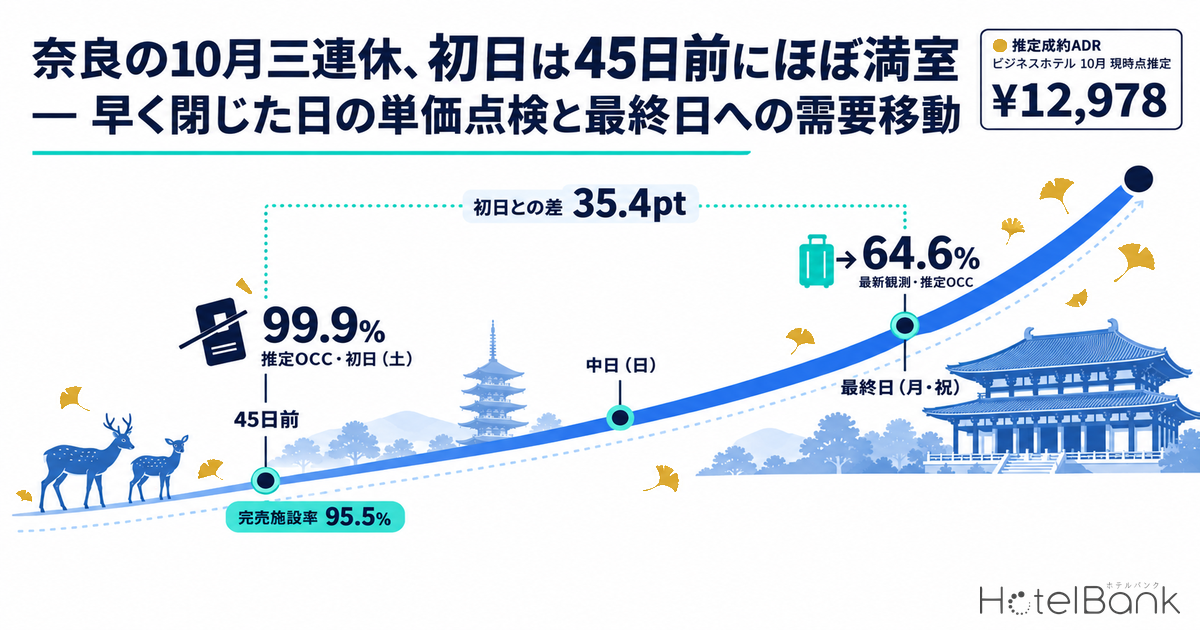
Among business hotels in Nara Prefecture (fixed cohort of N=22 properties, 2,613 rooms), Saturday, October 10, 2026 — the first night of the October three-day weekend — had already reached an estimated OCC (OTA-listed inventory basis) of 99.9% at 45 days before the stay date, and the share of properties with no listed inventory visible on OTAs and similar channels (estimated sell-out rate) stood at 95.5%. By contrast, the final night, Monday, October 12 (Sports Day), was at 52.9% at 45 days out and still only 64.6% at the latest observation (September 24, 18 days before the stay date) — a gap of 35.4pt against the first night within the same long weekend.
Closing out early is neither good nor bad in itself. A date that sells out 45 or more days in advance is one of the rare opportunities to test how rates were set. This article is organized in two parts for revenue managers at city and business hotels in Nara: a review of the dates that closed early (how the rate ladder was stepped, minimum length of stay, and how premium room types were held back), and shifting demand toward the final night that still has availability (encouraging multi-night stays and offering post-checkout options).
Scope: Nara Prefecture business hotels, N=22 properties / 2,613 rooms (booking curves); estimated settled ADR covers Nara Prefecture business hotels N=31–33 and city hotels N=7–8. Price metrics in this article are estimated settled ADR (the settled price level estimated from OTA and other sales data, tax-excluded equivalent); occupancy is an estimate based on OTA-listed inventory. Definitions are at the end of the article. Data as of: September 25, 2026.
• ADR (estimated settled ADR) = the estimated settled rate (tax-excluded equivalent), calculated by applying a segment-specific adjustment factor to the lowest-plan level each property publishes on OTAs (per room, 2 guests per room, tax-included). Median error against published operating results is 6.6%. These are estimates and differ from each property’s actual settled prices and accounting figures.
• OCC (occupancy) = the share of rooms sold relative to the total room count in the area (an estimate based on OTA sales inventory). The formula and target cohort are described under “About the Data” at the end of the article.
• Source: MetroEngines Research (continuous tracking of OTA public prices for approx. 138,000 properties in Japan, of which approx. 27,000 are confirmed operating)
- — Sat Oct 10 hit an estimated OCC of 99.9% at 45 days out (as of August 26, 2026), with a sell-out rate of 95.5%. Fixed cohort of Nara Prefecture business hotels, N=22 properties / 2,613 rooms
- — The final night, Oct 12, is still only 64.6% at the latest reading (observed September 24, 2026, 18 days out), 35.4pt below the first night. Even so, it is 6.6pt above a regular Saturday, Oct 3, at the same lead time (58.0%)
- — Oct 10–11 coincide with a large outdoor concert at the Heijo Palace Site (over 50,000 attendees expected across two days) on top of the long weekend, making the first and middle nights exceptionally strong
- — Estimated settled ADR for business hotels in October is a current estimate of ¥12,978 (N=32), versus a settled ¥9,512 for October 2025. City hotels, at N=8 and for reference only, are ¥19,530
- — A two-track playbook: record and test the rates and re-release of returned inventory on dates that closed early, and move demand onto the final night through multi-night stays and stay extensions rather than price cuts
Three Nights, Three Completely Different Booking Paces
In 2026, Monday, October 12 is Sports Day, making Saturday, October 10 through Monday, October 12 a three-day weekend. Lining up the booking curves by stay date from 45 days out to the latest observation for the fixed cohort of Nara Prefecture business hotels (N=22 properties / 2,613 rooms, based on listings on major booking sites) shows that the three nights take very different shapes.
The first night, October 10, was already at an estimated OCC of 99.9% at 45 days out (August 26), the start of the observation window. It stayed between 99.1% and 100.0% throughout the observation period and is at 100.0% at the latest reading (September 24, 16 days out). The middle night, October 11, went from 87.5% at 45 days out to 92.8% at 30 days out and 95.6% at the latest reading, steadily absorbing its remaining rooms (+8.1pt since 45 days out). The final night, October 12, went from 52.9% at 45 days out to 59.8% at 30 days out and 64.6% at the latest reading. Its pickup of +11.7pt is the largest of the three nights, but its level remains well below the first and middle nights.
For comparison, Saturday, October 3 — a regular Saturday before the long weekend — measured on the same set of properties was 47.1% at 45 days out, 49.4% at 30 days out and 58.0% at 18 days out. At the same 18-day lead time, October 12 was at 64.6%, 6.6pt above that regular Saturday. In other words, it is closer to reality to read this not as a “weak” final night but as a long weekend whose first and middle nights are exceptionally strong.
Source: Compiled by HotelBank Editorial Team from MetroEngines Research (Nara Prefecture business hotels, N=22 properties / 2,613 rooms; estimated OCC = OTA-listed inventory basis; X-axis is days remaining until the stay date)
| Stay date | 45 days out | 30 days out | Latest (observed 9/24) | Pickup since 45 days out | Latest sell-out rate |
|---|---|---|---|---|---|
| 10/10 (Sat) first night | 99.9% | 99.8% | 100.0% (16 days out) | +0.1pt | 95.5% |
| 10/11 (Sun) middle night | 87.5% | 92.8% | 95.6% (17 days out) | +8.1pt | 59.1% |
| 10/12 (Mon, holiday) final night | 52.9% | 59.8% | 64.6% (18 days out) | +11.7pt | 4.5% |
| Ref: 10/3 (Sat) regular weekend | 47.1% | 49.4% | 65.9% (9 days out) | +18.8pt | 9.1% |
| Ref: 10/17 (Sat) weekend after | 56.4% | 67.6% | 71.8% (23 days out) | +15.4pt | 18.2% |
Source: Compiled by HotelBank Editorial Team from MetroEngines Research (Nara Prefecture business hotels, N=22 properties / 2,613 rooms. Sell-out rate = share of properties with no listed inventory visible on OTAs and similar channels, estimated)
Looking beyond business hotels to all categories in the prefecture (N=140–141 properties / 5,113–5,116 rooms), the latest observation shows the same “first night > middle night > final night” staircase: 97.8% for October 10, 93.8% for October 11 and 68.4% for October 12. Because the same shape appears across categories, it can be read as reflecting an area-wide skew in demand rather than circumstances at individual properties.
The Demand Behind the First Night, and What Happened After It Closed
On Saturday, October 10 and Sunday, October 11, a special outdoor venue in the Heijo Palace Site Historical Park is scheduled to host a large-scale outdoor music concert, “LEGACY ZOMBIE LABO 『文禍伝雷』 Nara Heijo-kyo” by ZUTOMAYO (ずっと真夜中でいいのに。), expecting more than 50,000 attendees over the two days. Alongside the concert, a “Festival Area” with local products, food stalls and workshops is planned, turning each day into an all-day festival starting in the morning. The early close-out of the first and middle nights coincides with this overlap of the concert dates and the long weekend.
The trend in the sell-out rate makes the differences among the three nights even clearer. For October 10, 95.5% of properties had no listed inventory visible on OTAs and similar channels at 45 days out, and the figure is still 95.5% at the latest reading. For October 11, the rate rose step by step over the observation period — from 22.7% at 45 days out to 40.9% at 30 days out and 59.1% at the latest reading — as more properties closed out. For October 12, it was 0.0% at both 45 and 30 days out, and only 4.5% at the latest reading.
Source: Compiled by HotelBank Editorial Team from MetroEngines Research (Nara Prefecture business hotels, N=22 properties / 2,613 rooms. Sell-out rate = share of properties with no listed inventory visible on OTAs and similar channels, estimated. Latest = observed September 24)
Worth noting is that even the fully closed October 10 saw some small movement. The day after the 30-days-out mark (29 days out, September 11), listed remaining rooms rose from 5 to 21, and to 23 at 25 days out (September 15), before being absorbed back down to a single room by 16 days out (September 24). Against a base of 2,613 rooms this is a very small volume, but the fact that inventory that came back was absorbed again in under ten days is evidence of how deep demand was for that date. If your own hotel saw inventory come back in the same way, the rate at which you re-released it is a concrete point for your post-stay review.
Rate Levels for October and November Through Estimated Settled ADR
To connect the strength of the booking pace to a review of how rates were set, you need a handle on monthly settled price levels. Estimated settled ADR for Nara Prefecture business hotels (N=31–33 properties) was above the same month of the prior year in most settled months from January to August 2026: August was ¥9,500 (prior year ¥8,900, +5.9%, N=31) and April was ¥10,400 (prior year ¥9,200, +13.4%, N=32). On the other hand, June (−2.3%) and July (−3.5%) came in below the prior year, making this a year in which seasonal peaks and troughs are more pronounced than last year.
October 2026 is estimated at about ¥13,000 (N=32) and November at about ¥14,800 (N=31), based on current sales. The settled figure for October 2025 is ¥9,500 (N=32), but a simple comparison between the current estimate and the settled figure has to wait until the month closes. Current estimates may change with future sales. For prices and inventory during the Shosoin Exhibition from late October into November, see our in-depth analysis of Nara hotels during the Shosoin Exhibition 2026.
Source: Compiled by HotelBank Editorial Team from MetroEngines Research (Nara Prefecture business hotels, N=31–33 properties. Solid line = settled; dotted line = estimate based on current sales, subject to change)
City hotels have a small sample of N=7–8 properties, so we treat them as reference values rather than as a prefecture-wide trend. Estimated settled ADR for October 2026 is a current estimate of ¥19,500 (N=8), and November is ¥23,200 (N=7). Among settled months, April 2026 was ¥19,300 (prior year ¥19,100, +1.3%, N=7) and August was ¥16,600 (prior year ¥17,000, −2.4%, N=7).
| Category | Oct 2025 (settled) | Oct 2026 (current estimate) | Nov 2025 (settled) | Nov 2026 (current estimate) |
|---|---|---|---|---|
| Business hotels | ¥9,512 (N=32) | ¥12,978 (N=32) | ¥11,074 (N=32) | ¥14,785 (N=31) |
| City hotels | ¥17,793 (N=7) | ¥19,530 (N=8) | ¥20,022 (N=7) | ¥23,161 (N=7) |
Source: Compiled by HotelBank Editorial Team from MetroEngines Research (estimated settled ADR, tax-excluded equivalent. October and November 2026 are estimates based on current sales; a simple comparison with settled figures must wait until month-end)
Estimated settled ADR is a monthly level and does not represent the rate on any specific date. The three nights of a long weekend are the set of dates within a month where booking paces diverge the most. Keeping the monthly level at hand as a yardstick while checking where your own rates stood on the first, middle and final nights is the starting point for the next section.
For Revenue Managers at City and Business Hotels in Nara — Implications and Action Plan
1. For dates that closed out 45 days ahead, record “when and at what rate” they closed. In the market (N=22), October 10 was at an estimated OCC of 99.9% at 45 days out (as of August 26, 2026). If your own hotel also closed early, keeping a record of the rates at which the last few rooms sold, and how many days before the stay date, lets you test how much higher you could have stepped the rate ladder on similar dates in future years. The earlier a date closes, the more it suggests there may have been room to test the upper rungs.
2. Returned inventory is a moment to decide whether to re-release it at the original rate. For October 10, listed remaining rooms came back to around 20 between 29 and 25 days out and were absorbed again by 16 days out. It is worth checking whether there was room to re-release rooms returned through cancellations and the like at a rate matched to demand at that point, rather than at the rate in effect when the date closed.
3. Fill the final night not as a standalone night, but through multi-night stays and time on property. October 12 is still only 64.6% at the latest reading — a wide gap against the first and middle nights — yet it is above a regular Saturday (October 3) at the same lead time. Rather than cutting rates to fill it, shifting demand through middle-to-final-night multi-night stays and post-checkout offers is an approach less likely to erode rates across the whole long weekend.
4. On the middle night, holding premium room types “until the very end” is also an option. For October 11, the sell-out rate rose step by step from 22.7% at 45 days out to 59.1% at the latest reading. When more properties in the market are closing out, not releasing premium room types too early and keeping them for late demand may pay off on rate.
| Timing | Action | Decision trigger (figures in this article) | Aim |
|---|---|---|---|
| Today – this week | Feature a 2-night plan arriving 10/11 (10/11–12) to shift demand onto the final night | If your 10/12 is at or below the market’s latest estimated OCC of 64.6% (as of September 24, 2026, N=22) | Build occupancy on the final night without breaking rate |
| Today – this week | Make post-checkout options for 10/12 (late checkout, luggage storage plus local walking guides) explicit in the booking path | If your 10/12 is not heading for a sell-out and the market sell-out rate stays at 4.5% | Give guests more reasons to stay on the final night |
| Until the stay date (to 10/9) | Don’t rush to open premium room types for 10/11; hold them for late demand | If the market’s 10/11 sell-out rate keeps rising from the latest 59.1% | Protect the middle night’s average rate |
| Until the stay date (to 10/9) | Rather than automatically releasing returned 10/10 inventory at the rate in effect when the date closed, consider re-pricing it at the current rate | If the market’s 10/10 estimated OCC holds in the 99% range and the 95.5% sell-out rate continues | Match returned-room rates to demand |
| After the long weekend (from 10/13) | Organize the sales record for 10/10–12 (close-out dates, rates of the last few rooms, room types left unsold) | If, like the market, your hotel had nearly closed out the first night by 45 days out | Build material to test how to step the rate ladder next year |
| Toward the same period next year | For a first night where a major event overlaps a long weekend, consider attaching a 2-night minimum to part of the first-night-arrival inventory | If a gap like first night 99.9% vs. final night 52.9% (both at 45 days out) appears again | Redistribute first-night demand to the final night |
Source: Compiled by HotelBank Editorial Team from MetroEngines Research
None of these actions guarantees results. Where the opportunity lies depends on your guest mix (leisure, event visitors, business travelers) and your mix of premium room types. Line up the market curve and your own booking pace at the same checkpoints (45 days out, 30 days out, close-in) and prioritize the dates where the gap is largest.
Summary — Three Yardsticks for Reading Dates That Closed Early
| Yardstick | What Nara’s October long weekend showed | What to check at your hotel |
|---|---|---|
| When it closed | 10/10 reached an estimated OCC of 99.9% and a sell-out rate of 95.5% at 45 days out (as of August 26, 2026; N=22) | The date your hotel closed out, and the rates of the last few rooms |
| Gap within the long weekend | The first-to-final-night gap is still 35.4pt at the latest reading | How much demand can be shifted to the final night through multi-night stays and stay offers |
| Monthly rate level | Business hotels in October: current estimate ¥12,978 (N=32); city hotels ¥19,530 (N=8, reference only) | How far your rates over the three nights deviated from the monthly level |
Source: Compiled by HotelBank Editorial Team from MetroEngines Research
Dates that sell out 45 or more days ahead do not come around many times a year. That is exactly why the sales record for such a date is valuable material for next year’s rate design. Rather than filing a closed-out date away as “a day that went well,” treat it as a day to test how rates were set — and, at the same time, keep refining ways to shift demand onto the final night that still has rooms. That is the shortest path to building revenue across the whole long weekend.
Frequently Asked Questions
Q. Which night of Nara’s October 2026 three-day weekend filled up earliest?
A. Saturday, October 10. Among Nara Prefecture business hotels (N=22 properties / 2,613 rooms), it had reached an estimated OCC of 99.9% and a sell-out rate of 95.5% at 45 days out (as of August 26, 2026). The middle night, October 11, was at 87.5% at 45 days out, and the final night, October 12, at 52.9%.
Q. Is demand weak on the final night, October 12?
A. At the latest observation (September 24, 2026, 18 days before the stay date), its estimated OCC was 64.6%, 35.4pt below the first night. However, that is 6.6pt above a regular pre-holiday Saturday (October 3) at the same 18-day lead time (58.0%). It is closer to reality to read this not as a weak final night but as a long weekend whose first and middle nights are exceptionally strong.
Q. What should be reviewed for a date that closed out 45 or more days ahead?
A. Three things: at what rate and how many days before the stay date the last few rooms sold, at what rate inventory returned through cancellations and the like was re-released, and how far premium room types were held back. These become material for testing how to step the rate ladder in future years.
Q. Should vacancies on the final night be filled with price cuts?
A. This article suggests that, rather than cutting rates to fill it, demand can be shifted through middle-to-final-night multi-night plans and post-checkout offers (late checkout, luggage storage, etc.), because this is less likely to erode rates across the whole long weekend. Results vary with guest mix and room composition.
Q. Is the estimated OCC in this article the same as a hotel’s actual room occupancy?
A. No. Estimated OCC is an OTA-listed-inventory-based estimate calculated as 100 − 100 × OTA-listed remaining rooms ÷ total rooms. Because unlisted rooms are counted as sold, it runs higher than actual room occupancy. The target is a fixed cohort of properties that list at least 30% of their total rooms on OTAs.
About the Data
| Definition of estimated OCC | OTA-listed-inventory-based occupancy = 100 − 100 × OTA-listed remaining rooms ÷ total rooms. The target is a fixed cohort of properties that list at least 30% of their total rooms on OTAs (the same set of properties for each stay date). This is an estimate based on how OTA-sold inventory is being absorbed and is defined differently from actual room occupancy (it runs higher because unlisted rooms are counted as sold). |
| Booking curves | Based on observations from 45 days before the stay date to the most recent reading. “Close-in” in this article refers to the latest observation (September 24, 2026; 16–18 days before the stay date). The sell-out rate is the share of properties with no listed inventory visible on OTAs and similar channels (estimated). |
| Definition of estimated settled ADR | The settled price level (tax-excluded equivalent) estimated from OTA and other sales data (lowest-plan level × segment factor, ensemble across multiple channels). Past months are settled values; current and future months are estimates based on current sales. Median error against published operating results is 6.6%. |
| Breakdown of N | Booking curves: Nara Prefecture business hotels, N=22 properties / 2,613 rooms (based on listings on major booking sites). All categories (reference): N=140–141 properties / 5,113–5,116 rooms. Estimated settled ADR: Nara Prefecture business hotels N=31–33, city hotels N=7–8 (varies by month; shown alongside each figure). |
| Data as of | Data as of: September 25, 2026. Sales and inventory change daily, so the figures in this article are a snapshot at the time of retrieval. |
References and Sources
■ Data sources
MetroEngines Research (continuous tracking of OTA public prices for approx. 138,000 properties in Japan, of which approx. 27,000 are confirmed operating): booking curves by stay date and monthly estimated settled ADR. Public holidays were confirmed with the Cabinet Office; event dates with the organizer’s official website and the official Nara Prefecture tourism website.
■ Estimation assumptions
Estimated OCC tracks a fixed cohort of Nara Prefecture business hotels (N=22 properties / 2,613 rooms, the same set of properties for each stay date) from 45 days before the stay date to the observation on September 24, 2026 (16–18 days out). For estimated settled ADR, past months are settled values; October and November 2026 are estimates based on sales as of September 25, 2026.
■ Limitations and caveats
Estimated OCC is based on OTA-listed inventory and runs higher than actual room occupancy because unlisted rooms are counted as sold. City hotels are a small sample of N=7–8 and are not treated as a prefecture-wide trend. Current-estimate ADR may change with future sales. The figures do not represent the results of any individual property.
| Cabinet Office, “National Holidays” (国民の祝日について) | https://www8.cao.go.jp/chosei/shukujitsu/gaiyou.html |
| ZUTOMAYO (ずっと真夜中でいいのに。) “LEGACY ZOMBIE LABO 『文禍伝雷』 Nara Heijo-kyo” official website | https://zutomayo.net/bunka-denrai/ |
| encore (USEN): concert announcement article | https://e.usen.com/news/news-event/2026101011live-legacy-zombie-labo-live.html |
| Official Nara Prefecture tourism website “Aoniyoshi Nara Tabi Net” (October 2026 events) | https://yamatoji.nara-kankou.or.jp/003events/?ym=202610 |