

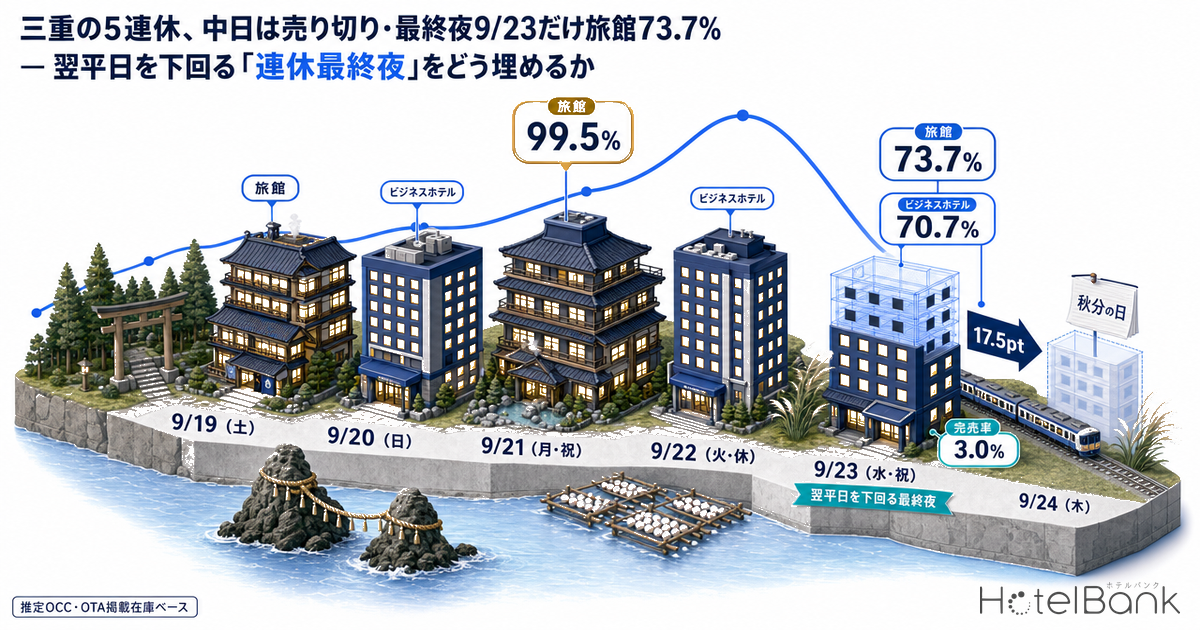
Mie Prefecture’s lodging market ended the 2026 Silver Week (a five-day holiday from September 19 to 23) with a clear shape: the middle nights sold out, and only the final night was left over. On the night of Monday, September 21 (Respect for the Aged Day), ryokan reached an estimated OCC (OTA listed-inventory basis) of 99.5% with a 99.2% sell-out rate one day before stay, and business hotels 99.9% and 98.4% — nearly every property was full. By contrast, the night of Wednesday, September 23 (Autumnal Equinox Day) stood at only 73.7% for ryokan, 79.9% for resort hotels and 70.7% for business hotels two days before stay, with sell-out rates of 29.6% for ryokan and just 3.0% for business hotels.
Compared at the same point three days before stay with Thursday, September 24 — the first weekday after the holiday — Sep 23 trailed by 8.5pt for ryokan and 17.5pt for business hotels. The closing night of a long holiday was not “strong because it is a holiday”; it was weaker than the following weekday precisely because the next day is a workday. This article confirms that structure at three points — 45 days out, 30 days out and just before stay — and sets out actions by property type for the October three-day weekend (Oct 10–12), where the same shape is already visible.
Coverage: Mie Prefecture ryokan N=124–126 properties, resort hotels N=27–28, business hotels N=64–66 (fixed cohort per stay date). This article does not address price levels; occupancy is an estimate based on OTA listed inventory (estimated OCC), and the sell-out rate is the estimated share of properties with no listed inventory found on OTAs and similar channels. Definitions are at the end of the article. Data as of September 22, 2026.
- — The night of Sep 21 (Mon, holiday) reached ryokan est. OCC of 99.5% with a 99.2% sell-out rate one day before stay, and business hotels 99.9% with a 98.4% sell-out rate — virtually sold out (est. OCC, OTA listed-inventory basis, observed September 2026).
- — Two days before stay, the closing night of Sep 23 (Wed, holiday) stood at only 73.7% for ryokan, 79.9% for resort hotels and 70.7% for business hotels; the business-hotel sell-out rate was just 3.0%.
- — At the same point three days before stay, the Sep 23 night trailed the post-holiday weekday night of Sep 24 (Thu) by 8.5pt for ryokan and by 17.5pt for business hotels. The closing night was weaker than the following weekday.
- — Sep 22, followed by another day off, climbed from 71.1% at T-30 to 98.4% at T-1, a gain of +27.3pt (ryokan). Sep 23, followed by a workday, added only +17.6pt from T-30.
- — The closing night of the October three-day weekend, Oct 12, stood at 60.2% for both ryokan and business hotels 21 days before stay — almost the same level as Sep 23 at the same point (ryokan 61.5%). The same shape is already emerging.
Five Nights at Three Points — Only Sep 23 Never Caught Up
The table below shows estimated OCC and sell-out rate by property type for each night of the five-day holiday, at 45 days out, 30 days out and the latest observation point. The latest point is one day before stay for Sep 19–22 and two days before stay for Sep 23. City hotels are excluded: only nine qualifying properties exist in Mie Prefecture, too few to show a per-stay-date trend, so the article covers three types — ryokan, resort hotels and business hotels.
| Type | Stay date | Properties / rooms | T-45 est. OCC | T-45 sell-out | T-30 est. OCC | T-30 sell-out | Latest est. OCC (obs. point) | Latest sell-out |
|---|---|---|---|---|---|---|---|---|
| Ryokan | Sep 19 (Sat) | N=126 / 3,275 rooms | 77.8% | 31.7% | 85.5% | 44.4% | 98.0% (T-1) | 88.1% |
| Ryokan | Sep 20 (Sun) | N=124 / 3,238 rooms | 91.8% | 57.3% | 97.1% | 83.9% | 99.8% (T-1) | 96.8% |
| Ryokan | Sep 21 (Mon, hol.) | N=124 / 3,238 rooms | 86.9% | 46.8% | 96.0% | 77.4% | 99.5% (T-1) | 99.2% |
| Ryokan | Sep 22 (Tue, hol.) | N=125 / 3,271 rooms | 63.4% | 13.6% | 71.1% | 19.2% | 98.4% (T-1) | 90.4% |
| Ryokan | Sep 23 (Wed, hol.) | N=125 / 3,271 rooms | 51.9% | 11.2% | 56.1% | 12.8% | 73.7% (T-2) | 29.6% |
| Resort hotels | Sep 19 (Sat) | N=28 / 2,507 rooms | 74.9% | 17.9% | 82.7% | 17.9% | 97.8% (T-1) | 60.7% |
| Resort hotels | Sep 20 (Sun) | N=28 / 2,507 rooms | 89.9% | 35.7% | 97.3% | 78.6% | 99.7% (T-1) | 89.3% |
| Resort hotels | Sep 21 (Mon, hol.) | N=28 / 2,507 rooms | 87.9% | 35.7% | 96.0% | 60.7% | 99.8% (T-1) | 89.3% |
| Resort hotels | Sep 22 (Tue, hol.) | N=27 / 2,399 rooms | 69.9% | 7.4% | 79.6% | 14.8% | 98.9% (T-1) | 74.1% |
| Resort hotels | Sep 23 (Wed, hol.) | N=27 / 2,375 rooms | 66.0% | 7.7% | 71.3% | 7.4% | 79.9% (T-2) | 22.2% |
| Business hotels | Sep 19 (Sat) | N=64 / 6,985 rooms | 71.0% | 31.2% | 79.2% | 26.6% | 99.3% (T-1) | 87.5% |
| Business hotels | Sep 20 (Sun) | N=64 / 6,985 rooms | 77.8% | 41.3% | 91.5% | 64.1% | 99.8% (T-1) | 95.3% |
| Business hotels | Sep 21 (Mon, hol.) | N=64 / 6,985 rooms | 74.7% | 29.7% | 87.2% | 43.8% | 99.9% (T-1) | 98.4% |
| Business hotels | Sep 22 (Tue, hol.) | N=66 / 7,144 rooms | 59.1% | 6.1% | 67.4% | 12.1% | 94.7% (T-1) | 48.5% |
| Business hotels | Sep 23 (Wed, hol.) | N=66 / 7,144 rooms | 51.7% | 1.5% | 55.8% | 0.0% | 70.7% (T-2) | 3.0% |
Source: Compiled by HotelBank Editorial Team from MetroEngines Research data
What stands out first is the strength of Sep 20 (Sun) and Sep 21 (Mon, holiday). Ryokan for Sep 20 were already at 91.8% 45 days out and 97.1% 30 days out — essentially sold out a month before stay. Sep 21 was likewise at 96.0% for both ryokan and resort hotels at T-30. In sell-out terms, Sep 21 reached 99.2% for ryokan, 89.3% for resort hotels and 98.4% for business hotels: across all three types, most properties had no inventory to be found.
Sep 22 (Tue, holiday) and Sep 23 (Wed, holiday) are the contrast. Yet although both belong to the “second half” of the holiday, they behaved completely differently. Sep 22 was lagging at T-30 — 71.1% for ryokan and 67.4% for business hotels — but by one day before stay it had added +27.3pt for ryokan, +27.3pt for business hotels and +19.3pt for resort hotels, catching up to 98.4% for ryokan and 98.9% for resort hotels. Because the day after Sep 22 was also a holiday, it effectively filled late as a “middle night” of the holiday.
Sep 23, on the other hand, is followed by a regular Thursday. Ryokan went from 51.9% at T-45 to 56.1% at T-30 and 73.7% at T-2, a gain of +17.6pt from T-30 to T-2. Business hotels went 51.7% → 55.8% → 70.7% (+14.9pt) and resort hotels 66.0% → 71.3% → 79.9% (+8.6pt). The gain was not zero, but compared with the three middle nights that ended in the 90s, the closing night clearly remained unsold. The same pattern — only the closing night of Sep 23 failing to fill — was also visible in neighboring Gifu during the same five-day holiday.
Booking Curves: The Middle-Night Catch-Up vs. the Stalled Closing Night
Overlaying ryokan booking curves for four stay dates makes the difference clear. Sep 21 (navy) rises almost in a straight line from 86.9% at T-45, reaches 96.0% at T-30 and then flattens. Sep 22 (grey dashed) steepens from around T-30 and fills rapidly in the second half: 83.8% at T-21 → 91.5% at T-14 → 98.4% at T-1. Sep 23 (blue fill) has a gentler slope over the same period, adding only +8.2pt in the final two weeks, from 65.5% at T-14 to 73.7% at T-2.
Source: Compiled by HotelBank Editorial Team from MetroEngines Research data
Booking curves of estimated OCC (OTA listed-inventory basis) for Mie Prefecture ryokan. N=124–126 properties / 3,238–3,275 rooms (major booking-site listings). For Sep 23, two days before stay is the latest observation point.
Business hotels show the same shape. Sep 21 sold out, going from 87.2% at T-30 to 99.7% at T-14, and Sep 22 caught up from 67.4% at T-30 to 94.7% at T-1. Sep 23 only reached 70.7% at T-2 from 55.8% at T-30, with a sell-out rate of 3.0% (roughly two of 66 properties with no inventory found). For Sep 22, business hotels’ estimated OCC rose to 94.7%, but the sell-out rate was 48.5% — compared with ryokan (90.4%) and resort hotels (74.1%), more properties reached the stay date still holding a few unsold rooms.
Source: Compiled by HotelBank Editorial Team from MetroEngines Research data
Booking curves of estimated OCC (OTA listed-inventory basis) for Mie Prefecture business hotels. N=64–66 properties / 6,985–7,144 rooms (major booking-site listings). For Sep 23, two days before stay is the latest observation point.
Lining up sell-out rates by property type makes the closing-night drop even sharper. Estimated OCC shows how full the market is, while the sell-out rate shows how many properties sold out; an OCC in the 70s combined with a sell-out rate in single digits to the 20s means many properties were still holding meaningful unsold inventory.
Source: Compiled by HotelBank Editorial Team from MetroEngines Research data
Mie Prefecture sell-out rate by property type (latest observation: one day before stay for Sep 19–22, two days before stay for Sep 23). Ryokan N=124–126, resort hotels N=27–28, business hotels N=64–66 properties.
The Closing Night Is Weaker Than the Next Weekday — Sep 23 vs. Sep 24 at the Same Point
The weakness of Sep 23 cannot be explained simply as demand thinning out late in the holiday. Set side by side with Sep 24 (Thu), the first night after the holiday, at the same point three days before stay, Sep 24 is higher for all three property types.
| Type | Sep 23 (Wed, hol.) T-3 est. OCC (sell-out) | Sep 24 (Thu) T-3 est. OCC (sell-out) | Properties |
|---|---|---|---|
| Ryokan | 71.0% (23.4%) | 79.5% (41.6%) | N=125 / 125 |
| Resort hotels | 78.8% (11.1%) | 81.5% (14.8%) | N=27 / 27 |
| Business hotels | 71.3% (3.0%) | 88.8% (21.2%) | N=66 / 66 |
Source: Compiled by HotelBank Editorial Team from MetroEngines Research data
The gap is largest for business hotels: 71.3% for Sep 23 against 88.8% for Sep 24, and a sell-out rate of 3.0% against 21.2%. A closing night followed by a workday is the day leisure travelers go home and a day business travelers have not yet started moving, so it catches neither demand. Ryokan, too, stood at 71.0% for Sep 23 versus 79.5% for Sep 24, with the closing night below the post-holiday weekday. Resort hotels showed only a small gap (81.5% for Sep 24, 78.8% for Sep 23), suggesting a segment that carries a certain amount of weekday demand to begin with. The pattern of the final night trailing the post-holiday weekday had already been visible before the stay dates in our T-45/T-30/T-14 countdown calendar for Shiga’s five-day holiday.
This structure is not unique to the five-day holiday. Current sales show the same shape already forming for the October three-day weekend that includes Sports Day (Oct 10–12).
| Type | Oct 10 (Sat) | Oct 11 (Sun) | Oct 12 (Mon, hol.) | Oct 13 (Tue) | Properties / rooms |
|---|---|---|---|---|---|
| Ryokan | 90.7% (54.0%) | 78.3% (26.2%) | 60.2% (9.5%) | 66.1% (24.0%) | N=126 / 3,285 rooms (Oct 13 only: 125 properties / 3,270 rooms) |
| Resort hotels | 84.8% (33.3%) | 82.3% (22.2%) | 72.4% (7.4%) | 70.7% (11.1%) | N=27 / 2,375 rooms |
| Business hotels | 90.2% (53.0%) | 73.9% (18.2%) | 60.2% (4.5%) | 65.5% (9.1%) | N=66 / 7,144 rooms |
Source: Compiled by HotelBank Editorial Team from MetroEngines Research data
All figures are estimated OCC observed on September 21, 2026 (19–22 days before stay), with sell-out rate in parentheses. They reflect current sales and will change before the stay dates.
Oct 10 (Sat), the first night of the weekend, is already at 90.7% for ryokan and 90.2% for business hotels 19 days before stay. The closing night, Oct 12 (Mon, holiday), is at 60.2% for both, below the following weekday night of Oct 13 (Tue) (ryokan 66.1%, business hotels 65.5%). Looking at Sep 23 at the same 21-days-out point, the levels almost overlap.
| Type | Sep 23 (last night of 5-day holiday) T-21 est. OCC | Oct 12 (last night of 3-day weekend) T-21 est. OCC |
|---|---|---|
| Ryokan | 61.5% | 60.2% |
| Resort hotels | 73.9% | 72.4% |
| Business hotels | 59.7% | 60.2% |
Source: Compiled by HotelBank Editorial Team from MetroEngines Research data
From that point to two days before stay, Sep 23 added +12.2pt for ryokan and +11.0pt for business hotels, yet still did not close the gap with the middle nights. Without action, Oct 12 may follow the same trajectory. Put the other way, the closing-night weakness is visible three weeks before stay, which leaves time to act. In Yamanashi, the same October three-day weekend also shows a weaker holiday closing night than its Saturday.
For Revenue Managers of Ryokan, Resort and Business Hotels in Mie — Implications and Action Plan
Operational Insights
1. Holiday strength is determined not by whether the night is a public holiday, but by whether the next day is a day off. Within the five-day holiday, both Sep 21 and Sep 22 were followed by a day off, and Sep 22 ultimately filled to 98.4% for ryokan despite lagging at T-30. Sep 23, followed by a workday, stopped at 73.7%. When building a holiday calendar, grouping nights by whether guests have work the next morning — rather than by whether the night is a holiday — makes it less likely to misset pricing and sales conditions.
2. A middle night that lags at T-30 may not need a hasty discount. Sep 22 added +27.3pt by the final days, from 71.1% for ryokan and 67.4% for business hotels at T-30. If your own middle-night pace is lagging at T-30 in line with the market, that may simply be the normal shape of a night that fills late. This is the moment to overlay your pace on the market curve and check whether the shapes match first.
3. The missing demand on the closing night differs by property type. For ryokan and resort hotels it coincides with leisure guests heading home; for business hotels it is a day when business travelers have not started moving. The 88.8% T-3 level for business hotels on Sep 24 shows that post-holiday business demand does exist. There is room to target differently: ryokan and resort hotels can aim to get guests to stay one more night, while business hotels can pull the next morning’s business trips forward to the night before.
4. Closing-night gains come late. Ryokan on Sep 23 gained +8.2pt in the final two weeks — slowly, but moving right to the end. Rather than long-distance tourists, it may be guests who can drive in from within the prefecture or nearby areas who decide at the last minute. Closing-night sales are better planned on the assumption of selling right up to the stay date than of settling early.
With this in mind, the following timeline of actions uses the October three-day weekend (closing night Oct 12), where the same shape is already visible, as the case.
| Timing | Action | Decision trigger (figures in this article) | Aim |
|---|---|---|---|
| This week (T-21 to T-14 for Oct 12) | Bundle Oct 11 (Sun) + Oct 12 (Mon, holiday) into one product and feature a multi-night plan that includes the second night | Oct 10 (Sat) is at 90.7% for ryokan and 90.2% for business hotels while Oct 12 (Mon, holiday) is at 60.2%. If your property is also skewed to the first night | Extend first-night demand through to the closing night |
| This week (same as above) | Offer closing-night guests an “extend into the weekday morning” product with a relaxed late checkout the next day | At T-3, Sep 23 was at 71.0% for ryokan with a 23.4% sell-out rate, below the following weekday Sep 24 (79.5%). If your closing night is also weaker than the next weekday | Sell the value of time on the morning after the holiday |
| Within two weeks (T-14 to T-7) | Increase visibility of one-night plans aimed at guests driving in from within the prefecture or neighboring prefectures (selectable dinner times, parking information, etc.) | Ryokan on Sep 23 moved +8.2pt late, from 65.5% at T-14 to 73.7% at T-2. If your closing night is still not growing at T-14 | Capture last-minute nearby demand |
| Within two weeks (same as above) | Business hotels: promote the closing night as the night before next-morning business trips, and treat corporate outreach the same as for the post-holiday weekday | Sep 24 (Thu) was at 88.8% with a 21.2% sell-out rate at T-3; Sep 23 at 71.3% and 3.0%. If your closing-night bookings are not capturing corporate night-before stays | Pull first-day-back business demand forward to the night before |
| Close-in (T-7 to day of stay) | Decide daily whether to prioritize folding closing-night rooms into multi-night stays and hold back single-night release | Sep 22 caught up +27.3pt, from 71.1% at T-30 to 98.4% at T-1. Even if your middle night lags at T-30 | Avoid early discounting of the middle night and use it for bundling with the closing night |
| For the next holiday (review) | Record your property’s T-45, T-30 and close-in figures for Sep 19–23 alongside the market table and use them for the initial settings of the next long holiday | In the market, Sep 21 was at 96.0% at T-30 (ryokan) and Sep 23 at 56.1%. Check whether your gap between the same nights is larger or smaller than the market’s | Reflect night-by-night strength within the holiday in the next pricing calendar |
All of these are actions to consider after checking your own booking status against the market figures. By property type, for ryokan and resort hotels the focus is on multi-night stays, productizing checkout time, and capturing nearby drive-in demand close to the stay date. For business hotels, the focus is on pulling remaining corporate demand — night-before stays for post-holiday business trips — forward to the closing night.
Summary — Three Yardsticks for the Next Holiday
In Mie Prefecture’s five-day Silver Week, the three nights of Sep 20–22 filled to estimated OCC in the 90s for all three property types (September 2026, one day before stay), while only the closing night of Sep 23 was left at 73.7% for ryokan, 79.9% for resort hotels and 70.7% for business hotels (all two days before stay). When reading the next holiday, you can check your property against these three yardsticks.
1. Group nights by whether the next day is a workday. The closing night can be weaker than the following weekday (Sep 24); for business hotels the gap was 17.5pt at T-3.
2. A lag at T-30 means different things for a “middle-night type” and a “closing-night type.” The middle night (Sep 22) caught up +27.3pt from T-30, while the closing night (Sep 23) gained only +17.6pt (both ryokan).
3. The closing-night level three weeks out is itself the warning signal for the next holiday. Sep 23 at T-21 (ryokan 61.5%) and Oct 12 at T-21 (ryokan 60.2%) are at almost the same level. Work on the closing night can begin as soon as you see the three-weeks-out figures.
Frequently Asked Questions
Q. Which night of Mie Prefecture’s five-day Silver Week filled the least?
The closing night of Wednesday, September 23 (holiday). Two days before stay (observed September 21, 2026), estimated OCC (OTA listed-inventory basis) was 73.7% for ryokan, 79.9% for resort hotels and 70.7% for business hotels, with sell-out rates of 29.6% for ryokan and 3.0% for business hotels. This contrasts with the three nights of Sep 20–22, which ended in the 90s for all three types.
Q. Is the closing night of a holiday weaker than the following weekday?
In Mie Prefecture in September 2026, yes. At the same point three days before stay, Sep 23 was at 71.0% for ryokan and 71.3% for business hotels, while the post-holiday Sep 24 (Thu) was at 79.5% and 88.8% — gaps of 8.5pt for ryokan and 17.5pt for business hotels. For resort hotels the gap was small, 78.8% vs. 81.5%.
Q. How should you judge a night whose bookings are lagging 30 days out?
It depends on whether the next day is a day off or a workday. Sep 22, followed by another day off, added +27.3pt for ryokan, from 71.1% at T-30 to 98.4% at T-1; Sep 23, followed by a workday, added only +17.6pt, from 56.1% at T-30 to 73.7% at T-2. The starting point is to overlay your pace on the market curve and first identify whether the night is a “middle-night type” or a “closing-night type.”
Q. Is the same shape appearing for the October three-day weekend?
Yes. As observed on September 21, 2026 (19–22 days before stay), the first night, Oct 10 (Sat), had reached 90.7% for ryokan and 90.2% for business hotels, while the closing night, Oct 12 (Mon, holiday), was at 60.2% for both, below the following weekday Oct 13 (Tue) (ryokan 66.1%, business hotels 65.5%). That is almost the same level as Sep 23 at the same 21-days-out point (ryokan 61.5%).
Q. Where should each property type start in filling the closing night?
For ryokan and resort hotels, the focus is on combining the night with the previous one into a multi-night stay, products with a relaxed checkout the next morning, and close-in promotion to guests driving in from within the prefecture and nearby. Business hotels should pull corporate demand forward to the night before as the pre-trip stay for post-holiday business travel. Business hotels on Sep 24 (Thu) were at 88.8% three days out, so post-holiday business demand itself does exist.
About the Data
| Definition of estimated OCC | OTA listed-inventory occupancy = 100 − 100 × OTA listed unsold rooms ÷ total rooms. Coverage is a fixed cohort of properties that list at least 30% of their total rooms on OTAs (the same set of properties for each stay date; N in the tables is that property count). It is an estimate based on the sell-through of inventory sold on OTAs and differs in definition from actual room occupancy (it runs higher, because unlisted rooms are counted as sold). The text refers to it as “estimated OCC (OTA listed-inventory basis).” |
| Booking curves | Based on observations from 45 days before stay to the latest point. Stay dates covered: September 17 and 19–24, and October 10–13, 2026. |
| Sell-out rate | Estimated share of covered properties with no listed inventory found on OTAs and similar channels. |
| Price metrics | This article discusses only occupancy (estimated OCC) and sell-out rate and does not address price levels. |
| Breakdown of N | Mie Prefecture: ryokan N=124–126 properties (3,238–3,285 rooms), resort hotels N=27–28 (2,375–2,507 rooms), business hotels N=64–66 (6,985–7,144 rooms). Fixed cohort per stay date; property and room counts are based on major booking-site listings. City hotels (nine properties) are excluded from per-stay-date trends. |
| Data as of | September 22, 2026 (latest observation September 21). Sales and inventory change daily, so the figures in this article are a snapshot at the time of retrieval. October stay dates reflect current sales and may change. |
Source: Compiled by HotelBank Editorial Team from MetroEngines Research data
References and Sources
■ Data source
HotelBank Editorial Team aggregated listed-inventory data from major booking sites, collected by MetroEngines Research, by stay date for Mie Prefecture × property type (ryokan / resort hotels / business hotels). Stay dates covered: September 17 and 19–24 and October 10–13, 2026; observations run from 45 days before each stay date to September 21, 2026. Data as of September 22, 2026.
■ Calculation assumptions
Estimated OCC = 100 − 100 × OTA listed unsold rooms ÷ total rooms, calculated for a fixed cohort per stay date of properties listing at least 30% of total rooms on OTAs (ryokan N=124–126, resort hotels N=27–28, business hotels N=64–66). The sell-out rate is the share of the cohort with no listed inventory found. Changes (pt) are differences between observation points for the same stay date; comparisons across stay dates are limited to the same lead time. Price levels are not covered.
■ Limitations and caveats
Estimated OCC is based on the sell-through of inventory sold on OTAs and runs higher than actual room occupancy because unlisted rooms are counted as sold. The latest observation points are two days before stay for Sep 23 and three days before stay for Sep 24; these are not final values. October stay dates reflect current sales and will change. Because the property set (fixed cohort) and retrieval timing differ from our earlier articles, figures may not match even for the same stay date and lead time. City hotels (nine properties) are excluded from per-stay-date trends. Demand factors such as “the next day being a workday” are this article’s interpretation, not causation proven by the data.