

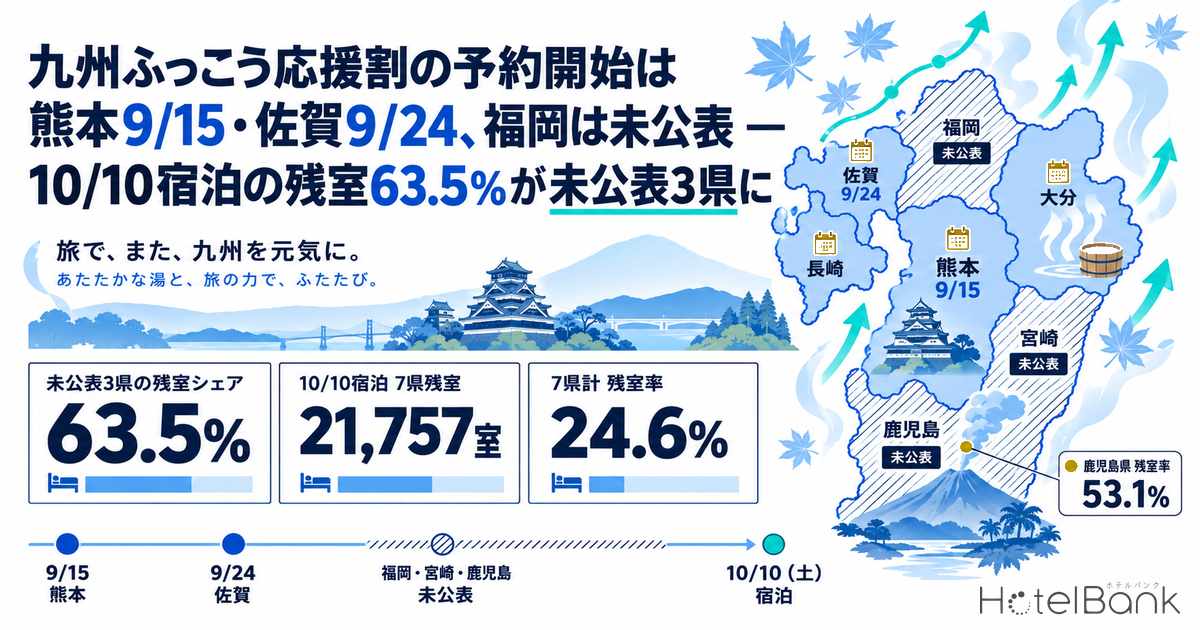
As of September 11, four prefectures have now announced booking start dates for the Kyushu Fukko Ouenwari (Kyushu Recovery Travel Discount, 九州ふっこう応援割), which covers stays from October 1 to December 25. According to the Japan Tourism Agency’s prefecture-by-prefecture information page (updated the same day), Kumamoto opens on September 15, Saga on September 24 for online bookings (October 2 for travel agencies), Nagasaki in the third week of September, and Oita in late September. Fukuoka, Miyazaki and Kagoshima had not announced dates as of that day.
When start dates differ by prefecture, so does the number of days between the sales start and the stay date — in other words, the length of the booking window during which discounted rooms can be sold. This article counts the booking window for each prefecture using the Saturday, October 10 stay date as the anchor, then overlays how much inventory remained at the latest pre-launch observation (September 10) to gauge how far the discount can actually reach. Of the 21,757 unsold rooms across the seven prefectures for the October 10 stay date, 63.5% were in the three prefectures that have yet to announce a start date.
Metric Definitions Used in This Article
- OCC (occupancy, estimated): The share of rooms sold relative to total guest rooms in the area (an estimate based on OTA sales inventory). It reflects how inventory offered on OTAs is being absorbed and differs from a property’s actual overall occupancy. Coverage is limited to properties listing at least 30% of their total rooms on major booking sites, and the same set of properties is tracked for each stay date.
- Unsold room rate: Rooms still available on major booking sites as a share of the covered properties’ total rooms (100% minus estimated occupancy).
- Booking curve: The progression of unsold rooms and estimated occupancy toward the stay date. LT (lead time) = days remaining until the stay date. This article uses only LT45 to LT1, and the September 10 observation (LT30 for the October 10 stay date) is the most recent.
- Booking window: The number of days from each prefecture’s booking start date to the stay date. For prefectures whose start date is given as a range, such as “third week of September” or “late September,” the number of days is also shown as a range.
- Data source: MetroEngines Research (number of properties and rooms covered is shown with each chart and table)
- — Four prefectures have announced booking start dates (as of September 11): Kumamoto September 15, Saga September 24 (travel agencies October 2), Nagasaki the third week of September, and Oita late September. Fukuoka, Miyazaki and Kagoshima have not.
- — The booking window to a Saturday, October 10 stay is 25 days in Kumamoto, versus 16 days in Saga, 20–26 days in Nagasaki and 10–19 days in Oita. Prefectures with shorter windows already have lower unsold room rates before sales begin (Oita 16.5%, Saga 17.8%).
- — Of the 21,757 unsold rooms across the seven prefectures for October 10 (24.6% of 88,612 covered rooms, observed September 10), 63.5% are in the three prefectures without a start date; Kagoshima’s unsold room rate is 53.1%.
- — In Kumamoto, 70.6% of remaining inventory is in business hotels (1,692 rooms). In Saga, ryokan account for 56.5% of unsold rooms — the property-type skew runs the opposite way.
- — Even if the recent pace speeds up 1.5x, Kumamoto’s unsold room rate at launch would still be 14.4%. Oita could fall to 1.1% if sales start at the end of September, so one option is to weight discounted allocations toward late October through December 25.
Four Prefectures Have Set Start Dates — Booking Windows to an October 10 Stay Range from 10 to 26 Days
First, the dates that can be confirmed from primary sources. We cross-checked the Japan Tourism Agency’s “Kyushu Fukko Ouenwari” prefecture information page (updated September 11) against Travel Watch articles reporting the prefectural announcements (Kumamoto and Saga, both September 11). Fields that have not been announced are left blank rather than filled in with guesses.
| Prefecture | Booking start (online) | Booking start (travel agencies) | Days to Oct 1 stay | Days to Oct 10 stay | Participating businesses published | Discount rate |
|---|---|---|---|---|---|---|
| Fukuoka | Not announced (as of 9/11) | Not announced (as of 9/11) | — | — | Not announced (as of 9/11) | 50% |
| Saga | 9/24 (Thu) | 10/2 (Fri) | 7 days Travel agencies miss the Oct 1 stay | 16 days 8 days via travel agencies | 9/18 (Fri) around 5 p.m. To be published on a dedicated website | 50% |
| Nagasaki | Third week of September Starting with some online products | Not announced (as of 9/11) | 11–17 days | 20–26 days | Not announced (as of 9/11) | 50% |
| Kumamoto | 9/15 (Tue) 10 a.m. Three channels: direct booking, travel agencies, OTAs, etc. | (Included at left) | 16 days | 25 days | Not announced (as of 9/11) | 60% |
| Oita | Late September | Not announced (as of 9/11) | 1–10 days | 10–19 days | Not announced (as of 9/11) | 50% |
| Miyazaki | Not announced (as of 9/11) | Not announced (as of 9/11) | — | — | Not announced (as of 9/11) | 50% |
| Kagoshima | Not announced (as of 9/11) | Not announced (as of 9/11) | — | — | Not announced (as of 9/11) | 60% |
Source: Compiled by the HotelBank Editorial Team from the Japan Tourism Agency’s “Kyushu Fukko Ouenwari” prefecture information page (updated September 11, 2026), Travel Watch (September 11, 2026) and NBC Nagasaki Broadcasting (September 11, 2026). Days are calendar days from the booking start date to the stay date. Nagasaki’s “third week of September” is calculated as Monday, September 14 to Sunday, September 20.
Kumamoto has the longest booking window. From its launch at 10 a.m. on Tuesday, September 15, there are 16 days to an October 1 stay and 25 days to an October 10 stay. Kumamoto’s sales channels have been reported as three types: direct booking with accommodation facilities, travel agencies, and OTAs and similar. Saga, on the other hand, split its start dates by channel: Thursday, September 24 for online bookings and Friday, October 2 for travel agencies. Through travel agencies, an October 1 stay falls before sales even begin, and the booking window for an October 10 stay is only 8 days. Participating businesses will be listed on a dedicated website scheduled to go live around 5 p.m. on Friday, September 18.
Oita’s start is given as “late September”: if the date is September 21, there are 19 days to an October 10 stay; if September 30, just 10. For Nagasaki, NBC Nagasaki Broadcasting reported that “bookings will start next week with some online products”; reading this as the week of September 14, the booking window is 20–26 days. According to the same report, the discount applies only to stays on or after October 1 that are booked “on or after the sales start date,” and it will not be applied retroactively to existing reservations.
At a regular press conference on September 2, the Governor of Fukuoka explained that, following the Cabinet decision to use reserve funds, the prefecture was compiling a supplementary budget and would submit it as an additional proposal to the September regular assembly session once finalized. According to the prefectural assembly’s session schedule, the session opened on September 9, with plenary votes scheduled for Thursday, October 1 and Friday, October 16. As of September 11, it had not been indicated when the additional proposal would be voted on. Miyazaki and Kagoshima likewise had not announced start dates as of the same day.
Unsold Rooms for October 10 Stand at 24.6% Across Seven Prefectures — 63.5% of Them in the Three Undated Prefectures
Next, we checked pre-launch inventory using booking curves. Looking at the unsold room rate for a Saturday, October 10 stay as observed on September 10, six prefectures are clustered between 16% and 24% — Oita 16.5%, Saga 17.8%, Fukuoka 19.8%, Kumamoto 20.5%, Nagasaki 22.4% and Miyazaki 23.9% — while Kagoshima alone has substantial remaining inventory at 53.1%. October 10 is the first day of a three-day weekend running through Monday, October 12 (Sports Day).
| Prefecture | Properties / rooms covered (10/10) | 10/3 (Sat) unsold rate LT23 | 10/10 (Sat) unsold rate LT30 | 10/10 unsold rooms | 10/11 (Sun) unsold rate LT31 | 10/10 OCC (est.) LT45→LT30 | Absorption, last 14 days (pt/day) |
|---|---|---|---|---|---|---|---|
| Fukuoka | 428 properties / 29,771 rooms | 18.5% | 19.8% | 5,909 rooms | 30.1% | 70.6%→80.2% | 0.66 |
| Saga | 131 properties / 4,162 rooms | 31.5% | 17.8% | 740 rooms | 25.2% | 76.8%→82.2% | 0.38 |
| Nagasaki | 249 properties / 11,388 rooms | 31.4% | 22.4% | 2,547 rooms | 29.9% | 73.0%→77.6% | 0.30 |
| Kumamoto | 358 properties / 14,007 rooms | 24.6% | 20.5% | 2,875 rooms | 26.6% | 66.6%→79.5% | 0.81 |
| Oita | 450 properties / 10,827 rooms | 28.2% | 16.5% | 1,785 rooms | 26.5% | 76.0%→83.5% | 0.51 |
| Miyazaki | 150 properties / 6,500 rooms | 43.5% | 23.9% | 1,553 rooms | 31.2% | 67.9%→76.1% | 0.53 |
| Kagoshima | 369 properties / 11,957 rooms | 50.0% | 53.1% | 6,348 rooms | 56.2% | 40.3%→46.9% | 0.51 |
| Seven-prefecture total | 2,135 properties / 88,612 rooms | — | 24.6% | 21,757 rooms | — | — | — |
Source: Compiled by the HotelBank Editorial Team from MetroEngines Research. Observed September 10. Coverage is based on major booking site listings (a fixed set of properties listing at least 30% of total rooms; property counts differ slightly by stay date). Absorption over the last 14 days = change in estimated occupancy for the October 10 stay from LT44 (August 27) to LT30 (September 10) ÷ 14.
Across all seven prefectures, 21,757 rooms (24.6% of the 88,612 covered rooms) remain unsold for October 10. Of these, Kagoshima holds 6,348, Fukuoka 5,909 and Miyazaki 1,553 — the three prefectures without a start date account for 13,810 rooms, or 63.5% of the total. The four prefectures that have announced dates (Kumamoto, Saga, Nagasaki and Oita) hold a combined 7,947 unsold rooms, just 36.5%. Running the same calculation for a Saturday, October 3 stay gives 55.9%, and for a Sunday, October 11 stay 61.6% — on every stay date, the majority of unsold rooms sit in the three undated prefectures.
Absorption pace also varies. Over the last 14 days, estimated occupancy rose fastest in Kumamoto at 0.81 pt per day, followed by Fukuoka at 0.66 pt, Miyazaki, Oita and Kagoshima at around 0.5 pt, Saga at 0.38 pt and Nagasaki at 0.30 pt. Kumamoto was the second-lowest of the seven prefectures at LT45 with 66.6%, but climbed to 79.5% by LT30, catching up with the cluster of six. The acceleration in October Saturdays that began right after the program was announced has continued.
Booking Window vs. Unsold Room Rate — The Shorter the Window, the Less Inventory Left Before Launch
For the four prefectures with known start dates, we plotted the booking window to an October 10 stay (horizontal axis) against the unsold room rate as of September 10 (vertical axis). Nagasaki and Oita, whose dates are given as ranges, are drawn as line segments.
Source: Compiled by the HotelBank Editorial Team from MetroEngines Research and the Japan Tourism Agency’s “Kyushu Fukko Ouenwari” prefecture information page. Unsold room rates observed September 10 (October 10 stay, LT30). Coverage: Kumamoto 358 properties / 14,007 rooms, Saga 131 / 4,162, Nagasaki 249 / 11,388, Oita 450 / 10,827 (based on major booking site listings). Fukuoka (428 properties / 29,771 rooms, 19.8%), Miyazaki (150 / 6,500, 23.9%) and Kagoshima (369 / 11,957, 53.1%), which have not announced start dates, cannot be placed on the horizontal axis and are excluded from the chart.
Within these four prefectures, the ordering broadly shows lower unsold room rates where booking windows are shorter. Oita has a 10–19 day window and a 16.5% unsold rate, Saga 16 days and 17.8%, Kumamoto 25 days and 20.5%, and Nagasaki 20–26 days and 22.4%. In other words, prefectures that start later generally face a double squeeze: a shorter period in which discounted rooms can be sold, and thinner inventory remaining during that period.
Moreover, September 10 is still before sales begin in every prefecture. Simply extending the pace of the last 14 days (a reference figure that does not account for changes in demand), Oita’s unsold rate would fall to about 6–11% over the 11–20 days until launch, Saga’s to about 12.5% by September 24 (14 days later), and Kumamoto’s to about 16.4% by September 15 (5 days later). Nagasaki would stay at around 19–21% over the 4–10 days until launch. Note that if guests hold off on booking after the announcement, actual absorption will be slower than this.
The extrapolation of recent pace comes with a range. Comparing a case where absorption before launch slows to 0.5x the last 14 days with one where it speeds up to 1.5x, the unsold room rate at launch would be as follows (both are reference calculations that do not model changes in demand itself).
| Prefecture | Sales start (assumed) | Days from 9/10 | Unsold rate 9/10 (LT30) | Absorption, last 14 days | At launch, 0.5x pace | At launch, 1x pace | At launch, 1.5x pace |
|---|---|---|---|---|---|---|---|
| Kumamoto | 9/15 (Tue) | 5 days | 20.5% | 0.81pt | 18.5% | 16.4% | 14.4% |
| Saga | 9/24 (Thu) *online bookings | 14 days | 17.8% | 0.38pt | 15.2% | 12.5% | 9.9% |
| Nagasaki | 9/14–9/20 (third week of September) | 4–10 days | 22.4% | 0.30pt | 20.9–21.8% | 19.4–21.2% | 17.9–20.6% |
| Oita | 9/21–9/30 (late September) | 11–20 days | 16.5% | 0.51pt | 11.4–13.7% | 6.2–10.8% | 1.1–8.0% |
Source: Compiled by the HotelBank Editorial Team from MetroEngines Research and the Japan Tourism Agency’s “Kyushu Fukko Ouenwari” prefecture information page. Reference calculation that subtracts the LT44→LT30 absorption pace (pt per day) linearly from the September 10 unsold room rate (October 10 stay, LT30) up to the sales start date. Coverage: Kumamoto 358 properties / 14,007 rooms, Saga 131 / 4,162, Nagasaki 249 / 11,388, Oita 450 / 10,827 (based on major booking site listings).
Even if absorption speeds up 1.5x, Kumamoto’s unsold rate would still be 14.4% at launch, so there will still be inventory available to move with the discount when sales open on September 15. Conversely, Oita would fall to 1.1% if its launch slips to September 30 and absorption speeds up 1.5x — meaning that for October 10 stays, there may be almost no inventory left to sell at the discounted rate. Saga falls within a range of 9.9–15.2%.
Overlaying Each Prefecture’s Sales Start Date on the October 10 Booking Curve
The chart below plots estimated occupancy for the October 10 stay from LT45 (August 26) to the latest LT30 (September 10), and marks each prefecture’s sales start date in the unobserved section on the right. Discounted sales begin at LT25 in Kumamoto, LT20–26 in Nagasaki, LT16 in Saga (online bookings) and LT10–19 in Oita.
Source: Compiled by the HotelBank Editorial Team from MetroEngines Research. Saturday, October 10 stay, showing LT45 to LT30 (data beyond LT45 not used). Coverage: Fukuoka 428 properties / 29,771 rooms, Saga 131 / 4,162, Nagasaki 249 / 11,388, Kumamoto 358 / 14,007, Oita 450 / 10,827, Miyazaki 150 / 6,500, Kagoshima 369 / 11,957 (based on major booking site listings; observation coverage of 98.5% or more at every point). The vertical and horizontal lines at the bottom indicate the position of sales start dates, not occupancy values.
Looking at the slope of the curves, over the 16 days from LT45 to LT30 Kumamoto rose +12.9 pt, Fukuoka +9.6 pt and Miyazaki +8.2 pt, while Saga (+5.4 pt) and Nagasaki (+4.6 pt) rose more gradually. Oita was already at 76.0% at LT45, second only to Saga (76.8%), and reached 83.5% by LT30 — the highest of the seven prefectures. With its sales start slipping to LT10–19, Oita will enter the discounted sales period with most of its October 10 inventory already absorbed at regular rates.
Which Property Types Hold the Remaining Inventory in Kumamoto and Saga? — 70% in Business Hotels in Kumamoto
For Kumamoto, which has the earliest start date, and Saga, which split its start dates by channel, we broke down unsold rooms for the October 10 stay by property type. Saga’s city hotels and resorts are excluded from the tally because each has fewer than 10 properties covered.
Source: Compiled by the HotelBank Editorial Team from MetroEngines Research. Saturday, October 10 stay; LT45 = observed August 26, LT30 = observed September 10. Number of properties and rooms covered is shown alongside each category label (based on major booking site listings; observation coverage of 92.3% or more at every point).
| Prefecture / type | Properties / rooms covered | OCC (est.) LT45 | OCC (est.) LT30 | Unsold rate LT30 | Unsold rooms LT30 | Share of unsold rooms across types in the prefecture |
|---|---|---|---|---|---|---|
| Kumamoto – business | 59 properties / 7,426 rooms | 64.2% | 77.2% | 22.8% | 1,692 rooms | 70.6% |
| Kumamoto – city | 13 properties / 1,525 rooms | 77.3% | 91.6% | 8.4% | 128 rooms | 5.3% |
| Kumamoto – ryokan | 164 properties / 3,002 rooms | 75.0% | 87.3% | 12.7% | 382 rooms | 15.9% |
| Kumamoto – resort | 18 properties / 1,021 rooms | 65.4% | 80.9% | 19.1% | 195 rooms | 8.1% |
| Saga – business | 20 properties / 1,832 rooms | 81.9% | 85.1% | 14.9% | 273 rooms | 43.5% |
| Saga – ryokan | 74 properties / 1,668 rooms | 69.4% | 78.7% | 21.3% | 355 rooms | 56.5% |
Source: Compiled by the HotelBank Editorial Team from MetroEngines Research. “Share of unsold rooms across types in the prefecture” is the share of the total unsold rooms for the property types in the table (Kumamoto 2,397 rooms, Saga 628 rooms).
In Kumamoto, city hotels are 91.6% full and ryokan 87.3%, while business hotels are at 77.2%, leaving a 22.8% unsold rate (1,692 rooms). Business hotels hold 70.6% of the 2,397 unsold rooms across the four property types, so weekend business-hotel inventory will be the core of what can be moved with the discount once sales open on September 15. Ryokan, with 3,002 rooms across 164 properties, have few rooms per property, and their remaining 382 rooms are thinly spread across many properties.
Saga shows the opposite pattern. Business hotels are 85.1% full, and ryokan hold more unsold rooms, at 355 (21.3% unsold rate). Ryokan account for 56.5% of the 628 unsold rooms across property types. In Saga, where online bookings open on September 24 and travel-agency sales on October 2, weekend ryokan inventory is likely to be the main recipient of discounted demand.
Options for Operators — How to Build Start-Date Differences into Inventory Allocation
Based on the data so far, we outline the sales approaches available in each prefecture. None of these is a one-size-fits-all answer; they are directions to choose from depending on each property’s booking mix.
Prefectures with short booking windows (Oita, Saga): Early-October weekends are already being absorbed at regular rates before discounted sales begin. One approach is to keep selling steadily at current rates before launch and weight discounted allocations more heavily toward stay dates from late October through December 25. Spreading allocations across several periods, with the December 25 cutoff and the budget cap in mind, widens room for adjustment. Booking progress for November and December stays is also worth tracking as a reference.
Prefecture with an early start date (Kumamoto): There is a 16-day booking window from September 15 to an October 1 stay, and 70% of the remaining inventory is in business hotels. Having breakfast-included and multi-night plans aimed at weekend leisure guests ready by the start date makes it easier to move weekend inventory as soon as the 60% discount goes live.
Prefectures without a start date (Fukuoka, Miyazaki, Kagoshima): These three prefectures hold 63.5% of the unsold rooms for October 10, and Kagoshima in particular, with a 53.1% unsold rate, has substantial capacity to absorb demand once the discount starts. Rather than preparing after a start date is set, locking in eligible plan setups and inventory allocation by sales channel in advance allows sales to begin the moment the announcement is made.
Operators with properties in multiple prefectures: Even for the same October 10 stay, Kumamoto properties will sell at the discounted rate from LT25, while Oita properties will do so from LT10–19. Rather than running a single sales calendar from headquarters, staggering rate changes to match each prefecture’s start date and unsold room rate reduces the risk of leaving inventory unsold at each property. Also, since the discount does not apply to bookings made before launch, operators should anticipate that some guests may cancel and rebook around the start date, and check cancellation policies and how released inventory flows back in advance.
For hotels: plan-naming tips for this theme
The most common selling points in published plan names in Kumamoto that include “応援割” (ouenwari, support discount) (N=54) ——
Breakfast included 24%Room only 22%Dinner & breakfast 22%Travel subsidy 19%Onsen / open-air bath 15%Members only 15%
Examples of actual names (anonymized):
- [For Kyushu residents] [Dinner & breakfast] Kumamoto Prefecture Support Discount Plan [Dinner: Japanese cuisine / Breakfast: buffet] (【九州在住のお客様対象】【2食付】熊本県応援割プラン【夕:和食 朝:バイキング】)
- [Recovery support ★ ¥3,000 bonus] One night with dinner & breakfast, onsen & seafood kaiseki ◇ Standard (【復興応援★3千円分特典】1泊2食付 温泉&海鮮会席◇スタンダード)
*These are trends based on a tally of published plan names and do not indicate that naming causes sales.
Summary
As of September 11, four prefectures have announced booking start dates for the Kyushu Fukko Ouenwari — Kumamoto on September 15, Saga on September 24 (October 2 for travel agencies), Nagasaki in the third week of September and Oita in late September — while Fukuoka, Miyazaki and Kagoshima have not. Booking windows to a Saturday, October 10 stay range from 25 days in Kumamoto to 10–19 days in Oita, and prefectures that start later have lower unsold room rates before sales begin (Oita 16.5%, Saga 17.8%).
At the same time, 63.5% of the 21,757 unsold rooms for October 10 across the seven prefectures are in the three undated prefectures, with Kagoshima in particular still 53.1% unsold. Because the reach of the discount is determined by both “the length of the booking window” and “the inventory remaining at that point,” the play for operators is to read each prefecture differently: for early-October weekends, focus on Kumamoto with its early start and the inventory-rich undated prefectures; from late October onward, revisit allocations across all prefectures. Once the three remaining prefectures announce their dates, booking windows and unsold inventory should be re-measured using the same framework.
⚠ Note on forward-dated data: Estimated occupancy and unsold room rates in this article are interim figures based on inventory listed on major booking sites as of September 10 and will change as stay dates approach. Each prefecture’s booking start date and the publication date for participating businesses are scheduled and may change. Please check the Japan Tourism Agency and each prefecture’s official website for the latest information. Extrapolations of recent pace are reference calculations that do not account for changes in demand.
Related Articles
References and Sources
■ Data sources
Booking curves from MetroEngines Research’s daily observation of public inventory on major booking sites (seven Kyushu prefectures at the prefecture level; October 3, 10 and 11 stays; LT45 to LT30; latest observation September 10). Coverage is a fixed set of properties listing at least 30% of total rooms on major booking sites; for the October 10 stay, 2,135 properties and 88,612 rooms across the seven prefectures. Booking start dates and publication dates for participating businesses are based on the Japan Tourism Agency’s prefecture information page (updated September 11) and announcements by prefectures and news outlets.
■ Calculation assumptions
Booking window = calendar days from booking start date to stay date (Nagasaki’s “third week of September” calculated as September 14–20 and Oita’s “late September” as September 21–30, both shown as ranges). Recent absorption pace = change in estimated occupancy for the October 10 stay from LT44 to LT30 ÷ 14 days. The unsold room rate at launch is a reference calculation subtracting this pace linearly from the September 10 unsold room rate up to the start date, with sensitivity cases at 0.5x, 1x and 1.5x the pace.
■ Limitations
Estimated occupancy and unsold room rates are estimates based on inventory listed on major booking sites and differ from properties’ actual overall occupancy. The extrapolation of recent pace does not account for changes in demand, such as guests holding off on booking after the discount announcement or a rush right after sales open. Saga’s city hotels and resorts are excluded from the property-type breakdown because each has fewer than 10 properties covered. Each prefecture’s booking start date is scheduled and may change.
- Japan Tourism Agency, “Kyushu Fukko Ouenwari” prefecture information page (updated September 11, 2026) (Japanese)
- Travel Watch, “Kumamoto Prefecture to Open Kyushu Fukko Ouenwari Bookings at 10 a.m. on September 15” (September 11, 2026) (Japanese)
- Travel Watch, “Saga Prefecture Announces Kyushu Fukko Ouenwari Booking Start Dates” (September 11, 2026) (Japanese)
- NBC Nagasaki Broadcasting, “Inquiries Flood In as Up-to-Half-Price ‘Kyushu Fukko Ouenwari’ Starts in October… Trips Already Booked Are ‘Not Eligible'” (September 11, 2026) (Japanese)
- Fukuoka Prefecture, “Governor’s Regular Press Conference, Wednesday, September 2, 2026” (Japanese)
- Fukuoka Prefectural Assembly, “18th Regular Session, September 2026: Session Schedule” (Japanese)
- MetroEngines Research — Booking curves for seven Kyushu prefectures (October 3, 10 and 11 stays, LT45 to LT30, observed September 10); estimated occupancy by property type