

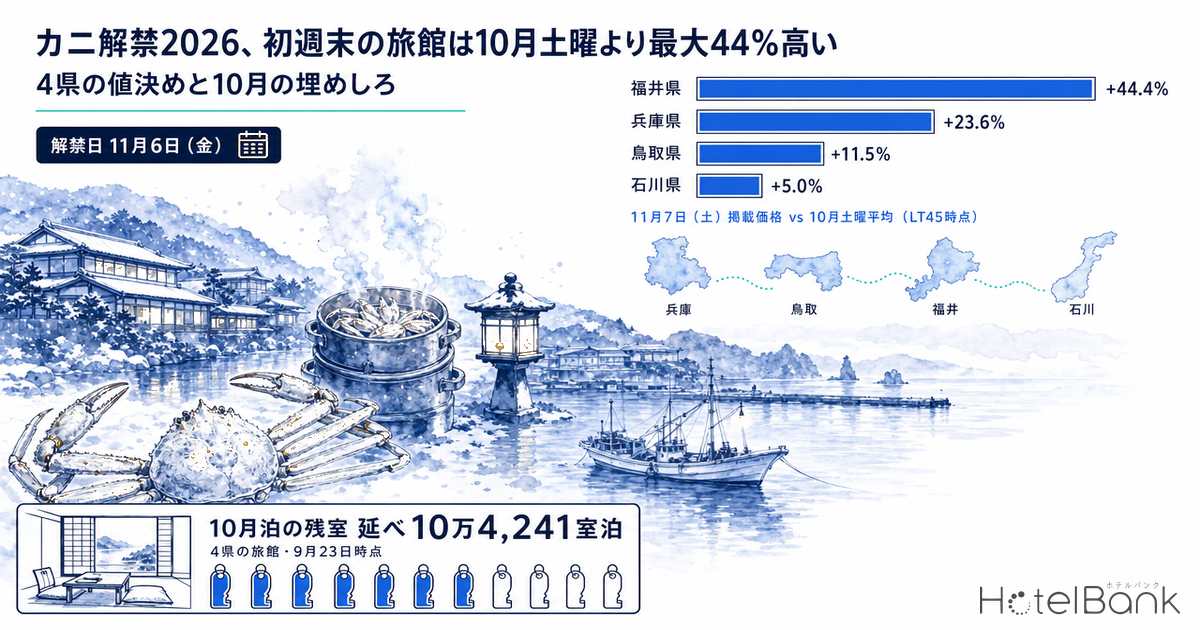
The 2026 snow crab (zuwai-gani) season on Japan’s Sea of Japan coast opens on Friday, November 6. Matsuba crab from Hyogo and Tottori, Echizen crab from Fukui and Kano crab from Ishikawa all start landing at once, and Saturday, November 7 — the day after the opening — becomes the first weekend of the season. Comparing MetroEngines Research inventory and price data at the same point in time, 45 days before check-in (LT45), the listed price of ryokan (traditional Japanese inns) for November 7 is 44.4% higher than the October Saturday average in Fukui and 23.6% higher in Hyogo. Yet the remaining-inventory rate at that same point was almost unchanged from October Saturdays. The opening weekend is a date that “fills just as fast even when sold at a higher price.”
This article sets November and December rates for four prefectures — Hyogo, Tottori, Fukui and Ishikawa — against the same months a year earlier, then examines how the October-to-November rate step differs by prefecture and by onsen town. We also count the inventory still unsold in October, before the opening, as “fill-up headroom,” and consider where winter pricing should be built from.
Metric Definitions Used in This Article
- ADR (Average Daily Rate, estimated settled ADR): An estimated settled room rate (tax-exclusive equivalent) calculated by applying property-type adjustment factors to the lowest-plan level each property publishes on OTAs (per-room rate for 2 guests, tax-inclusive). Checked against property-level results disclosed by listed hotel REITs (91 properties, most recent 3 months), the median error is about 7%. These are estimates and differ from each property’s actual settled prices or accounting figures. Area-level ADR is the median of the properties covered (the level of a typical property in the area).
- Listed price: The average price of plans on sale on OTAs and similar channels (room-only through meal-inclusive plans; per-room rate for 2 guests, tax-inclusive). It measures the pricing level itself and uses a different basis from the estimated settled ADR. This article always states which of the two is being used.
- OCC (occupancy rate): The share of rooms sold relative to total rooms in the area (an estimate based on OTA sales inventory).
- Remaining-inventory rate: The share of rooms on sale on OTAs and similar channels that remain unsold at the time of observation (an estimate based on OTA-listed inventory). 100% minus this rate corresponds to estimated OCC. It differs from a property’s actual overall vacancy rate.
- Booking curve / LT (lead time): The movement of OTA remaining inventory toward the check-in date. LT is the number of days until check-in; LT45 means 45 days before check-in. The inventory data in this article uses only observations within LT45.
- Data sources: MetroEngines Research (prices and inventory), HotelBank Editorial Team research (guest reviews), published materials from prefectures, fisheries cooperatives and others (fishing seasons)
- — At LT45, ryokan listed prices for Saturday, November 7 — the first weekend of the season — are +44.4% in Fukui and +23.6% in Hyogo, +11.5% in Tottori and +5.0% in Ishikawa versus the October Saturday average. The gap in remaining-inventory rate was within 6pt in all four prefectures.
- — The ryokan October-to-November step has exceeded +25% in Hyogo and Fukui for three straight years. The median across all 47 prefectures in 2026 is +3.5%; the two prefectures rank 2nd and 3rd (1st is Kyoto Prefecture, home to the crab inns of the Tango region).
- — December ryokan listed prices are up +10–20% year over year in all four prefectures, a larger rise than November. The close of the female-crab season (December 29 in Ishikawa, December 31 in Fukui) marks the cut-off.
- — In Echizen Town, the November 7 listed price is 2.73x that of October Saturdays, yet the remaining-inventory rate is 23.3%, lower than on October Saturdays (34.7%). Rooms are filling earlier at higher rates.
- — As of September 23, ryokan in the four prefectures still had 104,241 room-nights unsold for October stays, about 60% of them Monday–Thursday nights. Pre-season weekdays are the largest fill-up headroom in winter pricing.
The 2026 Season Opens Friday, November 6 — the Female-Crab Close Sets December’s Deadline
On the Sea of Japan, male snow crab may be fished from November 6 through March 20 of the following year, while females have shorter seasons set by each prefecture or fisheries cooperative. Ishikawa’s kobako-gani (female) runs from November 6 to December 29, and Fukui’s seiko-gani (female) from November 6 to December 31. In other words, plans that feature female crab at dinner hit a deadline at year-end.
The 2026 calendar has one more feature: opening day, November 6, falls on a Friday, making the 7th the first Saturday. For inns that can serve the first day’s catch at the next day’s dinner, the entire first weekend after the opening can be packaged as a product. Friday stays on opening day itself, however, are not filling as well as Saturdays, as shown below. The pattern of “the starting gun fires Friday, but Saturday is what sells” shows up directly in 2026 prices and inventory.
Rate curves from October to January for each port town, and a prefecture-by-prefecture list of female-crab seasons, are covered in Crab Season Opens Nov 6: Echizen Room Rates Jump 3.2x in One Month. This article goes a step further, comparing the opening weekend with October Saturdays and weekdays at the same lead time to inform pricing decisions.
November and December Rates in Four Prefectures — Year-over-Year Growth Is Larger in December
First, at the prefecture level, we set November and December listed prices against the same months a year earlier. Across all property types, November is up +12.6% in Hyogo and +15.6% in Ishikawa, while Tottori (+0.9%) and Fukui (-2.2%) are roughly flat. Narrowing to ryokan, November falls within a range of -2.0% to +12.0% in all four prefectures, but December shows double-digit growth across the board: Hyogo +19.8%, Fukui +12.1%, Tottori +10.7% and Ishikawa +10.4%.
On this article’s baseline ADR (estimated settled ADR), November 2026 ryokan stand at ¥24,500 in Hyogo, ¥18,600 in Ishikawa, ¥16,400 in Tottori and ¥14,700 in Fukui. The gap with listed prices is large — about 2.5x in Hyogo. The ryokan sales structure, in which half-board plans with crab are displayed at high price points while bookings concentrate in the lowest-plan band, shows up directly in the numbers.
| Prefecture / type | Nov listed price 2025 (final) |
Nov listed price 2026 (as surveyed) |
YoY | Dec listed price 2025 (final) |
Dec listed price 2026 (as surveyed) |
YoY | ADR (est. settled) Nov / Dec 2026 |
|---|---|---|---|---|---|---|---|
| Hyogo – all types (N=1,151) | ¥36,678 | ¥41,296 | +12.6% | ¥37,792 | ¥45,590 | +20.6% | ¥15,365 / ¥15,854 |
| Hyogo – ryokan (N=277) | ¥54,706 | ¥61,285 | +12.0% | ¥56,606 | ¥67,838 | +19.8% | ¥24,476 / ¥26,965 |
| Tottori – all types (N=211) | ¥23,507 | ¥23,722 | +0.9% | ¥22,928 | ¥23,161 | +1.0% | ¥11,462 / ¥10,321 |
| Tottori – ryokan (N=70) | ¥42,114 | ¥41,289 | -2.0% | ¥43,334 | ¥47,951 | +10.7% | ¥16,389 / ¥15,812 |
| Fukui – all types (N=342) | ¥30,985 | ¥30,290 | -2.2% | ¥32,345 | ¥33,789 | +4.5% | ¥12,917 / ¥13,822 |
| Fukui – ryokan (N=139) | ¥42,126 | ¥41,546 | -1.4% | ¥44,383 | ¥49,760 | +12.1% | ¥14,715 / ¥17,532 |
| Ishikawa – all types (N=472) | ¥26,743 | ¥30,921 | +15.6% | ¥24,709 | ¥28,058 | +13.6% | ¥15,456 / ¥13,246 |
| Ishikawa – ryokan (N=116) | ¥51,983 | ¥55,339 | +6.5% | ¥51,565 | ¥56,948 | +10.4% | ¥18,640 / ¥18,952 |
Source: Compiled by HotelBank Editorial Team from MetroEngines Research. N = number of properties covered for November 2026 listed prices. Properties covered for ADR (est. settled) in November 2026: Hyogo 523 (ryokan 266), Tottori 134 (ryokan 67), Fukui 194 (ryokan 129), Ishikawa 233 (ryokan 109). 2026 values are based on listings as of the survey (September 2026)
The table can be read in two ways. First, year-over-year growth is larger in December than in November. December is the last month before the female-crab season closes, and its weekends lead into the New Year holidays; pricing already appears to be set with that in mind. Second, in some prefectures growth differs between all property types and ryokan. Ishikawa is up +15.6% in November across all types but only +6.5% for ryokan, so much of the prefecture’s growth comes from non-ryokan properties. When examining crab-season pricing, it is necessary to drill down from the prefecture to ryokan, and further to the level of individual onsen towns.
Note, however, that November and December 2026 have not yet arrived, and these values are based on prices currently listed on OTAs. Last year’s final values were observed over the full month, so strictly speaking the two are not compared under identical conditions. For this reason, the analysis centers on comparisons made under matching conditions: the “October-to-November step” and “day-by-day comparisons at the same LT.”
The October-to-November Step Follows a Fixed “Pattern” in Each Prefecture
We lined up the October-to-November rise in ryokan listed prices over three years: 2024 and 2025 (both final values) and 2026 (listings as of the survey). Because October and November of the same year are observed on the same basis, the size of the step can be compared across years.
Source: Compiled by HotelBank Editorial Team from MetroEngines Research (ryokan; October-to-November change in listed price. 2024 and 2025 = final values; 2026 = based on listings as of the survey. 70–300 properties per prefecture)
Hyogo posted +31.9% (2024), +25.9% (2025) and +30.2% (2026), and Fukui +30.3%, +32.1% and +26.4% — above +25% in all three years. Tottori moved +10.9%, +19.2% and +10.4%, and Ishikawa +5.7%, +8.7% and +6.6%. The line-up of large-step Hyogo and Fukui versus small-step Tottori and Ishikawa held in all three years, showing that the size of the step is not a year-to-year accident but is largely determined by the composition of each prefecture’s accommodation products.
Hyogo and Fukui likely show large steps because half-board ryokan built around crab are concentrated in Tajima (Toyooka, Kami, Shin’onsen) and along the Echizen coast and Awara. Ishikawa’s ryokan are weighted toward large onsen inns such as those in Kaga Onsen and Wakura Onsen, whose rates are already high from October on autumn-foliage and group demand, so the November rise appears small. A small rise is also the flip side of thicker autumn demand. Each prefecture’s pattern for which month autumn rates peak is classified for all 47 prefectures in Japan Autumn ADR 2026: 20 Prefectures Peak in Nov, Kyoto +81.8%.
The order is the same on this article’s baseline ADR (estimated settled ADR). The 2026 ryokan October-to-November change was +36.1% in Hyogo, +21.6% in Fukui, +20.4% in Tottori and +9.6% in Ishikawa (all estimates as of the survey).
The October-to-November jump for each port town, and the movement of rates up to the December–January peak, are covered in detail in Crab Season Opens Nov 6: Echizen Room Rates Jump 3.2x in One Month. Here we change perspective and check where the four prefectures’ steps sit nationally.
Ranking all 47 prefectures on the same basis (ryokan listed price, October to November), the 2026 median step is only +3.5% (2024: +2.2%; 2025: +1.0%). Within that, Hyogo (+30.2%) ranks 2nd, Fukui (+26.4%) 3rd and Tottori (+10.4%) 5th. Only three prefectures — Kyoto, Hyogo and Fukui — exceeded +25% in all three years. Ishikawa (+6.6%) ranks 11th, remaining above the national middle in terms of step size.
| 2026 rank | Prefecture | 2024 (final) | 2025 (final) | 2026 (as surveyed) | Properties (Nov 2026) |
|---|---|---|---|---|---|
| 1 | Kyoto | +42.1% | +36.7% | +36.8% | 200 |
| 2 | Hyogo | +31.9% | +25.9% | +30.2% | 277 |
| 3 | Fukui | +30.3% | +32.1% | +26.4% | 139 |
| 4 | Ehime | +2.9% | +3.6% | +10.5% | 80 |
| 5 | Tottori | +10.9% | +19.2% | +10.4% | 70 |
| 6 | Tokushima | -0.2% | -2.4% | +9.2% | 46 |
| 11 | Ishikawa | +5.7% | +8.7% | +6.6% | 116 |
| — | Median of 47 prefectures | +2.2% | +1.0% | +3.5% | 19–492 properties |
Source: Compiled by HotelBank Editorial Team from MetroEngines Research (ryokan; October-to-November change in median listed price. 2024 and 2025 = final values; 2026 = based on listings as of the survey. Bold = the four prefectures covered in this article)
Broken down by municipality, first-ranked Kyoto Prefecture (+36.8%) is lifted by the Tango region: Kyotango City (61 ryokan) is up +102.6% and Miyazu City (20 ryokan) +43.2%. Kyotango is home to the landing port for Taiza crab, and its season opens on the same November 6. Within Kyoto City, even in a month that overlaps with autumn-foliage demand, the Higashiyama, Nakagyo and Shimogyo wards — each with 20 or more ryokan — are up only +14–24%. When reading the four prefectures’ figures, Tango should be kept in view as part of the same crab market. Ehime (+10.5%) and Tokushima (+9.2%), by contrast, show a large step only in 2026; in both 2024 and 2025 they were below +4%, so no consistent yearly pattern has formed.
At the Same LT45, the Opening Weekend Sells as Fast as October Saturdays — at Higher Rates
Monthly averages alone cannot answer the question “aren’t these rooms unsold because they are expensive?” So for each check-in date from October 1 to November 7, we extracted ryokan listed prices and remaining-inventory rates as of 45 days before check-in (LT45). Because the observation point is aligned at 45 days out, differences in pricing and in sales pace by date can be compared on the same yardstick.
Source: Compiled by HotelBank Editorial Team from MetroEngines Research (ryokan; listed price at LT45 for each check-in date. Coverage: Hyogo 186 properties / 3,846 rooms, Tottori 55 / 1,501, Fukui 83 / 1,981, Ishikawa 90 / 3,612 (based on major booking-site listings, as of the November 7 stay))
All four lines peak on Saturdays, and in Hyogo and Fukui November 7 is higher than any October Saturday (in Ishikawa, October 10, and in Tottori, October 17, are slightly higher). Fukui stands out: while its October Saturdays stay in the ¥30,000 range except for the 10th (the middle day of a three-day weekend), November 7 rises to about ¥50,000. In Hyogo, November 7 is ¥59,400, above the ¥53,800 of the October three-day-weekend middle day (October 10).
| Prefecture (ryokan) | Oct Saturday avg. listed price / remaining |
Sat, Oct 10 mid three-day weekend |
Oct Mon–Thu avg. listed price / remaining |
Fri, Nov 6 opening day |
Sat, Nov 7 first weekend |
Nov 7 vs. Oct Saturday price |
|---|---|---|---|---|---|---|
| Hyogo | ¥48,001 / 25.6% | ¥53,789 / 20.5% | ¥33,451 / 36.1% | ¥40,899 / 32.3% | ¥59,352 / 20.2% | +23.6% |
| Tottori | ¥38,526 / 23.0% | ¥42,661 / 12.3% | ¥24,203 / 36.8% | ¥29,298 / 37.7% | ¥42,962 / 25.0% | +11.5% |
| Fukui | ¥34,584 / 35.0% | ¥42,639 / 30.2% | ¥24,822 / 48.5% | ¥29,597 / 45.9% | ¥49,950 / 36.1% | +44.4% |
| Ishikawa | ¥49,675 / 29.4% | ¥56,650 / 21.5% | ¥34,008 / 41.0% | ¥42,303 / 33.9% | ¥52,141 / 30.5% | +5.0% |
Source: Compiled by HotelBank Editorial Team from MetroEngines Research (ryokan; all listed prices and remaining-inventory rates at LT45. October Saturday average = Oct 3, 17, 24 and 31; Monday–Thursday average = the 17 Monday–Thursday nights in October. Property and room counts are the same as in the chart above (based on major booking-site listings))
The combination of the two right-hand columns is what matters here. The remaining-inventory rate for November 7 was 20.2% in Hyogo (October Saturday average 25.6%), 25.0% in Tottori (23.0%), 36.1% in Fukui (35.0%) and 30.5% in Ishikawa (29.4%) — within 6pt of October Saturdays in every case. Hyogo is actually filling faster than on October Saturdays. Even with prices displayed up to just over 40% higher, sales pace at 45 days out has not slowed. The opening weekend is one of the few dates when a price increase does not dampen sales.
Opening day itself, Friday, November 6, is the contrast. In all four prefectures, listed prices are roughly ¥10,000–20,000 below Saturday, and remaining-inventory rates are higher than on Saturday. Friday stays on opening day appear to be driven less by tourists chasing the first catch than by multi-night stays continuing into Saturday and by pre-trip stays from nearby areas. Rather than putting Friday in the same price band as Saturday, there is room to grow with Friday-only offers promoting “opening night” and with Friday–Saturday two-night plans that pull Saturday demand forward.
Note that November 7 is still 44 days from check-in. What we see here is an interim snapshot of bookings, and final sales will change with movements from here on.
The Step by Onsen Town — 2.7x in Echizen, While Misasa Fills in October First
Next, we break the data down into seven municipalities that are home to the main crab onsen destinations: in Hyogo, Toyooka City (Kinosaki Onsen), Kami Town (Kasumi) and Shin’onsen Town (Yumura Onsen); in Tottori, Misasa Town (Misasa Onsen); in Fukui, Awara City (Awara Onsen) and Echizen Town (Echizen coast); and in Ishikawa, Kaga City (Kaga Onsen). First, on a monthly basis, we set out the October-to-November step and November year-over-year change.
| Municipality (main onsen) | Listed price Oct→Nov 2025 (final) |
Listed price Oct→Nov 2026 (as surveyed) |
ADR (est. settled) 2026 Oct→Nov |
ADR properties Oct / Nov |
Nov listed price YoY |
|---|---|---|---|---|---|
| Toyooka City (Kinosaki Onsen) | +26.9% | +34.5% | ¥18,234 → ¥27,755 (+52.2%) | 98 / 91 | +15.6% |
| Kami Town (Kasumi) | +32.4% | +35.0% | ¥22,702 → ¥32,760 (+44.3%) | 51 / 48 | +7.6% |
| Shin’onsen Town (Yumura Onsen) | +48.0% | +87.9% | ¥14,879 → ¥22,199 (+49.2%) | 23 / 21 | +30.0% |
| Misasa Town (Misasa Onsen) | +26.2% | +15.3% | ¥16,910 → ¥21,459 (+26.9%) | 19 / 18 | -1.7% |
| Awara City (Awara Onsen) | +16.3% | +14.7% | ¥16,323 → ¥21,408 (+31.2%) | 22 / 22 | +0.6% |
| Echizen Town (Echizen coast) | +169.7% | +151.4% | ¥13,131 → ¥40,634 (+209.5%) | 21 / 16 | -3.9% |
| Kaga City (Kaga Onsen) | +7.1% | +11.4% | ¥17,503 → ¥20,488 (+17.1%) | 47 / 47 | +8.5% |
Source: Compiled by HotelBank Editorial Team from MetroEngines Research (all property types. ADR (est. settled) is the median of covered properties; note that for towns with fewer than 20 covered properties, values can swing as individual properties enter or leave the sample)
Echizen Town’s step is in a different league: +169.7% in 2025 and +151.4% in 2026 on listed price, and on estimated settled ADR, a roughly 3.1x jump from ¥13,100 to ¥40,600. Most inns in Echizen are cuisine-focused ryokan and minshuku (family-run guesthouses) built around crab, so the fishing season itself divides the price bands. The three Tajima municipalities — Toyooka, Kami and Shin’onsen — also show large rises of +44–52% on estimated settled ADR, and in 2026 Shin’onsen’s listed price widened its step to +87.9% from the previous year.
By contrast, the 2026 steps in Misasa, Awara and Kaga are only +11–15% on listed price and +17–31% on estimated settled ADR. These are not crab-specialist port towns but onsen destinations whose hot springs draw demand year-round, so rates are already high in October. Misasa in particular has a low remaining-inventory rate on October Saturdays — a destination where autumn demand fills rooms first.
The same tendency appears in daily data. The chart below compares each municipality’s October Saturday average with its listed price for Saturday, November 7, at LT45.
Source: Compiled by HotelBank Editorial Team from MetroEngines Research (all property types; listed price at LT45. October Saturday average = Oct 3, 17 and 31 for Echizen Town only; Oct 3, 17, 24 and 31 for all others)
| Municipality | Properties / rooms | Oct Saturday avg. listed price / remaining |
Sat, Nov 7 listed price / remaining |
Price multiple | Unsold Oct room-nights (as of Sep 23, cumulative) |
|---|---|---|---|---|---|
| Toyooka City | 79 / 1,541 | ¥39,295 / 31.3% | ¥57,459 / 27.3% | 1.46x | 13,635 room-nights (28.5%) |
| Kami Town | 53 / 462 | ¥37,160 / 43.7% | ¥52,275 / 28.1% | 1.41x | 6,191 room-nights (43.8%) |
| Shin’onsen Town | 17 / 454 | ¥32,019 / 30.3% | ¥50,780 / 32.4% | 1.59x | 3,698 room-nights (26.2%) |
| Misasa Town | 16 / 536 | ¥44,405 / 17.9% | ¥51,257 / 32.5% | 1.15x | 3,428 room-nights (20.6%) |
| Awara City | 21 / 1,137 | ¥55,072 / 34.9% | ¥76,452 / 41.2% | 1.39x | 14,859 room-nights (42.2%) |
| Echizen Town | 14 / 120 | ¥28,600 / 34.7% | ¥78,038 / 23.3% | 2.73x | 1,426 room-nights (39.2%) |
| Kaga City | 45 / 2,613 | ¥43,440 / 33.6% | ¥52,092 / 34.2% | 1.20x | 26,834 room-nights (33.1%) |
Source: Compiled by HotelBank Editorial Team from MetroEngines Research (all property types, based on major booking-site listings. Properties and rooms as of the November 7 stay tally. Listed prices and remaining-inventory rates at LT45. Unsold October room-nights observed on September 23; figures in parentheses are the share of total October room-nights on sale)
In Echizen Town, the November 7 listed price is ¥78,000 — 2.73x October Saturdays — yet the remaining-inventory rate is 23.3%, lower than October Saturdays (34.7%). If anything, rooms are filling earlier at the higher rate. Kami Town in Tajima likewise sells faster at a 1.41x rate: 28.1% remaining on November 7 versus 43.7% on October Saturdays.
Misasa Town has a different shape. Its October Saturday remaining-inventory rate of 17.9% is the lowest of the seven, making it a destination where autumn weekends fill first. November 7, at a 1.15x rate, has 32.5% remaining — more slack than October. Misasa thus has two opportunities side by side: pricing headroom against strong October weekend demand, and room to fill November weekends with crab-led offers.
Awara City’s November 7 listed price of ¥76,500 is the second highest of the seven after Echizen, with 41.2% remaining. With many large onsen ryokan, more rooms are still open at 45 days out. It is a destination suited to a design that lays out high-rate products separately from products priced to fill the remaining rooms.
October “Fill-Up Headroom”: 100,000 Ryokan Room-Nights Across Four Prefectures, 60% on Weekdays
While the opening weekend fills at high rates, inventory is still left in October, just before it. Summing unsold ryokan rooms for each October night across the four prefectures as of September 23 gives a cumulative 104,241 room-nights. The breakdown: Hyogo 31,378 room-nights (26.4% of total October room-nights on sale), Ishikawa 36,717 (32.9%), Fukui 24,158 (39.2%) and Tottori 11,988 (25.6%).
Source: Compiled by HotelBank Editorial Team from MetroEngines Research (ryokan; cumulative unsold rooms for stays October 1–31, 2026, observed September 23. Coverage: Hyogo 184 properties / 3,843 rooms, Tottori 56 / 1,510, Fukui 86 / 1,998, Ishikawa 90 / 3,612 (based on major booking-site listings, as of the October 1 stay). Monday–Thursday nights include the night of October 12 (Sports Day))
Monday–Thursday nights account for 61.0% of unsold rooms in Hyogo, 61.8% in Ishikawa, 60.9% in Fukui and 66.2% in Tottori — 64,488 room-nights (61.9%) across the four prefectures. October Monday–Thursday nights are listed at LT45 at ¥33,500 in Hyogo, ¥34,000 in Ishikawa, ¥24,800 in Fukui and ¥24,200 in Tottori, roughly 50–69% of the November 7 level.
October stays are 8–38 days from check-in, and more bookings will come in. These 100,000 room-nights will therefore not all go unsold. But set against the picture of November weekends filling steadily at high rates, it becomes clear that the largest growth opportunity in winter pricing lies not in crab weekends but in pre-season weekdays.
The material for filling this headroom is not limited to crab itself. October brings the first autumn foliage, new-crop rice and autumn seafood, so designs that pull the buzz of the opening forward are possible — “eve-of-season” products for guests awaiting the male-crab opening, or October weekday multi-night plans combined with early booking of crab plans from November onward. When pricing such half-board plans, it is also worth checking how much autumn seafood purchase costs have risen against the premium the plan can command.
Inns Where Guests Talk About Crab — Top Properties by Review Mention Rate in Four Prefectures
What underpins the rate step is how the crab cuisine itself is received. The HotelBank Editorial Team ran a semantic analysis of guest reviews and tallied, by prefecture, the share of reviews that mention the crab dinner favorably (mention rate). For each prefecture, the table lists the five properties with the highest mention rate among the ten with the most mentions.
| Prefecture | Property | Reviews | Crab-dinner mentions | Mention rate |
|---|---|---|---|---|
| Hyogo | Kojin no Yado Sanpo (荒神の宿 三宝) | 227 | 123 | 54.2% |
| Yunagi no Oka (夕凪の丘) | 189 | 93 | 49.2% | |
| Minatokan (三七十館) | 198 | 84 | 42.4% | |
| Ryokufukaku (緑風閣) | 492 | 144 | 29.3% | |
| Yumura Onsen Uotoya (湯村温泉 魚と屋) | 349 | 83 | 23.8% | |
| Tottori | Hamamura Onsen Uotoya (浜村温泉 魚と屋) | 269 | 64 | 23.8% |
| Kaike Grand Hotel Tensui (皆生グランドホテル 天水) | 1,039 | 182 | 17.5% | |
| Misasa Royal Hotel (三朝温泉 三朝ロイヤルホテル) | 509 | 82 | 16.1% | |
| Misasakan (三朝館) | 800 | 104 | 13.0% | |
| Misasa Yakushi no Yu Mansuiro (三朝薬師の湯 万翆楼) | 618 | 66 | 10.7% | |
| Fukui | Ryori Ryokan Heisei (料理旅館 平成) | 275 | 126 | 45.8% |
| Mikuni Ocean Resort & Hotel (三国オーシャンリゾート&ホテル) | 462 | 110 | 23.8% | |
| Awara Onsen Kofu Yuho Beniya (あわら温泉 光風湯圃 べにや) | 290 | 67 | 23.1% | |
| Kamenoi Hotel Fukui (亀の井ホテル 福井) | 387 | 85 | 22.0% | |
| Umi no Hotel Hirose (海のホテルひろせ) | 744 | 128 | 17.2% | |
| Ishikawa | Ooedo Onsen Monogatari Premium Yamashitaya (大江戸温泉物語Premium 山下家) | 816 | 149 | 18.3% |
| Yamashiro Onsen Yuzankaku (加賀温泉郷 山代温泉 雄山閣) | 307 | 52 | 16.9% | |
| Ryotei Kaiseki Notoya (旅亭懐石 のとや) | 596 | 58 | 9.7% | |
| Hoshino Resorts KAI Kaga (星野リゾート 界 加賀) | 388 | 35 | 9.0% | |
| Yoshidaya Sannokaku (吉田屋 山王閣) | 524 | 41 | 7.8% |
Source: HotelBank Editorial Team research (semantic analysis of reviews). Share of guest reviews over the most recent 24 months (September 2024 – September 2026) that mention the crab dinner favorably. Covers properties with 20+ reviews and 10+ mentions. The mention rate measures frequency of mention, not a rating score
In Hyogo, three inns have mention rates above 40%. With around half of reviews referring to the crab cuisine, these inns are clearly attracting guests whose very reason for the stay is crab. Comments such as “the crab dishes are outstanding” and “for anyone who wants to eat their fill of delicious crab” stand out. At Ryori Ryokan Heisei in Fukui (45.8%), one guest wrote “I ate tagged crab for the first time,” showing that brand crab carrying a port-of-origin tag is talked about as part of the experience.
In Tottori and Ishikawa, large onsen ryokan with many reviews make the top ranks, and mention rates are spread from around 10% into the 20% range. In Ishikawa, crab is often praised as one course of a kaiseki meal, as in “the live-crab kaiseki was delicious.” Inns where crab is the star and inns where crab is one of an onsen ryokan’s winter highlights will promote the same opening differently. For the former, it is grounds for setting opening-weekend rates even higher; for the latter, working crab in step by step from October to December becomes a way to fill weekdays at the turn of the season.
Implications for Winter Pricing — Push Weekends Up, Pull Weekdays Forward
From the data so far, we summarize three steps for building winter crab-season pricing.
First, the opening weekend holds its sales pace even when priced higher. For November 7, ryokan listed prices at LT45 were 5–44% above October Saturdays, yet the gap in remaining-inventory rate was within 6pt. Some destinations, such as Echizen and Kami, are even filling earlier at higher rates. Separate dates where inventory lingers until the last minute from dates that fill from 45 days out; for the latter, there is room to raise prices in stages.
Second, December is the month where the “female-crab deadline” is easiest to reflect in price. December ryokan listed prices are up +10–20% year over year in all four prefectures, a larger rise than November. Ishikawa’s kobako-gani season closes on December 29 and Fukui’s seiko-gani on December 31. A deadline such as “this year’s kobako-gani is available only until December 29” can be used to pull November–December bookings forward.
Third, the largest fill-up headroom lies in pre-season weekdays. As of September 23, ryokan in the four prefectures had more than 100,000 unsold room-nights for October stays, about 60% of them Monday–Thursday nights. Opening day itself, Friday, November 6, also has more rooms remaining than Saturday. Weekday offers that pull crab buzz forward, and Friday–Saturday two-night designs that spread weekend demand, are opportunities to lift winter RevPAR.
For Inns: Plan-Naming Hints for This Theme
Most common selling points in published ryokan × crab plan names (N=344) —
Crab 93%Kaiseki course 42%Seafood 28%Wagyu / brand beef 17%Half-board 14%
Real examples (anonymized):
- [New: drinks-inclusive] Free-flow drinks in the lounge and at dinner! A luxury stay with a gourmet buffet of crab and beef steak
- [Crab plan / one whole crab per person] Enjoy today’s local sashimi platter and Okubungo pork mokuren hot pot <breakfast & dinner in-room / free private bath>
*These are tendencies based on a tally of published plan names and do not show that naming causes sales.
Frequently Asked Questions
Q. When does the 2026 crab season open?
A. Fishing for male snow crab on the Sea of Japan coast opens on Friday, November 6, 2026, and continues until March 20 of the following year. For females, Ishikawa’s kobako-gani runs until December 29 and Fukui’s seiko-gani until December 31.
Q. How much higher are room rates on the first weekend after the opening?
A. Compared at 45 days before check-in, ryokan listed prices for Saturday, November 7 were +44.4% in Fukui, +23.6% in Hyogo, +11.5% in Tottori and +5.0% in Ishikawa above the October Saturday average (as surveyed in September 2026).
Q. When is it relatively easy to book an inn during crab season?
A. According to the data, Friday stays on opening day and Monday–Thursday stays have higher remaining-inventory rates at the same point in time, and lower listed prices. Many rooms were also still available on October weekdays before the opening.
Q. Are there areas outside the four prefectures with large price rises from October to November?
A. Comparing ryokan listed prices across all 47 prefectures, Kyoto Prefecture had the largest rise in 2026 at +36.8%, led by Kyotango City — home to Taiza crab — at +102.6% (based on listings as of the September 2026 survey).
Q. How much availability is there on October weekdays?
A. As of September 23, 2026, ryokan in Hyogo, Tottori, Fukui and Ishikawa had a cumulative 104,241 unsold room-nights for October stays, about 60% of which (64,488 room-nights) were Monday–Thursday nights. This is an interim figure that will fall as bookings come in before check-in.
⚠ Note on ADR and listed prices for future dates: Listed prices, ADR (est. settled) and remaining-inventory rates for October 2026 onward are estimates based on prices and inventory published on OTAs and similar channels as of the survey (including observations on September 23, 2026), and will change as check-in dates approach. Please note that prices currently set high may be revised close to the date, and additional inventory may be listed. Prior-year values are final figures observed over the full month and were observed under different conditions from the values as of the survey.
Methodology and Sources
Prices are published rates for accommodation properties compiled by MetroEngines Research (per-room rate for 2 guests). Monthly values for prefectures and municipalities use the median of covered properties. Daily comparisons take the observation 45 days before check-in for each check-in date, and inventory data uses only observations within 45 days. Inventory and remaining-inventory rates are estimates based on inventory listed on major booking sites and differ from each property’s actual number of vacant rooms. Review tallies are by the HotelBank Editorial Team. Fishing seasons are based on published materials from prefectures, fisheries cooperatives and others. MetroEngines Research tracks approximately 168,000 properties, of which about 27,000 with activity confirmed on OTAs and similar channels are covered by the analysis.
Source: Compiled by HotelBank Editorial Team from MetroEngines Research
Related Articles
- Crab Season Opens Nov 6: Echizen Room Rates Jump 3.2x in One Month
- Hyogo’s Hotel Market in 5 Layers 2026: ADR from ¥10,700 to ¥29,600
- Tottori’s 3-Tier Hotel Market: Onsen ADR 2.16x the City Average
- Japan Autumn ADR 2026: 20 Prefectures Peak in Nov, Kyoto +81.8%
References and Sources
■ Data sources
MetroEngines Research published price and inventory data for accommodation properties (monthly listed prices and estimated settled ADR for prefectures and municipalities: October 2024 – December 2026; listed prices and remaining-inventory rates at LT45 for each check-in date: stays October 1 – November 7, 2026; unsold October room-nights: observed September 23, 2026). The 47-prefecture comparison uses monthly ryokan listed prices (19–492 properties per prefecture for November 2026). Reviews: semantic analysis of the most recent 24 months by the HotelBank Editorial Team. Fishing seasons: published materials from prefectures, fisheries cooperatives and tourism organizations.
■ Calculation assumptions
The October-to-November step is the rate of change calculated as each year’s November listed price (median of covered properties) divided by the October value, minus 1. The October Saturday average is the simple average of October 3, 17, 24 and 31 (three days for Echizen Town only); the Monday–Thursday average is the simple average of the 17 Monday–Thursday nights in October. “Fill-up headroom” is the cumulative room-nights obtained by summing unsold rooms for each night from October 1 to 31; the denominator of the share is total October room-nights on sale.
■ Limitations
Values for October 2026 onward are interim readings based on listings and inventory as of the survey, observed under different conditions from the prior year’s final values observed over the full month. Remaining-inventory rates and fill-up headroom are estimates based on OTA-listed inventory and do not match each property’s actual vacancies. Estimated settled ADR is derived using adjustment factors; year-over-year change is shown on listed prices (because estimated settled ADR for Hyogo ryokan in November 2025 could not be tallied). Values for municipalities with fewer than 20 covered properties can swing as individual properties enter or leave the sample.
- JF Ishikawa Wajima Branch, “Kano Crab Season Opens November 6” (in Japanese)
- Echizen Kanko Navi, “Echizen Crab Fishing Opens November 6, Through March 20 of the Following Year” (in Japanese)
- Fukui.com (Fukui Prefecture Tourism Association), “Echizen Crab Fishing Opens Again This Year on November 6” (in Japanese)
- Kyotango City Tourism Corporation, “Taiza Crab: Kyotango’s Premium Brand Crab” (in Japanese)
- Kyotango City, “Snow Crab Fishing Opens November 6!” (in Japanese)
- Fukui City, “Echizen Crab Fishing Opens November 6” (in Japanese)
- Japan Tourism Agency, “Overnight Travel Statistics Survey” (in Japanese)
- MetroEngines Research — published price and inventory data for accommodation properties (monthly values for prefectures and municipalities; daily prices and remaining-inventory rates at LT45)
- HotelBank Editorial Team research — semantic analysis of guest reviews (most recent 24 months)