

When lodging demand around autumn festivals comes up, the first number anyone reaches for is attendance. “This festival draws hundreds of thousands, so the hotels fill up” is an intuitive line of reasoning, and plenty of tourism-promotion material is written in exactly that order. Line up the October 2026 inventory data, however, and the size of the crowd and the size of the lodging demand do not point in the same direction. A different variable is doing the work — whether the festival is somewhere you can visit and get home the same day.
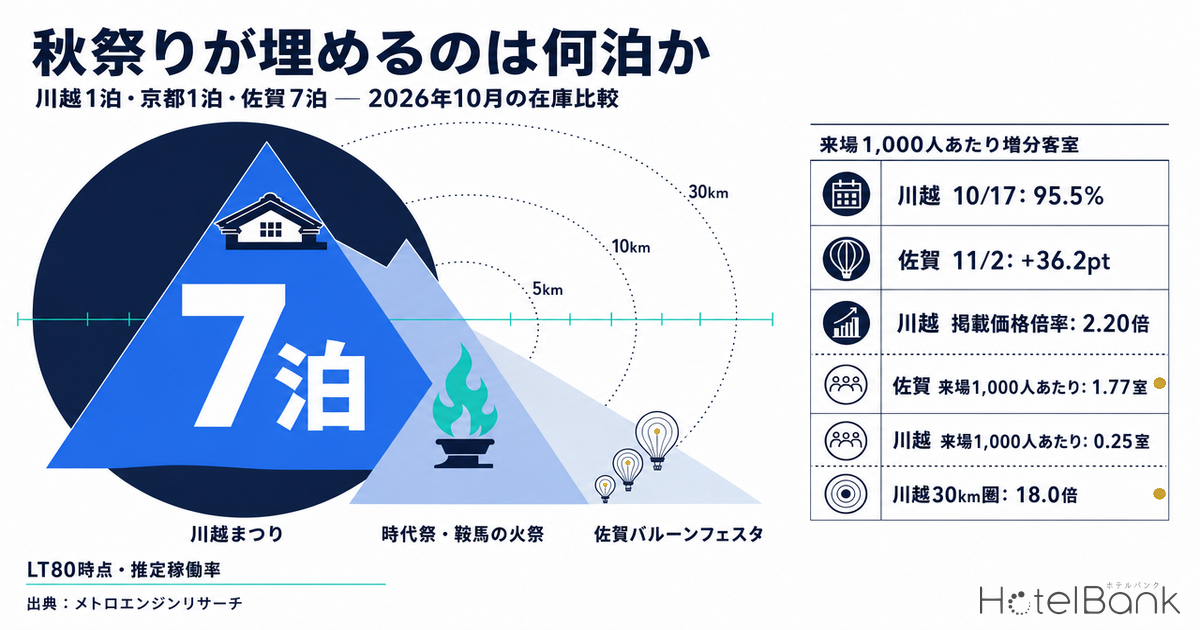
This article takes three festivals held at roughly the same time but different in character, and compares how the room inventory in each host municipality is drawn down using a single yardstick. They are the Kawagoe Festival (October 17–18, Kawagoe City, Saitama), the Jidai Matsuri and Kurama Fire Festival (October 22, Kyoto City), and the Saga International Balloon Fiesta (October 30 – November 3, Saga City). To put the conclusion first: the number of nights a festival lifts room demand differs sharply — one night in Kawagoe, one in Kyoto and seven in Saga — and measured as incremental rooms per 1,000 visitors, Saga reached roughly 7 times Kawagoe’s figure.
Metric Definitions Used in This Article
- Occupancy (estimated, based on OTA-listed inventory): the share of sold rooms against total rooms in the area, estimated from inventory offered for sale on OTAs. Formula: (total rooms − rooms remaining) ÷ total rooms. It is an estimate based on how listed inventory is being drawn down, and differs from a property’s actual overall occupancy. In this article it is used only at the prefecture and municipality level; occupancy for individual properties is not calculated.
- LT (lead time): days until the check-in date. LT0 = same day. Comparisons in this article are aligned, as a rule, to observations at LT80 (80 days before check-in), because LT80 is the common lead time at which observations exist for every date covered.
- Same-weekday median (baseline): the median estimated occupancy at LT80 across days falling on the same weekday within the 41 days from October 1 to November 10, 2026, excluding festival periods. The gap between a festival date and this baseline is what we call the “lift” (in percentage points, pt).
- Advertised price: the average price publicly listed on OTAs (double occupancy, per room, tax included, averaged across all plans). It is not a transacted price.
- ADR (average daily rate): an estimated transacted rate (tax-exclusive equivalent), derived by applying a category-specific adjustment factor to the lowest plan level each property publishes on OTAs (double occupancy, per room, tax included). Cross-checks against per-property results disclosed by listed hotel REITs put the median error at roughly 7%. It is an estimate and differs from each property’s actual transacted prices and accounting figures. Area-level ADR is the median across the covered properties.
- Data source: MetroEngines Research
- — Kawagoe fills for one Saturday night only — estimated occupancy on Saturday October 17 is 95.5% (+12.9pt vs the same-weekday median), but the lift narrows to +3.7pt on Sunday the 18th.
- — It does not spread to neighbouring areas — Omiya, Kawaguchi and Tokorozawa all came in below baseline, and Ikebukuro (Toshima Ward) moved just +0.7pt. Within day-trip range, demand does not disperse; only the thin inventory of the host city tightens.
- — In Kyoto the lodging clusters move more than the venue district — the lift is +8.0pt in Higashiyama Ward and +7.1pt in Nakagyo Ward, both above Sakyo Ward (+4.4pt), which hosts the venues. Across the four wards the increment is roughly 1,949 rooms.
- — Saga holds a seven-night plateau — every night from October 29 to November 4 sits above the same-weekday median, and the four nights attributable to the fiesta alone add roughly 1,417 rooms. Advertised prices reach up to 2.04x.
- — Distance, not crowd size, is what works — incremental rooms per 1,000 visitors run 0.25 in Kawagoe against 1.77 in Saga, a gap of about 7.1 times.
The three festivals and how much room capacity sits around each venue
First, the dates, as confirmed against official sources. The Kawagoe Festival’s official site announces it “is scheduled for Saturday October 17 and Sunday October 18, 2026.” The Jidai Matsuri is held every year on October 22, which in 2026 falls on a Thursday. The Kurama Fire Festival takes place on the night of the same October 22, and Kyoto City’s official tourism site lists it as “Thursday October 22, 2026, 18:00 to past midnight.” The Saga International Balloon Fiesta’s official event outline states that “balloon competition runs for five days, Friday October 30 to Tuesday November 3, 2026 (a public holiday), with the full schedule including official practice and the awards ceremony running Wednesday October 28 to Wednesday November 4, 2026,” with 124 balloons and teams participating.
Next, how many rooms sit within reach of each venue. Using the lodging property master, we counted properties and rooms within 5km, 10km and 30km of each venue’s coordinates.
| Venue | Within 5km | Within 10km | Within 30km | 30km ÷ 10km |
|---|---|---|---|---|
| Kawagoe (around the Kurazukuri warehouse district) | 41 properties / 1,455 rooms | 72 properties / 2,518 rooms | 1,058 properties / 45,429 rooms | 18.0x |
| Kyoto Gyoen (Jidai Matsuri procession start) | 3,643 properties / 71,285 rooms | 4,143 properties / 77,141 rooms | 4,580 properties / 88,146 rooms | 1.1x |
| Kasegawa riverbed (Saga balloon venue) | 36 properties / 1,781 rooms | 69 properties / 2,567 rooms | 414 properties / 12,256 rooms | 4.8x |
Source: compiled by MetroEngines Research and the HotelBank Editorial Team (tallied from registered coordinates in the lodging property master)
Here lies the coincidence this article starts from. Kawagoe and Saga hold almost exactly the same number of rooms within 10km (2,518 and 2,567 — a difference of under 2%). The absolute capacity is the same size, and yet, as we will see, the inventory behaves in completely different ways. What creates the difference sits outside the 10km ring: Kawagoe’s 30km ring is 18.0 times its 10km ring — which is to say, the enormous room stock of north-western Tokyo, and behind it something larger still: people’s own homes. Saga’s 30km ring is only 4.8 times its 10km ring.
Source: compiled by MetroEngines Research and the HotelBank Editorial Team
How the comparison is built — why LT80 and a same-weekday median
Comparing festival dates with ordinary dates has two pitfalls. The first is the day of the week: putting a Saturday next to a Thursday tells you nothing. The second is lead time — October 17 and November 3 are different distances from the observation date, so lining up figures observed on the same calendar day produces a chart that merely says “dates closer to now are fuller.”
So this article aligns everything to LT80 (80 days before check-in), the common point at which observations exist for every date covered, and places the same-weekday median — excluding festival periods — as the baseline. Each baseline is built from N=4–5 days. Note that October 10–12 is a three-day weekend, and those high values are included in the baseline. In other words the baseline runs somewhat high, which means the calculated lifts err on the conservative side.
We also ran a property-level screen. Limiting the sample to properties offering at least 30% of their total rooms on OTAs, 5 of the 14 properties with observable inventory qualified in Kawagoe City, 15 of 48 in Saga City, and 29 of 92 in Kyoto’s Nakagyo Ward. Kawagoe City’s low qualifying count could stem from several causes — channel strategies centred on direct booking through official sites and by phone, inventory control that releases rooms to OTAs in small tranches as check-in approaches, or simply small contracted OTA allocations — and public data cannot narrow it to one. Given the small qualifying count in Kawagoe City we avoid property-level assertions there, and keep the analysis in this article at the municipality level.
One more premise matters. Every date covered here is 55 to 73 days ahead of the observation date (August 23, 2026), and bookings are still in progress. The figures below are a snapshot of progress so far, not where the season will land.
Kawagoe Festival — one Saturday night fills, and advertised prices run 2.2x
In Kawagoe City, inventory is observable on OTAs at 14 properties totalling 838 rooms. Plot estimated occupancy at LT80 day by day from October 1 to November 10 and only Saturday October 17 stands out.
Source: compiled by MetroEngines Research and the HotelBank Editorial Team (Kawagoe City N=14 properties / 838 rooms; Saga City N=48 properties / 2,100 rooms; at LT80)
Estimated occupancy on Saturday October 17 is 95.5%, with just 38 of the 838 rooms left. The median for Saturdays outside the festival period is 82.6%, so the lift is +12.9pt. The average advertised price that day is about ¥40,700, against roughly ¥18,500 for a normal Saturday — 2.20x.
The next day, Sunday the 18th, estimated occupancy is 80.9% (stay date October 18, 2026, observed at LT80; 160 rooms remaining), and against a Sunday median of 77.2% the lift narrows to +3.7pt. The advertised price also retreats from the previous day, to about ¥22,100 (1.56x). By Monday the 19th the figure sits below baseline. Friday the 16th, the eve of the festival, is +1.8pt — effectively indistinguishable from a normal Friday.
This shape maps neatly onto the festival programme. The Kawagoe Festival’s official site reported attendance for the 2023 edition at 561,000 in total, split 342,000 on Saturday and 219,000 on Sunday. The crowd itself is weighted toward Saturday — and the lodging inventory tightens on that one Saturday night alone. People who come on Sunday go home the same day.
Source: compiled by MetroEngines Research and the HotelBank Editorial Team (Kawagoe City N=14 properties / 838 rooms; observations within LT90)
Look at the remaining-rooms trajectory and October 17 was already down to 39 rooms at LT90 (observed July 19), then moved in a 24–46 room range through LT56 (observed August 22). In other words, this single night has been running on thin inventory for nearly three months. The comparison dates — Saturday October 24, starting at 176 rooms at LT90, and Saturday October 3, starting at 218 — trace the gentle drawdown of an ordinary date.
It does not spread — Omiya, Kawaguchi and Tokorozawa actually fall
“For a festival within day-trip range, lodging demand spills thinly into the surrounding areas” sounds plausible enough: if you cannot get a room near the venue, stay a station or two away. The inventory data did not support it.
| Area | Rooms (observed properties) | Oct 17 (Sat) est. occupancy | Saturday median | Lift |
|---|---|---|---|---|
| Kawagoe City (venue) | 838 rooms (14 properties) | 95.5% | 82.6% | +12.9pt |
| Saitama City, Omiya Ward | 2,750 rooms (13 properties) | 75.4% | 81.1% | −5.7pt |
| Kawaguchi City | 648 rooms (9 properties) | 48.9% | 57.6% | −8.7pt |
| Tokorozawa City | 389 rooms (4 properties) | 78.4% | 83.5% | −5.1pt |
| Toshima Ward (Ikebukuro) | 10,067 rooms (63 properties) | 66.6% | 65.9% | +0.7pt |
| Shinjuku Ward | 20,258 rooms (119 properties) | 82.6% | 77.4% | +5.2pt(*) |
(*) Shinjuku Ward’s figure is driven by demand factors specific to central Tokyo and cannot be attributed to the Kawagoe Festival.
Source: compiled by MetroEngines Research and the HotelBank Editorial Team (at LT80)
All three municipalities adjacent to Kawagoe came in below baseline. Toshima Ward, home to Ikebukuro, moved +0.7pt — effectively flat. Ikebukuro is roughly 30 minutes from Kawagoe by Tobu Tojo Line express, and the festival does not move its room inventory by even a single point. Shinjuku Ward’s +5.2pt is the largest number in the table, but an area of 20,258 rooms has any number of reasons to move on a weekend, and reading it as festival spillover would be a stretch.
What happens with a festival inside day-trip range, then, is not “thin diffusion into the surroundings” but a split: the host city’s limited inventory tightens for one night, and everyone else goes home. The 45,429 rooms sitting within 30km of Kawagoe function not as capacity absorbing lodging demand but as proof of a distance you can travel home from. For how far demand really does ripple into surrounding areas when the event is remote, Nagaoka Fireworks 2026: City Sold Out by March, Demand Ripples Out shows the contrasting case.
Jidai Matsuri and Kurama Fire Festival — the lodging clusters move, not the venue district
Kyoto is a different case, because the venues themselves sit inside one of Japan’s largest concentrations of hotel rooms. Here is estimated occupancy at LT80 for Thursday October 22 across the city’s four main wards.
| Area | Rooms (observed properties) | Oct 22 (Thu) | Thursday median | Lift | Advertised price multiple |
|---|---|---|---|---|---|
| Higashiyama Ward | 3,354 rooms (132 properties) | 74.5% | 66.5% | +8.0pt | 1.02x |
| Nakagyo Ward | 11,552 rooms (158 properties) | 85.1% | 78.0% | +7.1pt | 1.15x |
| Sakyo Ward (Heian Jingu / Kurama) | 1,228 rooms (35 properties) | 81.2% | 76.8% | +4.4pt | 1.09x |
| Shimogyo Ward | 19,686 rooms (283 properties) | 81.2% | 77.1% | +4.1pt | 1.09x |
Source: compiled by MetroEngines Research and the HotelBank Editorial Team (at LT80; observed properties are those with observable inventory in the area)
The ranking is the interesting part. Heian Jingu, where the Jidai Matsuri procession ends, and Kurama, where the fire festival takes place, are both in Sakyo Ward. Yet the largest lifts are in Higashiyama Ward (+8.0pt) and Nakagyo Ward (+7.1pt), while Sakyo Ward, which hosts the venues, stops at +4.4pt.
This captures something about the nature of Kyoto’s lodging demand. Sakyo Ward has 35 properties and 1,228 rooms observable on OTAs — a small slice of the city’s inventory. People staying in Kyoto for a festival do not book next to the venue; they choose Shijo-Karasuma, the area around Kyoto Station, Gion — the places that already function as bases for sightseeing. The festival does not change where demand goes; it nudges up occupancy at the existing lodging clusters. Demand peaking outside the venue’s own catchment is not unique to Kyoto: SHINE UP FES 2026: Tottori’s Demand Peak Sat 100km From the Venue shows the same structure.
The lift itself is the smallest of the three festivals. But because the base is an order of magnitude larger, the increment converted into rooms comes to roughly 1,949 rooms across the four wards (820 in Nakagyo, 807 in Shimogyo, 268 in Higashiyama and 54 in Sakyo) — the largest single-night figure of the three. The price response is mild too, at 1.02x in Higashiyama and 1.09x in Shimogyo, in contrast to Kawagoe’s 2.20x. Deep inventory absorbs an increase in demand through volume rather than price.
Saga Balloon Fiesta — a seven-night plateau, and seepage into the 30km ring
Saga City’s shape differs from both Kawagoe and Kyoto. From Thursday October 29 through Wednesday November 4, all seven nights sit above the same-weekday median. Not a spike — a plateau.
| Stay date | Est. occupancy | Rooms left | Same-weekday median | Lift | Advertised price multiple |
|---|---|---|---|---|---|
| Oct 29 (Thu) official practice | 81.5% | 384 rooms | 64.7% | +16.8pt | 1.35x |
| Oct 30 (Fri) competition day 1 | 83.2% | 349 rooms | 63.8% | +19.4pt | 1.51x |
| Oct 31 (Sat) | 85.3% | 306 rooms | 70.3% | +15.0pt | 1.50x |
| Nov 1 (Sun) | 84.0% | 333 rooms | 67.7% | +16.3pt | 1.96x |
| Nov 2 (Mon)(*) | 94.3% | 118 rooms | 58.1% | +36.2pt | 1.99x |
| Nov 3 (Tue, holiday) final day(*) | 76.2% | 496 rooms | 59.2% | +17.0pt | 1.56x |
| Nov 4 (Wed) awards ceremony(*) | 90.9% | 188 rooms | 59.9% | +31.0pt | 2.04x |
(*) November 2–4 overlaps with the Karatsu Kunchi festival (Karatsu City, November 2–4, 2026). The effects of the two events cannot be separated.
Source: compiled by MetroEngines Research and the HotelBank Editorial Team (Saga City N=48 properties / 2,100 rooms, at LT80)
Saga City’s observed base is 48 properties and 2,100 rooms — only 2.5 times Kawagoe’s. Even so the lift holds at +15 to +19pt night after night, and the advertised price climbs to about ¥38,200 on the Sunday (1.96x a normal Sunday). What stands out is that Sunday, normally the softest night of the week, shows the strongest upside.
November 2–4 does call for caution, however. The Karatsu Kunchi festival runs in Karatsu City over the same dates (Karatsu City’s official announcement gives November 2–4), so Saga City’s +36.2pt on November 2 is a figure in which both effects overlap. Attributable to the balloon fiesta alone are the four nights from October 29 to November 1, where the increment comes to roughly 1,417 rooms.
The seepage into surrounding areas is observable as well. Over those same four nights, Tosu City added 167 rooms, Ureshino City 107 and Takeo City 74 — all moving in the positive direction. Ureshino and Takeo in particular are hot-spring towns, and their advertised prices on November 1 rose to 1.30x in Takeo and 1.34x in Ureshino. A 30km ring is too far for a day trip and just right as an alternative place to stay. For how capacity stacks up in concentric rings around the venue, Saga Balloon Fiesta 2026: 2,567 Rooms Within 10km, 12,157 Within 30km breaks it down by distance band. Karatsu City, by contrast, tracks negative from October 29 to November 1 and jumps only from November 2 on the back of its own festival. Fukuoka City’s Hakata Ward runs at or slightly below normal throughout.
Source: compiled by MetroEngines Research and the HotelBank Editorial Team (at LT80; Kawagoe group = Oct 17, Kyoto group = Oct 22, Saga group = average of Oct 29 – Nov 1)
Crowd size does not explain it — incremental rooms per 1,000 visitors
Now reorder the three festivals by how many rooms they generated relative to attendance. Kawagoe Festival attendance is the 2023 figure published on its official site, 561,000 in total; the Saga Balloon Fiesta’s official site states that “attendance during the event exceeds 800,000.” For the Jidai Matsuri and Kurama Fire Festival, viewing is mostly along the roadside and no published attendance figure could be found, so this metric is not calculated for them.
| Festival | Nights the lift persists | Incremental rooms in host city (est.) | Attendance | Per 1,000 visitors |
|---|---|---|---|---|
| Kawagoe Festival (Kawagoe City) | 1 night (effectively) | 139 rooms (2 nights combined) | 561,000(2023) | 0.25 rooms |
| Jidai Matsuri / Kurama Fire Festival (4 Kyoto wards) | 1 night | 1,949 rooms (4 wards combined) | not published | — |
| Saga Balloon Fiesta (Saga City) | 7 nights | 1,417 rooms (4 nights, Oct 29 – Nov 1) | approx. 800,000(event official) | 1.77 rooms |
Incremental rooms = (estimated occupancy on the festival date − same-weekday median) × rooms in the area. This is an estimate based on properties with observable inventory on OTAs, and excludes properties not listed on OTAs as well as stays with family and friends.
Source: compiled by MetroEngines Research and the HotelBank Editorial Team
Incremental rooms per 1,000 visitors come to 0.25 in Kawagoe against 1.77 in Saga — a gap of about 7.1 times. If anything the crowd is about 1.4 times larger in Saga, which cannot explain the difference. What is doing the work is distance.
Source: compiled by MetroEngines Research and the HotelBank Editorial Team (at LT80; Saga City is the average of the four nights Oct 29 – Nov 1)
The price response is worth setting out alongside it. Kawagoe City on October 17 runs at 2.20x, Saga City on November 4 at 2.04x and November 2 at 1.99x — the thinner the inventory, the wider the price swing. Kyoto, meanwhile, tops out at 1.15x in Nakagyo Ward. Read together, the depth of inventory decides whether incremental demand is passed through into price or absorbed as volume.
What this means for operators
Here is how the observations above translate into hotel operations.
When the festival in your market is within day-trip range — in the Kawagoe pattern, the revenue opportunity concentrates not on “the festival days” but on the festival’s main night. The gap between Saturday October 17 and Sunday the 18th (+12.9pt versus +3.7pt) shows that most visitors on the main day travel home the same day. Heavy on that night, thin the next. Designing separately for capturing Saturday as a single-night stay and for returning to normal operations from Sunday onward lets you take demand in the shape it actually arrives. That the advertised price has opened to 2.2x a normal Saturday also means the market has already priced in the scarcity of that one night. Combine it with a staged release that avoids holding too much inventory until the last minute, and there is further room to capture rate.
When the festival sits inside a lodging cluster — in the Kyoto pattern, being close to the venue is not necessarily an advantage. The larger lifts are in Higashiyama and Nakagyo wards, not in Sakyo Ward, which hosts the venues. The festival rides on existing tourist circulation. So the pitch to make is not “close to the venue” but ease of movement for someone who has a reason to be in Kyoto that day. Headroom on advertised price is limited (1.02–1.15x), but the value lies in lifting a weekday Thursday’s occupancy by several hundred rooms.
When the festival in your market is remote — the Saga pattern offers the biggest revenue opportunity. Demand runs for seven nights, and the strongest upside falls on Sunday and Monday, normally the softest nights. There is real scope to go after multi-night stays, and the demand visibly seeps into hot-spring towns within the 30km ring (Ureshino and Takeo), centred on November 1. For properties a little way from the venue, there is a clear position to hold as “the place that takes the overflow once the venue’s catchment is full.” One caveat this year: the dates overlap with Karatsu Kunchi, so from November 2 onward several streams of demand stand up at once.
Conclusion — distance beats attendance
The premise that “the bigger the crowd, the more lodging demand a festival generates” did not hold, at least for these three. The Kawagoe Festival, drawing 561,000 people, produced an increment of 139 rooms in its host city (two nights combined); the Saga Balloon Fiesta, on the order of 800,000 visitors, produced 1,417 rooms over four nights. Converted to a per-1,000-visitor basis, the gap is roughly sevenfold.
The hypothesis that “for a festival within day-trip range, lodging demand spreads thinly into the surroundings” was not supported either. Omiya, Kawaguchi and Tokorozawa, all adjacent to Kawagoe, came in below baseline, and Ikebukuro did not move beyond ±1pt. For a festival you can day-trip to, demand does not scatter into the surrounding areas: the host city’s thin inventory tightens for one night and everyone else goes home.
The hypothesis that “for a remote festival, demand concentrates in the venue’s catchment” broadly held for Saga. It is not complete concentration, though — there is clear seepage into hot-spring towns in the 30km ring. The boundary between concentration and dispersion is drawn by whether the venue is close enough to visit and return home the same day.
All figures in this article are a snapshot of progress based on LT80 observations as of the survey date (August 23, 2026), and where each festival’s lodging demand finally lands depends on booking activity over the next two months.
⚠ A note on data for future dates: every stay date covered in this article falls 55 to 73 days after the survey date (August 23, 2026), and bookings are still in progress. Occupancy, rooms remaining and advertised prices are all estimates based on the inventory and prices published on OTAs as of the survey date, and will shift as check-in approaches. Thin inventory now does not mean a sell-out in the end, and dates with room to spare now may fill later. At this stage properties may also still be partway through a strategy of releasing inventory to OTAs in small tranches, so we avoid definitive readings.
Methodology and sources
The supply-and-demand data in this article is based on observations of publicly listed OTA inventory collected on an ongoing basis by MetroEngines Research. At the municipality level, total rooms and rooms remaining within each area were tallied for each covered date, and estimated occupancy was calculated from them. The observed bases are: Kawagoe City 14 properties / 838 rooms; Saitama City Omiya Ward 13 properties / 2,750 rooms; Kawaguchi City 9 properties / 648 rooms; Tokorozawa City 4 properties / 389 rooms; Toshima Ward 63 properties / 10,067 rooms; Shinjuku Ward 119 properties / 20,258 rooms; Kyoto City Sakyo Ward 35 properties / 1,228 rooms; Nakagyo Ward 158 properties / 11,552 rooms; Shimogyo Ward 283 properties / 19,686 rooms; Higashiyama Ward 132 properties / 3,354 rooms; Saga City 48 properties / 2,100 rooms; Karatsu City 35 properties / 906 rooms; Tosu City 9 properties / 1,030 rooms; Takeo City 16 properties / 490 rooms; Ureshino City 32 properties / 1,080 rooms; and Fukuoka City Hakata Ward 218 properties / 22,973 rooms. Observed property counts for each date are noted in the text and in the notes to the tables and charts.
All comparisons are aligned to observations at LT80 (80 days before check-in). The baseline is the median across days of the same weekday within October 1 – November 10, 2026, excluding festival periods (N=4–5 days). The property-level screen used a parallel sample limited to properties offering at least 30% of their total rooms on OTAs, and in areas with few qualifying properties we avoided property-level assertions. Inventory observations are limited to within LT90. Room-stock tallies for surrounding areas are based on registered coordinates in the lodging property master, calculated as straight-line distance from the venue coordinates.
Every festival date was confirmed against an official announcement by the organiser or the local government. Note that MetroEngines Research can only observe properties whose inventory is on sale via OTAs; ryokan, minshuku and simple lodging houses not listed on OTAs are not included.
Related reading
- Nenrinpic Saitama 2026: 12,322 Rooms, 14.6% Left vs 27.7% Normal Sat
- Culture Day 2026 Falls Tuesday: Demand Peaks on Holiday Eve, +9.3pt
- 94.5% Sold 45 Days Out: Omagari Fireworks vs a Normal Akita Weekend
- Saitama Business Hotels: Sat 77.2% vs Sun 70.1%, Gap Widens to 11pt
- Saga Balloon Fiesta 2026: 2,567 Rooms Within 10km, 12,157 Within 30km
- SHINE UP FES 2026: Tottori’s Demand Peak Sat 100km From the Venue
- Nagaoka Fireworks 2026: City Sold Out by March, Demand Ripples Out
- HotelBank: Japan lodging market trends
- Seasonal Events — lodging demand reports
- Area & Property Analysis — article index
References and sources
■ Data sources
Daily observations of inventory and prices published on OTAs (16 target areas × the 41 days from October 1 to November 10, 2026), together with registered coordinates and room counts from the lodging property master (5km, 10km and 30km rings tallied by straight-line distance from each venue). Festival dates and attendance figures come from official announcements by organisers and local governments. Compiled by MetroEngines Research and the HotelBank Editorial Team.
■ Calculation assumptions
All comparisons are standardised to observations at LT80 (80 days before check-in). The baseline is the median estimated occupancy at LT80 for the same weekday across October 1 – November 10, 2026, excluding festival periods (N=4–5 days; it errs conservative because it includes the October 10–12 three-day weekend). Lift (pt) = estimated occupancy on the festival date − same-weekday median. Incremental rooms = lift × rooms in the area. Incremental rooms per 1,000 visitors = incremental rooms ÷ published attendance × 1,000. Advertised price multiples are the ratio to the same-weekday median.
■ Limitations and caveats
The stay dates covered fall 55 to 73 days after the survey date (August 23, 2026), so all of the following are progress snapshots with bookings still under way, not final outcomes. Occupancy is an estimate based on how OTA-listed inventory is being drawn down and differs from a property’s actual overall occupancy. Small properties not listed on OTAs and direct-only properties are outside the base, and figures are affected by strategies that release inventory to OTAs in small tranches. November 2–4 overlaps with Karatsu Kunchi, so the effects of the two events cannot be separated. No published attendance figure could be found for the Jidai Matsuri and Kurama Fire Festival, so per-visitor metrics are not calculated for them. Movements in large areas such as Shinjuku Ward include demand factors specific to central Tokyo and cannot be attributed to a festival.
■ Festival dates and attendance (organiser / local government official)
- Kawagoe Festival official site (scheduled for October 17–18, 2026)
- Kawagoe Festival official site, “2023 Kawagoe Festival attendance” (561,000 in total; 342,000 Sat / 219,000 Sun)
- Kyoto City official Kyoto Travel Navi, “Kurama Fire Festival (Yuki Shrine)” (Thursday October 22, 2026)
- Saga International Balloon Fiesta official site, “Event outline (2026)”
- Saga International Balloon Fiesta official site, “Dates for the 2026 event”
- Saga City, “Saga International Balloon Fiesta”
- Karatsu City, “Karatsu Kunchi (November 2, 3 and 4)”
- Saga International Balloon Fiesta official site, “Q&A” (attendance during the event exceeds 800,000)
■ Regional tourism statistics
■ Lodging market data
- MetroEngines Research — estimated occupancy, rooms remaining and advertised prices based on observations of OTA-listed inventory; coordinates and room counts from the lodging property master