

When we have covered hotel site acquisition in the past, the question has always been what can be built on the land. Zoning and floor area ratio set the ceiling (we mapped development headroom by market in Hotel Development Capacity 2026: Zoning, FAR & Land Price in 5 Markets), the Regulation of Residential Land Development Act sets the cost of grading a slope, and the Article 93 notification under the Act on Protection of Cultural Properties sets the schedule before groundbreaking. All of those concern what sits on the land, or its surface layer. This article goes one level below: what remains in the ground of the land you just bought.
The governing law is the Soil Contamination Countermeasures Act (Act No. 53 of 2002), administered by the Ministry of the Environment — an entirely separate regime from buried cultural properties, which fall under the Agency for Cultural Affairs. The decisive difference is that the Soil Contamination Countermeasures Act builds in a restriction on property rights known as area designation. A cultural property notification means “tell us before you dig, and we will record what is there if necessary.” But once land is designated a Designated Area Requiring Action, Article 9 provides that no person may change the character of the land. Until remediation is complete, construction itself cannot start. If the Regulation of Residential Land Development Act is a permit for moving soil, the Soil Contamination Countermeasures Act is a rule requiring you to investigate before you move it — and depending on what the investigation finds, you may not be allowed to move it at all.
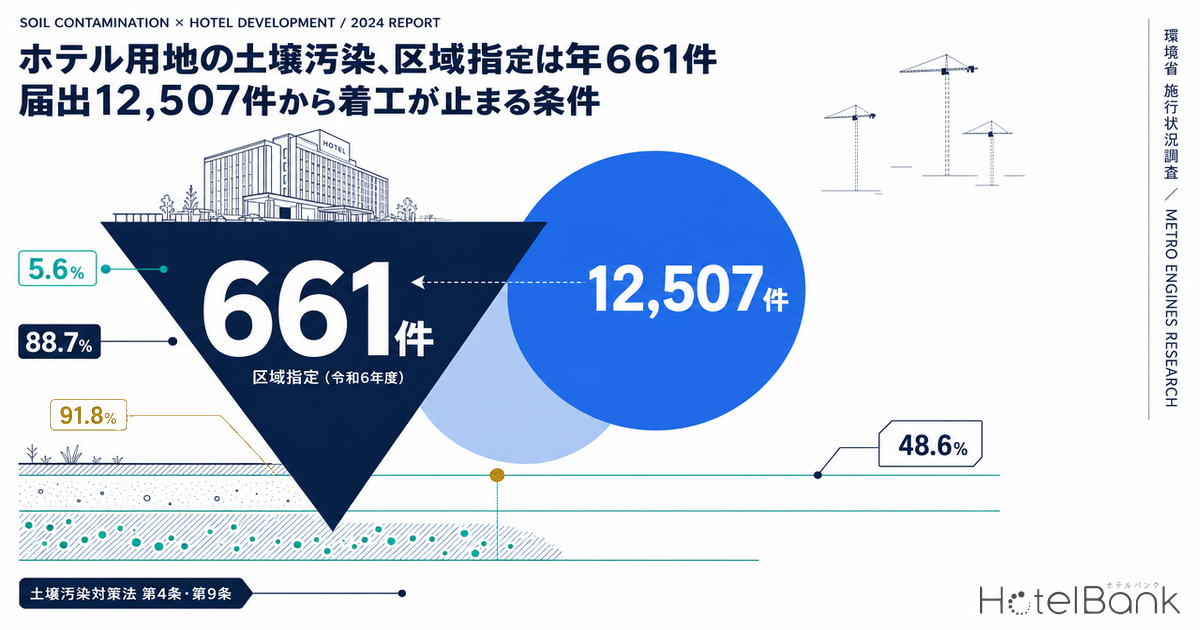
According to the FY2024 implementation status survey published by the Ministry of the Environment on 23 April 2026, 661 areas nationwide were designated during the year (588 the previous year), bringing the cumulative total to 7,599. At the entrance to that funnel, meanwhile, sit 12,507 annual notifications of changes to the character of land. This article breaks down what happens between those 12,507 filings and 661 designations, cross-reading the statutory text, the Ministry of the Environment’s implementation survey, the Ministry of Land, Infrastructure, Transport and Tourism’s published land prices and building plan data, and our own accommodation rate data.
Metric Definitions Used in This Article
- ADR (average daily rate): an estimated settled rate (tax-excluded equivalent) calculated by applying a format-specific adjustment coefficient to the lowest published plan level each property lists on OTAs (double occupancy, per-room rate, tax included). Cross-checked against property-level results disclosed by listed hotel REITs (91 properties, most recent three months), the median error is approximately 7%. These are estimates and differ from each property’s actual transacted prices and accounting figures. Area-level ADR is the median of the properties covered (the level of a typical property in the area).
- Area designation: designation by a prefectural governor or equivalent authority of land whose soil contamination exceeds the designated standards, following a soil contamination status investigation under the Soil Contamination Countermeasures Act, as either a Designated Area Requiring Action (Article 6) or a Designated Area Requiring Notification for Change of Character (Article 11).
- Change of character: excavation or any other act that changes the character of land. In hotel development this covers foundation work, underground structures and site grading.
- Data sources: Ministry of the Environment, “FY2024 Survey Results on the Implementation Status of the Soil Contamination Countermeasures Act and on Soil Contamination Investigation and Remediation Cases”; Ministry of Land, Infrastructure, Transport and Tourism, “Published Land Prices” and “Statistical Survey of Building Construction Dynamics”; MetroEngines Research.
- — 661 area designations a year, 7,599 cumulative. Up 27.6% in five years from 518 in FY2020, and 87.4% of them (578) are Designated Areas Requiring Notification for Change of Character, which require no remediation.
- — Only 5.6% of the 12,507 Article 4 filings reach an investigation report (699 cases), and investigation orders account for 0.32% (40 cases). Most projects that file purely on the area threshold proceed to construction without an investigation.
- — On land with a temporary exemption under Article 3, investigation orders are issued in 91.8% of cases (368 of 401). The reason for that level is that Article 3(8) says the governor “shall order” the investigation.
- — 88.7% of measures carried out are excavation and removal (473 of 533). The implementation rate for Designated Areas Requiring Action is 96.8%, so the mechanism by which designation leads to remediation and then to de-designation is working.
- — Industrial-zoned land trades at 24.0–70.8% of commercial-zoned land, while estimated settled ADR in waterfront and industrial-legacy locations matches or exceeds central urban districts. The asymmetry — comparable revenue at a third to a quarter of the land cost — remains.
Three entry points decide whether construction stops — Articles 3, 4 and 5
The investigation obligation under the Soil Contamination Countermeasures Act does not arise automatically from the land itself. It is triggered only when one of three entry points is crossed. For hotel development, Articles 3 and 4 are the ones that matter.
| Provision | Trigger | Relevance to hotel development | FY2024 investigation reports |
|---|---|---|---|
| Article 3 | Discontinuation of use of a Specified Facility Using Hazardous Substances (i.e. land where a factory or works has been closed) | Applies when the land being acquired was once a factory or workshop. The obligation falls on the seller | 668 cases (7,155 cumulative) |
| Article 4 | Change of character of land of 3,000 m² or more. The threshold falls to 900 m² for land where a Specified Facility Using Hazardous Substances currently stands or whose use has been discontinued (Enforcement Regulation Article 22) | The entry point every buyer passes through when excavating. Notification to the governor is due no later than 30 days before work begins (Article 4(1)) | 758 cases (5,775 cumulative) |
| Article 5 | When the governor finds that contamination poses a risk of harm to health | Almost never invoked in practice | 0 cases (6 cumulative) |
| Article 14 | Voluntary application for area designation by the owner | Used by sellers to establish the contamination position up front and settle the basis of the transaction | 251 cases (4,202 cumulative) |
The point to grasp here is that the area threshold has two tiers. The default is 3,000 m², but it drops to 900 m² on the site of a factory or works where a Specified Facility Using Hazardous Substances is currently installed, and on sites subject to discontinuation of use under Article 3(1). In other words, for the same size of hotel, the probability of falling within the notification net jumps the moment you choose a former factory site.
This is not a theoretical concern. Extracting hotel-use plans from the Ministry of Land, Infrastructure, Transport and Tourism’s “Statistical Survey of Building Construction Dynamics” and approximating building footprint as total floor area divided by number of floors for the 69 plans where both figures are known, only 20 plans (29.0%) reach 3,000 m², while 38 (55.1%) reach 900 m². Cutting the threshold to a third roughly doubles the number of plans caught. Because the actual area subject to a change of character is larger than the building footprint (it includes the excavation perimeter, temporary works and external works), this is a lower-bound estimate.
And once an area designation is made, the nature of the constraint on the project differs fundamentally between a Designated Area Requiring Action and a Designated Area Requiring Notification for Change of Character.
| Designated Area Requiring Action (Article 6) | Designated Area Requiring Notification for Change of Character (Article 11) | |
|---|---|---|
| What designation means | There is an exposure pathway to the contamination and a risk of harm to health | There is no exposure pathway and no risk of harm to health |
| Remediation | Removal of contamination or an equivalent measure is required. The governor specifies the measure and the deadline and directs submission of a contamination removal plan (Article 7(1)) | No measure is required |
| Change of character | Prohibited for any person as a rule (Article 9), with implementation of measures under a contamination removal plan as an exception | Permitted, subject to notification no later than 14 days before work begins (Article 12(1)) |
| Impact on the project | Construction cannot start until the measures are complete and the designation is lifted | Construction can start, but a filing arises for each work item and must be built into the schedule |
| FY2024 designations | 83 cases (1,093 cumulative) | 578 cases (6,506 cumulative) |
Of the 661 area designations, 87.4% (578) are Designated Areas Requiring Notification for Change of Character. Designation still leaves most sites buildable — that is the first practical fact. The remaining 83 are Designated Areas Requiring Action, where the schedule stops until remediation is complete. In an acquisition decision, the starting point is not to bundle these two under the single phrase “soil contamination.”
Designations up 27.6% in five years — more investigation, or more contamination?
Over the five years from FY2020 to FY2024, area designations rose 27.6%, from 518 to 661. Over the same period, investigation reports rose 25.2%, from 1,342 to 1,680. The fact that the two growth rates line up suggests that contamination itself is not spreading; rather, more land is being subjected to investigation. The more land trades and redevelops, the more of the subsurface becomes visible.
In the breakdown, Designated Areas Requiring Action have moved sideways — 60, 74, 93, 71, 83 — while the growth is driven by Designated Areas Requiring Notification for Change of Character (458 to 578, +26.2%). It is not that heavy contamination requiring remediation is increasing; the more accurate reading is that the stock of land that requires a filing whenever you dig is accumulating.
Next, the total volume of filings at that entry point, and the share that proceeds to investigation.
In FY2024, notifications of a change of character under Article 4(1) numbered 12,507 (13,248 the previous year). Of those, investigation results were reported under Article 4(2) in 699 cases — just 5.6% of all filings. Governors issued investigation orders under Article 4(3) in 40 cases, or 0.32% of filings. The previous year saw 625 reports (4.7%) and 71 investigation orders (0.54%) against 13,248 filings.
In short, most projects that file solely because they are excavating 3,000 m² or more start construction without proceeding to an investigation. The filing itself creates a statutory 30-day waiting period, but anything beyond that hits the schedule in roughly one case in twenty.
77.5% of closed factory sites remain uninvestigated — and once you dig, orders follow in over 90% of cases
What really bites in hotel development is not Article 4 but Article 3, one step upstream. When use of a Specified Facility Using Hazardous Substances is discontinued, the landowner incurs an investigation obligation. Yet of the 804 discontinuations in FY2024, 623 (77.5%) had the investigation obligation temporarily exempted. The previous year showed the same pattern: 664 of 902 (73.6%).
The temporary exemption is squarely provided for in the law where the site continues in use as a factory, people do not enter it, and other requirements are met. But from the buyer’s side, it means that land where “the factory has closed but the subsurface remains uninvestigated” is accumulating at a pace of more than 600 sites a year. The number of sites under temporary exemption during FY2024 totalled 1,039 — 623 discontinued that year plus 416 discontinued in earlier years.
And the exemption is not permanent. When someone attempts a change of character on exempted land, a notification under Article 3(7) is required, and Article 3(8) provides that the governor shall order an investigation (the wording is mandatory, not permissive). In FY2024, 368 investigation orders were issued against those 401 notifications — a rate of 91.8%. The previous year was 343 of 375 (91.5%), essentially the same level two years running.
Entry 804 discontinuations of use
The number of Specified Facilities Using Hazardous Substances whose use was discontinued in FY2024. At that moment the landowner incurs an investigation obligation.
Backlog 623 temporary exemptions (77.5%)
Where the requirements are met, the investigation obligation is temporarily exempted. This is where land can come to market without the subsurface position being settled.
Release 368 orders out of 401 filings
Of the 401 notifications filed to change the character of exempted land, 368 (91.8%) drew an investigation order. The exemption effectively lapses at the point the buyer digs.
That 91.8% issuance rate feeds directly into how site due diligence is designed. If you look only at Article 4 filings and assume “only 5.6% proceed to investigation,” the premise flips the moment the target site turns out to be temporarily exempted land under Article 3. What to verify before signing a sale and purchase agreement is whether the site has a history of temporary exemption — that is the branch point.
88.7% of measures are excavation and removal — the same work as hotel foundations, run first
Once an area is designated and remediation actually begins, the choice of method is heavily skewed. Of the 533 measures carried out in FY2024, excavation and removal accounted for 473 (88.7%). The cumulative figures since FY2010 show the same ratio: 5,945 of 6,677 (89.0%). In-situ purification accounts for 32 cases (373 cumulative) and capping with fill for 15 (126 cumulative).
Why excavation and removal wins is easy to understand from the developer’s logic. In-situ purification leaves the contamination in the ground and cleans it over time; the duration is hard to read and the timing of de-designation harder still. Excavation and removal, by contrast, digs out the contaminated soil, hauls it off site and backfills with clean soil. The work is the same “move the earth” operation as construction, and the duration can be estimated. For a developer who needs to lock a development schedule, it is the easier option to handle.
There is an overlap specific to hotel development here. Hotels frequently place plant rooms, parking and kitchen equipment below grade, so they excavate to a fair depth anyway. Where excavation and removal is required, the excavation for the building itself and the excavation as a remediation measure target broadly the same strata. If the two can be planned as one, duplication is avoidable — but in a Designated Area Requiring Action, Article 9 permits no change of character other than measures implemented under a contamination removal plan, so the default sequence is to complete the remediation first and then start the main works. That sequence is what hits the schedule.
The measures themselves are carried out in almost every designated area. Against 1,100 cumulative designations of Designated Areas Requiring Action, 759 (69.0%) have had the designation lifted and 306 (27.8%) are undergoing measures without yet being de-designated — an implementation rate of 96.8%. Only 35 cases (3.2%) remain untouched. As a system, the mechanism by which designation leads to remediation is working.
One note: this article does not present unit costs for excavation and removal, in-situ containment or any other measure. The Ministry of the Environment’s implementation survey compiles case counts, methods and progress but does not publish construction unit costs, and we could not identify any other current public source that could be cited generally. What follows quantifies only elapsed days and schedule impact, not money.
48.6% of designations sit in six prefectures — the deepest demand markets carry the most industrial history
Grouping FY2024’s 661 area designations by the jurisdictions of the regional environment offices, Kanto leads with 283 (42.8%), followed by Kinki with 145 (21.9%) and Chubu with 70 (10.6%); the top three account for 75.3%. By prefecture (including designated cities), Tokyo has 87, Osaka 67, Kanagawa 53, Aichi 48, Chiba 42 and Hyogo 41.
The six prefectures with the deepest hotel demand — Tokyo, Kanagawa, Aichi, Osaka, Hyogo and Fukuoka — account for 321 cases, or 48.6% of the national total. Narrowing to the four greater Tokyo prefectures (Tokyo, Kanagawa, Chiba and Saitama) still gives 213 cases, or 32.2%. Where accommodation demand concentrates and where industrial land history concentrates are all but the same map.
| Region | Investigation reports | Area designations | Share of national total |
|---|---|---|---|
| Kanto | 751 | 283 | 42.8% |
| Kinki | 292 | 145 | 21.9% |
| Chubu | 194 | 70 | 10.6% |
| Chugoku-Shikoku | 168 | 67 | 10.1% |
| Kyushu | 170 | 55 | 8.3% |
| Tohoku | 89 | 35 | 5.3% |
| Hokkaido | 16 | 6 | 0.9% |
| National total | 1,680 | 661 | 100.0% |
Industrial land at 24–71% of commercial land — the spread in Keihin, Hanshin and Chukyo
So how is industrial-legacy land valued as a hotel site? From the Ministry of Land, Infrastructure, Transport and Tourism’s “Published Land Prices” (2025), we compiled standard site prices by land use category for Keihin (Kawasaki Ward), Hanshin (Amagasaki), the Osaka waterfront (Konohana Ward), Chukyo (Nagoya Port), Chiba (Mihama Ward) and Shinagawa (Oi).
| Area | Industrial land, median | Commercial land, median | Industrial ÷ commercial | Industrial land YoY | Commercial land YoY |
|---|---|---|---|---|---|
| Kawasaki Ward (Keihin) | ¥161,000/m² | ¥670,000/m² | 24.0% | +7.5% | +13.8% |
| Amagasaki (Hanshin) | ¥166,000/m² | ¥440,000/m² | 37.7% | +13.8% | +5.3% |
| Konohana Ward (Osaka waterfront) | ¥193,500/m² | ¥502,000/m² | 38.5% | +7.0% | +8.2% |
| Oi (Shinagawa) | ¥611,000/m² | ¥1,120,000/m² | 54.6% | +7.6% | +9.7% |
| Nagoya Port (Chukyo) | ¥108,000/m² | ¥172,500/m² | 62.6% | +7.0% | +3.3% |
| Mihama Ward (Chiba) | ¥216,000/m² | ¥305,000/m² | 70.8% | +17.4% | +8.5% |
In Kawasaki Ward industrial land sits at 24.0% of commercial land, in Amagasaki 37.7% and in Konohana Ward 38.5%. Within the same market, a difference in land use category alone puts acquisition cost at a third to a quarter. At the same time, industrial land is in some cases rising faster than commercial land in the same area — Amagasaki +13.8%, Mihama Ward +17.4%. That reads as a sign that demand premised on conversion of use is already feeding into how industrial land is priced.
The question is whether that price gap reflects a gap in earning power as a hotel. We compared our estimated settled ADR for August 2026 across wards containing waterfront and industrial-legacy locations and the central wards of each city.
Konohana Ward in Osaka comes in at ¥11,900 (N=13 properties), 40% above the city’s central ward, Chuo, at ¥8,500 (N=191 properties). Minato Ward at ¥11,100 (N=11) and Suminoe Ward at ¥10,800 (N=7) also exceed Chuo. Kawasaki Ward in Kawasaki is ¥10,200 (N=28), on a par with Naka Ward in Yokohama at ¥9,800 (N=51). Mihama Ward in Chiba is ¥10,900 (N=12), above Chiba’s Chuo Ward at ¥9,100 (N=35). In Tokyo, Koto Ward at ¥12,200 (N=39) comes close to Chiyoda Ward at ¥12,700 (N=80).
Areas with a waterfront, reclaimed-land or industrial lineage are not lagging central districts on room rate. In locations close to event or leisure facilities they are ahead of them. No gap on the revenue side, a two- to fourfold gap on the cost side — that asymmetry is the structural reason industrial-legacy sites are drawing attention. The same asymmetry shows up in land competition with residential development, and the logic of backing out a feasible land price from ADR is covered in detail in Hotel vs Condo Land Rivalry: ADR-Implied Feasible Land Price Map.
Hotel plans on waterfront and industrial land — where they are actually being built
From the Ministry of Land, Infrastructure, Transport and Tourism’s “Statistical Survey of Building Construction Dynamics” we extracted hotel plans located on industrial-legacy land such as waterfront sites, reclaimed land and former railway land. Large projects cluster there: 1,000 rooms at Makuhari New City (Hibino, Mihama Ward, Chiba), 750 rooms and 126 rooms at Chidori in Urayasu, 338 rooms at Minato Mirai in Yokohama, 285 rooms at Hiromachi and Oi in Shinagawa Ward, and 217 rooms at Shibaura in Minato Ward.
To be explicit: the map above shows the character of the locations, not that these sites are contaminated. We have not verified, for any individual plan, whether an investigation has been carried out or whether an area designation exists. All it shows is the fact that large hotel plans are actually proceeding on industrial-legacy land.
How many months this adds — from the 30-day filing to completion of measures
In our earlier piece Hotel Build Times: 2.80-Year Median, 1.96 Solo vs 4.00 Mixed-Use, we measured an average of 2.80 years from groundbreaking to completion across 67 plans (1.96 years for single-use, 4.00 years for mixed-use). The Soil Contamination Countermeasures Act bites in the stretch before that groundbreaking. Below we stack up, stage by stage, only the durations that can be confirmed in statute or in public guidance.
| Stage | Basis | Duration | FY2024 frequency |
|---|---|---|---|
| 1. Article 4 change-of-character filing | Article 4(1) (no later than 30 days before work begins) | 30 days (statutory waiting period) | 12,507 cases (every project of the relevant scale) |
| 2. Land history and documentary investigation | Ministry of the Environment guidelines (review of land use history, registry, topographic maps and the like) | No published standard duration | Occurs in practice before filing |
| 3. Soil contamination status investigation under an order | Article 4(3) / Article 3(8). The order states the reporting deadline. Ministry of the Environment guidelines use roughly 120 days from the order as a guide for vacant land | Roughly 120 days (guide) | Article 4: 40 cases (0.32% of filings) / Article 3: 368 cases (91.8% of 401 filings) |
| 4. Area designation → Designated Area Requiring Notification for Change of Character | Articles 11 and 12(1) | 14 days notice before each work item begins | 578 cases |
| 5. Area designation → Designated Area Requiring Action | Articles 6, 7(1) and 9 | Change of character prohibited until the deadline set by the governor. Measures are implemented after preparing and submitting a contamination removal plan | 83 cases |
Pulling that together, the schedule impact that can be confirmed falls into three stages. Stage one is a filing and nothing more, adding the statutory 30 days. That covers the great majority of the 12,507 filings. Stage two is proceeding to investigation (699 cases a year via Article 4), where a land history review plus, if needed, sampling and analysis come into play. Where an order is issued, the Ministry of the Environment’s guidelines put the reporting deadline at roughly 120 days for vacant land, so this is where months are added. Stage three is designation as a Designated Area Requiring Action (83 cases a year), where construction cannot start until the contamination removal plan is prepared, submitted and the measures completed.
Measured against the 12,507 Article 4 filings, the probability of landing in stage three is extremely low. But if the target site is temporarily exempted land under Article 3, the investigation order rate jumps to 91.8%. The site’s history determines whether you are adding 30 days or several months — that is the practical takeaway.
Three schedule scenarios — stacking only the days that public sources confirm
The stages above, recast into a form usable in an acquisition decision. Durations are limited to those confirmable in statute or in Ministry of the Environment guidelines; where no published figure exists, we place no number and say so.
| Scenario | Applicable route | FY2024 cases and share of base | Confirmable schedule addition |
|---|---|---|---|
| Optimistic (filing only) | An Article 4(1) filing that reaches neither an investigation report nor an investigation order | 11,808 of 12,507 = 94.4% (filings minus 699 reports) | 30 days (the statutory Article 4(1) waiting period only) |
| Middle (proceeds to investigation) | A report under Article 4(2), or a soil contamination status investigation following an order under Article 4(3) | 699 reports = 5.6% / 40 orders = 0.32% | 30 days + roughly 120 days (guide for the reporting deadline on vacant land) |
| Pessimistic (Designated Area Requiring Action) | The investigation results in designation as an Article 6 Designated Area Requiring Action, and Article 9 bars any change of character until measures are complete | 83 Designated Areas Requiring Action (12.6% of the 661 designations) | 30 days + roughly 120 days + the remediation period (no published figure) |
| — For reference: where the site is temporarily exempted land under Article 3, the branch probabilities above invert. Against 401 change-of-character notifications, 368 investigation orders — 91.8% — land in the “middle” scenario or worse. | |||
Schedule sensitivity on two axes: land history × area of change
Which provision is triggered depends on the combination of the land’s history and the area subject to a change of character. Enforcement Regulation Article 22 sets the scale for an Article 4(1) filing at 3,000 m² as a rule, and at 900 m² for land where a Specified Facility Using Hazardous Substances currently stands or whose use has been discontinued. By contrast, the change-of-character notification for temporarily exempted land under Article 3 (Article 3(7)) has no minimum area: it must be filed in advance, other than for minor acts and similar exceptions.
| Land history \ area of change | Under 900 m² | 900–2,999 m² | 3,000 m² or more |
|---|---|---|---|
| No industrial use history | No filing required / 0 days added | No filing required / 0 days added | Article 4(1) filing / +30 days, 5.6% reach investigation |
| History of discontinued use of a Specified Facility Using Hazardous Substances (Article 3 investigation completed, no exemption) | No filing required / 0 days added | Article 4(1) filing (900 m² threshold) / +30 days | Article 4(1) filing / +30 days |
| History of a temporary exemption under Article 3 | Article 3(7) filing (no minimum area) / order rate 91.8% → +roughly 120 days | Article 3(7) plus Article 4(1) / 91.8% → +roughly 120 days | Article 3(7) plus Article 4(1) / 91.8% → 30 days and roughly 120 days run in parallel |
| Already designated (Designated Area Requiring Notification for Change of Character) | Article 12(1) requires notification 14 days before each work item begins. No measures are required, and the project can proceed if this is built into the schedule (578 cases in FY2024) | ||
| Already designated (Designated Area Requiring Action) | Article 9 prohibits any change of character until measures are complete. Measures are implemented after preparing and submitting a contamination removal plan (83 cases in FY2024) | ||
Price it in and it becomes leverage — the acquisition window others walk away from
Translating the numbers so far into the language of an acquisition decision.
1. History is the biggest branch point
On an Article 4 filing alone, 5.6% proceed to investigation and 0.32% draw an order. On temporarily exempted land under Article 3, 401 change-of-character filings drew 368 investigation orders (91.8%). What to verify before signing is not the area threshold but the history of temporary exemption.
2. 87.4% of designations still allow construction
Of FY2024’s 661 designations, 578 are Designated Areas Requiring Notification for Change of Character, where no measures are required. Each work item needs 14 days’ notice, but the project moves if that is built into the schedule. Designation does not mean the site cannot be developed.
3. Comparable revenue, a third to a quarter of the cost
Estimated settled ADR in waterfront and industrial-legacy locations matches or exceeds central urban districts, while industrial land trades at 24–71% of commercial land. That asymmetry is the upside for a developer who can price the schedule in advance.
Both the probability and the number of days that the Soil Contamination Countermeasures Act adds can be estimated from published material. The 30-day filing period is statutory, and the reporting deadline where an investigation order is issued has a guide in the Ministry of the Environment’s guidelines. The implementation rate for measures in Designated Areas Requiring Action is 96.8%, so as a system, remediation and de-designation do follow. In other words, much of the range of uncertainty can be narrowed in advance by checking the land’s history.
Conversely, for a developer who evaluates a site without checking that history, this looks like uncertainty that cannot be read. Unreadable uncertainty leads to avoidance, and avoidance stays in the price. The fact that industrial land changes hands at 24% of commercial land in some areas also means that part of that gap is still the price of subsurface uncertainty no one has examined.
As a matter of practice, the order of work is clear. First, confirm the site’s use history and whether any temporary exemption under Article 3 applies. Second, determine early in design whether the area subject to a change of character exceeds 3,000 m² (900 m² on a former factory site), and put the 30-day Article 4 filing on the programme. Third, hold the reporting deadline if an investigation becomes necessary (roughly 120 days for vacant land as a guide) and the remediation period should the site become a Designated Area Requiring Action as a range for price negotiation. Get that far and the site others walk away from turns into a site that can be acquired on conditions.
Where accommodation demand concentrates and where industrial land history concentrates overlap at a ratio of 48.6%. That overlap fits the facts better when read not as a constraint to avoid, but as a stock of sites open only to developers able to examine them.
How to read the data in this article: the Ministry of the Environment’s implementation survey is compiled from questionnaire responses by prefectures and designated cities, and the published year is FY2024 (covering 1 April 2024 to 31 March 2025). Plan data based on the Ministry of Land, Infrastructure, Transport and Tourism’s “Statistical Survey of Building Construction Dynamics” is on a building confirmation application basis; counts are expected to rise as further applications are filed, so treat them as a lower bound on the confirmed pipeline at this point in time. For the individual projects shown on the map and in the plan list, we have not verified whether a soil contamination status investigation has been carried out, its result, or whether an area designation exists, and their inclusion does not indicate the presence of contamination. Because unit costs for excavation and removal and other measures cannot be confirmed in published material, no monetary figures are presented in this article.
Related Reading
References and Sources
■ Data sources
The regime and case counts come from the Ministry of the Environment’s “FY2024 Survey Results on the Implementation Status of the Soil Contamination Countermeasures Act and on Soil Contamination Investigation and Remediation Cases” (published 23 April 2026; 47 prefectures plus 111 designated cities; covering 1 April 2024 to 31 March 2025) and the same survey for FY2020 to FY2023. Statutory text and scale thresholds come from e-Gov Law Search (Soil Contamination Countermeasures Act and its Enforcement Regulation). Land prices come from the Ministry of Land, Infrastructure, Transport and Tourism’s Real Estate Information Library, “Published Land Prices” (2025), and hotel plans from the same ministry’s “Statistical Survey of Building Construction Dynamics”. Accommodation rates are MetroEngines Research & Consulting’s estimated settled ADR (August 2026, ward-level medians; N= is the number of properties covered).
■ Calculation assumptions
Frequencies for the three scenarios use FY2024 national case ratios as they stand: 699 reports and 40 orders against a base of 12,507 Article 4 filings; 83 Designated Areas Requiring Action out of 661 designations; and 368 orders against 401 Article 3(7) filings. Schedule additions stack only statutory periods (30 days before under Article 4(1), 14 days before under Article 12(1)) and the reporting deadline the Ministry of the Environment’s guidelines give as a guide for vacant land (roughly 120 days); no days are assigned to intervals with no published figure. The area bands in the two-axis table correspond to the 3,000 m² and 900 m² thresholds in Enforcement Regulation Article 22, and no minimum area is applied to Article 3(7) filings (other than exemptions for minor acts and the like). Land prices are medians of standard sites within roughly a 1.5 km radius of each area, compiled by land use category.
■ Limitations and caveats
The case ratios are national aggregates and do not indicate the probability that any individual project will proceed to investigation or designation. Because neither the duration nor the unit cost of measures can be confirmed in published material, this article presents neither days nor money for them. The medians of published land prices include areas with few standard sites (one industrial site in Oi, one in Mihama Ward, two in Konohana Ward) and should be read with a wide margin. Estimated settled ADR is an estimate derived by applying a format-specific adjustment coefficient to the lowest published plan level each property lists on OTAs, and differs from actual transacted prices and accounting figures. For the individual projects shown on the map and in the plan list, we have not verified whether a soil contamination status investigation has been carried out, its result, or whether an area designation exists, and their inclusion does not indicate the presence of contamination. Building plan data is on a building confirmation application basis and counts are expected to rise as further applications are filed.
■ Legislation and regulation
- Soil Contamination Countermeasures Act (Act No. 53 of 2002) — e-Gov Law Search
- Enforcement Regulation of the Soil Contamination Countermeasures Act (Ministry of the Environment Ordinance No. 29 of 2002) — e-Gov Law Search (Article 22: filing thresholds of 3,000 m² / 900 m² under Article 4(1))
- Ministry of the Environment, “The Soil Contamination Countermeasures Act (act, cabinet orders, ministerial ordinances, notices and circulars)”
- Ministry of the Environment, “Guidelines on Investigation and Measures under the Soil Contamination Countermeasures Act” (approach to reporting deadlines for investigation orders)
- Tokyo Metropolitan Government Bureau of Environment, “Status of designated areas requiring action and related areas” / Tokyo Metropolitan Government soil contamination information disclosure system
■ Government statistics
- Ministry of the Environment, “FY2024 Survey Results on the Implementation Status of the Soil Contamination Countermeasures Act and on Soil Contamination Investigation and Remediation Cases” (23 April 2026)
- Ministry of the Environment, “FY2023 Survey Results on the Implementation Status of the Soil Contamination Countermeasures Act and on Soil Contamination Investigation and Remediation Cases” (24 April 2025)
- Ministry of the Environment, “FY2022 Survey Results on the Implementation Status of the Soil Contamination Countermeasures Act and on Soil Contamination Investigation and Remediation Cases”
- Ministry of the Environment, “FY2021 Survey Results on the Implementation Status of the Soil Contamination Countermeasures Act and on Soil Contamination Investigation and Remediation Cases”
- Ministry of the Environment, “FY2020 Survey Results on the Implementation Status of the Soil Contamination Countermeasures Act and on Soil Contamination Investigation and Remediation Cases”
- Ministry of Land, Infrastructure, Transport and Tourism, Real Estate Information Library, “Published Land Prices” (2025)
- Ministry of Land, Infrastructure, Transport and Tourism, “Statistical Survey of Building Construction Dynamics” (building plan data for hotel use)
■ Market data
- MetroEngines Research & Consulting — estimated settled ADR (August 2026, ward-level medians) and approximated building footprints for planned hotels