

Snow enters a hotel’s cost base at the design stage. The design load the roof has to carry, the snow-melting system at the entrance, the snow-clearing contract every winter, and heating. All of these are largely fixed the moment the site is chosen, and they are hard to cut later through operational effort. Under the Act on Special Measures for Heavy Snowfall Areas, Japan’s Ministry of Land, Infrastructure, Transport and Tourism (MLIT) designates 532 municipalities nationwide as Heavy Snowfall Areas, of which 201 are designated Special Heavy Snowfall Areas. Yet how many guest rooms actually sit inside those designated zones — and what snow costs per room — has rarely been laid out.
This article matches the designated zones against lodging supply at the municipal level for five prefectures — Hokkaido, Aomori, Niigata, Toyama and Nagano — and aggregates 4,570 properties and 182,492 rooms by designation category. It then converts the structural and roof premium required for snow loading, the upfront cost of snow-melting equipment, and the annual cost of snow-clearing contracts and winter heating into a per-room figure, and works backwards to the ADR (estimated settled rate) uplift a property needs in order to make the numbers work.
Metric Definitions Used in This Article
- ADR (average daily rate): an estimated settled rate (tax-exclusive equivalent) calculated by applying category-specific adjustment coefficients to the cheapest plan level each property publishes on OTAs (double occupancy, per-room rate, tax included). Against property-level actuals disclosed by listed hotel REITs (91 properties, most recent three months), the median error is about 7%. It is an estimate and differs from each property’s actual settled prices and accounting figures. Area-level ADR is the median across the target properties (the level of a standard property in that area).
- Listed price: where listed prices are mentioned, they are per-room rates for double occupancy (tax included). Every figure described as ADR in this article is an estimated settled ADR, which is a different metric from the listed price.
- Heavy Snowfall Area / Special Heavy Snowfall Area: zones designated under the Act on Special Measures for Heavy Snowfall Areas. This article sorts municipalities into five categories: (1) Special Heavy Snowfall Area (entire municipality designated), (2) includes a Special Heavy Snowfall Area (partially designated), (3) Heavy Snowfall Area (no Special designation), (4) partially Heavy Snowfall Area with most of the municipality undesignated, and (5) undesignated.
- Design snow depth: the snow depth used in structural calculations, set by the designated administrative agency under Article 86 of the Enforcement Order of the Building Standards Act. Zones with 1m or more are designated heavy-snow zones.
- Heating degree days (D18-18): a coldness index accumulating the gap from 18°C over the period during which the daily mean temperature falls below 18°C. This article approximates it from the Japan Meteorological Agency’s monthly mean temperature normals (1991-2020).
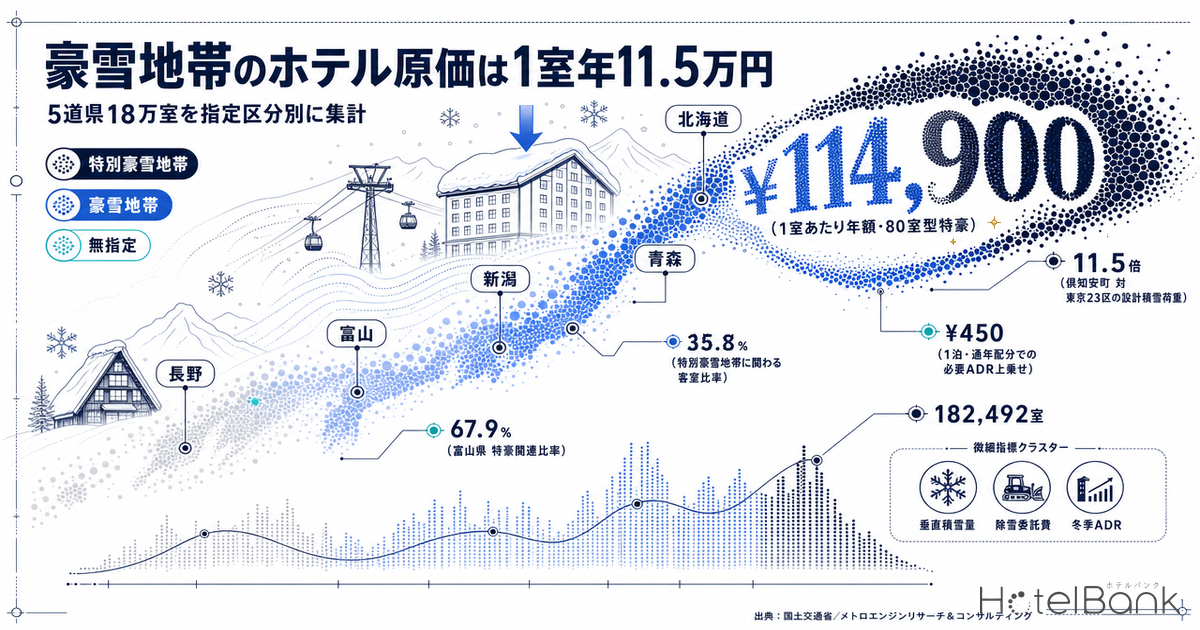
- — 65,311 rooms sit in or partly in Special Heavy Snowfall Areas, 35.8% of the 182,492 rooms across the five prefectures. Toyama is at 67.9%, Niigata 61.6% and Aomori 57.0%, while Hokkaido — entirely a Heavy Snowfall Area — stands at just 16.6%.
- — The cost of snow is ¥114,900 per room per year (80-room model, Special Heavy Snowfall Area). For a 30-room model it widens 2.4x to ¥272,800, because snow clearing and snow melting are driven by site area.
- — The required ADR uplift is ¥450 a night when spread across the year (3.4% of area ADR). Recover it in the four winter months instead and it becomes ¥1,360; a 30-room model on winter-concentrated recovery reaches ¥3,220 — a range of more than 6x.
- — Flexing unit-cost assumptions and occupancy still leaves a ¥380-¥540 range. What moves the conclusion is not unit-cost uncertainty but room count and winter demand.
- — Kutchan’s winter ADR is 1.68x its year-round level (¥28,000 to ¥47,000), absorbing the cost outright; in areas like Aomori City (0.81x) and Hakodate (0.85x), the cost has to be spread thinly across year-round pricing instead.
Breaking down 182,492 rooms across five prefectures by designation
Start with where the supply sits. Heavy Snowfall Area designation is made municipality by municipality, not prefecture by prefecture. Hokkaido, Aomori, Niigata and Toyama are designated in their entirety; in Nagano only 20 of 77 municipalities are designated (MLIT, as of 1 April 2026). Matching those designated zones against lodging properties registered as in operation within the scope tracked by MetroEngines Research, municipality by municipality, gives the following.
| Prefecture | Special (entire) | Special (partial) | Heavy Snowfall | Partly Heavy Snowfall (mostly undesignated) | Undesignated | Total |
|---|---|---|---|---|---|---|
| Hokkaido | 451 properties 11,415 rooms | 42 properties 2,377 rooms | 940 properties 69,068 rooms | — | — | 1,433 properties 82,860 rooms |
| Aomori | 60 properties 4,343 rooms | 69 properties 3,882 rooms | 111 properties 6,201 rooms | — | — | 240 properties 14,426 rooms |
| Niigata | 424 properties 10,608 rooms | 149 properties 6,673 rooms | 180 properties 10,758 rooms | — | — | 753 properties 28,039 rooms |
| Toyama | 15 properties 428 rooms | 143 properties 7,647 rooms | 95 properties 3,809 rooms | — | — | 253 properties 11,884 rooms |
| Nagano | 764 properties 13,805 rooms | 103 properties 4,133 rooms | 15 properties 312 rooms | 389 properties 10,975 rooms | 620 properties 16,058 rooms | 1,891 properties 45,283 rooms |
| Five-prefecture total | 1,714 properties 40,599 rooms | 506 properties 24,712 rooms | 1,341 properties 90,148 rooms | 389 properties 10,975 rooms | 620 properties 16,058 rooms | 4,570 properties 182,492 rooms |
Source: MLIT, “Designated Heavy Snowfall (Special Heavy Snowfall) Areas” (as of 1 April 2026) / MetroEngines Research & Consulting (properties in operation, N=4,570 properties, 182,492 rooms)
Source: MLIT, “Designated Heavy Snowfall (Special Heavy Snowfall) Areas” / MetroEngines Research & Consulting (N=4,570 properties)
The share of rooms tied to Special Heavy Snowfall Areas (fully plus partially designated) varies widely by prefecture. In the three Sea of Japan prefectures — Toyama at 67.9%, Niigata at 61.6% and Aomori at 57.0% — roughly 60% of rooms sit in areas connected to Special designation. Hokkaido, by contrast, is entirely a Heavy Snowfall Area, yet only 16.6% of its rooms are tied to Special Heavy Snowfall Areas. Its major cities — Sapporo, Hakodate, Chitose — fall outside Special designation, and that is where most of the rooms are concentrated.
Nagano is the only one of the five where designated and undesignated zones are evenly matched within the prefecture. Special Heavy Snowfall Areas (fully designated) hold 764 properties and 13,805 rooms, undesignated areas 620 properties and 16,058 rooms — the same order of magnitude on both property and room counts. That makes Nagano the easiest case for comparing cost structures within a single prefecture.
Plotting the municipal distribution on a map shows how supply clusters relate to the designation categories.
Source: MLIT, “Designated Heavy Snowfall (Special Heavy Snowfall) Areas” / MetroEngines Research & Consulting (90 municipalities with 300+ rooms, 164,264 rooms in total)
Roof design loads run 11.5x Tokyo — how snow loading reaches construction cost
Of all the snow-related costs, responding to snow loading is settled earliest. Article 86 of the Enforcement Order of the Building Standards Act sets the unit snow load at 20N/m² or more per centimetre of snow in ordinary zones and 30N/m² or more in heavy-snow zones (Niigata applies 29.4N/m² or more). Heavy-snow zones are designated where the design snow depth is 1m or more, or where the normal value for the number of days between the first and last snow cover is 30 days or more (Ministry of Construction Notification No. 1455 of 2000).
Using the design snow depths published by Hokkaido Prefecture, the design snow loads a roof has to carry compare as follows.
Source: Hokkaido Prefecture, “Design Snow Depth” (Article 86(3) of the Enforcement Order of the Building Standards Act); compiled by MetroEngines Research & Consulting from Article 86 of the Enforcement Order of the Building Standards Act
| Location | Design snow depth | Unit load | Roof design snow load | vs Tokyo |
|---|---|---|---|---|
| Central Tokyo (non-heavy-snow zone, reference) | 30cm | 20N/m² per cm | 600 N/m² (61kgf/m²) | 1.0x |
| Hakodate | 70cm | 30N/m² per cm | 2,100 N/m² (214kgf/m²) | 3.5x |
| Asahikawa (most of the city) | 130cm | 30N/m² per cm | 3,900 N/m² (398kgf/m²) | 6.5x |
| Sapporo (most of the city) | 140cm | 30N/m² per cm | 4,200 N/m² (429kgf/m²) | 7.0x |
| Kutchan and Niseko | 230cm | 30N/m² per cm | 6,900 N/m² (704kgf/m²) | 11.5x |
Source: Hokkaido Prefecture, “Design Snow Depth” (Building Guidance Division, Housing Bureau, Construction Department) / compiled by MetroEngines Research & Consulting from Article 86 of the Enforcement Order of the Building Standards Act
The 6,900N/m² in Kutchan and Niseko is equivalent to roughly 700kg per square metre. Given that the design load for one guest-room floor of a hotel (dead load plus live load) is broadly around 9,000N/m², that is close to adding 0.7 of a floor on top of the roof. Modelled on a five-storey reinforced-concrete building, the total vertical load carried by columns and foundations rises roughly 15% against an undesignated location. If the frame accounts for about a quarter of construction cost, that translates into an uplift of roughly 3.7% on the total. Adding snow guards, measures against snow cornices, eaves load capacity and site adjustments to keep clearance for snow shedding, this article assumes a structural and roof premium of +4.5% on construction cost in Special Heavy Snowfall Areas and +2.6% in Heavy Snowfall Areas without Special designation. The underlying per-room construction cost is worked back from planned projects in Hotel Construction Cost ¥20.67M per Room: 35.0m² Floor Area in 31 Plans.
How to read this estimate: the structural premium rate is a simplified estimate built from the increment in snow load and the frame’s share of cost. Actual premiums vary with structural type, storey count, span layout and roof form. Investment decisions require a property-specific feasibility study.
Snow clearing, snow melting and heating — costs set by site area, divided by room count
Once the building is up, the cost of snow keeps arriving every year as operating expense. What matters here is that both snow clearing and snow-melting equipment are sized by site area. Clearing a 2,000m² car park costs much the same whether an 80-room hotel or a 30-room ryokan sits on it. Divided back down to a per-room figure, the burden is therefore inversely proportional to room count.
The unit-cost assumptions are as follows. Mechanical clearing is priced at ¥20,000 per hour for a wheel loader or similar, and snow haulage at ¥8,000 per 4-tonne dump truck, both market rates. Road heating installation runs ¥40,000-¥45,000 per m² at residential scale (around 20m²); allowing for unit costs tapering at hotel scale, this article uses ¥35,000/m². Running costs are set at ¥2,600 per m² per season, based on the actual level of ¥65,000 per 25m² for a hot-water circulation system at Sapporo’s average operating hours (650 hours per season).
Source: MetroEngines Research & Consulting estimates (unit-cost basis set out in the text and in the reference list)
| Cost item (per room, per year) | 80-room Special | 80-room Heavy Snowfall | 30-room Special | 30-room Heavy Snowfall |
|---|---|---|---|---|
| Depreciation of snow-load response (structure and roof) / 39 years | ¥15,000 | ¥8,700 | ¥28,800 | ¥16,600 |
| Depreciation of snow-melting equipment (road heating, melting pit, roof melting) / 15 years | ¥12,700 | ¥5,800 | ¥33,900 | ¥15,300 |
| Snow-clearing contracts (mechanical clearing, haulage, roof snow removal) | ¥49,000 | ¥17,000 | ¥130,700 | ¥45,300 |
| Running cost of snow-melting equipment | ¥8,100 | ¥3,900 | ¥21,700 | ¥10,400 |
| Incremental winter heating cost (vs Tokyo) | ¥30,100 | ¥9,500 | ¥57,800 | ¥18,200 |
| Total | ¥114,900 | ¥44,800 | ¥272,800 | ¥105,900 |
| Upfront cost (structural premium + snow-melting equipment) per room | ¥774,600 | ¥423,700 | ¥1,631,400 | ¥878,900 |
Source: MetroEngines Research & Consulting estimates. The base construction unit cost of ¥1.65M per tsubo reflects the structure-specific unit costs in MLIT’s “Statistics on Building Construction Starts” (2024: ¥1.736M/tsubo for reinforced concrete, ¥1.648M/tsubo for steel frame). The heating increment is based on the ratio of heating degree days from the Japan Meteorological Agency’s climate normals (1991-2020)
¥114,900 a year for the 80-room model; ¥272,800 for the 30-room model. Even within the same Special Heavy Snowfall Area, the per-room cost of snow differs by a factor of 2.4 depending on scale. Most of the gap comes from snow-clearing contracts (¥49,000 versus ¥130,700) and depreciation of snow-melting equipment (¥12,700 versus ¥33,900) — both costs set by site area. In snow country, economies of scale bite harder than at a typical location, and this is where that shows up.
Heating alone is the exception: it is driven by coldness, not by designation category. The next section confirms that designation and heating degree days are separate axes.
Snowfall and cold are separate axes — Aomori and Hachinohe have almost identical heating degree days
Plotting maximum annual snow depth and heating degree days from the Japan Meteorological Agency’s normals (1991-2020) on the same plane shows that snow depth and cold are determined independently.
Source: Japan Meteorological Agency, “Climate normals (1991-2020 statistical period)”; compiled by MetroEngines Research & Consulting. Heating degree days are approximated from monthly mean temperature normals
The clearest illustration is within Aomori Prefecture. Aomori City has 2,981 heating degree days and Hachinohe 2,978 — essentially identical — yet the normal for maximum annual snow depth is 101cm in Aomori City against 27cm in Hachinohe, a 3.7x gap. Aomori City is a Special Heavy Snowfall Area (entirely designated); Hachinohe is a Heavy Snowfall Area without Special designation. The heating burden is the same, but the burden of snow clearing, snow melting and snow loading is another matter entirely.
The reverse case exists too. Takada (Joetsu) in Niigata records 96cm of maximum annual snow depth, on a par with Sapporo’s 97cm, yet its 2,175 heating degree days are nearly 40% below Sapporo’s 3,420. Heavy-snow areas on the Sea of Japan side are the “deep snow but not extreme cold” type; inland Hokkaido is the “less deep snow but high heating degree days” type. Their cost structures differ in substance even under the same “Heavy Snowfall Area” label.
| Location | Max annual snow depth (normal) | Heating degree days D18-18 | Mean temp, coldest month | Designation |
|---|---|---|---|---|
| Asahikawa | 89cm | 4,101 | -7.0°C | Heavy Snowfall Area (no Special designation) |
| Sapporo | 97cm | 3,420 | -3.2°C | Heavy Snowfall Area (no Special designation) |
| Aomori | 101cm | 2,981 | -0.9°C | Special Heavy Snowfall Area (entire) |
| Hachinohe | 27cm | 2,978 | -0.9°C | Heavy Snowfall Area (no Special designation) |
| Nagano | 33cm | 2,661 | -0.4°C | Partly Special Heavy Snowfall Area (Nagano City) |
| Takada (Joetsu) | 96cm | 2,175 | 2.5°C | Partly Special Heavy Snowfall Area (Joetsu City) |
| Niigata | 32cm | 2,164 | 2.5°C | Heavy Snowfall Area (no Special designation) |
| Toyama | 51cm | 2,021 | 3.0°C | Partly Special Heavy Snowfall Area (Toyama City) |
| Tokyo (reference) | 6cm | 1,586 | 5.4°C | Undesignated |
Source: Japan Meteorological Agency, “Climate normals (1991-2020 statistical period)” / MLIT, “Designated Heavy Snowfall (Special Heavy Snowfall) Areas”
The required ADR uplift runs ¥450 to ¥3,220 a night — a 6x swing on recovery period alone
Converting the annual costs above into a required ADR uplift: at 70% occupancy, annual rooms sold comes to 255.5 nights per room, and dividing by that gives the uplift required when the cost is spread thinly across the whole year. The cost of snow, however, is actually incurred in winter, and in areas where demand concentrates in winter it is equally valid to design for recovery across the 121 days from December to March.
| Model | Cost of snow (per room, per year) | Required ADR uplift spread across the year | Required uplift on winter (Dec-Mar) concentrated recovery | As a share of area ADR (year-round) |
|---|---|---|---|---|
| 80-room model, Special Heavy Snowfall Area | ¥114,900 | ¥450 | ¥1,360 | 3.4% |
| 80-room model, Heavy Snowfall Area | ¥44,800 | ¥175 | ¥530 | 1.6% |
| 30-room model, Special Heavy Snowfall Area | ¥272,800 | ¥1,070 | ¥3,220 | 8.2% |
| 30-room model, Heavy Snowfall Area | ¥105,900 | ¥415 | ¥1,250 | 3.7% |
Source: MetroEngines Research & Consulting estimates (spread across the year, at 70% occupancy, September 2025 to July 2026). The share of area ADR is approximate, against estimated settled ADR medians of ¥13,300 (Hokkaido) to ¥9,800 (Aomori) for fully designated Special Heavy Snowfall Area municipalities in the five prefectures
The range when unit-cost assumptions and occupancy are flexed
The required uplift above is a single value, with unit costs set at market medians and occupancy at 70%. In practice both snow-clearing contract rates and road-heating installation rates have a spread, and occupancy moves with location and seasonality. For the 80-room, Special Heavy Snowfall Area case, the table below places the assumptions used in the text at the mid case and flexes them either way.
| Cost item (per room, per year) | Optimistic | Mid (assumption used in the text) | Pessimistic |
|---|---|---|---|
| Depreciation of snow-load response (structure and roof) | ¥15,000 | ¥15,000 | ¥15,000 |
| Depreciation of snow-melting equipment | ¥12,700 | ¥12,700 | ¥16,300 |
| Snow-clearing contracts | ¥39,200 | ¥49,000 | ¥58,800 |
| Running cost of snow-melting equipment | ¥8,100 | ¥8,100 | ¥8,100 |
| Incremental winter heating cost | ¥30,100 | ¥30,100 | ¥30,100 |
| Total cost of snow | ¥105,100 | ¥114,900 | ¥128,300 |
| Assumed year-round occupancy | 75% | 70% | 65% |
| Required ADR uplift, spread across the year | ¥380 | ¥450 | ¥540 |
| Required uplift on winter (Dec-Mar) concentrated recovery | ¥1,160 | ¥1,360 | ¥1,630 |
Source: MetroEngines Research & Consulting estimates. The optimistic case sets snow-clearing contracts at the bottom of the market range (-20% versus mid) with 75% year-round occupancy; the pessimistic case sets them at the top of the range (+20%), road heating installation at the ¥45,000/m² upper bound for residential scale, and 65% year-round occupancy. Structural depreciation, snow-melting running costs and the heating increment are held identical across all three cases
Even with that spread, the required uplift for an 80-room property in a Special Heavy Snowfall Area stays within a ¥380-¥540 per night range. Against the roughly ¥13,000 year-round ADR level seen in the previous section, that is 2.9%-4.2% — the choice of unit-cost assumption is not sensitive enough to change the conclusion. What moves the conclusion is not unit-cost uncertainty but room count and occupancy, as the next table confirms.
| Assumption | 80-room Special | 80-room Heavy Snowfall | 30-room Special | 30-room Heavy Snowfall |
|---|---|---|---|---|
| Year-round occupancy 60% | ¥525 | ¥205 | ¥1,245 | ¥485 |
| Year-round occupancy 65% | ¥485 | ¥190 | ¥1,150 | ¥445 |
| Year-round occupancy 70% (assumption used in the text) | ¥450 | ¥175 | ¥1,070 | ¥415 |
| Year-round occupancy 75% | ¥420 | ¥165 | ¥995 | ¥385 |
| Year-round occupancy 80% | ¥395 | ¥155 | ¥935 | ¥365 |
Source: MetroEngines Research & Consulting estimates. Each model’s cost of snow (per room, per year) divided by 365 days x year-round occupancy
Moving year-round occupancy 20 points, from 60% to 80%, shifts the required uplift for the 80-room Special Heavy Snowfall Area case only ¥130, from ¥525 to ¥395. Read across the same 70% occupancy row and the 80-room model’s ¥450 becomes ¥1,070 for the 30-room model — 2.4x. Sensitivity is greater horizontally (room count) than vertically (occupancy). The first thing to settle in a snow-country lodging investment is not the occupancy assumption but the scale question: how many rooms will the snow-clearing and snow-melting footprint be divided across.
At 80-room scale, the cost of snow lands at ¥450 a night, in the 3% range of ADR. Estimated settled ADR in fully designated Special Heavy Snowfall Areas across the five prefectures sits at ¥13,300 in Hokkaido, ¥13,100 in Nagano and ¥12,600 in Niigata, so an uplift of that size is close to rounding error in pricing. Snow itself is not a decisive cost factor for a property with scale — that is the straightforward reading of the numbers.
What changes the question is scale and recovery period. Assume a 30-room model on winter-concentrated recovery and the required uplift jumps to ¥3,220 a night, more than seven times the ¥450 of the year-round spread. In other words, what bites in a snow-country lodging investment is not the absolute volume of snow but two things: how many rooms it can be divided across, and whether the property sells in winter.
Areas where winter lifts rates, and areas that recover thinly across the year
So what rates do hotels inside the designated zones actually achieve in winter? For municipalities across the five prefectures, we compared the year-round level of estimated settled ADR (the 11 months from September 2025 to July 2026) with the four winter months (December 2025 to March 2026).
Source: MetroEngines Research & Consulting (estimated settled ADR, September 2025 to July 2026, top 70 municipalities by cumulative observed property count)
Municipalities in fully designated Special Heavy Snowfall Areas split sharply in winter ADR relative to their year-round level. Where demand gathers in winter, Kutchan runs ¥47,000 in winter against ¥28,000 year-round (1.68x), Niseko ¥34,600 against ¥22,700 (1.52x), Yuzawa ¥20,400 against ¥15,600 (1.30x) and Hakuba ¥19,000 against ¥14,600 (1.30x) — winter uplifts running from several thousand yen to the ¥20,000 range. That is far above the required uplift calculated in the previous section (¥1,360 for the 80-room model, ¥3,220 for the 30-room model), so the cost of snow is comfortably absorbed within winter pricing. The same winter rate formation viewed through a different lens — distance from a ski resort — is covered in Japan’s 30 Ski Resorts: 40,419 Rooms Within 3km, Top 3 Hold 39%.
Where winter is the trough in demand, the recovery design changes. Aomori City runs ¥7,600 in winter against ¥9,400 year-round (0.81x), Hakodate ¥7,100 against ¥8,300 (0.85x) and Tateyama ¥7,700 against ¥11,600 (0.66x) — winter rates below the year-round level. In these areas the cost of snow is not absorbed in winter rates but folded thinly into the year-round price level. The previous section’s figures — ¥450 a night at 80-room scale, in the 3% range of ADR — carry straight through as the year-round design value.
| Municipality | Designation | Year-round ADR | Winter ADR | Winter / year-round | Cumulative observed properties |
|---|---|---|---|---|---|
| Kutchan, Hokkaido | Special (entire) | ¥28,000 | ¥47,000 | 1.68 | 237 |
| Niseko, Hokkaido | Special (entire) | ¥22,700 | ¥34,600 | 1.52 | 103 |
| Yuzawa, Niigata | Special (entire) | ¥15,600 | ¥20,400 | 1.30 | 467 |
| Hakuba, Nagano | Special (entire) | ¥14,600 | ¥19,000 | 1.30 | 462 |
| Iiyama, Nagano | Special (entire) | ¥10,300 | ¥13,200 | 1.28 | 126 |
| Nozawaonsen, Nagano | Special (entire) | ¥13,000 | ¥15,700 | 1.21 | 244 |
| Myoko, Niigata | Special (entire) | ¥10,300 | ¥12,400 | 1.21 | 443 |
| Yamanouchi, Nagano | Special (entire) | ¥12,800 | ¥14,800 | 1.16 | 1,139 |
| Chuo-ku, Sapporo, Hokkaido | Heavy Snowfall Area | ¥14,300 | ¥15,700 | 1.10 | 1,474 |
| Nagano City, Nagano | Special (partial) | ¥11,000 | ¥11,200 | 1.02 | 820 |
| Hachinohe, Aomori | Heavy Snowfall Area | ¥6,500 | ¥6,200 | 0.94 | 351 |
| Toyama City, Toyama | Special (partial) | ¥6,900 | ¥6,200 | 0.91 | 625 |
| Hakodate, Hokkaido | Heavy Snowfall Area | ¥8,300 | ¥7,100 | 0.85 | 932 |
| Aomori City, Aomori | Special (entire) | ¥9,400 | ¥7,600 | 0.81 | 428 |
Source: MetroEngines Research & Consulting (estimated settled ADR; year-round = September 2025 to July 2026, winter = December 2025 to March 2026). Cumulative observed properties is the sum of properties covered by the monthly estimated settled ADR calculation
The designated-versus-undesignated cost gap, seen in Nagano
The cleanest within-prefecture comparison is Nagano. Supply is evenly matched — 764 properties and 13,805 rooms in fully designated Special Heavy Snowfall Areas against 620 properties and 16,058 rooms in undesignated areas — and conditions other than climate (the prefecture’s demand base, access, the character of its tourism assets) are reasonably aligned.
| Category within Nagano | Properties | Rooms | Year-round ADR | Winter ADR | Winter / year-round | Cumulative observed properties |
|---|---|---|---|---|---|---|
| Special Heavy Snowfall Area (entire) | 764 | 13,805 | ¥13,100 | ¥15,600 | 1.19 | 2,319 |
| Includes a Special Heavy Snowfall Area (Nagano City) | 103 | 4,133 | ¥11,000 | ¥11,200 | 1.02 | 820 |
| Heavy Snowfall Area (no Special designation) | 15 | 312 | ¥10,300 | ¥11,100 | 1.07 | 60 |
| Partly Heavy Snowfall Area (mostly undesignated) | 389 | 10,975 | ¥11,500 | ¥11,000 | 0.96 | 2,323 |
| Undesignated | 620 | 16,058 | ¥13,700 | ¥14,000 | 1.02 | 3,414 |
Source: MLIT, “Designated Heavy Snowfall (Special Heavy Snowfall) Areas” / MetroEngines Research & Consulting (estimated settled ADR, September 2025 to July 2026, N=1,891 properties, 45,283 rooms)
Year-round ADR is nearly level: ¥13,100 in Special Heavy Snowfall Areas against ¥13,700 in undesignated areas. Come winter, however, the Special Heavy Snowfall Areas move to ¥15,600 (1.19x their year-round level) while undesignated areas barely shift, at ¥14,000 (1.02x). The undesignated areas include year-round high-rate destinations such as Karuizawa (¥22,200 year-round), which are designed to recover at a stable rate through every season.
On the cost side, an 80-room property located in a Special Heavy Snowfall Area in Nagano carries ¥114,900 a year — roughly ¥110,000 per room per year in additional cost against a comparable property in an undesignated area. That is ¥450 a night, or ¥1,360 if loaded onto the four winter months. The winter ADR uplift in Special Heavy Snowfall Areas (¥15,600 minus ¥13,100 = ¥2,500) exceeds it, confirming that in areas with winter demand the cost is being priced in.
A note on the aggregation: Matsumoto, Ueda, Suzaka, Omachi, Iida and Azumino, classified here as “partly Heavy Snowfall Area (mostly undesignated)”, have only part of their municipal territory designated, with most of their built-up areas undesignated. Following MLIT’s treatment of partially designated cities (Sendai, Koriyama, Shizuoka and Otsu), which it excludes from Heavy Snowfall Areas when aggregating population, this article likewise separates them out of the designated-zone totals.
Conclusion — the cost of snow means different things depending on room count and winter demand
Matching 4,570 properties and 182,492 rooms across Hokkaido, Aomori, Niigata, Toyama and Nagano against MLIT’s designated zones shows that 65,311 rooms are tied to Special Heavy Snowfall Areas — 35.8% of the five-prefecture total. By prefecture the share is high on the Sea of Japan side, at 67.9% in Toyama, 61.6% in Niigata and 57.0% in Aomori, and low in Hokkaido at 16.6% despite the entire prefecture being a Heavy Snowfall Area, because its major cities fall outside Special designation.
Dividing the four cost items — snow loading, snow-melting equipment, snow-clearing contracts and winter heating — back down to a per-room figure gives ¥114,900 a year for an 80-room property in a Special Heavy Snowfall Area and ¥272,800 for a 30-room property. The required ADR uplift is ¥450 to ¥1,070 a night when spread across the year, or ¥1,360 to ¥3,220 if designed for concentrated recovery across the four winter months.
Three implications follow. First, the cost of snow moves by a factor of 2.4 with room count. Snow clearing and snow melting are costs set by site area, so economies of scale work harder in snow country than elsewhere. Second, snowfall and cold reach cost through separate axes. Aomori City and Hachinohe have near-identical heating degree days but a 3.7x gap in maximum annual snow depth, while Takada (Joetsu) and Sapporo have almost the same snow depth but a 40% gap in heating degree days. Neither designation category alone nor temperature alone is enough to build the cost stack. Third, the recovery design is set by the area’s seasonality. Where winter ADR runs 1.3x to 1.7x the year-round level — Kutchan, Niseko, Yuzawa, Hakuba — the cost can be absorbed in winter rates; where winter is the trough in demand, as in Aomori City and Hakodate, it has to be folded thinly into the year-round price level. Where the boundary lies between treating snow as a cost and treating it as a revenue source is examined as an axis of location assessment in Snow as Cost or Asset: Winter RevPAR 53% vs Winter ADR 2.66x.
When assessing a lodging investment in a heavy-snowfall area, looking at three things together — (1) the intended room count, (2) the site area subject to snow clearing and snow melting, and (3) winter demand seasonality — rather than designation status alone gives an early read on the relationship between cost and recovery.
A note on these estimates: the cost estimates in this article are simplified calculations built from published unit-cost levels, official statistics and design standards. Actual construction and operating costs vary considerably with structural type, site conditions, construction timing and the terms of contracts with service providers. A property-specific feasibility study is advisable before making an investment decision. Estimated settled ADR is likewise an estimate and differs from each property’s actual settled prices and accounting figures.
Related reading
- Snow as Cost or Asset: Winter RevPAR 53% vs Winter ADR 2.66x
- Japan’s 30 Ski Resorts: 40,419 Rooms Within 3km, Top 3 Hold 39%
- Hotel Construction Cost ¥20.67M/Room: 35.0m² Floor Area in 31 Plans
- Staff Housing Is 10% of Resort Hotel Cost: Kutchan at 9.5%
- Niseko’s Top Tier: Just 2 Hotels, 75 Rooms — Where Fairmont’s 165 Fit
- Matsumoto ADR ¥13,400 vs ¥18,300 Ceiling: Absorbing 222 New Rooms
References and sources
■ Data sources
Property and room counts are our own aggregation of properties in operation (299 municipalities across five prefectures, N=4,570 properties, 182,492 rooms). Estimated settled ADR uses monthly values from September 2025 to July 2026, with winter covering the four months from December 2025 to March 2026. Heavy Snowfall Area and Special Heavy Snowfall Area categories follow MLIT’s municipality-level designation list (as of 1 April 2026); design snow depths are Hokkaido Prefecture’s published values; climate data is from the Japan Meteorological Agency’s climate normals (1991-2020); and construction unit costs are from MLIT’s “Statistical Survey on Building Construction Starts” (e-Stat statistics ID: 0003114490).
■ Estimate assumptions
Year-round occupancy of 70% (255.5 room-nights sold per room per year) is the base case, with 60-80% shown in the sensitivity analysis. The structural and roof premium is +4.5% in Special Heavy Snowfall Areas and +2.6% in Heavy Snowfall Areas. Depreciation periods are 39 years for structure and 15 years for snow-melting equipment. Unit costs are ¥20,000 per hour for mechanical snow clearing, ¥8,000 per 4-tonne dump truck for haulage, ¥35,000/m² for road heating installation and ¥2,600/m² per season for running it, and ¥1.65M per tsubo for construction. Winter-concentrated recovery is spread across the 121 days from December to March.
■ Limitations and caveats
The cost estimates in this article are simplified calculations built from published unit costs, official statistics and design standards; actual construction and operating costs vary with structural type, site conditions, construction timing and contract terms. Estimated settled ADR is an estimate and differs from each property’s actual settled prices and accounting figures (cross-checked against property-level disclosures by listed hotel REITs, the median error is about 7%). Heating degree days are approximated from monthly mean temperature normals. Cities with only part of their territory designated are separated out of the designated-zone totals, following MLIT’s treatment in its population aggregation. Investment decisions require a property-specific feasibility study.
■ Market data
- MetroEngines Research & Consulting — estimated settled ADR (September 2025 to July 2026), property and room counts (properties in operation, N=4,570 properties, 182,492 rooms)
■ Designated zones and legislation
- MLIT, “Regional Development: Promotion of Heavy Snowfall Area Measures”
- MLIT, “Designation of Heavy Snowfall Areas and Special Heavy Snowfall Areas (as of 1 April 2026)”
- MLIT, “Designated Heavy Snowfall (Special Heavy Snowfall) Areas” (municipality-level list)
- Act on Special Measures for Heavy Snowfall Areas (Act No. 73 of 1962)
■ Building standards and snow loading
- Hokkaido Prefecture, “Design Snow Depth” (Building Guidance Division, Housing Bureau, Construction Department)
- Ministry of Construction Notification No. 1455 of 2000, “Criteria for Designating Heavy-Snow Zones and for Setting Design Snow Depth”
- Niigata Prefecture, “Operational Criteria for Design Snow Depth (Snow Loading)”
- MLIT, “On Snow-Related Criteria in the Building Standards Act”
■ Climate and construction cost
- Japan Meteorological Agency, “Past Weather Data Search: Climate Normals (1991-2020 statistical period)”
- MLIT, “Statistical Survey on Building Construction Starts” (e-Stat statistics ID: 0003114490) — planned construction cost and floor area by structure for lodging-use buildings
■ Unit-cost basis for snow clearing and snow melting
- Reshop Navi, “How much does installing road heating cost?” (installation unit costs, melting pits)
- COZY, “What are the running costs of road heating?” (actual running costs in Sapporo at 650 operating hours)
- Alpha Reform, “Guide to choosing a snow-clearing contractor: market rates” (mechanical clearing, seasonal contracts)
- Kokorowa, “Market rates for snow haulage” (4-tonne dump truck haulage unit costs)