

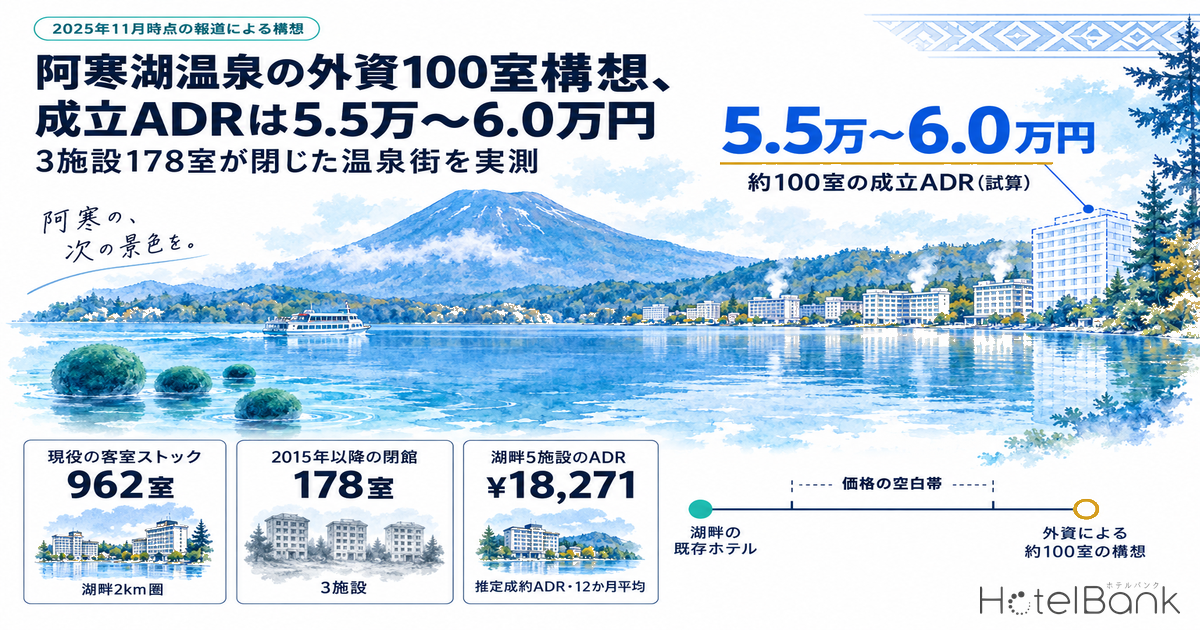
According to a Hokkaido Shimbun report dated November 1, 2025, talks are under way to bring a luxury-brand hotel of US-based Marriott International to the former site of Hotel Akankoso (ホテル阿寒湖荘) in Akanko Onsen (Lake Akan hot spring resort), Kushiro City, Hokkaido. The plan is for a seven-storey building with about 100 rooms, aiming to break ground by spring 2026 and open in spring 2028 at the earliest. It would be the first international luxury hotel in eastern Hokkaido, but as of October 1, 2026 we could not confirm a construction start or any official announcement of the operating brand. This article therefore treats the project as “a plan as reported in November 2025.”
The plan would enter a hot spring town where three properties with a combined 178 rooms have closed since 2015 and where total guest-nights have shrunk by roughly 30% since FY2018. At the same time, a 25-room villa-style property achieves an estimated transacted ADR averaging ¥64,000 over the year, and on the middle nights of long weekends its remaining inventory can hit zero 45 or more days before the stay date. Below we measure, in order, the room stock within 2 km of the lakefront, the seasonality of monthly ADR, the price tiers and early sell-outs, and the site conditions inside a national park, and then estimate the rate level at which roughly 100 rooms become viable.
Metric Definitions Used in This Article
- ADR (average daily rate): An estimated transacted rate (tax-exclusive equivalent) calculated by applying a correction factor by property type to the lowest-plan rate level each property publishes on OTAs and similar channels (two guests per room, per-room rate, tax included). Checked against property-level actuals disclosed by listed hotel REITs (91 properties, most recent three months), the median error is about 7%. These are estimates and differ from each property’s actual transacted prices and accounting figures. Area-level ADR is the median of the properties covered (the level of a typical property in the area).
- ADR of the five lakefront properties: The five main properties of Akanko Onsen (875 rooms in total) are held fixed, and each property’s estimated transacted ADR is averaged weighted by room count. The method differs from the municipality-level median.
- Room stock: Rooms at properties within a 2 km radius of the lakefront (43.433°N, 144.095°E) whose operation could be confirmed from official information or from selling prices over the most recent three months. Room counts are from each property’s official website and published materials; where unavailable, from MetroEngines Research property data.
- LT (lead time): Days until the check-in date. Early sell-out LT = the lead time at which remaining rooms first reached zero (the larger the value, the earlier the sell-out). Remaining rooms are counted within the allotment published on major booking sites and do not mean the whole property is full.
- Data source: MetroEngines Research & Consulting
- — Operating stock is 11 properties and 962 rooms. Three properties with 178 rooms have closed since 2015, and the top two properties hold 67.2% of rooms (within 2 km of the lakefront, as of October 1, 2026).
- — Guest-nights in the Akan district were 414,000 in FY2025 (−29.6% vs FY2018). Inbound guest-nights fell only 5.9%, lifting their share to 26.4%.
- — The estimated transacted ADR of the five lakefront properties (875 rooms) averaged ¥18,300 over 12 months (September 2025–August 2026). The peaks are August and February, and there is no property in the ¥30,000–60,000 band.
- — The viable ADR for about 100 rooms is ¥55,000–60,000 (assuming a 6% GOP yield, 65% year-round occupancy and a 30% GOP margin). Land is less than 1% of total investment; construction cost and schedule drive the project.
- — The plan rests on press reports as of November 2025; as of October 1, 2026 no construction start or official brand announcement could be confirmed.
Where the Plan Stands — 11 Months After the Report, No Confirmed Groundbreaking
First, what can be confirmed from public information. The Hokkaido Shimbun article of November 1, 2025 reported that the parties involved were coordinating to attract a luxury-brand hotel of Marriott International to the former Akankoso site. According to the paper’s Kushiro bureau, brands such as The Luxury Collection are candidates, and the scale at the concept stage is seven storeys above ground with about 100 rooms. A follow-up article on November 4 quoted local tourism stakeholders welcoming the plan as something that “won’t compete with us and can bring in affluent travelers.”
These, however, are reports of coordination toward attracting a hotel, not an official announcement by the project owner. Regarding the original target of “breaking ground by spring 2026,” we found no published material as of October 1, 2026 indicating a construction start or a decision on the operating brand. This article therefore does not treat the brand name or opening date as settled; it assumes only the scale — “about 100 high-rate rooms added on the lakefront.”
| Date | Confirmed facts | Source |
|---|---|---|
| March 31, 2024 | Hotel Akankoso closes after roughly 90 years, mainly because of ageing facilities. Sale of the land and building is under consideration | Kushiro Shimbun (March 3, 2024) |
| November 1, 2025 | Coordination to attract a luxury-brand hotel to the former Akankoso site is reported. Plan for seven storeys and about 100 rooms | Hokkaido Shimbun |
| November 4, 2025 | Welcoming comments from local tourism stakeholders are reported | Hokkaido Shimbun |
| By spring 2026 (target) | Groundbreaking target. No published material indicating a construction start could be confirmed as of October 1, 2026 | Same as above; our research |
| Spring 2028 (earliest) | Opening target. Concept stage; not finalized | Hokkaido Shimbun |
Source: Compiled by MetroEngines Research & Consulting from Hokkaido Shimbun and Kushiro Shimbun reports
Lakefront Room Stock — 11 Operating Properties, 962 Rooms, Top Two Hold 67%
Next, the size of the market the plan would join. MetroEngines Research & Consulting confirmed 11 operating properties with 962 rooms within a 2 km radius of the lakefront. Two properties of 200 rooms or more account for 646 rooms (67.2%), two properties of 50–199 rooms for 204 rooms (21.2%), and seven properties under 50 rooms for 112 rooms (11.6%). It is a two-layer structure: rooms concentrated in two large properties, with small inns lined up beneath them.
| Size band | Properties | Rooms | Share | Properties (rooms) |
|---|---|---|---|---|
| 200 rooms or more | 2 | 646 | 67.2% | New Akan Hotel (ニュー阿寒ホテル) (370), Akan Yuku no Sato Tsuruga (あかん遊久の里 鶴雅) (incl. Wings wing; 276) |
| 50–199 rooms | 2 | 204 | 21.2% | Hotel Gozensui (ホテル御前水) (109), THE FOREST Akan TSURUGA RESORT (THE FOREST 阿寒 TSURUGA RESORT) (95) |
| 20–49 rooms | 2 | 50 | 5.2% | Akan Tsuruga Besso Hinanoza (あかん鶴雅別荘 鄙の座) (25), Tohokan (東邦館) (25) |
| Under 20 rooms | 5 | 62 | 6.4% | Akan terrace (阿寒terrace) (15), Business Hotel Matsuoka (ビジネスホテルまつおか) (15), Onsen Minshuku Ryogoku Sohonten (温泉民宿 両国総本店) (12), Tsuruga Lake Akan Lodge Turano (鶴雅レイク阿寒ロッジ トゥラノ) (10), Onsen Minshuku Yamaguchi (温泉民宿 山口) (10) |
| Total | 11 | 962 | 100.0% | There are also several small inns whose sales could not be confirmed |
Source: MetroEngines Research & Consulting (N=11 properties, as of October 1, 2026. Room counts from each property’s official website, published materials and other sources)
Traced over time, supply over the past decade or so has been led by exits. An 80-room ryokan ceased operations in April 2015, followed by a 20-room ryokan, and Hotel Akankoso (78 rooms) closed on March 31, 2024. The three total 178 rooms, equal to 18.5% of the current operating stock of 962 rooms. Simply adding them back gives 1,140 rooms, implying a net contraction of 15.6% (a rough figure that excludes room-count changes from renovations at surviving properties).
New lodging buildings, by contrast, have been limited to small, high-value-added types. As far as MetroEngines Research can identify, these are a 25-room villa-style property opened in 2004 and a 15-unit whole-villa rental property opened in June 2023; no new build on the scale of 100 rooms can be confirmed. The roughly 100-room plan equals 10.4% of the operating stock and exceeds the closed Akankoso’s 78 rooms by 22. In other words, the plan is better understood as replacing part of the exited rooms at a high rate tier than as a net addition.
Figure: The 11 operating properties of Akanko Onsen (circle size = room count) and the planned site (as reported). Source: MetroEngines Research & Consulting
The Demand Base — Guest-Nights Down 29.6% vs FY2018, Inbound Down Only 5.9%
Behind the loss of rooms lies a shrinking demand base. According to Kushiro City’s tourist arrivals survey, guest-nights in the Akan district, which includes Akanko Onsen, fell from 616,000 in FY2017 to 414,000 in FY2025, down 29.6% from FY2018 (587,000). Although the figure has recovered from the 240,000–250,000 range of FY2020–21, it has been flat at 410,000–420,000 since FY2023.
Source: Compiled by MetroEngines Research & Consulting from Kushiro City “Tourist Arrivals Survey,” each fiscal year’s edition (Akan district, guest-nights)
The breakdown shows that it is domestic guests who have declined. Inbound guest-nights were 109,000 in FY2025 against 116,000 in FY2018, down only 5.9%, and their share rose from 19.8% to 26.4%. The remainder, domestic guests, fell 35.4% from 471,000 to 304,000 guest-nights. Taiwan accounts for 55.2% of inbound guest-nights (60,000), while six countries — the UK, France, Germany, the US, Canada and Australia — total 6,110 guest-nights (5.6%), still small. That said, the US is up 96.9% and Australia up 57.1% versus FY2018, which can also be read as growth in the segment that an international brand’s membership base reaches most easily.
By quarter, the position of winter has changed. January–March was the largest quarter of the year in FY2018 at 163,000 guest-nights, but in FY2025 it was 108,000 (−33.9%), second to July–September’s 131,000. Even so, winter still accounts for 26.1% of the year, and the character of a hot spring resort with two peaks, summer and winter, is unchanged. Dividing FY2025 guest-nights by the 962 operating lakefront rooms gives about 1.18 guest-nights per room per day (a rough figure, since the Akan district includes stays away from the lakefront).
Source: Compiled by MetroEngines Research & Consulting from Kushiro City “Tourist Arrivals Survey” (FY2025 edition, Akan district, quarterly guest-nights)
Monthly ADR Seasonality — Twin Peaks in August and February, Trough in April
What does the price side show? The estimated transacted ADR for Kushiro City as a whole averaged ¥8,900 over the 12 months from September 2025 to August 2026 (N=29–31 properties), and was ¥12,900 in August 2026 (N=30 properties). This, however, is a median that mixes business hotels in central Kushiro with hot spring ryokan on the lakefront, and does not represent the level of Akanko Onsen. We therefore fixed the five main lakefront properties (875 rooms in total, 91.0% of the operating stock) and aggregated them property by property.
The result: a room-weighted estimated transacted ADR of ¥18,300 over the same 12 months, with a median across the five properties of ¥16,300. That is about 2.1 times the Kushiro City figure and also above Teshikaga Town (¥9,700, N=10–14 properties), which shares the same national park. Compared with the preceding 12 months (¥18,100) it is up 0.9% — essentially flat.
| Area | Estimated transacted ADR (12-month avg.) | Preceding 12 months | YoY | Method / N |
|---|---|---|---|---|
| Akanko Onsen (five lakefront properties) | ¥18,271 | ¥18,105 | +0.9% | Room-weighted, N=5 properties, 875 rooms |
| Kushiro City (whole city) | ¥8,885 | ¥8,492 | +4.6% | Property median, N=29–31 properties |
| Teshikaga Town | ¥9,713 | ¥7,845 | +23.8% | Property median, N=10–14 properties |
Source: MetroEngines Research & Consulting (finalized 12 months, September 2025–August 2026. Preceding 12 months = September 2024–August 2025)
Lined up by month, there are two peaks: August and February. In 2026, August was ¥20,600 (−2.2% YoY) and February ¥20,200 (−7.1% YoY), with the trough in April at ¥16,100. The peak-to-trough ratio is 1.28x, and the fact that summer and winter stand at almost the same height is what characterizes this resort. February is when Lake Akan freezes over and on-ice events cluster. October, the autumn-foliage season, by contrast came in at ¥18,400 in 2025, only on a par with the annual average.
Source: MetroEngines Research & Consulting (five lakefront properties, 875 rooms, room-weighted. The dashed line from September 2026 is an estimate based on listed rate levels at the time of the survey)
Figures from September 2026 onward are estimated from listed rate levels at the time of the survey: ¥22,600 for September and ¥23,100 for October, both above the same months a year earlier. These are not final values, however, and will move as stay dates approach. The seasonal shape worth noting is that winter rates stand level with summer. For an international brand that wants to hold high rates year-round, a market where rates do not fall in winter makes a business plan easier to build.
Price Tiers and Early Sell-Outs — No Property Between ¥26,000 and ¥64,000
Ranking the five properties by rate reveals a gap in the tiers. At the top is the 25-room villa-style property, whose estimated transacted ADR reaches a 12-month average of ¥64,300 (monthly range ¥57,800–75,000). Below it the level drops straight to ¥25,800 at the 276-room large ryokan; there is no property in the ¥30,000–60,000 band. Rooms in the ¥50,000-and-above tier number 25, just 2.6% of the 962-room operating stock. The vacant position of “large and high-rate” is a pattern shared with Niseko, as seen in Niseko’s Top Tier: Just 2 Hotels, 75 Rooms — Where Fairmont’s 165 Fit.
| Price tier | Type / scale | Rooms | Estimated transacted ADR (12-month avg.) | Monthly range |
|---|---|---|---|---|
| ¥60,000s | Villa-style (all rooms suite class) | 25 | ¥64,268 | ¥57,753–¥74,966 |
| ¥30,000–60,000 | No property (the plan’s viable ADR sits at the top of this band) | 0 | — | — |
| ¥20,000s | Large hot spring ryokan | 276 | ¥25,844 | ¥22,470–¥30,206 |
| Upper ¥10,000s | Resort hotel | 95 | ¥16,340 | ¥13,839–¥19,124 |
| Lower ¥10,000s | Large hot spring hotel | 370 | ¥12,523 | ¥10,257–¥14,491 |
| Around ¥10,000 | Hot spring ryokan | 109 | ¥9,741 | ¥8,350–¥13,250 |
Source: MetroEngines Research & Consulting (N=5 properties, 875 rooms, finalized 12 months, September 2025–August 2026)
Source: MetroEngines Research & Consulting (N=5 properties. The blue band is the viable ADR for about 100 rooms estimated later in this article)
So are the upper price tiers actually filling? We checked inventory movements on a room-count basis. The sample is those properties, among the 31–32 in Kushiro City whose inventory could be observed continuously, whose published allotment on OTAs and similar channels is at least 30% of total rooms; five to seven of them fall within 2 km of the lakefront (530–552 rooms, as listed on major booking sites). For all three long weekends from summer to autumn 2026, zero remaining rooms was observed on every stay date at every property in the sample.
| Period (2026) | Lakefront sample: properties / rooms | Zero remaining observed | Of which zero 30+ days ahead | How the sell-out progressed |
|---|---|---|---|---|
| Marine Day long weekend (nights of Jul 18–20) | 5 properties, 530 rooms | 15 of 15 property-nights | 0 | LT 8 at the earliest property; most within 3 days of the stay date |
| Obon (nights of Aug 13–16) | 7 properties, 552 rooms | 28 of 28 property-nights | 5 | The three properties with 95+ rooms reached zero within 8 days of the stay date; small inns went first |
| September long holiday (nights of Sep 19–22) | 7 properties, 552 rooms | 28 of 28 property-nights | 15 | On the middle nights (Sep 20 and 21), 13 of 14 property-nights reached zero 30+ days ahead |
Source: MetroEngines Research & Consulting (remaining-room movements on a room-count basis. Property-nights = number of properties × number of stay dates)
The September holiday moved especially early. For the middle nights of September 20 and 21, the two properties of around 100 rooms reached zero remaining at LT 38–44, and the 276-room large ryokan also hit zero at LT 41 for the night of the 21st. The high-rate tier behaved the same way: at Akan Tsuruga Besso Hinanoza (25 rooms), remaining rooms on major booking sites stood at 0 of 25 from 45 or more days before the stay date for both September 20 and 21, and likewise for the Obon night of August 14. The observation that rooms in the ¥60,000s can become unavailable a month and a half before a long weekend suggests that demand at this price point may extend beyond the current 25 rooms.
Two caveats apply to reading this. First, zero remaining rooms refers to the allotment published on major booking sites and does not mean the whole property is full. At many properties the published allotment is 30–50% of total rooms, and several operating practices are possible: sales mainly through the property’s own website or travel agencies, allotment added as the stay date approaches, or allocation to booking sites restricted from the outset. Second, early fill is skewed toward the middle nights of long weekends, while annual guest-nights, as noted above, are 30% below FY2018. This is a market where thick peaks coexist with room to grow on weekdays and in shoulder seasons.
Site Conditions — Outside City Planning, With National Park Rules Deciding How You Build
In assessing the location, the first distinctive point is how official land price indicators are placed. Checking the Real Estate Information Library of the Ministry of Land, Infrastructure, Transport and Tourism (MLIT), we found that Akanko Onsen has neither an official land price (chika-koji) standard site nor a prefectural land price survey reference site, and no residential-land point within roughly 20 km of the lakefront. The nearest reference point within Kushiro City is Akan-cho Chuo, about 35 km to the south (residential, ¥5,700/m² as of July 1, 2026, −1.7% YoY). The reference site at Kawayu Onsen in Teshikaga Town, a hot spring town in the same Akan-Mashu National Park, stands at ¥3,400/m², flat after falling from ¥3,700 in 2018.
| Reference site (prefectural land price survey) | Category / city planning | 2018 | 2022 | 2026 | 2018→2026 |
|---|---|---|---|---|---|
| Kushiro-8 (Akan-cho Chuo 3-chome, Kushiro City) | Residential; area with no city planning area designated | 6,000 | 6,000 | 5,700 | −5.0% |
| Teshikaga-1 (Kawayu Onsen 3-chome, Teshikaga Town) | Residential; area with no city planning area designated | 3,700 | 3,400 | 3,400 | −8.1% |
| Teshikaga 5-1 (Chuo 1-chome, Teshikaga Town) | Commercial; commercial zone (non-delineated city planning area) | 16,000 | 15,600 | 15,200 | −5.0% |
Source: Compiled by MetroEngines Research & Consulting from the MLIT Real Estate Information Library (prefectural land price survey, as of July 1 each year, yen/m²)
Zoning shows the same picture. In the same library, no city planning area or use-zone designation can be confirmed for Akanko Onsen, so floor-area ratio and building coverage cannot be read from city planning. In this hot spring town, in other words, both land prices and building regulation sit outside the yardstick of city planning, and what effectively sets the conditions for development is the national park rules under the Natural Parks Act. Leaving the general framework of permits and approvals aside, we list here only the conditions specific to the Lake Akan lakefront.
In the Ministry of the Environment’s park plan, the lakefront town area is positioned as a lodging base under the “Akan Kohan Collective Facility District” (81.0 ha, of which 49.0 ha is privately owned). The management plan of the Hokkaido Regional Environment Office (January 2006) sets out specific handling policies on height, wall faces and design for lodging facilities in this district; the main items are shown in the table below. Seven storeys above ground, at around 4 m per floor, comes to roughly 28 m, which reads as a scale within the policy of 30 m or less at the highest point. The policy that “length parallel to the shoreline shall not exceed the existing condition” also suits plans that rebuild on the site of an existing inn. This is why new builds in hot spring towns inside national parks tend to gather on former sites.
| Item | Handling policy in the Akan Kohan Collective Facility District |
|---|---|
| Status of the district | Collective facility district, 81.0 ha (national land 15.6 ha, public land 16.4 ha, private land 49.0 ha) |
| Height of lodging facilities | 30 m or less from average ground level to the highest point (including penthouses) |
| Wall faces of buildings facing the lake | In principle, length parallel to the shoreline shall not exceed the existing condition |
| Wall setback | Set back at least 15 m from the lakeshore; set back from roads as far as possible |
| Roof | Gable or hipped, with a pitch of at least 3/10 and no more than 10/10 |
| Colors | Roofs in brown tones. Walls based on brown, beige, cream or gray tones |
| Buildings other than lodging facilities (special provision for District A) | Main building 20 m or less; 25 m or less including penthouses (Environment Agency Notice No. 47 of 2000) |
Source: Compiled by MetroEngines Research & Consulting from Ministry of the Environment, Hokkaido Regional Environment Office / Kushiro Nature Conservation Office, “Akan National Park Akan Area Management Plan” (January 2006) and Ministry of the Environment, “Akan National Park: Revision of the Park Plan” materials. Current handling must be confirmed with the office in charge
On demand and workforce, the character of a small town specialized in tourism comes through clearly. According to the Economic Census for Business Activity (2021) of the Ministry of Internal Affairs and Communications and the Ministry of Economy, Trade and Industry, there are 135 establishments and 879 workers within 1 km of the lakefront, with office-type workers only 3.1%. Business demand such as corporate travel can hardly be expected; lodging demand at this location depends on tourism.
The resident population is not deep either. In the 250 m mesh future population estimates of MLIT’s National Land Numerical Information, the resident population within 1.5 km of the lakefront is projected to fall from 1,202 in 2020 to 1,132 in 2025 and 941 in 2040 (−21.7% vs 2020), with a working-age population of 667 in 2025. If a 100-room full-service hotel were to staff 1.0–1.5 employees per room, it would need 100–150 people, equal to 15–22% of the working-age population within the radius. Hiring would presuppose relocation from outside the area, and securing staff housing is likely to become part of the opening plan.
Figure: Resident population within 1.5 km of Akanko Onsen (250 m mesh, 2020). Source: MLIT National Land Numerical Information (future population estimates by 250 m mesh, 2024 National Spatial Planning Bureau estimates). This is resident population (census basis), not visiting or pass-through population
Viable ADR for About 100 Rooms — ¥55,000 at 2025 Costs, ¥60,000 With Inflation
Based on the measurements so far, we back-calculate the rate level at which a hotel of about 100 rooms becomes viable. Because neither the project cost nor the site area of the plan has been published, everything below is a simplified estimate based on this article’s own assumptions. Construction cost is set in two stages. Stage one uses 2025 unit costs: we adopt, as this article’s assumption, ¥3.3 million per tsubo (about 3.3 m²), toward the upper end of the luxury-tier guide range (¥2.5–3.5 million per tsubo). In MLIT’s Building Starts Statistics, hotel construction cost in 2025 was ¥2.405 million per tsubo for steel structures and ¥2.026 million for reinforced concrete; the premise is that an upper-tier property with hot spring, food and beverage and spa facilities exceeds these. Stage two factors in escalation during the construction period, adding two years at 5% compounded annually (Turner & Townsend’s outlook is +5.3% for 2026 and +5.0% for 2027).
| Assumption | Value and basis |
|---|---|
| Rooms / gross floor area | 100 rooms, 9,000 m² gross floor area (assuming 90 m² per room including common areas) = about 2,722 tsubo |
| Construction cost (2025 unit cost) | ¥3.3 million per tsubo × 2,722 tsubo = about ¥8.98 billion |
| Construction cost (with inflation) | 5% compounded annually × 2 years = about ¥9.91 billion |
| Land cost | 5,000 m² site × ¥15,200/m² (the commercial reference land price in central Teshikaga Town, applied as a guide) = about ¥76 million |
| Total investment | About ¥9.06 billion at 2025 unit cost / about ¥9.98 billion with inflation (about ¥90–100 million per room) |
| Revenue mix | Ancillary revenue such as food and beverage and spa assumed at 40% of rooms revenue |
| GOP margin | 30% (midpoint of the 20–40% industry guide for resort hotels. The actual figure for the 91 operated properties disclosed by Invincible Investment Corporation is 38.9% (fiscal period ended December 2024), but that includes many limited-service hotels, so we set it conservatively) |
| Assumed occupancy | 65% (assumption; 60% and 70% cases also shown) |
Source: Compiled by MetroEngines Research & Consulting from MLIT “Building Starts Statistics,” the Real Estate Information Library, Invincible Investment Corporation disclosure materials and other sources
That land is less than 1% of total investment is a major feature of this location. Whereas land takes up a substantial part of project cost in urban hotel development, on the Lake Akan lakefront the outcome is decided almost entirely by construction cost and operating capability. Under these assumptions, setting ADR at three levels gives the following GOP yields (GOP ÷ total investment).
| Item (65% occupancy) | A. ADR ¥45,000 | B. ADR ¥60,000 Base | C. ADR ¥75,000 |
|---|---|---|---|
| RevPAR | ¥29,250 | ¥39,000 | ¥48,750 |
| Rooms revenue (annual) | ¥1.07 billion | ¥1.42 billion | ¥1.78 billion |
| Total revenue (annual) | ¥1.49 billion | ¥1.99 billion | ¥2.49 billion |
| GOP (annual) | ¥450 million | ¥600 million | ¥750 million |
| GOP yield (2025 unit cost, ¥9.06 billion) | 4.9% | 6.6% | 8.2% |
| GOP yield (with inflation, ¥9.98 billion) | 4.5% | 6.0% | 7.5% |
Source: MetroEngines Research & Consulting estimates (assuming 100 rooms, 40% ancillary revenue, 30% GOP margin)
Taking a 6% GOP yield as the viability threshold and working backward, the ADR required at 65% occupancy is ¥54,600 at 2025 unit costs and ¥60,100 with inflation. At 60% occupancy it is ¥59,100–65,100, and at 70%, ¥50,700–55,800. The viable ADR is thus roughly ¥55,000–60,000, positioned just below the existing top property (¥64,000, 25 rooms) and a little more than twice the 276-room large ryokan (¥26,000). Rather than competing for the same guests as existing inns, the 100 rooms would slot into the top of the vacant ¥30,000–60,000 band — consistent with the local view that the hotel “won’t compete.”
| Sensitivity (Scenario B, with inflation) | Base | ADR −10% | Occupancy −5pt | Both |
|---|---|---|---|---|
| ADR / occupancy | ¥60,000 / 65% | ¥54,000 / 65% | ¥60,000 / 60% | ¥54,000 / 60% |
| Total revenue (annual) | ¥1.99 billion | ¥1.79 billion | ¥1.84 billion | ¥1.66 billion |
| GOP (annual) | ¥600 million | ¥540 million | ¥550 million | ¥500 million |
| GOP yield | 6.0% | 5.4% | 5.5% | 5.0% |
Source: MetroEngines Research & Consulting estimates. This is a simplified estimate; actual investment decisions require a detailed feasibility study
The table below shows GOP yield when ADR and occupancy move together, on the inflation-adjusted total investment (about ¥9.98 billion). Combinations that reach a 6% yield are, as a guide, an ADR of ¥60,000 at 65% occupancy, the upper ¥50,000s at 70%, and a little over ¥65,000 at 60%. A 5-point move in occupancy is roughly equivalent to a move of about ¥5,000 in ADR.
| Year-round occupancy \ ADR | ¥50,000 | ¥55,000 | ¥60,000 | ¥65,000 | ¥70,000 |
|---|---|---|---|---|---|
| 55% occupancy | 4.2% | 4.6% | 5.1% | 5.5% | 5.9% |
| 60% occupancy | 4.6% | 5.1% | 5.5% | 6.0% | 6.5% |
| 65% occupancy | 5.0% | 5.5% | 6.0% | 6.5% | 7.0% |
| 70% occupancy | 5.4% | 5.9% | 6.5% | 7.0% | 7.5% |
| 75% occupancy | 5.8% | 6.3% | 6.9% | 7.5% | 8.1% |
Source: MetroEngines Research & Consulting estimates (assuming 100 rooms, 40% ancillary revenue, 30% GOP margin, total investment of about ¥9.98 billion)
In terms of how the price tiers are shared, the change in volume is large. Rooms at ¥50,000 and above would increase fivefold, from the current 25 to 125. Meeting 65% occupancy requires about 24,000 room-nights a year, or about 47,000 guest-nights at two guests per room — equal to 11.5% of the Akan district’s FY2025 guest-nights and 43% of its inbound guest-nights. Put the other way, it is a scale that can be reached by recovering, at the high-rate tier, 27% of the 174,000 guest-nights lost since FY2018. The condition for this estimate to hold is not a fight over existing guests but bringing new segments to the lakefront, such as an international brand’s membership base and long-stay guests from Europe, North America and Australia.
We also checked whether institutional capital has entered this market. In the ownership master for the seven listed hotel REITs — Ichigo Hotel REIT Investment Corporation (いちごホテルリート投資法人, 3463), Invincible Investment Corporation (インヴィンシブル投資法人, 8963), Nippon Hotel & Residential Investment Corporation (日本ホテル&レジデンシャル投資法人, 3472), Japan Hotel REIT Investment Corporation (ジャパン・ホテル・リート投資法人, 8985), Hoshino Resorts REIT (星野リゾート・リート投資法人, 3287), MORI TRUST REIT (森トラストリート投資法人, 8961) and Kasumigaseki Hotel REIT Investment Corporation (霞ヶ関ホテルリート投資法人, 401A) — covering 300 properties in Japan as of September 28, 2026, there is no property in Akanko Onsen. The only two confirmed in eastern Hokkaido are Comfort Hotel Kushiro (コンフォートホテル釧路; 126 rooms, acquisition price ¥300 million, acquired August 2016), held by Ichigo Hotel REIT, and Comfort Hotel Kitami (コンフォートホテル北見; 127 rooms, acquisition price ¥851 million, acquired January 2016), held by Invincible — both limited-service hotels in town centers. If an international brand comes to the lakefront resort, it could create one of the few resort assets in eastern Hokkaido of a scale that institutional investors can consider.
Issues for Investment Decisions — Before the Rate, Fix the Schedule and Staffing Assumptions
The viable ADR in our estimate is close to the existing top tier, and judging from the long-weekend sell-outs, the rate itself is not out of reach. What will shape the business plan is rather the assumptions other than rate. We have organized the points that developers and lenders will want to confirm.
| Area | Facts confirmed in this article | Points to confirm on the plan side |
|---|---|---|
| Demand | Guest-nights are down 29.6% vs FY2018. Of inbound, Taiwan is 55.2%; six Western countries and Australia are 5.6% | Which markets will supply the additional ~47,000 guest-nights a year. Channels for weekday and shoulder-season business |
| Seasonality | ADR peaks in August and February. The April trough is about 0.78x the peak | Occupancy assumptions for April–June and November–December. Winter air access and local transport |
| Construction | Construction is 99% of total investment. At 5% annual escalation, cost rises by about ¥900 million in two years. At Kawayu Onsen in the same national park, the start of construction of a luxury lodging facility was reported to have been pushed back because securing a contractor took time | Contractor arrangements and the winter construction schedule. Project cost if groundbreaking slips by a year |
| Permits | No city planning area or use-zone designation can be confirmed; handling policies for lodging facilities include height of 30 m or less and a setback of at least 15 m from the lakeshore | Handling under the current management and operation plan. Time needed for consultations on design and wall length |
| Staffing | Working-age population within 1.5 km is 667; resident population in 2040 is −21.7% vs 2020 | Scale of staff housing and its inclusion in project cost. Designing year-round employment |
| Natural hazards | Nearby Mt. Meakan is an active volcano under constant observation by the Japan Meteorological Agency | Business continuity plan and insurance for when the volcanic alert level is raised |
| Guest charges | Collection of accommodation taxes by Hokkaido and Kushiro City began in April 2026, on top of the bathing tax | Pricing on a tax-inclusive total basis. Developments in returning tax revenue to the area |
Source: Compiled from materials of MetroEngines Research & Consulting, Kushiro City, the Ministry of the Environment, MLIT and Hokkaido Shimbun (April 16 and 17, 2026)
As next steps, it is realistic to work through three things in order. First, confirm the current handling policies with the Nature Conservation Office in charge and fix the building volume. Second, firm up project cost including contractor arrangements and staff housing, and keep a sensitivity to slippage in the construction start. Third, design how to fill weekdays and shoulder seasons in addition to the winter and summer peaks, including cooperation with existing inns and the tourism association. On the use of bathing tax revenue, see also Onsen Bathing Tax Rises: ¥350 Aizuwakamatsu, ¥300 Izu, 1.1–1.6% of ADR.
Conclusion
Akanko Onsen is a hot spring town where three properties with 178 rooms have closed since 2015 and the operating stock has narrowed to 11 properties and 962 rooms. Guest-nights are down 29.6% versus FY2018, but inbound is down only 5.9%, and rates retain their two peaks in summer and winter. In the price tiers there is no property between ¥26,000 and ¥64,000, and for the 25 rooms in the ¥60,000s there were middle nights of long weekends when remaining inventory hit zero 45 or more days before the stay date.
Estimating the roughly 100-room plan under this article’s assumptions gives a viable ADR of ¥55,000–60,000, which falls exactly at the top of this vacant band. Land is less than 1% of total investment; what decides the project is construction cost and schedule, and securing a workforce. As of October 1, 2026 the plan remains at a stage where neither groundbreaking nor an official announcement can be confirmed. In future announcements, we will be watching less for the brand name than for whether three things are disclosed: construction start date, project cost and staff housing.
⚠ Note on ADR for future dates: The ADR shown in this article for September 2026 onward is an estimate based on selling price levels published on OTAs and similar channels at the time of the survey (October 1, 2026), and will change as check-in dates approach. Please note that rates currently set high may be lowered in last-minute adjustments. All figures in the development scenarios are simplified estimates based on this article’s assumptions and do not represent the financials of any specific business plan.
References and Sources
■ Data sources
Estimated transacted ADR is compiled by MetroEngines Research & Consulting (the five main lakefront properties, 875 rooms, held fixed and weighted by room count; period is the finalized 12 months from September 2025 to August 2026. Kushiro City, N=29–31 properties, and Teshikaga Town, N=10–14 properties, are property medians). Remaining-room movements cover properties whose published allotment is at least 30% of total rooms (five to seven lakefront properties, 530–552 rooms, as listed on major booking sites). Room stock is the 11 properties whose operation could be confirmed within 2 km of the lakefront. Guest-nights are based on Kushiro City’s “Tourist Arrivals Survey,” land prices on the prefectural land price survey, and building handling policies on the Ministry of the Environment’s management plan.
■ Estimate assumptions
100 rooms, 9,000 m² gross floor area (about 2,722 tsubo). Construction cost in two stages: ¥3.3 million per tsubo (2025 unit cost), and that figure plus two years at 5% compounded annually. Land cost about ¥76 million; total investment about ¥9.06–9.98 billion. Ancillary revenue at 40% of rooms revenue, GOP margin 30%, year-round occupancy 65% (60% and 70% also shown), with a 6% GOP yield as the viability threshold. The plan’s project cost and site area have not been published; all are this article’s assumptions.
■ Limitations and caveats
Estimated transacted ADR is an estimate based on published prices and differs from each property’s actual transacted prices and accounting figures. Values from September 2026 onward are estimates based on levels at the time of the survey, not final values. Zero remaining rooms refers to the published allotment and does not mean the whole property is full. GOP yield is a measure before deducting fixed charges, interest, depreciation and FF&E reserves, and differs from NOI yield or investment yield. The scale and timing of the plan are based on press reports and the assumptions may change with an official announcement.
■ Market data
- MetroEngines Research & Consulting — Estimated transacted ADR (five lakefront properties, 875 rooms; Kushiro City N=29–31 properties; Teshikaga Town N=10–14 properties), remaining-room movements on a room-count basis (five to seven lakefront properties), room stock (N=11 properties, 962 rooms)
■ Government statistics and public data
- Kushiro City, “Kushiro City Tourist Arrivals” survey results (FY2017–FY2025)
- MLIT Real Estate Information Library — prefectural land price survey, city planning areas, use zones
- Ministry of the Environment, Hokkaido Regional Environment Office / Kushiro Nature Conservation Office, “Akan National Park Akan Area Management Plan” (January 2006)
- Ministry of the Environment, “Akan National Park: Revision of the Park Plan” materials (Akan Kohan Collective Facility District)
- MLIT National Land Numerical Information (future population estimates by 250 m mesh, 2024 National Spatial Planning Bureau estimates)
- Ministry of Internal Affairs and Communications / Ministry of Economy, Trade and Industry, “Economic Census for Business Activity” (2021)
- MLIT, “Building Starts Statistics Survey”
■ REITs and industry reports
- Ichigo Hotel REIT Investment Corporation, portfolio list
- Invincible Investment Corporation, portfolio list / hotel operating results
- Relo Hotel Solutions, “GOP guide by hotel type”
- Turner & Townsend construction cost outlook (+5.3% for 2026, +5.0% for 2027)
- Ownership master: seven listed hotel REITs, 300 properties in Japan (as of September 28, 2026)
■ News and official websites
- [Exclusive] International luxury hotel for Akanko Onsen: Marriott of the US, coordinating toward spring 2028 opening (Hokkaido Shimbun, November 1, 2025)
- Marriott to be attracted to Akanko Onsen: locals welcome it, “won’t compete, can bring in affluent travelers” (Hokkaido Shimbun, November 4, 2025)
- Hotel Akankoso to close on the 31st: 90 years of history end as facilities age (Kushiro Shimbun, March 3, 2024)
- Report on the construction start timing of a luxury lodging facility at Kawayu Onsen (Hokkaido Shimbun, April 17, 2026)
- Report on the start of accommodation tax collection (Hokkaido Shimbun, April 16, 2026)
- Tsuruga Group official website (property list and room counts), Akan terrace official website