

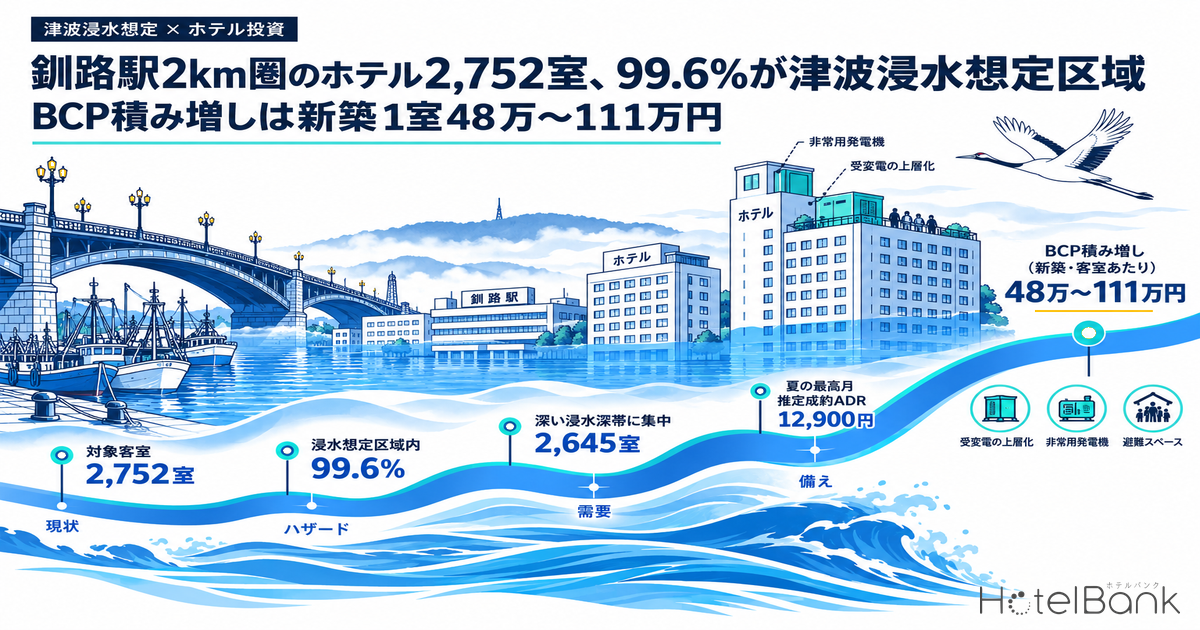
When the tsunami inundation projection for the Pacific coast that Hokkaido published on July 19, 2021 (based on the megaquake model for the Japan Trench and Kuril Trench) is overlaid on lodging facilities within a 2 km radius of Kushiro Station, using open data from the Ministry of Land, Infrastructure, Transport and Tourism (MLIT) Real Estate Information Library, 31 of 34 properties and 2,740 of 2,752 rooms (99.6% on a room basis) sit inside the projected inundation zone. The 5 m to under 10 m depth band alone holds 24 properties and 2,645 rooms (96.1%), and all 18 properties with 40 or more rooms stand in this band. At the same time, Kushiro is a port city where the estimated settled ADR climbs to ¥12,900 in August, 1.8 times the March level, and where the three months from July to September generate roughly one third of annual room revenue. This article reviews the distribution of rooms by inundation depth band and the summer-weighted seasonality of demand, then estimates on a per-room basis the Capex for raising substation equipment to upper floors, emergency power and evacuation space that would be added in a rebuild or new build, and reads what that means for development headroom in the city center.
Metric Definitions Used in This Article
- ADR (average daily rate): An estimated settled rate (tax-exclusive equivalent) calculated by applying a correction factor by hotel type to the lowest plan level each property publishes on OTAs (two guests per room, price per room, tax included). In a comparison with property-level results disclosed by listed hotel REITs (91 properties, most recent three months), the median error is about 7%. These are estimates and differ from each property’s actual settled prices and accounting figures. Area-level ADR is the median of the properties covered (the level of a typical property in the area).
- OCC (occupancy rate): The share of rooms sold out of total rooms in the area (an estimate based on inventory sold through OTAs). It is an estimate based on how inventory sold on OTAs is being absorbed and differs from the actual occupancy of a whole property. This article uses the value for the whole of Kushiro City (including Lake Akan Onsen).
- Booking curve and LT: The booking curve is the change in remaining OTA rooms toward the check-in date. LT (lead time) is the number of days until check-in. This article uses LT45 through LT1.
- Tsunami inundation projection and depth bands: The tsunami inundation projection set by Hokkaido under the Act on Development of Tsunami-Resilient Communities (an official projection that assumes a maximum-class tsunami), obtained from the MLIT Real Estate Information Library (National Land Numerical Information, “Tsunami Inundation Projection”). Inundation depths follow the classes in that data (1 m to under 3 m, 3 m to under 5 m, 5 m to under 10 m, and so on).
- In-zone determination: Determined by whether each property’s registered coordinate (a single point) falls inside a projected inundation polygon. Cases where only part of a site touches the zone, the number of floors and the ground elevation are not taken into account.
- Scope: A 2 km radius from Kushiro Station (42.9906°N, 144.3821°E). Lodging facilities in MetroEngines Research property data with no closure record, at least one room and a registered opening year (excluding leisure hotels). A property whose name changed through rebranding is counted as one property, as the same building. As of 2026 this gives 34 properties and 2,752 rooms, of which selling prices for stays in August to October 2026 could be confirmed for 22 properties and 2,561 rooms.
- Data sources: MetroEngines Research (properties, prices, inventory); MLIT Real Estate Information Library (tsunami inundation projection, flood inundation projection zones, zoning, fire prevention districts, land prices, designated emergency evacuation sites); published materials from Hokkaido and Kushiro City
| — 99.6%: Of the 34 properties and 2,752 rooms within 2 km of Kushiro Station, 31 properties and 2,740 rooms are inside the tsunami inundation zone projected by Hokkaido. Only 3 properties and 12 rooms on the upland side are outside it. |
| — 2,645 rooms: 96.1% of rooms are concentrated in the 5 m to under 10 m depth band. All 18 properties with 40 or more rooms (2,584 rooms) are in this band. |
| — 6 of 53 sites: Six of the designated emergency evacuation sites for tsunami within the radius are hotel buildings (1,014 rooms in total). Mid- and high-rise hotels serve as the destination for vertical evacuation. |
| — ¥12,900 vs ¥7,200: Kushiro City’s estimated settled ADR in August is 1.8 times that of March. At equal occupancy, July to September generates 33.4% of annual room revenue. |
| — −294 rooms: Rooms within the 2 km radius fell 9.7% in nine years from 3,046 in 2017. The last registered opening of a property with 40 or more rooms was in 2012, leaving room for rebuilds and new development. |
| — ¥480,000–¥1,110,000 per room: The cost of adding upper-floor substation equipment, an emergency generator and upper-floor evacuation space in a 150-room new-build model (3.4–7.9% of construction cost). It is of a size that an ADR uplift of ¥300–700 can offset. |
Key Points — Little Room to Build Outside the Zone, So the Question Shifts to How the Building Is Made
We start with the conclusions. First, within 2 km of Kushiro Station the option of “building outside the projected inundation zone” barely remains. Only 3 properties and 12 rooms on the upland south of Nusamai Bridge (the Urami district) are outside the zone, and almost all of the commercial land around the station front, Kita-odori and Nusamai Bridge falls into the 5 m to under 10 m depth band. In Shirahama Onsen, new supply had been moving up onto the terrace, but the center of Kushiro has little high ground within walking distance to play that role, so the question shifts from site selection to how the building is made.
Second, those buildings already function as evacuation destinations for the community. Six of the 53 designated emergency evacuation sites for tsunami within the radius are hotel buildings, and mid- and high-rise hotels have carried part of the disaster-preparedness infrastructure. Third, the additional equipment stays within a scale that can be built into a business plan. For a 150-room new-build model, raising the substation equipment to an upper floor, an emergency generator and upper-floor evacuation space together were estimated at ¥480,000–¥1,110,000 per room, or 3.4–7.9% of construction cost. In the ¥9,000 ADR scenario the effect on GOP yield is limited to 0.2–0.5 points, a level that an ADR uplift of ¥300–700 can offset. Below, we go through the published figures, the tally, demand, supply and the estimates in that order.
Published Figures for the Kuril Trench Model — Kushiro City (Kushiro District): 6,945 ha Inundated, Maximum Tsunami Level of 5.6–20.3 m at the Coastline
We first set out the published figures that form the premise. Following the “megaquake model for the Japan Trench and Kuril Trench” released by the national government in April 2020, Hokkaido published on July 19, 2021 a tsunami inundation projection for the Pacific coast covering a maximum-class tsunami (Kushiro City website). According to Hokkaido’s explanatory material, the projected inundation area for Kushiro City (Kushiro district) is 6,945 ha, and the maximum tsunami level at the coastline is 5.6–20.3 m in elevation (T.P.). The time until tsunami effects begin (sea level change of ±20 cm) is shown as 5–18 minutes, and the arrival time of the first wave as 28–34 minutes. Within Kushiro City, the Onbetsu district is listed separately, with a projected inundation area of 2,294 ha and a maximum tsunami level of 12.5–18.0 m. These figures are separate from those for the neighboring Kushiro Town (maximum tsunami level of 4.8–26.5 m), and this article deals only with the city center of Kushiro City (Kushiro district).
The city’s own plan is also clear on where this stands. According to the Kushiro City Resilience Plan (March 2023), Kushiro City was designated a Tsunami Disaster Warning Area by Hokkaido in March 2022, and reference water levels were also published. The plan estimates the likelihood of an earthquake on the scale of the Kushiro-oki Earthquake occurring in the city at once in 35 years, and lists 113 temporary evacuation sites and similar facilities for tsunami disasters (fiscal 2021) with a capacity of 138,808 people. It also sets out a policy of using private buildings and developing evacuation functions that double as everyday facilities, so the role played by hotel buildings overlaps with the city’s plan. Note that the tsunami inundation projection is a projection premised on a maximum-class tsunami and does not indicate the timing or frequency of occurrence or the damage to individual buildings.
Scope and Method — Recounting the 34 Properties and 2,752 Rooms Within 2 km Under One Definition
The scope is a 2 km radius centered on Kushiro Station, which takes in the station front, Kita-odori, the Suehiro-cho entertainment district, the area around Nusamai Bridge and both banks of the Kushiro River mouth. From MetroEngines Research property data we extracted lodging facilities with no closure record, at least one room and a registered opening year (excluding leisure hotels), and counted a property whose name changed through rebranding as one property, as the same building. For example, Smile Hotel Kushiro (スマイルホテル釧路; 108 rooms), which reopened under a new brand in April 2024, is a name change of an existing building and is therefore not included in new supply. The stock under this definition as of 2026 is 34 properties and 2,752 rooms, of which selling prices for stays in August to October 2026 could be confirmed for 22 properties and 2,561 rooms (93.1% of rooms).
The tsunami inundation projection was obtained from the Real Estate Information Library by map tile (zoom level 15, 36 tiles), and 3,261 projected inundation polygons were overlaid on each property’s registered coordinate. Where more than one class applied, the deeper one was used. The same procedure as in our Shirahama Onsen tally was used, so the results for the two areas can be compared on the same yardstick.
Tally by Inundation Depth Band — 2,645 Rooms (96.1%) Stand in the 5 m to Under 10 m Band
| Inundation depth band (tsunami inundation projection) | Properties | Rooms | Share of rooms | Of which sales confirmed: properties | Of which sales confirmed: rooms |
|---|---|---|---|---|---|
| Outside the zone | 3 | 12 | 0.4% | 1 | 1 |
| 1 m to under 3 m | 4 | 55 | 2.0% | 1 | 24 |
| 3 m to under 5 m | 3 | 40 | 1.5% | 0 | 0 |
| 5 m to under 10 m | 24 | 2,645 | 96.1% | 20 | 2,536 |
| Inside the zone, total | 31 | 2,740 | 99.6% | 21 | 2,560 |
| Total | 34 | 2,752 | 100.0% | 22 | 2,561 |
By inundation depth band, 24 properties and 2,645 rooms are concentrated in the 5 m to under 10 m band, accounting for 96.1% of the rooms covered. The 3 m to under 5 m band has 3 properties and 40 rooms, the 1 m to under 3 m band has 4 properties and 55 rooms, and only 3 properties and 12 rooms are outside the zone. Narrowed to the 22 properties and 2,561 rooms for which sales could be confirmed, the share in the 5 m-plus band rises to 99.0% (20 properties, 2,536 rooms). In Shirahama Onsen, 36.2% of rooms were inside the zone and 24.9% in the 5 m-plus band, whereas in the center of Kushiro nearly all rooms fall into the deep band. The city spreads over the sandbar at the mouth of the Kushiro River, with almost no difference in elevation from the station to Nusamai Bridge, and that terrain shows up directly in the numbers.
| Room-count band \ depth band | Outside the zone | 1–3 m | 3–5 m | 5–10 m | Total |
|---|---|---|---|---|---|
| 150 rooms or more | — | — | — | 8 properties, 1,756 rooms | 8 properties, 1,756 rooms |
| 40–149 rooms | — | — | — | 10 properties, 828 rooms | 10 properties, 828 rooms |
| 10–39 rooms | 1 property, 10 rooms | 2 properties, 39 rooms | 3 properties, 40 rooms | 2 properties, 39 rooms | 8 properties, 128 rooms |
| 1–9 rooms | 2 properties, 2 rooms | 2 properties, 16 rooms | — | 4 properties, 22 rooms | 8 properties, 40 rooms |
| Total | 3 properties, 12 rooms | 4 properties, 55 rooms | 3 properties, 40 rooms | 24 properties, 2,645 rooms | 34 properties, 2,752 rooms |
The pattern does not change when split by room count. All 18 properties with 40 or more rooms (2,584 rooms) are in the 5 m to under 10 m band, and only small lodgings with 39 rooms or fewer are located outside the zone or in the shallow bands. In other words, a decision to hold, or to build, a hotel of a certain scale in the city center is nearly the same as accepting a projected inundation depth of 5 m or more as a design condition.
On the Map — Two Clusters, at the Station Front and the Foot of Nusamai Bridge, Both in the 5 m-Plus Band
The map below divides the tsunami inundation projection into a grid of roughly 100 m cells colored by depth band, and overlays the 34 properties in the tally (circle size shows room count) and the designated emergency evacuation sites for tsunami (gray diamonds). The dark band runs continuously from around the station through Kita-odori and Suehiro-cho to the mouth of the Kushiro River, and the uncolored land outside the zone is largely limited to the upland from south to east across Nusamai Bridge. The hotel clusters split into two, at the station front and at the southern end of Kita-odori (the foot of Nusamai Bridge), but both sit within the 5 m-plus band.
| Center | JR Kushiro Station |
| Scope | 2 km radius |
| Lodging facilities | 34 properties, 2,752 rooms |
| Of which 40+ rooms | 18 properties, 2,584 rooms |
| Designated emergency evacuation sites for tsunami | 53 sites |
| 2017 | ¥56,500/m² |
| 2021 | ¥53,500/m² |
| 2026 | ¥53,000/m² (0.0% YoY) |
| Commercial district (FAR 600%) | 1,608 rooms |
| Commercial district (FAR 400%) | 973 rooms |
| Fire prevention district | 12 properties, 1,608 rooms |
| Quasi-fire prevention district | 16 properties, 1,047 rooms |
Hotels as Evacuation Destinations — 6 of the 53 Designated Emergency Evacuation Sites Are Hotel Buildings
There are 53 designated emergency evacuation sites for tsunami within the 2 km radius. Of these, 46 are inside the projected inundation zone, and they are mainly vertical evacuation points designated on the upper floors of public housing, schools and government buildings. What stands out is that 6 of the 53 are hotel buildings.
| Property | Registered floors | Rooms |
|---|---|---|
| Kushiro Royal Inn (釧路ロイヤルイン) | 10F–11F | 153 rooms |
| Hotel Crown Hills Kushiro (ホテルクラウンヒルズ釧路) | 10F | 150 rooms |
| Lasting Hotel (ラスティングホテル) | 3F–8F | 84 rooms |
| Kushiro Prince Hotel (釧路プリンスホテル) | 3F and 5F | 400 rooms |
| ANA Crowne Plaza Hotel Kushiro (ANAクラウンプラザホテル釧路) | 3F and 5F | 179 rooms |
| Kushiro Century Castle Hotel (釧路センチュリーキャッスルホテル) | 3F | 48 rooms |
| 6 buildings, total | — | 1,014 rooms |
The six buildings have 1,014 rooms in total, or 36.8% of the rooms in the tally. The registered floors range from the 3rd to the 11th, showing that mid- and high-rise hotels support the evacuation system by opening their upper floors to the community. In a city center where even the nearest designated emergency evacuation site outside the zone is about 1.4 km from the station, the upper floors of mid- and high-rise buildings within walking distance tend to be the realistic evacuation destination. For hotels, maintaining the structure of the upper floors and emergency power serves both guest safety and their role in the community.
Zoning, Land Prices and Other Hazards — 94% of Rooms in Commercial Districts, Station-Front Land at ¥53,000 per m²
| Zoning district (FAR) | Properties | Rooms | Share of rooms | Fire prevention designation |
|---|---|---|---|---|
| Commercial district (600%) | 12 | 1,608 | 58.4% | Fire prevention district |
| Commercial district (400%) | 10 | 973 | 35.4% | Quasi-fire prevention district |
| Neighborhood commercial district (200–300%) | 6 | 74 | 2.7% | Quasi-fire prevention district |
| Residential, quasi-residential and industrial districts (200%) | 6 | 97 | 3.5% | None |
| Total | 34 | 2,752 | 100.0% | — |
By zoning, 12 properties and 1,608 rooms are in the commercial district with a floor-area ratio (FAR) of 600% and 10 properties and 973 rooms in the commercial district with an FAR of 400%, so commercial districts alone account for 93.8% of rooms. The 600% area overlaps with the fire prevention district designation and the 400% area with the quasi-fire prevention district, so buildings with high fire resistance are the premise. Ample FAR is a condition that makes it easy to adopt a design that gives the lower floors to parking and the lobby and stacks guest rooms on the upper floors.
What about land prices? The station-front commercial site (Kita-odori 13-chome, Official Land Prices) stood at ¥53,000 per m² in 2026, down 6.2% from ¥56,500 in 2017, and has been flat since 2023. Sakaemachi 6-chome, close to the entertainment district, is at ¥44,400, and the residential site at Urami 3-chome on the upland outside the zone (Prefectural Land Price Survey) is at ¥18,700 and has not moved in nine years. Even across the publication of the inundation projection (2021), the change in station-front commercial land stayed below 1% a year, which can be read as the market maintaining the locational value of the city center. Even if a 1,000 m² site is used for a 150-room hotel, the land costs ¥53 million, or ¥350,000 per room, only around 2% of total investment. In the center of Kushiro, it is construction cost and rate, not land, that determine feasibility.
Other hazards overlap on the same lowland. The flood inundation projection zone (maximum assumed scale) contains 26 properties and 2,293 rooms (83.3%), and on the liquefaction tendency map based on landform classification, 31 properties and 2,740 rooms fall into the class of “somewhat prone to liquefaction” or higher. Because tsunami, flood and liquefaction overlap over the same area, it is efficient to consider the foundation type and the floors on which equipment is installed against all three hazards at once.
Seasonality of Demand — August at ¥12,900 Is 1.8 Times March; July to September Brings 33% of Annual Room Revenue
Next we look at the demand side. Kushiro City’s estimated settled ADR averaged ¥8,900 over the 12 months from October 2025 to September 2026 (29–31 properties). By month, August 2026 was highest at ¥12,900 and March lowest at ¥7,200. August is 1.8 times March and was also up 7.3% YoY. July was −1.0% YoY and September +2.4% YoY, and the 12-month average is 4.4% above the same period a year earlier (¥8,500). Assuming occupancy is the same throughout the year, the 92 days from July to September (25.2% of the days in the year) would generate 33.4% of annual room revenue. Rates rise in a concentrated way in the period when summer retreats and long stays in search of a cool summer overlap with stays as a base for touring eastern Hokkaido.
| Size band | Properties and rooms | 12-month average | August 2026 | March 2026 | August ÷ March |
|---|---|---|---|---|---|
| 150 rooms or more | 8 properties, 1,756 rooms | ¥9,896 | ¥14,420 | ¥7,732 | 1.9x |
| 40–149 rooms | 9 properties, 766 rooms | ¥8,055 | ¥12,572 | ¥5,815 | 2.2x |
Because the figure for the whole of Kushiro City also includes the ryokan and resorts of Lake Akan Onsen, we also checked the properties within the 2 km radius alone. Splitting by size the 17 properties with 40 or more rooms for which property-level estimated settled ADR was available in all 12 months, the 8 properties with 150 rooms or more averaged ¥9,900 over 12 months against ¥14,400 in August, and the 9 properties with 40–149 rooms averaged ¥8,100 against ¥12,600 in August. The gap between August and March is 1.9–2.2 times, wider than for the city as a whole (1.8 times). City-center hotels appear to have a two-layer structure, with larger headroom for summer rates and weekday demand such as business travel supporting rates in winter.
The pace of bookings also backs up the strength of summer. Tracing from LT45 to LT1 the booking curves of the 19–20 properties across Kushiro City for which inventory can be confirmed (2,341–2,407 rooms, major booking-site listing basis), occupancy (OTA-listed inventory basis, estimated) for stays on Saturday, August 8 was 71.9% at LT45, 89.5% at LT14 and 95.3% at LT1. For stays on Saturday, September 19, the first day of a long weekend, it reached 78.6% at LT45 and 95.6% at LT21, with 98.2% at LT1. Even on a weekday, Wednesday, July 15, it advanced to 91.4% at LT1, and Saturday, October 3 was at 91.9% at LT1. Monthly average occupancy (same basis, estimated) was 89.3% in July 2026, 91.8% in August and 92.5% in September (19 properties, 2,341 rooms, major booking-site listing basis), so inventory is absorbed at a high level from summer into early autumn. Note that this is an estimate based on how inventory sold on OTAs is being absorbed and differs from the actual occupancy of a whole property.
Visitor numbers for the region as a whole are also firm. According to the Hokkaido Shimbun (May 20, 2026), tourist arrivals in Kushiro City in fiscal 2025 were 4.45 million, and foreign overnight guests have recovered to near the pre-pandemic level.
Supply Trend — Down 294 Rooms in Nine Years; Last Registered Opening With 40+ Rooms Was in 2012
Going back in time under the same definition, the stock within the 2 km radius fell from 38 properties and 3,046 rooms in 2017 to 31 properties and 2,749 rooms in 2019, and has since been nearly flat through to 34 properties and 2,752 rooms in 2026. The change over nine years is −294 rooms (−9.7%). The decline is due to 8 properties and 305 rooms whose closure was registered in 2017–2018, and only 4 properties and 11 rooms (guesthouses and whole-house rentals) have been newly registered within the radius since 2018. Limited to the 17 properties with 40 or more rooms for which sales could be confirmed, the only opening registered since 2010 was 1 property with 74 rooms in 2012.
The fact that station-area rooms fell by nearly a tenth in nine years, and that no new building of meaningful scale has been added for more than ten years, means, seen from the other side, that rebuilds and new development are in a state where the market can readily absorb them. Given that summer occupancy (estimated) reaches around 90%, there is ample scope to remake buildings reaching their renewal period to suit tsunami and cold-region conditions. New supply in the city has come in the Hoshigaura district, about 6 km west of the station, where Workman House Kushiro (ワークマンハウス釧路; 30 rooms) was added in July 2024 and its Premium counterpart (45 rooms) in August 2025, so that so far it has been heading outside the city center.
There is movement in the city center as well. The Hokkaido Shimbun has reported (April 14 and September 12, 2026) that, for the building of the former Marui Imai Kushiro department store, which closed in 2006, Reda Group Holdings (レダグループホールディングス; Tokyo), which is working to consolidate ownership, plans to begin demolition as early as spring 2027 and to attract an international-brand hotel to the site. At the former Bank of Japan Kushiro Branch near Nusamai Bridge, an operator that proposed using it as a hotel and restaurant was selected in June 2025, but talks did not progress against the backdrop of rising prices, and in March 2026 the plan was sent back to the drawing board for the time being (same newspaper). This suggests that rising construction costs are affecting the timing of projects, and that an outlook for total investment that includes the cost of equipment to address the inundation projection will be key to moving projects forward. In planning data based on the MLIT “Survey on Building Dynamics Statistics,” no building plans for lodging facilities in Kushiro City were confirmed at the time of the survey.
* The trend in properties and rooms is on an OTA listing-confirmed basis, and listings are reflected with a time lag before and after opening, so recent years may increase with future listings. Building plans are on a building-confirmation application basis as of the time of the survey; the number of projects and rooms is expected to increase as further applications are added, and the figures should be read as the lower bound of the confirmed pipeline at this point.
BCP Equipment for Existing Hotels — ¥120,000–¥390,000 per Room for Upper-Floor Substation Equipment and an Emergency Generator
From here we turn to the cost side. The “Guidelines for Flood Countermeasures for Electrical Equipment in Buildings” (June 2020) from MLIT and the Ministry of Economy, Trade and Industry name as a pillar of countermeasures the placement of substation equipment and similar facilities in locations that are hard to flood, in light of the projected inundation depth. In the 5 m-plus band it is difficult to cope with equipment left on the first floor or on the ground outdoors, and placement on upper floors or the rooftop becomes the realistic option. We therefore took the 17 properties with 40 or more rooms within the 2 km radius for which property-level ADR was available, and converted to a per-room basis, from published market prices for equipment, the cost of raising substation equipment to an upper floor and installing an emergency generator on an upper floor or rooftop. The calculation method is the same as in our estimate for storm surge inundation zones.
| Item | 40–149 rooms | 150 rooms or more | Basis |
|---|---|---|---|
| Substation equipment cost (including installation) | ¥2–6 million | ¥10–20 million | Published market prices for cubicle-type high-voltage receiving equipment |
| Relocation factor | 1.5–2.5x | 1.5–2.5x | Structural reinforcement, cable extension, hoisting, removal of existing equipment, power-outage work (editorial assumption) |
| Emergency generator unit | ¥5–8 million (60–100 kVA) | ¥8–15 million (100–200 kVA) | Published market prices for diesel units. The capacity mapping is an editorial assumption |
| Generator installation work (outdoor installation) | ¥3.3–10 million | ¥3.3–10 million | Same as above. ¥6.5–20 million for indoor installation |
| Conversion to per room | Divided by the median of 84 rooms | Divided by the median of 214 rooms | Median room count by size band within the 2 km radius |
| Size band | Properties and rooms | Raising substation equipment | Emergency generator | Total per room | ADR equivalent |
|---|---|---|---|---|---|
| 40–149 rooms (median 84 rooms) | 9 properties, 766 rooms | ¥3–15 million (¥36,000–¥179,000 per room) | ¥8.3–18 million (¥99,000–¥214,000 per room) | ¥135,000–¥393,000 | 16.7–48.8 room-nights (ADR ¥8,055) |
| 150 rooms or more (median 214 rooms) | 8 properties, 1,756 rooms | ¥15–50 million (¥70,000–¥234,000 per room) | ¥11.3–25 million (¥53,000–¥117,000 per room) | ¥123,000–¥350,000 | 12.4–35.4 room-nights (ADR ¥9,896) |
| 17 properties, total | 17 properties, 2,522 rooms | — | — | ¥124,000–¥356,000 | Total approx. ¥310–900 million |
In the estimate, the cost per room came to ¥135,000–¥393,000 in the 40–149 room band and ¥123,000–¥350,000 for 150 rooms or more. The larger the property, the more rooms the generator cost can be spread over, so the burden per room is somewhat lighter. The total assuming all 17 properties take the same measures is approximately ¥310–900 million, or ¥124,000–¥356,000 per room. The range comes out higher than in the estimate for the Osaka Bay and Ise Bay coasts (¥30,000–¥250,000 per room for substation equipment alone) because an emergency generator was added and because Kushiro’s properties are relatively small.
Emergency power carries more weight in Kushiro because a winter power outage leads directly to the heating stopping. The Kushiro City Resilience Plan also states that, in designating temporary evacuation sites for tsunami, it uses guidelines on evacuation speed and preparation time for snowy cold regions. Evacuating on foot over a long distance to outdoor high ground is a heavy burden in winter, and the value of the upper floors of a building that can keep its heating running is higher than in warmer regions. The materials showing market prices for equipment also indicate that the cost of an outdoor generator rises as countermeasures against snow accumulation and salt damage are added, so in Kushiro, close to the port, it is prudent to estimate toward the upper end.
Seasonality can be put to use in the timing of the work. Renewal of substation equipment involves work days with a full-building power outage, but if these are moved to December through March, when the estimated settled ADR falls to the ¥7,200–¥8,000 range, the effect on revenue opportunity per day is about 40% smaller than if the work were done in August (¥12,900). The work is mainly indoors and on the rooftop, and is less subject to the constraints of winter construction than structural work, which also suits retrofit planning in a cold region. An annual cycle of earning in summer and preparing in winter comes naturally in this market.
New-Build 150-Room Model — Total Investment of ¥2.29 Billion Including BCP, GOP Yield of 6.4–10.7%
What about a rebuild or new build? Assuming a 150-room hotel newly built at the station front in the commercial district (FAR 600%), we estimated total investment and GOP yield when BCP equipment is added. Evacuation space is sized at 1 m² per person, the guide figure in the Cabinet Office’s “Guidelines for Tsunami Evacuation Buildings” (June 2005). MLIT’s technical advice (2011) treats evacuation space placed two floors above the floor corresponding to the projected inundation depth as being on the safe side; with a floor height of 3 m, the floors corresponding to an inundation depth of 5–10 m are the 2nd to 4th, and two floors above that are the 4th to 6th. The basic section gives the lower floors to parking and the lobby and places guest rooms and evacuation space on the upper floors. For an individual site, the floor setting would be decided after checking the reference water level published by Hokkaido.
| Item | Assumption | Basis |
|---|---|---|
| Scale | 150 rooms, total floor area 3,462 m² (1,047 tsubo) | 15 m² guest rooms, guest-room share of floor area 65% |
| Construction cost (2025 actual basis) | ¥2.12 billion (¥14.14 million per room) | RC structure, ¥2.026 million per tsubo (based on MLIT Building Starts Statistics) |
| Construction cost (with inflation) | ¥2.45 billion (¥2.341 million per tsubo) | +5.3% in 2026, +5.0% in 2027 (Turner & Townsend forecast), +4.5% in 2028 (editorial assumption) |
| Land | ¥53 million (¥350,000 per room) | Official Land Price for station-front commercial land, ¥53,000/m² × 1,000 m² |
| Raising substation equipment | ¥15–50 million | Same as 150 rooms or more in Table 6 |
| Emergency generator | ¥11.3–25 million | Same as 150 rooms or more in Table 6 |
| Upper-floor evacuation space | ¥46–91.9 million (75–150 m²) | 1 m² per person × a headcount of 0.5–1.0 times the room count (editorial assumption) × ¥613,000/m² |
| BCP add-on, total | ¥72.3–166.9 million (¥482,000–¥1,113,000 per room) | 3.4–7.9% of construction cost. The mid case is ¥119.6 million |
| Revenue and profit | Full-year occupancy 75%, GOP margin 40% | Occupancy is an editorial assumption. GOP margin refers to the 38.9% actual result (fiscal period ended December 2024) for the 91 MHM-operated properties of Invincible Investment Corporation (インヴィンシブル投資法人) |
| Item | A. Limited-service | B. Upper business tierRecommended | C. Upper tier |
|---|---|---|---|
| Assumed ADR (full year) | ¥9,000 | ¥12,000 | ¥15,000 |
| Where the ADR sits | In line with Kushiro City’s 12-month average | The ¥12,000 range, where the radius has no property | Level of the top two properties in the radius |
| Room revenue (annual) | ¥370 million | ¥493 million | ¥616 million |
| GOP (annual) | ¥148 million | ¥197 million | ¥246 million |
| GOP yield (no BCP, total investment ¥2.175 billion) | 6.80% | 9.06% | 11.33% |
| GOP yield (BCP mid case, total investment ¥2.294 billion) | 6.44% | 8.59% | 10.74% |
| Payback period (BCP mid case) | 15.5 years | 11.6 years | 9.3 years |
| Yield with inflation (BCP mid case, total investment ¥2.642 billion) | 5.59% | 7.46% | 9.32% |
| Payback period with inflation | 17.9 years | 13.4 years | 10.7 years |
There are three points to take from the estimate. The first is how little the BCP add-on moves the yield. In Scenario A, the 6.80% without the add-on becomes 6.58% in the low case and 6.31% in the high case, a decline limited to 0.2–0.5 points. To recover this through rate, an uplift of ¥300–700 (3.3–7.7%) in full-year ADR is enough. Considering that this is a market where the estimated settled ADR in July to September exceeds the annual average by about ¥2,900, that is well within sight.
The second is that what moves the yield substantially is the choice of rate tier, not the equipment cost. Property-level ADR (12-month average) within the radius is distributed across ¥5,800–¥16,100, but there is no property in the ¥12,000 range. Scenario B, which corresponds to this gap, came to 8.59% even in the BCP mid case and 7.46% with inflation. If the upper-floor evacuation space is used in normal times as a breakfast venue, a lounge or a rest area after bathing, the floor can both generate revenue and serve the evacuation function. This also points in the same direction as the “development with a view to effective use in normal times” set out in the Kushiro City Resilience Plan.
The third is the rise in construction costs. With inflation, total investment increases 15% from ¥2.294 billion to ¥2.642 billion, and the yield falls 0.9–1.4 points in each scenario. That is far larger than the effect of the BCP add-on, and consideration of the timing of construction start and the procurement method will shape feasibility. On the other hand, rising construction costs also work to restrain new supply, so for properties that complete their renewal first there is the upside that the increase in competitors will be gradual. In cold regions, insulation, freeze protection and curing for winter construction are added, so the national average unit construction cost should be treated as a guide toward the lower end.
| Case | Room revenue | GOP | GOP yield |
|---|---|---|---|
| Base (ADR ¥9,000, full-year occupancy 75%) | ¥370 million | ¥148 million | 6.44% |
| ADR −10% (¥8,100) | ¥333 million | ¥133 million | 5.80% |
| Occupancy −5 points (70%) | ¥345 million | ¥138 million | 6.01% |
| Both | ¥310 million | ¥124 million | 5.41% |
Two-Axis Sensitivity of Rate × Occupancy — The 8% Yield Line Is a Full-Year ADR of About ¥11,000
| Full-year ADR \ full-year occupancy | 65% | 70% | 75% | 80% | 85% |
|---|---|---|---|---|---|
| ¥8,000 | 4.96% | 5.35% | 5.73% | 6.11% | 6.49% |
| ¥9,000 | 5.58% | 6.01% | 6.44% | 6.87% | 7.30% |
| ¥10,000 | 6.21% | 6.68% | 7.16% | 7.64% | 8.11% |
| ¥12,000 | 7.45% | 8.02% | 8.59% | 9.16% | 9.74% |
| ¥15,000 | 9.31% | 10.02% | 10.74% | 11.46% | 12.17% |
Table 11 expands the four cases of Table 10 into five levels of full-year ADR × five levels of full-year occupancy (all editorial assumptions). In the ¥9,000 tier of Scenario A, GOP yield reaches only 7.30% even if full-year occupancy is raised to 85%, and at a full-year occupancy of 75% it takes a full-year ADR of about ¥9,800 to reach 7% and about ¥11,200 to reach 8%. By contrast, the ¥12,000 tier of Scenario B secures 7.45% even at a full-year occupancy of 65%. Moving up one rate tier has a larger effect on yield than moving occupancy by a tenth, and the BCP add-on (0.2–0.5 points) amounts to less than one cell of the table. Occupancy in Kushiro City in July to September 2026 (estimated, major booking-site listing basis) was around 90%, but the full-year figure falls in winter, so it is reasonable to read the table mainly in the 65–75% full-year occupancy columns.
* This section is a simplified estimate based on published market prices and assumptions, and an actual investment decision requires a detailed feasibility study. Costs vary greatly with power receiving capacity, structure, delivery conditions, the reference water level and eligibility for subsidy programs.
Framing the Investment Decision — Three Ways Forward With Inundation Depth as a Given Condition
Equipment renewal at existing hotels
17 properties, 2,522 rooms / ¥120,000–¥360,000 per room
Move substation equipment and the emergency generator to upper floors. Shift work involving a full-building power outage to December through March, when rates are low. For buildings whose upper floors serve as designated emergency evacuation sites, it is also an investment that maintains their role in the community.
Rebuild or new build
150-room model / ¥480,000–¥1,110,000 per room
Give the lower floors to parking and the lobby, and place guest rooms and evacuation space on the 4th to 6th floors or higher. An FAR of 600% and a land price of ¥53,000 per m² support a design that stacks upward. For the rate tier, the gap in the ¥12,000 range is the leading candidate.
Upland outside the zone
3 properties, 12 rooms / residential land at ¥18,000–¥19,000 per m²
The upland south of Nusamai Bridge is outside the zone and in a class less prone to liquefaction. Zoning there is mainly residential, so small lodgings and whole-house rentals are the natural fit. Distance from the station and the entertainment district is the point to consider.
| Category | What to check | Link to the data in this article |
|---|---|---|
| Market | Summer–winter rate gap, weekday demand in winter | August ¥12,900, March ¥7,200 (1.8x). July to September is 33.4% of annual room revenue |
| Regulation and designation | Tsunami Disaster Warning Area, reference water level, fire prevention district | Designated a warning area in March 2022. 58.4% of rooms are in a fire prevention district |
| Building and equipment | Floors for substation equipment and the generator, floor for evacuation space | In the 5–10 m band, the 4th to 6th floors or higher is the guide. ¥480,000–¥1,110,000 per room |
| Construction | Timing of construction start, winter construction, rate of construction cost increase | With inflation, total investment +15%, yield −0.9 to −1.4 points |
| Community coordination | Registration as a designated emergency evacuation site, stockpiles, keeping heating running | 6 of the 53 sites are hotels. 1,014 rooms in total |
To sum up so far, in the center of Kushiro it fits reality to treat the response to the inundation projection not as a matter of avoiding a location but as a design condition that determines the building section and the placement of equipment. In discussions with lenders and insurers too, the axis of comparison is likely to be not whether a property is inside or outside the zone but specific specifications such as the floors on which equipment is installed, the floor of the evacuation space and the running time of emergency power.
Summary
Within 2 km of Kushiro Station, 31 of the 34 properties and 2,740 of the 2,752 rooms (99.6%) are inside the tsunami inundation zone projected by Hokkaido, and 2,645 rooms, or 96.1%, stand in the 5 m to under 10 m depth band. Every property with 40 or more rooms is in this band, and 6 of the 53 designated emergency evacuation sites within the radius were hotel buildings. By making use of their upper floors on the premise of the projected inundation depth, city-center hotels support both lodging and evacuation for the community.
Demand is thick in summer. Kushiro City’s estimated settled ADR rose to ¥12,900 in August, 1.8 times that of March, and occupancy (estimated) in July to September ran at around 90%. Meanwhile, rooms within the 2 km radius fell by 294 in nine years, and the last registered opening with 40 or more rooms was in 2012. Raising substation equipment to an upper floor and adding an emergency generator were estimated at ¥120,000–¥390,000 per room for existing hotels, and at ¥480,000–¥1,110,000 per room for the new-build 150-room model with evacuation space added; an uplift of ¥300–700 in full-year ADR is enough to hold the yield. Directing summer earning power toward winter preparedness and remaking buildings reaching their renewal period to suit cold-region and tsunami conditions is an opportunity to strengthen Kushiro’s capacity to host visitors as the hub city of eastern Hokkaido.
Note on the tally: The tsunami inundation projection in this article is the projection set by Hokkaido under the Act on Development of Tsunami-Resilient Communities (one that assumes a maximum-class tsunami), obtained via the MLIT Real Estate Information Library. It does not indicate the timing or frequency of occurrence or the damage to individual buildings. Whether a property is inside or outside the zone is determined from a single registered coordinate, and the number of floors, ground elevation and site shape are not taken into account. Please check official information from Kushiro City and Hokkaido for the latest hazard maps and evacuation information. Estimated settled ADR uses closed months only (October 2025 to September 2026); figures from October 2026 onward are estimates based on listed levels at the time of the survey and are not used for comparison in this article. Occupancy is an estimate on a major booking-site listing basis and uses only observations within a lead time of 45 days.
Further Reading
References and Sources
■ Data sources
Properties, room counts, estimated settled ADR, booking curves and estimated occupancy are tallies by MetroEngines Research & Consulting (2 km radius of Kushiro Station, 34 properties / 2,752 rooms; estimated settled ADR for Kushiro City, 29–31 properties per month, and property-level N=17 within the 2 km radius; estimated occupancy for the whole of Kushiro City, 19–20 properties and 2,341–2,407 rooms). Tsunami, flood, liquefaction, zoning, fire prevention designation, land prices and designated emergency evacuation sites are from the MLIT Real Estate Information Library; published figures for the inundation projection are from materials published by Hokkaido and Kushiro City; unit construction cost, equipment costs and GOP margin are from the public materials listed under References.
■ Estimate assumptions
For the retrofit of existing hotels, a relocation factor of 1.5–2.5x and a capacity mapping (editorial assumptions) were applied to published market prices for substation equipment and emergency generators, and the result was divided by the median room count by size band (84 rooms, 214 rooms). The new-build model is 150 rooms with a total floor area of 3,462 m², RC structure at ¥2.026 million per tsubo (2025 actual basis), land at ¥53 million, evacuation space of 1 m² per person × 0.5–1.0 times the room count, full-year occupancy of 75% and a GOP margin of 40% (editorial assumptions). GOP yield is before deduction of management fees, property tax and FF&E reserve.
■ Limitations and caveats
Whether a property is inside or outside the zone, and its depth band, is determined by which class of the projected inundation polygons (3,261) obtained by map tile at zoom level 15 contains the property’s single registered coordinate; the number of floors, ground elevation and site shape are not taken into account. The trend in properties and rooms is based on opening and closure dates in property data, and because the currently registered room count is applied to each year, changes from extensions and alterations are not reflected. Estimated occupancy is an estimate on a major booking-site listing basis (July to September 2026, observations within a lead time of 45 days) and is defined differently from actual occupancy. Equipment costs are a simplified estimate that varies greatly with the power receiving capacity, structure, delivery conditions and reference water level of each property.
■ Market data
- MetroEngines Research & Consulting — Property data (2 km radius of Kushiro Station, 34 properties / 2,752 rooms; sales confirmed for 22 properties / 2,561 rooms), estimated settled ADR (Kushiro City, 29–31 properties per month; property-level N=17), booking curves and estimated occupancy (whole of Kushiro City, 19–20 properties and 2,341–2,407 rooms, major booking-site listing basis)
■ Government statistics and public data
- MLIT Real Estate Information Library — Tsunami inundation projection (set by Hokkaido), flood inundation projection zones (maximum assumed scale), liquefaction tendency map, zoning, fire prevention and quasi-fire prevention districts, Official Land Prices and Prefectural Land Price Survey, designated emergency evacuation sites
- Kushiro City, “Publication of the Tsunami Inundation Projection for the Pacific Coast of Hokkaido (July 19, 2021)”
- Hokkaido, “Tsunami Inundation Projection (Pacific Coast)” and “On the Tsunami Inundation Projection for the Pacific Coast of Hokkaido (Explanation)” (1st edition July 2021, 2nd edition February 2023)
- Kushiro City, “Kushiro City Resilience Plan (Regional Plan for National Resilience), FY2023–FY2027” (March 2023)
- MLIT and Ministry of Economy, Trade and Industry, “Guidelines for Flood Countermeasures for Electrical Equipment in Buildings” (June 2020)
- Cabinet Office, “Guidelines for Tsunami Evacuation Buildings” (June 2005)
- MLIT, “Technical Advice on Design Methods for Buildings Structurally Safe Against Tsunami” (2011)
- MLIT, “About the Act on Development of Tsunami-Resilient Communities”
- MLIT, “Building Starts Statistics” and “Survey on Building Dynamics Statistics” (building plan data)
■ REIT and industry materials
- Invincible Investment Corporation (インヴィンシブル投資法人; 8963), hotel portfolio and operating results — Reference value for GOP margin (91 MHM-operated properties, 38.9% for the fiscal period ended December 2024)
- archi-book, “What Level Are Hotel Construction Costs per Tsubo? [2026 Edition]” — RC structure, ¥2.026 million per tsubo
- Energy-Saving Subsidy Support Center for SMEs, “How Much Does It Cost to Install, Replace or Add a Cubicle?” (July 28, 2025)
- Kansai Electric Power, corporate solutions, “What Is Cubicle-Type High-Voltage Receiving Equipment?”
- Denki Setsubi dot-com (Ogawa Denki), “What Does It Cost to Install an Emergency Generator? A Clear Explanation by Type of Work”
■ News and press releases
- Hokkaido Shimbun, “Kushiro Tourists in FY2025 Down 2.4% to 4.45 Million” (May 20, 2026)
- Hokkaido Shimbun, “Kushiro’s Former Marui Imai to Be Demolished After 20 Years, as Early as Spring 2027” (April 14, 2026)
- Hokkaido Shimbun, “International-Brand Hotel to Be Attracted to Former Marui Imai Kushiro Store Site” (September 12, 2026)
- Hokkaido Shimbun, “Former BOJ Kushiro Branch to Become a Hotel, Opening Planned for 2028” (June 11, 2025) and “Reuse of Former BOJ Kushiro Branch Back to the Drawing Board” (March 13, 2026)
- HotelBank, “[Interview] Smile Hotel Kushiro Reopens Under New Brand on April 1” (April 1, 2024)