

Demand for long-stay accommodation in Japan is shifting from one-off plans to purpose-built brands. In 2026 alone, Mitsubishi Estate opened its first WAYPOINT property in Tsukiji, ORIX Hotel Management launched its new CROSS Suites brand in Asakusa, and The Ascott Japan opened Oakwood Oimachi Tracks Tokyo (オークウッド大井町トラックス東京). This article sorts the long-stay brands operating in Japan into four types, then sets each company’s published expansion plans alongside MetroEngines Research’s measured listed-price ranges for a 30-night stay. It is written for investors and operators weighing whether to enter the segment.
Metric Definitions Used in This Article
- Listed price: the selling price published on OTAs and similar channels — the per-room rate for two guests sharing one room (tax included). This article uses each property’s lowest-priced plan, calculates the per-night average for each property across the 30 nights from October 5 to November 3, 2026, and reports the median and quartiles for each type. It is a different metric from ADR (estimated settled rate) and does not match actual booked prices or the amount billed after long-stay discounts.
- 30-night rate: a reference figure equal to the per-night listed price above multiplied by 30. Multi-night discounts and dedicated monthly rates are not reflected, so the actual monthly cost may be lower.
- Type: a working classification made for this article based on in-room facilities (kitchen, laundry), minimum stay, expected length of stay and the nature of the operator. It is not an official industry classification.
- Data sources: MetroEngines Research (listed prices, property master) and company disclosures
- — Japan’s long-stay brands fall into four types (apartment hotels / serviced apartments / business hotels with monthly plans / weekly-monthly specialists), separated by facilities and minimum stay.
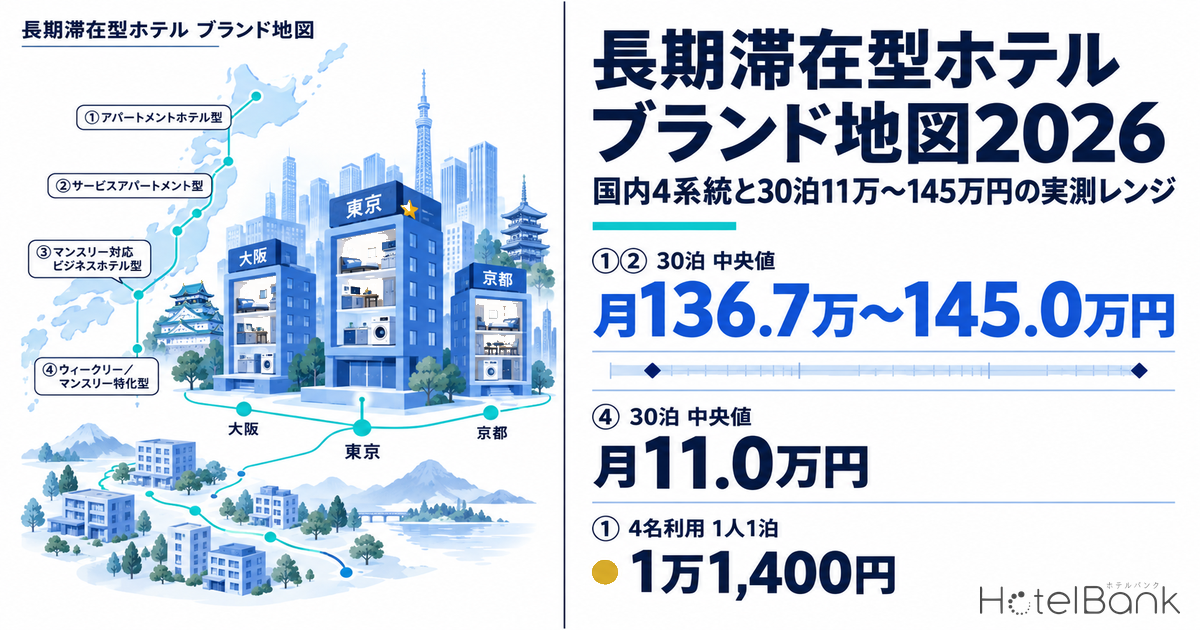
- — The median 30-night listed price is ¥1.367M–¥1.450M per month for types 1 and 2, versus ¥110,000 per month for type 4 (October 5 – November 3, 2026, N=75 properties).
- — A tenfold gap is not a gap in profitability. Split among four guests, a type 1 room works out to ¥11,400 per person per night (median, estimate); its real competitor is a limited-service hotel where a group must book several rooms.
- — 2026 saw openings from Mitsubishi Estate (WAYPOINT), ORIX (CROSS Suites) and The Ascott Japan (Oakwood Oimachi Tracks Tokyo), while MIMARU targets 3,000 rooms by 2030.
- — Type 2 properties requiring stays of 30+ nights are hard to see in public price data, so corporate contract rates must be checked directly. For existing operators, type 3 monthly plans are the entry point requiring the least additional investment.
Long-Stay Brands Fall into Four Types
Properties lumped together as “long-stay” actually comprise four types that differ sharply in facilities, minimum stay and target guests. The first step in any entry discussion is agreeing which type is being talked about. Each type requires a different level of investment, different sales channels to win, and faces different substitutes.
| Type | Facilities / typical minimum stay | Target guests | Representative brands (alphabetical) |
|---|---|---|---|
| 1. Apartment hotel | In-room kitchen and washer-dryer; rooms mostly sleep 4–6. Sold from one night. | Inbound families and groups; a few nights to two weeks | CROSS Suites / GRAND BASE / MIMARU / Minn / WAYPOINT |
| 2. Serviced apartment | Residential-grade facilities and weekly housekeeping. Some properties require 30+ nights. | Expatriates and corporate assignees; 1–12 months | Ascott / Citadines / lyf / Oakwood / Somerset |
| 3. Business hotel with monthly plans | Monthly plans layered onto existing limited-service rooms. No lease required. | Long business trips and solo job transfers; 1–3 months | APA Hotel Monthly Plan / Hotel Livemax “Hotel Biz Monthly (ホテルビズマンスリー)” and others |
| 4. Weekly/monthly specialist | Basic facilities and shared laundry. Pricing mainly by the week or month. | Construction, plant maintenance shutdowns, regional postings; several weeks to several months | Local and independent properties branded “weekly” or “monthly” |
Source: Compiled by HotelBank Editorial Team from company disclosures and the MetroEngines Research property master
The line between types 1 and 2 is the minimum stay. Apartment hotels sell from one night, so they appear in daily OTA inventory and their prices move on the same field as leisure demand. Properties that require 30+ nights, by contrast, never generate daily listings at all, which makes them structurally hard to see in market statistics and price data. That invisibility is itself the first issue to address when considering entry into type 2.
Expansion Plans from Company Disclosures — Room Targets Line Up Toward 2030
Expansion scale for each type is quoted directly from figures the companies themselves have published. Because operators count “properties” differently (directly operated only, including partner/franchise properties, or including overseas), this article does not rank them side by side.
| Type | Brand / operator | Published expansion scale and plans | Source |
|---|---|---|---|
| 1 | MIMARU (Cosmos Hotel Management) | Reached 28 properties and 1,500 rooms with the opening of MIMARU Osaka Shinsaibashi CENTRAL on September 1, 2026. Targets 3,000 rooms by 2030. New rooms are split evenly between 4-person and 6-person capacity. | Cosmos Initia / Cosmos Hotel Management disclosures (March and September 2026) |
| 1 | WAYPOINT (Mitsubishi Estate) | First property in Tsukiji, Chuo-ku, Tokyo, with 52 rooms, opened April 1, 2026. Targets 10 openings by 2030. Positioned for larger groups and multi-night stays. | Mitsubishi Estate news release (February 2, 2026) |
| 1 | CROSS Suites (ORIX Hotel Management) | First property, CROSS Suites Tokyo Asakusa (クロススイーツ東京浅草), has 78 rooms and opened July 3, 2026. Rooms sleep up to 6, with mini-kitchens and laundry available. With this opening, the company’s directly operated portfolio reached 15 properties across 6 brands. | ORIX Real Estate news releases (December 2025, February 2026) |
| 2 | The Ascott Japan (Ascott / Somerset / Citadines / Oakwood / lyf) | Operates 21 properties under 5 brands in Japan, with plans to expand to about 40 properties over the next five years. Opened Oakwood Oimachi Tracks Tokyo (78 rooms, 30+ nights) on June 25, 2026. Regional resorts such as Hakuba (Nagano) and Hakone (Kanagawa) have been reported as candidate locations. | The Ascott Japan press release (March 2026) / Nikkei (November 2024) |
| 3 | Hotel Biz Monthly (Hotel Livemax) | Offers existing business hotel rooms on a monthly basis. States that the 30-night monthly rate starts from ¥100,000 and varies by area. Promotes free Wi-Fi, microwaves, rental meeting rooms and more. | Livemax Co., Ltd. announcement (February 26, 2021) |
| 3 | APA Hotel Monthly Plan | Maintains a dedicated monthly plan page on its official website, explicitly treating long stays as a product line. Its nationwide directly operated network can be repurposed as-is to absorb long-stay demand. | APA Hotel official website |
Source: Compiled by HotelBank Editorial Team from company disclosures (no side-by-side ranking, as each operator defines property counts differently)
Overseas operators are moving in the same direction. Hilton has partnered with furnished-apartment operator Placemakr and announced that a new category, “Apartment Collection by Hilton,” would open for booking via Hilton.com in the first half of 2026. The initial markets are New York, Washington, D.C. and Atlanta, with units ranging from studios to four bedrooms. No expansion into Japan has been announced, but the fact that a global chain has formally built long stays into its brand hierarchy also bears on how the Japanese types are organized. Hoshino Resorts likewise opened OMO5 Yokohama Bashamichi (OMO5横浜馬車道) in January 2026, stating that all 175 rooms have washer-dryers and cooking utensils — apartment-style specifications are also appearing inside existing brands.
30-Night Listed Prices Differ Tenfold by Type — ¥110,000 vs ¥1.45M
Next, we measure price levels by type. For the 30 nights from October 5 to November 3, 2026, we took the per-night average of each property’s lowest-plan listed price (two guests per room, tax included), then calculated the median and quartiles for each type. Only properties with 20 or more observed nights are included.
Source: Compiled by MetroEngines Research and HotelBank Editorial Team (period October 5 – November 3, 2026, N=75 properties)
| Type | Properties | Total rooms | Per-night median | 30-night Q1 | 30-night median | 30-night Q3 |
|---|---|---|---|---|---|---|
| 1. Apartment hotel | 57 | 2,255 | ¥45,600 | ¥916,400 | ¥1,366,500 | ¥2,424,800 |
| 2. Serviced apartment | 5 | 943 | ¥48,300 | ¥878,400 | ¥1,449,700 | ¥1,455,600 |
| 4. Weekly/monthly specialist | 13 | 528 | ¥3,700 | ¥84,000 | ¥110,500 | ¥148,500 |
Source: Compiled by MetroEngines Research and HotelBank Editorial Team (lowest plan, two guests per room, tax included; per-night average over 30 nights calculated for each property. Multi-night discounts and dedicated monthly rates not reflected)
Type 3, business hotels with monthly plans, sells at dedicated monthly rates and therefore does not appear in daily listing data. Hotel Livemax’s published level of “from ¥100,000 per month for 30 nights” sits in almost the same range as the measured type 4 median of ¥110,000 per month. In other words, prices form a two-tier structure: types 3 and 4 overlap in the lower tier, and types 1 and 2 overlap in the upper tier.
The key point is that a per-room rate for types 1 and 2 more than ten times that of type 4 does not in itself mean higher profitability. Type 1 rooms mostly sleep 4–6, and Cosmos Hotel Management has stated that its new rooms are split evenly between 4-person and 6-person capacity. A room may be expensive, but split among four guests the per-person nightly cost falls to the ¥10,000 range. Type 1’s competitors are not type 4 business hotel rooms but limited-service hotels where the same number of guests must book several rooms, or short-stay residential inventory. Comparing per-room rates across types does not support a decision.
Sensitivity Analysis — How Far Party Size and Multi-Night Discounts Move the Rate
To quantify the gap between per-room and per-person rates, we present estimates that move the Table 3 distribution along two axes. The first converts type 1’s 30-night listed prices (Q1, median, Q3) into per-person, per-night figures for parties of two, four and six. The second applies multi-night discounts of 0%, 10% and 20% to each type’s 30-night median; the 20% upper bound matches the measured market rate of 20% at 30 nights in our separate analysis of long-stay discounts at Japanese hotels.
| Party size | Q1 | Median | Q3 |
|---|---|---|---|
| 2 guests | ¥15,300 | ¥22,800 | ¥40,400 |
| 4 guests | ¥7,600 | ¥11,400 | ¥20,200 |
| 6 guests | ¥5,100 | ¥7,600 | ¥13,500 |
Source: Compiled by MetroEngines Research and HotelBank Editorial Team (30-night listed price ÷ 30 ÷ party size, rounded to the nearest ¥100. N=57 properties. Prices were queried for two guests per room, so actual room rates for four or six guests may be higher; the 4- and 6-guest columns are lower-bound guides)
| Type | No discount | 10% discount | 20% discount |
|---|---|---|---|
| 1. Apartment hotel | ¥1,367,000 | ¥1,230,000 | ¥1,093,000 |
| 2. Serviced apartment | ¥1,450,000 | ¥1,305,000 | ¥1,160,000 |
| 4. Weekly/monthly specialist | ¥110,000 | ¥99,000 | ¥88,000 |
Source: Compiled by MetroEngines Research and HotelBank Editorial Team (estimates applying a uniform discount rate to the 30-night medians in Table 3. N=75 properties. Actual discount rates vary by property and season)
Used by four guests, a type 1 room costs ¥11,400 per person per night even at the median, and a Q1 property shared by six falls to ¥5,100. Meanwhile, a 10% discount alone brings type 4’s monthly rate to ¥99,000, virtually matching the “from ¥100,000 per month” level published for type 3. In the upper tier (types 1 and 2), party size is the variable that determines the effective rate; in the lower tier (types 3 and 4), it is how multi-night discounts are set. Which variable to fix first when designing pricing at entry also depends on the type.
The type 2 sample of only five properties is not a gap in the data but a reflection of the business model itself. Oakwood Oimachi Tracks Tokyo, opened by The Ascott Japan in June 2026, requires stays of 30+ nights, and properties like this are never published as daily inventory. The type 2 properties observable in daily data are limited to some Citadines and lyf properties that also sell from one night. When considering entry, assume that public price data offers little benchmark for type 2, and check corporate contract rates directly.
Location Splits by Type: Three Major Cities vs Regional Areas
Looking at the location of each type, the upper and lower tiers divide neatly by area. Types 1 and 2 concentrate in Tokyo, Kyoto and Osaka, while type 4 is located in regional hubs outside the three major cities.
Type 1 apartment hotels are notably concentrated in the three major cities of Tokyo, Kyoto and Osaka, while also spreading into regional cities on inbound visitors’ travel circuits. This is an expansion that follows the touring patterns of inbound families, and the 3,000-room target for 2030 published by Cosmos Hotel Management sits on the same trajectory.
Type 2 is limited to city centers where corporate assignment demand clusters, with four properties in Tokyo and one in Osaka. The Ascott Japan’s published plan to expand to about 40 properties over the next five years, with regional resorts such as Hakuba (Nagano) and Hakone (Kanagawa) cited as candidates, suggests that type 2’s location criteria are widening from “where expatriates work” to “places where the long stay itself is the purpose.”
Most of the 13 type 4 properties in the sample were outside the three major cities. This type serves as the receptacle for work-driven stays — construction, plant maintenance shutdowns and regional postings — and differs fundamentally from types 1 and 2 in that its demand does not originate from tourism. As for how much long-stay room stock exists in regional areas, our tally of the 28 municipalities designated for dual residence found long-stay-type rooms at only 6.0% of inventory, so supply remains thin.
Entry Considerations Differ by Type
Here we reorganize the analysis into a form usable for entry decisions. Each type differs in the nature of its investment, its sales channels and its competing substitutes.
| Type | Investment and design essentials | Main sales channels | Competing substitutes |
|---|---|---|---|
| 1 | In-room kitchens and washer-dryers make plumbing and ventilation costs heavier than for limited-service hotels. Larger rooms mean fewer keys on the same floor area. | Mainly daily online sales. Subject to the same price swings as leisure demand. | Limited-service hotels booked as multiple rooms; short-stay residential inventory |
| 2 | Requires residential-grade facilities and an operating setup that includes weekly housekeeping. Occupancy depends on corporate contracts; daily price elasticity is low. | Mainly direct corporate sales and relocation companies. Public price data is thin. | Corporate leased housing; furnished rentals |
| 3 | Entry is possible with almost no additional investment by layering monthly plans onto existing rooms. The key is designing it to lift off-season occupancy. | Own website and corporate contracts. Existing direct sales infrastructure can be used as-is. | Monthly apartments; type 4 specialist properties |
| 4 | Light capital expenditure; viable even in regional hubs. Because demand is tied to work, it moves with local events such as construction projects and maintenance shutdowns. | Direct deals with local companies; own website. | Weekly apartments; dormitories and temporary worker housing |
Source: Compiled by HotelBank Editorial Team based on company disclosures and MetroEngines Research data
For existing hotel operators, type 3 has the lowest barrier to entry. Monthly products can be layered onto rooms they already own with almost no additional capital expenditure. As APA Hotel’s permanent monthly plan page on its official website shows, a nationwide directly operated network can serve as a long-stay receptacle as-is. Hotel Livemax’s Hotel Biz Monthly is another example of repackaging existing business hotel inventory into a monthly product, and its published level of from ¥100,000 for 30 nights is priced to compete head-on with the measured type 4 range. Some existing international hotels also offer long-stay plans (for example, Hilton Tokyo Odaiba), so the idea of repurposing existing rooms is not limited to limited-service hotels. For when long-stay discounts start to kick in, see our separate analysis of measured market rates of 15% at 7 nights and 20% at 30 nights.
New entry into type 1, on the other hand, requires committing to the type from the design stage. Placing kitchens and washer-dryers in rooms increases plumbing and ventilation costs, and larger rooms reduce the key count on the same floor area. The opening scales of Mitsubishi Estate’s first WAYPOINT in Tsukiji (52 rooms) and ORIX’s CROSS Suites Tokyo Asakusa (78 rooms) show that this type takes shape at mid-scale. The decision hinges on whether a structure with high per-room rates but a capped room count can be recouped through per-person rates from larger parties. For how the market as a whole is taking off, see Long-Stay Hotels Take Off in Tokyo: Mitsubishi Estate WAYPOINT and Hilton Enter the Market.
Summary
Japan’s long-stay brands can be organized into four types: apartment hotels, serviced apartments, business hotels with monthly plans, and weekly/monthly specialists. The 30-night listed price shows a tenfold gap — ¥1.367M–¥1.450M per month for the upper-tier types 1 and 2 versus ¥110,000 per month for the lower-tier type 4 — but this reflects differences in room capacity and the nature of demand, not a difference in profitability.
2026 was the year Mitsubishi Estate, ORIX and The Ascott Japan opened new properties in quick succession and each published room targets toward 2030. For those considering entry, there are three practical implications. First, define which type your “long-stay” business is before discussing it. Second, because type 2’s minimum stays of 30+ nights make it invisible in public price data, check corporate contract rates directly. Third, for existing hotel operators, type 3 monthly plans are the lowest-barrier entry point to test, allowing verification to start from leveraging existing assets to lift off-season occupancy.
⚠ Note on listed prices for future dates: The listed prices for October 5 – November 3, 2026 compiled in this article are selling prices published on OTAs and similar channels at the time of the survey, and they change as check-in dates approach. Current levels will not necessarily become booked prices. Multi-night discounts and dedicated monthly rates are also not reflected, so actual monthly costs may be lower.
Related Articles
- Long-Stay Hotels Take Off in Tokyo: Mitsubishi Estate WAYPOINT and Hilton Enter the Market
- Hotel Subscription Market Tipping Point 2026 — goodroom, unito, HafH Disrupt Settled-Living Hotel Demand
- Inbound Stay Length Varies 2.0x: Tokyo 2.32 vs Yamanashi 1.16 Nights
- Monthly Hotels in Japan: No Lease, 20% Off at 30 Nights (Aug 2026)
- APA Hotel Multi-Night Stays: Day Mix Saves 10%, Monthly Plan 29%
- Japan Hotel Long-Stay Discounts: 15% at 7 Nights, 20% at 30 Nights
References and Sources
■ Data Sources
MetroEngines Research listed-price data and property master. From property and brand names, 108 properties qualifying as long-stay were extracted and classified into four types; the 75 properties with observed prices for at least 20 of the 30 nights from October 5 to November 3, 2026 (type 1: 57, type 2: 5, type 4: 13) were included in the price analysis. Expansion scale and opening information are quoted from company news releases, official websites and press reports.
■ Estimation Assumptions
Listed prices are each property’s lowest plan, two guests per room, tax included. The per-night average over 30 nights was calculated for each property, the median and quartiles were calculated for each type, and these were multiplied by 30 to give the 30-night rate. The per-person figures in Table 4 are 30-night rate ÷ 30 ÷ party size; Table 5 applies uniform multi-night discounts of 0%, 10% and 20% to the 30-night median.
■ Limitations
These are listed prices for future dates and do not match booked prices or amounts billed after long-stay discounts. Properties requiring 30+ nights and dedicated monthly rates do not appear in daily listings, so observation of types 2 and 3 is limited. The type classification is a working framework for this article, not an official industry classification. Company property counts are defined differently and are not used for side-by-side comparison.
■ Market Data
- MetroEngines Research — Listed-price data and property master (period October 5 – November 3, 2026; N=75 properties analyzed)
■ Company Disclosures (in Japanese unless noted)
- Cosmos Initia, “Accelerating Expansion of Apartment Hotel MIMARU in the Osaka Area” (March 2026)
- Jutaku Sangyo Shimbun, “Cosmos Initia to Scale Apartment Hotels to 3,000 Rooms by 2030”
- Mitsubishi Estate, “Full-Scale Entry into the Apartment Hotel Business” (February 2, 2026)
- ORIX Real Estate, “Reservations Open for CROSS Suites Tokyo Asakusa, Opening July 3, 2026” (February 2026)
- ORIX Real Estate, “Launch of New Brand CROSS Suites” (December 2025)
- The Ascott Japan, “Oakwood Oimachi Tracks Tokyo to Open June 25, 2026”
- Livemax, “Launch of Hotel Biz Monthly, Enabling Long Stays at Business Hotels”
- APA Hotel, “Why Choose the APA Hotel Monthly Plan”
- Hilton, “Hilton Introduces Apartment Collection by Hilton” (English)
- Hoshino Resorts, “OMO5 Yokohama Bashamichi to Open January 15, 2026” (PR TIMES)
■ Press Reports (in Japanese)