


Japan Hotel REIT Investment Corporation (ジャパン・ホテル・リート投資法人; TSE 8985, “JHR”) announced on November 25, 2026 that it has decided to renovate Hyatt Regency Tokyo (ハイアット リージェンシー 東京), which it owns in Nishi-Shinjuku, Shinjuku City, Tokyo. The renovation budget doubles from the ¥1.5bn assumed at acquisition to ¥3.0bn, yet the assumed post-renovation NOI yield has been raised to 7.0%, above the 6.4% assumed at acquisition. Why does the yield go up when the cost doubles? This article breaks down the assumptions in the disclosure documents to calculate how much income the additional ¥1.5bn is expected to generate, and overlays the change in room mix and the Nishi-Shinjuku market and supply picture using our own data.
• ADR (Average Daily Rate) = an estimated settled rate (tax-excluded equivalent) calculated by applying a property-type correction factor to the lowest plan level each property publishes on OTAs (per-room rate for two guests sharing one room, tax included). Checked against property-level results disclosed by listed hotel REITs (91 properties, latest three months), the median error is about 7%. These are estimates and differ from each property’s actual settled prices and accounting figures.
• Area-level ADR (prefecture / municipality) is the median estimated settled rate of the properties covered (the level of a typical property in the area).
• Where listed prices are mentioned, they are per-room rates for two guests sharing one room (tax included).
• OCC (occupancy) = rooms sold as a share of total rooms in the area (an estimate based on OTA sales inventory).
• Source: MetroEngines Research (continuously tracks OTA public prices for about 168,000 properties in Japan, of which about 27,000 are confirmed active)
MetroEngines Research tracks about 168,000 properties in Japan and analyzes about 27,000 properties (about 1.26 million rooms) confirmed as active on OTAs. Note that all NOI, yield and RevPAR figures cited in this article are assumptions or forecasts stated in JHR’s disclosure documents, not the hotel’s actual results. Where actual figures are used, this is stated explicitly.
- — ¥3.0bn renovation, 7.0% assumed NOI yield — JHR doubled the renovation budget from the ¥1.5bn assumed at acquisition while raising the assumed post-renovation NOI yield from 6.4% to 7.0% (disclosed November 25, 2026)
- — NOI uplift on the extra ¥1.5bn is about ¥0.9bn (about 60%) — Because this ratio is an order of magnitude higher than the overall investment yield (6–7%), the yield rises even though the denominator grows by about 1.2% (our calculation from JHR’s assumptions)
- — 7.0% depends on the effect of the additional works — If the extra works add just under ¥0.1bn of NOI a year, the yield stays at about the 6.4% assumed at acquisition; if the post-renovation NOI assumed at acquisition falls 5% short, the yield is about 6.7% (our estimate)
- — Rooms: 712 → 706 (simple calculation) — 11 new medium-to-long-stay rooms, 34 rooms combined into 17, and renovation of 77 Club Floor rooms: designed to raise revenue per room rather than room count
- — Estimated settled ADR of city hotels in Shinjuku City: +15.5% in October 2026(N=12 properties), but below the prior year in June–August. Room stock within a 1km radius has been flat at 9,089 rooms since 2023
Key Points of the Disclosure — Wider Scope, Cost Up from ¥1.5bn to ¥3.0bn
The renovation consists of three projects. To the two planned since acquisition — (1) new medium-to-long-stay rooms in an unused area on the 5th floor and (2) combining small rooms — JHR has added (3) a renovation of all guest rooms on the Club Floors (6th–9th floors). JHR explains the addition by saying that, “in light of the currently strong market conditions,” it judged that further revenue growth could be expected. The works are scheduled for March–December 2027 and are to be funded by borrowings or cash on hand.
The assumed effects are set out below. For comparison, the “pre-additional-renovation assumptions” and RevPAR stated in the supplementary materials of February 25, 2026, when the acquisition was announced, are also shown. Note that the November 25 document explicitly states that the post-renovation figures are “not forecasts for any specific fiscal period and are used solely for the purpose of formulating an investment plan” (Note 3).
| Item | FY12/2026 forecast (annualized) | At acquisition: before additional renovation | At acquisition: after additional renovation | Current: after renovation |
|---|---|---|---|---|
| Renovation cost (CAPEX III) | — | — | approx. ¥1.5bn | ¥3.0bn |
| NOI | ¥6,243m (approx. ¥6.2bn) | ¥7,061m | ¥8,125m (approx. ¥8.1bn) | approx. ¥9.0bn |
| NOI yield | 5.0% | 5.6% | 6.4% | 7.0% |
| NOI yield after depreciation | 4.3% | 4.9% | 5.6% | 6.2% |
| NOI yield after depreciation (adjusted) | 4.7% | 5.3% | 6.0% | 6.6% |
| RevPAR | ¥47,469 | ¥49,877 | ¥55,630 | Not stated |
| Yield denominator | Acquisition price ¥126.0bn | Acquisition price ¥126.0bn | ¥126.0bn + approx. ¥1.5bn | ¥126.0bn + ¥3.0bn |
What the table shows is that the assumed post-renovation NOI has been raised by about ¥0.9bn from the plan at acquisition. Against the FY12/2026 forecast of about ¥6.2bn, that is an increase of about ¥2.8bn, but this gap also includes operational measures assumed since acquisition — more refined revenue management and stronger banquet sales — as well as the market outlook, so it is not purely the effect of the renovation. In the acquisition materials, the pre-additional-renovation assumption (¥7,061m) already built in an increase of about ¥0.8bn over the 2026 forecast.
Why the Yield Rises Even Though the Cost Doubles — NOI Uplift of About 60% on the Extra ¥1.5bn
Yield is NOI divided by the amount invested, so it rises if the numerator grows faster than the denominator. Here the denominator (acquisition price + increase in book value from the renovation) grows only about 1.2%, from ¥127.5bn to ¥129.0bn. The numerator, assumed NOI, rises by about 10%, from about ¥8.1bn to about ¥9.0bn. The gap between the two growth rates is what lifts the yield from 6.4% to 7.0%.
Isolating the additional portion makes the relationship clearer. Against the ¥1.5bn added to the renovation budget versus the acquisition assumption, assumed NOI rises by about ¥0.9bn.
= (current assumed post-renovation NOI approx. ¥9.0bn − post-renovation NOI assumed at acquisition approx. ¥8.1bn) ÷ (¥3.0bn − ¥1.5bn)
= approx. ¥0.9bn ÷ ¥1.5bn ≒ approx. 60%
*Using the ¥8,125m in the supplementary materials as the NOI assumed at acquisition gives (approx. ¥9.0bn − ¥8.125bn) ÷ ¥1.5bn ≒ about 58%. Because the current assumed NOI is disclosed only as a rounded “approx. ¥9.0bn,” the ratio carries a range of a few percentage points. Both figures are our calculations from JHR’s assumptions and are neither actual results nor forecasts.
Compared with the overall investment yield (6–7%), the ratio on the additional portion is an order of magnitude higher. Merely keeping the overall yield at the level assumed at acquisition (about 6.4%) would require the extra ¥1.5bn to generate just under ¥0.1bn of NOI a year. The current plan therefore assumes an uplift roughly nine times that. Put the other way, the 7.0% level depends on how far the additional works deliver as assumed. The table below shows our estimate of the yield when the NOI uplift from the extra ¥1.5bn is varied, holding all other assumptions constant.
| Annual NOI uplift from the extra ¥1.5bn | Assumed NOI | NOI yield (denominator ¥129.0bn) | How to read |
|---|---|---|---|
| ¥0 | ¥8.125bn | 6.30% | Additional works generate no income |
| ¥0.1bn | ¥8.225bn | 6.38% | Roughly in line with the acquisition assumption (6.4%) |
| ¥0.3bn | ¥8.425bn | 6.53% | — |
| ¥0.5bn | ¥8.625bn | 6.69% | — |
| ¥0.7bn | ¥8.825bn | 6.84% | — |
| approx. ¥0.875bn | approx. ¥9.0bn | approx. 7.0% | Equivalent to the current disclosure |
The NOI yield after depreciation is also assumed to rise, from 5.6% to 6.2%. A higher book value from the renovation increases depreciation, but JHR plans to apply negative goodwill to an amount equivalent to the assumed depreciation of building equipment for the three years 2026–2028; the adjusted figure reflecting that assumption goes from 6.0% to 6.6%.
The estimate above assumes that the post-renovation NOI assumed at acquisition (¥8,125m) is achieved as planned. Varying that assumption as well gives the following range of yields. The vertical axis is the achievement rate of the post-renovation NOI assumed at acquisition, the horizontal axis is the NOI uplift from the extra ¥1.5bn, and the denominator is fixed at ¥129.0bn in this simple calculation of ours.
| Achievement of post-renovation NOI assumed at acquisition | Uplift ¥0 | Uplift ¥0.3bn | Uplift ¥0.5bn | Uplift ¥0.7bn | Uplift ¥0.875bn |
|---|---|---|---|---|---|
| 90% (¥7.312bn) | 5.67% | 5.90% | 6.06% | 6.21% | 6.35% |
| 95% (¥7.719bn) | 5.98% | 6.22% | 6.37% | 6.53% | 6.66% |
| 100% (¥8.125bn) | 6.30% | 6.53% | 6.69% | 6.84% | 6.98% |
| 105% (¥8.531bn) | 6.61% | 6.85% | 7.00% | 7.16% | 7.29% |
| 110% (¥8.938bn) | 6.93% | 7.16% | 7.32% | 7.47% | 7.61% |
If the acquisition assumption is met (100%) and the additional portion delivers the assumed uplift, the yield is about 7.0%; even if the acquisition assumption falls 5% short, the yield is 6.66% as long as the additional portion performs as assumed, still above the 6.4% assumed at acquisition. Conversely, if the acquisition assumption falls 10% short and the additional portion adds only ¥0.3bn, the yield is 5.90%, close to the pre-additional-renovation assumption of February 2026 (5.6%). Both the effect of the additional works and the effect of the operational measures assumed since acquisition underpin the 7.0%.
Change in Room Mix — Investment Tilted Toward Groups, Long Stays and the Club Floors
Next, we look room by room at where the ¥3.0bn goes. According to JHR’s acquisition materials, the hotel is a large full-service property with 28 floors above ground, 712 rooms (before the additional renovation) and an average room size of 34㎡, and it completed a major ¥9.4bn renovation between May 2024 and July 2025. At that time it had already combined 68 rooms into 34 (32㎡/24㎡ → 64㎡/48㎡), and the current room combination extends that approach.
| Works | Scope | Before | After | Aim (JHR’s explanation) |
|---|---|---|---|---|
| (1) New medium-to-long-stay rooms | 5th floor (unused area, former wedding-related facilities) | 0 rooms | 11 rooms (avg. approx. 60㎡, all for 4+ guests) | High-rate leisure demand from larger parties. Equipped with kitchen, washer-dryer, etc. |
| (2) Room combination | 2 rooms on each floor from 10F to 26F | 34 rooms (24㎡) | 17 rooms (48㎡) | Lift both ADR and occupancy of small, underperforming rooms |
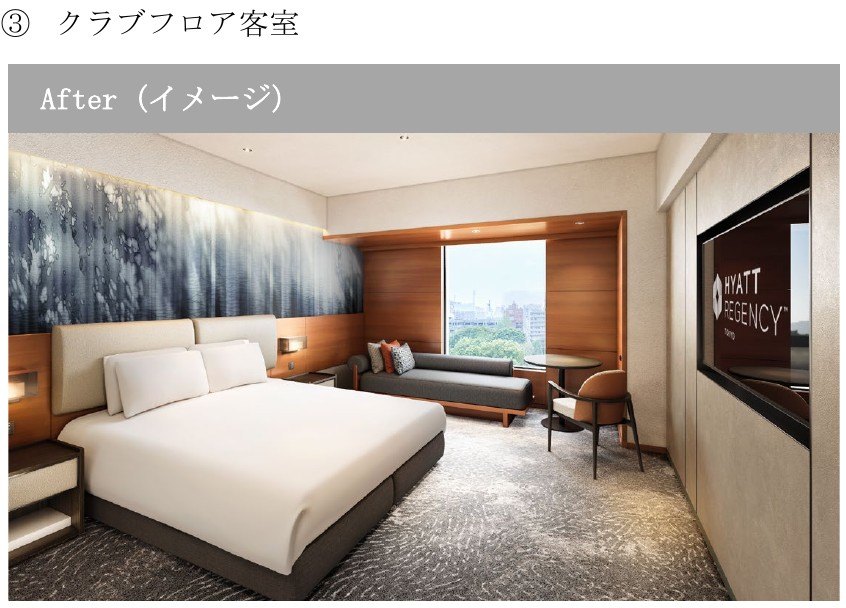
| (3) Club Floor room renovation | All rooms on 6F–9F | 77 rooms | 77 rooms (59 Club rooms, 18 suites) | Full in-room renovation to raise ADR |
| Room count (simple calculation) | 712 rooms | 706 rooms | +11 new, −17 from combination. The post-renovation total room count is not stated in the disclosure; this is our simple calculation | |
What the three projects have in common is that they aim to raise “earnings per room” rather than the “number” of rooms. Room combination cuts sellable inventory by 17 rooms, so each combined room must earn more than the room revenue of the two rooms it replaces for income to increase. That is why JHR targets a “significant increase in both ADR and occupancy,” and the judgment appears to be that a single 48㎡ room captures family and group demand more easily than two 24㎡ rooms.
The 11 new rooms fit the same logic. The acquisition materials put the share of inbound guests at Hyatt Regency Tokyo at about 90% (actual, January–December 2025) and cited strong demand from Western travelers, who pay higher room rates, as a growth driver. Rooms of about 60㎡ that sleep four or more and have a kitchen and washer-dryer can be seen as a product for families and groups staying several nights with large luggage. Because an unused area is being converted into guest rooms, sellable inventory is added without cannibalizing revenue from existing rooms.
The 77 Club Floor rooms are the largest project by scale. The Club Lounge was already refreshed in the 2024–2025 renovation; this time the aim is to bring the rooms themselves up to a standard “befitting a Club room” and add to ADR. It is a project that raises rates without changing the room count. The 105 rooms covered after renovation (11 new, 17 combined, 77 Club) equal about 15% of the post-renovation room count (706 by simple calculation). Dividing ¥3.0bn simply by 105 rooms gives about ¥28.6m per room, but because the works differ greatly in content, this is a reference figure only.
The brand positioning is also worth confirming. Hyatt Hotels Japan’s press materials (April 2026) classify “Hyatt Regency” in the Classics portfolio, and the list of hotels in Japan in the same materials shows Hyatt Regency Tokyo as opened in September 1980 with 746 rooms. This article uses JHR’s disclosed figure of 712 rooms (before the additional renovation, as of February 25, 2026).
The Nishi-Shinjuku Location — Directly Linked to Tochomae Station; Shinjuku Commercial Land Prices +13.8% YoY
| Shinjuku City commercial land, average price | ¥6,159,400/㎡ |
| Shinjuku City commercial land, YoY change | +13.8% |
| Central 5 wards commercial land, YoY change | +13.6% |
The hotel sits among the skyscrapers of the Shinjuku sub-center and is connected underground to Tochomae Station. According to the Tokyo Metropolitan Government Bureau of Finance, in the 2026 Official Land Price Publication commercial land in Shinjuku City averaged ¥6,159,400/㎡, up 13.8% year on year, continuing to rise in line with the central five wards average (+13.6%). When both land prices and construction costs are rising, investment that remakes rooms in an existing hotel tends to require less capital than achieving the same income through new construction. JHR also noted in its acquisition materials that soaring construction costs are expected to limit new supply in central Tokyo for the time being. Shinjuku is also drawing attention in the transaction market: we track investment volumes inJapan Hotel Investment H1 2026: $1.9bn, +75% YoY, 28% of APAC, and development economics in Shinjuku inIsetan Mitsukoshi Shinjuku Hotel: ¥51k–¥66k ADR to Beat a Land Sale.
The Nishi-Shinjuku Market — Shinjuku City Hotels +15.5% YoY in October
We check the “strong market” underpinning the renovation against our own data. The estimated settled ADR of city hotels in Shinjuku City (N=12 properties) was ¥43,300 in October 2026, up 15.5% year on year. All categories in Shinjuku City (N=102 properties) moved in the same direction in October, at ¥19,300 (+13.0%). On the other hand, in June–August 2026 Shinjuku City city hotels were down 16.5–27.8% year on year and Tokyo city hotels (N=107–109 properties) were down 12.8–20.6%, so growth has not been steady throughout the year. Comparing January–October 2026 averages, Shinjuku City city hotels were −3.4% year on year, Tokyo city hotels −4.6%, and all categories in Shinjuku City +5.8%.
| Month | Shinjuku City city hotels ADR | YoY | Tokyo city hotels ADR | YoY | Shinjuku City all categories ADR | YoY |
|---|---|---|---|---|---|---|
| June 2026 | ¥24,755 | −17.7% | ¥22,195 | −12.8% | ¥12,946 | −5.8% |
| July 2026 | ¥25,619 | −16.5% | ¥22,434 | −17.1% | ¥13,259 | −7.7% |
| August 2026 | ¥24,538 | −27.8% | ¥21,265 | −20.6% | ¥12,425 | −8.3% |
| September 2026 | ¥28,476 | 0.0% | ¥24,650 | −10.3% | ¥15,127 | +1.1% |
| October 2026 | ¥43,252 | +15.5% | ¥31,731 | −0.7% | ¥19,272 | +13.0% |
| Jan–Oct 2026 average | ¥31,599 | −3.4% | ¥26,214 | −4.6% | ¥15,853 | +5.8% |
Note that Shinjuku City has only 12 city hotels in the sample, so month-to-month swings tend to be large. Also, under our classification most of the large international hotels in Nishi-Shinjuku, including Hyatt Regency Tokyo, fall into the “Deluxe” category and are outside the estimated settled ADR coverage. For reference, the listed price (average of all plans, tax included, two guests per room) for the Deluxe category in Shinjuku City (N=6 properties) was ¥107,300 in October 2026; because the number of properties in that category changed from five a year earlier, no YoY figure is shown. The high October level broadly matches the “currently strong market” JHR describes.
Nearby Supply — 9,511 Rooms Within 1km, Almost Flat Since 2023
Room stock in this article covers accommodation with 10 or more rooms (excluding leisure hotels) within a 1,000m radius of Hyatt Regency Tokyo; “active” means properties whose selling prices were confirmed on major booking sites in the latest three months (September–November 2026) (as of November 26, 2026, compiled by MetroEngines Research).
On this definition, 31 properties with 9,511 rooms are listed within a 1km radius of Hyatt Regency Tokyo, of which 28 properties with 9,099 rooms are active. Large properties with 201 or more rooms account for most of the rooms (14 properties, 8,139 rooms); by category there are 17 business hotels (4,984 rooms), 4 Deluxe (3,180 rooms) and 4 city hotels (1,076 rooms). Looking at properties with a known opening year, room stock grew from 7,956 rooms in 2017 to 9,251 in 2020, and has been flat at 9,089 rooms in 2023–2026.
This chart is based on OTA listing confirmation. Only about 19% of properties are listed on OTAs before opening, and more than half are listed after opening, so the count for recent months/years may rise as further listings appear. We recommend reading it alongside the building-plan pipeline based on building confirmation applications (MLIT “Statistical Survey on Building Construction Starts”).
| Property (main large full-service / city hotels within 1km) | Rooms | Distance | Notes |
|---|---|---|---|
| Keio Plaza Hotel (京王プラザホテル) | 1,438 rooms | approx. 360m | Opened 1971 |
| Hilton Tokyo (ヒルトン東京) | 830 rooms | approx. 180m | Relocated to Nishi-Shinjuku in 1984 |
| Hyatt Regency Tokyo (ハイアット リージェンシー 東京) | 712 rooms | — | Owned by JHR. Renovation planned March–December 2027 |
| THE KNOT TOKYO Shinjuku | 408 rooms | approx. 350m | — |
| Odakyu Hotel Century Southern Tower (小田急ホテルセンチュリーサザンタワー) | 375 rooms | approx. 920m | Rooms closed October 2026–spring 2028; 377 rooms after renovation |
| Park Hyatt Tokyo (パーク ハイアット 東京) | 171 rooms | approx. 480m | Opened July 1994 |
| Kimpton Shinjuku Tokyo (キンプトン新宿東京) | 151 rooms | approx. 610m | Opened 2020 |
The biggest supply-side change nearby is Odakyu Hotel Century Southern Tower (375 rooms) on the Shinjuku Station South Exit side. According to the hotel’s news release (December 16, 2025), accommodation was suspended at the end of September 2026; guest rooms are closed from October 2026 to spring 2028, banquet and meeting rooms from April 2027 to spring 2028, and restaurants and lounges from April to autumn 2027. The grand reopening is targeted for spring 2028, with 377 rooms planned after renovation. The 28 active properties above include this hotel, which was selling rooms until September.
On the new-opening side, the building plans we compile from building confirmation applications (10 or more rooms, 91 projects at the time of the survey) included no project located in Shinjuku City. However, confirmation applications are usually filed one to two years before opening, so this count should be regarded as a lower bound at present. An environment in which supply is unlikely to increase significantly is one of the tailwinds for investment that upgrades room quality through renovation.
Impact During the Works — FY12/2027 Forecast Not Yet Published
March–December 2027, when the renovation takes place, is the period during which the rooms under construction will progressively become unsellable. The rooms affected are the 34 to be combined and the 77 on the Club Floors, 111 in total, equivalent to about 16% of the 712 rooms before the additional renovation. However, JHR has not disclosed whether the works will be carried out all at once or floor by floor, nor how many rooms will be taken out of service and when.
JHR says that, because the renovation is scheduled for FY12/2027, there is no change to its FY12/2026 operating forecast, and that it will announce its FY12/2027 operating and distribution forecasts once the outlook is determined. The impact on revenue during the works is best confirmed once that announcement is made. Nearby, as noted above, Odakyu Hotel Century Southern Tower’s rooms are also closed until spring 2028, so in 2027 the Nishi-Shinjuku / Shinjuku South Exit area will see periods of temporarily reduced sellable inventory overlapping. How this will show up in nearby rates and occupancy cannot be judged at this stage.
Summary
The Hyatt Regency Tokyo renovation doubles the cost from ¥1.5bn to ¥3.0bn while raising the assumed NOI yield from the 6.4% assumed at acquisition to 7.0%. The key is the large NOI uplift — about ¥0.9bn (about 60%) — expected on the additional ¥1.5bn. Because the additional investment is assumed to return a ratio an order of magnitude higher than the overall investment yield, the yield rises even as the denominator grows.
Looking at the content, the new rooms for larger parties and long stays in an unused area, the combination of small rooms and the Club Floor refresh are all works that change rates per room and how rooms are used, rather than adding rooms. It is a picture of a large full-service hotel with an inbound share of about 90% tilting its investment toward long stays by families and groups and toward high-rate guests. New supply nearby is limited, and the estimated settled ADR of Shinjuku City city hotels rose 15.5% year on year in October, but it was below the prior year over the summer, so the market cannot be called uniformly strong. JHR itself positions the post-renovation figures as assumptions for investment planning, and its FY12/2027 forecast, including the impact during the works, has not been published. This article does not constitute an investment decision or a recommendation to buy or sell; it is offered as material for breaking down and reading the disclosed figures.
Related Articles
- Japan Hotel Investment H1 2026: $1.9bn, +75% YoY, 28% of APAC
- Isetan Mitsukoshi Shinjuku Hotel: ¥51k–¥66k ADR to Beat a Land Sale
- Hotel REIT ADR Sep 2026: +16.3%, +7.6%, +2.3% by Price Band
References & Sources
■ Data sources
NOI, NOI yield, NOI yield after depreciation, RevPAR, room mix and construction period are assumptions or forecasts from Japan Hotel REIT Investment Corporation’s disclosure documents (the renovation notice of November 25, 2026 and the supplementary materials of February 25, 2026). Market data are MetroEngines Research estimated settled ADR (Shinjuku City city hotels N=12 properties, Tokyo city hotels N=104–110 properties, Shinjuku City all categories N=84–102 properties; median of properties covered for closed months October 2024–October 2026); supply is room stock within a 1km radius (N=31 properties, as of November 26, 2026); land prices are from the Tokyo Metropolitan Government Bureau of Finance’s 2026 Official Land Price Publication.
■ Estimation assumptions
NOI uplift as a share of the extra ¥1.5bn = (current assumed post-renovation NOI approx. ¥9.0bn − post-renovation NOI assumed at acquisition ¥8,125m) ÷ (¥3.0bn − ¥1.5bn). The sensitivity table uses NOI yield = (post-renovation NOI assumed at acquisition × achievement rate + NOI uplift from the additional portion) ÷ (acquisition price ¥126.0bn + increase in book value from renovation ¥3.0bn), a simple calculation holding other assumptions constant. The post-renovation room count of 706 is a simple calculation of 712 + 11 new rooms − 17 lost to combination and is not stated in the disclosure.
■ Limitations and caveats
JHR describes the post-renovation figures as assumptions used solely for formulating an investment plan, not forecasts for any specific fiscal period, and the estimates in this article are likewise neither actual results nor forecasts. Because the current assumed NOI is disclosed as a rounded “approx. ¥9.0bn,” the ratio carries a range of a few percentage points. The FY12/2027 operating forecast and the scale of sales suspension during the works have not been published. Shinjuku City city hotels number only 12 in the sample, so monthly swings are large. Hyatt Regency Tokyo itself falls into our Deluxe category and is outside the estimated settled ADR coverage.
■ REIT disclosure documents
- Japan Hotel REIT Investment Corporation, “Notice Concerning Renovation Works at Hyatt Regency Tokyo” (November 25, 2026)
- Japan Hotel REIT Investment Corporation, “Supplementary Material on Today’s Press Release” (February 25, 2026)
- Japan Hotel REIT Investment Corporation official website
■ Hotel operator materials
- Hyatt Hotels Japan, “Press Materials, April 2026”
- Hilton, “Company Overview” (updated August 25, 2026)
- Odakyu Electric Railway / Hotel Odakyu Southern Tower, “Odakyu Hotel Century Southern Tower to Begin Renovation Works Next Autumn” (December 16, 2025)
■ Government statistics and public data
- Bureau of Finance, Tokyo Metropolitan Government, “Overview of the 2026 Official Land Prices (Tokyo)” (March 17, 2026)
- MLIT, “Statistical Survey on Building Construction Starts” (used to compile building plans)
■ Market data
- MetroEngines Research & Consulting — Estimated settled ADR (Shinjuku City city hotels N=12 properties, Tokyo city hotels N=104–110 properties, Shinjuku City all categories N=84–102 properties, October 2024–October 2026), listed prices, room stock within a 1km radius (N=31 properties, as of November 26, 2026)
Source: Hyatt Hotels Japan, “Press Materials, April 2026”
Source: Hilton, “Company Overview” (updated August 25, 2026)