

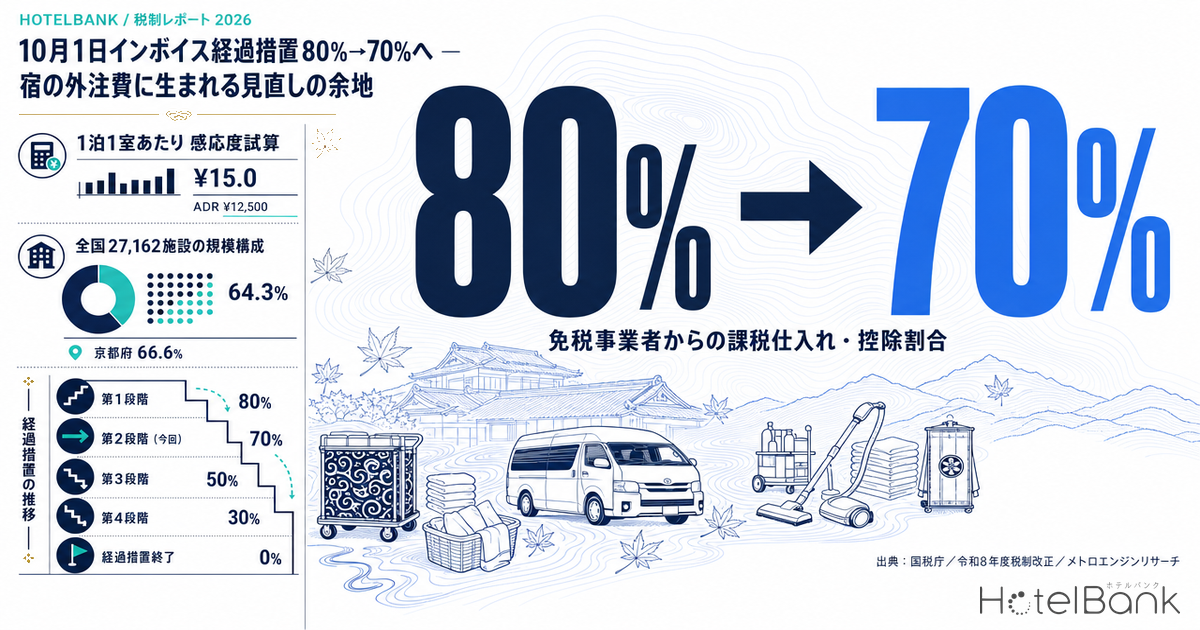
On October 1, 2026, the transitional relief for input tax credits on taxable purchases from non-registered (tax-exempt) businesses steps down from an 80% to a 70% deductible percentage. Lodging is an industry where transactions with sole proprietors are built into the core of operations — guest room cleaning, shuttle transport, in-house treatments, local ingredient sourcing, experience programs — so this 10-point reduction is a good occasion to review contract terms. This article organizes the new schedule, redesigned into five stages under the FY2026 tax reform, then quantifies the impact in yen per room-night using outsourcing ratio and tax-exempt vendor ratio as variables, along with the regional differences visible in the size composition of 27,162 properties nationwide.
- — 80%→70%, effective October 1, 2026. The determining date is neither the invoice date nor the payment date but the date the taxable purchase was made, and no prior application or filing is required. It is completed entirely through a settings change on the accounting side.
- — Under the FY2026 tax reform, the transitional relief was subdivided from three stages into five and extended by two years, running through September 2031. The originally scheduled “30-point drop to 50% in October 2026” does not apply.
- — The impact is ¥2.5–15.0 per room-night (estimated settled ADR ¥12,500; outsourcing ratio 10–20%; tax-exempt vendor ratio 20–60%). Annualized for a 30-room property, that stays within ¥19,200–¥115,000.
- — When the transitional relief fully ends in October 2031, the same maximum case reaches ¥120 per room-night, or roughly ¥3.3 million a year at 100 rooms. This 10-point step is only one-eighth of the full 80 points.
- — 64.3% of the 27,162 properties nationwide have fewer than 30 rooms. In markets with a high density of small properties — Kyoto at 66.6% and Okinawa at 62.4% — the providers of cleaning, transport, ingredients and experiences are also more likely to be sole proprietors.
Metric Definitions Used in This Article
- ADR (average daily rate): An estimated settled rate (tax-exclusive equivalent) calculated by applying property-type correction coefficients to the lowest published plan level each property posts on OTAs and similar channels (double occupancy, per-room rate, tax-inclusive). Cross-checked against property-level results disclosed by listed hotel REITs (91 properties, most recent three months), the median error is approximately 7%. These are estimates and differ from each property’s actual transacted prices and accounting figures. Area-level ADR is the median across the target properties (the level of a typical property in that area).
- Deductible percentage: For taxable purchases from parties other than qualified invoice issuers, the share of the equivalent input tax amount that may be treated as an input tax credit (transitional relief under the supplementary provisions of the Consumption Tax Act amendment).
- Data sources: MetroEngines Research / National Tax Agency and Ministry of Finance (tax system) / Statistics Bureau of Japan (Consumer Price Index)
What Changes on October 1 — In Three Lines
The essentials come down to three points. First, taxable purchases made through September 30, 2026 carry an 80% deductible percentage, and those made on or after October 1 carry 70%. Second, the determining date is neither the invoice date nor the payment date but the date the taxable purchase was made, so cases where services rendered in September are invoiced in October require careful classification. Third, this switch requires no prior application or filing whatsoever — it is completed entirely through a settings change on the accounting side.
Worth noting here is that the content has changed from the original schedule. Under the design in place when the system launched, October 2026 was to bring a single 30-point drop from 80% to 50%; the FY2026 tax reform eased the size of the reduction and extended the application period by two years. As a result, the transitional relief was subdivided from three stages into five and now runs through September 2031. This 10-point reduction is gentler than the 30 points on the old schedule, which can be read as widening the time available to build a response.
| Applicable period (date the taxable purchase was made) | Deductible | Non-deductible | Stage |
|---|---|---|---|
| Oct 1, 2023 – Sep 30, 2026 | 80% | 20% | Stage 1 (current, through end-September) |
| Oct 1, 2026 – Sep 30, 2028 | 70% | 30% | Stage 2 (this switch) |
| Oct 1, 2028 – Sep 30, 2030 | 50% | 50% | Stage 3 |
| Oct 1, 2030 – Sep 30, 2031 | 30% | 70% | Stage 4 |
| On or after Oct 1, 2031 | 0% | 100% | Transitional relief ends |
Source: Compiled by the HotelBank Editorial Team from the National Tax Agency “Q&A on the Invoice System” and the FY2026 tax reform (transitional relief under the supplementary provisions of the Consumption Tax Act amendment)
Source: Compiled by the HotelBank Editorial Team from the National Tax Agency and the FY2026 tax reform
Alongside the transitional relief, measures to ease administrative burden are also in motion. Businesses with taxable sales of ¥100 million or less in the base period (or ¥50 million or less in the specified period) can claim input tax credits on taxable purchases under ¥10,000 tax-inclusive by keeping books alone, without retaining a qualified invoice — the “small-amount exception,” which applies through September 30, 2029. Shuttle runs and one-off performance bookings, where the unit value per transaction is small, include no small number of transactions within the scope of this exception. Whether your own property meets the requirements is worth confirming once, together with the transitional relief switch.
Taking Stock of Vendors — Where Tax-Exempt Businesses Enter Hotel Outsourcing
What the transitional relief affects is strictly taxable purchases from “parties other than qualified invoice issuers.” Transactions with corporations or with registered businesses are unaffected. The first move therefore comes down to sorting the payee list by whether a registration number exists. In lodging, that sorting reveals clear patterns in where tax-exempt businesses concentrate.
| Area | Typical transactions | Why sole proprietors take it on |
|---|---|---|
| Guest room cleaning and linen | Contracting work to self-employed cleaning staff; spot assignments in peak season | Variable contracts matched to occupancy swings are easy to structure, and small-team subcontracting is well established |
| Shuttles and last-mile transport | Independent drivers for station and airport transfers; driving duties doubling as tour guiding | Unit value per job is small, and local individuals still hold the distribution channel |
| In-house treatments | Visiting massage, bodywork and esthetic services; commission-based settlement | Work is tied to the individual practitioner’s qualification, and serving multiple properties is the norm |
| Direct local farm and seafood sourcing | Direct purchasing from producers; negotiated trades outside morning markets and fishery cooperatives | The more a property pursues “ingredients with a face behind them,” the more direct dealing with small producers increases |
| Experience programs | External instructors for pottery, wagashi, canoeing, nature guiding and similar | Individual artisans and guides lead the work, and seasonal-only operation is common |
| Creative and staging work | Photographers shooting on property, lobby performances, outsourced social media, design | The freelance share is structurally high and one-off engagements dominate |
| Minor repairs and landscaping | Owner-operator equipment repairs, garden tree pruning, seasonal decor | Dependence on local artisan networks means unincorporated providers remain |
Source: Compiled by the HotelBank Editorial Team
What these share is that every one of them directly creates the property’s guest experience. Cleaning quality, the reassurance of a shuttle, local ingredients, the quality of an experience — all feed straight into review scores. That is exactly why this stocktaking is not an exercise in reducing transactions, but a starting point for thinking about how to put the transactions that underpin experience value onto sustainable terms. Cleaning in particular is an area where rising outsourcing rates are themselves pushing on the earnings structure, and the substance of that pressure is analyzed in detail in Cleaning Dispatch Rate Surge & Mid-Size Hotel Pressure.
Sensitivity Analysis — How Many Yen per Room-Night
So how much does the 10-point reduction actually amount to? We model it along two axes: the outsourcing ratio (outsourcing costs as taxable purchases, as a share of revenue) and the tax-exempt vendor ratio (the share of those outsourcing costs paid to parties other than qualified invoice issuers). The formula is simple: increase = ADR × outsourcing ratio × tax-exempt vendor ratio × consumption tax rate 10% × reduction of 10 points.
| Outsourcing ratio (of revenue) |
Tax-exempt vendor ratio (of outsourcing costs) | ||
|---|---|---|---|
| 20% | 40% | 60% | |
| 10% | ¥2.5 ¥19,200/yr | ¥5.0 ¥38,300/yr | ¥7.5 ¥57,500/yr |
| 15% | ¥3.8 ¥28,700/yr | ¥7.5 ¥57,500/yr | ¥11.3 ¥86,200/yr |
| 20% | ¥5.0 ¥38,300/yr | ¥10.0 ¥76,700/yr | ¥15.0 ¥115,000/yr |
* Upper figure = increase per room-night; lower = annualized at 30 rooms and 70% occupancy (an assumed input for this model; 7,665 room-nights per year). Assumption: revenue per room-night is set at an estimated settled ADR of ¥12,500 (tax-exclusive equivalent). This is a rounded figure informed by the ¥12,200 median estimated settled ADR across seven major prefectures (Tokyo, Kyoto, Okinawa, Nagano, Shizuoka, Osaka, Hokkaido) as of July 2026. Consumption tax rate 10% (food and beverage purchases subject to the reduced rate are taxed at 8%, so properties with a high share of direct ingredient sourcing will see a smaller figure than this model). Outsourcing costs are assumed to be classified entirely as taxable purchases, under the standard taxation method. Payroll paid as wages to directly employed staff is not a taxable purchase and is therefore out of scope. Properties electing the simplified taxation method or the 20% special rule do not calculate input tax credits on an actual-amount basis and are unaffected by this transitional relief.
Source: MetroEngines Research (ADR levels), HotelBank Editorial Team estimates
The bottom line is that the impact of this switch on its own falls in a range of a few yen to ¥15 per room-night. Even in the largest case — a 20% outsourcing ratio and a 60% tax-exempt vendor ratio, envisioning a property heavily reliant on local individual vendors — the figure is ¥15.0, annualizing to roughly ¥115,000 for a 30-room property and roughly ¥410,000 even at 100 rooms and 75% occupancy (both assumed inputs, not measured occupancy). In markets where ADR exceeds ¥10,000, this range sits comfortably within the room available for pricing adjustments.
That said, the amount scales with the ¥12,500 ADR used as the baseline. Even in the same maximum case (20% outsourcing ratio, 60% tax-exempt vendor ratio), the estimated settled ADR as of October 2026 discussed later in this article ranges from ¥21,500 in Kyoto to ¥11,600 in Osaka — a 1.85× spread — and the increase per room-night moves by exactly that ratio. It is worth translating into your own property’s ADR level before judging.
| Estimated settled ADR level (tax-exclusive equivalent) | This switch (10 points) | When relief ends (80 points) |
|---|---|---|
| Kyoto ¥21,500 | ¥25.8 | ¥206 |
| Tokyo ¥18,800 | ¥22.6 | ¥181 |
| Baseline for this model ¥12,500 | ¥15.0 | ¥120 |
| Osaka ¥11,600 | ¥13.9 | ¥111 |
* Increase = ADR × outsourcing ratio 20% × tax-exempt vendor ratio 60% × consumption tax rate 10% × size of reduction. ADR is the estimated settled level as of October 2026 (N = 495–1,046 properties per prefecture). Same formula as the sensitivity table, with only the ADR substituted.
Source: MetroEngines Research (ADR levels), HotelBank Editorial Team estimates
Extend the view to 2031, however, and the picture changes. The non-deductible share expands from today’s 20% to an eventual 100% — an 80-point widening. This 10-point step is only one-eighth of that. Calculating the same maximum case (20% outsourcing ratio, 60% tax-exempt vendor ratio) at the point where the transitional relief has fully ended gives ¥120 per room-night, roughly ¥920,000 a year at 30 rooms and roughly ¥3.3 million a year at 100 rooms. Whether this switch is processed as “a matter of a few yen” or treated as “one-eighth has arrived” and used as the starting point for designing the whole picture will make a large difference to where a property lands five years from now.
Source: MetroEngines Research (ADR levels), HotelBank Editorial Team estimates
What the chart shows is that the burden curve is not a straight line but steepens in its second half. There are two years between October 2026 and October 2028, and another two between October 2028 and October 2030. Using each of these two-year intervals to put contract terms in order ahead of the larger steps in October 2028 (a 20-point reduction) and October 2030 (another 20 points) is, in practical terms, the least strained way to proceed.
The Weight of the Issue Varies by Region — Size Composition of 27,162 Properties
How much this issue bites depends on the composition of businesses in each market. Aggregating the 27,162 properties among the lodging facilities tracked by MetroEngines Research whose operation can be confirmed on OTAs and whose room counts are known, 9,055 properties (33.3%) have fewer than 10 rooms and 8,424 (31.0%) have 10–29 rooms — together, 64.3% of the total have fewer than 30 rooms. Properties with 100 or more rooms account for just 3,935 (14.5%).
In markets with a high density of small properties, it is not only the properties themselves that are small: the providers of cleaning, transport, ingredients and experiences that support them are likely to be small businesses too. Because the entire transaction network tends to be composed of sole proprietors, the degree to which the phased reduction in transitional relief prompts a review of contract terms is also relatively greater.
Source: MetroEngines Research & Consulting (N = 27,162 properties with confirmed operation and known room counts; aggregation covers the 46 prefectures with 100 or more properties)
| Prefecture | Properties counted | Under 10 rooms | Share under 10 rooms | Average rooms |
|---|---|---|---|---|
| Kyoto | 2,107 | 1,403 | 66.6% | 20.9 |
| Okinawa | 1,442 | 900 | 62.4% | 29.5 |
| Yamanashi | 722 | 342 | 47.4% | 23.4 |
| Shizuoka | 1,435 | 604 | 42.1% | 32.9 |
| Oita | 579 | 241 | 41.6% | 30.7 |
| Nara | 252 | 102 | 40.5% | 26.5 |
| Kagoshima | 532 | 213 | 40.0% | 38.6 |
| Nagano | 1,891 | 737 | 39.0% | 23.9 |
| Wakayama | 393 | 152 | 38.7% | 29.9 |
| Gifu | 568 | 206 | 36.3% | 30.6 |
| Nationwide (46 prefectures) | 27,162 | 9,055 | 33.3% | — |
| Osaka | 1,002 | 134 | 13.4% | 92.9 |
| Tokyo | 1,499 | 193 | 12.9% | 106.9 |
| Saitama | 251 | 19 | 7.6% | 61.5 |
Source: MetroEngines Research & Consulting (confirmed OTA operation basis, N = 27,162 properties)
Kyoto (66.6%) and Okinawa (62.4%) stand out because small-scale lodging formats such as whole-house machiya rentals and vacation rentals are deeply rooted in those markets. Both ranked near the top for new openings in 2025 as well (Okinawa 126 properties, Kyoto 82; of 1,716 nationwide, vacation rentals were the largest category at 732), and this composition looks set to hold for some time. By contrast, urban prefectures such as Tokyo (12.9%), Osaka (13.4%) and Saitama (7.6%) average more than 60 rooms per property, and their vendors tend to be incorporated contracting companies. The same transitional relief carries considerably different practical weight from market to market. The revised Hotel Business Act that took effect on June 15, 2026 permitting single-room operation has widened the base of these small-scale formats further, a shift readable in the new-opening data for 554 properties.
Practical Options — Four Moves and How to Combine Them
From here, we organize the moves available ahead of October 1. As a premise, it is worth keeping in mind that unilaterally terminating a relationship on the grounds that a vendor is tax-exempt, or notifying a vendor of an amount with the full consumption-tax equivalent deducted, is treated as conduct that may draw scrutiny under the Antimonopoly Act and the Subcontract Act. The Japan Fair Trade Commission has repeatedly publicized this point since the system began. What is available is strictly an orderly adjustment of terms that both sides can accept.
First, negotiating a review of contract rates. The size of this reduction corresponds to 1% of the purchase amount (consumption tax rate 10% × 10 points). For both the vendor and the property, discussing how to share that 1% is in itself legitimate commercial dealing. What matters is not notifying an amount unilaterally, but sharing the transitional relief schedule and reaching an agreement that looks ahead to the two years until the next switch in October 2028.
Second, confirming intent to convert to taxable status. If a vendor registers as a qualified invoice issuer, the deductible-percentage question dissolves entirely. But registration means the vendor takes on a consumption tax liability, so it is not appropriate for the property to request it unilaterally. The practical approach is to share information on burden-easing measures available to the vendor if they do register — such as the 20% special rule (for sole proprietors, extended under the FY2026 tax reform as a 30% special rule limited to the 2027 and 2028 tax years) — and to confine the property’s role to helping assemble the material for the decision. For sole proprietors, this extension is also a moment when the bar to registering has come down.
Third, designing a staged schedule. Four milestones are already fixed: October 2026 (70%), October 2028 (50%), October 2030 (30%) and October 2031 (0%). Deciding vendor by vendor how each will be handled — “hold as is this time, renegotiate in October 2028,” or “reflect it in stages starting now” — and building that into the contract renewal cycle can compress negotiation costs substantially. Having a calendar fixed five years out is, if anything, a condition that makes planning easier.
Fourth, room to reflect it in pricing. Looking at the Statistics Bureau of Japan’s Consumer Price Index (lodging charges, nationwide), June 2026 was 160.6, up 3.1% from the same month a year earlier (155.8), and May 2026 was 172.3, up 4.8% from a year earlier (164.4) — lodging charges are tracking above the prior year. Given that this reduction amounts to at most ¥15.0 per room-night, there is ample room to absorb it within that price momentum. How room rates have risen while factoring in inflation and labor costs is explored across three years of data in National Avg ADR Hits Record ¥32,340 (May 2026).
Source: Compiled by the HotelBank Editorial Team from the Statistics Bureau of Japan “Consumer Price Index” (lodging charges, nationwide, 2020 = 100)
It is worth confirming this from the prevailing-rate side as well. According to MetroEngines Research data, the estimated settled ADR as of October 2026 stands at ¥21,500 in Kyoto, ¥18,800 in Tokyo, ¥14,400 in Nagano, ¥12,600 in Okinawa, ¥12,600 in Hokkaido, ¥13,500 in Shizuoka and ¥11,600 in Osaka (all estimates based on published levels at the time of survey, N = 495–1,046 properties per prefecture) — strong levels that price in the autumn foliage season. Kyoto’s ¥21,500 is 1.76× its July 2026 result (¥12,200); measured against that seasonal swing, this ¥2.5–15.0 increase is relatively small.
Source: MetroEngines Research
⚠ Note on ADR for future dates: ADR figures referenced in this article for August 2026 onward are estimates based on selling prices published on OTAs and similar channels at the time of survey, and will fluctuate as the check-in date approaches. Please note that levels set high at present may move with last-minute adjustments.
Conclusion — Turning 10 Points into a Five-Year Design
The October 1, 2026 switch from 80% to 70% amounts, in pure monetary terms, to a scale of a few yen to ¥15 per room-night. Yet using this switch as the occasion to sort the payee list by whether a registration number exists, and to establish the two numbers — outsourcing ratio and tax-exempt vendor ratio — for your own property carries value beyond the amount. The same framework applies unchanged in October 2028, October 2030 and October 2031.
By subdividing the transitional relief into five stages and extending it by two years, the FY2026 tax reform has secured preparation time for properties and vendors alike. Within a composition where 64.3% of Japan’s lodging facilities have fewer than 30 rooms, relationships with the local sole proprietors handling cleaning, transport, ingredients and experiences underpin the property’s experience value itself. This switch is a well-timed occasion to take stock of those relationships in numbers and shape them into contract terms visible five years ahead.
Related Reading
- Cleaning Dispatch Rate Surge & Mid-Size Hotel Pressure: 2026 H2 Polarization
- Okinawa’s 2% Lodging Tax: ¥60–¥340 per Guest Night by Municipality
- FY2026 Tourism DX Subsidy Guide for Hotels: 7 Programs for PMS & Smart Check-In
- Secondary Transport x Hotel Shuttles: Subsidies Unlock Regional Resort Investment
- National Avg ADR Hits Record ¥32,340 (May 2026): +19% in 3 Years from CPI & Cost Pass-Through
References and Sources
■ Tax system (primary sources and commentary)
- National Tax Agency, “Invoice System Special Site (Qualified Invoice Retention Method)” — FY2026 tax reform feature, Q&A, 20% special rule
- National Tax Agency, “Index of Q&A on the Invoice System”
- Dosai Accounting Office, “Invoice Transitional Relief: 80% Deduction Changes to 70% from October 2026” — five-stage schedule
- Kigyo Supple Journal, “[October 2026 Revision] Input Tax Credit Transitional Relief Extended Two Years: The New 80→70→50→30→0% Schedule”
- Tsuji-Hongo Tax & Consulting, “The Invoice System Is Revised Again: FY2026 Tax Reform and Preparations to Start Now” — 20% and 30% special rules
- Dosai Accounting Office, “Invoice Small-Amount Exception 2026: Input Tax Credit on Books Alone for Purchases Under ¥10,000”
- Japan Fair Trade Commission, “Q&A on the Response of Tax-Exempt Businesses and Their Counterparties to the Invoice System”
■ Government statistics
- Statistics Bureau of Japan, “Consumer Price Index,” lodging charges, nationwide, 2020 = 100 (e-Stat statistics ID: 0003427113)
■ Market data
- MetroEngines Research & Consulting — estimated settled ADR (monthly by prefecture, N = 495–1,136 properties per prefecture), room-size composition of properties with confirmed operation (N = 27,162 properties), 2025 new-opening aggregation (N = 1,716 properties, confirmed OTA listing basis)