

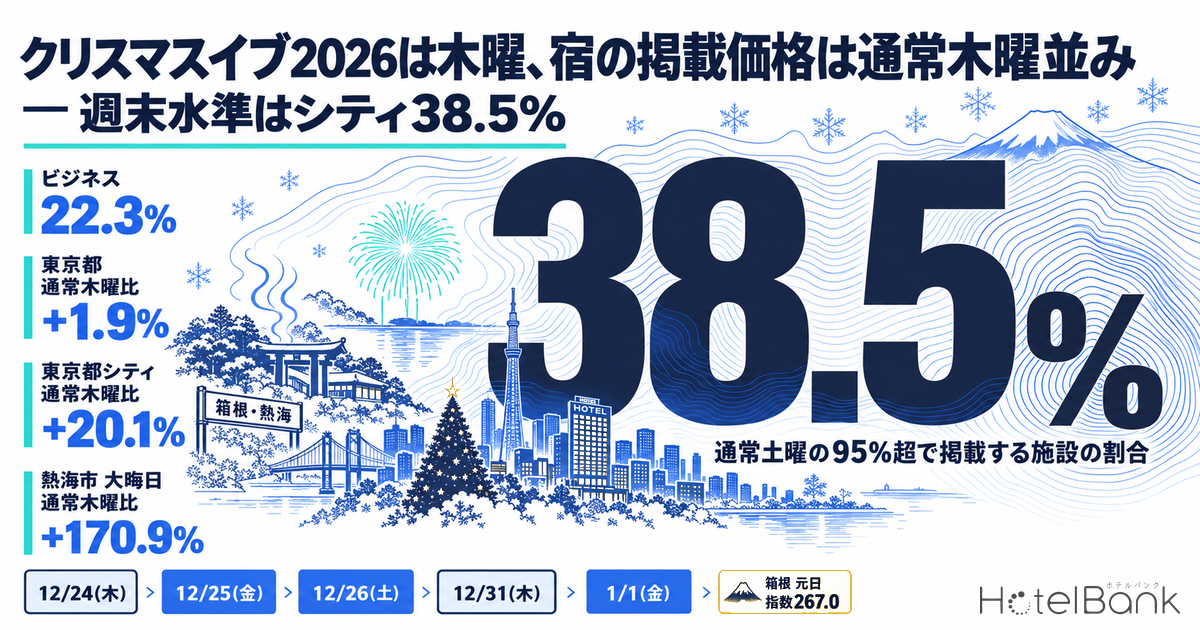
In December 2026, Christmas Eve (December 24) falls on a Thursday, Christmas Day (the 25th) on a Friday and the 26th on a Saturday. New Year’s Eve (the 31st) is also a Thursday, New Year’s Day is a Friday, and the first working day of the year, January 4, is a Monday. With both Christmas Eve and New Year’s Eve landing on a “weekday Thursday,” this calendar is one where pricing decisions are most likely to diverge among properties that build their rate tables by day of week. This article takes the room prices listed on OTAs and other channels as of the survey date (September 25, 2026) for stay dates from December 1 to January 4, compares them with each property’s own “normal Thursday, Friday and Saturday,” and quantifies how much is added on special dates across eight areas — Tokyo, Osaka, Kyoto, Hokkaido and Okinawa, plus the onsen towns of Hakone, Atami and Kusatsu — covering 3,955 properties (330,481 rooms).
Metric Definitions Used in This Article
- ADR (Average Daily Rate): An estimated settled rate (tax-exclusive equivalent), calculated by applying segment-specific adjustment factors to the lowest-plan price level each property publishes on OTAs (per room, based on 2 guests per room, tax-inclusive). Checked against property-level results disclosed by listed hotel REITs (91 properties, most recent 3 months), the median error is about 7%. These are estimates and differ from each property’s actual settled rates and accounting figures. Area-level ADR is the median of the properties covered (the level of a typical property in the area).
- OCC (Occupancy Rate): The share of rooms sold out of total rooms in an area (an estimate based on OTA sales inventory; consistency checks against REIT monthly disclosures confirm accuracy within roughly a few percentage points). OCC figures are not used in this article.
- Listed price (lowest plan): The price of the cheapest plan each property lists for each stay date (per room, based on 2 guests per room, tax-inclusive). Day-by-day comparisons use this value.
- Normal Thursday / Friday / Saturday: The average of two dates each — Dec 10 (Thu) and 17 (Thu), Dec 11 (Fri) and 18 (Fri), Dec 12 (Sat) and 19 (Sat). The ratio of each special date’s price to this baseline is computed per property, and the median is used as the value for each area and segment (because it compares each property with itself, it is not affected by differences in property mix).
- LT (Lead Time): The number of days until the check-in date.
- Data source: MetroEngines Research
- — Christmas Eve (Dec 24) is a Thursday. Versus a normal Thursday, urban listed prices are +1.9% in Tokyo and ±0.0% in Osaka, Kyoto, Hokkaido and Okinawa — essentially the same as an ordinary Thursday
- — Pricing the weekday Eve at weekend levels is mainly a city hotel practice: 38.5% list it above 95% of their normal Saturday rate (business hotels: 22.3%), and Tokyo city hotels are +20.1% vs a normal Thursday
- — New Year’s Eve (Dec 31) is +38.7% to +76.9% vs a normal Thursday in urban areas, and +151.4% in Hakone and +170.9% in Atami
- — Atami peaks at an index of 157.9 on Dec 25 (Fri), its fireworks night, while Hakone’s New Year’s Day index of 267.0 is the period high. Local events override the day-of-week pattern
- — Inventory absorption becomes comparable only from Nov 9 for Christmas Eve and Nov 16 for New Year’s Eve (when they reach LT45). Until then, competitors’ listed-price positioning is the leading indicator
The December Calendar — A Year When Both Christmas Eve and New Year’s Eve Fall on Thursday
Lined up by day of week, the special dates of December 2026 are the 24th (Thu), 25th (Fri) and 26th (Sat), followed by the 31st (Thu) and January 1 (Fri). In 2025, Christmas Eve fell on a Wednesday and Christmas on a Thursday, so the big difference this year is that “Christmas is a Friday night” followed by a Saturday, linking it directly to the weekend. In Atami, December 25 (Fri) also coincides with the Atami Winter Fireworks Festival over the sea.
For the year-end and New Year period, Japan’s government holidays run from December 29 (Tue) to January 3 (Sun), with January 4 (Mon) as the first working day. In other words, both New Year’s Eve and New Year’s Day are weekdays in the middle of the holiday period, and January 2 (Sat) and 3 (Sun) form the last weekend of the break. If a day-of-week rate table is simply carried over, the 31st could start from a “Thursday rate” and the 1st from a “Friday rate.”
So how are properties in each area pricing this calendar at this point? Below, we look in turn at monthly ADR, daily listed prices, the size of the premium by segment, and when the pace of bookings becomes observable.
Estimated Settled ADR for December and January — January Falls in Cities, Holds in Onsen Towns
First, the monthly level. MetroEngines Research’s estimated settled ADR for December 2026 is about ¥17,500 in Tokyo, about ¥17,400 in Kyoto and about ¥10,800 in Osaka — all lower than in October and November. Hokkaido, by contrast, rises toward its winter demand season, to about ¥12,500 in December and about ¥13,100 in January. The three onsen areas of Hakone, Atami and Kusatsu hold at or above their October–November levels in both December and January.
Figure 1: Estimated Settled ADR for December 2026 and January 2027 (by Area)
Source: MetroEngines Research; compiled by HotelBank Editorial Team
Table 1: Monthly Estimated Settled ADR (¥, tax-exclusive equivalent, area median)
| Area | Oct 2026 | Nov 2026 | Dec 2026 | Jan 2027 | N (Dec / Jan) |
|---|---|---|---|---|---|
| Tokyo | 19,000 | 18,900 | 17,500 | 13,800 | 1,039 / 987 |
| Osaka | 11,300 | 11,300 | 10,800 | 10,100 | 622 / 584 |
| Kyoto | 21,400 | 26,100 | 17,400 | 13,600 | 545 / 508 |
| Hokkaido | 12,400 | 11,300 | 12,500 | 13,100 | 802 / 703 |
| Okinawa | 12,800 | 11,300 | 11,800 | 11,300 | 499 / 471 |
| Hakone | 28,200 | 30,300 | 29,400 | 29,000 | 163 / 146 |
| Atami | 21,100 | 22,700 | 26,100 | 26,800 | 98 / 91 |
| Kusatsu | 17,500 | 18,100 | 19,800 | 20,200 | 64 / 56 |
*October 2026 through January 2027 are all months that had not yet arrived as of the survey date (September 2026); values are estimates based on listed price levels at that time. N is the number of properties used in the estimate and is smaller for later months because listings are not yet complete. Prior-year values for the same months are computed on the basis used for past stay dates, which differs from the basis for future months, so this article does not show year-over-year comparisons.
Source: MetroEngines Research; compiled by HotelBank Editorial Team
Monthly values are averages smoothed over all of December, and December is a month with a wide gap between early-month dates and the special dates. The large drop in Kyoto from November to December likely reflects the rebound from the November autumn-foliage season. Meanwhile, Tokyo city hotels fall from about ¥28,300 in December to about ¥23,400 in January, and business hotels from about ¥17,100 to about ¥13,300. In urban areas the slide into the January off-season is clear, suggesting that how much rate can be built up on December’s special dates shapes revenue for the whole winter.
Table 2: Estimated Settled ADR by Segment (Dec 2026 → Jan 2027, ¥)
| Prefecture | City | Business | Resort | Ryokan |
|---|---|---|---|---|
| Tokyo | 28,300 → 23,400 | 17,100 → 13,300 | — | 13,600 → 13,600 |
| Osaka | 13,400 → 12,600 | 10,300 → 9,700 | — | 17,300 → 17,400 |
| Kyoto | 22,500 → 17,300 | 14,100 → 11,200 | — | 29,800 → 29,300 |
| Hokkaido | 14,800 → 15,200 | 11,200 → 11,500 | 18,000 → 20,700 | 12,200 → 13,200 |
| Okinawa | — | 9,600 → 9,400 | 14,800 → 14,100 | — |
*Cells with N below 20 properties are shown as “—”. Estimates based on listed price levels as of the survey date.
Source: MetroEngines Research; compiled by HotelBank Editorial Team
Day by Day, Dec 1 – Jan 4 — Urban Christmas Eve Sits Almost Exactly at a Normal Thursday
Next, the daily movement. Figure 2 indexes each property’s lowest-plan listed price to its own normal Thursday (average of December 10 and 17) = 100 and plots the median for each area. On the December Saturdays — the 5th, 12th and 19th — clear weekend peaks appear: 131–134 in Tokyo and 139–143 in Osaka. By contrast, December 24 (Thu) stays at the normal Thursday level: 101.9 in Tokyo and 100.0 in Osaka, Hokkaido, Okinawa and Kyoto.
Figure 2: Daily Listed-Price Index, Dec 1 – Jan 4 (5 urban/regional areas, normal Thursday = 100)
*Median of each property’s lowest-plan listed price divided by the same property’s average for Dec 10 (Thu) and Dec 17 (Thu). Coverage: Tokyo 848 properties, Osaka 484, Kyoto 724, Hokkaido 679, Okinawa 617 (daily N varies with the number of properties listing).
Source: MetroEngines Research; compiled by HotelBank Editorial Team
The peak begins on the 25th (Fri); from the 26th (Sat) onward prices stay high in line with the year-end holidays, and the 31st (Thu) is the highest point. The New Year’s Eve index reaches 160.6 in Tokyo and 164.0 in Osaka. Kyoto shows high values of around 120 in early December, which appear to reflect late autumn-foliage rates still in place; using Thursdays from December 10 onward as the baseline removes this effect.
Table 3 shows the results of comparing each property with itself on the same day of week. The median for December 24 (Thu) versus a normal Thursday is +1.9% in Tokyo and ±0.0% in the other four areas. December 25 (Fri), by contrast, carries a premium of +10.2% in Osaka and +5.4% in Tokyo versus a normal Friday. New Year’s Eve ranges from +38.7% (Hokkaido) to +76.9% (Kyoto) versus a normal Thursday, and New Year’s Day from +16.0% (Tokyo) to +61.7% (Kyoto) versus a normal Friday.
Table 3: Listed Prices on Special Dates vs Normal Days of the Same Weekday (median of per-property ratios)
| Area | Properties | Rooms | 12/24 (Thu) vs normal Thu | 12/25 (Fri) vs normal Fri | 12/26 (Sat) vs normal Sat | 12/31 (Thu) vs normal Thu | 1/1 (Fri) vs normal Fri | 12/24 (Thu) vs normal Sat |
|---|---|---|---|---|---|---|---|---|
| Tokyo | 876 | 122,740 | +1.9% | +5.4% | ±0.0% | +60.6% | +16.0% | 81.9% |
| Osaka | 505 | 67,925 | ±0.0% | +10.2% | ±0.0% | +64.0% | +38.9% | 73.8% |
| Kyoto | 837 | 29,813 | ±0.0% | +2.6% | +7.1% | +76.9% | +61.7% | 90.9% |
| Hokkaido | 745 | 63,908 | ±0.0% | ±0.0% | +1.0% | +38.7% | +29.9% | 97.8% |
| Okinawa | 677 | 35,166 | ±0.0% | +3.4% | +7.7% | +53.8% | +40.1% | 96.9% |
| Hakone | 144 | 4,837 | +8.3% | +11.9% | +14.3% | +151.4% | +162.4% | 88.5% |
| Atami | 100 | 4,242 | ±0.0% | +51.6% | +13.9% | +170.9% | +146.6% | 76.2% |
| Kusatsu | 71 | 1,850 | ±0.0% | +2.5% | ±0.0% | +75.0% | +64.8% | 88.6% |
*Lowest-plan listed price (2 guests per room, tax-inclusive). Ratios are computed for properties with listings on both the special date and the normal days (averages of Thursdays 12/10 and 12/17, Fridays 12/11 and 12/18, Saturdays 12/12 and 12/19). N per ratio is, for example, 826 properties for Tokyo 12/24 vs normal Thursday and 754 for 12/31 vs normal Thursday. The rightmost column is the 12/24 (Thu) price divided by the normal Saturday price.
Source: MetroEngines Research; compiled by HotelBank Editorial Team
The rightmost column of Table 3 shows whether properties are pricing the weekday Eve as a “weekend.” Christmas Eve sits at 81.9% of the normal Saturday in Tokyo and 73.8% in Osaka, meaning that in urban areas the weekday Eve is listed closer to weekday rates than to weekend rates. Hokkaido (97.8%) and Okinawa (96.9%) are close to weekend levels on the Eve, partly because these are markets where the weekday–Saturday gap is small to begin with. To get a sense of the actual levels in Tokyo: the median lowest-plan listed price (N=714 properties) is about ¥15,800–16,400 on a normal Thursday, about ¥16,400 on Christmas Eve, about ¥23,000–23,200 on a normal Saturday and about ¥27,000 on New Year’s Eve. For how the weekday–weekend price gap is distributed across properties, see also Weekend Premium 2026: Tokyo Business 24% vs Hakone Ryokan 10%.
The day-of-week calendar also shows up after the New Year. In Tokyo, the index for January 3 (Sun) is 84.0 and for January 4 (Mon) 80.7 — listed below the normal Thursday level. These are the Sunday before the first working day and the Monday itself, suggesting dates just before urban demand returns after the holiday homecoming rush.
Three Onsen Areas — Atami Peaks on Its Dec 25 Fireworks Night, Hakone from New Year’s Day to Jan 2
In the resort-oriented areas of Hakone, Atami and Kusatsu, premiums on special dates are far larger than in the cities. New Year’s Eve versus a normal Thursday is +151.4% in Hakone, +170.9% in Atami and +75.0% in Kusatsu; in Hakone and Atami the median is 2.5–2.7 times a normal Thursday.
Figure 3: Daily Listed-Price Index, Dec 1 – Jan 4 (3 onsen areas, normal Thursday = 100)
*Same method as Figure 2. Coverage: Hakone 131 properties, Atami 93, Kusatsu 45 (daily N varies).
Source: MetroEngines Research; compiled by HotelBank Editorial Team
For Christmas, the three areas diverge. Atami’s index on December 25 (Fri) is 157.9, far above its other Fridays. According to Atami’s official tourism site, the 2026 Atami Winter Fireworks Festival over the sea is scheduled for December 6 (Sun) and December 25 (Fri); the jump in the December 6 index (146.2) above normal Sunday levels likely has the same cause. It is an example of a fireworks schedule overriding the day-of-week pattern and becoming the basis for pricing.
Hakone starts adding a premium from Christmas Eve (+8.3% vs a normal Thursday); its New Year’s Eve index is 251.4 and New Year’s Day 267.0, the highest of the period, with January 2 (Sat) staying high at 256.7. January 2 and 3 are the days of the Tokyo–Hakone Round-Trip College Ekiden Race, so New Year spectator demand overlaps with the last weekend of the holidays. Kusatsu holds both Christmas Eve and Christmas at normal-day levels and keeps a flat, high index of 175–185 from December 30 to January 2 — pricing that is squarely focused on the New Year period.
By Segment — City Hotels Are the Ones Pricing the Weekday Eve at Weekend Levels
So which segment is trying to sell the weekday Eve at weekend prices? Table 4 combines the eight areas and compares each segment’s Christmas Eve price with its normal Thursday and normal Saturday. City hotels list the Eve at a median of +9.6% versus a normal Thursday, with 56.7% of properties pricing it at least 5% above a normal Thursday. Business hotels, resorts and ryokan all have a median of ±0.0%, and most list the Eve at the same price as an ordinary Thursday.
Table 4: Positioning of Listed Prices on 12/24 (Thu) (by segment and key area)
| Segment | N | 12/24 vs normal Thu (median) | Share priced +5% or more | N | 12/24 vs normal Sat (median) | Share listed above 95% of normal Sat |
|---|---|---|---|---|---|---|
| City (8 areas) | 240 | +9.6% | 56.7% | 239 | 89.1% | 38.5% |
| of which Tokyo | 77 | +20.1% | 75.3% | 76 | 93.9% | 47.4% |
| of which Hokkaido | 58 | +21.2% | 60.3% | 58 | 100.0% | 72.4% |
| of which Osaka | 62 | +2.6% | 48.4% | 62 | 71.7% | 12.9% |
| Business (8 areas) | 1,321 | ±0.0% | 31.9% | 1,317 | 79.8% | 22.3% |
| of which Hokkaido | 248 | ±0.0% | 37.1% | 247 | 92.4% | 42.9% |
| Resort (8 areas) | 252 | ±0.0% | 40.9% | 259 | 92.9% | 43.2% |
| of which Hokkaido | 75 | ±0.0% | 40.0% | 75 | 95.5% | 50.7% |
| of which Okinawa | 136 | ±0.0% | 37.5% | 141 | 93.9% | 48.2% |
| Ryokan (8 areas) | 487 | ±0.0% | 30.8% | 505 | 90.0% | 36.2% |
| of which Hokkaido | 154 | ±0.0% | 21.4% | 155 | 95.9% | 51.0% |
| of which Hakone | 87 | +6.7% | 56.3% | 93 | 86.4% | 32.3% |
*8 areas = Tokyo, Osaka, Kyoto, Hokkaido, Okinawa, Hakone, Atami and Kusatsu. Segments follow MetroEngines Research’s property classification. Key-area breakdowns are shown where N is 50 properties or more. Based on lowest-plan listed prices (2 guests per room, tax-inclusive).
Source: MetroEngines Research; compiled by HotelBank Editorial Team
Looking one level deeper, Tokyo city hotels list Christmas Eve at +20.1% versus a normal Thursday, with 75.3% of properties adding 5% or more. Hokkaido city hotels are similar at +21.2%, with a median of 100.0% of the normal Saturday and 72.4% of properties listing above 95% of the normal Saturday — effectively treating the weekday Eve as a weekend. Among resorts in Hokkaido and Okinawa, too, about half of properties list the Eve above 95% of their normal Saturday.
Figure 4: Distribution of Properties by 12/24 (Thu) Listed Price vs Normal Saturday (by segment, 8 areas)
Source: MetroEngines Research; compiled by HotelBank Editorial Team
Business hotels, on the other hand, have only 22.3% of properties listing above 95% of the normal Saturday. For business hotels in Tokyo (77.6% of the normal Saturday) and Osaka (69.0%), the standard pattern is to list Christmas Eve as an extension of weekday rates, and the prevailing approach appears to be waiting to see how far demand swings toward a weekend pattern before moving. Note that the data in this article are listed prices and do not show how many bookings were actually made at those prices. “Listing at weekend levels” and “selling at weekend levels” are different things; the latter needs to be confirmed through inventory absorption once the stay date is within 45 days.
Figure 5: Size of Special-Date Premiums (by segment, median of per-property ratios, 8 areas)
*12/24 vs normal Thursday, 12/25 vs normal Friday, 12/31 vs normal Saturday. N: City 236–240 properties, Business 1,226–1,321, Resort 231–259, Ryokan 335–505 (varies by comparison date).
Source: MetroEngines Research; compiled by HotelBank Editorial Team
As Figure 5 shows, segments differ sharply in “which dates they concentrate their premium on.” City hotels spread their premium over three special dates: Christmas Eve (+9.6%), Christmas (+13.9%) and New Year’s Eve (+24.8% vs normal Saturday). Resorts concentrate on Christmas (+14.3%) and New Year’s Eve (+76.9%), and ryokan on New Year’s Eve (+48.1%), with most listing Christmas Eve and Christmas at normal-day levels. Business hotels add only a modest +11.7% versus a normal Saturday even on New Year’s Eve, and many position their year-end rates between weekday and weekend levels.
Booking Curves — “Which Date Fills First” Can Only Be Judged from November 9
Alongside price, the pace of inventory absorption is a key input for pricing decisions. However, as of the survey date the December 24 and 31 stay dates are about 90 days out, and remaining-inventory data at this stage are not used as decision inputs. Observations more than 45 days before the stay date can include periods before listing allocations have been loaded and may not reflect booking progress. In fact, MetroEngines Research’s booking curves aggregate only points within LT45, using a fixed cohort of properties that list at least 30% of their total rooms on OTAs and other channels.
Table 5 shows when each special date and baseline date enters LT45. Comparison data for the normal Thursday (December 10) start from October 26, for Christmas Eve (December 24) from November 9, and for New Year’s Eve from November 16. In other words, questions such as “Does Christmas Eve fill faster than a normal Thursday?” or “Which fills first, New Year’s Eve or New Year’s Day?” can only be answered by comparing the same set of properties from mid-November onward. For when winter stay-date listings fill out, December Listings 56–83% of August: Japan’s Winter Inventory Timing measures sales start timing across 13 prefectures.
Table 5: When Inventory Absorption on Special Dates Becomes Comparable (date LT45 is reached)
| Stay date | Role | Date LT45 is reached (2026) |
|---|---|---|
| 12/10 (Thu), 12/17 (Thu) | Normal Thursday (baseline) | 10/26, 11/2 |
| 12/24 (Thu) | Weekday Christmas Eve | 11/9 |
| 12/25 (Fri) | Christmas Day (Atami winter fireworks) | 11/10 |
| 12/26 (Sat) | Saturday just before the year-end holidays | 11/11 |
| 12/31 (Thu) | New Year’s Eve | 11/16 |
| 2027/1/1 (Fri) | New Year’s Day | 11/17 |
Source: MetroEngines Research; compiled by HotelBank Editorial Team
Until then, the leading indicator available is the positioning of listed prices shown in this article. How much competitors in the same area are adding on special dates can be observed earlier than inventory movement. For example, among Tokyo city hotels, three-quarters of properties already list Christmas Eve at least 5% above a normal Thursday; if your property lists the Eve at its normal Thursday rate, the next checkpoint is how that gap shows up in the booking pattern from November onward.
Implications for Pricing — Three Issues in Overriding Day-of-Week Rate Tables with “Special Dates”
Based on these results, we outline three issues for operators and investors to consider when setting December rates.
The first is how to position the weekday Christmas Eve. Among urban business hotels and ryokan, most properties list the Eve at the same price as an ordinary Thursday, but city hotels in Tokyo and Hokkaido add a median premium of about 20% (+20.1% and +21.2%; Osaka city hotels +2.6%). There is still room, depending on segment and area, to reflect Christmas Eve demand in room rates. If inventory absorption starts to outpace the normal Thursday after November 9, that provides the basis for a stepwise move toward weekend levels.
The second is how to handle Christmas falling on a Friday. On the 25th (Fri), the median premium versus a normal Friday is around +14% for both city hotels and resorts, and it connects to the year-end holidays starting on the 26th (Sat). How to design for demand that books the 25th and 26th as a two-night stay is a separate issue from single-night pricing. On dates that coincide with local events, as in Atami, the local event calendar — rather than the day of week — becomes the starting point for pricing.
The third is the exit from the New Year period. In Tokyo, January 3 (Sun) and 4 (Mon) are listed below normal Thursday levels, while in Hakone the period’s highest levels continue from New Year’s Day through January 2 (Sat). Where the year-end peak “ends” depends on the weekday of the first working day and on local events. With January 4 falling on a Monday this time, there is also upside in adjusting rates around the last day of the holidays while watching demand return.
Summary
December 2026 has a calendar in which both Christmas Eve and New Year’s Eve fall on a Thursday. In listed prices as of the survey date, urban Christmas Eve is almost at the normal Thursday level (Tokyo +1.9%; Osaka, Kyoto, Hokkaido and Okinawa ±0.0%), and it is mainly city hotels that list the weekday Eve at weekend-like levels (+9.6% vs a normal Thursday across the 8 areas, +20.1% in Tokyo, +21.2% in Hokkaido). Premiums start from Christmas Day on the 25th (Fri), and New Year’s Eve reaches +39–77% versus a normal Thursday in urban areas and 2.5–2.7 times a normal Thursday in Hakone and Atami. On some dates, such as the Atami fireworks (December 25) and Hakone from New Year’s Day to January 2, local events override the day-of-week pattern.
In monthly estimated settled ADR, urban areas fall from December to January, while Hokkaido and the onsen towns hold flat or rise. The pace of inventory absorption can be compared from November 9 for Christmas Eve and November 16 for New Year’s Eve; until then, the positioning of competitors’ listed prices is the earliest available input.
⚠ Note on ADR and listed prices for future dates: The December 2026 and January 2027 values in this article are all estimates and aggregates based on selling prices published on OTAs and other channels for months and stay dates that had not yet arrived as of the survey date (September 25, 2026), and they will change as the check-in date approaches. Please note that prices currently set high may be revised close to the date, and that levels may change as new plans are added.
Methodology
- Coverage: Of the roughly 27,000 properties tracked by MetroEngines Research and confirmed as operating, those with listed prices for stay dates from December 1, 2026 to January 4, 2027: Tokyo 876, Osaka 505, Kyoto 837, Hokkaido 745, Okinawa 677, Hakone 144, Atami 100 and Kusatsu 71 (3,955 properties, 330,481 rooms in total).
- Price: Lowest-plan price per room for 2 guests (tax-inclusive). Survey date: September 25, 2026.
- Ratios: Each property’s special-date price divided by its own normal-day price (averages of the same weekday on 12/10 and 17, 12/11 and 18, 12/12 and 19), with the median taken by area and segment.
- Monthly ADR: Estimated settled ADR (area median). October 2026 to January 2027 are future months (estimates based on listed price levels as of the survey date).
Frequently Asked Questions
Q. What day of the week is Christmas Eve 2026, and how are hotels pricing it?
A. December 24 is a Thursday. As of the survey date (September 25, 2026), lowest-plan listed prices compared with the same property’s normal Thursday are +1.9% in Tokyo and ±0.0% in Osaka, Kyoto, Hokkaido and Okinawa (median of per-property ratios) — almost the same as an ordinary Thursday.
Q. Which segment prices the weekday Christmas Eve at weekend levels?
A. Mainly city hotels. Across the 8 areas, their Christmas Eve price is +9.6% versus a normal Thursday (median, N=240 properties), and 38.5% list it above 95% of their normal Saturday. Among business hotels, the same share is only 22.3%.
Q. How much higher are New Year’s Eve listed prices than on normal days?
A. Versus a normal Thursday, the 5 urban/regional areas range from +38.7% (Hokkaido) to +76.9% (Kyoto); in the onsen towns, Hakone is +151.4%, Atami +170.9% and Kusatsu +75.0% (listed prices as of September 25, 2026).
Q. From when can you tell whether Christmas Eve or New Year’s Eve is filling faster than normal days?
A. Booking curves can be compared from 45 days before the stay date (LT45): Christmas Eve reaches it on November 9, New Year’s Eve on November 16, and the baseline normal Thursday (December 10) on October 26. Until then, competitors’ listed-price positioning is the leading indicator.
Q. Why are prices in Atami high on December 25?
A. Most likely because the 2026 Atami Winter Fireworks Festival over the sea is scheduled for December 6 (Sun) and December 25 (Fri) (Atami City Tourism Association). Atami’s index for December 25 is 157.9 (normal Thursday = 100), far above its other Fridays.
Related Articles
- Weekend Premium 2026: Tokyo Business 24% vs Hakone Ryokan 10%, N=659
- December Listings 56–83% of August: Japan’s Winter Inventory Timing
References and Sources
■ Data Sources
Of the roughly 27,000 properties tracked by MetroEngines Research, daily lowest-plan listed prices (2 guests per room, tax-inclusive) for 3,955 properties (330,481 rooms) in 8 areas with listed prices for stay dates from December 1, 2026 to January 4, 2027, plus estimated settled ADR by area (monthly, area median). Survey date: September 25, 2026.
■ Calculation Assumptions
Special-date ratios divide each property’s special-date listed price by its normal-day price (the two-day averages of Thursdays 12/10 and 17, Fridays 12/11 and 18, and Saturdays 12/12 and 19), with the median taken by area and segment. Estimated settled ADR is a tax-exclusive-equivalent estimate obtained by applying segment-specific adjustment factors to the lowest-plan price level.
■ Limitations
Listed prices are selling prices and do not show how many bookings were made at those prices. Because all stay dates are in the future, prices and the number of listing properties will change as check-in approaches. Booking curves use only points within LT45, so this article does not show inventory-absorption figures.
- MetroEngines Research — daily listed prices (lowest plan, 2 guests per room, tax-inclusive, N=3,955 properties), estimated settled ADR, booking curves (cohort aggregation within LT45)
- Atami City Tourism Association, “Atami Fireworks Festival over the Sea” (Atami News, 2026 schedule)
- Japan Tourism Agency, “Overnight Travel Statistics Survey”
- Japan Tourism Agency, “Overnight Travel Statistics Survey (April 2026 second preliminary, May 2026 first preliminary, and 2025 annual final figures)”
- e-Gov Law Search, “Act on Holidays of Administrative Organs” (year-end holidays: December 29 to January 3)