

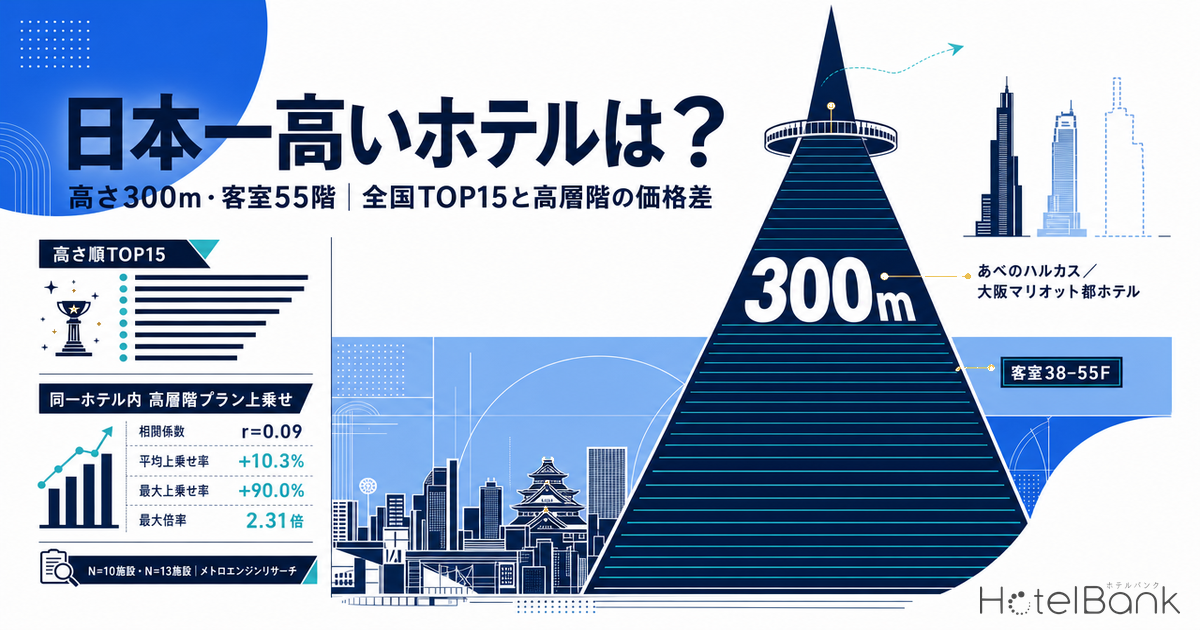
Search for “the tallest hotel in Japan” and you get two different questions tangled together: one about price, one about the height of the building. This article deals strictly with the second — physical height. The short answer: the hotel occupying the tallest building in the country today is Osaka Marriott Miyako Hotel (大阪マリオット都ホテル) inside Abeno Harukas (あべのハルカス) in Osaka, 300m tall, with guest rooms on floors 38 to 55. From there we tested a follow-up question against our own lodging price data: are hotels high up actually more expensive? The answer lands somewhere quite different from what you would guess.
Metric Definitions Used in This Article
- ADR (average daily rate): an estimated settled rate (tax-excluded equivalent) calculated by applying a segment-specific correction factor to the lowest published plan rate each property lists on OTAs and other channels (double occupancy, per-room, tax-included). Cross-checked against property-level results disclosed by listed hotel REITs (91 properties, most recent 3 months), the median error is roughly 7%. These are estimates and differ from each property’s actual transacted rates and accounting figures. Area-level ADR is the median across the properties covered (the level of a typical property in that area).
- Published rate: the selling price as displayed on OTAs and other channels — the per-room rate at double occupancy, tax included. The plan-level comparison in Section 4 is built on this published-rate basis; because its granularity and basis differ from estimated settled ADR, the two are never compared directly.
- Building height, floor count and hotel floors: listed only where confirmable from primary sources — hotel official sites, developer and municipal disclosures. Properties that could not be confirmed are excluded from the tables.
- Data sources: MetroEngines Research / Ministry of Land, Infrastructure, Transport and Tourism (MLIT), “Building Construction Statistics Survey”
- — 300m tall, rooms on floors 38–55 — Osaka Marriott Miyako Hotel, inside Japan’s tallest building Abeno Harukas, has the highest guest rooms of any hotel currently operating.
- — The highest guest room sits on floor 67 — at Yokohama Royal Park Hotel, currently closed. It should reclaim the national record when it reopens in fiscal 2028.
- — r=0.09 — across 10 supertall properties, the correlation between building height and estimated settled ADR is essentially undetectable. Over a height span of 172.5–300m, rates range from about ¥12,000 to ¥136,000 — a 10.9x spread.
- — 2.31x inside one building — the gap in estimated settled ADR between BELLUSTAR TOKYO and HOTEL GROOVE SHINJUKU, both in Tokyu Kabukicho Tower. What drives it is room size, specification and brand tier, not height.
- — Median +10.3% — yet within a single hotel, high-floor plans do carry a markup (11 of 13 properties positive, up to +90.0%). Mix the granularities and the conclusion flips.
Japan’s tallest hotel is Osaka Marriott Miyako — but the highest guest room is somewhere else
Start with the answer. The hotel housed in Japan’s tallest skyscraper is Osaka Marriott Miyako Hotel, inside Abeno Harukas (300m, 60 storeys) in Abeno-ku, Osaka. The lobby sits on floors 19–20, guest rooms on 38–55, and the restaurant on 57, across 360 rooms. Among hotels currently in operation, floor 55 is also the highest floor on which any guest room is located in Japan.
For years, though, the hotel known for having the highest guest rooms has been Yokohama Royal Park Hotel. It occupies floors 52–67 of Yokohama Landmark Tower (296m, 70 storeys) with 603 rooms. The hotel closed temporarily on 31 March 2025 and is undergoing a major renovation. According to Mitsubishi Estate and Mitsubishi Estate Hotels & Resorts, a franchise agreement has been signed with Marriott International and the property will reopen in fiscal 2028 as a Luxury Collection hotel. In other words, the title of “highest guest room in Japan” is likely to return to Yokohama in fiscal 2028.
One point of confusion is worth clearing up first. A tall building and a hotel positioned high up are two different things. Put both in the same table and the ranking order changes. In the ranking below, properties are ordered by building height, with the floors the hotel actually occupies listed alongside.
Top 15 by height: the supertall buildings that house hotels, and the floors they occupy
Below are the 15 supertall buildings containing hotels, ordered by height. The list is limited to buildings where height, storey count and hotel floors could all be confirmed from primary sources, so a handful of towers commonly described as “high-rise hotels” are excluded. Because Tokyu Kabukicho Tower at rank 11 houses two hotels, the table covers 16 properties.
| # | Building | Height | Storeys | Hotel | Hotel floors | Rooms | Location |
|---|---|---|---|---|---|---|---|
| 1 | Abeno Harukas | 300.0m | 60 | Osaka Marriott Miyako Hotel | 19–20F / 38–55F / 57F | 360 | Abeno-ku, Osaka |
| 2 | Yokohama Landmark Tower | 296.3m | 70 | Yokohama Royal Park Hotel *Closed March 2025 / reopening scheduled fiscal 2028 | 52–67F | 603 | Nishi-ku, Yokohama |
| 3 | Toranomon Hills Station Tower | 265.8m | 49 | Hotel Toranomon Hills Unbound Collection by Hyatt | 11–14F | 205 | Minato-ku, Tokyo |
| 4 | Rinku Gate Tower Building | 256.1m | 56 | Star Gate Hotel Kansai Airport | Rooms 29–50F | 358 | Izumisano, Osaka |
| 5 | Midtown Tower | 248.1m | 54 | The Ritz-Carlton, Tokyo | 45–53F | 245 | Minato-ku, Tokyo |
| 6 | Toranomon Hills Mori Tower | 247.0m | 52 | Andaz Tokyo | 47–52F | 164 | Minato-ku, Tokyo |
| 7 | Tokyo Midtown Yaesu | 240.0m | 45 | Bulgari Hotel Tokyo | 40–45F | 98 | Chuo-ku, Tokyo |
| 8 | Shinjuku Park Tower | 235.0m | 52 | Park Hyatt Tokyo | 39–52F | 171 | Shinjuku-ku, Tokyo |
| 9 | BLUE FRONT SHIBAURA TOWER S | approx. 230m | 43 | Fairmont Tokyo | 35–43F | 217 | Minato-ku, Tokyo |
| 10 | JR Central Towers, Hotel Wing | 226.0m | 53 | Nagoya Marriott Associa Hotel | Rooms 20–49F | 774 | Nakamura-ku, Nagoya |
| 11 | Tokyu Kabukicho Tower | 225.0m | 48 | BELLUSTAR TOKYO | 18F / 39–47F | 97 | Shinjuku-ku, Tokyo |
| 11 | Tokyu Kabukicho Tower | 225.0m | 48 | HOTEL GROOVE SHINJUKU | 18–38F | 538 | Shinjuku-ku, Tokyo |
| 12 | Act Tower | 212.8m | 45 | Okura Act City Hotel Hamamatsu | Rooms 32–44F | 322 | Chuo-ku, Hamamatsu |
| 13 | Otemachi One Tower | approx. 200m | 40 | Four Seasons Hotel Tokyo at Otemachi | 34–39F | 190 | Chiyoda-ku, Tokyo |
| 14 | Otemachi Tower | 199.7m | 38 | Aman Tokyo | 33–38F | 84 | Chiyoda-ku, Tokyo |
| 15 | Nakanoshima Festival Tower West | 199.3m | 41 | Conrad Osaka | 33–40F | 164 | Kita-ku, Osaka |
Source: compiled by the HotelBank Editorial Team from official hotel websites, developer and municipal disclosures (15 buildings / 16 properties whose height, storeys and hotel floors were confirmable from primary sources)
Source: compiled by the HotelBank Editorial Team from official hotel websites, developer and municipal disclosures
At the top, the 300m Abeno Harukas and the 296m Yokohama Landmark Tower stand clear of the field, while everything from rank 3 down clusters around 250m. That Yokohama Landmark Tower (completed 1993) and JR Central Towers (2000) still sit near the top a quarter of a century later says something about how Japan’s supertall hotels were built: in two waves — the large-scale redevelopments of the bubble era, and the mixed-use urban redevelopments of the 2010s onward.
“Tall building” and “high guest rooms” do not coincide — the ranking changes once you look at hotel floors
Toranomon Hills Station Tower, third in the ranking, is 265.8m and 49 storeys — but Hotel Toranomon Hills (Unbound Collection by Hyatt, 205 rooms) occupies floors 11–14. Its rooms sit in the low-to-mid section directly connected to Toranomon Hills Station on the Tokyo Metro Hibiya Line, with the upper floors given over to offices. The design leads with station-direct access rather than views, so even as another “hotel in a 265m tower” the experience is nothing like the upper-floor model. Hyatt operates 9 brands and 22 hotels (5,066 rooms) in Japan, and in Tokyo this station-direct format coexists with upper-floor properties such as Park Hyatt Tokyo (floors 39–52) and Andaz Tokyo (47–52) (Source: Hyatt Japan Co., Ltd., “Press Materials, April 2026”).
The reverse also happens: buildings low in the height table whose guest rooms sit high up. In a mixed-use supertall in Bashamichi, Yokohama, OMO5 Yokohama Bashamichi by Hoshino Resorts occupies floors 46–51, with a 360-degree observation floor 154m above ground on the 46th. Lodging takes the top quarter of a roughly 200m tower — judged on hotel floors alone, it is on par with properties near the top of the ranking.
Then there is the large-format model, like Nagoya Marriott Associa Hotel, which stacks guest rooms across 30 floors from 20 to 49. Its 774 rooms make it one of the largest supertall hotels in Japan, and even among properties that “have rooms up to floor 49,” the product mix is nothing like that of a small luxury hotel occupying a handful of floors. Japan’s ranking by room count itself is covered in Japan’s Largest Hotel: Shinagawa Prince, 2,384 Rooms — Top 30 Ranking, where you can also see that “tallest in Japan” and “largest in Japan” are entirely different properties. If you are going to talk about height, look at four things together: building height, storey count, hotel floors and room count.
Does height mean a higher rate? At property level the correlation is barely detectable (N=10, r=0.09)
Now to price. We first looked at the relationship between building height and estimated settled ADR (monthly medians over the most recent 12 months, September 2025–August 2026) at the property level. The sample is the 10 supertall hotels above that fall into a segment where estimated settled ADR has been validated (business / city / resort / ryokan / capsule) and whose pricing is stable. Properties classified in the deluxe segment are outside the validation scope for estimated settled ADR and are therefore excluded from this section, as are properties that opened in 2026, whose rates are still in a ramp-up phase.
Source: compiled by the HotelBank Editorial Team from MetroEngines Research (N=10 properties, monthly medians of estimated settled ADR, September 2025–August 2026)
The result was unambiguous. The correlation coefficient between building height and estimated settled ADR is r=0.09 (rank correlation ρ=0.31): height explains less than 1% of the variance in rate. Across a 128m span from 172m to 300m, estimated settled ADR ranges from about ¥12,000 to about ¥136,000 — a 10.9x spread. Height explains almost nothing about price.
The clearest counter-example sits inside a single building. Tokyu Kabukicho Tower (225m, 48 storeys) houses two hotels: BELLUSTAR TOKYO (97 rooms, floors 39–47) has an estimated settled ADR of about ¥117,700, while HOTEL GROOVE SHINJUKU (538 rooms, floors 18–38) is about ¥50,900. Same building, same height, a 2.31x gap. What decides it is not height but room size, specification and brand position.
Another example: Osaka Marriott Miyako Hotel, at Japan’s highest point of 300m, has an estimated settled ADR of about ¥54,100. The Tokyo EDITION Toranomon, in Kamiyacho Trust Tower (179.95m, 38 storeys), comes in at about ¥135,600 — 2.51x higher. The property that loses by 120m on height wins by 2.5x on rate. Location (central Tokyo’s five core wards versus southern Osaka) and brand tier are doing far more work.
That said, supertall hotels do sit well above the market norm. The median estimated settled ADR in Tokyo over the most recent 12 months is about ¥14,500 (N=1,067–1,145 properties per month), and in Osaka about ¥9,800 (N=623–650). Most of the supertall hotels in the table fall in a band 3–9x that. So “being supertall” carries a correlation that follows from belonging to a high-rate tier — but it cannot rank properties within the supertall set. That is the accurate reading.
This question of how scale and price combine extends well beyond supertall towers to new openings generally. How rates ramp after opening is covered in New Hotel ADR Recovery: Median 2 Months Across 182 Japan Openings.
Within a single hotel, altitude does carry a price — high-floor plans add a median +10.3%
The correlation vanishes between properties, but within a single hotel height is unmistakably priced. Because the granularity is completely different, this has to be handled separately from the property-level ADR in the previous section.
The method: any inventory whose room name or plan name contains one of 高層階 (high floor), ハイフロア (high floor), 上層階 (upper floor), スカイフロア (sky floor) or 最上階 (top floor) was classified as “high-floor designated,” and everything else as “standard.” We then compared the lowest published rate for each (double occupancy, tax included) for the same hotel, same check-in date, same sales channel. Because the ratio is taken per day before the median is computed, day-of-week and peak/off-peak effects cancel out. The window is check-in dates from 1 June to 31 August 2026; 13 properties met the conditions, each with roughly 92 days of data.
Source: compiled by the HotelBank Editorial Team from MetroEngines Research (N=13 properties, June–August 2026 check-in, published rates, lowest-rate basis, double occupancy, tax included)
In 11 of the 13 properties the high-floor plan was more expensive, and the median markup was +10.3%. The distribution is wide: Star Gate Hotel Kansai Airport leads at +90.0% (¥10,000→¥19,000), followed by The Westin Sendai at +58.3% (¥38,000→¥60,100) and Osaka Marriott Miyako Hotel at +37.4% (¥46,200→¥68,300). A site looking across the water at Kansai Airport, the tallest tower in the Tohoku region overlooking central Sendai, and the panorama from Abeno Harukas — in each case the view itself is the core of the product.
Mix the granularities and the conclusion flips
At property-level ADR, “height and rate are unrelated (r=0.09).” At plan level, “high floors carry a median +10.3%.” The two do not contradict each other. The first compares hotels against each other, the second compares within one hotel — different things are being measured. A high-floor view does work as a pricing lever, but it operates inside the price band that brand and location have already set.
Worth noting: the markup is not the preserve of top-tier luxury. APA Hotel & Resort Tokyo Bay Makuhari, with a 2,007-room, 180m central tower, prices high-floor designation at +16.6% (¥8,500→¥9,600) — a good example of packaging a supertall view at a rate a broad audience can reach, on the back of one of the largest room counts in Japan. Okura Act City Hotel Hamamatsu is at +25.2% (¥20,500→¥27,600), pricing in the fact that every guest room sits on floor 32 or above. There is ample room for regional supertall hotels to design a view premium of their own.
Two properties showed essentially no markup, or a lower rate on the high-floor designation. That does not mean the view has no value; it reads as either building high floors into every room as standard specification, or setting upper-grade pricing on factors other than the view (space, lounge access and so on). Whether to carve the view out as a separate charging axis or dissolve it into the overall experience is a product-design choice, and both are defensible.
The supertall hotels still to come — 46–48 storeys at Uchisaiwaicho, 385m in front of Tokyo Station
The ranking will certainly be rewritten. From building-plan data based on MLIT’s “Building Construction Statistics Survey,” we extracted projects of 25 storeys or more that include hotel use.
| Location | Storeys | Hotel rooms | Scheduled completion | Principal use / developer |
|---|---|---|---|---|
| Otemachi 2-chome and adjacent, Chiyoda-ku, Tokyo | 63 | 100 | December 2027 | Office, hotel, hall, retail / Mitsubishi Estate |
| Uchisaiwaicho 1-1-1, Chiyoda-ku, Tokyo (central district) | 48 | 100 | October 2031 | Office, retail, hotel / NTT Urban Development and others |
| Uchisaiwaicho 1-chome, Chiyoda-ku, Tokyo (south district) | 46 | 100 | February 2029 | Office, commercial, hotel / NTT Urban Development, Mitsui Fudosan and others |
| Nishiki 3-chome, Naka-ku, Nagoya | 41 | 170 | July 2026 | Hotel, office, theatre, retail / Mitsubishi Estate and others |
| Kitanakadori 6-chome, Naka-ku, Yokohama | 40 | 272 | May 2027 | Residential, hotel / Daiwa Jisho, Sumitomo Realty & Development |
| Dojimahama 2-chome, Kita-ku, Osaka | 40 | 220 | February 2027 | Condominium, hotel, office / Mitsubishi Jisho Residence |
| Nihonbashi 1-chome, Chuo-ku, Tokyo | 39 | 197 | October 2027 | Commercial, office, hotel, residential / redevelopment association (Mitsui Fudosan, Nomura Real Estate) |
| Dogenzaka 2-chome, Shibuya-ku, Tokyo | 36 | 100 | March 2028 | Retail, hotel, residence / Tokyu and others |
| Kumoidori 5-chome, Chuo-ku, Kobe | 32 | 70 | December 2027 | Hotel, office, commercial, bus terminal / Kumoidori 5-chome redevelopment |
Source: compiled by MetroEngines Research & Consulting from MLIT’s “Building Construction Statistics Survey.” *Building-confirmation-application basis. Counts and scale are expected to grow as further applications are filed, so treat this as a floor for the confirmed pipeline at this point in time. Storeys and room counts are planned figures as filed and may differ from developer disclosures.
The top entry, the Otemachi 2-chome project, is Torch Tower within TOKYO TORCH, the Tokiwabashi development Mitsubishi Estate is building in front of Tokyo Station. Per the developer’s disclosure it will stand approximately 385m across 62 storeys — Japan’s tallest building on completion — with a luxury hotel (approximately 110 rooms, with Dorchester Collection selected as operator) and an observation facility in the upper section. If realised, the ranking in this article jumps from 300m to 385m in one step, an 85m revision.
The second cluster is the “TOKYO CROSS PARK Vision” on the Uchisaiwaicho 1-chome block facing Hibiya Park. Ten companies including Mitsui Fudosan, NTT Urban Development, TEPCO Power Grid and Imperial Hotel are participating in a development of approximately 1.1 million sqm of gross floor area across a site of roughly 6.5ha. Per developer disclosures, the South Tower in the south district will be 46 storeys and approximately 227.8m, and the Central Tower in the central district 48 storeys and approximately 229.4m; the central district is set to house a small luxury hotel from the NTT Group and Imperial Hotel, and the south district a hotel themed on wellbeing. Our own building-plan data confirms filings of 46 storeys (completion scheduled February 2029) and 48 storeys (October 2031) respectively.
Regional and sub-central markets are moving too. A 41-storey mixed-use tower in Sakae, Nagoya (170 rooms, completion scheduled July 2026), a 40-storey building in Kitanaka, Yokohama (272 rooms, May 2027) and a 40-storey project in Dojimahama, Osaka (220 rooms, February 2027) are all rising — short of the 200m class, but towers with lodging functions in the high-30s storey range are appearing across the country. The structural reason redevelopments granted floor-area-ratio bonuses have become a supply source for supertall hotels is set out in detail in Japan FAR Bonus: 138 Districts, 10.96M sqm, Under 10% Becomes Rooms.
Conclusion: height is an admission ticket, not a price tag
To summarise. First, the hotel occupying Japan’s tallest building today is Osaka Marriott Miyako Hotel (Abeno Harukas, 300m, rooms on floors 38–55), and among operating properties its guest rooms are also the highest in the country. Second, Yokohama Royal Park Hotel (Yokohama Landmark Tower, 296m, rooms on floors 52–67) closed in March 2025 for renovation and is scheduled to reopen in fiscal 2028 as a Luxury Collection hotel. Third, because building height and hotel floors do not coincide, any ranking has to be read together with the floors the hotel occupies.
On price, separating the granularities turned out to be decisive. Compared across properties, height explains almost nothing about rate (N=10, r=0.09). Two hotels in the same 225m building differ by 2.31x in estimated settled ADR, and a hotel just under 180m is 2.51x more expensive than one at 300m. What sets the rate is location and brand tier, not altitude.
But within a single hotel, height reliably becomes money (N=13 properties, median markup +10.3%, maximum +90.0%). The view functions as an independent charging axis, and not only at the luxury end. Regional supertall hotels and large resort-format properties alike sustain markups of +16–25%. For any property holding a supertall location as an asset, refining floor-tier pricing is a straightforward revenue opportunity.
From 2027 onward, a 385m-class project in front of Tokyo Station and 46–48-storey towers at Uchisaiwaicho reach completion. This ranking has only a few years left to run.
Frequently asked questions
| Which is the tallest hotel in Japan? | Osaka Marriott Miyako Hotel, inside Japan’s tallest building (Abeno Harukas, 300m, 60 storeys). Guest rooms are on floors 38–55 and the restaurant on floor 57. |
| Which hotel has guest rooms on the highest floor? | Among operating properties, Osaka Marriott Miyako Hotel at floor 55. Yokohama Royal Park Hotel, currently closed, has rooms up to floor 67 and should reclaim the national record after reopening in fiscal 2028. |
| How much more expensive are high-floor rooms? | Comparing the lowest published rate of a high-floor plan against a standard plan at the same hotel on the same date, the median markup was +10.3% (13 properties, June–August 2026 check-in). At properties where the view is the core of the product, examples reach +37–90%. |
| Will Japan’s tallest hotel change? | A luxury hotel is planned for the upper section of Torch Tower, under construction at Tokiwabashi in front of Tokyo Station (approximately 385m and 62 storeys per the developer). On completion it will be the highest hotel in Japan. |
Related reading
- Japan FAR Bonus: 138 Districts, 10.96M sqm, Under 10% Becomes Rooms
- Japan Hotel Openings: April, July, December Peaks, 2.70x Gap
- Are May Hotels Expensive in Japan? Tokyo Peaks in November, 1.33x Gap
- Japan’s Largest Hotel: Shinagawa Prince, 2,384 Rooms — Top 30 Ranking
- Tokyo Station Supertall Luxury Hotel Pipeline: Tokyo-Shinagawa-Nagoya Tri-Pole (2027-2028)
- Kobe Sannomiya Redevelopment: ¥52.2bn Floors, ¥44,000 Required ADR
References and sources
■ Price and supply data
- MetroEngines Research — estimated settled ADR (September 2025–August 2026, N=10 properties), plan-level comparison on published rates (June–August 2026 check-in, N=13 properties), prefecture-level median ADR
- Compiled by MetroEngines Research & Consulting from MLIT’s “Building Construction Statistics Survey” — building plans (building-confirmation-application basis)
■ Primary sources on buildings and hotels
- Mitsubishi Estate, “Start of major renovation works at Yokohama Royal Park Hotel” (31 March 2025)
- Yokohama City tourism site, “Yokohama Royal Park Hotel begins major renovation; partnering with Marriott International to reopen in fiscal 2028”
- Yokohama City tourism site, “360-degree views of Yokohama at OMO5 Yokohama Bashamichi” (hotel floors and observation floor)
- Shinjuku Park Tower official site, “39F–52F: Park Hyatt Tokyo”
- Tokyo Midtown official site, “The Ritz-Carlton, Tokyo”
- Tokyo Midtown Yaesu official site, “Facilities” (Bulgari Hotel Tokyo, floors 40–45)
- Tokyu Kabukicho Tower official site (BELLUSTAR TOKYO / HOTEL GROOVE SHINJUKU floor composition)
- Act City Hamamatsu official site, “Accommodation” (guest rooms on floor 32 and above)
- Star Gate Hotel Kansai Airport official site (256m, 56 storeys; guest rooms on floors 29–50)
- Conrad Osaka official site (Nakanoshima Festival Tower West, floors 33–40)
- The Westin Sendai official site, “Hotel overview” (Sendai Trust Tower, floors 25–37)
- Nagoya Marriott Associa Hotel official site, “Facilities”
- The Prince Gallery Tokyo Kioicho official site, “Hotel overview”
- Chiba City Tourism Association, “APA Hotel & Resort Tokyo Bay Makuhari” (Central Tower, 180m)
- Osaka Convention & Tourism Bureau, OSAKA INFO, “Osaka Marriott Miyako Hotel” (Abeno Harukas, floors 38–55)
- Impress Watch, “Hamamatsucho twin tower ‘TOWER S’ opens 1 September, BLUE FRONT SHIBAURA” (floors 35–43, 217 rooms)
- Travel Watch, “Four Seasons Hotel Tokyo at Otemachi opens on floors 34–39 of the station-connected Otemachi One Tower”
■ Development projects
- NTT Urban Development, “TOKYO CROSS PARK Vision” press release (Uchisaiwaicho 1-chome block)
- Mitsubishi Jisho Sekkei, “TOKYO TORCH Torch Tower” project overview
Source: Hyatt Japan Co., Ltd., “Press Materials, April 2026”
■ Data sources
Heights, storey counts and hotel floors in the ranking were verified individually against primary sources — the official websites of each building and hotel, developer press releases, and disclosures from municipalities and tourism associations — and only properties that could be confirmed are listed. Rates are published rates and estimated settled ADR collected by MetroEngines Research across Japanese lodging properties (property level = monthly medians September 2025–August 2026, N=10 properties; plan level = June–August 2026 check-in, N=13 properties). Projects under construction or planned are compiled by MetroEngines Research & Consulting from MLIT’s “Building Construction Statistics Survey.” Room counts for Hyatt properties were cross-checked against Hyatt Japan Co., Ltd., “Press Materials, April 2026.”
■ Calculation assumptions
“Height” is the highest point of the building (architectural height) and is treated separately from the floors a hotel occupies. Property-level comparison is limited to properties falling into a segment where estimated settled ADR has been validated (business / city / resort / ryokan / capsule) and whose pricing is stable; deluxe-segment properties and those that opened in 2026 were excluded, the latter because they are still in a ramp-up phase. For the high-floor premium, inventory whose room name or plan name contains 高層階, ハイフロア, 上層階, スカイフロア or 最上階 was defined as “high-floor designated” and everything else as “standard”; the lowest published rate (double occupancy, tax included) was compared for the same hotel, same check-in date and same sales channel, with the ratio taken per day before the median was computed.
■ Limitations and caveats
Coverage is limited to properties whose rates can be observed through listings; this is not a complete census. Estimated settled ADR is inferred from published rates and does not match figures disclosed by individual companies. Because property-level ADR and plan-level markups differ in granularity, arithmetic on the representative rates quoted in the text will not necessarily reproduce the markup rates (which are medians of daily ratios). N=10 and N=13 are both small samples, and correlation coefficients are sensitive to a handful of properties. Building plans are on a building-confirmation-application basis, and storey counts and completion years may change. This article addresses the relationship between height and price; occupancy and profitability are out of scope.