

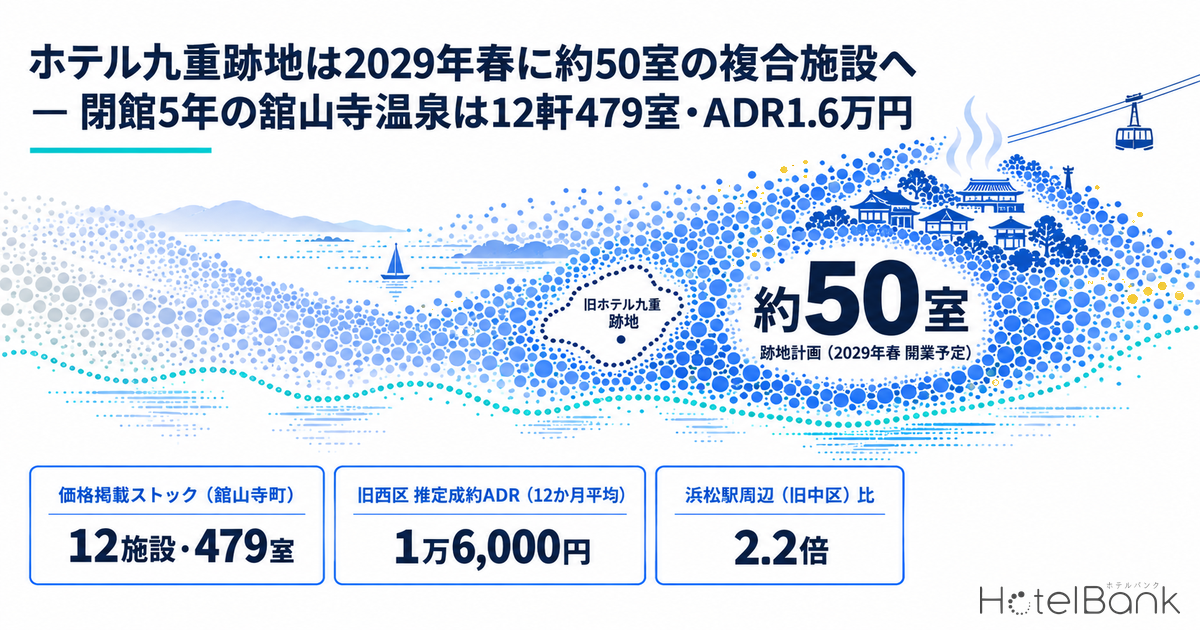
Hotel Kokonoe (ホテル九重) at Kanzanji Onsen on Lake Hamana (2178 Kanzanji-cho, Chuo Ward, Hamamatsu; opened September 6, 1987; 86 rooms) ceased operations on October 31, 2021, and the building has since been demolished. On March 28, 2025, Enshu Railway (遠州鉄道) announced a basic concept for the site: a mixed-use complex anchored by a lodging facility of about 50 rooms, together with a restaurant, cafe, spa and an open-mall-style retail component, with opening planned for spring 2029. Five years after the closure, how many properties and rooms make up the Kanzanji Onsen room stock, and where do rates stand? This article first answers directly where the site plan stands today, then uses MetroEngines Research data to examine the listing status of the 22 properties whose address contains “Kanzanji-cho” and the estimated settled ADR of the former Nishi Ward and former Naka Ward, and considers what the shift from 86 rooms to about 50 means in terms of rate bands. The focus here is on supply and pricing rather than on guidance for travelers choosing where to stay.
Metric Definitions Used in This Article
- ADR (average daily rate): An estimated settled rate (tax-exclusive equivalent) calculated by applying a category-specific adjustment factor to the lowest-plan level each property publishes on OTAs (two guests per room, per-room rate, tax included). When checked against property-level results disclosed by listed hotel REITs (91 properties, most recent three months), the median error is about 7%. These are estimates and differ from each property’s actual settled prices and accounting figures. Area-level ADR is the median of the covered properties (the level of a typical property in the area).
- Listed price: The prices of all plans published on OTAs (two guests per room, per room, tax included). At the area level, it is the monthly average of the area median of each property’s daily average. It is not a settled price and sits at a different level from the ADR in this article.
- OCC (occupancy rate): The share of sold rooms relative to total rooms in the area (an estimate based on OTA sales inventory). It reflects how inventory sold on OTAs is being absorbed and differs from a property’s actual overall occupancy.
- How “operating” is determined: Properties for which OTA price listings were confirmed in the most recent 12 months (October 2025 to September 2026) or in forward sales months (October 2026 onward) are counted as “prices listed.” Properties with no confirmed listing may be operating through their official website or telephone bookings only.
- Data source: MetroEngines Research (aggregated as of October 8, 2026)
- — The site will become a mixed-use complex anchored by a hotel of about 50 rooms. Enshu Railway announced the basic concept on March 28, 2025, with opening planned for spring 2029. As of October 2026, no follow-up on design or groundbreaking has been confirmed.
- — Kanzanji-cho has 12 properties and 479 rooms with prices listed (as of October 8, 2026). The large band of 97 rooms or more is down to 2 properties with 219 rooms, and additions since 2021 have been mostly small: a 21-room ryokan, one whole-house rental and the like.
- — Estimated settled ADR in the former Nishi Ward averaged ¥16,000 over 12 months (October 2025 to September 2026, N=12–15 properties), up 3.7% year on year. That is 2.2 times the ¥7,300 of the former Naka Ward around Hamamatsu Station.
- — The five properties in the 30–65 room band average ¥28,300, above the two properties with 97 rooms or more (¥15,200) and the three with fewer than 30 rooms (¥9,400). The roughly 50 rooms planned for the site sit in the middle of this band.
- — Indicative room revenue is about ¥360 million a year (about 50 rooms x ¥28,300 x an assumed 70% year-round occupancy). That is on the same scale as the roughly ¥330 million from 86 rooms x ¥15,200, meaning revenue can be maintained with 40% fewer rooms, depending on the rate achieved.
Where the Site Stands Now — A Mixed-Use Complex Anchored by a Roughly 50-Room Hotel, Opening Planned for Spring 2029
To state the conclusion first, the Hotel Kokonoe site will be redeveloped by Enshu Railway itself (headquartered in Asahi-cho, Chuo Ward, Hamamatsu). According to the news release the company published on March 28, 2025, the plan for the site is a mixed-use complex in which a “hotel,” “restaurant,” “spa” and “retail” work together. The hotel is described as having “an iconic architectural design that is nonetheless in harmony with the nature of Lake Hamana” with about 50 guest rooms, and the retail facility as “an open-mall format where visitors can feel the nature of Lake Hamana.” Opening is planned for spring 2029, and the release explained that the project was at the stage where the company “will go on to draw up a detailed business plan, including the basic design of the building.”
As of October 2026, a year and a half after that announcement, we could find no follow-up reporting a finalized design, a construction start or a change in room count in Enshu Railway’s release list, the Kanzanji Onsen Tourism Association’s notices or press coverage. This article therefore treats the March 2025 basic concept as the latest published figures. Because the release itself says the company will “provide information as progress is made,” completion of the basic design or the timing of groundbreaking is likely to be the next occasion for an announcement.
| Period | Event | Source |
|---|---|---|
| September 6, 1987 | Hotel Kokonoe opens (2178 Kanzanji-cho, 86 rooms) | Enshu Railway release (March 28, 2025) |
| April 2020 | Temporarily closed in response to the spread of COVID-19 (lasting about a year and a half) | HotelBank report (October 2021) |
| October 31, 2021 | Operations end. Building demolished over about two years from November | Same as above; Enshu Railway release |
| March 28, 2025 | Basic concept for site redevelopment announced (hotel of about 50 rooms plus restaurant, cafe, spa and retail) | Enshu Railway release |
| 2025 onward | Detailed business plan, including basic building design, being drawn up (no follow-up as of October 2026) | Same as above |
| Spring 2029 (planned) | Planned opening of the mixed-use complex | Same as above |
Source: Enshu Railway, “Notice Regarding Redevelopment of the Former Hotel Kokonoe Site” (March 28, 2025); compiled by the HotelBank Editorial Team
The Hotel Kokonoe Story — How a Large Group-Oriented Property Ended 34 Years of Operation
Hotel Kokonoe was operated by Entetsu Kanko Kaihatsu, part of the Entetsu Group, and opened in 1987 as an upscale ryokan with sweeping views of Lake Hamana. According to our 2021 report, it initially drew guests from across Japan, mainly group travelers, and in 1989 added a large banquet hall seating up to 400 people. After the collapse of the bubble economy, as travel shifted toward individuals and families, it responded with renovations such as installing open-air baths and expanding rooms aimed at individual guests.
The spread of COVID-19 from spring 2020 then came on top of this, and the hotel was closed for about a year and a half from April of that year. With no prospect of travel demand returning, and with the building aging, Enshu Railway’s board of directors decided to end operations and demolish the building, and the hotel is reported to have closed its 34-year history on October 31, 2021. According to the Kanzanji Onsen Tourism Association, it was the first closure of a large lodging facility in the hot-spring town since 1989. In its 2025 release, Enshu Railway explained the background to the redevelopment by saying that “changes in demand from domestic and international tourists are pronounced” and that “providing new value is required in order to maintain competitiveness.” This article confines itself to the facts as published, and the sections below look at the hot-spring town’s room stock and rates five years after the closure.
Room Stock Five Years After the Closure — 12 Properties and 479 Rooms in Kanzanji-cho on a Prices-Listed Basis
Of the properties tracked by MetroEngines Research, 22 have an address containing “Kanzanji-cho” (the 97-room property at 3302 Kanzanji-cho has been listed under the name Sun Royal Hotel Hamanako since May 2026, and this article counts it as a single property together with its former name). Of these, OTA price listings were confirmed in the most recent 12 months or in forward sales months for 12 properties with 479 rooms; for the remaining 10 properties with 239 rooms (including the 86 rooms of the closed Hotel Kokonoe), no listing could be confirmed. The 9 properties with 153 rooms other than Hotel Kokonoe are mainly small ryokan, minshuku guesthouses and condominiums, and because they may be operating through official websites or telephone bookings only, we have not classified them as “closed.”
Because this article draws the boundary by address, KAReN HaMaNaKo Kanzanji-so (KAReN HaMaNaKo かんざんじ荘; 28 rooms, listed since December 2021) in neighboring Kurematsu-cho is not included. Hamamatsu reorganized its administrative wards from seven to three on January 1, 2024, and Kanzanji-cho moved from the former Nishi Ward to Chuo Ward. The area aggregates below are based on the pre-reorganization ward boundaries and use the terms “former Nishi Ward” and “former Naka Ward.”
| Property | Rooms | Category | Registered opening year | Price listing |
|---|---|---|---|---|
| Hotel Wellseason Hamanako (ホテルウェルシーズン浜名湖) | 122 | Ryokan | 1978 | Yes (listed ahead through March 2027) |
| Sun Royal Hotel Hamanako (サンロイヤルホテル浜名湖; 3302 Kanzanji-cho) | 97 | Resort | 1970 (listed under current name since May 2026) | Yes |
| Tokiwasure Kaikatei (時わすれ 開華亭) | 60 | Ryokan | 1973 | Yes (through March 2027) |
| Hotel Kikusuitei (ホテル鞠水亭) | 50 | Ryokan | 1970 | Yes (through February 2027) |
| Wan Wan Paradise Hamanako (わんわんパラダイス 浜名湖) | 42 | Ryokan | 1994 | Yes (through March 2027) |
| Sansuikan Kinryu (山水館欣龍) | 34 | Ryokan | 1910 | Yes (through March 2027) |
| Hoshino Resorts KAI Enshu (星野リゾート 界 遠州) | 36 | Resort | 2013 | Yes (through March 2027) |
| Arashi no Yakata (嵐の館) | 21 | Ryokan | June 2024 | Yes (through March 2027) |
| Hinode (日の出) | 9 | Ryokan | — | Yes (June to December 2026) |
| Ryokan Fujiya (旅館ふじや) | 6 | Ryokan | — | Yes (through December 2026) |
| Kashibesso Reserve (貸別荘リザーブ; whole-house rental) | 1 | Vacation rental | 2019 | Yes (through March 2027) |
| UMI&kanzanji (whole-house rental) | 1 | Vacation rental | October 2025 | Yes (through March 2027) |
| Subtotal, prices listed | 479 | 12 properties | ||
| Hotel Kokonoe (ホテル九重; closed and demolished) | 86 | Ryokan | 1987 | No (operations ended October 31, 2021) |
| 9 properties with no confirmed listing (ryokan, minshuku, condominiums) | 153 | 5–65 rooms (the largest is one 65-room ryokan) | No (neither in the most recent 12 months nor in forward sales months) | |
Source: MetroEngines Research; compiled by the HotelBank Editorial Team (22 properties with “Kanzanji-cho” in the address, as of October 8, 2026. Opening years are as registered; unknown shown as “—”)
Summarizing supply movements since 2021, on the reduction side, the 86 rooms of Hotel Kokonoe are the only large case, while additions are limited to Arashi no Yakata (21 rooms) in June 2024 and the whole-house rental UMI&kanzanji (one unit) in October 2025, plus the 97-room Sun Royal Hotel Hamanako, which began to be listed under its new name in May 2026. In other words, the rooms that have returned to the hot-spring town in the five years since the closure are mostly small-scale, and the large band of 97 rooms or more has narrowed to 2 properties (219 rooms in total). If about 50 rooms are added in spring 2029, the prices-listed stock would go from the current 12 properties and 479 rooms to 13 properties and about 529 rooms, a configuration with roughly 36 fewer rooms than the level before Kokonoe closed.
Source: MetroEngines Research; compiled by the HotelBank Editorial Team. Circle size indicates room count; blue = prices listed, gray = no confirmed listing, navy = former Hotel Kokonoe site
Rates — Former Nishi Ward Estimated Settled ADR Averages ¥16,000 Over 12 Months, 2.2 Times Central Hamamatsu
Next, rates. Estimated settled ADR in the former Nishi Ward, which covers the Kanzanji side, averaged ¥16,000 over the most recent 12 months (October 2025 to September 2026; N=12–15 properties each month), up 3.7% year on year from ¥15,400 in the same period a year earlier. By month, September 2026 came in at ¥16,500 (N=15), up 26.7% from the same month a year earlier, while August 2026 was ¥18,900, down 11.6%, and July was ¥13,200, down 10.6%, so the summer months were below the prior year. Because August 2025 stood out at ¥21,400, it is reasonable to read summer 2026 as a pullback from a high prior-year peak.
By contrast, the former Naka Ward, which includes the area around Hamamatsu Station, averaged ¥7,300 over the same 12 months (N=33–35 properties), down 4.1% year on year, putting the former Nishi Ward at 2.2 times that level. The former Kita Ward to the north (Mikkabi, Hosoe and other areas on the north shore of Lake Hamana) was ¥15,500 (N=8–9 properties), up 19.8%, and Kosai City on the west shore was ¥7,300 (N=5–6 properties), down 2.9%. The Lake Hamana area shows a clear two-tier structure: a hot-spring and resort tier (¥15,000–¥16,000 in the former Nishi and Kita wards) and a business tier (the ¥7,000 range in the former Naka Ward and Kosai City).
Source: MetroEngines Research; compiled by the HotelBank Editorial Team (estimated settled ADR, area median. Former Nishi Ward N=12–15 properties/month, former Naka Ward N=29–35 properties/month. October 2026 onward are estimates based on listing levels at the time of the survey)
Overlaying the monthly trend by year, the former Nishi Ward shows clear seasonality with peaks in August and over the year-end and New Year period; in 2026, August at ¥18,900 was the high for the year, followed by January at ¥18,600. The former Naka Ward stays within a narrow range of ¥6,500–¥9,700 throughout the year, with only slight peaks during the May holidays and from October onward. The gap between the two widens to around ¥10,000 depending on the season, but even in the off-season there is not a single month in which the former Nishi Ward falls below the former Naka Ward.
Source: MetroEngines Research; compiled by the HotelBank Editorial Team (average of monthly medians, October 2025 to September 2026. N is the range of covered properties across months)
| Area | Estimated settled ADR, 12-month average | YoY | September 2026 listed price (median) | Properties covered |
|---|---|---|---|---|
| Former Nishi Ward (Kanzanji, Yuto, Maisaka, etc.) | ¥15,989 | +3.7% | ¥31,630 | N=12–15 (listed price N=25) |
| Former Kita Ward (Mikkabi, Hosoe, etc.) | ¥15,489 | +19.8% | ¥38,926 | N=8–9 (listed price N=13) |
| Former Naka Ward (around Hamamatsu Station) | ¥7,298 | -4.1% | ¥14,630 | N=33–35 (listed price N=40) |
| Kosai City | ¥7,306 | -2.9% | ¥19,747 | N=5–6 (listed price N=12) |
Source: MetroEngines Research; compiled by the HotelBank Editorial Team (estimated settled ADR covers October 2025 to September 2026; the prior-year period is October 2024 to September 2025. Listed price is the area median of all plans, tax included)
Note that the number of covered properties varies by month. The former Nishi Ward’s estimated settled ADR covered 12–13 properties from November 2025 to March 2026 and 15 properties from May 2026 onward, and coverage for listed prices (all categories) also rose from 16 properties in November 2025 to 25 from June 2026 onward. When listings from small properties are added, the median tends to swing somewhat lower, and the ¥12,700–¥13,200 of June and July 2026 likely includes that effect. On the occupancy side, estimated OCC in the former Nishi Ward was 85.8% in July 2026 (13 properties, 836 rooms), 93.3% in August (13 properties, 841 rooms) and 87.9% in September (12 properties, 714 rooms), holding at a high level from summer into early autumn (all figures are on a major-booking-site listing basis and are estimates based on OTA sales inventory).
Forward Listings for Autumn Foliage and the New Year — December and January Listed Medians Are 22–28% Above September
Looking at prices listed ahead as of October 8, 2026, the former Nishi Ward’s listed price (all plans, median) is ¥32,500 for November 2026 (N=24), up 2.7% from September; ¥38,700 for December (N=23), up 22.4%; and ¥40,600 for January 2027 (N=18), up 28.3%, stepping up toward the year-end and New Year period. Estimated settled ADR for the same period, meanwhile, is nearly flat at ¥16,600 for November, ¥16,700 for December and ¥16,900 for January, so the upswing on the listed side can be read as reflecting the early release of higher-priced plans. For November, the autumn foliage season, the listed median remains at almost the same level as September, suggesting that around Lake Hamana the year-end and New Year period shows up in prices more readily than foliage demand does.
That said, the number of covered properties in forward months declines: 18 in January, 17 in February and 16 in March. Because the median moves as properties that open sales later are added, these figures are best treated as “the listing level of properties that were selling ahead at the time of the survey.”
From 86 Rooms to About 50 — Entering the Size Band Where Kanzanji Rates Are Strongest
The shift from Hotel Kokonoe’s 86 rooms to the roughly 50 rooms of the site plan looks like a contraction if one considers room count alone. But when the properties with prices listed in Kanzanji-cho are divided into three bands by room count and their estimated settled ADR is compared (property-level averages for October 2025 to September 2026), it becomes clear where a scale of about 50 rooms sits within the hot-spring town.
Source: MetroEngines Research; compiled by the HotelBank Editorial Team (10 properties with prices listed in Kanzanji-cho; within-band average of property-level estimated settled ADR, October 2025 to September 2026. 97 rooms or more N=2, 30–65 rooms N=5, fewer than 30 rooms N=3. The two whole-house rentals are outside the scope of the estimate)
The two properties with 97 rooms or more average ¥15,200 and the three with fewer than 30 rooms average ¥9,400, whereas the five properties with 30–65 rooms average ¥28,300 (median ¥28,600), well above the other two bands. This band is made up of long-established lakeside ryokan and hot-spring ryokan and resorts of 34–60 rooms, which capture stays by individuals and stays for anniversaries and dining. The roughly 50-room scale of the site plan falls squarely in the middle of this band. Among business hotels nationwide, our earlier analysis found that ADR actually bottoms out in the 30–59 room band, but in the hot-spring destination of Kanzanji the opposite holds: the mid-size band is where rates are strongest. Note that the sample includes some properties with less than 12 months of data (one property in the 97-rooms-or-more band has 5 months, one in the 30–65 room band has 7 months, and one in the under-30 band has 2 months).
As a simple yardstick, if year-round occupancy is assumed to be 70%, room revenue of about 50 rooms x ADR of ¥28,300 x 70% occupancy x 365 days comes to about ¥360 million a year. The same occupancy applied to 86 rooms x ¥15,200 (the average ADR of the 97-rooms-or-more band) gives about ¥330 million, which shows that even with 40% fewer rooms, the scale of room revenue can be maintained if the rates of the 30–65 room band are achieved. The site plan is of course also expected to include a restaurant, spa and retail facilities, which would add non-lodging income. A shift from a large group-oriented property to a small, high-rate model built around local food and hot springs appears to be a rational direction given actual conditions in Kanzanji. This estimate is a simple one based on our data; no room rates or occupancy for the site plan have been published. Hotel Kokonoe’s rates during its years of operation (2021 and earlier) fall outside the period covered by this article and are not compared.
Supply Pipeline — No New Kanzanji Projects Recorded in Data Based on Public Statistics
In our planned-hotel data, which is based on building confirmation applications in the Ministry of Land, Infrastructure, Transport and Tourism’s Building Starts Statistics, the only entry in Shizuoka Prefecture as of October 2026 is one project in Atami City (277 rooms, completion scheduled for April 2025); no project in Hamamatsu or Kanzanji is recorded (entries based on confirmation applications are a lower bound at this point and will increase as further applications are filed). The site plan is at the March 2025 basic-concept stage and will appear in the statistics only once it advances to basic design and a confirmation application. The statements about the site plan in this article therefore rely solely on Enshu Railway’s official announcement, and we note explicitly that the project is not included in our planned-hotel data. Because confirmation applications are usually filed one to two years before opening, movement would be expected around 2027 for a spring 2029 opening.
The implications for investors and operators at Kanzanji Onsen can be summarized as follows. First, for the roughly two and a half years until spring 2029, the hot-spring town’s large band will remain limited to two properties, and the former Nishi Ward’s estimated settled ADR is holding above the prior year. Second, because the site plan includes a restaurant, spa and retail, foot traffic from day visitors as well as overnight guests could spread across the hot-spring town as a whole. Third, the fact that rates of around ¥28,000 are being sustained in the 30–65 room band is likely to serve as a reference for existing properties as they move toward more individual-oriented, higher-value-added rooms. In contrast to the case of the former Utsunomiya Grand Hotel site, which five years after closing was turned over to non-lodging use as a 146-lot residential subdivision, in Kanzanji the same operator is redeveloping the site for lodging. The next five years at Kanzanji can be read as a move from a phase of decline through closure to a phase of rebuilding around a small-scale, high-rate model.
⚠ Note on prices for future dates: The listed prices and estimated settled ADR for October 2026 onward in this article are estimates based on sales prices published on OTAs at the time of the survey (October 8, 2026) and will change as new plans are added and prices are adjusted closer to check-in. Because fewer properties are covered in forward months, the median may move as properties that open sales later are added.
Frequently Asked Questions
Q. What is the status of the former Hotel Kokonoe site?
A. The building has been demolished. Under the basic concept Enshu Railway announced on March 28, 2025, a mixed-use complex anchored by a lodging facility of about 50 rooms (with a restaurant, cafe, spa and retail) is planned to open in spring 2029. As of October 2026, no follow-up on design, groundbreaking or room count has been confirmed.
Q. Why did Hotel Kokonoe cease operations?
A. It was closed for about a year and a half from April 2020 because of the spread of COVID-19. With no recovery in travel demand in sight and the building aging, the decision was made to end operations and demolish it, and the hotel closed after 34 years on October 31, 2021.
Q. How many lodging facilities are there at Kanzanji Onsen since the closure?
A. Of the properties with a “Kanzanji-cho” address tracked by MetroEngines Research, 12 properties with 479 rooms have confirmed price listings as of October 2026, and two of them are large properties with 97 rooms or more.
Related Articles
- Japan Hotel Closures 2026: 3 Hotels, 316 Rooms Closed, 1,149 Delayed
- Senjukaku Site Now a 305-Car Park: Machida Hotel Market 5 Years On
- Shizuoka’s 67 New 2026 Hotels: 1,089 Rooms, 64% One-Room Villas
References and Sources
■ Data sources
Estimated settled ADR, listed prices and estimated OCC based on OTA published prices and sales inventory continuously collected by MetroEngines Research (the former Nishi, Naka and Kita wards of Hamamatsu and Kosai City, July 2024 to March 2027), and the room counts and price listing status of the 22 properties with “Kanzanji-cho” in the address (as of October 8, 2026). The site plan is based on Enshu Railway’s release dated March 28, 2025.
■ Assumptions for the estimate
Indicative room revenue is calculated as “rooms x estimated settled ADR x occupancy x 365 days.” Occupancy is an assumed 70% year-round and is neither an actual result nor a planned figure. ADR uses the size-band averages for Kanzanji-cho (¥28,300 for the 30–65 room band and ¥15,200 for the 97-rooms-or-more band, October 2025 to September 2026) and does not include non-lodging income such as restaurant, spa and retail.
■ Limitations and caveats
The size-band samples are small at N=2–5 properties and include properties without a full 12 months of data, so within-band averages can shift with the movement of a single property. Properties with no confirmed price listing may be operating through official websites or telephone bookings only and are not classified as closed. Figures for October 2026 onward are estimates based on forward listings at the time of the survey and will change. Area classifications follow the ward boundaries prior to the January 2024 administrative reorganization.
- Enshu Railway Co., Ltd., “Notice Regarding Redevelopment of the Former Hotel Kokonoe Site” (March 28, 2025; in Japanese)
- Kanzanji Onsen Tourism Association, “Regarding Redevelopment of the Former Hotel Kokonoe Site” (March 28, 2025; in Japanese)
- Nikkei, “Enshu Railway to Build Mixed-Use Complex on Former Lakeside Hotel Site at Lake Hamana, Opening as Early as Spring 2029” (March 31, 2025; in Japanese)
- Mynavi News, “New Mixed-Use Complex on Former Hotel Kokonoe Site at Kanzanji Onsen, Hamamatsu, Shizuoka, to Open in Spring 2029” (March 31, 2025; in Japanese)
- HotelBank, “Hotel Kokonoe at Kanzanji Onsen to Cease Operations at the End of October” (October 19, 2021; in Japanese)
- City of Hamamatsu (administrative ward reorganization on January 1, 2024: from seven wards to three — Chuo, Hamana and Tenryu)
- Compiled by MetroEngines Research & Consulting from the Ministry of Land, Infrastructure, Transport and Tourism’s Building Starts Statistics (planned-hotel data, Shizuoka Prefecture)
- MetroEngines Research — estimated settled ADR and listed prices (former Nishi, Naka and Kita wards of Hamamatsu and Kosai City, July 2024 to March 2027), estimated OCC (former Nishi Ward, July to September 2026), property master data (22 properties with a “Kanzanji-cho” address, as of October 8, 2026)