

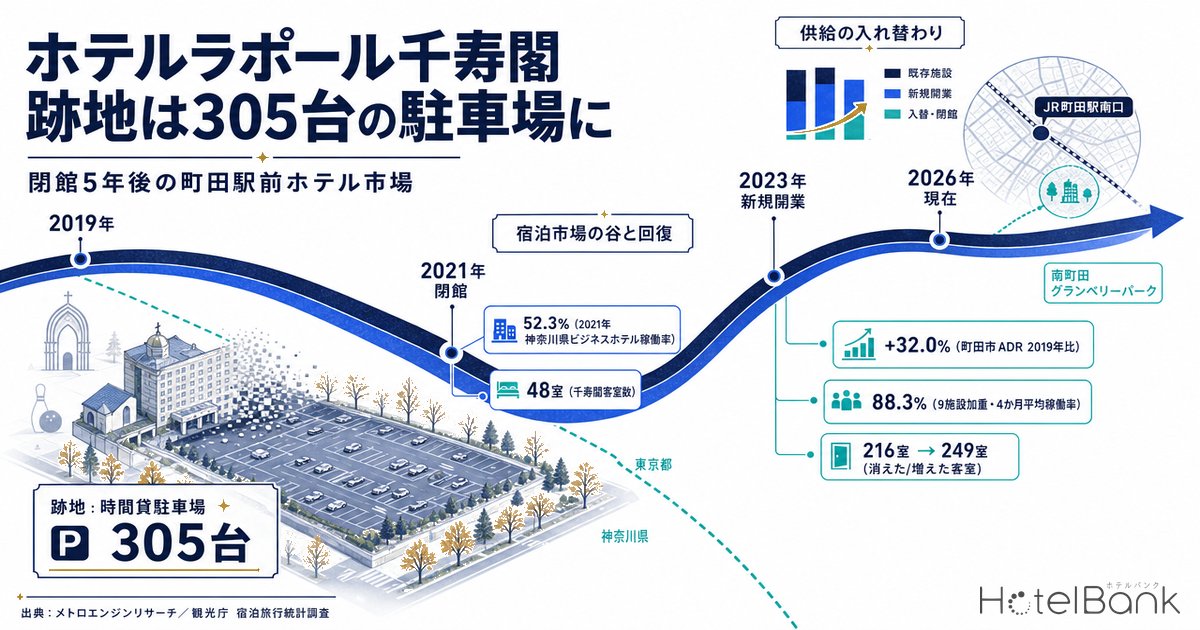
Hotel Rapport Senjukaku (ホテルラポール千寿閣), a five-minute walk from the south exit of JR Machida Station in Kamitsuruma-honcho, Minami-ku, Sagamihara, Kanagawa, closed its doors on 31 August 2021. Five years on, the site holds a 305-space hourly car park, and the 48 guest rooms have quietly disappeared from the accommodation inventory of the Machida Station catchment. Rather than revisiting the circumstances of the closure — which were reported at the time — this article uses publicly listed price data and official statistics to trace what has happened to the lodging market around Machida Station in the five years since.
Metric Definitions Used in This Article
- ADR (average daily rate): an estimated settled rate (tax-excluded equivalent) calculated by applying a property-type correction factor to the lowest plan level each property lists on OTAs and elsewhere (double occupancy, per-room rate, tax-included). Reconciliation against per-property results disclosed by listed hotel REITs (184 property-months, April–May 2026) puts the median error at roughly 7%. These are estimates and differ from each property’s actual settled prices and accounting figures. Area-level ADR is the median of the properties covered — the level of a typical property in the area.
- OCC (occupancy): rooms sold as a share of total rooms in the area (an estimate based on OTA sales inventory). This article uses only area aggregates for the 9 properties and 1,103 rooms covered around Machida Station, weighted by room count; occupancy for individual properties is not calculated.
- Official occupancy statistics: annual figures by prefecture and property type from the Japan Tourism Agency’s Overnight Travel Statistics Survey. The survey population and definitions differ from the estimated OCC above, so the two cannot be compared directly.
- Data sources: MetroEngines Research; Japan Tourism Agency, Overnight Travel Statistics Survey
- — The site is now a 305-space hourly car park. Hotel Rapport Senjukaku (48 rooms, roughly 2,700 tsubo / about 8,900 m²), which closed at the end of August 2021, has not returned to lodging use.
- — The closure came at the bottom of the market. Business hotel occupancy in Kanagawa recovered from 52.3% in 2021 to 80.5% in 2025, back to 96% of the 2019 level (84.0%).
- — Estimated settled ADR is up 32.0% against 2019, and estimated occupancy is 88.3% (median of 11 properties covered in Machida City, ¥6,366 → ¥8,404; 9 properties and 1,103 rooms around Machida Station, April–July 2026 average).
- — Supply grew on net, but the location and the format changed. Five properties with 216 rooms stopped selling across Machida City and Minami-ku, Sagamihara, while a 249-room limited-service hotel opened in 2023.
- — General inventory in front of Machida Station is concentrated on the Tokyo side. All 8 properties and 983 rooms within a 1 km radius sit in Machida City, and Senjukaku was the last general lodging property on the Kanagawa side.
The site is now a 305-space hourly car park — what can be confirmed at Kamitsuruma-honcho 3-11
Hotel Rapport Senjukaku was a 48-room lodging property at 3-11-8 Kamitsuruma-honcho, Minami-ku, Sagamihara, Kanagawa. The straight-line distance from the station plaza at JR Machida Station is about 384 m. Administratively it sat in Kanagawa, but as a trade area it was squarely “in front of Machida Station”. Its operator, Senju Sangyo, was founded in 1964 and began as the Dai-Machida Sports Center, a complex with a wedding hall and a bowling alley; in 1985 it added lodging and a garden chapel and changed its name to Rapport, meaning a deep bond.
The reason for the closure, as reported by the Minami-ku Sagamihara edition of Town News on 3 June 2021, was a sharp fall in revenue caused by the spread of COVID-19. According to that report, overnight stays began to decline around March 2020, and the decisive blow was the disappearance of the banquet demand — welcome and farewell parties, year-end and new-year gatherings — that had underpinned the hotel business; sales in May 2020 fell short of ¥400,000. The company said it would sell the roughly 2,700-tsubo site and building and wind up the business, and the adjacent Machida Bowling Center closed on the same day.
What has become of the site? The Times 24 car park directory lists “Times Machida Station South Exit” (3-11 Kamitsuruma-honcho, Minami-ku, Sagamihara, Kanagawa; 305 spaces; entry and exit 24 hours; weekday 24-hour maximum ¥600, ¥700 on weekends and holidays). It sits in the same block as the hotel’s address (3-11-8), and a site of roughly 2,700 tsubo is consistent with capacity for 305 cars. Local media have reported that the car park opened in June 2024, but no official announcement by the operator could be confirmed, so this article does not assert a date. What can be confirmed is that this block is currently in use as a large hourly car park in the outer Tokyo suburbs. The conditions under which a site of this size returns to lodging use are a question of development economics, examined separately in our work on converting former hospital sites into hotels.
In MetroEngines Research data, the property’s last OTA sales record is for a check-in date of 31 October 2021; no resumption has been observed in the five years since.
The closure came at the bottom of the market — Kanagawa business hotel occupancy was 52.3% in 2021
It is worth establishing, from official statistics, exactly when this closure occurred. Business hotel room occupancy in Kanagawa, per the Japan Tourism Agency’s Overnight Travel Statistics Survey, fell from 84.0% in 2019 to 49.8% in 2020, and stood at just 52.3% in 2021, the year the closure was announced. The decision was taken after two straight years of a 31.7-point drop from the peak.
The recovery that followed was rapid. At 65.9% in 2022, 75.5% in 2023, 80.1% in 2024 and 80.5% in 2025, Kanagawa business hotel occupancy returned to 96% of its pre-COVID level within five years. Tokyo followed a similar path, recovering from 41.8% in 2021 to 81.5% in 2025. In other words, 2021 — the year Senjukaku decided to exit — turned out to be the trough immediately before the recovery curve began to rise. The lodging market came back; whether the separate banquet and wedding demand that had supported the property’s earnings would return at the same pace was not something that could have been factored into the decision at the time.
Source: Japan Tourism Agency, Overnight Travel Statistics Survey; compiled by the HotelBank Editorial Team
Estimated settled ADR around Machida Station is up 32% on 2019 — the price band has moved up a step
Next, how room rates around Machida Station have moved over these five years. Estimated settled ADR for Machida City (11 properties covered), as aggregated by MetroEngines Research, averaged ¥6,400 (¥6,366) over July–December 2019 before COVID, against ¥8,400 (¥8,404) for January–July 2026 — a shift in level of +32.0%.
Overlaying the monthly series year by year reveals more than a rise in level; the seasonal pattern has changed as well. In 2021 the series was pinned to a flat ¥5,200–¥5,600 band all year, with almost no gap between peak and off-peak. From 2023 the shape returns: rising into the summer and holding high into year-end. In 2026 the series has run in a ¥8,200–¥8,700 band since February. Read another way, the room to move price at all has come back to this market.
Source: MetroEngines Research; compiled by the HotelBank Editorial Team (median of 11 properties covered in Machida City)
One caveat applies to the 2021 level. Estimated settled ADR during the COVID period (March 2020 to April 2022) is known, from reconciliation against disclosed REIT results, to run higher than actual figures. The real gap between 2021 and today is therefore likely to be wider than the apparent gap above. This article uses 2019 — pre-COVID — as its comparison base.
By property the range runs from +10% to +78% — the upside has not been evenly distributed
Behind the area median, individual properties have moved very differently. Comparing estimated settled ADR for July–December 2019 with January–July 2026 across nine major properties around Machida and Sagami-Ono stations, the rate of change is distributed from +10.3% to +77.6%, with a median of +40.0%.
Source: MetroEngines Research; compiled by the HotelBank Editorial Team (N=9 properties)
The largest gains came from properties that had been sitting in the ¥6,000 business band. Renovation and brand initiatives moved several of them into the ¥9,000–¥11,000 band, and that band is now clearly deeper than it was five years ago. Properties that started in the upper tier at around ¥9,000, meanwhile, gained roughly 40% and have reached the ¥13,000 range in absolute terms. The Machida Station catchment has shifted from a homogeneous business-demand market clustered around ¥6,000 to a tiered market running from the ¥6,000s to the ¥13,000s — the single biggest structural change of these five years.
By grade, Senjukaku sat in the budget band, and in the first half of 2021, just before closing, it was broadly at the level of the Machida City median (¥5,400). Had it stayed open, this tiering would certainly have created room to raise its room rates. As discussed below, however, the property’s earnings structure was not self-contained within lodging.
216 rooms lost, 249 gained — supply turned over and still grew on net
The closure was not an isolated event. Across Machida City and Minami-ku, Sagamihara, five properties totalling 216 rooms — Senjukaku included — could no longer be confirmed as selling on OTAs between 2020 and 2021.
| Property | Rooms | Location | Last confirmed OTA listing |
|---|---|---|---|
| Ryokan A | 8 | Minami-ku, Sagamihara | July 2020 |
| Business-type B | 72 | Minami-ku, Sagamihara | January 2021 |
| Training and lodging complex C | 46 | Machida City | June 2021 |
| Business-type D | 42 | Minami-ku, Sagamihara | September 2021 |
| Hotel Rapport Senjukaku (closure announced for 31 August 2021) | 48 | Minami-ku, Sagamihara | October 2021 |
| Total | 216 | — | — |
Source: MetroEngines Research; compiled by the HotelBank Editorial Team. Senjukaku is the only property to have announced its closure publicly; for the other four, what was confirmed is that OTA sales stopped, which does not indicate a property’s operating status, so their names are withheld.
Supply has also been added. On 8 November 2023, a 249-room limited-service hotel opened at Minami-machida Grandberry Park. That single opening exceeds the 216 rooms that stopped selling in 2020–2021. Taken together, the general lodging room count across Machida City and Minami-ku, Sagamihara has therefore turned to a net increase over these five years.
This chart is aggregated on an OTA-listing-confirmed basis. Listings often begin several months before opening, and a fair number of properties are listed only after opening, so new-opening room counts for the most recent years (2025–2026) may rise as further listings appear. Read alongside a building-plan pipeline on a building-confirmation basis.
Source: MetroEngines Research (OTA-listing-confirmed basis); compiled by the HotelBank Editorial Team
What deserves attention, though, is that the turnover changed the location and the format rather than the quantity. Of the 216 rooms that disappeared, 170 were in Minami-ku, Sagamihara, while the 249 rooms added sit at the southern edge of Machida City, about 3.9 km in a straight line from Machida Station. Narrow the frame to the immediate vicinity of Machida Station and supply is still down and has not come back. How far rate levels decay with distance from a station is measured across eight major stations in Station Premium Ends at an 8-Minute Walk.
General lodging has vanished from the Kanagawa side of Machida Station’s south exit — where the trade area and the administrative border diverge
Lining up the lodging properties within a 1 km radius of Machida Station makes the geographic shift of these five years plain. Today, 8 properties with 983 rooms in total serve general lodging demand within that radius — business travel, tourism and corporate training — and every one of them is on the Tokyo side, in Machida City. Until August 2021, while Senjukaku was operating, the Kanagawa side added 48 rooms for a total of 1,031. The property accounted for 4.7% of inventory within the radius.
Several lodging properties still operate in 3-chome Kamitsuruma-honcho, where Senjukaku stood, but under our property classification all of them fall into the leisure hotel category. In other words, Senjukaku was the last general lodging property on the Kanagawa side of JR Machida Station’s south exit able to serve business and tourism demand head-on. Looking at Minami-ku, Sagamihara as a whole, business-type inventory remains in Sagami-Ono and Kobuchi, so the ward has not lost its lodging function. Inside the “in front of Machida Station” trade area, however, general inventory on the far side of the prefectural border has fallen to zero.
Source: MetroEngines Research; compiled by the HotelBank Editorial Team
This is also a textbook case of lodging demand clustering in ways that do not line up with administrative boundaries. Demand in the Machida Station catchment appears only partially in either Tokyo’s or Kanagawa’s statistics. Run an area analysis purely at prefecture or municipality level and this kind of “station-front market on a prefectural border” will always be missed.
Supply and demand today — 9 properties and 1,103 rooms at 88.3% estimated occupancy, April–July average
Five years after the closure, where does supply and demand around Machida Station stand? Estimated occupancy across the 9 properties and 1,103 rooms covered, weighted by room count and based on OTA sales inventory, was 94.0% in April 2026, 88.1% in May, 83.6% in June and 87.3% in July — 88.3% on a four-month average (April–July 2026; 9 properties and 1,103 rooms covered; room-count weighted; estimate based on OTA sales inventory).
| Month | Estimated occupancy (9 properties, weighted) | Machida City estimated settled ADR |
|---|---|---|
| April 2026 | 94.0% | ¥8,700 |
| May 2026 | 88.1% | ¥8,700 |
| June 2026 | 83.6% | ¥8,200 |
| July 2026 | 87.3% | ¥8,300 |
| Four-month average | 88.3% | ¥8,500 |
Source: MetroEngines Research; compiled by the HotelBank Editorial Team (occupancy N=9 properties, 1,103 rooms; ADR is the median of 11 properties covered in Machida City)
Holding near 90% for four consecutive months means the area in front of Machida Station is a market where demand is comfortably deep relative to supply. Given a location roughly 30 minutes from both Shinjuku and Yokohama, with universities, corporate offices and large-scale retail clustered around the station, that is a reasonable outcome. It is also the backdrop against which the hole left by 48 rooms was absorbed on the price side, allowing the remaining properties to lift their rates.
Lodging came back, banquets did not — the structure a mixed-use property carried
The data so far leaves one question open. If the lodging market recovered this far, why did Senjukaku not come back?
The answer lies in the property’s earnings structure. As Senju Sangyo itself described, what supported revenue at Rapport Senjukaku was not guest rooms but banquet demand — welcome and farewell parties, year-end and new-year gatherings — together with wedding demand anchored on the garden chapel. It was a mixed-use complex including a bowling centre, and a room count of 48 only works as a design when paired with banquet halls and a chapel. A limited-service hotel can wait out a recovery on two variables, room rate and occupancy; a mixed-use property cannot reach its former earnings unless the separate banquet and wedding markets return at the same time.
In practice the market’s answer was clear. The 249 rooms added to the Machida Station catchment over these five years are limited-service, while the 216 rooms that disappeared included several properties with banquet halls or training facilities attached. Supply gravitated to the segment where demand recovered fastest — an unusually legible piece of turnover.
This is not confined to Machida. In front of stations in regional and suburban cities across Japan, a great many properties built between the 1960s and the 1980s as complexes of banquet hall, wedding venue and guest rooms are still run in that same configuration today. For those properties, the fact that room rates have risen 30–40% in five years means more room to re-centre the business on lodging. Alongside a strategy of waiting for banquet demand to return, rebuilding the earnings base by redesigning the guest-room product has become a more realistic option than it was before COVID.
Summary — what remains five years on
Here is what can be confirmed five years after the closure of Hotel Rapport Senjukaku.
First, the site is in use as a 305-space hourly car park. The roughly 2,700-tsubo plot has not, at least for now, been regenerated for lodging use.
Second, the closure came at the bottom of the market. Business hotel room occupancy in Kanagawa recovered from 52.3% in 2021 to 80.5% in 2025, and estimated settled ADR in Machida City has risen 32.0% against 2019.
Third, supply grew on net in volume terms, but the location and the format changed. In front of Machida Station specifically, 48 rooms remain lost, and the 249 rooms added are limited-service and about 3.9 km from the station.
Fourth, general lodging has disappeared from the Kanagawa side of JR Machida Station’s south exit. All 983 rooms of general inventory within a 1 km radius are on the Tokyo side, creating an asymmetry across a trade area that straddles a prefectural border.
And fifth, a recovery in the lodging market was not the same thing as a recovery for mixed-use properties. What the Machida Station catchment selected over these five years was limited-service, and the regeneration of mixed-use properties depends on a separate demand curve in banquets and weddings. How to redesign mixed-use lodging properties in front of stations remains an open question — not only in Machida, but across suburban cities nationwide.
Related reading
- Kanagawa Hotel Market 2026: Four Tiers and a ¥15,400 Autumn ADR Gap
- Station Premium Ends at an 8-Minute Walk: 8 Stations, 1,012 Hotels
- Tokyo Business Hotel ADR 12-Month Trend: 30% Central vs Outer Ward Gap
References and Sources
■ Data sources
MetroEngines Research (estimated settled ADR and estimated occupancy based on daily collection of publicly listed OTA prices and sales inventory); the Japan Tourism Agency’s Overnight Travel Statistics Survey trend tables; press reports and material published by the properties and their operators. ADR for Machida City covers 11 properties; occupancy covers 9 properties and 1,103 rooms around Machida Station.
■ Calculation assumptions
ADR is an estimated settled rate (tax-excluded equivalent) derived by applying a property-type correction factor to the lowest publicly listed per-room plan level at double occupancy (tax-included); area figures are the median of the properties covered. Occupancy is an estimate based on how far OTA sales inventory has been taken up, and only room-count-weighted area aggregates are used. The comparison base is the pre-COVID July–December 2019 average; current values are the January–July 2026 average for ADR and the April–July 2026 average for occupancy.
■ Limitations and caveats
Estimated settled ADR differs from each property’s actual settled prices and accounting figures, and during the COVID period (March 2020 to April 2022) it is known to run higher than actual results. A halt in OTA listings does not directly indicate a property’s operating status, and Hotel Rapport Senjukaku is the only property in this article to have announced its closure publicly. The opening date of the car park on the site is not asserted, because no official announcement by the operator could be confirmed. Official occupancy statistics use a different survey population and definitions and cannot be compared directly with estimated occupancy.
■ Market data
- MetroEngines Research — estimated settled ADR (Machida City, 11 properties covered), estimated occupancy (9 properties and 1,103 rooms around Machida Station), property master and OTA listing history
■ Government statistics
■ Press and primary sources
- Town News, Minami-ku Sagamihara edition, “Rapport Senjukaku to close: struggling under COVID, closing at the end of August” (3 June 2021, in Japanese)
- Sagamihara Machida Keizai Shimbun, “Rapport Senjukaku to close in August” (in Japanese)
- Sagamihara Machida Keizai Shimbun, “Machida Bowling Center to close: the last retro lanes end 57 years of history” (in Japanese)
- Times car park directory, “Times Machida Station South Exit” (3-11 Kamitsuruma-honcho, Minami-ku, Sagamihara, Kanagawa; 305 spaces, in Japanese)