

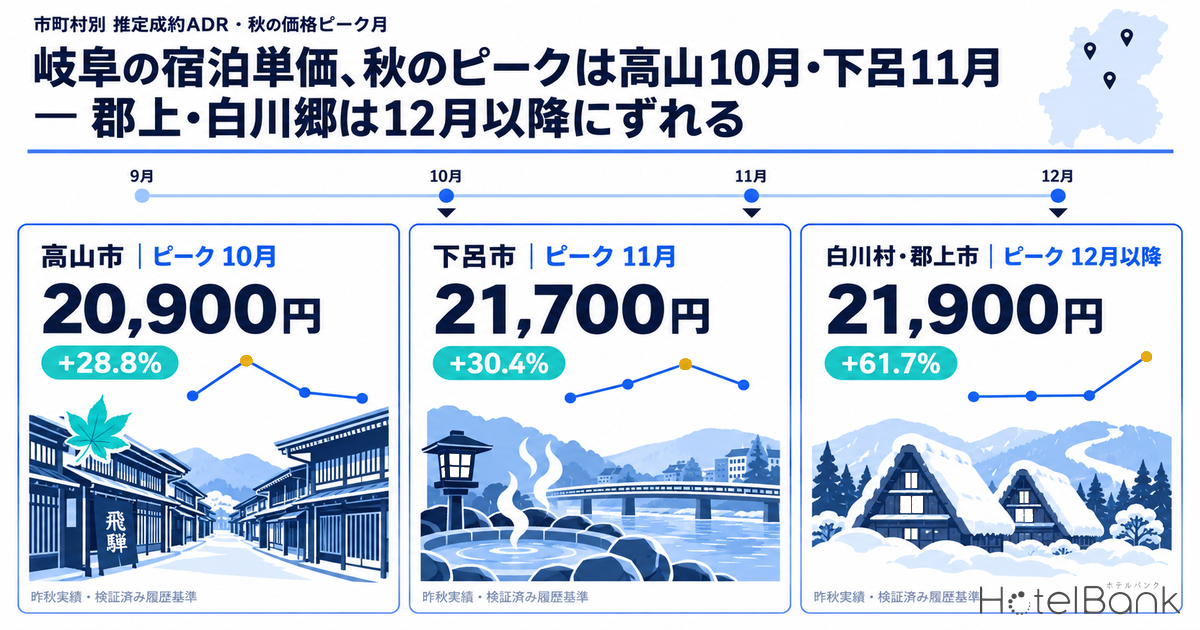
Describe Gifu Prefecture’s lodging market with a single average and you lose the most important information. Price levels in the mountains of Hida and on the Nobi Plain differ by more than a factor of two, and even the month in which prices start to climb differs from place to place. Lining up municipal-level estimated settled ADR (average daily rate) by month from MetroEngines Research data shows that the autumn price peak falls in October in Takayama, November in Gero, and December or later in Gujo and Shirakawa Village — a gap of up to three months within the same prefecture. This article sorts nine municipalities into four price tiers, then examines how the autumn-foliage ramp-up (October–November) differs by tier, using two separate bases: last autumn’s verified actuals and the current forward listing snapshot.
Metric Definitions Used in This Article
- ADR (average daily rate): An estimated settled rate (tax-excluded equivalent), calculated by applying segment-specific adjustment factors to the lowest-priced plan each property publishes on booking sites (per-room rate for 2 guests, tax included). Checked against property-level actuals disclosed by listed hotel REITs (91 properties, most recent 3 months), the median error is about 7%. These are estimates and differ from each property’s actual transaction prices and accounting figures. Municipal ADR is the median across covered properties (the level of a typical property in the area).
- Listed price: The average of all plans shown on booking sites (from room-only to half-board; per-room rate for 2 guests, tax included). Because it is calculated on a different basis from the ADR above, this article always labels the two separately.
- Two bases (very important): Months up to August 2026 use the verified historical basis, built on finalized actuals. Months from September 2026 onward use the listing snapshot basis, calculated from what is listed on booking sites at the time of the survey. The two bases do not share the same level, so this article compares months only within the same basis. No year-over-year change is calculated across bases.
- Occupancy (OTA listed-inventory basis, estimated): Rooms sold as a share of total rooms in the area. This is an estimate based on how inventory sold on booking sites is being absorbed, and differs from a property’s actual overall occupancy.
- Data source: MetroEngines Research (coverage period September 2025–December 2026; data retrieved as of September 11, 2026)
- — Autumn peak months split three ways across the prefecture: Takayama = October, Gero and Ena = November, Gujo, Shirakawa Village and Hida = December or later. Last autumn’s verified actuals and this autumn’s listing snapshot show the same order.
- — Takayama’s estimated settled ADR rose from ¥16,200 in September to ¥20,900 in October last autumn (+28.8%), and from ¥18,400 to ¥22,900 in this autumn’s listing snapshot (+24.0%). Two independent bases both point to October.
- — Gero rose from ¥16,600 in September to ¥21,700 in November last autumn (+30.4%). The increase matches Takayama’s, but the peak arrives one month later.
- — Nakatsugawa follows a two-month plateau pattern. In this autumn’s listing snapshot, October (¥14,900) and November (¥15,100) sit at almost the same level.
- — Municipal medians show a gap in the ¥11,000–16,000 band. No market of meaningful size sits between Tier 1 (¥17,000s) and Tier 2 (around ¥10,000).
- — On the demand side, estimated ryokan occupancy consistently beats business hotels (August 2026: ryokan 91.8% / business 84.3%). Ryokan lead by property count (134), but business hotels hold the majority of rooms (5,770).
Gifu’s Lodging Market Splits into Four Price Tiers
First, the price map. Averaging each municipality’s estimated settled ADR over the 12 months from September 2025 to August 2026 (all on the verified historical basis), Gifu’s nine main municipalities fall neatly into four bands. At the top are Shirakawa Village (白川村) at ¥18,500, Gero (下呂市) at ¥17,500 and Takayama (高山市) at ¥17,100, each with a clear asset: a World Heritage Site, a hot spring town or an international tourist destination. Below them come Tier 2 with Nakatsugawa at ¥10,900 and Gujo at ¥9,700, Tier 3 with Gifu City at ¥8,400, Ena at ¥8,000 and Hida at ¥7,900, and Tier 4 with Ogaki at ¥7,000.
It is worth stressing that this is not a story of lower tiers “falling short” of higher ones. As shown below, each tier’s demand rises in a different month, so the shape of its peak season is fundamentally different. The prefecture’s structure is read more accurately by how much each tier gains in which season than by absolute rate levels. How this four-tier structure itself came about, together with prefecture-wide supply and demand, is covered in Gifu’s Hotel Market in 4 Tiers 2026: ADR from ¥6,200 to ¥16,500.
Source: MetroEngines Research; compiled by HotelBank Editorial Team
| Price tier | Municipality | Est. settled ADR 12-mo avg (historical basis) | Listed properties period max | Last autumn peak month | This autumn peak month | Main demand drivers |
|---|---|---|---|---|---|---|
| Tier 1: ¥17,000s | Shirakawa Village | ¥18,532 | 17 | Dec | Nov | Shirakawa-go World Heritage Site; winter light-up (January) |
| Tier 1: ¥17,000s | Gero | ¥17,497 | 66 | Nov | Nov | Gero Onsen; Onsenji Temple foliage illumination (mid-November) |
| Tier 1: ¥17,000s | Takayama | ¥17,083 | 300 | Oct | Oct | Old town, Okuhida Onsen villages, Northern Alps (foliage across a wide elevation range) |
| Tier 2: ~¥10,000 | Nakatsugawa | ¥10,854 | 34 | Oct | Nov | Magome-juku, Nakasendo, foot of Mt. Ena (Oct–Nov) |
| Tier 2: ~¥10,000 | Gujo | ¥9,720 | 82 | Dec | Nov | Gujo Hachiman; Takasu-area snow resorts (from December) |
| Tier 3: ~¥8,000 | Gifu City | ¥8,354 | 52 | Oct | Sep | Business demand in the prefectural capital + Nagara River, Gifu Castle |
| Tier 3: ~¥8,000 | Ena | ¥8,047 | 27 | Nov | Nov | Ena Gorge, Iwamura castle town |
| Tier 3: ~¥8,000 | Hida | ¥7,857 | 28 | Dec | Sep | Hida-Furukawa old town, Sugo Highlands |
| Tier 4: ~¥7,000 | Ogaki | ¥6,972 | 17 | Nov | Sep | Business demand in western Mino; the “City of Water” |
Estimated settled ADR is the 12-month average for September 2025–August 2026 (verified historical basis). “Last autumn peak month” is the month with the highest estimated settled ADR among the four months of September–December 2025; “This autumn peak month” is the highest among September–December 2026 (listing snapshot basis). Because the two use different bases, levels cannot be compared; each is compared only within its own basis.
Source: MetroEngines Research; compiled by HotelBank Editorial Team
Last Autumn’s Verified Actuals: Peak Months Split Across October, November and December
This is the core of the analysis. September–December 2025 is entirely on the verified historical basis (finalized actuals), so the shape of autumn can be compared without crossing bases. The result is clear: peak months split three ways.
First, the October group. Takayama posted the largest increase in the prefecture, from ¥16,200 in September to ¥20,900 in October (+28.8%), before easing to ¥18,500 in November. Takayama’s municipal area includes the Okuhida Onsen villages and the Northern Alps. On the Shinhotaka Ropeway, leaves around the summit station (2,156 m) begin to turn in late September, and the color descends to the base (1,117 m) over roughly a month into late October (Shinhotaka Ropeway / Gifu Prefecture official tourism site). Terrain that keeps foliage going through all of October shows up directly as an October price peak. Nakatsugawa also belongs to the October group, rising from ¥12,600 in September to ¥15,400 in October (+22.2%).
Next, the November group. Gero rose from ¥16,600 in September to ¥21,700 in November (+30.4%), a larger increase than Takayama’s. Autumn foliage in Gifu normally peaks from mid to late November, and Gero Onsen holds its Onsenji Temple foliage illumination every mid-November (Gifu Prefecture official tourism site). Hot spring towns at lower elevations peak later than the high mountains. Foliage peaks and lodging price peaks do not always coincide; the price peak comes about two weeks earlier on average. Ena is also in the November group, rising from ¥8,700 in September to ¥9,400 in November (+7.7%), though the move is modest.
Then the December-or-later group. Gujo rose from ¥8,200 in September to ¥11,300 in December (+36.7%), and Shirakawa Village from ¥13,500 to ¥21,900 (+61.7%). Their peak comes in winter, not autumn. In Gujo’s Takasu area, Takasu Snow Park and Dynaland open in stages from early December (official ski resort sites), and the Shirakawa-go winter illumination in 2027 will be held on four days — January 11, 17, 24 and 31 — by reservation only (Shirakawa-go Tourist Association). Indeed, Shirakawa Village’s estimated settled ADR went from ¥21,900 in December to ¥19,900 in January 2026 and ¥26,800 in February, hitting its highest level in the depths of winter. Hida also climbs sharply from November into December, from ¥6,000 in September to ¥10,400 in November and ¥11,400 in December.
Source: MetroEngines Research; compiled by HotelBank Editorial Team (estimated settled ADR, Sep–Dec 2025, verified historical basis, N=7 municipalities)
| Municipality | Sep 2025 | Oct | Nov | Dec | Listed properties Sep/Oct/Nov/Dec | ADR-calculated properties Sep/Oct/Nov/Dec |
|---|---|---|---|---|---|---|
| Takayama | ¥16,236 | ¥20,911 +28.8% | ¥18,484 +13.8% | ¥17,290 +6.5% | 227 / 226 / 215 / 211 | 127 / 125 / 119 / 120 |
| Gero | ¥16,628 | ¥18,109 +8.9% | ¥21,680 +30.4% | ¥19,632 +18.1% | 53 / 51 / 52 / 50 | 45 / 43 / 43 / 42 |
| Shirakawa Village | ¥13,538 | ¥14,591 +7.8% | ¥14,535 +7.4% | ¥21,892 +61.7% | 11 / 10 / 10 / 9 | 7 / 6 / 6 / 5 |
| Nakatsugawa | ¥12,597 | ¥15,394 +22.2% | ¥14,574 +15.7% | ¥13,810 +9.6% | 26 / 29 / 26 / 27 | 11 / 10 / 9 / 12 |
| Gujo | ¥8,243 | ¥8,331 +1.1% | ¥10,050 +21.9% | ¥11,265 +36.7% | 65 / 67 / 64 / 65 | 27 / 27 / 25 / 28 |
| Hida | ¥6,040 | ¥5,951 -1.5% | ¥10,396 +72.1% | ¥11,433 +89.3% | 25 / 25 / 24 / 23 | 13 / 12 / 12 / 11 |
| Ena | ¥8,725 | ¥9,002 +3.2% | ¥9,396 +7.7% | ¥9,283 +6.4% | 26 / 25 / 22 / 22 | 13 / 13 / 12 / 13 |
| Gifu City | ¥7,704 | ¥8,736 +13.4% | ¥7,954 +3.2% | ¥7,568 -1.8% | 40 / 41 / 38 / 35 | 32 / 32 / 32 / 32 |
| Ogaki | ¥6,978 | ¥6,919 -0.8% | ¥7,333 +5.1% | ¥6,811 -2.4% | 13 / 13 / 13 / 12 | 11 / 11 / 11 / 11 |
| Gifu Prefecture total | ¥10,715 | ¥12,327 +15.0% | ¥12,519 +16.8% | ¥12,081 +12.7% | 581 / 585 / 562 / 554 | 365 / 358 / 347 / 352 |
All figures on the verified historical basis. Shading marks each municipality’s highest value across the four months. Percentages show change versus September for the same municipality. “Listed properties” are properties with observable prices on booking sites; “ADR-calculated properties” are those among them included in the estimated settled ADR calculation.
Source: MetroEngines Research; compiled by HotelBank Editorial Team
This Autumn’s Listing Snapshot Shows the Same Order
Will the order seen in last autumn’s actuals repeat this autumn? September–December 2026 is on the listing snapshot basis, calculated from what is currently listed on booking sites; these are not finalized actuals. Levels cannot be set side by side with last autumn, but the monthly shape can be compared within the same basis.
In short, the order has held almost unchanged. Takayama traces the same October peak as last year: ¥18,400 in September, ¥22,900 in October (+24.0%) and ¥21,100 in November. Gero peaks in November: ¥18,500 in September, ¥18,900 in October and ¥20,300 in November (+9.3% vs September). Shirakawa Village keeps climbing toward year-end, from ¥21,100 in September to ¥23,100 in November and ¥23,000 in December, and Gujo rises after October rather than in it, from ¥10,800 in October (−2.2% vs September) to ¥12,200 in November (+10.7%). The structure of three tiers peaking in different months remains intact this autumn.
One important caveat: in 2026, September 19–23 is a five-day holiday period, which makes September a stronger base month than usual. Changes measured from September may look smaller as a result. In fact, in Gifu City and Ogaki, where business demand dominates, September is the highest of the four months — more naturally read as a holiday effect than as autumn tourism demand.
Source: MetroEngines Research; compiled by HotelBank Editorial Team (estimated settled ADR, Sep–Dec 2026, listing snapshot basis, N=7 municipalities)
| Municipality | Sep 2026 | Oct | Nov | Dec | Listed properties Sep/Oct/Nov/Dec · vs Sep | ADR-calculated properties Sep/Oct/Nov/Dec |
|---|---|---|---|---|---|---|
| Takayama | ¥18,425 | ¥22,853 +24.0% | ¥21,094 +14.5% | ¥17,911 -2.8% | 297 / 287 / 269 / 224 -25% | 137 / 133 / 130 / 115 |
| Gero | ¥18,531 | ¥18,926 +2.1% | ¥20,256 +9.3% | ¥19,610 +5.8% | 63 / 62 / 57 / 48 -24% | 47 / 46 / 42 / 37 |
| Shirakawa Village | ¥21,094 | ¥21,908 +3.9% | ¥23,063 +9.3% | ¥22,992 +9.0% | 17 / 16 / 14 / 10 -41% | 8 / 8 / 7 / 6 |
| Nakatsugawa | ¥12,022 | ¥14,851 +23.5% | ¥15,074 +25.4% | ¥11,510 -4.3% | 34 / 32 / 32 / 29 -15% | 12 / 11 / 11 / 11 |
| Gujo | ¥11,002 | ¥10,755 -2.2% | ¥12,176 +10.7% | ¥11,816 +7.4% | 82 / 72 / 66 / 50 -39% | 27 / 23 / 20 / 20 |
| Hida | ¥10,892 | ¥10,605 -2.6% | ¥10,124 -7.1% | ¥10,207 -6.3% | 28 / 27 / 23 / 17 -39% | 13 / 13 / 12 / 11 |
| Ena | ¥10,892 | ¥10,534 -3.3% | ¥11,365 +4.3% | ¥10,658 -2.1% | 27 / 27 / 24 / 23 -15% | 14 / 14 / 13 / 12 |
| Gifu City | ¥13,366 | ¥12,470 -6.7% | ¥12,097 -9.5% | ¥12,199 -8.7% | 52 / 51 / 45 / 39 -25% | 32 / 32 / 29 / 27 |
| Ogaki | ¥10,184 | ¥9,575 -6.0% | ¥9,648 -5.3% | ¥9,890 -2.9% | 16 / 16 / 14 / 13 -19% | 11 / 11 / 10 / 10 |
| Gifu Prefecture total | ¥13,297 | ¥14,330 +7.8% | ¥14,472 +8.8% | ¥13,165 -1.0% | 730 / 702 / 646 / 539 -26% | 373 / 361 / 339 / 305 |
All figures on the listing snapshot basis (estimates based on listings on booking sites at the time of the survey). Shading marks each municipality’s highest value across the four months.
Source: MetroEngines Research; compiled by HotelBank Editorial Team
Watch the drop in listed properties: In December, the number of listed properties falls sharply versus September: prefecture-wide from 730 to 539 (−26%), Takayama from 297 to 224 (−25%), Gujo from 82 to 50 (−39%) and Gero from 63 to 48 (−24%). Listings for dates further out are not yet complete, and averages jump more easily on a thin sample. We checked for months where the number of ADR-calculated properties falls below 60% of the period median; all nine municipalities shown meet the threshold (the thinnest is Gujo in December at 20 properties, 74% of its median). Even so, December figures are treated as provisional and are used in the text only to indicate trends for municipalities whose main season is winter.
Over 12 Months, the Tiers Themselves Do Not Move
While autumn peaks shift, the ranking between tiers barely changes. Across the 12 months from September 2025 to August 2026, Takayama and Gero move within a ¥13,000–21,700 range, with Shirakawa Village breaking above them only in winter. Nakatsugawa ranges from ¥7,500 to ¥15,400, and Gujo and Gifu City from ¥7,500 to ¥12,700, each moving seasonally within its own band.
Shirakawa Village’s pattern is especially distinctive. From September to November it stays at ¥13,500–14,600, close to Tier 2 levels, then jumps to ¥21,900 in December and ¥26,800 in February 2026. Prices show that the season when snow covers the gassho-zukuri village is the village’s core product. Rather than smoothing revenue across the year, the market is built around capturing winter. The difference between mountain areas that peak in autumn and those that peak in winter can also be seen nationwide in Japan’s 15 Trailhead Towns: Autumn ADR Peaks vs Winter Ski Premiums.
Prefecture-wide estimated settled ADR peaked at ¥12,600 in August 2026 and bottomed at ¥9,600 in June 2026 — a swing of just 1.31x. That is far smaller than the swings at municipal level (Shirakawa Village 1.98x, Hida 1.92x), showing that the prefectural average is the result of different seasonal patterns canceling each other out. Investment decisions or pricing built on prefecture-level figures alone will miss this offsetting effect.
Source: MetroEngines Research; compiled by HotelBank Editorial Team (estimated settled ADR, Sep 2025–Aug 2026, verified historical basis, N=6 municipalities + prefecture average)
Listed Properties vs Price Level: A Gap in the ¥11,000–16,000 Band
Next, the relationship between the number of listed properties and price level. Plotting listed properties (period maximum) on the horizontal axis against 12-month average estimated settled ADR on the vertical axis brings Gifu’s market structure into sharper focus.
Takayama stands out with 300 properties, by far the largest in the prefecture, yet its ADR remains in the top tier at ¥17,100. Normally, thicker supply pulls the median down, but not in Takayama. This is likely because two very different catchments — the walkable old town and the Okuhida Onsen villages — coexist within one city, with upper-tier properties supporting the median. Achieving both scale and rate is a useful model for other areas in the prefecture.
What stands out is that not a single municipal median falls between ¥11,000 and ¥16,000. The floor of Tier 1 is Takayama at ¥17,100 and the ceiling of Tier 2 is Nakatsugawa at ¥10,900, leaving a gap of about ¥6,200. The prefecture has two poles — a “hot spring / international destination” price band and a “regional city / suburban” price band — and no area appears to be targeting the middle position as a market. Individual properties likely aim at this band, but they are not yet numerous enough to lift any municipal median.
Source: MetroEngines Research; compiled by HotelBank Editorial Team (12-month average estimated settled ADR × listed properties, Sep 2025–Aug 2026, N=9 municipalities)
The growth in listed properties also deserves a note. Takayama’s listed properties rose from 227 in September 2025 to 300 in July 2026, and prefecture-wide from 581 to 737. This includes not only new openings but also small properties that were previously not observable on booking sites. Absolute property counts therefore cannot simply be compared across periods; this article shows the sample size for each point in the tables and limits comparisons to municipalities within the same month.
Demand Side: Ryokan and Business Hotels Earn in Different Shapes
The same structure shows up not only in prices but in how inventory is absorbed. The table below shows estimated monthly occupancy by segment for the 250 properties and 10,824 rooms in Gifu whose booking-site inventory can be tracked.
| Month | All properties 250 properties / 10,824 rooms | Business hotels 59 properties / 5,770 rooms | Ryokan 134 properties / 3,511 rooms | Listed price business | Listed price ryokan |
|---|---|---|---|---|---|
| May 2026 | 83.2% | 80.7% | 88.2% | ¥14,672 | ¥36,984 |
| Jun 2026 | 77.7% | 75.1% | 82.9% | ¥11,458 | ¥32,266 |
| Jul 2026 | 81.1% | 79.2% | 86.0% | ¥12,756 | ¥35,637 |
| Aug 2026 | 86.7% | 84.3% | 91.8% | ¥13,877 | ¥43,488 |
| Sep 2026 Sep 1–11 | 82.2% | 81.7% | 85.4% | ¥12,582 | ¥33,366 |
Occupancy is an estimate based on the absorption of inventory listed on booking sites and differs from actual overall occupancy. Property and room counts are for the observation cohort as of August 2026. Listed price is the all-plan average (2 guests per room, per room, tax included) and is on a different basis from estimated settled ADR. September 2026 covers the 11 days from September 1–11.
Source: MetroEngines Research; compiled by HotelBank Editorial Team
Source: MetroEngines Research; compiled by HotelBank Editorial Team (estimated occupancy and listed price by segment; cohort of 250 properties / 10,824 rooms as of August 2026)
Estimated ryokan occupancy exceeded business hotels in every month, reaching 91.8% in August 2026, which includes the Obon holidays. Business hotels were at 84.3% in the same month, a gap of 7.5 points. Listed prices move even more differently: ryokan rose about 35%, from ¥32,300 in June to ¥43,500 in August, while business hotels rose only about 21%, from ¥11,500 to ¥13,900. Ryokan stretch hard in peak seasons; business hotels fill steadily year-round — within the same prefecture, the revenue model itself is different.
Supply mix matters too. By property count, ryokan (134) outnumber business hotels (59) more than two to one, but by rooms, business hotels (5,770) exceed ryokan (3,511). Per property, ryokan average 26 rooms and business hotels 98 — about a fourfold difference in scale. Weighted by rooms, the prefecture-wide average occupancy is pulled toward business hotels. Looking only at the prefectural average makes the strength of demand in the foliage and winter seasons — the ryokan’s main battleground — look smaller than it really is.
Note that estimated occupancy for October and November is not yet finalized. Our inventory data requires an accumulated observation period, so only elapsed months are reliable at this point. For reading foliage-season demand ahead of time, the shape of listing-snapshot prices discussed here is the best available guide for now.
Upside by Tier: Where Is There Still Room to Capture?
Finally, what room is left in each tier? To be clear, lower-rate tiers are not inferior. When demand rises in a different month, the approach to capturing it simply needs to differ.
Tier 1: Extend both sides of the peak
Takayama concentrates in October and eases back to +13.8% vs September by November. Gero peaks in November, so its October is a modest +8.9% vs September. The two cities have a relationship where each one’s trough is the other’s peak, so the Hida area as a whole can be positioned to capture demand across October and November. The upside lies in how to design the weekends outside each peak month.
Tier 2: Make use of the two-month plateau
In this autumn’s listing snapshot, Nakatsugawa holds nearly the same level for two months: ¥14,900 in October and ¥15,100 in November. Compared with single-month spike markets, it has a wider demand window. Year-round draws such as Magome-juku and the Nakasendo overlap with foliage at the foot of Mt. Ena, a structure well suited to multi-night stays and touring itineraries.
Tier 3: Two peaks, autumn and winter
Hida showed the largest relative rise in the prefecture last autumn, about +72%, from ¥6,000 in September to ¥10,400 in November. Because its September level is low, its autumn ramp-up is the steepest in the prefecture. Ena also has a gentle November peak. With only 11–14 ADR-calculated properties, monthly swings are large, so trends are better read across several months than in a single month.
Tier 4: Stability plus holiday uplift
Gifu City and Ogaki show small seasonal swings; last autumn’s maximum change versus September was +13.4%. Steady year-round absorption is their strength, with holidays adding uplift on top. In this autumn’s listing snapshot, September is the highest of the four months, likely reflecting the five-day holiday on September 19–23. This tier can plan ahead around calendar effects.
And once more, the ¥11,000–16,000 gap. Lodging demand in the prefecture is polarized between Tier 1 in the ¥17,000s and Tier 2 around ¥10,000, and no area holds the space in between as a market. This data alone cannot identify where travelers priced out of Takayama and Gero during foliage season go. Still, locations within reach of the Hida area that can offer mid-range prices appear to have room left to capture.
For hotels: Plan-name tips for this theme
Common selling points in published plan names for Gifu × autumn foliage (N=141) —
Kaiseki course 36%Wagyu / brand beef 28%Seasonal SALE 21%Half-board 16%Breakfast included 13%Open-air onsen 11%
Actual plan name examples (anonymized, English gloss with original):
- [Standard Kaiseki] For families and couples: a full Japanese course with Hida beef hoba-miso steak — local produce through the four seasons (【スタンダード会席】ご家族・カップル♪飛騨牛朴葉味噌ステーキ付の和食フルコース!地産地消と春夏秋冬)
- [Autumn/Winter SALE] [Long Stay, room only] 3pm check-in to 1pm check-out plan (【秋冬SALE】【ロングステイ◆素泊り】15時イン〜13時アウトプラン♪)
- [Autumn/Winter SALE] [Long Stay, breakfast included] 3pm check-in to 1pm check-out plan (【秋冬SALE】【ロングステイ◆朝食付き】15時イン〜13時アウトプラン♪)
*Trends based on aggregated published plan names; this does not show that naming causes sales.
⚠ Note on forward-dated figures: Estimated settled ADR from September 2026 onward is calculated from listings published on booking sites at the time of the survey (September 11, 2026) and will change as check-in dates approach. Levels that look high now may fall with last-minute adjustments, or rise as inventory tightens. Because fewer properties are listed for later months, December figures in particular are subject to larger revisions.
Summary
Gifu’s lodging market splits into four tiers by price level, and further splits three ways by the month its seasonal peak arrives: October for Takayama, November for Gero and Ena, and December or later for Gujo, Shirakawa Village and Hida. This order was confirmed on two independent bases — last autumn’s verified actuals and this autumn’s listing snapshot. Foliage descends from the high mountains first, lowland hot spring towns peak in November, and once snow falls, demand shifts to ski resorts and the gassho-zukuri village — the sequence of natural conditions is observed directly as a sequence of prices.
Prefecture-wide estimated settled ADR stays within a 1.31x swing, from ¥12,600 in August 2026 to ¥9,600 in June 2026. But this is the result of cities peaking in October and cities peaking in December offsetting each other; at municipal level, large swings are hidden — 1.98x in Shirakawa Village and 1.92x in Hida. Building pricing or investment decisions on prefecture-level figures alone risks being tripped up by this offset.
What differs by tier is not the height of the peak but the month it arrives and its width: single-month spikes in Takayama, a two-month plateau in Nakatsugawa, winter concentration in Shirakawa Village, and year-round stability in Gifu City and Ogaki. Each needs a different approach. And the open ¥11,000–16,000 band in municipal medians shows that the prefecture still has unfilled positions.
Related Articles
- Gifu’s Hotel Market in 4 Tiers 2026: ADR from ¥6,200 to ¥16,500
- Japan’s 15 Trailhead Towns: Autumn ADR Peaks vs Winter Ski Premiums
References and Sources
■ Data Sources
MetroEngines Research municipal estimated settled ADR (the nine main municipalities in Gifu Prefecture with continuously observable listed properties; period September 2025–December 2026), estimated occupancy and listed inventory by segment (observation cohort of 250 properties / 10,824 rooms as of August 2026), and aggregated published plan names (Gifu × autumn foliage, N=141). All retrieved as of September 11, 2026. Foliage peaks, event dates and ski resort opening dates reference official announcements from tourism associations, local governments and facilities as primary sources.
■ Estimation Assumptions
Estimated settled ADR is an estimate calculated by applying segment-specific factors to the lowest-priced plan (per room, tax-excluded equivalent) and is on a different basis from listed price (2 guests per room, per room, tax included, all-plan average). Months up to August 2026 use the verified historical basis built on finalized actuals; months from September 2026 onward use the listing snapshot basis calculated from what is listed on booking sites at the time of the survey. Because the two bases do not share the same level, months are compared only within the same basis, and no year-over-year change is calculated across bases. Municipal values are monthly averages of daily property-level medians, and price tiers are defined by 12-month average levels.
■ Limitations
Estimated occupancy is based on the absorption of inventory listed on booking sites and differs from actual overall occupancy. Later months tend to have thinner samples because listings are not yet complete; months in which ADR-calculated properties fall below 60% of the period median are excluded (the thinnest included is Gujo in December with 20 properties, 74% of its median). December figures are treated as provisional. Listed property counts include not only new openings but also small properties that were previously unobservable, so absolute counts are not compared across periods. Estimated occupancy for October and November 2026 lacks a sufficient observation period and is not finalized.
■ Market Data
- MetroEngines Research — municipal estimated settled ADR (9 municipalities in Gifu Prefecture, September 2025–December 2026), estimated occupancy and listed inventory by segment (cohort of 250 properties / 10,824 rooms as of August 2026), aggregated published plan names (Gifu × autumn foliage, N=141)
■ Tourism and Event Information (Primary Sources)
- Shirakawa-go Tourist Association: “Dates Announced for the 41st Shirakawa-go Light-Up, 2027” (Japanese)
- Shirakawa-go Tourist Association: “Winter Light-Up” (Japanese)
- Gifu Prefecture Official Tourism Site: “Autumn Leaves at Shinhotaka Ropeway” (Japanese)
- Gifu Prefecture Official Tourism Site: “Autumn Leaves at Gero Onsen Gassho Village” (Japanese)
- Gifu Prefecture Official Tourism Site: “Recommended Autumn Foliage Spots in Gifu” (Japanese)
- Japan Weather Association tenki.jp: “Gifu Prefecture Autumn Foliage Forecast” (Japanese)
- Dynaland official site (Takasu, Gujo)
- Takasu Snow Park official site (Takasu, Gujo)