

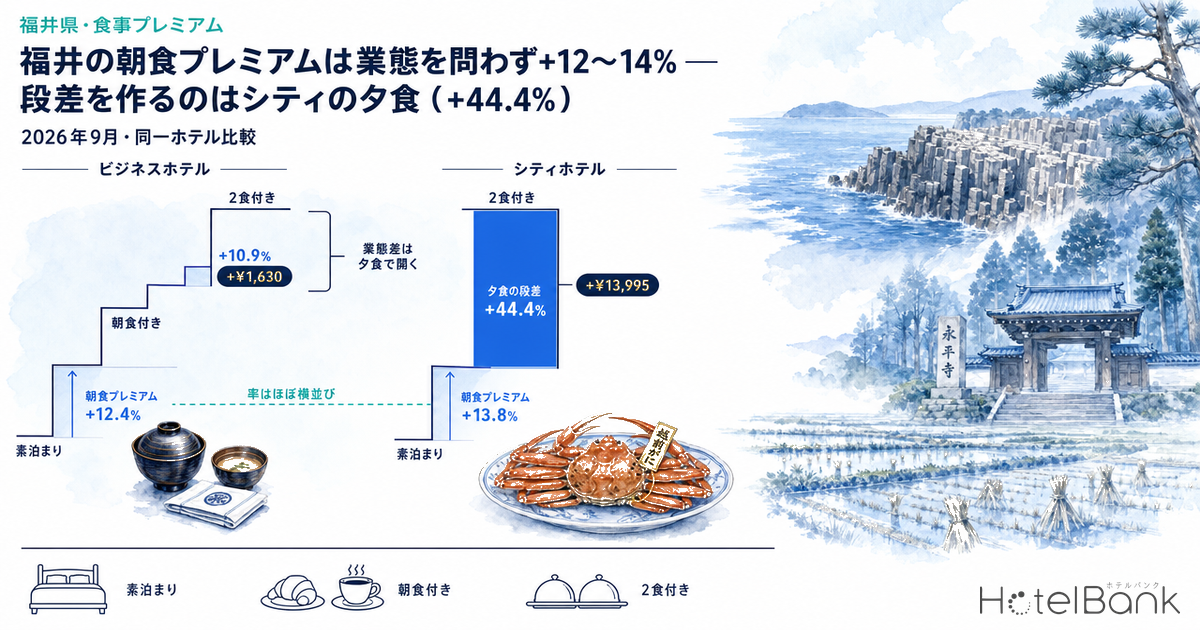
Among hotels in Fukui Prefecture that sell both room-only and breakfast-included rates at the same property, the price difference between the two (the breakfast premium) stood at +12.4% (+¥1,825, N=19 properties) for business hotels and +13.8% (+¥3,013, N=12 properties) for city hotels as of September 2026. In percentage terms, the hotel type makes almost no difference. The clear gap between types appears on the dinner side. The step up from breakfast-included to half-board (breakfast and dinner) was +44.4% (+¥13,995, N=5 properties) at city hotels and +10.9% (+¥1,630, N=8 properties) at business hotels — roughly 4x apart in percentage terms and about 8.6x in yen. This article tests that “breakfast is level, dinner makes the difference” structure against the other two Hokuriku prefectures and Okinawa, and turns it into a yardstick for reworking meal-inclusive packages for autumn and winter.
Scope: business and city hotels in Fukui Prefecture that sell more than one meal type at the same property (breakfast-included vs room-only pairs were found at N=35 properties prefecture-wide: 19 business hotels and 12 city hotels). Ryokan are excluded. Price metrics in this article are the estimated settled ADR (the settled price level estimated from OTA and other sales data, tax-exclusive equivalent) and the difference in selling price between meal types within the same hotel (per room, 2 guests). Definitions are collected at the end of the article. Data as of September 23, 2026.
- — Fukui’s breakfast premium is level across hotel types: business hotels +12.4% (+¥1,825, N=19 properties) and city hotels +13.8% (+¥3,013, N=12 properties) (September 2026, same-hotel pair comparison)
- — The gap between types opens at dinner. The step from breakfast-included to half-board is +44.4% (+¥13,995, N=5) at city hotels vs +10.9% (+¥1,630, N=8) at business hotels — about 4x in percentage terms and about 8.6x in yen
- — From May to September 2026, the business-hotel breakfast premium held steady at +12.3% to +13.3%. The city-hotel half-board step narrowed from +62.2% to +44.4% in percentage terms, while in yen it stayed in the mid-¥10,000s
- — Fukui business hotels’ half-board step (+¥1,630) is less than 30% of Ishikawa’s +¥6,633 and Toyama’s +¥5,589, suggesting many properties use dinner-inclusive rates as a discounted bundle for multi-night stays and business travelers
- — The underlying estimated settled ADR rose year on year in August 2026, the latest settled month: business hotels +11.1% (¥8,847, N=45) and city hotels +10.5% (¥10,730, N=14)
Fukui’s Meal Premiums in a Same-Hotel Pair Comparison
Calculating the meal premium as a simple prefecture-wide average means comparing “the average breakfast-included price” with “the average room-only price”. That comparison lets differences in which properties sell each rate (location, grade, room type) flow straight into the gap. This article therefore takes only cases where the same hotel sells both meal types for the same stay month, calculates the difference between its room-only and breakfast-included rates within the hotel, and then aggregates. N= in the figures below is the number of properties where such a pair exists (only pairs with N=5 or more are shown).
Here are Fukui Prefecture’s results for September 2026. The add-on for one breakfast was +¥1,825 at business hotels and +¥3,013 at city hotels, so in yen city hotels charge about 1.65x as much. But because their room-only price levels differ, in percentage terms the two come out almost the same, at +12.4% and +13.8%. These are per-room differences for 2 guests, so per person they come to about ¥900 at business hotels and about ¥1,500 at city hotels. How much one breakfast can be sold for appears to be set almost in proportion to the room-only price level rather than by hotel type.
| Hotel type (Sep 2026) | Breakfast vs room-only | Half-board vs breakfast | Half-board vs room-only |
|---|---|---|---|
| Business hotels | +¥1,825 (+12.4%) N=19 | +¥1,630 (+10.9%) N=8 | +¥3,217 (+23.2%) N=7 |
| City hotels | +¥3,013 (+13.8%) N=12 | +¥13,995 (+44.4%) N=5 | +¥19,720 (+76.4%) N=5 |
| Prefecture total (excl. ryokan) | +¥2,384 (+13.6%) N=35 | +¥6,229 (+28.9%) N=16 | +¥9,892 (+52.4%) N=15 |
Source: Compiled by HotelBank Editorial Team from MetroEngines Research (difference between meal types within the same hotel, per room for 2 guests; September 2026 values are based on current sales status)
The gap between types shows clearly in the half-board step. At city hotels, the add-on from breakfast-included to half-board is +¥13,995 (+44.4%), more than 4x the add-on for one breakfast (+¥3,013). At business hotels, by contrast, the +¥1,630 add-on for half-board is smaller than the +¥1,825 for one breakfast. Business hotels’ half-board rates look less like dinner priced as a stand-alone meal product and more like a “bundle discount” for multi-night stays and business travelers.
Source: Compiled by HotelBank Editorial Team from MetroEngines Research (Fukui Prefecture, September 2026, same-hotel pair comparison; N = business hotels 19/8/7, city hotels 12/5/5)
Month by Month, the Breakfast Rate Holds Still While the Dinner Step Stays Apart by Type
To check that this is not a one-month coincidence, we lined up May through September 2026 using the same method. The business-hotel breakfast premium stays within +12.3% to +13.3% and barely moves (N=18–19). City hotels move between +9.9% (August) and +15.2% (June) (N=10–12), but on average they sit in the same band as business hotels. August’s lower rate appears to reflect room-only prices rising with summer demand while the breakfast add-on itself (+¥2,420) moved relatively little.
Source: Compiled by HotelBank Editorial Team from MetroEngines Research (Fukui Prefecture, breakfast vs room-only, same-hotel pair comparison; September values are based on current sales status)
| Stay month (2026) | Business: breakfast | Business: half-board − breakfast | City: breakfast | City: half-board − breakfast |
|---|---|---|---|---|
| May | +¥1,720 (+12.3%) N=18 | +¥187 (+1.2%) N=9 | +¥2,891 (+14.4%) N=10 | +¥16,462 (+62.2%) N=5 |
| Jun | +¥1,766 (+12.6%) N=19 | +¥1,484 (+10.5%) N=8 | +¥2,922 (+15.2%) N=12 | – |
| Jul | +¥1,922 (+13.3%) N=19 | +¥1,558 (+10.9%) N=8 | +¥2,697 (+12.7%) N=12 | +¥15,176 (+50.1%) N=5 |
| Aug | +¥1,931 (+12.4%) N=19 | +¥1,670 (+11.1%) N=8 | +¥2,420 (+9.9%) N=12 | +¥15,462 (+45.6%) N=5 |
| Sep (current) | +¥1,825 (+12.4%) N=19 | +¥1,630 (+10.9%) N=8 | +¥3,013 (+13.8%) N=12 | +¥13,995 (+44.4%) N=5 |
Source: Compiled by HotelBank Editorial Team from MetroEngines Research (“–” = months where pairs did not reach N=5)
The half-board step ran +¥13,995 to +¥16,462 (+44.4% to +62.2%) at city hotels and, from June to September, +¥1,484 to +¥1,670 (+10.5% to +11.1%) at business hotels — the gap between types persists every month. In percentage terms the city-hotel step narrowed from +62.2% in May to +44.4% in September, but in yen it stayed in the mid-¥10,000s. The dinner price was essentially held, and the percentage fell only because breakfast-included prices rose. This suggests many properties set the dinner add-on as a fixed yen amount, like a course price, rather than as a fixed percentage.
Set Against Hokuriku and Okinawa, Fukui’s Business-Hotel Dinner Stands Out
What kind of market lets the same single breakfast command nearly twice the add-on depending on hotel type? To find out, we used the same method to line up Fukui’s Hokuriku neighbors Ishikawa and Toyama, along with Okinawa, where tourism demand weighs heavily (all September 2026, same-hotel pair comparison).
| Prefecture (Sep 2026) | Business: breakfast | City: breakfast | Business: half-board − breakfast | City: half-board − breakfast |
|---|---|---|---|---|
| Fukui | +¥1,825 (+12.4%) N=19 | +¥3,013 (+13.8%) N=12 | +¥1,630 (+10.9%) N=8 | +¥13,995 (+44.4%) N=5 |
| Ishikawa | +¥2,196 (+12.8%) N=36 | +¥4,283 (+14.7%) N=5 | +¥6,633 (+29.8%) N=10 | – |
| Toyama | +¥1,597 (+10.1%) N=26 | +¥3,072 (+17.4%) N=9 | +¥5,589 (+32.1%) N=10 | +¥10,124 (+43.0%) N=5 |
| Okinawa | +¥2,231 (+13.2%) N=76 | +¥5,985 (+25.6%) N=8 | +¥4,938 (+27.0%) N=15 | – |
Source: Compiled by HotelBank Editorial Team from MetroEngines Research (“–” = segments where pairs did not reach N=5)
The business-hotel breakfast premium falls within a +10.1% to +13.2% band in all four prefectures, so differences between prefectures are small. Across all 47 prefectures, measured with the same same-hotel pair comparison, the median business-hotel breakfast premium is 9.9% (August 2026 tally, 47 prefectures), and Fukui’s +12.4% sits slightly above it. The prefecture where the city-hotel breakfast opened up a near-2x gap between types was Okinawa (business +13.2% vs city +25.6%); in the three Hokuriku prefectures, city hotels stayed at +13.8% to +17.4%. A large add-on for city-hotel breakfast appears in resort-type markets, where breakfast itself is part of the reason for the trip. Fukui’s city hotels differentiate on dinner rather than breakfast.
The other thing that stands out is how small Fukui business hotels’ half-board step is. In Ishikawa (+29.8%), Toyama (+32.1%) and Okinawa (+27.0%), moving from breakfast-included to half-board adds +¥4,900 to +¥6,600, whereas in Fukui it adds +¥1,630 (+10.9%). Business hotels in the other two Hokuriku prefectures price dinner as a one-meal product, while in Fukui many properties appear to use dinner-inclusive rates as a discounted bundle for multi-night stays and business travelers. On the monthly average for May–September 2026, the Fukui business-hotel step was +8.9% (N=8–9), against a national median of +28.3% computed the same way.
Source: Compiled by HotelBank Editorial Team from MetroEngines Research (business hotels, September 2026, same-hotel pair comparison; N = breakfast: Fukui 19, Ishikawa 36, Toyama 26, Okinawa 76 / half-board − breakfast: Fukui 8, Ishikawa 10, Toyama 10, Okinawa 15)
The same tendency holds at the municipal level. In September 2026 the breakfast premium was +8.8% (+¥1,678, N=9) for city hotels in Fukui City, +7.0% (+¥1,124, N=7) for business hotels in Fukui City, and +10.7% (+¥1,511, N=8) for business hotels in Tsuruga City. Fukui City’s city hotels sit below the prefecture’s city-hotel figure (+13.8%), showing that urban city hotels in the prefectural capital keep the breakfast add-on down to business-hotel levels.
The Underlying Estimated Settled ADR Is Up About 10% YoY in Settled Months
Meal steps sit on top of the underlying room-only price level. Fukui Prefecture’s business-hotel estimated settled ADR was ¥8,847 (N=45) in August 2026 on a settled basis, +11.1% from ¥7,966 (N=43) a year earlier. City hotels were ¥10,730 (N=14) in August 2026, +10.5% from ¥9,709 (N=13) a year earlier. For the settled months of January–July 2026, business hotels were +4.4% year on year; how growth tilted toward the later part of the period is examined in our analysis of Fukui’s estimated settled ADR in H1 2026. From September onward the figures are estimates based on current sales status: business hotels ¥11,125 in September (N=44), ¥11,221 in October (N=44) and ¥11,207 in November (N=41); city hotels ¥11,527 in September, ¥12,326 in October and ¥12,068 in November (all N=14). Estimates may change as each month is settled, so a straight comparison with last year’s settled values has to wait until month-end.
Source: Compiled by HotelBank Editorial Team from MetroEngines Research (Fukui Prefecture business hotels, estimated settled ADR; 2025 N=41–44, 2026 N=39–48; solid line = settled, dashed line = estimate based on current sales status)
Taken together with the breakfast premium moving at a near-constant rate, this suggests that at Fukui business hotels the prevailing practice is percentage-linked pricing: when the room-only price level rises, the breakfast add-on rises with it. City-hotel dinners, on the other hand, have their yen amount fixed first, so the half-board step looks smaller in percentage terms in seasons when the room-only price level is higher.
For Revenue Managers at Fukui Business and City Hotels — Implications and Action Plan
1. Check breakfast against the market as a percentage. Fukui’s breakfast premium is +12.4% (N=19) at business hotels and +13.8% (N=12) at city hotels — almost the same band across types, and it barely moved from May to September. The first step is to divide your own breakfast-included vs room-only difference by your room-only price and see whether it strays far from this band. Well below the band suggests room to better communicate breakfast’s value; well above it suggests you may not be reaching guests who choose room-only.
2. Design dinner as a yen amount. The city-hotel half-board step moved from +62.2% to +44.4% in percentage terms, yet stayed between +¥13,995 and +¥16,462 in yen. Setting the dinner add-on as a yen amount from course cost and delivered value — without linking it to the room-only price level, and reviewing it separately from room-only price changes — is closer to how the market actually works.
3. Decide what half-board is for at business hotels. The half-board step at Fukui business hotels (+¥1,630, N=8) is less than 30% of Ishikawa’s (+¥6,633) and Toyama’s (+¥5,589). Whether you position it cheaply as a product to lock in multi-night stays and business travelers, or aim for a step in line with the other two Hokuriku prefectures as a one-dinner product, the moves are opposite. Decide which role it plays first.
4. The winter delicacy season is the starting point for reviewing the dinner step. The Echizen crab (越前がに) season opens every year on November 6 (running until March 20 of the following year). It is the time when the value of dinner comes across most easily, and it suits city hotels’ yen-based step design. The autumn estimated settled ADR sits around ¥11,000 for September–November, so check that you are not squeezing the dinner step too far in percentage terms while the underlying price level is high.
| Timing | Action | Decision trigger (figures from this article) | Aim |
|---|---|---|---|
| This week | Calculate your own breakfast-included vs room-only difference as a percentage and set it against the market band | If it is far from business +12.4% (N=19) / city +13.8% (N=12) | Identify over- or under-pricing of breakfast |
| This week | Write out the half-board add-on in yen rather than as a percentage | If a city hotel’s step is well below +¥13,995 (N=5) | Check that dinner’s delivered value and price are consistent |
| Within 2 weeks | Decide the role of business-hotel half-board (multi-night lock-in vs dinner product) | Whether your step is closer to the Fukui average of +¥1,630 or to Ishikawa +¥6,633 / Toyama +¥5,589 | Clarify the product’s positioning |
| Within 2 weeks | Set an operating rule so the breakfast difference follows room-only price changes as a percentage | If estimated settled ADR is up +11.1% (business) / +10.5% (city) YoY in settled months but your breakfast difference has not moved | Make meal add-ons follow the rise in the underlying price |
| Before the November season opening | Set the step for winter dinner-inclusive packages (dinners featuring local ingredients) on a yen basis | If the autumn estimated settled ADR stays around ¥11,000 | Secure the step in the season when dinner’s value comes across |
| Next month onward | Record breakfast and half-board difference rates monthly and compare them with the market trend | Any month when the market breakfast rate moves outside the +9.9% to +15.2% band | Spot market shifts early |
In every case the right answer depends on your own product mix and costs. The table above is intended as a prompt to consider a review against market levels.
Summary — Three Yardsticks for Measuring Meal Steps
| Yardstick | Fukui market (Sep 2026) | How to read it |
|---|---|---|
| Read breakfast as a percentage | Business +12.4% (N=19) / city +13.8% (N=12) | The same band regardless of type. Large add-ons like Okinawa’s city +25.6% (N=8) occur in resort-type markets |
| Read dinner in yen | City half-board − breakfast +¥13,995 (N=5) | The percentage moves with the season, but the yen amount stays steady in the mid-¥10,000s |
| Decide what half-board is for | Business half-board − breakfast +¥1,630 (N=8) | A different design from Ishikawa +¥6,633 / Toyama +¥5,589. Choose between lock-in and dinner product |
Source: Compiled by HotelBank Editorial Team from MetroEngines Research
A near-2x gap in breakfast between hotel types is a feature of markets where breakfast itself is part of the travel experience. In Fukui Prefecture, the breakfast add-on is level across types, and what sets properties apart is city-hotel dinner. Before reworking your autumn and winter packages, compare your breakfast against the market as a percentage and your dinner in yen.
Frequently Asked Questions
How large is the breakfast premium at hotels in Fukui Prefecture?
In a same-hotel pair comparison as of September 2026, it is +12.4% (+¥1,825, N=19 properties) for business hotels and +13.8% (+¥3,013, N=12 properties) for city hotels. Both are per-room differences for 2 guests, and across May–September 2026 the business-hotel figure stayed within +12.3% to +13.3%.
How different is the half-board step between city hotels and business hotels?
The add-on from breakfast-included to half-board was +44.4% (+¥13,995, N=5 properties) at city hotels and +10.9% (+¥1,630, N=8 properties) at business hotels (September 2026). That is about 4x apart in percentage terms and about 8.6x in yen; the gap between types arises on the dinner side, not breakfast.
Should the dinner add-on be designed as a percentage or a yen amount?
At Fukui city hotels, the half-board step moved from +62.2% (May) to +44.4% (September) in percentage terms, while in yen it stayed between +¥13,995 and +¥16,462. Setting dinner as a yen amount, like a course price, and reviewing it separately from room-only price changes is closer to how the market actually works.
Is the half-board step at Fukui business hotels smaller than in the other Hokuriku prefectures?
Yes. In September 2026 the add-on from breakfast-included to half-board was +¥1,630 (+10.9%, N=8) in Fukui, compared with +¥6,633 (+29.8%, N=10) in Ishikawa and +¥5,589 (+32.1%, N=10) in Toyama. In Fukui, many properties appear to use dinner-inclusive rates as a discounted bundle for multi-night stays and business travelers.
How are meal premiums calculated?
We take only cases where the same hotel sells both of the two meal types being compared (room-only, breakfast-included, half-board) for the same stay month, calculate the per-room difference for 2 guests and the difference rate, and average across properties. Ryokan are excluded, and only segments with N=5 or more are shown. September 2026 values are based on current sales status.
About the Data
| Meal premium | Limited to properties that sell both of the two meal types being compared (room-only, breakfast-included, half-board) within the same hotel for the same stay month: the difference in selling price per room for 2 guests and the difference rate (relative to the baseline price), averaged across properties. Properties that do not sell a given meal type drop out of that comparison, so the result differs from a simple prefecture-wide average. Ryokan are excluded. Only pairs with N=5 or more are shown. September 2026 values are based on current sales status. |
| Estimated settled ADR | The settled price level (tax-exclusive equivalent) estimated from OTA and other sales data (lowest-plan level × hotel-type coefficient, ensemble across multiple channels). Past months are settled values; current and future months are estimates based on current sales status. Median error of 6.6% when checked against published operating results. YoY is calculated between settled months only. |
| Breakdown of N= | Fukui Prefecture (September 2026) — breakfast vs room-only: 35 properties prefecture-wide (19 business hotels, 12 city hotels); half-board vs breakfast: 16 properties prefecture-wide (8 business hotels, 5 city hotels); half-board vs room-only: 15 properties prefecture-wide (7 business hotels, 5 city hotels). N for the comparison prefectures is shown in each table. Estimated settled ADR: business hotels N=39–48, city hotels N=13–14 (varies by month). |
| Data as of | Data as of September 23, 2026. Sales status and inventory change daily, so the figures in this article are a snapshot at the time of retrieval. |
References and Sources
■ Data sources
OTA and other selling-price data collected by MetroEngines Research (business and city hotels in Fukui, Ishikawa, Toyama and Okinawa; selling prices by meal type for stays May–September 2026), and the estimated settled ADR derived from the same data (Fukui Prefecture, January 2025 – November 2026). Data as of September 23, 2026.
■ Calculation assumptions
Meal premiums are limited to properties where the same hotel sells both of the two meal types being compared for the same stay month; the per-room difference for 2 guests and the difference rate relative to the baseline price are averaged across properties. Only segments with N=5 or more are shown. Per-person amounts are approximations obtained by halving the per-room difference for 2 guests. YoY for estimated settled ADR is calculated between settled months only (August 2026 and August 2025).
■ Limitations and caveats
September 2026 meal premiums and September–November estimated settled ADR are based on current sales status and may change as each month is settled. The city-hotel half-board comparison has a small N=5, so price changes at a few properties can move the percentage by several points. Differences in selling price do not indicate meal costs or the actual breakdown of settled bookings. Estimated settled ADR has a median error of 6.6% when checked against published operating results. Ryokan are excluded.
■ External sources
| Echizen Town Tourism Federation, “Echizen crab season opens November 6, through March 20 of the following year” (越前がに漁 11月6日解禁), Echizen Kanko Navi | https://www.town-echizen.jp/pages/?id=9 |
| Fukui City official tourism site Fuku-iro, “Echizen crab season opens” (越前がに漁解禁) | https://fuku-iro.jp/event/detail_12083.html |