

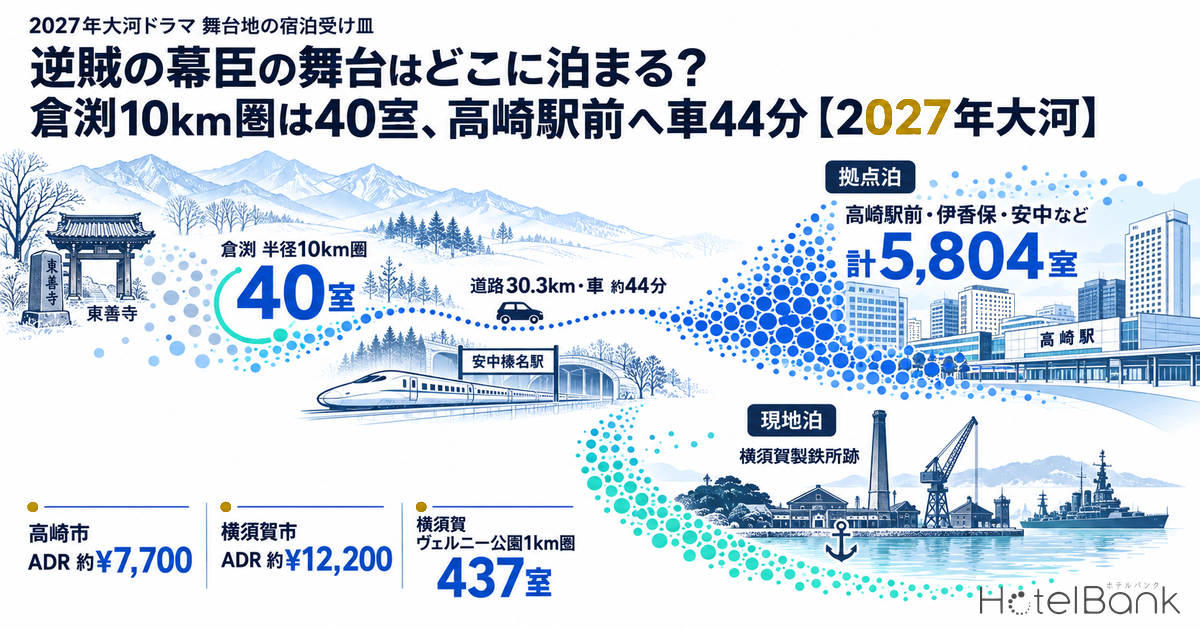
NHK’s 66th Taiga drama, Gyakuzoku no Bakushin (“The Traitor Retainer,” starring Tori Matsuzaka), begins airing on January 10, 2027, and its story is set in two separate places: Kurabuchi-machi in Takasaki City, Gunma, where the protagonist Tadamasa Oguri Kozukenosuke met his end, and Yokosuka City, Kanagawa, where he led the construction of an ironworks. As of October 2026, roughly three months before broadcast, MetroEngines Research data shows only 3 properties with 40 rooms listed within a 10 km radius of Gonda, Kurabuchi-machi, while the real lodging capacity — 5,804 rooms in total — is spread across Takasaki Station, Ikaho, Annaka and other clusters a 30–47 minute drive away. This article sorts out the question “stay on site, or stay at a base and commute?” by road distance, then uses monthly data to check how room rates moved in the broadcast year at locations tied to the past three Taiga dramas, and finally looks at the new supply that will arrive in time for the broadcast year.
Metric Definitions Used in This Article
Note on metric definitions in this article: ADR (average daily rate) = an estimated settled rate (tax-exclusive equivalent) calculated by applying property-type correction coefficients to the lowest published plan level each property lists on OTAs (two guests per room, per-room rate, tax-included). Cross-checked against property-level results disclosed by listed hotel REITs (91 properties, most recent three months), the median error is approximately 7%. These are estimates and differ from each property’s actual settled rates and accounting figures. Area-level ADR is the median of the properties covered (the level of a typical property in the area). OCC (occupancy rate) = rooms sold as a share of total rooms in the area (an estimate based on OTA sales inventory; consistency checks against monthly REIT disclosures have confirmed accuracy within roughly a few points). Where published prices are mentioned, they are per-room rates for two guests per room (tax-included).
Lodging capacity (properties and rooms): Of the properties tracked by MetroEngines Research, those confirmed as listed between April and September 2026 (excluding leisure hotels) are counted by straight-line distance from each origin point. Ryokan, minshuku and simple lodgings not listed on OTAs are not included. Because the listing-confirmation period differs from that of the related article published in August 2026, the property and room counts do not match.
Road distance and travel time: Guideline figures from route calculations based on publicly available road network data; congestion and winter road conditions are not taken into account. The origin on the Kurabuchi side is a representative point in Gonda, Kurabuchi-machi, Takasaki City, where Tozenji Temple is located. Data source: MetroEngines Research
- — Kurabuchi has 3 properties and 40 rooms within 10 km. Takasaki Station is 30.3 km and about 44 minutes away by road, making this a “stay at a base and commute” location. A total of 5,804 rooms is spread across five clusters a 30–47 minute drive away.
- — Yokosuka has 10 properties and 892 rooms within 5 km of Verny Park. Three properties with 437 rooms sit within a 1 km radius — a “stay on site” location where guests can sleep within walking distance of the historic sites.
- — August 2026 ADR was about ¥7,700 in Takasaki (N=33), about ¥8,900 in Annaka (N=13) and about ¥12,200 in Yokosuka (N=17). Takasaki stands at 58% of the Gunma prefectural median.
- — Locations tied to the past three dramas ranged from −6.9 to +6.0 points versus their prefectures, with mixed signs (six comparisons covering Otsu, Echizen, Taito Ward, Nagahama and Nakamura Ward in Nagoya). A Taiga drama is one demand factor; there is no evidence of it moving city-wide rates on its own.
- — New supply arriving in time for the broadcast year totals 378 rooms in Takasaki City (199 rooms scheduled to open on November 2, 2026, and 179 rooms reported as due for completion in 2026). In Yokosuka, 129 rooms are scheduled for completion in 2029, so the broadcast year will be served by existing stock.
Gyakuzoku no Bakushin Is Set in Kurabuchi (Takasaki) and Yokosuka — 2027 Marks Oguri’s 200th Birthday
First, the facts. Gyakuzoku no Bakushin is NHK’s 66th Taiga drama, written by Naoko Adachi and starring Tori Matsuzaka. Its protagonist, Tadamasa Oguri Kozukenosuke (1827–1868), was a shogunate retainer who joined the 1860 mission to the United States, went on to hold a series of key posts in the shogunate, and drove the construction of the Yokosuka Ironworks. The year 2027 marks the 200th anniversary of Oguri’s birth, and the broadcast is scheduled to begin on January 10, 2027. In the mayor’s comment issued when production was announced, Yokosuka City described Oguri as “a figure who worked to establish the Yokosuka Ironworks.”
Note that this article deals not with filming locations but with the “associated places” where the story is set as a matter of historical fact. On the Gunma side, that is Gonda, Kurabuchi-machi, Takasaki City (the former village of Gonda), where Oguri moved after his dismissal and where his life ended in 1868; Tozenji Temple, which holds his grave, is the focal point. According to the Jomo Shimbun, the Oguri Kozukenosuke Kenshokai, a general incorporated association, is building a memorial museum near Tozenji and is aiming to open it in December 2026. On the Kanagawa side, it is the area around Verny Park, which looks across the water to the former ironworks site (now a U.S. Navy facility). The Townnews Yokosuka edition (September 25, 2026) reports that the city plans to operate a Taiga Drama Museum at the Yokosuka Industrial Exchange Plaza near Shioiri Station from July to December 2027, a design that places the visitor peak in the second half of the broadcast year.
| Area | Main sites | Developments ahead of the broadcast year | Source |
|---|---|---|---|
| Kurabuchi-machi, Takasaki City, Gunma | Tozenji Temple (Oguri’s grave), the site of his death (bank of the Karasu River) | Oguri Kozukenosuke Memorial Museum aiming to open in December 2026 | Jomo Shimbun, Takasaki City |
| Annaka City area, Gunma | Adjacent to Kurabuchi. Annaka-Haruna Station on the Hokuriku Shinkansen | One of the rail gateways to Kurabuchi | — |
| Yokosuka City, Kanagawa | Verny Park, Verny Commemorative Museum, Tibaudier Residence | Taiga Drama Museum scheduled to operate July–December 2027. Special exhibition at the Yokosuka Museum of Art (July–September 2027) | Townnews, Yokosuka City |
Source: Compiled by the HotelBank Editorial Team from announcements and reports by Yokosuka City, Takasaki City, the Jomo Shimbun and the Townnews Yokosuka edition
An inventory of the lodging capacity at the story locations by property count, room count and price band was published in August 2026 in 2027 Taiga Drama Sites: 939 Rooms in Yokosuka vs 10 Near Tozenji. As a follow-up, this article digs into three points: how to choose where to stay as seen through road distance, how room rates moved at locations tied to past Taiga dramas, and the supply that will arrive in time for the broadcast year.
Rate Tiers at the Story Locations — Takasaki at 58% of the Prefectural Median, Yokosuka in Kanagawa’s Mid-Range
Where do the lodging markets of the story locations sit within their prefectures’ price range? Ranking estimated settled ADR for August 2026 by municipality, the top of the Gunma table is occupied by municipalities with hot spring resorts: Minakami at about ¥20,400 (N=48), Kusatsu at ¥19,500 (N=92) and Shibukawa, home to Ikaho Onsen, at about ¥19,400 (N=46). Takasaki, by contrast, stood at about ¥7,700 (N=33) — 12th among the 16 municipalities with five or more properties in the calculation, and 58% of the prefecture-wide median (about ¥13,200, N=429). Neighboring Annaka at about ¥8,900 (N=13) and the prefectural capital Maebashi at about ¥7,900 (N=30) sit alongside it; all three cities fall in the price band of limited-service hotels clustered around Shinkansen and conventional-line stations.
Source: MetroEngines Research; compiled by the HotelBank Editorial Team (August 2026, estimated settled ADR. 16 municipalities with five or more properties in the calculation; dark bars = the three cities around the story location; dashed line = Gunma prefectural median, N=429)
Seen another way, Takasaki’s rate is roughly 40% of that of Shibukawa with its Ikaho Onsen, which means visitors to Kurabuchi have two options within the same prefecture: an affordable base, or a hot spring base for a longer stay. As for the direction of rates, the January–August 2026 average was up 7.0% year on year in Takasaki (about ¥7,000 to about ¥7,500) and up 11.9% in Annaka (about ¥7,500 to about ¥8,400), both ahead of the 2.0% rise for Gunma as a whole. In the most recent 13 months (August 2025 to August 2026), Takasaki’s year-on-year change exceeded the prefecture’s in nine months. This is a trend that predates the broadcast and does not indicate any link to the drama, but it is worth noting that the broadcast year will arrive while rates are edging upward.
Yokosuka, meanwhile, stood at about ¥12,200 (N=17), or 84% of the Kanagawa median (about ¥14,500, N=578). Compared across the 12 cities and towns with five or more properties in the calculation, excluding the wards of designated cities, it ranks sixth, behind tourist destinations such as Hakone (about ¥28,200, N=186), Yugawara (about ¥21,700, N=56) and Kamakura (about ¥20,100, N=18), and in almost the same band as Fujisawa (about ¥12,100, N=22). The January–August 2026 average was up 8.2% year on year (about ¥11,400 to about ¥12,300), 5.6 points ahead of the prefecture-wide 2.6%, and Yokosuka outpaced the prefecture’s growth in 10 of the most recent 13 months. Note that 49 properties are confirmed as listed in Takasaki and 37 in Yokosuka, of which 33 and 17 respectively are property types covered by the estimated settled ADR calculation.
Source: MetroEngines Research; compiled by the HotelBank Editorial Team (August 2026, estimated settled ADR. 12 cities and towns with five or more properties in the calculation, excluding wards of designated cities; dark bar = Yokosuka; dashed line = Kanagawa prefectural median, N=578)
Kurabuchi Is a “Stay and Commute” Location — 40 Rooms Within 10 km, 5,804 Rooms a 30–47 Minute Drive Away
This is the heart of the matter. Gonda, Kurabuchi-machi is a mountain district on the western foot of Mt. Haruna in the upper reaches of the Karasu River, and although it is part of Takasaki City it is some distance from the city center. Within a 10 km radius of the origin point, 3 properties with 40 rooms were confirmed as listed; narrowing to 5 km leaves 1 property with 10 rooms. Widening to a 20 km straight-line radius yields 148 properties and 5,313 rooms, but that circle takes in the far side of Mt. Haruna and the Usui Pass, so it needs to be re-read in terms of actual travel time. We therefore calculated road distance and travel time to the main lodging clusters.
| Lodging cluster (representative point) | Road distance | Drive time | Properties | Rooms | Median ADR (properties in calculation) |
|---|---|---|---|---|---|
| Takasaki City: Kurabuchi / Haruna (Lake Haruna) | 17.0 km | About 29 min | 5 | 62 | — |
| Annaka City (Annaka-Haruna Station) | 20.0 km | About 34 min | 16 | 431 | ¥7,687 (13) |
| Naganohara Town (Kita-Karuizawa district) | 31.3 km | About 36 min | 23 | 466 | ¥15,021 (9) |
| Shibukawa City (Ikaho Onsen stone steps) | 26.1 km | About 37 min | 51 | 2,224 | ¥17,006 (46) |
| Within 3 km of Takasaki Station (Takasaki Station) | 30.3 km | About 44 min | 31 | 2,621 | ¥8,182 (23) |
| Karuizawa Town (Karuizawa Station) | 51.9 km | About 58 min | 37 | 1,863 | ¥27,784 (27) |
Source: MetroEngines Research; compiled by the HotelBank Editorial Team (except for the 3 km radius of Takasaki Station, properties within a 20 km straight-line radius of Gonda, Kurabuchi-machi are aggregated by municipality. For Annaka City, Isobe Station is 30.4 km and about 47 minutes away. Median ADR is the median of per-property averages for October 2025 to September 2026 and is not shown where fewer than five properties are in the calculation. Road distance and travel time are guideline figures based on publicly available road network data)
Source: MetroEngines Research; compiled by the HotelBank Editorial Team (N=163 properties. Ordered by drive time from Gonda, Kurabuchi-machi)
The result is clear: Kurabuchi is a location where visitors “stay at a base and commute” rather than “stay on site.” Takasaki Station is 30.3 km and about 44 minutes away by road. Within a 3 km radius of that station there are 31 properties with 2,621 rooms, dominated by affordable limited-service hotels with a median ADR of about ¥8,200. Ikaho Onsen is close in a straight line at 11.6 km, but because the road skirts Mt. Haruna it is 26.1 km and about 37 minutes by road, where a group of ryokan — 51 properties, 2,224 rooms, median ADR of about ¥17,000 — provides capacity. Annaka-Haruna Station on the Hokuriku Shinkansen is the nearest rail gateway at about 34 minutes, and Annaka City has 16 properties with 431 rooms, including Isobe Onsen. Excluding Karuizawa Station, the five clusters fall within a range of about 30–47 minutes by car and together reach 5,804 rooms.
This structure means there is considerable room for both lodging operators and local governments to shape where visitors stay. For an itinerary that covers Kurabuchi’s historic sites and the memorial museum in half a day, the nights before and after work equally well near Takasaki Station or in Ikaho, so which cluster comes to be recognized as “the base for visiting Kurabuchi” will depend on the product development and communication that happen from here. For example, a hotel near Takasaki Station could offer a one-night, two-day trip combining the Shinkansen and a rental car, while an Ikaho ryokan could offer a multi-night stay pairing a tour of the historic sites with time at the hot springs; in either case, guidance that expresses proximity in terms of time is likely to be effective. The scale of 40 rooms within 10 km of the site can also be read as leaving upside for small inns and whole-house rentals to capture stay demand once the memorial museum opens.
Source: MetroEngines Research; compiled by the HotelBank Editorial Team (circles = 10 km and 20 km radius from Gonda, Kurabuchi-machi; dot size = number of rooms)
Yokosuka Is a “Stay on Site” Location — 10 Properties and 892 Rooms Within 5 km of Verny Park
The Yokosuka side is a contrast. Taking Verny Park as the origin, 3 properties with 437 rooms were confirmed within a 1 km radius, 9 properties with 887 rooms within 3 km, and 10 properties with 892 rooms within 5 km. Ninety-nine percent of the rooms within 5 km fall inside the 3 km radius, so the historic sites, the planned Taiga Drama Museum site (near Shioiri Station) and the lodging are all gathered within walking distance or one to two stops on the Keikyu Line. The median ADR of the 10 properties within 5 km (per-property averages for October 2025 to September 2026) is about ¥11,200, and business and city hotels in the 150–200 room class make up the core of the capacity.
| Origin | Radius | Properties | Rooms | Share of 5 km total |
|---|---|---|---|---|
| Verny Park (Shioiri-cho, Yokosuka City) | 1 km | 3 | 437 | 49% |
| Same | 3 km | 9 | 887 | 99% |
| Same | 5 km | 10 | 892 | 100% |
| Gonda, Kurabuchi-machi (reference) | 5 km | 1 | 10 | — |
| Same | 10 km | 3 | 40 | — |
Source: MetroEngines Research; compiled by the HotelBank Editorial Team (straight-line distance. Properties confirmed as listed between April and September 2026)
In other words, in Yokosuka an itinerary of “staying on site” can be put together without any transfer in between. Being around an hour from central Tokyo on the Keikyu Line also makes day trips an easy option, but the flip side is that there is room to convert visits into overnight stays by combining naval port cruises and tours of modern industrial heritage with an evening stroll through the town. Given that the Taiga Drama Museum is scheduled for July–December 2027, the second half of the broadcast year, it would be realistic to build sales plans around a two-stage pattern: in the first half, as in Kurabuchi, visits centered on the historic sites themselves, with a visitor attraction added in the second half.
What Happened in the Broadcast Year at Locations Tied to the Past Three Dramas — −6.9 to +6.0 Points Versus the Prefecture, With Mixed Signs
So does the broadcast of a Taiga drama push up room rates at its story locations? Within the range our monthly ADR data can trace — August 2024 onward — we examined the municipalities that hosted Taiga Drama Museums for the past three dramas: Otsu and Echizen for Hikaru Kimi e (2024), Taito Ward in Tokyo for Berabou (2025), and Nagahama and Nakamura Ward in Nagoya for Toyotomi Kyodai! (2026). Uji and Yamatokoriyama are not covered because the number of properties in the calculation is limited. The comparison sets the growth rate of the average for the same months versus the prior year alongside the growth rate of the prefecture in which each location sits.
| Drama (broadcast year) | Location | Periods compared | Location growth | Prefecture growth | Difference | Properties in calculation |
|---|---|---|---|---|---|---|
| Hikaru Kimi e (2024) | Otsu | Aug–Dec of broadcast year → same period next year | +21.0% | Shiga +15.0% | +6.0pt | 33–35 |
| Hikaru Kimi e (2024) | Echizen | Aug–Dec of broadcast year → same period next year | −5.0% | Fukui +1.9% | −6.9pt | 7–8 |
| Berabou (2025) | Taito Ward | Aug–Dec of prior year → same period of broadcast year | +9.5% | Tokyo +13.0% | −3.5pt | 161–180 |
| Berabou (2025) | Taito Ward | Jan–Aug of broadcast year → same period next year | +1.0% | Tokyo +1.7% | −0.7pt | 164–177 |
| Toyotomi Kyodai! (2026) | Nagahama | Jan–Aug of prior year → same period of broadcast year | +3.0% | Shiga +5.9% | −2.9pt | 22–24 |
| Toyotomi Kyodai! (2026) | Nakamura Ward, Nagoya | Jan–Aug of prior year → same period of broadcast year | +7.8% | Aichi +3.3% | +4.5pt | 71–73 |
Source: MetroEngines Research; compiled by the HotelBank Editorial Team (period averages of estimated settled ADR. Actual months from August 2024 to August 2026)
Source: MetroEngines Research; compiled by the HotelBank Editorial Team (same aggregation as the table above. Dark bars = drama location; light bars = its prefecture)
Of the six comparisons, the location’s growth rate exceeded its prefecture’s in two and fell short in four, with the differences scattered across a range of −6.9 to +6.0 points. Even limiting the view to the three comparisons that measure the change from the prior year into the broadcast year, the direction is inconsistent: Nakamura Ward in Nagoya at +4.5 points, Nagahama at −2.9 points and Taito Ward at −3.5 points. At least as far as city- and ward-wide medians go, no uniform tendency for “rates to rise in the broadcast year” could be identified.
It would be premature, however, to read this as “Taiga dramas have no effect.” Behind the numbers is the fact that in every region, major factors other than the drama were at work at the same time. The Kansai region hosted Expo 2025 Osaka, Kansai from April to October 2025, and Shiga’s growth in 2025 includes that spillover. Otsu’s +21.0% was recorded in the year after the broadcast, a period after its Taiga Drama Museum had closed. Taito Ward contains Asakusa and Ueno, which are driven by inbound visitor trends, and Nakamura Ward in Nagoya has deep business demand around Nagoya Station. Echizen has only 7–8 properties in the calculation, so a price change at a single property can easily move the median. On a different yardstick — visitor numbers — the Taiga Drama Museum at Biwako Otsu drew about 280,000 people (Nikkei) and the one in Echizen drew more than 160,000 over 312 days (Chunichi BIZ Navi), so there is no doubt that a flow of people was created.
To sum up so far: a Taiga drama is one of the factors making up lodging demand, but it is not observed as a force strong enough to move, on its own, the median of several dozen to well over a hundred properties — that is as far as the monthly data allows us to go. If an effect does appear, it is likely to be at the level of individual properties close to the historic sites and drama museums, or of lodging products created to coincide with the broadcast. Dramas from 2023 and earlier cannot be traced in our data on the same basis and are therefore not covered here.
New Supply in Time for the Broadcast Year — 199 and 179 Rooms in Takasaki City, 129 Rooms in Yokosuka in 2029
Finally, the supply side. At the east exit of Takasaki Station, APA Hotel Takasaki-Ekihigashiguchi (アパホテル〈高崎駅東口〉; 199 rooms, 14 stories above ground) is scheduled to open on November 2, 2026, and the company has announced the confirmed opening date and the start of reservations on its official website. It is a six-minute walk from Takasaki Station, and once open it will lift the room count within 3 km of the station from 2,621 to 2,820, an increase of about 7.6%. That adds new capacity near the station that serves as the base for Kurabuchi roughly two months before the broadcast begins.
In addition, the Jomo Shimbun (March 4, 2025) reported that Dormy Inn EXPRESS Maebashi Inter (tentative name; ドーミーインEXPRESS前橋インター; 179 rooms, eight stories, with a natural hot spring bath planned), along National Route 17 in Koyagi-machi, Takasaki City, is due for completion around September 2026. It is close to the Maebashi Interchange on the Kan-Etsu Expressway, and at about 30 km and about 43 minutes by road from Kurabuchi it is at almost the same time-distance as the Takasaki Station area. Together, the two projects are expected to add 378 rooms in Takasaki City by the broadcast year.
| Area | Project / facility | Rooms | Timing | Relation to the broadcast year (2027) |
|---|---|---|---|---|
| Takasaki City (Takasaki Station east exit) | APA Hotel Takasaki-Ekihigashiguchi (アパホテル〈高崎駅東口〉) | 199 | Scheduled to open November 2, 2026 | Operating before broadcast begins |
| Takasaki City (Koyagi-machi) | Dormy Inn EXPRESS Maebashi Inter (tentative name; ドーミーインEXPRESS前橋インター) | 179 | Due for completion around September 2026 (as reported in March 2025) | Expected to be operating in the broadcast year |
| Takasaki City (Kurabuchi-machi) | Oguri Kozukenosuke Memorial Museum (exhibition facility) | — | Aiming to open December 2026 | Opening before broadcast begins |
| Yokosuka City (Shioiri) | Taiga Drama Museum (visitor attraction) | — | July–December 2027 | Second half of the broadcast year |
| Yokosuka City (in front of Yokosuka-chuo Station) | Keikyu EX Inn Yokosuka-chuo Ekimae (tentative name; 京急EXイン 横須賀中央駅前) | 129 | Scheduled for completion December 2029 | After the broadcast year |
Source: Compiled by the HotelBank Editorial Team from the APA Hotel official website, the Jomo Shimbun, the Townnews Yokosuka edition, and announcements by Keikyu Corporation and the Wakamatsu-cho 1-chome District Urban Redevelopment Association / MetroEngines Research & Consulting (based on confirmed OTA listings)
On the Yokosuka side, by contrast, the Keikyu EX Inn (tentative name; 129 rooms) that will occupy part of the Wakamatsu-cho 1-chome district redevelopment in front of Yokosuka-chuo Station is scheduled for completion in December 2029 and will not be ready for the broadcast year. Yokosuka in 2027 will therefore receive visitors with the 10 existing properties and 892 rooms within 5 km of Verny Park, giving existing properties a year in which they can pursue opportunities on both rate and occupancy without a new entrant in between. On site in Kurabuchi (within 10 km), too, no new openings since 2025 were found within the range we can confirm as listed on OTAs.
Note: Information on new openings and projects reflects what was identified at the time of the survey from confirmed OTA listings and from company announcements and media reports. Because listings begin several months before opening, the number may increase with future listings and announcements. The list is not exhaustive.
Implications for Lodging Operators, Local Governments and Investors — Selling Distance as “Time”
From the numbers so far, three focal points for preparing for the broadcast year stand out. The first, for Kurabuchi, is product design that puts “how many minutes it takes to get there” front and center. Time-distances of about 44 minutes from the Takasaki Station area, about 37 minutes from Ikaho and about 34 minutes from Annaka-Haruna Station are all close enough to serve as a base for half-day sightseeing. For lodging operators, simply posting directions to the memorial museum and Tozenji, travel times and parking information on their own booking pages creates a point of contact with visitors who are searching.
The second is how to set expectations for rates. The examination of the past three dramas found no pattern of city- or ward-wide rates at drama locations rising uniformly in the broadcast year. Rather than imposing bullish pricing throughout the year on the strength of the broadcast, an approach that identifies the periods when demand tends to concentrate — immediately after the memorial museum opens, the month the broadcast begins, the period when the drama museum is open, the climax of the story — and adjusts price and inventory day by day is less likely to leave revenue opportunities on the table. In both Takasaki and Yokosuka, rates in 2026 have been rising faster than their prefectures, and broadcast-year demand will be layered on top of that trend.
The third is the opportunity for local governments and for investors looking at regional projects. The current figure of 40 rooms within 10 km of Kurabuchi indicates, seen from the other side, that there is room to grow small-scale places to stay. A Taiga drama, however, airs for one year, and visitor numbers at drama museums typically settle down once the broadcast ends. Anyone considering new construction should not rely on broadcast-year demand alone, but should identify a scale that works in combination with year-round demand for Haruna and Ikaho and with touring routes along National Route 406.
Summary
From a lodging perspective, the story locations of Gyakuzoku no Bakushin divide into two types of different character. Kurabuchi in Takasaki City is the “stay and commute” type, with 3 properties and 40 rooms within a 10 km radius and a total of 5,804 rooms spread across the Takasaki Station area, Ikaho, Annaka, Kita-Karuizawa and elsewhere a 30–47 minute drive away. Yokosuka is the “stay on site” type, with 10 properties and 892 rooms gathered within 5 km of Verny Park. Rates sit in different tiers — about ¥7,700 in Takasaki and about ¥12,200 in Yokosuka — and both have continued to grow faster than their prefectures in 2026.
As far as monthly data for locations tied to the past three dramas shows, rate movements in the broadcast year were split, at −6.9 to +6.0 points versus the prefecture, and it seems reasonable to treat a Taiga drama as one demand factor. New supply arriving in time for the broadcast year amounts to 378 rooms in Takasaki City, while in Yokosuka existing stock takes the lead role. For operators at the story locations, the roughly three months until broadcast begins are the preparation period for putting in place guidance that conveys distance as time and a price and inventory design focused on specific periods.
Notes on the data: ADR in this article is an estimate covering actual months through September 2026; prices for future dates are not addressed. Lodging capacity counts are limited to properties confirmed as listed on OTAs at the time of the survey. No OCC (occupancy rate) figures are cited in this article. Please note that this article does not identify a causal relationship between the broadcast of a Taiga drama and changes in room rates, and that the effects of other factors such as the Expo, international events and inbound demand have not been separated out.
Related Articles
References and Sources
■ Taiga drama and story locations
Yokosuka City, “On the Selection of Gyakuzoku no Bakushin as the 2027 NHK Taiga Drama” (March 5, 2025; in Japanese)
Takasaki City, “Oguri Kozukenosuke, a Shogunate Retainer With Ties to Our City” (Digital Koho Takasaki; in Japanese)
Jomo Shimbun, “Oguri Kozukenosuke ‘Memorial Museum’ Aims for December Opening in Takasaki, Gunma” (February 12, 2026; in Japanese)
Townnews Yokosuka edition, “The Taiga Drama Draws Near as PR Gets Into Full Swing: Taiga Drama Museum to Open at ‘Sanpura'” (September 25, 2026; in Japanese)
Stera net, “Taiga Drama Gyakuzoku no Bakushin” (NHK Foundation; in Japanese)
■ Taiga Drama Museums for past dramas
Nikkei, “‘Taiga Drama Museum’ in Otsu, Shiga Closes After Drawing 280,000 Visitors, Beating Its Target” (in Japanese)
Chunichi BIZ Navi, “Hikaru Kimi e Taiga Drama Museum Closes: More Than 160,000 Visitors in 312 Days in Echizen” (in Japanese)
Taito Ward, “Berabou Edo Taito Taiga Drama Museum” (February 1, 2025–January 12, 2026; in Japanese)
City of Nagoya, “On the Toyotomi Museum Occasioned by the Broadcast of the Taiga Drama Toyotomi Kyodai!” (in Japanese)
“Conquer the Sengoku Era: Nagahama, Shiga, Home of the Brothers Toyotomi Hideyoshi and Hidenaga” (Kita-Omi Toyotomi Expo; in Japanese)
■ Lodging supply
APA Hotel, “APA Hotel Takasaki-Ekihigashiguchi: Opening Date Confirmed and Reservations Now Open” (in Japanese)
Jomo Shimbun, “‘Dormy Inn’ Business Hotel With Natural Hot Spring Coming Near the Kan-Etsu Expressway Maebashi IC in Gunma” (March 4, 2025; in Japanese)
Wakamatsu-cho 1-chome District Urban Redevelopment Association and Keikyu Corporation, “Yokosuka-chuo ‘Wakamatsu-cho 1-chome District Category 1 Urban Redevelopment Project'” (January 21, 2026; in Japanese)
■ Data sources
Estimated settled ADR (municipal, monthly medians) based on OTA published prices and listing information tracked by MetroEngines Research, together with per-property listing confirmation and room counts. Facts concerning the story locations, past dramas and new supply are drawn from published materials of local governments and operators and from media reports (listed above).
■ Calculation assumptions
Lodging capacity counts properties confirmed as listed between April and September 2026 (excluding leisure hotels) by straight-line distance from each origin. Median ADR by cluster is the median of per-property averages for October 2025 to September 2026 and is not shown where fewer than five properties are in the calculation. The examination of the past three dramas compares the growth rate of the simple average of monthly ADR for the same months versus the prior year with the growth rate of the prefecture in which each location sits. Room counts for new supply are taken as published or reported by each company.
■ Limitations and caveats
ADR is an estimate and differs from each property’s actual settled rates. Ryokan, minshuku and simple lodgings not listed on OTAs are not included in lodging capacity. Road distance and travel time are guideline figures that do not account for congestion or winter road conditions. The comparison of past dramas is limited to three dramas and six comparisons and does not separate out other factors such as the Expo and inbound demand, so it does not demonstrate a causal relationship between the broadcast and rate changes. Opening and completion dates are schedules as of the time of announcement or reporting and are subject to change.
■ Market data and aggregation method
MetroEngines Research — estimated settled ADR (municipal, monthly; actual months from August 2024 to September 2026. August 2026: Takasaki N=33 / Annaka N=13 / Maebashi N=30 / Yokosuka N=17 / Gunma Prefecture N=429 / Kanagawa Prefecture N=578), and per-property listing confirmation and room counts (20 km radius of Gonda, Kurabuchi-machi N=148 properties; 3 km radius of Takasaki Station N=31 properties; 5 km radius of Verny Park N=10 properties). Growth rates compare the simple averages of monthly ADR for each period, and the difference between a drama location and its prefecture is obtained by subtracting the growth rates as displayed. Road distance and travel time are route calculations based on publicly available road network data.