


Should a hotel keep its three-in-one modular bathrooms, or split them into a bathroom with its own washing area and a separate toilet? The question comes up in every guest room renovation plan. We measured, property by property, how much guests actually talk about this specification in their reviews. HotelBank Editorial Team ran an NLP analysis of guest reviews and, as of November 23, 2026, extracted the top 100 hotels with the most positive mentions of a “separate bath and toilet” over the past 24 months. Mentions totaled 12,776, and roughly 8 in every 100 reviews touched on the separated bathroom (median mention rate 7.8%). The leader, Hotel Universal Port Vita (ホテルユニバーサルポートヴィータ; Konohana Ward, Osaka City; 428 rooms), drew 305 mentions, while at Chorus Hotel Sendai Tomizawa (コーラスホテル仙台富沢; Taihaku Ward, Sendai; 99 rooms), which has the highest mention rate, 26.42% of reviews refer to the feature. Following the same structure as the rest of this series, this article sets out how hotels that rank high by mention count differ from those that rank high by mention rate, where they sit against ADR in their municipality, and how sensitive payback is to the per-room cost of separation works.
• ADR (average daily rate) = estimated settled rate (tax-exclusive equivalent), calculated by applying a segment-specific adjustment factor to the lowest plan price each property publishes on OTAs (two guests per room, per room, tax included). Against property-level results disclosed by listed hotel REITs (91 properties, most recent three months), the median error is about 7%. These are estimates and differ from each property’s actual transacted rates and accounting figures.
• Area-level ADR (prefecture, municipality) is the median of the estimated settled rates of the properties covered (the level of a standard property in the area).
• Where listed prices are mentioned, they are per-room prices for two guests (tax included).
• OCC (occupancy) = rooms sold as a share of total rooms in the area (estimated from OTA inventory).
• Source: MetroEngines Research (continuously tracks OTA-published prices for about 168,000 properties in Japan, of which about 27,000 are confirmed in operation)
• Mentions = among guest reviews posted in the past 24 months (November 2024–November 2026), the number that refer positively to the bathroom and toilet being separate in the guest room (separate bath and toilet). Classified by HotelBank Editorial Team’s NLP analysis.
• Mention rate = mentions ÷ total reviews in the same period. It indicates how much the feature was talked about and is not a rating score (★); the two are different things.
• Selection = 100 hotels in descending order of mentions, among those with at least 20 total reviews and at least 10 mentions.
• ADR ratio = median of (property’s monthly estimated settled ADR ÷ its municipality’s monthly median estimated settled ADR) over closed months from November 2025 to October 2026, using only months in which the municipality has at least five covered properties. Limited to hotels matched for at least six months.
• Source: HotelBank Editorial Team (NLP analysis), MetroEngines Research
- — 12,776 mentions, median 7.8%: Of the 198,615 reviews for the top 100 hotels, 12,776 mention the separate bath and toilet positively. The mention rate is 10% or higher at 32 hotels and 15% or higher at 11.
- — Large hotels lead by count, compact ones by rate: The top 20 by count have a median of 270 rooms. The top 20 by rate have a median of 149 rooms and a median average room size of 19.4 m². Only six hotels appear on both lists.
- — The smaller the room, the higher the mention rate: Among the 88 hotels whose average room size could be confirmed, the median mention rate is 11.0% for the 31 hotels under 20 m², versus 3.9% for the eight hotels at 30 m² or more. The more compact the room, the more guests describe a separated bathroom as a point of difference.
- — Median ADR ratio of 1.23: 81 of the 98 matched hotels (82.7%) exceed the median estimated settled ADR of their municipality. The median estimated settled ADR of the top 100 is ¥14,900.
- — Separation works cost ¥800,000–¥1.5 million per room: This is the published residential range (like-for-like replacement is ¥400,000–¥1 million). Even including a ¥2.5 million case that allows for hotel-specific overruns, the ADR uplift needed for a 10-year payback is ¥391–¥1,223 per night (assuming 80% annual occupancy).
Who Is in the Top 100 — 27 Prefectures, 73 Business Hotels
We start with the overall picture. The top 100 hotels have 198,615 reviews in total, of which 12,776 mention the separate bath and toilet positively. The median is 113 mentions per hotel, and the median mention rate is 7.8% (average 8.6%). The top 100 hotels on the positive side for shower pressure, covered earlier in this series, had a median mention rate of 2.8%, so a separated bathroom is talked about considerably more. With 32 hotels at a mention rate of 10% or higher and 11 at 15% or higher, it appears to be recognized as a structural feature that guests readily notice on entering the room.
By type, there are 73 business hotels, 20 city hotels, six resort hotels and one deluxe hotel, so the group centers on limited-service properties. The median room count is 216 and the median opening year is 2018, with 70 hotels opened in 2015 or later. Locations are spread across 27 prefectures, led by Chiba (14), Osaka (13), Hiroshima (8) and Tokyo (7).
Source: HotelBank Editorial Team (NLP analysis, past 24 months, positive mentions only). Top 12 prefectures by number of hotels in the top 100
Chiba and Osaka rank high because the list includes clusters of large hotels around theme parks. Eleven of the 14 hotels in Chiba are in Urayasu, and six of the 13 in Osaka are in Konohana Ward, Osaka City. The 11 Urayasu hotels have a median of 550 rooms and a relatively spacious median average room size of 33.0 m². Their median mention rate of 4.15% is below the overall figure, but their large review base lifts them by count. Hiroshima, by contrast, has eight hotels with a high median mention rate of 9.1%. Most are business hotels in Fukuyama and Hiroshima City, where separated bathrooms are valued even in relatively compact rooms.
| Prefecture | Hotels | Total Mentions | Median Mention Rate |
|---|---|---|---|
| Chiba | 14 | 1,891 | 5.3% |
| Osaka | 13 | 1,787 | 5.0% |
| Hiroshima | 8 | 1,096 | 9.1% |
| Tokyo | 7 | 850 | 9.1% |
| Fukuoka | 6 | 978 | 12.0% |
| Kanagawa | 6 | 830 | 9.2% |
| Aichi | 6 | 821 | 9.5% |
| Kyoto | 5 | 513 | 3.5% |
| Hokkaido | 5 | 513 | 9.4% |
| Miyagi | 4 | 522 | 13.8% |
| Ishikawa | 4 | 428 | 5.4% |
| Hyogo | 3 | 373 | 9.9% |
Source: HotelBank Editorial Team (NLP analysis). N = top 12 prefectures by number of hotels in the top 100
Source: HotelBank Editorial Team (NLP analysis), MetroEngines Research. Circle size = number of mentions
Top 20 by Mention Count — Large Hotels Accumulate on Review Volume
The table lists the 20 hotels with the most mentions. At the leader, Hotel Universal Port Vita, 305 of 3,273 reviews mention the separate bath and toilet; at second-placed Esperia Hotel Hakata (エスペリアホテル博多), it is 273 of 1,609. Many guests simply praise the existence of the feature, with comments such as “it was nice that the bath was separate from the toilet” and “I liked that the bath and toilet were the separate type” (from the 12,776 positive mentions compiled by HotelBank Editorial Team, November 2024–November 2026; translated from Japanese).
| Rank | Hotel | Location | Type | Rooms | Mentions | Total Reviews | Mention Rate |
|---|---|---|---|---|---|---|---|
| 1 | Hotel Universal Port Vita (ホテルユニバーサルポートヴィータ) | Konohana Ward, Osaka | Resort hotel | 428 | 305 | 3,273 | 9.32% |
| 2 | Esperia Hotel Hakata (エスペリアホテル博多) | Hakata Ward, Fukuoka | Business hotel | 287 | 273 | 1,609 | 16.97% |
| 3 | Richmond Hotel Yokohama-Ekimae (リッチモンドホテル横浜駅前) | Kanagawa Ward, Kanagawa | Business hotel | 194 | 236 | 1,856 | 12.72% |
| 4 | JR-East Hotel Mets Premier Yokohama Sakuragicho (JR東日本ホテルメッツ プレミア 横浜桜木町) | Naka Ward, Kanagawa | Business hotel | 274 | 220 | 1,348 | 16.32% |
| 5 | Vessel Hotel Fukuyama (ベッセルホテル福山) | Fukuyama, Hiroshima | Business hotel | 121 | 208 | 1,004 | 20.72% |
| 6 | Hotel Universal Port (ホテルユニバーサルポート) | Konohana Ward, Osaka | City hotel | 600 | 205 | 4,140 | 4.95% |
| 7 | Sendai Washington Hotel (仙台ワシントンホテル) | Aoba Ward, Miyagi | Business hotel | 223 | 200 | 1,391 | 14.38% |
| 8 | The Royal Park Hotel Maihama Resort Tokyo Bay (ザ ロイヤルパークホテル 舞浜リゾート東京ベイ) | Urayasu, Chiba | Resort hotel | 750 | 199 | 3,089 | 6.44% |
| 9 | Meitetsu Inn Nagoya-eki Shinkansen-guchi (名鉄イン名古屋駅新幹線口) | Nakamura Ward, Aichi | Business hotel | 313 | 193 | 1,660 | 11.63% |
| 10 | Grand Nikko Tokyo Bay Maihama (グランドニッコー東京ベイ 舞浜) | Urayasu, Chiba | Resort hotel | 707 | 191 | 8,128 | 2.35% |
| 11 | JR-East Hotel Mets Premier Makuhari Toyosuna (JR東日本ホテルメッツ プレミア 幕張豊砂) | Mihama Ward, Chiba | City hotel | 229 | 190 | 1,821 | 10.43% |
| 12 | Hotel Bellclassic Tokyo (ホテルベルクラシック東京) | Toshima Ward, Tokyo | City hotel | 151 | 188 | 1,100 | 17.09% |
| 13 | Comfort Suites Tokyo Bay (コンフォートスイーツ東京ベイ) | Urayasu, Chiba | Business hotel | 312 | 187 | 2,530 | 7.39% |
| 14 | Mont Blanc Hotel Raffine Nagoya Ekimae (モンブランホテルラフィネ名古屋駅前) | Nakamura Ward, Aichi | City hotel | 239 | 186 | 1,727 | 10.77% |
| 15 | Shizutetsu Hotel Prezio Hakata-Ekimae (静鉄ホテルプレジオ 博多駅前) | Hakata Ward, Fukuoka | Business hotel | 182 | 179 | 1,621 | 11.04% |
| 16 | Hotel Granvia Hiroshima South Gate (ホテルグランヴィア広島サウスゲート) | Minami Ward, Hiroshima | Business hotel | 380 | 178 | 2,808 | 6.34% |
| 17 | L stay & grow Harumi (L stay & grow 晴海) | Chuo Ward, Tokyo | City hotel | 206 | 172 | 1,511 | 11.38% |
| 18 | Daiwa Roynet Hotel Omiya Nishiguchi (ダイワロイネットホテル大宮西口) | Omiya Ward, Saitama | Business hotel | 265 | 171 | 1,431 | 11.95% |
| 19 | Tokyo Bay Maihama Hotel First Resort (東京ベイ舞浜ホテル ファーストリゾート) | Urayasu, Chiba | City hotel | 696 | 170 | 4,099 | 4.15% |
| 20 | Hotel Forza Kanazawa (ホテルフォルツァ金沢) | Kanazawa, Ishikawa | Business hotel | 193 | 167 | 3,108 | 5.37% |
Source: HotelBank Editorial Team (NLP analysis, past 24 months, positive mentions only; as of November 23, 2026)
The top 20 by count have a median of 270 rooms and a high median review total of 1,774. Resort and city hotels around theme parks (such as Grand Nikko Tokyo Bay Maihama and Tokyo Bay Maihama Hotel First Resort) have mention rates in only the 2–6% range, but their large review base puts them near the top by count. Some hotels, however, rank high on both measures: JR-East Hotel Mets Premier Yokohama Sakuragicho (274 rooms) at 16.32%, and Vessel Hotel Fukuyama in Hiroshima (121 rooms) at 20.72%. Guests at the latter comment that “a spacious bathroom was my condition, and I was satisfied” and “big bath, and separate from the toilet!”, rating bathroom size and separation as a set.
Top 20 by Mention Rate — At Hotels in the 16% Range, the Room Spec Is Seen as a Selling Point
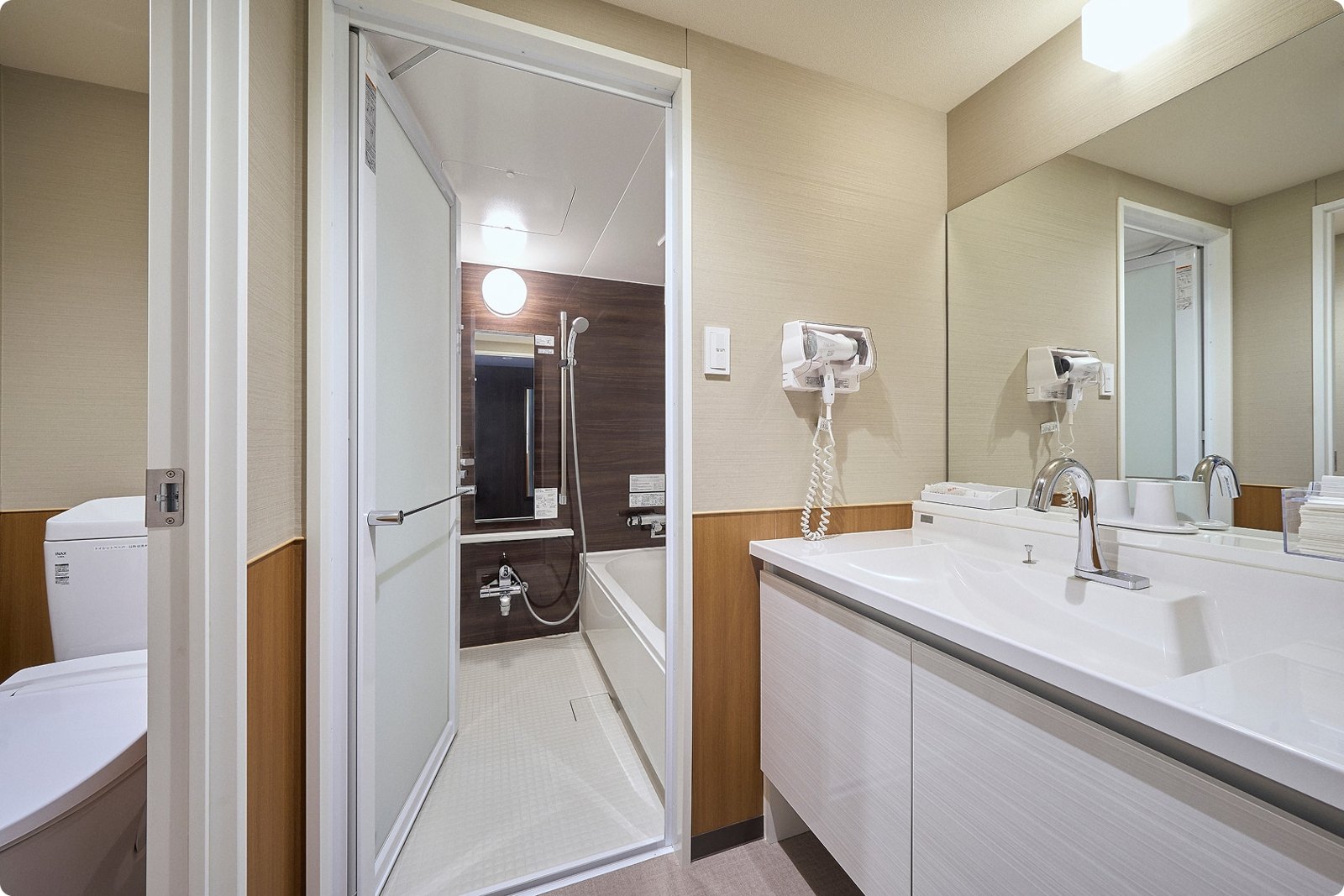
Sorting by mention rate changes the lineup substantially. Only six hotels appear in both the top 20 by rate and the top 20 by count. The top 20 by rate have a median of 149 rooms, a median of 853 reviews and a median average room size of 19.4 m², and nearly all (17) are business hotels. Among hotels working with limited floor area, those that separate the bath and toilet seem to leave guests with an impression of “unexpectedly good,” which makes it more likely to appear in reviews.
| Rank by Rate | Hotel | Location | Rooms | Avg. Room Size | Mentions | Mention Rate |
|---|---|---|---|---|---|---|
| 1 | Chorus Hotel Sendai Tomizawa (コーラスホテル仙台富沢) | Taihaku Ward, Miyagi | 99 | 17.5 m² | 102 | 26.42% |
| 2 | Vessel Hotel Fukuyama (ベッセルホテル福山) | Fukuyama, Hiroshima | 121 | 21.7 m² | 208 | 20.72% |
| 3 | Esperia Hotel Fukuoka Nakasu (エスペリアホテル福岡中洲) | Hakata Ward, Fukuoka | 87 | 21.4 m² | 140 | 19.77% |
| 4 | Sanco Inn Grande Tokyo Hamamatsucho (三交インGrande東京浜松町) | Minato Ward, Tokyo | 120 | 15.4 m² | 99 | 17.97% |
| 5 | Hotel Bellclassic Tokyo (ホテルベルクラシック東京) | Toshima Ward, Tokyo | 151 | 19.7 m² | 188 | 17.09% |
| 6 | Esperia Hotel Hakata (エスペリアホテル博多) | Hakata Ward, Fukuoka | 287 | 17.7 m² | 273 | 16.97% |
| 7 | Esperia Hotel Nagasaki (エスぺリアホテル長崎) | Nagasaki City, Nagasaki | 155 | 15.8 m² | 111 | 16.92% |
| 8 | JR-East Hotel Mets Premier Yokohama Sakuragicho (JR東日本ホテルメッツ プレミア 横浜桜木町) | Naka Ward, Kanagawa | 274 | 19.6 m² | 220 | 16.32% |
| 9 | Hotel Vista Ebina (ホテルビスタ海老名) | Ebina, Kanagawa | 176 | 15.5 m² | 88 | 16.15% |
| 10 | Shizutetsu Hotel Prezio Numazu (静鉄ホテルプレジオ沼津) | Numazu, Shizuoka | 105 | 21.2 m² | 134 | 15.37% |
| 11 | Hotel MyStays Shimizu (ホテルマイステイズ清水) | Shimizu Ward, Shizuoka | 152 | 15.6 m² | 126 | 15.09% |
| 12 | Hotel Lantana Osaka (ホテルランタナ大阪) | Yodogawa Ward, Osaka | 100 | 22.3 m² | 104 | 14.86% |
| 13 | Hiroshima Grand Intelligent Hotel (広島グランドインテリジェントホテル) | Minami Ward, Hiroshima | 137 | 18.1 m² | 93 | 14.72% |
| 14 | Hotel Nets Sapporo (ホテルネッツ札幌) | Chuo Ward, Hokkaido | 144 | 17.1 m² | 116 | 14.65% |
| 15 | Sendai Washington Hotel (仙台ワシントンホテル) | Aoba Ward, Miyagi | 223 | 19.1 m² | 200 | 14.38% |
| 16 | Henn na Hotel Premier Sendai Kokubuncho (変なホテルプレミア仙台 国分町) | Aoba Ward, Miyagi | 146 | 22.0 m² | 133 | 13.31% |
| 17 | Hotel Pearl Garden (ホテル パールガーデン) | Takamatsu, Kagawa | 144 | 19.8 m² | 115 | 13.22% |
| 18 | Hotel Hakata Place (ホテル博多プレイス) | Hakata Ward, Fukuoka | 170 | 25.0 m² | 165 | 12.99% |
| 19 | Hotel Vista Sapporo Odori (ホテルビスタ札幌 [大通]) | Chuo Ward, Hokkaido | 153 | 16.8 m² | 81 | 12.94% |
| 20 | Richmond Hotel Yokohama-Ekimae (リッチモンドホテル横浜駅前) | Kanagawa Ward, Kanagawa | 194 | 24.4 m² | 236 | 12.72% |
Source: HotelBank Editorial Team (NLP analysis, past 24 months); average room size from MetroEngines Research (listed size by room type, weighted by room count; “—” marks hotels with no listed size)
Hotels in the 16% range include Esperia Hotel Hakata (16.97%), Esperia Hotel Nagasaki (エスぺリアホテル長崎, 16.92%), JR-East Hotel Mets Premier Yokohama Sakuragicho (16.32%) and Hotel Vista Ebina (ホテルビスタ海老名, 16.15%). At this level one review in six mentions the separated bathroom, which suggests that guests cite the room specification as a reason for choosing the hotel or for returning. Esperia Hotel Hakata has an average room size of 17.7 m², and about 90% of its 287 rooms are 15–19 m² doubles. That this feature still defines the hotel in guests’ minds is highly instructive for limited-service hotels with small rooms.
Source: HotelBank Editorial Team (NLP analysis, past 24 months). X-axis = total reviews, Y-axis = mention rate. N = 100 hotels
Grouping by room size makes the trend clearer still. Of the 88 hotels whose average room size could be confirmed, the median mention rate is 11.0% for the 31 under 20 m², 8.2% for the 32 at 20–25 m², 5.7% for the 17 at 25–30 m² and 3.9% for the eight at 30 m² or more: the smaller the room, the higher the rate. In larger rooms a separate bath and toilet is taken for granted, while in compact rooms it is described as a point of difference. The relationship between room size and reviews is covered in detail in our earlier article, Hotel Room Size in Reviews: Top 100 Median 29.6 m². Hotels praised for spaciousness have a median of 29.6 m², whereas hotels with high mention rates for a separate bath and toilet cluster around 20 m². The two reflect different layers of the guest experience.
Source: HotelBank Editorial Team (NLP analysis), MetroEngines Research (average room size, ADR ratio). N = 88 hotels (average room size confirmed)
Rate Positioning — Median ADR Ratio of 1.23 Across 98 Hotels, 82.7% Above Their Municipality
Next, we look at where the top 100 sit within their own municipality’s rate range. For the 98 hotels where the property’s estimated settled ADR could be matched with the municipality’s median estimated settled ADR for at least six months among the closed months of November 2025–October 2026, the median ADR ratio was 1.23. The ratio exceeds 1.00 at 81 hotels (82.7%), is 1.20 or higher at 55, and 1.50 or higher at 24. The largest band is 1.2–1.5x with 31 hotels, followed by 1.0–1.2x with 26 and 1.5–2.0x with 21. The median estimated settled ADR of the top 100 is ¥14,900 (two guests per room, tax-exclusive equivalent, N = 99 hotels).
Source: MetroEngines Research, compiled by HotelBank Editorial Team (N = 98 hotels. ADR ratio = property’s monthly estimated settled ADR ÷ municipality’s monthly median estimated settled ADR; median of closed months November 2025–October 2026)
The table below shows the 10 hotels with the highest ADR ratios. Hotel Granvia Hiroshima South Gate (Minami Ward, Hiroshima City; 380 rooms) has an estimated settled ADR of ¥23,000, or 2.53x its municipality, and Hotel Hankyu Respire Osaka (ホテル阪急レスパイア大阪; Kita Ward, Osaka City; 1,030 rooms) is at 2.34x. In Toyama City, both Hotel JAL City Toyama (1.94x) and Daiwa Roynet Hotel Toyama Ekimae (1.77x) make the list, showing that even in regional prefectural capitals, station-front hotels with separated bathrooms hold the upper price tier in the city. Note that the ADR ratio reflects several factors, including location, opening year and brand, and does not isolate the effect of the bathroom specification.
| Hotel | Location | Rooms | Mention Rate | Estimated Settled ADR | Municipality ADR | ADR Ratio |
|---|---|---|---|---|---|---|
| Hotel Granvia Hiroshima South Gate (ホテルグランヴィア広島サウスゲート) | Minami Ward, Hiroshima | 380 | 6.34% | ¥23,000 | ¥10,200 | 2.53 |
| Hotel Hankyu Respire Osaka (ホテル阪急レスパイア大阪) | Kita Ward, Osaka | 1,030 | 2.90% | ¥25,800 | ¥10,600 | 2.34 |
| Karaksa Hotel Grande Shin-Osaka Tower (からくさホテルグランデ新大阪タワー) | Yodogawa Ward, Osaka | 396 | 2.23% | ¥17,100 | ¥8,600 | 2.08 |
| Hotel JAL City Toyama (ホテルJALシティ富山) | Toyama City, Toyama | 252 | 4.40% | ¥14,300 | ¥7,200 | 1.94 |
| Daiwa Roynet Hotel Hiroshima Ekimae (ダイワロイネットホテル広島駅前) | Higashi Ward, Hiroshima | 197 | 9.39% | ¥17,600 | ¥9,100 | 1.89 |
| Lake Biwa Otsu Prince Hotel (びわ湖大津プリンスホテル) | Otsu, Shiga | 529 | 3.40% | ¥21,800 | ¥11,600 | 1.86 |
| Hotel Intergate Hiroshima (ホテルインターゲート広島) | Naka Ward, Hiroshima | 228 | 2.78% | ¥17,500 | ¥10,500 | 1.85 |
| Hotel JAL City Tokyo Toyosu (ホテルJALシティ東京 豊洲) | Koto Ward, Tokyo | 330 | 3.74% | ¥27,800 | ¥14,500 | 1.77 |
| Daiwa Roynet Hotel Toyama Ekimae (ダイワロイネットホテル富山駅前) | Toyama City, Toyama | 204 | 7.47% | ¥12,900 | ¥7,200 | 1.77 |
| Hotel Metropolitan Kamakura (ホテルメトロポリタン鎌倉) | Kamakura, Kanagawa | 138 | 4.04% | ¥34,700 | ¥19,400 | 1.73 |
Source: MetroEngines Research, compiled by HotelBank Editorial Team (estimated settled ADR is the median of closed months November 2025–October 2026, two guests per room, tax-exclusive equivalent)
Looking at mention rate bands reveals another kind of upside. The median ADR ratio is 1.34 for the 27 hotels with a mention rate under 5% and 1.28 for the 41 hotels at 5–10%, compared with 1.12 for the 21 hotels at 10–15% and 1.15 for the 11 hotels at 15% or higher. Hotels with high mention rates have a median estimated settled ADR of ¥10,500–¥13,400, offering separated bathrooms at prices close to the municipal standard. This group has room to put a feature that guests value enough to write about at the forefront of room and plan names, and to reflect it in price differentials between room types.
Source: HotelBank Editorial Team (NLP analysis), MetroEngines Research (ADR ratio, estimated settled ADR). N = 100 hotels (98 for ADR ratio)
Cost of Separation Works — Published Range of ¥800,000–¥1.5 Million per Room, 1–2 Weeks of Works
Published hotel examples of the cost of splitting a three-in-one modular bathroom into a bathroom with a washing area and a separate toilet are scarce. This article therefore starts from the residential price range published by the renovation comparison site Reform Hikaku Navi (リフォーム比較なび; CREX, Inc., updated October 27, 2025). According to the site, replacing a three-in-one unit with an equivalent costs ¥400,000 to over ¥1 million (3–5 days of works), while separating the bath and toilet costs a total of ¥800,000 to over ¥1.5 million (1–2 weeks or longer). The additional ¥430,000–¥1.1 million for separation breaks down as follows: partition walls and interior finishing ¥100,000–¥250,000; toilet unit and installation ¥100,000–¥250,000; vanity unit ¥50,000–¥200,000; relocating and adding water supply and drainage pipes ¥80,000–¥200,000; additional electrical work and ventilation fans ¥50,000–¥100,000; and an additional door ¥50,000–¥100,000.
Hotel rooms add further constraints: night work and short schedules out of consideration for the floors above and below, waterproofing and drainage slope, and distance from the pipe space (PS). The site also notes that separation may not be possible depending on space, drainage slope and PS location, and that a site survey is a prerequisite. We ran three scenarios: “Low” at the residential lower end of ¥800,000, “Mid” at the upper end of ¥1.5 million, and “High” at ¥2.5 million (an editorial assumption) to allow for overruns from hotel-specific construction conditions.
| Scenario | Renovation Cost per Room | Assumption | Sales Opportunity During Works (7–14 days) |
|---|---|---|---|
| Low | ¥800,000 | Lower end of the published residential range for separation works. Layout allows partitioning close to the existing pipe space (PS) | ¥83,000–¥167,000 |
| Mid | ¥1.5 million | Upper end of the same range. Includes relocating water supply and drainage pipes and installing a new vanity unit | ¥83,000–¥167,000 |
| High | ¥2.5 million | Editorial assumption. Costs overrun because of hotel-specific conditions such as night work, waterproofing and drainage rerouting | ¥83,000–¥167,000 |
Source: Compiled by HotelBank Editorial Team from Reform Hikaku Navi, “How much does renovating a three-in-one bathroom cost? Separation prices and points to note” (updated October 27, 2025). Sales opportunity during works = median estimated settled ADR of the top 100, ¥14,900 × 80% occupancy × 7–14 days (reference value)
Payback Sensitivity — ADR Uplift of ¥391–¥1,223 per Night for a 10-Year Payback
We back-solve the ADR uplift needed to recover the renovation cost using the same formula as the rest of this series. We assume that 70% of the ADR uplift flows through to GOP (GOP flow-through) and a payback period of 10 years, with annual occupancy at three levels: 70%, 80% and 90%. At 80% occupancy and a 10-year payback, the required uplift is ¥391 per night in the Low scenario, ¥734 in Mid and ¥1,223 in High. Against the top 100’s median estimated settled ADR of ¥14,900, that is +2.6%, +4.9% and +8.2%, respectively.
Source: HotelBank Editorial Team estimates (10-year payback, 70% GOP flow-through). Renovation costs are based on Reform Hikaku Navi’s published range and an editorial assumption
| Scenario (cost per room) | Required ADR Uplift (annual occupancy 70%) | Same (80%) | Same (90%) | Payback at +¥500 | At +¥1,000 | At +¥1,500 |
|---|---|---|---|---|---|---|
| Low (¥800,000) | ¥447 | ¥391 | ¥348 | 7.8 years | 3.9 years | 2.6 years |
| Mid (¥1.5 million) | ¥839 | ¥734 | ¥652 | 14.7 years | 7.3 years | 4.9 years |
| High (¥2.5 million) | ¥1,398 | ¥1,223 | ¥1,087 | 24.5 years | 12.2 years | 8.2 years |
Source: HotelBank Editorial Team estimates. Required ADR uplift = renovation cost ÷ (365 days × occupancy × 70% GOP flow-through × 10 years). Payback years assume 80% annual occupancy. Sales opportunity during works is not included
A note on the occupancy assumption. By our estimated OCC (based on OTA inventory), business hotels in the six prefectures with the most top-100 hotels (Chiba, Osaka, Hiroshima, Tokyo, Fukuoka and Kanagawa) stood at 89.1–95.8% in October 2026 (1,346 properties and 190,364 rooms, based on listings on major booking sites). Because this is an estimate based on the sell-through of inventory offered on OTAs and differs from actual whole-property occupancy, our base case is a conservative 80%, with 70% and 90% shown as sensitivities.
What determines the payback outlook is how much can be added to the rate after renovation. In the within-property comparison in our earlier article, Bath-Toilet Separation Adds ¥1,049/m²: 4,515 Hotels, 6.1-Year Payback, differences in listed prices were explained by room size rather than by the bathroom type itself, with a price difference of ¥1,049 per additional square meter. Rather than treating separation as a standalone equipment upgrade, planning it alongside a full room refresh or layout revision, and redefining the room type as an “upgraded bathing experience” that includes the size of the washing area, is likely to offer more scope for conversion into rate. In this top 100 as well, many comments at hotels with high mention rates praise size, such as “the bathroom is spacious” and “big bath,” indicating that separation and space are perceived as one.
Three Perspectives for Renovation Decisions
In summary, three perspectives are useful when considering separation works. The first is the combination with room size. The median mention rate of 11.0% for rooms under 20 m² shows that a separate bath and toilet can be a clear differentiator even in compact rooms. The feature can be expected to appeal even at existing properties where floor area cannot be expanded much.
The second is how the renovated rooms are presented. Many hotels with high mention rates are priced close to the municipal standard and have upside in reflecting the value of the feature in their rates. Stating “separate bath and toilet” or “with washing area” in the room name and setting a room-type price differential against unrenovated rooms makes it easier to raise rates progressively, starting with the renovated rooms.
The third is timing. A one- to two-week sales stop for the works equates to ¥83,000–¥167,000 of sales opportunity per room, so it makes sense to carry out the works floor by floor when demand is quieter and to align them with the replacement cycle for piping and waterproofing. The same issue is also addressed in this series, in terms of pipe replacement and fixture generations, in Shower Pressure: 78% of Top-100 Hotels Beat Local ADR.
Conclusion
The top 100 hotels praised in guest reviews for a separate bath and toilet drew 12,776 mentions with a median mention rate of 7.8%, forming a group centered on business hotels spread across 27 prefectures. Large hotels around theme parks lead by count, while compact limited-service hotels of around 20 m² lead by rate. The median ADR ratio is 1.23, and 82.7% exceed the level of their municipality. Separation works cost ¥800,000–¥1.5 million per room in the published residential range, and even including a ¥2.5 million case that allows for hotel-specific conditions, the ADR uplift needed for a 10-year payback is ¥391–¥1,223 per night at 80% annual occupancy. Combining the works with a redesign of room size and room types, and reflecting the feature guests talk about in room names and price differentials, will be key to faster payback.
Related Articles
- Bath-Toilet Separation Adds ¥1,049/m²: 4,515 Hotels, 6.1-Year Payback
- Hotel Room Size in Reviews: Top 100 Median 29.6m², Namba ¥1,128/m²
- Hotel Soundproofing: ¥80k–¥1.65m per Room, +0.3–5.6% ADR to Recoup
- Shower Pressure: 78% of Top-100 Hotels Beat Local ADR, ¥10–30/Night
- Hotel Fridge & Kettle Reviews: Top 100, ¥17–133/Night, 1.28x City ADR
- 219 Hotels Praised for Humidifiers: Mets Premier 5.6%, ¥17–49/Night
- Business Hotel Baths: Onsen + Sauna Add 9.3% to ADR — Capex Ceiling
- Hotel Room Odor Reviews 11x More Negative: ¥50k–¥480k per Room to Fix
- Hotel Suitcase Storage: 58 of Top 100 Net Negative, Fixes from ¥8,500
References and Sources
- HotelBank Editorial Team — NLP analysis of guest reviews (positive mentions of “separate bath and toilet,” top 100 hotels, 198,615 reviews, November 2024–November 2026, as of November 23, 2026)
- MetroEngines Research — Estimated settled ADR by property and municipality (closed months November 2025–October 2026), average room size, estimated OCC (October 2026)
- Reform Hikaku Navi, “How much does renovating a three-in-one bathroom cost? Separation prices and points to note” (CREX, Inc., updated October 27, 2025; in Japanese)
- Japan Tourism Agency, Accommodation Travel Statistics Survey
■ Data Sources
NLP analysis of guest reviews (past 24 months = November 2024–November 2026; 100 hotels in order of mention count among those with at least 20 reviews and at least 10 positive mentions of “separate bath and toilet”; as of November 23, 2026). Estimated settled ADR by property and municipality (closed months November 2025–October 2026, two guests per room, tax-exclusive equivalent), listed size by room type, and estimated OCC (October 2026; 1,346 business hotels and 190,364 rooms in six prefectures) are from MetroEngines Research. Renovation costs are the residential range published by Reform Hikaku Navi (CREX, Inc., updated October 27, 2025).
■ Calculation Assumptions
Renovation cost per room is Low ¥800,000, Mid ¥1.5 million (lower and upper ends of the residential range for separation works) and High ¥2.5 million (an editorial assumption allowing for hotel-specific construction conditions). Required ADR uplift = renovation cost ÷ (365 days × annual occupancy × 70% GOP flow-through × 10-year payback). The base case is 80% annual occupancy, with 70% and 90% as sensitivities. Sales opportunity during works = median estimated settled ADR of the top 100, ¥14,900 × 80% × 7–14 days (reference value). Interest, tax and the sales stop during works are not included in the payback calculation.
■ Limitations
Mention count and mention rate indicate how much a topic is discussed in reviews; they are not rating scores. Because the top 100 is ordered by mention count, hotels tied at the bottom of the list may change places. The ADR ratio reflects several factors such as location, opening year and brand, and does not show the isolated effect of the bathroom specification. Renovation costs are a published residential range; actual hotel construction costs vary widely with structure, pipe space location and construction conditions. Estimated OCC is based on OTA inventory and differs from actual whole-property occupancy.