

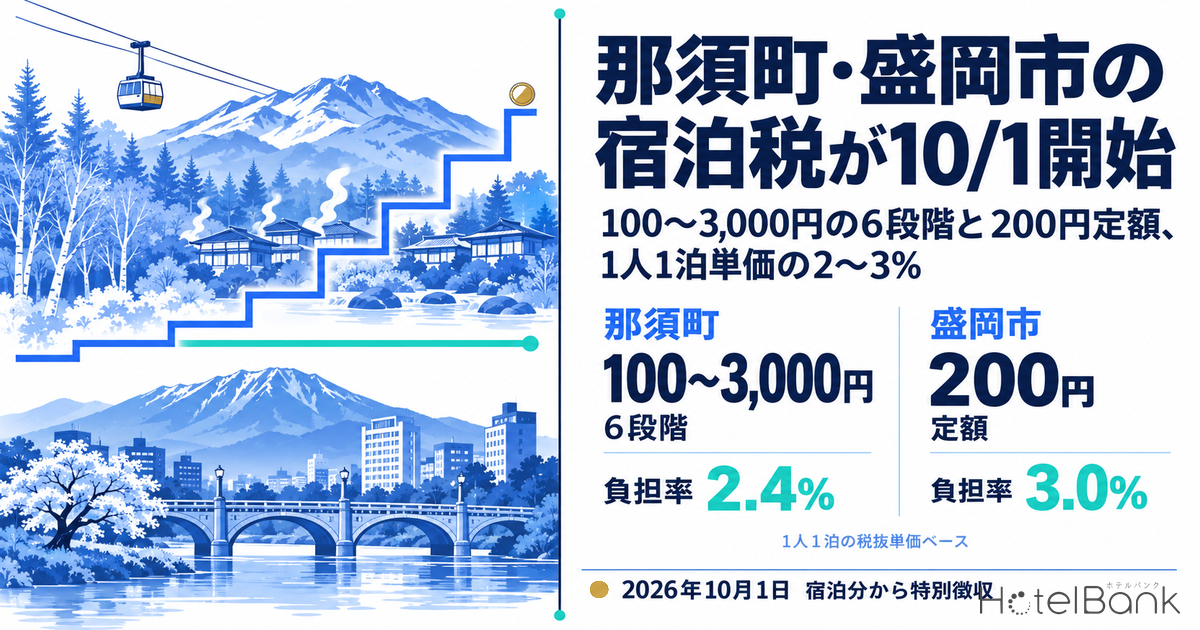
Nasu Town in Tochigi Prefecture and Morioka City in Iwate Prefecture began collecting lodging tax through accommodation operators for stays from Thursday, October 1, 2026. Nasu charges six tiers from ¥100 to ¥3,000 per person per night depending on the room rate, while Morioka charges a flat ¥200 per person per night regardless of price; neither sets a tax-free threshold. This article first walks through both ordinances from primary sources, covering tax amounts, exemptions and filing deadlines. It then converts MetroEngines Research listed prices (2 guests per room, tax included) into a pre-tax rate per person per night and estimates how the effective burden rate (tax divided by that rate) steps up and down across price bands. Finally, it compares the two municipalities with untaxed neighbors in the same prefectures (Nikko, Nasushiobara, Hanamaki and Hachimantai), checks post-implementation rates in Kumamoto and Miyazaki, which introduced the tax in July, and closes with a practical checklist for front desks, PMS and OTA listings.
Metric Definitions Used in This Article
- Listed price (all-plan average): The average selling price each property publishes on OTAs and other channels. Per-room rate for 2 guests, tax included, covering all plans from room-only to meal-inclusive. Area figures are the median of the properties covered.
- ADR (Average Daily Rate): An estimated achieved rate (excluding-tax equivalent), derived from the cheapest plan level each property publishes on OTAs (per-room rate for 2 guests, tax included) with a segment-specific adjustment factor. Checked against property-level results disclosed by listed hotel REITs (91 properties, latest 3 months), the median error is about 7%. These are estimates and differ from each property’s actual achieved rates and accounting figures. Area-level ADR is the median of the properties covered (the level of a typical property in the area).
- Pre-tax rate per person per night (this article’s conversion): Listed price (per room, 2 guests, tax included) / 2 / 1.1. An approximation of the lodging tax base, the “room charge excluding meals and consumption tax,” which differs from each property’s actual tax base. The conversion is explained in the body.
- Price notation: Prices in the text are generally rounded to the nearest ¥100; tables, charts and the medians used for tax calculations show unrounded values.
- Data source: MetroEngines Research (tracks OTA listings for about 27,000 properties and about 1.26 million rooms in Japan). Ordinance details come from official materials of Nasu Town, Morioka City, Kumamoto City and Miyazaki City.
- — Both Nasu and Morioka tax stays from October 1, 2026. Nasu charges ¥100-3,000 per person per night in six tiers; Morioka charges a flat ¥200. Neither has a tax-free threshold.
- — Nasu exempts children under 12 and participants in school-organized trips (excluding universities). Morioka’s ordinance has no exemption clause, so students and children are also taxed ¥200 per person.
- — Converting September 2026 listed prices to a pre-tax rate per person per night, the median property’s burden is 2.4% / 1.1% in Nasu (N=109 properties) and 3.0% / 4.9% in Morioka (N=32 properties) (upper bound / lower bound in each case).
- — Nasu’s burden rate jumps from 1.0% just below ¥10,000 to 3.0% just above it. For the roughly 30 properties whose tier differs between the upper and lower bounds, how the room-only portion is separated decides the tax amount.
- — In Kumamoto Chuo Ward and Miyazaki City, which introduced the tax in July, estimated ADR was -0.8% to -4.6% year over year in July-August 2026, with no ¥200 upward shift observed.
Nasu: Six Tiers, Morioka: Flat ¥200 — Primary Sources for Both Ordinances
First, the rules themselves, from primary sources. On its official page “Introduction of Lodging Tax,” Nasu Town announces that the tax applies from October 1, 2026, with six tiers based on the room rate per person per night. The taxable room charge is “the so-called room-only rate plus related service charges,” excluding meals and consumption tax. Exemptions are limited to guests under 12 and to participants and chaperones on school trips organized by schools defined in Article 1 of the School Education Act (excluding universities); there is no tax-free threshold. Tax is filed and paid monthly by the end of the following month, and operators meeting certain requirements may opt for quarterly special filing. For the first year only, a transitional measure allows the five months from October 2026 through February 2027 to be filed together by March 31, 2027; this requires a separate application.
Morioka, by contrast, sets a flat “¥200 per guest per night” in Article 4 of the Morioka City Lodging Tax Ordinance (Ordinance No. 47 of 2025, promulgated December 24, 2025), and the supplementary provisions of its enforcement regulations (promulgated March 27, 2026) fixed the effective date as October 1, 2026. The system overview states explicitly that “no tax-free threshold shall be set,” and the ordinance itself contains no exemption clause. In other words, school-trip students and children under 12 are also taxed ¥200 per person whenever a room charge is incurred. Under Article 10 of the ordinance, tax for the previous month is filed and paid by the end of each month. Operators that meet requirements such as having paid ¥1.2 million or less per property over the most recent 12 months, and that obtain the mayor’s approval, can switch to quarterly filing (December-February by the end of March, March-May by the end of June, June-August by the end of September, September-November by the end of December). Operators must keep books recording the date of stay, number of guests, number of taxable guests and tax amount for five years, and penalties apply for violations.
| Item | Nasu Town | Morioka City | Kumamoto City (reference) | Miyazaki City (reference) |
|---|---|---|---|---|
| Tax starts | Stays from Oct 1, 2026 | Stays from Oct 1, 2026 | Check-ins from Jul 1, 2026 | From Jul 1, 2026 (supplementary provisions of enforcement regulations) |
| Tax (per person per night) | Under ¥10,000: ¥100 / ¥10,000 to under ¥20,000: ¥300 / ¥20,000 to under ¥30,000: ¥500 / ¥30,000 to under ¥50,000: ¥800 / ¥50,000 to under ¥100,000: ¥1,500 / ¥100,000 and over: ¥3,000 | Flat ¥200 | Flat ¥200 | Flat ¥200 |
| Tax-free threshold | None | None (stated in system overview) | None (stated on city website) | None |
| Exemptions | Under 12; participants and chaperones on school-organized trips (excluding universities) | No clause (all ages and school trips taxed) | Essentially none (only reciprocal exemptions for diplomats, etc.) | None |
| Taxable room charge | Room-only rate + service charges, etc. (excluding meals and consumption tax) | Consideration for lodging excluding food and drink, entertainment, use of facilities other than guest rooms, consumption tax, etc. (Regulation Art. 2) | All stays that incur a room charge | Amount excluding food and drink, facility use, consumption tax, etc. (Regulation Art. 3) |
| Filing and payment deadline | Monthly, by the end of the following month (quarterly if requirements are met). First-year special filing of Oct-Feb by Mar 31, 2027 (application required) | Previous month by the end of each month (quarterly with approval) | By the end of the following month (quarterly with approval) | Monthly under the ordinance and regulations; quarterly with approval (requirements relaxed in the first year) |
| Taxable facilities | Facilities licensed under the Hotel Business Act + registered private lodging (minpaku) | Same as Nasu (excluding boarding houses) | Same as Nasu | Same as Nasu |
Source: Compiled by HotelBank Editorial Team from Nasu Town “Introduction of Lodging Tax”; the Morioka City Lodging Tax Ordinance (Ordinance No. 47 of 2025), its enforcement regulations and system overview; Kumamoto City “Overview of Lodging Tax”; and the Miyazaki City Lodging Tax Ordinance Enforcement Regulations (Miyazaki City Regulation No. 6)
What operators should note is that although both start on October 1 with no tax-free threshold, Nasu requires two tasks, determining the rate tier and verifying exemptions, while in Morioka the tax is fixed simply by counting guests. In Nasu, school-trip exemptions require a certificate issued by the school, which the property must keep for five years. In Morioka there are no exemptions, and operators need not split the room charge from “food and drink, entertainment, and use of facilities other than guest rooms” in their books; the mandatory entries are limited to four items: date of stay, number of guests, number of taxable guests and tax amount. The structural character of the two designs, with the tiered system raising the burden rate in peak season and the flat system raising it in the off-season, was laid out before implementation in Nasu vs Morioka Lodging Tax Oct 1: Tiered 1.0-3.0% vs Flat ¥200.
From Per-Room Listed Prices to a Pre-Tax Rate per Person per Night — Conversion Steps
MetroEngines Research aggregates listed prices as the “per-room rate for 2 guests, tax included.” The lodging tax base is “per person per night” and “room charge excluding meals and consumption tax,” so the two cannot be compared directly. This article converts in three steps. First, divide the room rate by 2 to get a tax-included rate per person. Nasu’s FAQ likewise states that where rates are set per room, “the per-person rate is obtained by dividing the room rate by the number of guests,” which is consistent with this treatment. Second, divide by 1.1 to remove the consumption-tax component. Third comes separating out meals. The all-plan average includes plans with breakfast and dinner, so treating it as the tax base pushes the tier higher. We therefore also use each property’s cheapest plan price as a proxy closer to room-only, and present a band with “all-plan average / 2 / 1.1” as the upper bound and “cheapest plan / 2 / 1.1” as the lower bound.
Applying this conversion to the 109 properties in Nasu and 32 in Morioka with observable listed prices for September 2026, the median pre-tax rate per person per night is ¥12,700 (upper bound) and ¥9,245 (lower bound) in Nasu, and ¥6,638 (upper bound) and ¥4,098 (lower bound) in Morioka. The median Nasu property falls into the “¥10,000 to under ¥20,000 = ¥300” tier on the upper bound and the “under ¥10,000 = ¥100” tier on the lower bound. In other words, the typical property in the town operates right across the ¥10,000 boundary, where the tax triples depending on how the room-only and meal portions are separated for filing. Morioka’s flat rate requires no tier determination, but because its median rate is lower, the tax weighs relatively more.
The Burden-Rate Staircase — Nasu Jumps from 1.0% to 3.0% Across ¥10,000
Plotting the effective burden rate (tax divided by the pre-tax rate per person per night) by price band, Nasu shows a classic sawtooth pattern. In the under-¥10,000 tier the tax is ¥100, so even a ¥9,999 stay carries only a 1.0% burden, but the moment the rate reaches ¥10,000 the tax jumps to ¥300 and the burden to 3.0%. The rate then falls as prices rise: 1.5% just below ¥20,000, 2.5% at ¥20,000 where the tax rises to ¥500, 2.67% at ¥30,000 (¥800), 3.0% at ¥50,000 (¥1,500) and 3.0% at ¥100,000 (¥3,000), oscillating between 2.5-3.0% at the entry of each tier and 1.5-1.7% at its exit. Put differently, Nasu’s system is designed to keep the burden roughly within a 1.5-3.0% band regardless of price level.
Morioka’s flat ¥200, on the other hand, traces a hyperbola in which the burden falls steadily as prices rise: 4.0% on a ¥5,000 stay, 2.0% at ¥10,000, 1.0% at ¥20,000 and 0.5% at ¥40,000. At the median of Morioka’s 32 properties it is 3.0% on the upper bound (¥6,638) and 4.9% on the lower bound closer to room-only (¥4,098), heavier than the 2.4% (upper bound) and 1.1% (lower bound) obtained by applying Nasu’s staircase to Nasu’s median property. The difference in character, with a flat tax weighing most heavily on low-priced business hotels and a tiered tax producing larger amounts at high-priced inns, shows up directly in the numbers.
Source: MetroEngines Research; compiled by HotelBank Editorial Team
Source: MetroEngines Research; compiled by HotelBank Editorial Team
Which Tier Are Nasu’s 109 and Morioka’s 32 Properties In?
Looking at the distribution by price band, on the upper-bound conversion Nasu’s largest group is “¥10,000 to under ¥20,000 (¥300)” with 57 properties, followed by “under ¥10,000 (¥100)” with 32, “¥20,000 to under ¥30,000 (¥500)” with 14, “¥30,000 to under ¥50,000 (¥800)” with 5 and “¥50,000 to under ¥100,000 (¥1,500)” with 1; no property was observed in the ¥100,000-and-over tier. On the lower bound (cheapest-plan basis), under ¥10,000 becomes the majority with 60 properties, and the ¥300 tier drops to 42. The roughly 30 properties making up this difference can be regarded as “boundary properties” whose tax, ¥100 or ¥300, depends on how the room-only portion is separated. Nasu’s property mix is weighted toward pensions and vacation rentals: 74 pensions, 58 vacation rentals, 28 cottages, 27 ryokan, 23 resort hotels and 10 glamping sites (September 2026, properties with observable listed prices), with many whole-unit rentals and per-room rates. Settling at the time of booking how guests are counted in “room rate / number of guests,” for example when a whole-unit rental for six is used by four, is the first step toward fewer filing corrections.
In Morioka, on the upper bound 23 properties are under ¥10,000, 6 are ¥10,000 to under ¥20,000 and 3 are ¥20,000 or more; on the lower bound 30 are under ¥10,000. The city’s mix is 23 business hotels, 11 ryokan and 7 city hotels, and the flat ¥200 bites hardest on weekday business-hotel rates. For example, ¥200 on a ¥5,000 pre-tax room-only stay per person is 4.0%, equivalent to just over 3.5% even of the total payment including consumption tax. That said, Morioka’s September 2026 listed prices were up 18.1% year over year (¥14,900 to ¥17,600, N=46 properties) and estimated ADR was up 7.5% (¥7,550 to ¥8,116, N=41 properties); the tax arrived in a strong-demand phase, which is a tailwind for operators.
Source: MetroEngines Research; compiled by HotelBank Editorial Team
| Pre-tax rate per person per night | Nasu tax | Burden rate (tier entry to exit) | Nasu upper bound | Nasu lower bound | Morioka upper bound | Morioka lower bound |
|---|---|---|---|---|---|---|
| Under ¥10,000 | ¥100 | — to 1.0% | 32 | 60 | 23 | 30 |
| ¥10,000 to under ¥20,000 | ¥300 | 3.0% to 1.5% | 57 | 42 | 6 | 1 |
| ¥20,000 to under ¥30,000 | ¥500 | 2.5% to 1.7% | 14 | 5 | 2 | 1 |
| ¥30,000 to under ¥50,000 | ¥800 | 2.7% to 1.6% | 5 | 2 | 1 | 0 |
| ¥50,000 to under ¥100,000 | ¥1,500 | 3.0% to 1.5% | 1 | 0 | 0 | 0 |
| ¥100,000 and over | ¥3,000 | 3.0% to — | 0 | 0 | 0 | 0 |
Source: MetroEngines Research; compiled by HotelBank Editorial Team (109 properties in Nasu and 32 in Morioka with observable listed prices for September 2026. Upper bound = all-plan average / 2 / 1.1; lower bound = cheapest plan / 2 / 1.1. Morioka’s tax is ¥200 regardless of band)
Compared with Untaxed Neighbors — Operational Differences vs Nikko, Nasushiobara, Hanamaki and Hachimantai
Because lodging tax is introduced municipality by municipality, taxed/untaxed boundaries appear within the same tourist area. In Tochigi, Nasu is taxed while neighboring Nasushiobara (Shiobara Onsen, Itamuro Onsen) and Nikko (Kinugawa, Nikko, Okunikko) are not; in Iwate, Morioka is taxed while Hanamaki (Hanamaki Onsen-kyo) and Hachimantai (Appi Kogen, Hachimantai Onsen-kyo) are not. Listed prices for September 2026 (all-plan average, 2 guests per room) were ¥36,500 in Nasu (N=261 properties) versus ¥32,600 in Nikko (N=238) and ¥32,700 in Nasushiobara (N=103), and ¥17,600 in Morioka (N=46) versus ¥37,500 in Hanamaki (N=33) and ¥27,300 in Hachimantai (N=47). Estimated ADR was ¥18,900 in Nasu, ¥17,600 in Nikko, ¥12,000 in Nasushiobara, ¥8,116 in Morioka, ¥14,100 in Hanamaki and ¥11,000 in Hachimantai.
There is not yet any evidence to argue whether being taxed helps or hurts demand. Applying Nasu’s tiered tax to the per-person ADR (¥18,900 / 2 / 1.1 = approx. ¥8,600, the ¥100 tier) gives a burden of about 1.2%, and applying Morioka’s ¥200 to its per-person ADR (¥8,116 / 2 / 1.1 = approx. ¥3,700) gives about 5.4%; both are smaller than the year-over-year price changes (Nasu listed prices +9.6%, Morioka +18.1%). A similar back-calculation that HotelBank ran in early September, before implementation, used forward-listed ADR for October 2026; because its reference month and price basis differ from this article’s, the figures do not connect directly. What operators should focus on instead are the operational differences that arise when running multiple properties across the boundary, or when properties are compared as the same area on OTAs. Specifically, three points differ in practice: (1) if tax-inclusive/exclusive display rules vary by property, listings within the same search results will not look consistent; (2) properties in Nasu must receive and retain school-trip exemption certificates, while those in Nasushiobara and Nikko do not; and (3) whether group and school-travel quotes state “lodging tax charged separately (¥X per person per night)” varies by municipality.
Source: MetroEngines Research; compiled by HotelBank Editorial Team
| Municipality | Lodging tax | Listed price Sep 2026 | YoY | Estimated ADR Sep 2026 | YoY | N (listed / ADR) |
|---|---|---|---|---|---|---|
| Nasu Town, Tochigi | Taxed (from 10/1) | ¥36,471 | +9.6% | ¥18,882 | -7.4% | 261 / 53 |
| Nikko City, Tochigi | Not taxed | ¥32,598 | -4.2% | ¥17,620 | -3.7% | 238 / 121 |
| Nasushiobara City, Tochigi | Not taxed | ¥32,728 | +5.9% | ¥12,005 | -4.9% | 103 / 71 |
| Morioka City, Iwate | Taxed (from 10/1) | ¥17,582 | +18.1% | ¥8,116 | +7.5% | 46 / 41 |
| Hanamaki City, Iwate | Not taxed | ¥37,491 | +9.8% | ¥14,145 | +0.2% | 33 / 29 |
| Hachimantai City, Iwate | Not taxed | ¥27,321 | +24.1% | ¥10,965 | -0.5% | 47 / 14 |
Source: MetroEngines Research; compiled by HotelBank Editorial Team (listed price = median all-plan average, 2 guests per room, tax included; ADR = median estimated achieved rate, excluding-tax equivalent)
Early Adopters Kumamoto and Miyazaki — Was Pass-Through Visible After July?
Kumamoto City and Miyazaki City, which have levied the same flat ¥200 since July 1, 2026, are reference cases three months ahead of Morioka. Kumamoto states that “lodging tax applies to check-ins from July 1, 2026,” and Miyazaki’s enforcement regulations provide in their supplementary provisions that they “take effect on July 1, 2026.” Comparing estimated ADR year over year in Kumamoto Chuo Ward, where the city’s hotels concentrate (N=55-60 properties for estimated ADR), and Miyazaki City (N=54-59), Kumamoto Chuo Ward was ¥7,994 in July (-4.6% YoY) and ¥8,799 in August (-0.8%), while Miyazaki was ¥7,240 in July (-4.2%) and ¥7,642 in August (-2.8%). ¥200 equals 5-6% of per-person ADR in both cities (¥3,300-4,000), yet July-August ADR shows no upward shift of that size. Over the same period Kagoshima Prefecture (July -2.5%, August -6.1%), Oita Prefecture (-9.4%, -4.1%) and Fukuoka Prefecture (0.0%, -2.1%) were also soft, so Kumamoto and Miyazaki moved within the range of Kyushu’s overall demand cycle.
In September, Kumamoto Chuo Ward rose sharply to ¥10,400 (+21.1%) and Miyazaki to ¥8,968 (+23.8%), but neighbors rose at the same time (Kagoshima Prefecture +4.4%, Fukuoka Prefecture +9.8%, Oita Prefecture +5.7%), and the increase far exceeds the tax’s 5-6%, so reading it as lodging-tax pass-through is a stretch. In listed prices too, Miyazaki was already running +11-13% year over year in April-June, before the tax, with no sign of a change in slope from July. What can be said is only this: at least through July-August, operators in both cities did not collectively add the ¥200 to their base rates, and the prevailing practice appears to have been collecting it separately at checkout. The national accommodation-charges CPI (2020 = 100) was also flat, at 169.1 in July 2026 (+2.0% YoY) and 181.1 in August (-0.2%); this was not a phase in which rate trajectories diverged depending on whether a lodging tax applied.
Source: MetroEngines Research; compiled by HotelBank Editorial Team
Source: MetroEngines Research; compiled by HotelBank Editorial Team
Practical Checklist from October 1 — OTA Display, PMS, Receipts, Exemptions and Filing
Finally, here are the items properties in both municipalities should check before their first post-implementation filing (in principle, the end of November for both Nasu and Morioka). Even properties that have already started operating under the new rules will reduce rework by cross-checking these before the first filing.
| Area | Check item | Nasu Town | Morioka City |
|---|---|---|---|
| OTA listings | Do plan descriptions and notes state “lodging tax charged separately, payable at the property” with the amount? For per-room plans, do they explain that the tier is determined by “room rate / number of guests”? | Show the six-tier table. For whole-unit and per-room rates, state how the per-person split works | State “¥200 per person per night” |
| PMS / POS | Is lodging tax set up as a separate item outside the scope of consumption tax, with room-only charges aggregated separately from meals and service charges? Can guests under 12 and exempt guests be counted separately? | Rate-tier logic plus an exemption flag are needed | Automatic calculation of guests x ¥200 is sufficient |
| Receipts / invoices | Is lodging tax itemized separately from the room charge as “Lodging tax (¥X per person per night x guests)”? Is it indicated as outside the scope of consumption tax? | State the unit amount for each tier | State ¥200 x guests |
| Groups / school trips | Do quotes and contracts state how lodging tax is handled? Is there a workflow for receiving exemption documents? | Receive school-issued certificates and keep them for 5 years. Club and team training camps are not exempt | No exemptions. Include students and chaperones as taxable in quotes |
| Books / retention | Are the date of stay, number of guests, number of taxable guests and tax amount recorded per property? | Also link exempt-guest counts to certificates | Books retained 5 years, documents 2 years (Ordinance Art. 13) |
| Filing / payment | Have you confirmed the deadline and method (eLTAX, etc.) for the first filing? Do you qualify for special filing? | Monthly by the end of the following month. First year: Oct-Feb by Mar 31, 2027 (application required) | Previous month by the end of each month. May switch to quarterly if requirements such as ¥1.2 million or less are met (approval required) |
| Registration | Have you submitted the special collection agent declaration? Is a tax administrator appointed if headquarters are outside the town or city? | Obtain the town’s designation number | Declare per property by the day before starting business (Ordinance Art. 7) |
Source: Compiled by HotelBank Editorial Team from official materials of Nasu Town and Morioka City. Confirm how the rules apply to individual properties with the competent tax division
In Nasu in particular, breaking OTA meal-inclusive plans into “room-only + meals” to determine the tax base becomes part of daily settlement. Registering a room-only equivalent amount for each plan in the master data lets the PMS automate tier determination and keeps filings stable even at boundary properties. In Morioka, where the calculation is simple, stating “no exemptions” in quotes for school trips and training camps is the shortcut to avoiding misunderstandings when taking school-travel orders.
Summary — Designing 2-3% of the Rate as an Operational Difference
Nasu’s six tiers and Morioka’s flat ¥200 correspond to burden rates of roughly 1.5-3.0% (Nasu) and 3.0-4.9% at the median (Morioka) of the pre-tax rate per person per night. Typical Nasu properties straddle the ¥10,000 boundary between ¥100 and ¥300, so separating the room-only portion determines the amount filed. What arises versus untaxed Nikko, Nasushiobara, Hanamaki and Hachimantai in the same prefectures is less price competition than operational differences in display, exemptions and quotes, and in the early adopters Kumamoto and Miyazaki no pass-through of the tax was observed in July-August ADR. If properties cross-check five points (OTA display, PMS, receipts, exemption verification and filing schedule) before the first filing, the conversation can move beyond the burden itself to how the revenue is used for tourism (tourism infrastructure in Nasu; MICE attraction and tourism DX in Morioka, among others).
Frequently Asked Questions
Q. When did lodging tax start in Nasu and Morioka?
A. Both apply to stays from Thursday, October 1, 2026. Kumamoto and Miyazaki started on July 1, 2026.
Q. In Nasu, how much tax do 2 guests pay for a ¥30,000 room?
A. Nasu’s tax is determined by the room charge per person per night (excluding meals and consumption tax). A ¥30,000 room (tax included, room only) works out to about ¥13,600 per person, which falls in the “¥10,000 to under ¥20,000” tier: ¥300 per person, or ¥600 for 2 guests. For meal-inclusive plans, the tier is determined on the amount excluding meals.
Q. Are school trips and children taxed?
A. In Nasu, children under 12 and participants and chaperones on school-organized trips (excluding universities) are exempt. Morioka, Kumamoto and Miyazaki have no age or school-trip exemptions, so any stay that incurs a room charge is taxable.
Q. Is consumption tax charged on lodging tax?
A. Lodging tax is outside the scope of consumption tax. Receipts list it separately from the room charge.
Related Articles
- Nasu vs Morioka Lodging Tax Oct 1: Tiered 1.0-3.0% vs Flat ¥200
- Iwate Hotel Market 2026: 2.2x ADR Gap, Morioka ¥200 Lodging Tax
- Tochigi Hotel ADR: 3.6x City Gap, Nasu ¥20,192 vs Utsunomiya ¥7,349
References and Sources
■ Data sources
MetroEngines Research listed prices (2 guests per room, tax included; all-plan average and cheapest plan) and estimated ADR (excluding-tax equivalent). Period: January 2025 to September 2026. Burden-rate estimates cover the 109 properties in Nasu and 32 in Morioka with observable listed prices for September 2026. Tax amounts, thresholds, exemptions and filing deadlines are based on official materials of Nasu Town, Morioka City, Kumamoto City and Miyazaki City.
■ Assumptions
Pre-tax rate per person per night = listed price (per room, 2 guests, tax included) / 2 / 1.1. Values using the all-plan average are the upper bound; values using the cheapest plan are the lower bound. Effective burden rate = tax / pre-tax rate per person per night. Tax: six tiers (¥100-3,000) in Nasu; flat ¥200 in Morioka. Area values are medians of the properties covered.
■ Limitations
The converted values approximate the tax base (room charge excluding meals, consumption tax, etc.). Because meal separation differs by property and plan, they will not match each property’s actual tax. Estimated ADR is an estimate and differs from each property’s achieved rates and accounting figures. Post-implementation rates in Kumamoto and Miyazaki are year-over-year observations and do not establish causation with the lodging tax. Confirm how the rules apply to individual properties with the competent tax division.
- Nasu Town, “Introduction of Lodging Tax” (tax amounts, exemptions, filing deadlines, FAQ; Japanese)
- Morioka City Lodging Tax Ordinance (Ordinance No. 47 of 2025, promulgated December 24, 2025; Japanese)
- Morioka City Lodging Tax Ordinance Enforcement Regulations (promulgated March 27, 2026; effective date, definition of room charge, special filing requirements; Japanese)
- Morioka City, “Overview of the Lodging Tax System in Morioka City” (Japanese)
- Kumamoto City, “Overview of Lodging Tax” (taxed from July 1, 2026; no tax-free threshold or exemptions; Japanese)
- Miyazaki City Lodging Tax Ordinance Enforcement Regulations (Miyazaki City Regulation No. 6, effective July 1, 2026; Japanese)
- Ministry of Internal Affairs and Communications, materials on consent to the new Nasu Town lodging tax (Japanese)
- Ministry of Internal Affairs and Communications, materials on consent to the new Miyazaki City lodging tax (Japanese)
- Kumamoto Nichinichi Shimbun, “Kumamoto City lodging tax to be introduced July 1, 2026 after minister’s consent; ¥200 per person per night” (Japanese)
- Honichi Lab, “Nasu becomes first in Tochigi to introduce lodging tax, aiming to collect from October 2026” (June 20, 2025; Japanese)
- e-Stat, “Consumer Price Index,” accommodation charges, national (Statistics ID: 0003427113)
- MetroEngines Research — listed prices (2 guests per room, tax included; all-plan average / cheapest plan) and estimated ADR. Nasu, Morioka, Nikko, Nasushiobara, Hanamaki, Hachimantai, Kumamoto Chuo Ward, Miyazaki and Kyushu prefectures, January 2025 to September 2026