

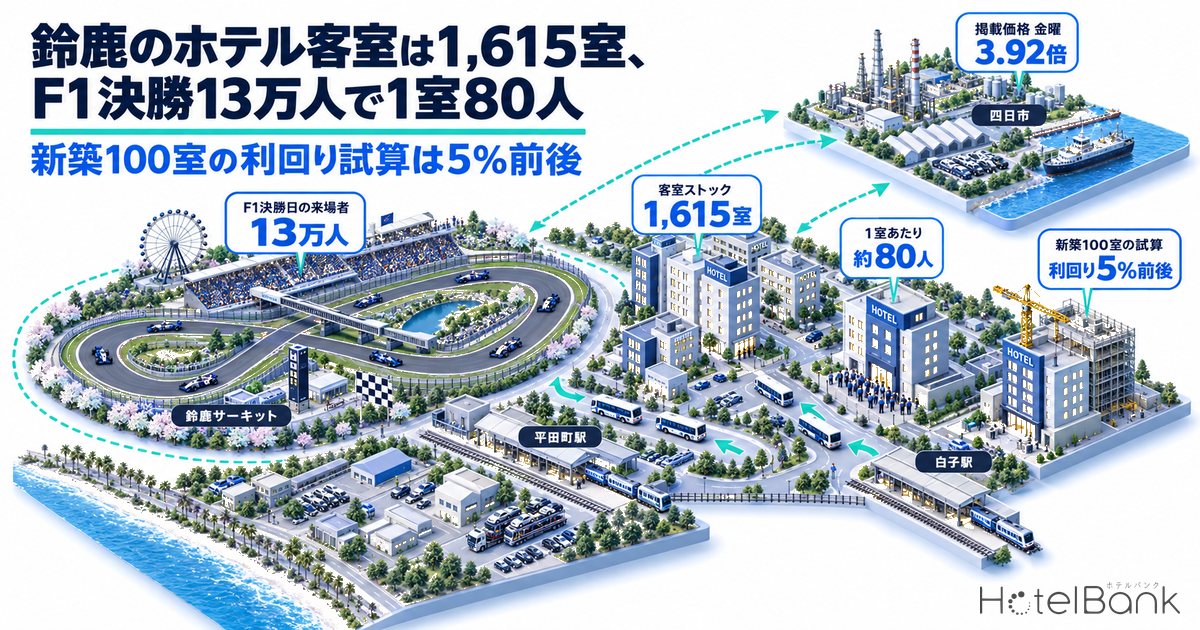
Suzuka Circuit announced the 2027 Formula 1 Japanese Grand Prix dates in September 2026: the race will run on April 9–11, 2027 with Suzuka’s first-ever Sprint, and tickets go on sale on November 15. The 2026 edition drew 315,000 spectators over three days, including 130,000 on race day alone. Against that, Suzuka City has 22 lodging facilities with 1,615 rooms that showed listed prices in the past three months — roughly 80 race-day spectators per room. Can a new hotel work in a market with a few enormous peaks a year and an estimated settled ADR of around ¥6,400 the rest of the time? This article looks at room stock, the spread of prices over the F1 weekend, monthly ADR and normal-day occupancy, and then estimates the economics of a newly built 100-room limited-service hotel.
Metric Definitions Used in This Article
*Metric definitions: ADR (average daily rate) = an estimated settled rate (tax-exclusive equivalent) calculated by applying segment-specific adjustment factors to the lowest-plan price level each property publishes on OTAs (per room, two adults sharing, tax-inclusive). Checked against property-level results disclosed by listed hotel REITs (91 properties, most recent 3 months), the median error is about 7%. These are estimates and differ from each property’s actual settled prices and accounting figures. Area-level ADR is the median of the covered properties (the level of a typical property in the area). OCC (occupancy) = the share of rooms sold out of total rooms in the area (an estimate based on OTA sales inventory; consistency checks against REIT monthly disclosures show accuracy of roughly a few percentage points). Where listed prices are mentioned, they are per-room rates for two adults sharing (tax-inclusive).
Room stock = total rooms of facilities whose prices were listed between July and September 2026 (excluding adults-only facilities). Data source: MetroEngines Research.
- — 22 facilities, 1,615 rooms — Suzuka City’s room stock. Against 130,000 spectators on the 2026 F1 race day, that is about 80 people per room; even with every room double-occupied, the city can house only 2.5% of race-day attendees.
- — 2.4–3.9x — On the three F1 nights, listed prices in Yokkaichi rose to as much as 3.92 times the same weekday in April. In host city Suzuka, listings almost vanished from the open market; the price peak formed outside the city.
- — +11.1% — Suzuka’s estimated settled ADR in March 2026, the month that included F1, rose 11.1% YoY. Yet its 12-month average of ¥6,397 is about ¥900–2,100 below four neighboring cities, and the race adds less than 1% on an annual basis.
- — 5.6%→5.1% — Simple GOP yield for a new 100-room limited-service hotel in front of Hiratacho Station (the right-hand figure includes construction cost inflation). The 15 nights of F1 and major races account for 9.6% of revenue.
- — ~¥10,100 — The normal-day ADR needed for a 7% GOP yield on Case A’s investment. This is the entry point of the ¥9,000–15,000 band where the city has no hotels; the key question is whether weekday business demand will pay it.
130,000 on Race Day vs. 1,615 Rooms in the City — Every Room Is Within 6km of the Circuit
Let us start by setting demand and supply side by side. According to Suzuka Circuit, the F1 Japanese Grand Prix on March 27–29, 2026 attracted 315,000 spectators over three days, up 49,000 from 266,000 the previous year and the highest since the race returned to Suzuka in 2009. Qualifying Saturday drew 110,000 and race-day Sunday 130,000, which leaves 75,000 for Friday.
What about capacity? Among the properties tracked by MetroEngines Research, 22 facilities with 1,615 rooms in Suzuka City showed listed prices between July and September 2026. By straight-line distance from the circuit, 6 facilities (494 rooms) lie within 3km, 15 facilities (1,120 rooms) at 3–5km, and 1 facility (1 room) beyond 5km — virtually all of the city’s rooms sit within 5km of the circuit. Limited-service hotels cluster around Kintetsu Hiratacho Station and Shiroko Station, while a large resort property and camp/training-type facilities stand right next to the circuit.
Dividing 130,000 race-day spectators by 1,615 rooms gives about 80 people per room. Even if every room is filled with two guests, only 3,230 people can stay — 2.5% of race-day attendees. In other words, the F1 weekend was never designed to be absorbed by Suzuka’s rooms alone; cities along the Kintetsu line such as Yokkaichi, Tsu and Nagoya act together as the overflow. This structure is the premise for the phenomenon discussed below: “the price peak forms outside the city.”
| Property | Rooms | Distance from circuit | Nearest hub |
|---|---|---|---|
| Suzuka Circuit Hotel (鈴鹿サーキットホテル) | 229 | 0.6km | Circuit |
| Suzuka Midori no Mori (鈴鹿みどりの杜) | 14 | 1.4km | Circuit |
| Suzukato (スズカト) | 43 | 1.5km | Circuit |
| Suzuka Royal Hotel (鈴鹿ロイヤルホテル) | 36 | 2.3km | Hiratacho Sta. |
| Sportsman House Suzuka (スポーツマンハウス鈴鹿) | 66 | 2.4km | Circuit |
| APA Hotel Suzuka Chuo (アパホテル〈鈴鹿中央〉) | 106 | 2.9km | Hiratacho Sta. |
| Super Hotel Suzuka (スーパーホテル 鈴鹿) | 96 | 3.3km | Hiratacho Sta. |
| Suzuka Storia Hotel Hirata Ekimae (鈴鹿ストーリアホテル平田駅前) | 70 | 3.4km | Hiratacho Sta. |
| Hotel Route-Inn Suzuka (ホテルルートイン鈴鹿) | 207 | 3.5km | Hiratacho Sta. |
| Ryokan Isuzu (旅館いすゞ) | 9 | 3.5km | Hiratacho Sta. |
| Hotel Castle Inn Suzuka (ホテルキャッスルイン鈴鹿) | 184 | 3.6km | Hiratacho Sta. |
| Hotel Castle Inn Suzuka Chuo (ホテルキャッスルイン鈴鹿中央) | 100 | 3.7km | Hiratacho Sta. |
| Hotel Green Park Suzuka (ホテルグリーンパーク鈴鹿) | 142 | 4.1km | Shiroko Sta. |
| Uoyo (魚要) | 8 | 4.4km | Shiroko Sta. |
| Comfort Hotel Suzuka (コンフォートホテル鈴鹿) | 105 | 4.4km | Shiroko Sta. |
| ARIGATO STAY Suzuka (ARIGATO STAY鈴鹿) | 70 | 4.6km | Shiroko Sta. |
| Shiroko Storia Hotel (白子ストーリアホテル) | 125 | 4.6km | Shiroko Sta. |
| Whole-house rentals, etc. (5 facilities) | 5 | 4.1–6.0km | — |
| Total (22 facilities) | 1,615 | — | — |
A word on supply movements. Within MetroEngines Research’s coverage, two facilities of 40+ rooms have started listing in the city since 2024. One is Suzukato (43 rooms), which reopened in April 2024 after the renovation of the Mie Prefectural Suzuka Youth Center; the other is ARIGATO STAY Suzuka (70 rooms), a renamed existing hotel. Both are conversions of existing buildings. Planning data based on the MLIT Building Dynamics Statistics Survey also showed no new-build plans in Suzuka City as of the survey date (*based on building confirmation applications at the time of the survey; counts and room numbers are expected to rise as applications are added, so treat this as the lower bound of the confirmed pipeline). New construction that adds net rooms does not appear to be under way at present.
On the Three F1 Nights the Price Peak Formed Outside the City — Yokkaichi at 2.4–3.9x a Normal Weekend
How did demand from 315,000 spectators show up in prices? For each night of March 27–29, 2026, we compared each property’s listed price (all-plan average, tax-inclusive) with its average on the same weekday on April 10–12 and 17–19, and took the median ratio for each city.
| Area | Fri 3/27 | Sat 3/28 | Sun 3/29 | Properties (Fri/Sat/Sun) |
|---|---|---|---|---|
| Yokkaichi | 3.92x | 3.16x | 2.35x | N=14/10/15 |
| Kameyama | 2.33x | 2.05x | 1.98x | N=5/4/5 |
| Nagoya Station 1km area | 2.02x | 1.84x | 1.96x | N=41/36/43 |
| Kuwana | 1.30x | 1.94x | 1.40x | N=12/6/13 |
| Tsu | 1.62x | 1.36x | 1.46x | N=15/12/16 |
| (Reference) Shizuoka Station 1.5km area | 1.19x | 1.12x | 1.01x | N=28/28/28 |
| Suzuka | 1.82x | — | 2.60x | N=2/0/7 |
Yokkaichi moved the most: 3.92x on Friday, 3.16x on Saturday and 2.35x on Sunday. Its median Saturday listed price was about ¥51,700, more than triple the roughly ¥16,000 on April Saturdays. Kameyama followed at 2.0–2.3x and the Nagoya Station 1km area at 1.8–2.0x. Compared with 1.0–1.2x around Shizuoka Station, which F1 barely affects, the increase along the belt from Suzuka to Nagoya clearly exceeded the seasonal spring-break effect. Note that March in Yokkaichi also coincided with business demand from scheduled maintenance at the petrochemical complex (Yokkaichi’s estimated settled ADR in March 2026 was up 45.9% YoY), so part of the multiple may reflect a lift in weekday demand.
Host city Suzuka looked different. Listed prices were observed at 15 facilities on April weekends, but in observations from about two weeks before the stay date onward, only 2 facilities on Friday, 0 on Saturday and 7 on Sunday. Several explanations are possible — inventory may have been allocated early through channels other than OTAs, such as spectator tours, official sales or allocations for teams and staff, or it may have sold out before being listed — and public OTA data alone cannot tell them apart. What is certain is that, at least for the three F1 nights, Suzuka’s rooms were not competing on price in the open market. The price peak formed not in the host city but in surrounding cities 30 minutes to an hour away. We have also covered how lodging demand from a major event spreads beyond the host city, with reference to Kuwana and Yokkaichi, in Asian Games 2026: Toyohashi +18.7pt, Kuwana +14.4pt Beyond Nagoya.
F1 Shows Up as +11% in Monthly ADR — the 12-Month Average Is ¥6,400, Below Four Neighboring Cities
Next, we smooth the daily peaks into monthly figures to gauge how much the event weighs on annual rates. Suzuka’s estimated settled ADR (tax-exclusive equivalent) averaged about ¥6,400 over the 12 months from October 2025 to September 2026. Over the same period Yokkaichi averaged about ¥7,300, Tsu about ¥7,700 and Kuwana about ¥8,500 — despite hosting a global event, Suzuka sits about ¥900–2,100 below its neighbors.
The F1 effect is easy to isolate because the race month shifted between years. The 2025 race was held on April 4–6 and the 2026 race on March 27–29. ADR in March 2026 was about ¥6,400, up 11.1% YoY, while April 2026 — without F1 — was about ¥6,100, down 6.4%. In other words, the three-night event lifts monthly ADR by roughly 6–11%, which translates into less than 1% of the annual average. The same reading applies in summer: in 2025, when the Suzuka 8 Hours was held on August 1–3, August came in at about ¥8,200; in 2026, when the race moved to July 3–5, July was about ¥7,500 (+8.1% YoY) and August about ¥7,400 (−9.3%) — the peak moves with the race.
| City | 12-month avg. ADR | Mar 2026 (YoY) | Apr 2026 (YoY) | Properties |
|---|---|---|---|---|
| Suzuka | ¥6,397 | ¥6,437 (+11.1%) | ¥6,116 (−6.4%) | N=17–19 |
| Yokkaichi | ¥7,331 | ¥9,932 (+45.9%) | ¥7,162 (−10.0%) | N=24–26 |
| Tsu | ¥7,719 | ¥8,194 (+14.6%) | ¥7,277 (−16.2%) | N=26–28 |
| Kuwana | ¥8,485 | ¥9,605 (+18.9%) | ¥8,786 (−1.0%) | N=18–19 |
| Kameyama (reference) | ¥7,185 | ¥7,823 (+11.7%) | ¥7,084 (−3.6%) | N=6–7 |
The table also shows that in 2026, when F1 fell in March, the strongest YoY growth was in Yokkaichi (+45.9%), far above host city Suzuka (+11.1%). The pattern seen in daily multiples appears in the same direction in monthly data. Behind this are two factors: many of Suzuka’s rooms trade outside the open market during events, and its normal price range is concentrated in the ¥5,000–8,000 band. Annual rates are determined not by the three-night peak but by the level over the remaining 350-odd days.
Suzuka on a Normal Day — 72% Mon–Thu, 59% on Sundays: the Weekly Pattern of a Manufacturing Town
What supports those “remaining days”? For the 105 days with observations between June 10 and September 30, 2026, we averaged Suzuka’s occupancy (OTA-inventory basis, estimated) by day of week and day type. Coverage is 11–12 facilities with about 1,430 rooms (based on listings on major booking sites).
Occupancy averaged 72.1% Monday through Thursday, 78.8% on Fridays and 84.6% on regular Saturdays, falling to 58.6% on Sundays. Stable weekdays in the 70s with a Sunday trough is the profile of a business city rather than a tourist destination. On September 11–12, when the Suzuka 1000km was held, occupancy averaged 93.1% and listed prices were about ¥18,000 — 1.4 times a regular Saturday (about ¥13,100). Major race weekends do form peaks, but not the 3–4x of F1; they sit only slightly above holidays and Obon (87.5%, about ¥15,000). Note that this metric is an estimate based on the sell-through of inventory offered on OTAs and differs from a property’s actual occupancy. Because unlisted rooms are counted as sold, it tends to run higher than actual occupancy.
Where the weekday base demand comes from can be inferred from local employment. According to the Economic Census by the Ministry of Internal Affairs and Communications and the Ministry of Economy, Trade and Industry, there are 606 establishments with 8,568 employees within 1km of Hiratacho Station and 981 establishments with 18,566 employees within 3km of the circuit, but the share of office-type industries is low at 6.8% and 2.8%, respectively. The Shiroko Station 1km area had 469 establishments and 4,413 employees, with 9.5% office-type. This is a manufacturing cluster centered on the automotive industry, and factory-driven stays — business trips, support staff, training and construction — appear to generate weekday occupancy.
| Location | Establishments | Employees | Office-type share |
|---|---|---|---|
| Hiratacho Station, 1km radius | 606 | 8,568 | 6.8% |
| Shiroko Station, 1km radius | 469 | 4,413 | 9.5% |
| Suzuka Circuit, 3km radius | 981 | 18,566 | 2.8% |
Site Assessment — Station-Front Commercial Land at ¥80,000–110,000/㎡; Industrial and Residential Zoning Around the Circuit
From a development-site perspective, Suzuka’s defining feature is cheap land. According to the MLIT Real Estate Information Library, commercial land in front of Hiratacho Station (Sansho 1-chome, 400% floor area ratio) was ¥79,500/㎡ in the 2026 Prefectural Land Price Survey (+0.8% YoY), and commercial land near Shiroko Station (Minamiejima-cho, 300% FAR) was ¥114,000/㎡ in the 2026 Official Land Price Publication (+1.8%). Residential land near the circuit (Inou-nishi 3-chome) was ¥35,400/㎡ (+1.4%).
About 230m from the station
About 620m from the station
About 3.4km from Shiroko Station
Whether one can build right next to the circuit, however, is a separate question. Zoning shows that commercial and neighborhood commercial districts lie around Hiratacho and Shiroko stations, while the area surrounding the circuit is mainly quasi-industrial, industrial, exclusively industrial and residential zoning. With limited areas where hotels are permitted, realistic candidate sites narrow down to the two station areas and arterial roads. Spectators arriving by rail typically take the shuttle bus from Shiroko Station, so the key site-selection criterion is whether a location captures both event-time traffic and weekday factory access.
A Gap in the Price Range — 11 of 12 Properties With 50+ Rooms Sit in the ¥5,000–8,000 Band
Next, we look at where the city’s properties sit in terms of price and size. The 17 facilities with estimated settled ADR available for all 12 months are plotted by room count and 12-month average ADR. Because the purpose is not to evaluate individual properties, names are not shown.
ClusterThe limited-service battleground
¥5,000–8,000 × 60–210 rooms
11 of the 12 properties with 50+ rooms fall here — a price band that splits weekday business demand among many players.
GapUpper limited-service band
¥9,000–15,000 × 80–200 rooms
No properties identified. There is room to command higher rates through added value such as a large public bath or larger rooms.
StandaloneCircuit-adjacent resort
About ¥19,400 × 200+ rooms
Its stay value is bundled with the amusement park and race spectating, forming a separate market within the city.
Among the 12 properties with 50+ rooms, 11 fall between ¥5,100 and ¥8,000, and the remaining one is a resort at about ¥19,400. Nothing sits in the ¥9,000–15,000 range between them. This gap does not necessarily mean there is no demand. Given that neighboring Kuwana averages ¥8,500 and Tsu ¥7,700 at the city level, a design that uses a new building and facilities to capture rates ¥1,000–2,000 above the top of the Suzuka market merits consideration. A similar pattern — a price-band gap in an automotive manufacturing cluster where a 100-room hotel’s economics are in question — can also be seen in Nishimikawa in Aichi Prefecture, where the market ADR is around ¥6,800.
A Simple Model for a New 100-Room Build — 90% of Revenue Comes From Normal Days
Using the observations so far, we model a new 100-room limited-service hotel in front of Hiratacho Station. The year is split into “the 3 F1 nights,” “12 major race weekend nights (6 events × 2 nights)” and “350 normal nights.” Normal-day ADR is set at the level of the city’s top properties (about ¥8,000) with 70% occupancy. The 3 F1 nights are assumed fully booked at 3.0x the rate, and the 12 major race nights at 95% occupancy and 1.5x the rate. The F1 multiple is the middle of the 2.4–3.9x observed in surrounding cities, and the major race multiple is an assumption based on the measured value on the Suzuka 1000km dates (1.4x).
| Item | A. Limited-service, standardBase | B. Limited-service, upper price band |
|---|---|---|
| Rooms / gross floor area | 100 rooms / ~2,400㎡ | 100 rooms / ~2,770㎡ |
| Normal-day ADR / occupancy (assumed) | ¥8,000 / 70% | ¥10,000 / 68% |
| Annual room revenue | ¥217m | ¥264m |
| Annual occupancy / ADR / RevPAR | 71.1% / ~¥8,400 / ~¥5,900 | 69.2% / ~¥10,500 / ~¥7,200 |
| GOP (assumed GOP margin) | ¥98m (45%) | ¥114m (43%) |
| Construction cost (2025 actuals basis) | ¥1.60bn (¥2.2m/tsubo) | ¥1.97bn (¥2.35m/tsubo) |
| Land (~2,000㎡, station-front commercial land price) | ¥0.16bn | ¥0.16bn |
| Total investment / GOP yield / payback | ¥1.76bn / 5.6% / 18.0 yrs | ¥2.13bn / 5.3% / 18.7 yrs |
| Construction cost (with inflation during construction, +5%/yr × 2 yrs) | ¥1.76bn | ¥2.17bn |
| Same: total investment / GOP yield / payback | ¥1.92bn / 5.1% / 19.7 yrs | ¥2.33bn / 4.9% / 20.5 yrs |
A note on the cost and profitability assumptions. Based on the MLIT Building Construction Starts Statistics, 2025 hotel construction costs remained high at an average of ¥1.952m per tsubo across all structures and ¥2.405m for steel-frame buildings; we set ¥2.2m per tsubo as the standard specification for a limited-service hotel. Gross floor area is about 2,400㎡, based on 16㎡ per room and a 67% guest-room ratio, giving Case A a construction cost of ¥1.60bn (about ¥15.97m per room). Reflecting Turner & Townsend’s outlook (+5.3% in 2026, +5.0% in 2027), adding two years of 5% annual inflation up to the midpoint of construction raises the cost to ¥1.76bn. For the GOP margin, we took a point between the 38.9% achieved by the 91 MHM-operated properties disclosed by Invincible Investment Corporation (8963) (fiscal period ended December 2024) and the 50–60% industry benchmark for limited-service hotels, and used 45% as a conservative value for the early years after opening. On this basis, Case A’s GOP yield is 5.6%, or 5.1% with construction cost inflation. Case B, with higher rates, also needs larger rooms and more facilities, raising construction costs, so its yield stays at 5.3%–4.9%. The result: a yield of around 5% is a reasonable benchmark for a new build.
Breaking down revenue makes the weight of events clear. Of Case A’s ¥217m in annual revenue, the 3 F1 nights contribute ¥7m (3.3%) and the 12 major race nights ¥14m (6.3%), together 9.6%. Fifteen nights — just 4.1% of the year’s room nights — generate about a tenth of revenue, which is highly efficient. Still, the remaining 90.4% comes from the 350 normal nights, and the uplift compared with a case where all 15 nights performed like normal days is ¥12m (+6.1%).
| Sensitivity (Case A as base) | Annual revenue | Revenue change | GOP | GOP yield |
|---|---|---|---|---|
| Base case | ¥217m | — | ¥98m | 5.6% |
| F1 3-night rate multiple at 2.0x | ¥214m | −1.1% | ¥97m | 5.5% |
| F1 3 nights perform like normal days | ¥211m | −2.5% | ¥95m | 5.4% |
| All 15 F1/major race nights perform like normal days | ¥204m | −5.8% | ¥92m | 5.2% |
| Normal-day occupancy −5pt (65%) | ¥203m | −6.5% | ¥91m | 5.2% |
| Normal-day occupancy +5pt (75%) | ¥231m | +6.5% | ¥104m | 5.9% |
| Normal-day ADR −10% (¥7,200) | ¥197m | −9.0% | ¥89m | 5.1% |
| Normal-day ADR +10% (¥8,800) | ¥236m | +9.0% | ¥106m | 6.1% |
The sensitivities show that even if the F1 rate multiple falls from 3.0x to 2.0x, revenue drops by only 1.1%, whereas a 5pt change in normal-day occupancy moves revenue by 6.5% and a 10% change in normal-day ADR by 9.0%. A 5pt move in normal-day occupancy has a bigger impact than the extreme case in which the entire F1 and major-race uplift disappears (−5.8%). Working backward, achieving a 7% GOP yield on Case A’s investment requires a normal-day ADR of about ¥10,100. That is the entry point of the ¥9,000–15,000 gap identified above, and whether weekday business demand will accept that rate is the central question for a development decision.
Two-Way Sensitivity — GOP Yield by Normal-Day ADR × Occupancy
The sensitivities above move one variable at a time, but in practice rate and occupancy move together. We therefore varied normal-day ADR and occupancy simultaneously and tabulated GOP yield on Case A’s total investment of ¥1.76bn. For the 3 F1 nights and 12 major race nights, the multiples relative to normal-day ADR (3.0x and 1.5x) and occupancy (full and 95%) are held fixed, with rates linked to normal-day ADR.
| Normal-day ADR \ normal-day occupancy (assumed) | 60% | 65% | 70% | 75% | 80% |
|---|---|---|---|---|---|
| ¥7,000 | 4.2% | 4.5% | 4.9% | 5.2% | 5.5% |
| ¥8,000 | 4.8% | 5.2% | 5.6% | 5.9% | 6.3% |
| ¥9,000 | 5.4% | 5.8% | 6.3% | 6.7% | 7.1% |
| ¥10,100 | 6.1% | 6.6% | 7.0% | 7.5% | 7.9% |
| ¥11,000 | 6.7% | 7.1% | 7.6% | 8.1% | 8.6% |
At the base-case ¥8,000, even raising normal-day occupancy to 80% yields only 6.3%; reaching 7% would require about 90%. At ¥9,000 the threshold is about 79%, and at ¥10,100 a 7% yield is reached at 70%. Given that Mon–Thu occupancy in the city runs in the 70s, designing for a step up in rate is more realistic than chasing yield through occupancy. With construction cost inflation included (total investment ¥1.92bn), every cell falls by about 9%, and the normal-day ADR needed to hit 7% at 70% occupancy rises to about ¥11,000.
Rising construction costs are a barrier to new entrants and, at the same time, a factor that limits new competition for existing properties. That Suzuka’s most recent supply came from the renovation of a public facility and the rebranding of an existing hotel is consistent with this model. Conversion projects, which keep per-room investment down through acquisition and renovation, can more easily secure yield with the same revenue structure. In addition, when we checked the city’s 8 main properties against ownership data for listed hotel REITs (as of October 2026), no properties held by any of seven REITs were found: Ichigo Hotel REIT (いちごホテルリート投資法人, 3463), Invincible Investment Corporation (インヴィンシブル投資法人, 8963), Nippon Hotel & Residential Investment Corporation (日本ホテル&レジデンシャル投資法人, 3472), Japan Hotel REIT (ジャパン・ホテル・リート投資法人, 8985), Hoshino Resorts REIT (星野リゾート・リート投資法人, 3287), Mori Trust REIT (森トラストリート投資法人, 8961) and Kasumigaseki Hotel REIT (霞ヶ関ホテルリート投資法人, 401A).
Framing the Investment Decision — Four Variables to Check
To sum up, what drives a development decision in Suzuka is less “whether the events continue” than “how much of the weekday market can be captured.” With that in mind, the table below lists the variables to build into a business plan.
| Variable | Current observation | How to treat it in the plan |
|---|---|---|
| Event continuity | The contract to hold the F1 Japanese Grand Prix at Suzuka runs through 2029. In 2027 the race takes place April 9–11 with the first Sprint, and Friday also becomes all reserved seating | F1 is just over 3% of revenue. Treat it as upside and base the core P&L on normal days |
| Weekday business demand | Mon–Thu occupancy (OTA-inventory basis, estimated) of 72.1%; Sundays 58.6% | Check manufacturing production and capex cycles; estimate the share of corporate contracts and long stays |
| Price band | 11 of 12 properties with 50+ rooms at ¥5,100–8,000; none at ¥9,000–15,000 | A normal-day ADR of about ¥10,100 is the benchmark for a 7% yield. Justify the rate through facilities and room size |
| Construction cost | Steel-frame cost of ¥2.405m per tsubo in 2025; inflation of around 5% a year expected | Compare per-room investment under two options: new build and conversion of an existing building |
On the operating side, sales channels and pricing for the 15 F1 and major race nights should be designed in advance. In surrounding cities listed prices moved at 2–4 times normal, and keeping a share of inventory in the open market to price dynamically versus wholesaling it early to spectator tours produces different rates even at full occupancy. In the model, the difference between a 2.0x and a 3.0x multiple on the 3 F1 nights is about ¥2.4m in annual revenue. This is a market whose drawing power is already proven, and combining it with tiered pricing can create further revenue opportunities.
Summary
Suzuka City has 22 facilities with 1,615 rooms — about 80 people per room against 130,000 spectators on F1 race day. As a result, demand on the three F1 nights spilled outside the city: listed prices in Yokkaichi rose to 2.4–3.9 times a normal weekend, and around Nagoya Station to about 2x. Meanwhile, Suzuka’s estimated settled ADR averages about ¥6,400 over 12 months, below four neighboring cities, and F1 moves monthly ADR by 6–11% — less than 1% annually.
In our model for a new 100-room limited-service hotel, the GOP yield is 5.6%, or 5.1% with construction cost inflation, and about 90% of revenue comes from normal days. Events are an attractive source of upside, but what decides success is Mon–Thu occupancy in the 70s and whether rates of ¥9,000 or more will hold. Suzuka’s first Sprint in April 2027 may raise the demand peak another notch, but the investment case is best anchored in weekday demand from Suzuka as a manufacturing town.
About the period covered: ADR, occupancy and listed prices in this article are all based on observations for finalized periods whose stay dates have passed (through September 2026). Prices and inventory for the April 2027 F1 Japanese Grand Prix were not observed as of the survey date (October 2026) and are not indicative of levels for future dates. Multiples and occupancy in the model are assumptions based on past observations and will change with future sales.
Frequently Asked Questions
Q. How many hotel rooms are there in Suzuka City?
A. According to MetroEngines Research, 22 facilities with 1,615 rooms showed listed prices between July and September 2026. There are 494 rooms within 3km of the circuit and 1,120 rooms at 3–5km.
Q. How much did hotel prices in the surrounding area rise during the F1 Japanese Grand Prix?
A. Compared with the same weekdays in April, listed prices on March 27–29, 2026 were 2.4–3.9x in Yokkaichi, 2.0–2.3x in Kameyama, 1.8–2.0x in the Nagoya Station 1km area and 1.4–1.6x in Tsu.
Q. When will the 2027 F1 Japanese Grand Prix be held?
A. According to Suzuka Circuit, it will be held on April 9–11, 2027, with Suzuka’s first-ever Sprint. Tickets go on sale on November 15, 2026.
Related Articles
References and Sources
■ Data sources
MetroEngines Research & Consulting estimated settled ADR (monthly by city for Suzuka, Yokkaichi, Tsu, Kuwana and Kameyama; finalized months from March 2025 to September 2026), listed prices (same-property comparison of the 3 F1 weekend nights with the same weekdays on April 10–12 and 17–19), estimated occupancy on an OTA-inventory basis (11–12 facilities in Suzuka City; 105 observed days between June 10 and September 30, 2026, as of the day before the stay date), and facility room counts and locations (22 facilities with listed prices confirmed July–September 2026). Attendance figures are from Suzuka Circuit announcements (as reported in the press); land prices and zoning from the MLIT Real Estate Information Library; establishments and employees from the Economic Census for Business Activity (2021).
■ Model assumptions
100 rooms, in front of Hiratacho Station, land of about 2,000㎡ (¥0.16bn at ¥79,500/㎡). The year is split into 350 normal nights, 3 F1 nights (full occupancy, 3.0x normal-day ADR) and 12 major race weekend nights (6 events × 2 nights, 95% occupancy, 1.5x). A = normal-day ADR ¥8,000, 70% occupancy, 45% GOP margin, construction ¥2.2m/tsubo (GFA ~2,400㎡); B = ¥10,000, 68%, 43%, ¥2.35m/tsubo (~2,770㎡). Construction cost inflation of +5%/yr × 2 yrs. GOP yield = GOP ÷ total investment (land + construction; excludes pre-opening costs, transaction costs, taxes, FF&E reserves and borrowing). Table 6 holds event-night rates fixed; Table 7 and the required ADR (about ¥10,100) link event-night rates to normal-day ADR.
■ Limitations and caveats
Estimated settled ADR is an estimate (tax-exclusive equivalent) derived by applying segment-specific adjustments to listed prices and differs from each property’s actual settled rates and accounting figures. Occupancy counts unlisted rooms as sold and therefore runs higher than actual occupancy. During the 3 F1 nights, prices could be observed at only 0–7 facilities in Suzuka City, so the host city’s own multiples are reference values. Prices and inventory for April 2027 (Suzuka’s first Sprint) were not observed as of the survey date. The model is a simple GOP yield; actual investment decisions require a detailed feasibility study.
■ Market data
| MetroEngines Research & Consulting — estimated settled ADR (Suzuka City N=17–19 facilities plus four other cities), listed prices (F1 weekend vs. same weekdays in April), occupancy (OTA-inventory basis, estimated; Suzuka City 11–12 facilities / about 1,430 rooms), facility data (Suzuka City 22 facilities, 1,615 rooms), listed hotel REIT ownership data (as of October 2026) |
■ Government statistics and public data
■ REIT and industry reports
| Invincible Investment Corporation hotel portfolio (GOP results of MHM-operated hotels) |
| Relo Hotel Solutions “What is GOP?” (GOP margin benchmarks by hotel type, Japanese) |
| Turner & Townsend construction cost outlook (+5.3% in 2026, +5.0% in 2027) |
■ News and press releases