

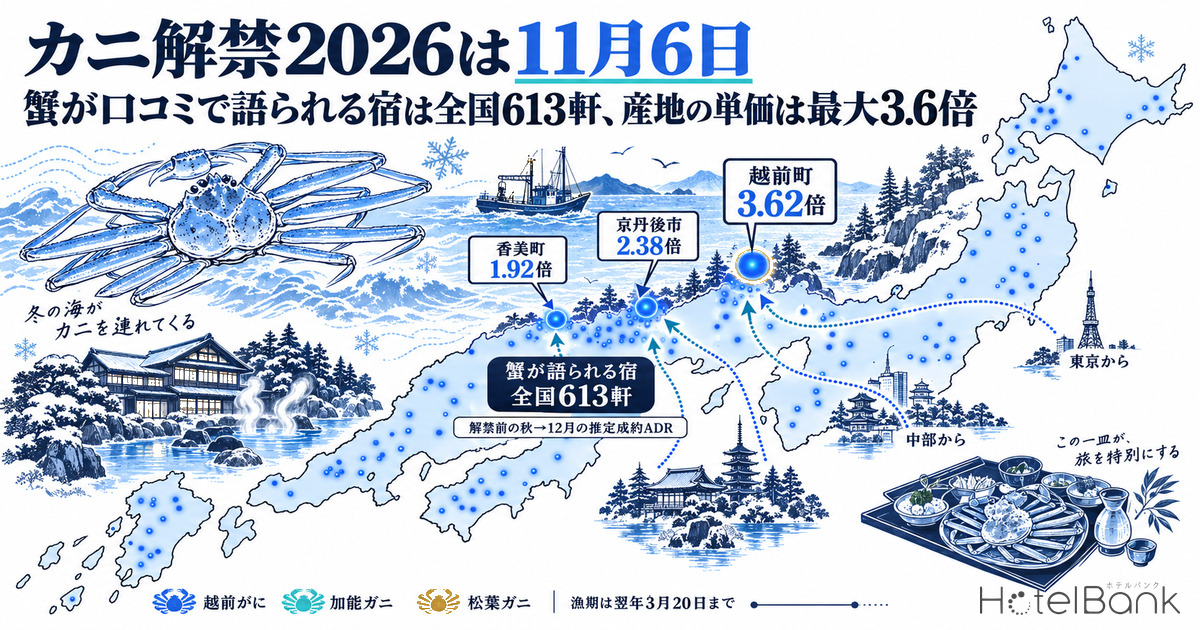
Crab season 2026 opens on Friday, November 6, when snow crab (zuwaigani) fishing begins simultaneously along the Sea of Japan coast in Fukui, Ishikawa, Kyoto, Hyogo, Tottori and neighboring prefectures. The HotelBank Editorial Team analyzed guest reviews from the past 24 months and found 613 properties across 45 prefectures where crab at dinner is mentioned repeatedly. The six prefectures that land Echizen-gani, Kano-gani and Matsuba-gani account for 311 of them (50.7%), while the remaining half extends to Hokkaido, Kyushu and hot-spring towns in the Kanto region. This article looks in turn at the geography of properties where crab is talked about, how far the settled ADR estimate in the producing areas steps up once the season opens, and how bookings for the opening weekend are pacing at this point.
Metric Definitions Used in This Article
*Metric definitions used in this article: ADR (average daily rate) = a settled-rate estimate (tax-excluded equivalent) calculated by applying a property-type correction factor to the lowest plan rate each property publishes on OTAs (double occupancy, per room, tax included). Cross-checked against property-level results disclosed by listed hotel REITs (91 properties, most recent 3 months), the median error is approximately 7%. These are estimates and differ from each property’s actual transacted rates and accounting figures. Area-level ADR is the median across covered properties (the level of a typical property in the area). OCC (occupancy) = rooms sold as a share of total rooms in the area (an estimate based on inventory sold through OTAs; consistency checks against monthly REIT disclosures indicate accuracy within roughly a few percentage points). Where published rates are mentioned, they are per-room rates at double occupancy (tax included).
Crab mention rate = the share of each property’s total reviews that refer positively to crab at dinner (crab kaiseki courses, grilled crab, crab hot pot, all-you-can-eat crab and so on). It measures how often crab is mentioned and is not a rating score. Coverage: properties with at least 20 reviews in the past 24 months and at least 10 crab mentions. LT (lead time) = days remaining until the check-in date. Data sources: MetroEngines Research and HotelBank Editorial Team research.
- — The season opens on Friday, November 6. The male crab season runs through March 20, 2027, while the female season ends within the year (December 31 in Fukui, December 29 in Ishikawa), so both are available together for only about eight weeks.
- — Crab at dinner is mentioned repeatedly in guest reviews at 613 properties nationwide (October 2024 – September 2026). The six producing prefectures account for 311 (50.7%); the other half sits outside the regional crab brands, in Hokkaido, Kyushu and inland hot-spring towns.
- — Last season’s December settled ADR estimate, relative to the September–October average, was 3.62x in Echizen Town and 2.38x in Kyotango. The higher a town’s crab mention rate, the larger the multiple; Awara and Kaga were both at 1.35x.
- — For Saturday, November 7, the first weekend of the season, estimated occupancy based on OTA-listed inventory had reached 77.9% in Toyooka and 72.0% in Kami Town as of October 4 (LT34), roughly the same pace as Saturday, October 24 at the same lead time.
Crab Season 2026 Calendar — Males from November 6 to March 20, Females Until Late December
Let us start with the calendar. Snow crab fishing in the Sea of Japan from Toyama Prefecture westward opens on November 6 every year, and the male crab season continues until March 20 of the following year. In 2026, November 6 falls on a Friday, so the first weekend on which the new season’s catch reaches the dinner table is Saturday, November 7 and Sunday, November 8 — about one month ahead as of this writing (October 5).
Echizen-gani (Fukui Prefecture, yellow tag), Kano-gani (Ishikawa Prefecture, blue tag) and Matsuba-gani (Kyoto, Hyogo, Tottori and Shimane prefectures) are all regional brand names for the same male snow crab, distinguished by where it is landed. Some areas also use port-level names, such as Taiza-gani in Kyoto and Kasumi-gani and Tsuiyama-gani in Hyogo. Females — known as Seiko-gani, Seko-gani or Kobako-gani — have a shorter season to protect the resource: through December 31 according to Fukui Prefecture, and through December 29 in Ishikawa, ending within the year in both cases. In other words, properties can serve both male and female crab together only during the roughly eight weeks from November 6 to the end of December, which makes this the period when menus at inns in the producing areas are at their richest.
| Category | Fishing season | Main regional brands |
|---|---|---|
| Snow crab (male) | November 6, 2026 – March 20, 2027 | Echizen-gani (Fukui) / Kano-gani (Ishikawa) / Matsuba-gani (Kyoto, Hyogo, Tottori, Shimane) |
| Snow crab (female) | November 6 – late December 2026 (through December 31 in Fukui, December 29 in Ishikawa) | Seiko-gani (Fukui) / Kobako-gani (Ishikawa) / Seko-gani, Oya-gani (San’in) |
Source: compiled by the HotelBank Editorial Team from Fukui Prefecture’s “Echizen-gani” pamphlet and materials published by each prefecture and fisheries cooperative. Seasons may be shortened by sea area or by prefectural voluntary restrictions.
613 Properties Nationwide Where Crab Is Talked About — Six Producing Prefectures Hold Half, the Rest Stretch from Hokkaido to Kyushu
So where are guests actually talking about crab? The HotelBank Editorial Team analyzed guest reviews from the past 24 months (October 2024 – September 2026) and found 613 properties nationwide with at least 10 mentions of crab at dinner. These properties had 389,401 reviews in total, of which 23,741 mentioned crab. By prefecture, Hyogo leads with 114 properties, followed by Kyoto with 66, Fukui with 50, Hokkaido with 44 and Tottori with 38.
Source: HotelBank Editorial Team research (text analysis of guest reviews; N=613 properties, 389,401 reviews; October 2024 – September 2026)
The six prefectures with snow crab regional brands — Fukui, Ishikawa, Kyoto, Hyogo, Tottori and Shimane — together account for 311 properties, or 50.7% of the total. Put the other way, almost half of the properties where crab is talked about lie outside the regional brands. Hokkaido alone ranks fourth with 44 properties, and the distribution reaches inland hot-spring areas too: 34 in Shizuoka, 20 in Niigata, 18 in Tochigi and 13 each in Gunma and Nagano. The seven Kyushu prefectures add up to 36, and the 10 in Saga include inns in Tara Town, known for Takezaki crab (a swimming crab). Crab, in short, is built into dinner propositions across Japan, not only into winter on the Sea of Japan.
The Top Properties by Mention Count Are Outside the Producing Areas — Crab Stars at Large Hotels’ Dinners
The surprise lies in who tops the ranking by number of crab mentions. First is Unzen Mikado Hotel (雲仙みかどホテル) in Nagasaki, where 566 of 2,144 reviews (26.4%) mentioned crab. Second is Imagine Hotel & Resort Hakodate (イマジン ホテル&リゾート函館) in Hokkaido (366 mentions, 16.0%), and third is Harazuru Grand Sky Hotel (原鶴グランドスカイホテル) in Fukuoka (365 mentions, 23.0%). None of the top three is in a region with a snow crab brand.
| Rank | Property | Prefecture | Crab mentions | Total reviews | Mention rate |
|---|---|---|---|---|---|
| 1 | Unzen Mikado Hotel (雲仙みかどホテル) | Nagasaki | 566 | 2,144 | 26.4% |
| 2 | Imagine Hotel & Resort Hakodate (イマジン ホテル&リゾート函館) | Hokkaido | 366 | 2,283 | 16.0% |
| 3 | Harazuru Grand Sky Hotel (原鶴グランドスカイホテル) | Fukuoka | 365 | 1,589 | 23.0% |
| 4 | Grand Hotel Taiyo (グランドホテル太陽) | Chiba | 323 | 1,148 | 28.1% |
| 5 | Hotel Mahoroba (ホテルまほろば) | Hokkaido | 301 | 2,164 | 13.9% |
| 6 | Awara Onsen Seifuso (あわら温泉 清風荘) | Fukui | 242 | 1,631 | 14.8% |
| 7 | Hotel Zuiho (ホテル瑞鳳) | Miyagi | 241 | 2,309 | 10.4% |
| 8 | Hotel Koyokan (ホテル紅葉館) | Iwate | 232 | 1,050 | 22.1% |
| 9 | Kaike Grand Hotel Tensui (皆生グランドホテル 天水) | Tottori | 180 | 1,048 | 17.2% |
| 10 | Kasugai View Hotel (春日居びゅーほてる) | Yamanashi | 180 | 577 | 31.2% |
Source: HotelBank Editorial Team research (ranked by number of crab mentions; N=613 properties; October 2024 – September 2026)
Property size and dinner format likely explain this. At four of the top 10 — Unzen Mikado Hotel, Harazuru Grand Sky Hotel, Grand Hotel Taiyo and Kasugai View Hotel — dinner buffets are also mentioned in 16.8–22.8% of reviews, suggesting that “a dinner where you can eat as much crab as you like” sticks in the memory of families and groups. Even far from the producing areas, crab can become the main subject of reviews when it is made the headline of dinner — a useful finding for operators designing winter dining plans.
Re-rank by mention rate (the share of reviews that mention crab), however, and the picture changes completely. Limiting the list to the 135 properties with at least 50 mentions, eight of the top 10 are in Hyogo, Kyoto or Fukui, and at the top-ranked inn in Kami Town, 72.3% of reviews mentioned crab. At small culinary ryokan and minshuku guesthouses, the stay itself has become synonymous with crab.
| Rank | Property | Prefecture | Crab mentions | Total reviews | Mention rate |
|---|---|---|---|---|---|
| 1 | Kani Rakuza Koragi (かに楽座 甲羅戯) | Hyogo | 60 | 83 | 72.3% |
| 2 | Kojin no Yado Sanpo (荒神の宿 三宝) | Hyogo | 124 | 227 | 54.6% |
| 3 | Yatomiso (夜灯見荘) | Saga | 121 | 246 | 49.2% |
| 4 | Yunagi no Oka (夕凪の丘) | Hyogo | 93 | 191 | 48.7% |
| 5 | Ryori Ryokan Heisei (料理旅館 平成) | Fukui | 123 | 279 | 44.1% |
| 6 | Yuhigaura Onsen Kaishu (夕日ヶ浦温泉海舟) | Kyoto | 160 | 370 | 43.2% |
| 7 | Umi wo Nozomu Yado Sukai (海を望む宿 澄海) | Kyoto | 111 | 257 | 43.2% |
| 8 | Minatokan (三七十館) | Hyogo | 84 | 197 | 42.6% |
| 9 | Onsen Minshuku Shirahamaya (温泉民宿 しらはま屋) | Yamagata | 58 | 142 | 40.9% |
| 10 | Shinpuro (神風楼) | Kyoto | 56 | 140 | 40.0% |
Source: HotelBank Editorial Team research (the 135 properties with at least 50 crab mentions, ranked by mention rate; October 2024 – September 2026)
To sum up so far, crab properties come in two types. One is the “large property with crab as the dinner headline” type that tops the ranking by mention count and is found across the country regardless of producing area. The other is the “small culinary inn with a local crab kaiseki course” type that tops the ranking by mention rate and is concentrated along the Tajima, Tango and Echizen coasts. The rate movements examined next show up most clearly in the towns where the latter type clusters.
Rates After the Opening — Echizen Town Steps Up 3.6x, Kyotango 2.4x
How much do rates in the producing areas change once the season opens? Using MetroEngines Research data, we looked at the settled ADR estimate by municipality for last season (2025), for which confirmed figures are complete. Relative to the pre-season September–October average, December rose 3.62x in Echizen Town, from about ¥17,100 to about ¥61,800, and 2.38x in Kyotango, from about ¥17,700 to about ¥42,200. The three Tajima municipalities in Hyogo also all exceeded 1.7x their autumn level: Kami Town at 1.92x, Shin-Onsen Town at 1.96x and Toyooka at 1.75x. Rate levels by port town for November through January are analyzed in detail in Crab Season Opens Nov 6: Echizen Room Rates Jump 3.2x in One Month.
Source: compiled by the HotelBank Editorial Team from MetroEngines Research data (settled ADR estimate, median across all property types; confirmed figures for September–December 2025)
| Municipality | Properties (N) | Sep–Oct 2025 avg. | Nov | Dec | Dec multiple | Crab mention rate (properties covered) |
|---|---|---|---|---|---|---|
| Awara, Fukui | 21 | ¥21,099 | ¥25,135 | ¥28,567 | 1.35x | 7.7% (17 properties) |
| Sakai, Fukui | 15 | ¥8,836 | ¥16,968 | ¥14,106 | 1.60x | 23.9% (9 properties) |
| Echizen Town, Fukui | 18 | ¥17,054 | ¥49,997 | ¥61,769 | 3.62x | 30.2% (13 properties) |
| Kaga, Ishikawa | 44 | ¥18,205 | ¥22,792 | ¥24,640 | 1.35x | 5.7% (32 properties) |
| Kyotango, Kyoto | 80 | ¥17,710 | ¥40,132 | ¥42,182 | 2.38x | 26.5% (63 properties) |
| Toyooka, Hyogo | 99 | ¥18,766 | — | ¥32,776 | 1.75x | 13.7% (71 properties) |
| Kami Town, Hyogo | 45 | ¥23,237 | — | ¥44,622 | 1.92x | 49.3% (39 properties) |
| Shin-Onsen Town, Hyogo | 20 | ¥12,933 | — | ¥25,380 | 1.96x | 10.5% (13 properties) |
| Tottori City, Tottori | 30 | ¥7,924 | ¥9,316 | ¥8,015 | 1.01x | 11.4% (5 properties) |
| Iwami Town, Tottori* | 4 | ¥12,380 | ¥15,068 | ¥18,685 | 1.51x | 6.8% (3 properties) |
Source: compiled by the HotelBank Editorial Team from MetroEngines Research data. The number of properties is N for December 2025. November 2025 is not shown for the three Hyogo municipalities. *Iwami Town is shown for reference only (N=4). The crab mention rate is the share of crab mentions in total reviews at properties with at least five crab mentions (HotelBank Editorial Team research).
What stands out is that the size of the multiple and the crab mention rate line up in the same direction. In Echizen Town (mention rate 30.2%), Kyotango (26.5%) and Kami Town (49.3%), December rates reach roughly 2x to 3.6x the autumn level. By contrast, Awara (7.7%) and Kaga (5.7%) both stay at 1.35x. Both cities are dominated by hot-spring ryokan with large room counts, where the crab kaiseki course is sold as one of many dinner plans, so the tier shift appears milder when measured by the town-wide median. This does not demonstrate causation, but the density with which guests talk about crab and the degree to which a town’s rate band switches after the opening can be seen as two views of the same structure.
Tottori City is almost flat at 1.01x on the all-property-type median, but this is because business hotels in the city center dominate the sample. Limited to ryokan, the September–October average of about ¥11,900 rose 1.33x to about ¥15,800 in December (N=13), so the opening effect is visible in the hot-spring ryokan segment. Wajima is not included in this article’s comparison because the number of properties available for aggregation is limited.
Kyotango Month by Month — A “Five-Month Plateau” from November to March
Let us confirm the tier shift on a monthly basis. Kyotango’s settled ADR estimate stepped up from about ¥17,800 in October 2025 to about ¥40,100 in November, then moved along a plateau at about ¥42,200 in December and about ¥43,600 in January 2026. After about ¥38,300 in March, when the season ends, it returned to about ¥20,000 in April. The high-rate period almost exactly overlaps the male crab season (November 6 – March 20), showing that the town’s rate calendar is built around the fishing season itself.
Source: compiled by the HotelBank Editorial Team from MetroEngines Research data (Kyotango, settled ADR estimate, N=68–82 properties; October–December 2026 are estimates based on listed rate levels at the time of the survey)
For this season, the table below sets out the confirmed figures for September 2026 alongside November and December values estimated from listed rate levels at the time of the survey (early October). The December estimates for Toyooka (about ¥32,400) and Shin-Onsen Town (about ¥25,900) are almost level with last December’s confirmed figures (about ¥32,800 and about ¥25,400), while Kyotango (about ¥38,300) and Echizen Town (about ¥46,600) are still building toward last year’s confirmed levels. Note that October is a month in progress and November onward are future months; none of these are confirmed figures.
| Municipality | Sep 2026 (confirmed) | Nov (estimate) | Dec (estimate) | Reference: Dec 2025 (confirmed) | Properties in Dec estimate (N) |
|---|---|---|---|---|---|
| Awara | ¥21,552 | ¥21,570 | ¥23,907 | ¥28,567 | 21 |
| Sakai | ¥12,583 | ¥11,337 | ¥12,385 | ¥14,106 | 14 |
| Echizen Town | ¥15,794 | ¥38,782 | ¥46,563 | ¥61,769 | 16 |
| Kaga | ¥17,679 | ¥20,506 | ¥20,214 | ¥24,640 | 46 |
| Kyotango | ¥19,121 | ¥33,839 | ¥38,333 | ¥42,182 | 68 |
| Toyooka | ¥19,502 | ¥27,190 | ¥32,381 | ¥32,776 | 83 |
| Kami Town | ¥24,074 | ¥34,588 | ¥36,778 | ¥44,622 | 45 |
| Shin-Onsen Town | ¥14,817 | ¥22,184 | ¥25,937 | ¥25,380 | 21 |
| Tottori City | ¥8,743 | ¥10,367 | ¥8,814 | ¥8,015 | 26 |
Source: compiled by the HotelBank Editorial Team from MetroEngines Research data (settled ADR estimate, median across all property types; November and December are estimates based on listed rate levels as of early October 2026)
Opening-Weekend Pace So Far — Saturday, November 7 Is Tracking a Late-October Saturday
Finally, we check how bookings are progressing for November 7, the first Saturday after the opening. With just over a month to go before opening day, what is shown here is strictly an interim snapshot. As of October 4 (LT34), occupancy (estimate based on OTA-listed inventory) stood at 77.9% in Toyooka (81 properties / 1,549 rooms), 72.0% in Kami Town (53 properties / 483 rooms), 71.0% in Kaga (46 properties / 2,614 rooms) and 61.9% in Kyotango (70 properties / 968 rooms).
Source: prepared by MetroEngines Research and the HotelBank Editorial Team (check-in November 7, 2026; LT45 to LT34; based on listings on major booking sites; property and room counts are shown in the table below)
| Municipality | Coverage for Nov 7 (listed on major booking sites) | Sat, Oct 24 at LT34 | Sat, Nov 7 at LT34 | Difference |
|---|---|---|---|---|
| Awara | 21 properties / 1,137 rooms | 75.8% | 64.3% | -11.5pt |
| Sakai | 20 properties / 256 rooms | 74.8% | 85.5% | +10.7pt |
| Echizen Town | 14 properties / 124 rooms | 81.2% | 82.3% | +1.1pt |
| Kaga | 46 properties / 2,614 rooms | 73.9% | 71.0% | -2.9pt |
| Kyotango | 70 properties / 968 rooms | 65.1% | 61.9% | -3.2pt |
| Toyooka | 81 properties / 1,549 rooms | 78.7% | 77.9% | -0.8pt |
| Kami Town | 53 properties / 483 rooms | 62.8% | 72.0% | +9.2pt |
| Shin-Onsen Town | 20 properties / 483 rooms | 81.5% | 76.4% | -5.1pt |
| Tottori City | 22 properties / 1,634 rooms | 73.2% | 66.3% | -6.9pt |
Source: prepared by MetroEngines Research and the HotelBank Editorial Team (occupancy is an estimate based on OTA-listed inventory; compared at the same lead time of 34 days before check-in)
Compared with Saturday, October 24 at the same lead time (34 days out), Kami Town is ahead by +9.2pt and Sakai by +10.7pt, while Toyooka, Echizen Town, Kaga and Kyotango are all within ±4pt, building at almost the same pace as a Saturday in the autumn-foliage season. Awara and Tottori City start from a lower position than the late-October Saturday and are still at the stage of filling up. As the previous section showed, this is a date on which the rate tier rises 1.4x to 3.6x, so the reasonable reading is that bookings are holding a pace comparable to autumn weekends even at those price levels. In Kyotango, the number of rooms remaining has increased since late September, suggesting that listed inventory is being added ahead of the opening. The shape of the opening weekend is yet to be settled.
*Occupancy (estimate based on OTA-listed inventory) reflects how inventory sold on OTAs is being taken up and differs from each property’s actual overall occupancy. Booking curve = the trend in rooms remaining on OTAs toward the check-in date. Only observations within a 45-day lead time were used.
Implications for Operators and Investors — The Upside Lies in “Crab That Is Not Yet Talked About”
From these results, we offer three directions for operators designing winter dining plans. First, Awara and Kaga, where crab mention rates are in the 5–8% range, are best understood not as towns that do not serve crab but as towns where it is not yet talked about enough. In these towns, where hot-spring ryokan with large room counts cluster, there appears to be room to lift the town-wide rate band by putting forward a “dish with a name” that tends to stay in reviews — a plan with one tagged crab per guest, for example, or a year-end-only menu timed to the female crab season.
Second, for properties outside the producing areas, the large hotels at the top of the mention-count ranking offer a clue. If crab is made the headline of dinner and shaped into an experience that families and groups can describe as “we ate as much as we wanted,” it can become the main subject of reviews even without a regional brand. Third, for investors looking at strongly seasonal locations, a relevant consideration is that the shape of the revenue peak differs entirely between towns where rates switch to 2x or more for the five months from November to March and towns with a gentle year-round profile. In towns such as Echizen Town and Kyotango, how occupancy and rates are built from April to October emerges as the theme that determines full-year revenue.
The roughly eight weeks to year-end when both males and females are available, the period from January to March 20 when only males remain, and spring onward after the season closes — taking the fishing season as a fixed calendar and redesigning menus, plan names and rate steps across these three periods looks like a practical move to work on now, one month before the opening.
⚠ Note on ADR for future dates: ADR figures in this article for October 2026 onward are estimates based on rates published on OTAs at the time of the survey and will change as the check-in date approaches. Please note that rates currently set high may be lowered in last-minute adjustments, and that levels may shift as new plans are added.
Frequently Asked Questions
Q. When does crab season open in 2026?
A. Along the Sea of Japan coast from Toyama Prefecture westward — including Fukui, Ishikawa, Kyoto, Hyogo and Tottori — snow crab fishing opens on Friday, November 6, 2026. The male crab season runs through March 20, 2027.
Q. Are Echizen-gani, Kano-gani and Matsuba-gani different species?
A. All are the same male snow crab; the name changes with the region where it is landed. It is Echizen-gani (yellow tag) in Fukui Prefecture, Kano-gani (blue tag) in Ishikawa Prefecture, and Matsuba-gani from Kyoto Prefecture through Shimane Prefecture.
Q. Until when can female crab (Seko-gani, Seiko-gani, Kobako-gani) be eaten?
A. The female crab season ends within the year: through December 31 in Fukui Prefecture and through December 29 in Ishikawa Prefecture, according to published information. Both male and female crab can be enjoyed during the roughly eight weeks from November 6 to the end of December.
Related Articles
References and Sources
■ Data sources
Text analysis of guest reviews (24 months from October 2024 to September 2026; 613 properties nationwide with at least 10 crab mentions; 389,401 reviews); settled ADR estimate by municipality (September 2025 – December 2026, median across all property types); booking curves for check-in on October 24 and November 7, 2026 (lead time within 45 days). All from MetroEngines Research and HotelBank Editorial Team research. Fishing seasons are based on materials published by Fukui, Ishikawa and Kyoto prefectures.
■ Calculation assumptions
The December multiple is the December 2025 settled ADR estimate divided by the September–October average of the same year (simple average of monthly values). Figures through December 2025 are confirmed; October–December 2026 are estimates based on listed rate levels as of early October. Booking pace was compared between points at the same lead time (34 days out). The crab mention rate is the number of reviews that refer positively to crab at dinner divided by total reviews.
■ Limitations and caveats
The mention rate measures how often crab is talked about; it does not represent a rating score or the quantity served. Rates fluctuate more easily at properties with few total reviews. Iwami Town is treated as a reference value because N=4, and Wajima is not included in the comparison. The alignment between multiples and mention rates is a relationship observed at the same time and does not demonstrate causation. ADR and occupancy for future months will change as bookings progress.