

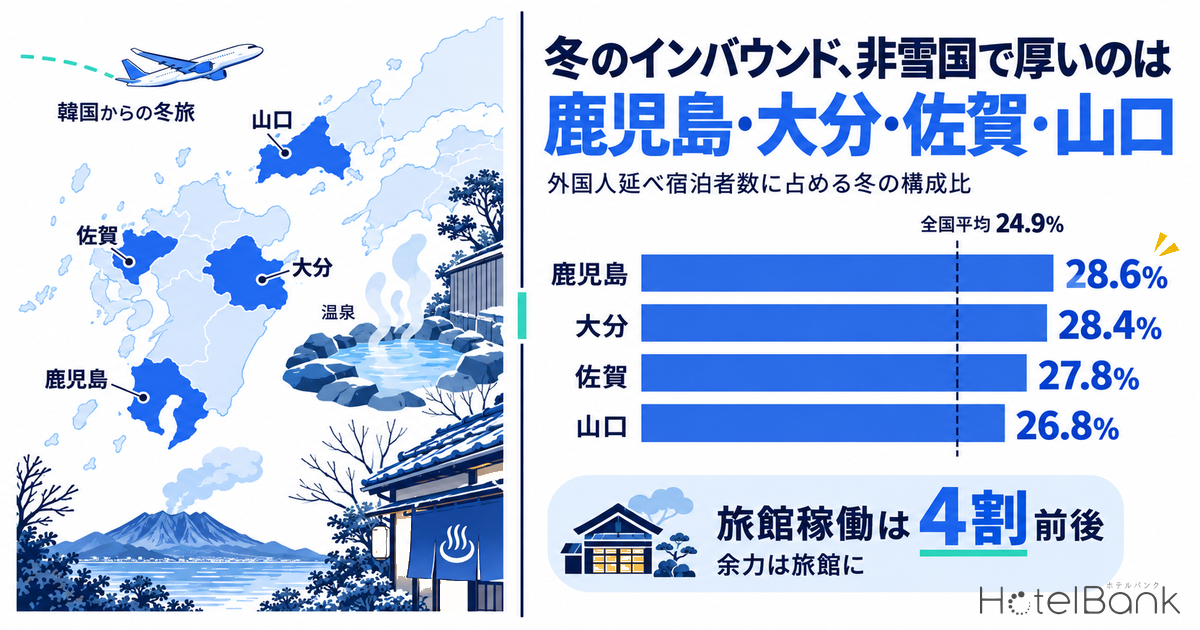
Re-sorting the Japan Tourism Agency’s Overnight Travel Statistics Survey for 2025 (final figures, January–December) by prefecture and month shows that December–February accounts for a larger share of foreign guest nights than the national average (24.9%) in 15 prefectures. Of those, only four are not snow country: Kagoshima, Oita, Saga and Yamaguchi. In all four, travelers from South Korea make up 36.2–50.5% of winter foreign guest nights, and onsen (hot springs) stand out in guest reviews. This article overlays winter ADR and room occupancy by property type for the four prefectures to identify which price bands still have room to grow in the winter season.
Metric Definitions Used in This Article
- Winter share: For foreign guest nights in the Japan Tourism Agency’s Overnight Travel Statistics Survey, the sum of January, February and December 2025 divided by the 2025 annual total. Figures through December 2025 are final; January–July 2026 are second preliminary figures (the stratification basis changed from number of employees to number of rooms starting with January 2026, so year-on-year comparisons may include the effect of that revision).
- Non-snow prefectures: The 23 prefectures with no areas designated as heavy snowfall areas under the Act on Special Measures concerning Countermeasures for Heavy Snowfall Areas. The 24 prefectures that do have designated areas are treated as snow country in this article.
- ADR (average daily rate): An estimated transacted rate (tax-exclusive equivalent) calculated by applying a property-type adjustment factor to the lowest plan level each property publishes on OTAs (two guests in one room, per-room rate, tax included). When checked against property-level results disclosed by listed hotel REITs (91 properties, most recent three months), the median error is about 7%. These are estimates and differ from each property’s actual transacted prices and accounting figures. Area-level ADR is the median of the properties covered (the level of a typical property in the area).
- Room occupancy: Monthly figures by prefecture and accommodation type published in the Japan Tourism Agency’s Overnight Travel Statistics Survey (rooms used ÷ total rooms, Japanese and foreign guests combined). Winter values are the simple average of January, February and December 2025.
- Data sources: Japan Tourism Agency, Overnight Travel Statistics Survey; MetroEngines Research; HotelBank Editorial Team research (guest reviews)
- — Four non-snow prefectures beat the national average — In the 2025 final figures, January, February and December accounted for 28.6% of foreign guest nights in Kagoshima, 28.4% in Oita, 27.8% in Saga and 26.8% in Yamaguchi (Japan overall: 24.9%).
- — South Korea leads the winter — South Korea accounts for 36.2–50.5% of winter foreign guest nights in the four prefectures, 2.5–3.5 times the national figure (14.3%).
- — Winter ADR is 96.4–104.7% of the annual average — In Oita (¥15,300) and Saga (¥13,300), winter is above the annual average, and rates hold up well.
- — The headroom is in ryokan priced at ¥10,000–¥29,999 — Average room occupancy for January, February and December 2025 was 38.1–45.3% for ryokan versus 62.7–72.8% for business hotels.
- — Recent momentum is firm — January–February 2026 (second preliminary figures) was up 17.3% year on year for the four prefectures combined, against −7.4% nationally.
15 Prefectures Exceed the National Winter Share — the Snow-Free Ones Are Three in Kyushu plus Yamaguchi
Start with the overall picture. Foreign guest nights in Japan totaled 179.92 million in 2025, of which January, February and December together accounted for 44.86 million, a winter share of 24.9% (23.6% in 2024). Of the 15 prefectures above that level, 11 have designated heavy snowfall areas, such as Hokkaido (42.1%), Nagano (45.0%) and Niigata (53.0%), where skiing and snow scenery are the purpose of the trip.
Among the 23 prefectures with no designated areas, however, only four exceeded the national average: Kagoshima (28.6%), Oita (28.4%), Saga (27.8%) and Yamaguchi (26.8%). All four were also above the national average (23.6%) in 2024 (Kagoshima 23.7%, Oita 29.3%, Saga 29.0%, Yamaguchi 24.6%), so this is hard to dismiss as a single-year swing. Fukuoka, the gateway to Kyushu, sits at 24.9%, almost exactly the national average. The pattern that emerges is that winter depth appears in the prefectures with onsen areas beyond Fukuoka.
A mild climate alone does not draw foreign visitors in winter, though. Okinawa (19.2%), Kagawa (20.6%) and Wakayama (13.1%) are all below the national average, with peaks in summer or in spring and autumn. The winter peak appears to be determined less by climate itself than by the combination of a reason to visit in winter and the source market.
Source: Compiled by the HotelBank Editorial Team from the Japan Tourism Agency, Overnight Travel Statistics Survey (2025 final figures). Gray bars are three snow-country prefectures shown as a reference baseline
| Prefecture | Winter share 2025 | Winter share 2024 | Foreign guest nights 2025 | Of which Jan, Feb, Dec (guest nights) | Foreign share of winter guest nights, 2025 | Jan–Feb 2026 YoY (preliminary) |
|---|---|---|---|---|---|---|
| Kagoshima | 28.6% | 23.7% | 708,960 | 202,770 | 9.9% | +27.6% |
| Oita | 28.4% | 29.3% | 1,491,590 | 424,170 | 21.2% | +13.2% |
| Saga | 27.8% | 29.0% | 251,600 | 70,020 | 12.8% | +11.7% |
| Yamaguchi | 26.8% | 24.6% | 162,210 | 43,480 | 5.2% | +20.9% |
| Four-prefecture total | 28.3% | 27.6% | 2,614,360 | 740,440 | — | +17.3% |
| Japan | 24.9% | 23.6% | 179,922,130 | 44,857,490 | 29.6% | −7.4% |
Source: Compiled by the HotelBank Editorial Team from the Japan Tourism Agency, Overnight Travel Statistics Survey. Figures through 2025 are final; January–February 2026 are second preliminary figures (may include the effect of the change in stratification basis). Foreign share of winter guest nights = foreign guest nights in January, February and December ÷ total guest nights in the same period
A Plateau from October to February, a Trough from June to September — Jan–Feb 2026: Four Prefectures +17.3% vs −7.4% Nationally
Looking at the monthly pattern for the four prefectures combined, winter does not so much spike on its own as form part of a high plateau running from October through February, with a trough from June to September. The four prefectures recorded 2.614 million foreign guest nights in 2025; the five months from October to February accounted for 48.5% of that (42.5% nationally), while the four months from June to September accounted for just 23.9% (30.8% nationally). This is a market whose seasonality runs opposite to the national curve, which peaks in summer.
Scale matters too. Winter foreign guest nights in the four prefectures total 740,000, or 1.7% of the national winter figure (44.86 million), and Oita accounts for 57.3% of that. This is not a story of volume on par with Tokyo or Osaka; rather, winter foreign guests matter for each prefecture’s own lodging market. In Oita, 21.2% of all winter guest nights are foreign, higher than the annual figure (18.3%).
What about the most recent period? Prefecture-level figures have been published through July 2026 (second preliminary). Within that, the four prefectures combined recorded 557,000 foreign guest nights in January–February 2026, up 17.3% year on year. The national figure for the same period was −7.4%, so Kagoshima (+27.6%), Yamaguchi (+20.9%), Oita (+13.2%) and Saga (+11.7%) all moved in the opposite direction. Because the survey’s stratification basis changed starting with January 2026, the figures should be read with some latitude, but they suggest that the winter depth is continuing.
Source: Compiled by the HotelBank Editorial Team from the Japan Tourism Agency, Overnight Travel Statistics Survey. Total for Kagoshima, Oita, Saga and Yamaguchi. 2024 and 2025 are final figures; 2026 is second preliminary figures for January–July
South Korea Leads the Winter — 36.2–50.5% of Winter Stays, and 43.6% of Korean Guest Nights in Kagoshima Fall in Winter
Behind the winter peak is a concentrated source market. Aggregating the nationality breakdown (properties with 10 or more employees) for January, February and December 2025, South Korea’s share is 50.5% in Oita, 50.0% in Kagoshima, 49.1% in Yamaguchi and 36.2% in Saga, 2.5–3.5 times the national figure (14.3%). On top of that, Korean stays themselves skew toward winter: winter accounts for 43.6% of annual Korean guest nights in Kagoshima and 39.7% in Oita, against 31.1% nationally.
| Prefecture | Winter foreign guest nights | South Korea | Taiwan | Hong Kong | China | Winter share of annual Korean guest nights |
|---|---|---|---|---|---|---|
| Kagoshima | 168,040 | 50.0% | 11.1% | 5.8% | 12.9% | 43.6% |
| Oita | 335,970 | 50.5% | 17.4% | 8.5% | 7.2% | 39.7% |
| Saga | 67,560 | 36.2% | 17.9% | 9.5% | 14.4% | 29.8% |
| Yamaguchi | 42,950 | 49.1% | 10.3% | 4.1% | 4.9% | 32.8% |
| Japan | 38,494,010 | 14.3% | 14.5% | 5.5% | 20.2% | 31.1% |
Source: Compiled by the HotelBank Editorial Team from the Japan Tourism Agency, Overnight Travel Statistics Survey, 2025 final figures (by nationality, properties with 10 or more employees). Winter = January, February and December 2025
What underpins winter demand from South Korea is the seasonal allocation of airline seats. At Kagoshima Airport, Korean Air and Jeju Air each increased their Seoul (Incheon) services to seven round trips a week, from four and three respectively, in the winter schedule starting October 26, 2025 (Aviation Wire, August 22, 2025). Kagoshima Prefecture’s tourism trends survey also reports that foreign guest nights in January 2026 (78 surveyed properties) came to 30,690, up 13.8% year on year, and attributes the rise to more “guests from South Korea, including those visiting for golf,” as scheduled flights were added or resumed and charter flights arrived from Busan (Kagoshima Prefecture, Tourism Trends Survey, January 2026).
In short, winter in the four snow-free prefectures can be summed up as the result of four conditions lining up in the Korean market: they are close, warm, have onsen, and gain flights in winter. This article does not cover the airports adding flights in the 2026 winter schedule (starting October 25) or the room stock around them; it focuses on prefecture-level seasonality, rates and occupancy rather than airport catchments.
Winter ADR Is 96.4–104.7% of the Annual Average — Oita and Saga Are Higher in Winter
How far is the demand peak reflected in rates? Averaging ADR for January, February and December 2025 from MetroEngines Research data and comparing it with the 12-month average for the same year, Oita came to ¥15,300, or 104.6% of its annual average (¥14,600), and Saga to ¥13,300, or 104.7%, so winter exceeded the annual level in both. Kagoshima was ¥6,800, or 100.2%, roughly in line with the year, and Yamaguchi was ¥7,200, recovering to 96.4%.
The same tendency shows up against summer (July–August). Winter ADR in Oita and Saga was 104.5% and 106.0% of summer, above the summer level, while Kagoshima was 96.2% and Yamaguchi 86.4%. Compared with Okinawa, where summer is clearly the peak-rate season (winter is 93.9% of the annual average and 75.0% of summer), or Hokkaido, which is summer-weighted on a prefecture-wide median basis (92.6% and 72.5%), the four prefectures are markets where rates hold up well in winter. Note that for resorts alone, winter in Hokkaido is 111.4% of the annual average; the snow-country winter premium appears once the property type is narrowed.
Comparing the most recent winter (December 2025–February 2026) with the previous winter, Oita was ¥16,500, up 13.9% year on year, Kagoshima ¥7,200, up 10.0%, and Yamaguchi ¥7,600, up 6.5%. Saga’s prefecture-wide median was ¥13,000, down 4.8%, but by property type business hotels were up 1.0% and ryokan were ¥22,600, up 12.2%, both above the previous year. The prefecture-wide median is sensitive to the mix of properties, which should be kept in mind.
Source: Compiled by MetroEngines Research and the HotelBank Editorial Team. Shows by what percentage average winter ADR (January, February and December 2025) is above or below the 12-month average for the same year (all finalized months)
| Prefecture | Winter ADR Jan, Feb, Dec 2025 | Annual average 2025 | Winter ÷ annual | Winter ÷ summer (Jul–Aug) | Latest winter Dec 2025–Feb 2026 | YoY | Properties N |
|---|---|---|---|---|---|---|---|
| Kagoshima | ¥6,755 | ¥6,739 | 100.2% | 96.2% | ¥7,214 | +10.0% | 312–317 |
| Oita | ¥15,310 | ¥14,633 | 104.6% | 104.5% | ¥16,523 | +13.9% | 437–467 |
| Saga | ¥13,279 | ¥12,682 | 104.7% | 106.0% | ¥13,026 | −4.8% | 146–155 |
| Yamaguchi | ¥7,241 | ¥7,509 | 96.4% | 86.4% | ¥7,564 | +6.5% | 189–195 |
| (Ref.) Hokkaido | ¥9,022 | ¥9,744 | 92.6% | 72.5% | ¥10,119 | +18.9% | 875–924 |
| (Ref.) Okinawa | ¥10,161 | ¥10,826 | 93.9% | 75.0% | ¥11,844 | +22.5% | 482–491 |
Source: Compiled by MetroEngines Research and the HotelBank Editorial Team. ADR is the estimated transacted rate (tax-exclusive equivalent, area median). N is the range of properties covered across the months
The Headroom Is in Ryokan at ¥10,000–¥29,999 — Winter Occupancy 38.1–45.3% vs 62.7–72.8% for Business Hotels
Rates hold up, but how much room capacity remains? Averaging the three winter months of the Japan Tourism Agency’s room occupancy figures (2025 final), the prefecture-wide levels were 52.5% in Kagoshima, 54.5% in Oita, 51.9% in Saga and 53.4% in Yamaguchi. The gap versus the annual average is small — +0.8pt in Kagoshima, +0.2pt in Oita and −0.6pt in Saga — with almost none of the winter dip seen nationally (58.2% in winter, −3.4pt versus the year). Yamaguchi, at −3.6pt, has the most winter upside of the four.
Breaking this down by property type makes clear where the headroom lies. Winter room occupancy reaches 62.7–72.8% for business hotels and 53.9–69.9% for city hotels, whereas ryokan sit at around 40%: 38.1% in Kagoshima, 45.3% in Oita, 39.9% in Saga and 39.7% in Yamaguchi. That is higher than ryokan nationally (34.9%), but it still means 50–60% of rooms remain available to sell. Resort hotels, at 39.6–60.9%, have the next-largest headroom after ryokan.
The table below overlays this with rates. Winter ADR for ryokan ranges from ¥10,100 in Kagoshima to ¥21,500 in Saga, spread across the ¥10,000–¥29,999 band, and in all four prefectures winter is 4.8–6.7% above the annual average. Rates rise in winter yet rooms are not filling up: that is the defining feature of this price band. By contrast, business hotels at ¥5,900–¥6,500 are already running at 60–70% occupancy, so any winter upside there has to come from the rate side.
Source: Compiled by the HotelBank Editorial Team from the Japan Tourism Agency, Overnight Travel Statistics Survey (2025 final figures). Simple average of room occupancy for January, February and December 2025
| Prefecture | Property type | Winter ADR (estimated transacted) | Winter ÷ annual | Properties N | Winter room occupancy (Japan Tourism Agency) | Gap vs annual average |
|---|---|---|---|---|---|---|
| Kagoshima | Ryokan | ¥10,084 | 106.7% | 82–90 | 38.1% | +2.3pt |
| Resort hotel | ¥13,385 | 99.0% | 48–50 | 39.6% | −1.2pt | |
| Business hotel | ¥5,959 | 98.9% | 153–159 | 69.5% | +0.6pt | |
| City hotel | ¥7,949 | 93.1% | 21–23 | 67.1% | +6.6pt | |
| Oita | Ryokan | ¥19,213 | 106.0% | 296–316 | 45.3% | +2.0pt |
| Resort hotel | ¥18,353 | 99.8% | 36–38 | 59.0% | −0.5pt | |
| Business hotel | ¥6,045 | 98.5% | 91–92 | 63.5% | −1.5pt | |
| City hotel | ¥10,698 | 101.7% | 13–14 | 69.9% | −0.9pt | |
| Saga | Ryokan | ¥21,452 | 104.8% | 83–89 | 39.9% | +1.8pt |
| Resort hotel | ¥14,548 | 102.7% | 6–7 (reference) | 60.9% | −0.4pt | |
| Business hotel | ¥6,453 | 99.0% | 46–50 | 72.8% | −1.4pt | |
| City hotel | ¥9,729 | 103.3% | 7–8 (reference) | 67.0% | −2.3pt | |
| Yamaguchi | Ryokan | ¥16,994 | 105.4% | 70–71 | 39.7% | −2.3pt |
| Resort hotel | ¥11,222 | 105.9% | 12–15 | 52.3% | −7.9pt | |
| Business hotel | ¥5,888 | 95.2% | 96–97 | 62.7% | −4.1pt | |
| City hotel | ¥7,425 | 95.8% | 10 | 53.9% | −6.2pt |
Source: ADR compiled by MetroEngines Research; room occupancy compiled by the HotelBank Editorial Team from the Japan Tourism Agency, Overnight Travel Statistics Survey (2025 final figures). Both cover January, February and December 2025. Property-type classifications are defined differently in the two datasets, so the correspondence is approximate
By month, January is where the upside is largest. Prefecture-wide room occupancy was 47.9–52.5% in January, 2.7–9.4pt below February (55.2–57.3%). Lunar New Year moves between late January and mid-February depending on the year (January 29 in 2025, February 17 in 2026, February 6 in 2027), and in years when the holiday falls in February, inventory tends to remain in January, especially on weekdays.
Evidence from Reviews — Over 20% of Korean and Traditional Chinese Reviews in Oita Mention Onsen
Guest reviews offer a check on why foreign visitors come in winter. The HotelBank Editorial Team aggregated guest reviews from the past 24 months by language and found that, of 9,166 Korean-language reviews for properties in Oita, 23.0% mentioned onsen, as did 22.2% of Traditional Chinese reviews (4,987) and 15.0% of English reviews (8,941). Elsewhere in Kyushu, urban Fukuoka came in at just 2.8% for Korean and 2.7% for Traditional Chinese, and Oita’s rates are more than double those of Hokkaido (9.7% Korean, 9.9% Traditional Chinese), used here as the snow-country baseline.
A closer look reveals the outline of the experience guests are seeking. In Oita’s Korean-language reviews, the next most frequent mentions are open-air baths (9.3%, 853 reviews), private-use baths (6.3%, 581) and kaiseki cuisine (6.1%, 558); in English, rooms with open-air baths (7.2%, 647) rank high, and in Traditional Chinese, private-use baths (8.7%, 432). In Korean-language reviews for Saga (8.8%), Yamaguchi (7.7%) and Kagoshima (5.0%), large communal baths stand out, suggesting that beyond onsen itself, being “an inn where you can soak in a big bath” contributes to how guests rate a stay.
Source: HotelBank Editorial Team research (guest reviews aggregated by language, past 24 months, as of October 2026). Mention rate = share of reviews in each language that mention onsen
| Prefecture | Korean onsen mention rate | Reviews N | Traditional Chinese onsen mention rate | Reviews N | English onsen mention rate | Reviews N |
|---|---|---|---|---|---|---|
| Kagoshima | 10.4% | 2,671 | 8.8% | 1,395 | 6.2% | 4,815 |
| Oita | 23.0% | 9,166 | 22.2% | 4,987 | 15.0% | 8,941 |
| Saga | 14.3% | 2,063 | 14.3% | 908 | 9.0% | 1,251 |
| Yamaguchi | 12.0% | 841 | 17.4% | 247 | 8.1% | 1,106 |
| (Ref.) Hokkaido | 9.7% | 28,337 | 9.9% | 21,462 | 7.2% | 53,435 |
| (Ref.) Fukuoka | 2.8% | 43,725 | 2.7% | 20,024 | — | 27,421 |
Source: HotelBank Editorial Team research (past 24 months, as of October 2026). “—” indicates the topic did not rank among the top items for that language. Mention rate shows how often a topic came up, not whether ratings were high or low. Review language does not necessarily match the reviewer’s nationality
Three Directions for Building Winter Capacity
To sum up so far: in the four prefectures, winter demand is arriving and rates are holding at or above the annual level, but rooms remain available at ryokan and resort hotels in the ¥10,000–¥29,999 band. The data point to three directions for capturing that headroom as a growth opportunity.
The first is product design aimed at January weekdays. January, when room occupancy is 2.7–9.4pt lower than in February, is also a period when seat capacity is up under the winter schedule. Multi-night designs built around a three-day, two-night onsen stay, or combined with the golf-purpose stays noted in Kagoshima Prefecture’s survey, look effective. This winter, with Lunar New Year falling on February 6, it is again worth making January inventory and rates visible early.
The second is communicating the strengths of ryokan concretely in foreign languages. The topics mentioned most in reviews are open-air baths, private-use baths, large communal baths and kaiseki cuisine, all assets ryokan already have. Simply stating in Korean and Traditional Chinese how to reserve a private-use bath and its hours, whether rooms with open-air baths are available, and what dinner consists of can add reasons for guests to choose a property by name in winter. In addition, offering breakfast-only or room-only options without dinner on winter weekdays could broaden the chance of converting travelers who stay in cities such as Fukuoka and make side trips to onsen areas into overnight guests.
The third is a broader source-market base. While South Korea accounts for 36.2–50.5% of winter in the four prefectures, Taiwan is only 10.3–17.9% and Hong Kong 4.1–9.5%. Nationally, 27.9% of guest nights from Taiwan and 32.4% from Hong Kong fall in the three winter months, and the Traditional Chinese-speaking markets, with their high onsen mention rates, look like markets that could be developed into a second winter pillar after South Korea. How to capture, in the onsen areas beyond Fukuoka, a winter share that in Fukuoka itself is only at the national level is likely to be a shared theme for northern Kyushu and Yamaguchi.
For properties: plan-name ideas for this theme
Selling points that appear most often in published onsen-related plan names at ryokan in Oita (N=731):
Room only 27%Kaiseki course 27%Dinner & breakfast 22%Breakfast included 16%In-room dining 12%Wagyu / branded beef 12%
Examples of actual names (anonymized, translated from Japanese):
- [Last-minute deal] 5% off per person! Enjoy onsen and seasonal ingredients! Standard plan <dinner & breakfast>
- [Selected dates only] Onsen, private dining room, solo guests welcome: solo travel plan / standard seasonal kaiseki, dinner & breakfast
* A tendency based on an aggregation of published plan names; it does not show that naming causes sales. Source: Compiled by MetroEngines Research and the HotelBank Editorial Team
Summary
Winter inbound travel tends to be discussed as a snow-country story, but on the 2025 final figures, even among prefectures without snow, Kagoshima, Oita, Saga and Yamaguchi had December–February shares of 26.8–28.6%, above the national average (24.9%). Behind this are winter travel demand from South Korea and onsen, and in the preliminary figures for January–February 2026 the four prefectures combined were up 17.3% year on year, moving differently from the country as a whole (−7.4%).
Rates stay at 96.4–104.7% of the annual average even in winter, and business hotels and city hotels fill to 60–70%. The remaining upside is in the ¥10,000–¥29,999 band, centered on ryokan with winter room occupancy of 38.1–45.3%, and in January, which has no extended holiday. Late October through November, when the winter schedule begins, is the time to prepare inventory and messaging for that headroom.
Note on data timing: Foreign guest nights and room occupancy are final through December 2025; prefecture-level preliminary figures are used through July 2026 (second preliminary). ADR is an estimate covering finalized months through February 2026 and does not indicate the level for winter 2026–27. Rates for this winter will vary with listing and booking trends after the time of the survey.
Frequently Asked Questions
Q. Which prefectures outside snow country have strong winter inbound demand?
A. In the Japan Tourism Agency’s Overnight Travel Statistics Survey (2025 final figures), among the 23 prefectures with no designated heavy snowfall areas, four had a January, February and December share of foreign guest nights above the national average (24.9%): Kagoshima (28.6%), Oita (28.4%), Saga (27.8%) and Yamaguchi (26.8%). All four were also above the national average (23.6%) in 2024.
Q. Why do foreign stays in these four prefectures concentrate in winter?
A. Travelers from South Korea account for 36.2–50.5% of winter foreign guest nights (14.3% nationally), and Korean stays themselves skew toward winter. At Kagoshima Airport, Seoul (Incheon) services were increased in the 2025 winter schedule. Onsen are frequently mentioned in reviews: in Oita, 23.0% of Korean-language reviews and 22.2% of Traditional Chinese reviews mention onsen.
Q. How do winter room rates in the four prefectures compare with the annual average?
A. Estimated transacted ADR (tax-exclusive equivalent, area median) for January, February and December 2025 was ¥15,300 in Oita, 104.6% of the annual average; ¥13,300 in Saga, 104.7%; ¥6,800 in Kagoshima, 100.2%; and ¥7,200 in Yamaguchi, 96.4%. Winter is above the annual average in Oita and Saga, and in all four prefectures rates hold up well in winter.
Q. Which property types and periods still have room capacity in winter?
A. Averaging January, February and December in the Japan Tourism Agency’s 2025 final figures, room occupancy in the four prefectures was 38.1–45.3% for ryokan and 62.7–72.8% for business hotels. Winter ADR for ryokan ranges from ¥10,100 to ¥21,500, and the upside remains in ryokan in the ¥10,000–¥29,999 band. By month, January, when prefecture-wide room occupancy is 47.9–52.5%, has more headroom than February (55.2–57.3%).
Q. What period does the data in this article cover?
A. Foreign guest nights and room occupancy are final through December 2025, and prefecture-level preliminary figures are used through July 2026 (second preliminary). ADR is an estimate covering finalized months through February 2026 and does not indicate the level for winter 2026–27.
Related Articles
References and Sources
■ Data sources
This article uses the time-series tables of the Japan Tourism Agency’s Overnight Travel Statistics Survey (foreign guest nights by prefecture and month; room occupancy by accommodation type) and its 2025 final tabulations (by nationality, properties with 10 or more employees); MetroEngines Research’s estimated transacted ADR (finalized months from January 2025 to February 2026; medians by prefecture and by property type); and the HotelBank Editorial Team’s aggregation of guest reviews by language (past 24 months) and of published plan names (N=731).
■ Assumptions
Winter is defined as the three months of January, February and December 2025 (calendar-year basis), and the winter share is foreign guest nights in those three months divided by the 2025 annual total. Non-snow prefectures are the 23 prefectures with no designated heavy snowfall areas. Winter ADR is the simple average of the three months and the annual average is the simple average of 12 months; only the most recent winter uses the consecutive three months of December 2025–February 2026. Winter room occupancy is the simple average of the monthly figures published by the Japan Tourism Agency.
■ Limitations and caveats
Winter 2025 combines January–February and December and is not a single continuous winter. Figures from January 2026 onward are second preliminary, and year-on-year comparisons may include the effect of the change in stratification basis. The nationality breakdown covers properties with 10 or more employees, so its base differs from prefecture-wide figures. ADR is an estimate, and property types with fewer than 10 properties covered are treated as reference values. Ryokan have a high share of plans with meals, so the estimation range tends to be wider than for other property types. Property-type classifications for ADR and room occupancy are defined differently by source, so the correspondence is approximate. Review language does not necessarily match the reviewer’s nationality.
| Japan Tourism Agency, Overnight Travel Statistics Survey — Time-series tables (foreign guest nights and room occupancy by prefecture; final through December 2025, second preliminary for January–July 2026); January–December 2025 (annual final) tabulations, Reference Table 1 (by nationality) |
| Ministry of Land, Infrastructure, Transport and Tourism, Number of Municipalities in Heavy Snowfall Areas by Prefecture — List of the 24 prefectures with designated heavy snowfall areas |
| Kagoshima Prefecture, Tourism Trends Survey: Tourist Trends in January 2026 (Kagoshima Prefecture Tourism, Culture and Sports Department) |
| “Kagoshima Airport: Korean Air and Jeju Air each add Seoul flights to one daily round trip in the winter schedule” (Aviation Wire, August 22, 2025; in Japanese) |
| MetroEngines Research — Estimated transacted ADR (Kagoshima, Oita, Saga, Yamaguchi and others; finalized months from January 2025 to February 2026; number of properties covered each month is shown in the tables above); aggregation of published plan names (N=731) |
| HotelBank Editorial Team research — Guest reviews aggregated by language (past 24 months, as of October 2026; counts are shown in the table above) |