

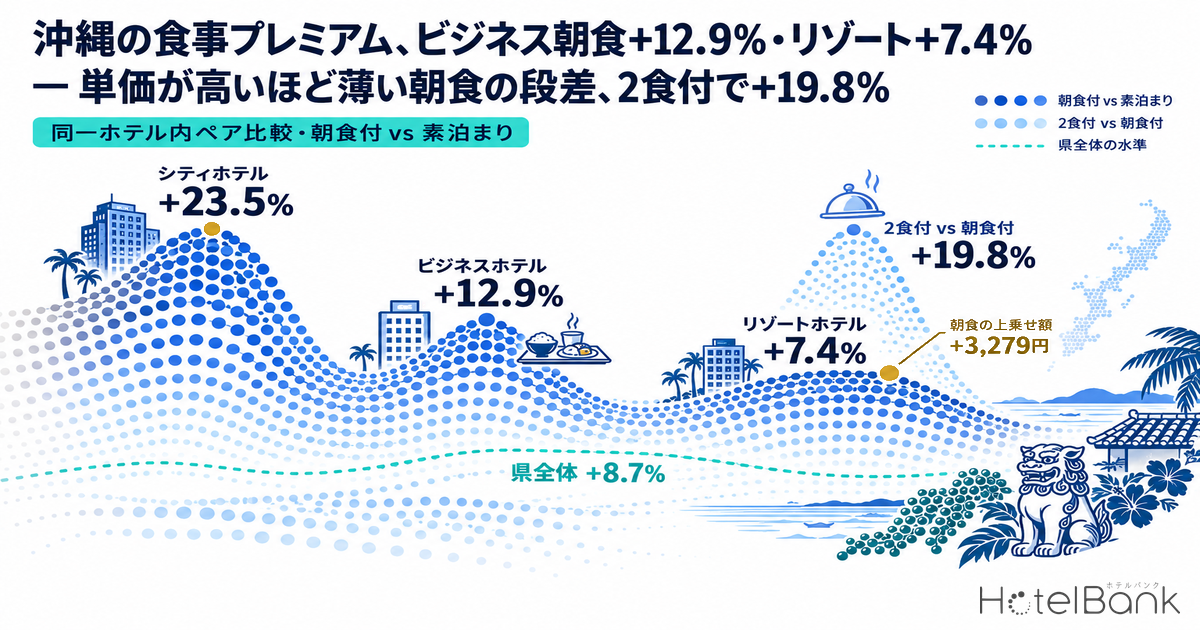
Comparing the accommodation plans that Okinawa hotels are selling for October 2026 stays, limited to properties that sell both a room-only plan and a breakfast-included plan within the same hotel, the uplift for adding breakfast (the meal premium) was +12.9% at business hotels (N=75 paired properties) and +23.5% at city hotels (N=8), but only +7.4% at resort hotels (N=88). The higher the room rate, the thinner the breakfast step; yet the same resorts set a clear step for half-board (dinner and breakfast) plans: +19.8% over breakfast-included (N=65) and +28.3% over room-only (N=65). This article breaks Okinawa’s hotels down by hotel type, municipality and month, sets them alongside Hokkaido, Kyoto and Tokyo, and reads the price-step design of meal plans from an operator’s perspective ahead of the winter low season.
Scope: city hotels, business hotels and resort hotels in Okinawa Prefecture (ryokan excluded). Meal premiums are paired comparisons among properties selling both meal types within the same hotel (breakfast-included vs room-only: N=183 properties, October 2026 stays). The price metric in this article is estimated settled ADR (the settled price level estimated from OTA and other sales data, tax-exclusive equivalent); occupancy is an estimate based on OTA-listed inventory. Both are defined at the end of the article. Data as of: October 9, 2026.
- — The pricier the hotel type, the thinner the breakfast step: for October 2026 stays, breakfast-included vs room-only was +23.5% at city hotels (N=8), +12.9% at business hotels (N=75) and +7.4% at resort hotels (N=88). The prefecture-wide figure was +8.7% (N=183).
- — In yen terms the order flips: the resort breakfast uplift is +¥3,279 per room, larger than the +¥2,238 at business hotels. The rate is thin because the room-only rate is so much higher (¥44,082 vs ¥17,350).
- — Resorts build their step at dinner: half-board vs breakfast-included is +19.8% at resorts (N=65; +¥10,860 per room) and +24.4% at business hotels (N=14).
- — Location splits the role of breakfast: Naha City is +17.4% (N=64), while resorts in Onna Village are −3.4% (N=14). The prefectural average alone will misread your own property’s pattern.
- — Hold the yen uplift flat and the rate thickens in winter: if October’s yen uplift is kept while room prices move only by the change in November’s estimated settled ADR (resorts −16.7%), the resort breakfast premium goes from +7.4% to +8.9%.
How the Meal Premium Is Measured — Same-Hotel Paired Comparisons Only
First, let us be clear about what the “meal premium” in this article measures. Simply comparing the prefecture-wide average of breakfast-included plans with the average of room-only plans mixes in the price gap between high-rate resorts whose mainstay is breakfast-included plans and low-rate hotels centered on room-only plans, so it ends up measuring the difference in the hotel mix rather than the value of the meal. This article therefore extracts only cases where the same hotel sells both room-only and breakfast-included plans in the same month, and aggregates the percentage difference within each property. “+12.9%” is thus close to a hotel-type average of how much a property adds on top of its own room-only rate when it includes breakfast.
The scope is three hotel types: city hotels, business hotels and resort hotels. Ryokan are excluded because half-board is their standard product and pairs with room-only plans are hard to form. All figures are on a two-guests-per-room basis, with the number of properties forming a pair shown as N=. Segments with a small N (such as N=8 for city hotels) should be read as a rough indication of level; it is safest not to debate one-point differences.
Breakfast Premium by Hotel Type — The Higher the Rate, the Thinner the Step
Looking at breakfast-included vs room-only for October 2026 stays by hotel type, city hotels were +23.5% (N=8), business hotels +12.9% (N=75) and resort hotels +7.4% (N=88), a clear ordering in which the higher the room rate of the hotel type, the thinner the breakfast step. Prefecture-wide the figure was +8.7% (N=183), with resorts, which account for the most pairs, pulling the overall figure down.
Source: MetroEngines Research; compiled by the HotelBank Editorial Team
This ordering may seem counterintuitive. Given the number of buffet items and the size of the venue, the food cost and service cost of breakfast should be higher at resorts. But the percentage difference is “breakfast value ÷ room-only rate,” so at resorts, where the denominator is large, adding a breakfast of the same yen amount yields a smaller rate. In addition, breakfast-included has effectively become the standard product at resorts, and room-only plans are often used to sell upper-category rooms or last-minute inventory. If room-only is sold on more expensive rooms, the paired difference is compressed or, in some cases, reversed. The Onna Village example discussed below is exactly that.
Conversely, at business hotels room-only is the mainstay product and breakfast is easy to price as an “add-on option,” and with a small denominator the rate comes out large. The +23.5% for city hotels rests on a small N=8, but it reflects how Naha’s urban hotels clearly build restaurant breakfasts into the price.
| Hotel type | Breakfast vs room-only | Dinner vs room-only | Half-board vs breakfast | Half-board vs room-only |
|---|---|---|---|---|
| City hotels | +23.5% (N=8) | — | — | — |
| Business hotels | +12.9% (N=75) | +19.1% (N=5) | +24.4% (N=14) | +40.3% (N=15) |
| Resort hotels | +7.4% (N=88) | +8.6% (N=13) | +19.8% (N=65) | +28.3% (N=65) |
| Overall | +8.7% (N=183) | +9.8% (N=19) | +19.1% (N=87) | +28.6% (N=88) |
Okinawa; October 2026 stays; two guests per room; same-hotel paired comparison. N = number of properties forming a pair. “—” marks segments where the number of pairs falls below the threshold. Source: MetroEngines Research; compiled by the HotelBank Editorial Team
The Step Taken at Dinner — Resorts +19.8% for Half-Board, Business Hotels +24.4%
The resort step that was thin at breakfast rises the moment dinner is added. Half-board at resort hotels is +19.8% over breakfast-included (N=65) and +28.3% over room-only (N=65), clearly a different size of step from the +7.4% for breakfast. At business hotels too, half-board was +24.4% over breakfast-included (N=14) and +40.3% over room-only (N=15), well above the breakfast step (+12.9%).
Source: MetroEngines Research; compiled by the HotelBank Editorial Team
What this shows is a structure at Okinawa’s resorts in which “breakfast is already built into the price band, and dinner is the revenue step.” The very fact that as many as 65 resorts sell both breakfast-included and half-board plans is evidence that capturing dinner in-house is a widely adopted design. Whereas 65 properties form a breakfast-included/half-board pair, only 13 form a dinner-only pair (dinner-included vs room-only), so a product structure of “if dinner is added, it comes as a set with breakfast” is the mainstream.
Half-board at business hotels, meanwhile, is limited to N=14–15 properties, but the step rate is larger than at resorts. Besides the smaller denominator, dinners at business hotels have a different cost structure (partner restaurants or in-house set meals, for example), so the rate tends to come out high. Raising the share of half-board is not a common design at Naha business hotels, where business-travel demand dominates, but in remote-island and suburban locations with limited dinner options, the step appears to be accepted.
By Municipality — Naha’s +17.4% and Onna Village’s −3.4% Show the Location Gap
Even for the same breakfast-included vs room-only comparison, the way the step is set differs completely by municipality. Naha City sets a step of +17.4% overall (N=64), nearly twice the prefectural average, and by hotel type breakfast is priced in across the board: business hotels +14.2% (N=51), city hotels +23.6% (N=8) and resort hotels +26.5% (N=5). In contrast, resort hotels in Onna Village were at −3.4% (N=14): the average of breakfast-included plans was below the average of room-only plans.
| Municipality | Overall | Business hotels | Resort hotels | City hotels |
|---|---|---|---|---|
| Naha City | +17.4% (N=64) | +14.2% (N=51) | +26.5% (N=5) | +23.6% (N=8) |
| Ishigaki City | +4.5% (N=24) | +8.7% (N=10) | +3.6% (N=14) | — |
| Miyakojima City | +14.2% (N=15) | +14.9% (N=8) | +14.0% (N=7) | — |
| Onna Village | −3.4% (N=14) | — | −3.4% (N=14) | — |
| Nago City | +11.7% (N=9) | — | +21.2% (N=6) | — |
| Motobu Town | +3.3% (N=6) | — | +3.3% (N=6) | — |
| Taketomi Town | +8.7% (N=6) | — | +8.7% (N=6) | — |
Breakfast-included vs room-only; October 2026 stays; two guests per room; same-hotel paired comparison. Only segments with five or more pairs are shown. Source: MetroEngines Research; compiled by the HotelBank Editorial Team
Onna Village’s negative figure does not mean “breakfast is free.” It is most naturally read as a reflection of product structure: room-only plans are offered on higher room types or in last-minute sales slots, while breakfast-included is sold as the mainstay plan for standard rooms. Resorts in Ishigaki City (+3.6%, N=14) and Motobu Town (+3.3%, N=6) also show thin steps; what the high-rate resort belts of the west coast and the outer islands have in common is that breakfast-included is the default. On the other hand, resorts in Miyakojima City (+14.0%, N=7) and Nago City (+21.2%, N=6) set a clear step, so even among “Okinawa resorts” the role of breakfast splits by location.
The +14.2% (N=51) for Naha City business hotels is slightly above the prefectural business hotel average (+12.9%). The gap with Ishigaki City business hotels (+8.7%, N=10) suggests that breakfast in Naha is established as an option for business travelers and is easy to reflect in the price.
May–October Trend and Cross-Prefecture Comparison — Okinawa’s Step Is Stable Across Months
The breakfast premium does not move much with the seasons. Tracking the six months from May to October 2026 by hotel type, business hotels stayed between +12.0% (May, N=68) and +13.1% (September, N=77), and resort hotels moved within a range of +7.4% (October, N=88) to +9.1% (September, N=87). City hotels show a somewhat wider range, from +22.6% (May and August) to +25.3% (September), but with N=8 a degree of fluctuation is unavoidable.
Source: MetroEngines Research; compiled by the HotelBank Editorial Team
What stands out is that the resort step did not widen in the summer peak of July–August. Resorts were at +8.4% in August (N=86) and +8.1% in July (N=86), only about one point different from the +7.4% of October, when demand heads toward the low season. At Okinawa’s resorts, where room rates rise sharply in summer, rooms are repriced while the yen amount for breakfast stays almost fixed, so the step measured as a rate actually becomes thinner in the high-rate summer. That September showed the largest step for every hotel type within these six months can be understood as the result of the breakfast amount being held flat as rates came down from summer.
Lining up prefectures makes Okinawa’s characteristics even clearer. For business hotels, breakfast-included vs room-only is level at +12.9% in Okinawa (N=75) and +12.9% in Kyoto (N=70), followed by Hokkaido at +10.6% (N=197) and Tokyo at +9.0% (N=354). For city hotels, Okinawa at +23.5% (N=8) and Hokkaido at +20.5% (N=49) are high, while Kyoto at +13.6% (N=29) and Tokyo at +13.3% (N=64) are more restrained. Hokkaido, the one other prefecture where resort hotels can be compared, was at +8.3% (N=48), in single digits just like Okinawa’s +7.4% (N=88).
| Prefecture | Overall | Business hotels | City hotels | Resort hotels |
|---|---|---|---|---|
| Okinawa | +8.7% (N=183) | +12.9% (N=75) | +23.5% (N=8) | +7.4% (N=88) |
| Hokkaido | +11.5% (N=349) | +10.6% (N=197) | +20.5% (N=49) | +8.3% (N=48) |
| Kyoto | +11.7% (N=111) | +12.9% (N=70) | +13.6% (N=29) | — |
| Tokyo | +10.6% (N=462) | +9.0% (N=354) | +13.3% (N=64) | — |
Breakfast-included vs room-only; October 2026 stays; two guests per room; same-hotel paired comparison. “—” marks segments where the number of pairs falls below the threshold. Source: MetroEngines Research; compiled by the HotelBank Editorial Team
Okinawa’s prefecture-wide step of +8.7% is the thinnest of the four because resort hotels account for 88 of the 183 pairs, roughly half. By hotel type, Okinawa’s business and city hotels set steps equal to or higher than other prefectures, so the accurate reading is not “breakfast is cheap in Okinawa” but “Okinawa has a high resort share, which makes the prefecture-wide rate look thin.”
Okinawa’s Estimated Settled ADR — The Price Base the Step Sits On
Because the meal premium is a rate, converting it into yen requires the context of the underlying room rate. Looking at Okinawa’s estimated settled ADR by hotel type on a year-on-year basis for finalized months, in September 2026 resort hotels were at ¥16,800 (N=282; ¥15,700 a year earlier; +7.3%), business hotels at ¥8,800 (N=197; ¥8,100 a year earlier; +9.4%) and city hotels at ¥18,100 (N=16; ¥16,800 a year earlier; +7.5%), all three above the prior year. In August, resorts were at ¥22,300 (N=282; +3.1%), business hotels at ¥9,700 (N=196; +3.3%) and city hotels at ¥20,700 (N=15; −0.2%), so growth in the peak month was milder than in September.
| Hotel type | Sep 2025 (final) | Sep 2026 (final) | YoY | Oct 2026 (current estimate) | Nov 2026 (current estimate) |
|---|---|---|---|---|---|
| Resort hotels | ¥15,652 (N=267) | ¥16,799 (N=282) | +7.3% | ¥16,760 (N=280) | ¥13,964 (N=280) |
| Business hotels | ¥8,079 (N=193) | ¥8,835 (N=197) | +9.4% | ¥10,144 (N=194) | ¥9,776 (N=192) |
| City hotels | ¥16,824 (N=11) | ¥18,089 (N=16) | +7.5% | ¥19,888 (N=16) | ¥17,728 (N=16) |
Estimated settled ADR (tax-exclusive equivalent). September 2025 and September 2026 are finalized values; October and November 2026 are estimates based on current sales conditions and may change. A simple comparison with finalized values must wait until the month closes. Source: MetroEngines Research; compiled by the HotelBank Editorial Team
The October and November estimates are based on current sales conditions, and a simple comparison with the prior year’s finalized values (resorts: ¥14,800 in October 2025 and ¥13,700 in November) has to wait until the month closes. Still, even the shape of the finalized 2025 values alone shows that resorts have a seasonal profile that peaks at ¥21,600 in August and falls to ¥13,700 by November (January of the same year was also ¥12,700), so in winter the room-rate base is around 60% of summer. It is worth keeping in mind for winter product design that a breakfast step that looks thin as a rate weighs relatively more against the room rate in yen terms in winter.
The Breakfast Uplift in Yen — How the Rate Moves When the Amount Is Held Flat
To confirm the structure that rates alone do not show, we convert the uplift into yen. On a listed-price basis for October 2026 stays, breakfast-included at resort hotels is +¥3,279 per room (about ¥1,640 per person) above room-only, exceeding the +¥2,238 (about ¥1,119 per person) at business hotels. Resorts add more yen for breakfast, yet the rate stays at +7.4% because the room-only average that serves as the base is ¥44,082, 2.5 times that of business hotels (¥17,350); the structure described earlier, in which the larger the denominator the smaller the rate, shows up directly in the numbers. Half-board at resorts is +¥10,860 per room over breakfast-included, so the step for one dinner is a little over three times the breakfast amount.
The rate also changes with the number of guests. Because breakfast is charged per person, with single occupancy breakfast-included vs room-only is +7.7% at business hotels (N=76) and +6.2% at resorts (N=88), thinner than with two guests (+12.9% and +7.4%). For business hotels, whose mainstay is solo business travelers, the single-occupancy rate is the yardstick closer to reality.
| Hotel type | Comparison | Base plan average (two guests per room) | Uplift (per room) | Per person | Uplift rate (two guests) | Uplift rate (one guest) |
|---|---|---|---|---|---|---|
| City hotels | Breakfast vs room-only | ¥25,119 | +¥5,911 | +¥2,956 | +23.5% (N=8) | +17.3% (N=8) |
| Business hotels | Breakfast vs room-only | ¥17,350 | +¥2,238 | +¥1,119 | +12.9% (N=75) | +7.7% (N=76) |
| Resort hotels | Breakfast vs room-only | ¥44,082 | +¥3,279 | +¥1,640 | +7.4% (N=88) | +6.2% (N=88) |
| Business hotels | Half-board vs breakfast | ¥19,387 | +¥4,725 | +¥2,362 | +24.4% (N=14) | +16.5% (N=14) |
| Resort hotels | Half-board vs breakfast | ¥54,743 | +¥10,860 | +¥5,430 | +19.8% (N=65) | +8.9% (N=64) |
Base plan = room-only for breakfast-included vs room-only, and breakfast-included for half-board vs breakfast-included. Per person = per-room uplift ÷ 2. Source: MetroEngines Research; compiled by the HotelBank Editorial Team
If this uplift is held at the October level and only room prices move, the rate changes mechanically. If the base plan price falls 20%, the resort breakfast premium becomes +9.3%; if it falls 30%, +10.6%. On current estimates, the estimated settled ADR of Okinawa’s resort hotels is expected to move -16.7% from ¥16,760 in October to ¥13,964 in November; applying this, the resort breakfast premium thickens from +7.4% to +8.9%, and half-board vs breakfast-included from +19.8% to +23.8%. For business hotels the October-to-November change is small at -3.6%, and the rate barely moves (+13.4%). Whether breakfast-included plans will look expensive in winter can be checked through this movement of the rate with the amount fixed.
| Hotel type / comparison | +10% | ±0% | -10% | -20% | -30% | Applying the Oct→Nov change in estimated settled ADR |
|---|---|---|---|---|---|---|
| City hotels: breakfast vs room-only | +21.4% | +23.5% | +26.1% | +29.4% | +33.6% | +26.4% (-10.9%) |
| Business hotels: breakfast vs room-only | +11.7% | +12.9% | +14.3% | +16.1% | +18.4% | +13.4% (-3.6%) |
| Resort hotels: breakfast vs room-only | +6.8% | +7.4% | +8.3% | +9.3% | +10.6% | +8.9% (-16.7%) |
| Business hotels: half-board vs breakfast | +22.2% | +24.4% | +27.1% | +30.5% | +34.8% | +25.3% (-3.6%) |
| Resort hotels: half-board vs breakfast | +18.0% | +19.8% | +22.0% | +24.8% | +28.3% | +23.8% (-16.7%) |
Calculated values assuming the uplift for October 2026 stays (per room, two guests) is fixed and only the base plan price changes by the rate in the column heading (rate = October rate ÷ (1 + rate of change)). Figures in parentheses at the far right are the rate of change in estimated settled ADR from October to November 2026 (both current estimates). Source: MetroEngines Research; compiled by the HotelBank Editorial Team
For Revenue Managers Running Okinawa’s Resort, Business and City Hotels — Implications and Action Plan
Operator Insights
1. Check your property’s breakfast step on two axes: hotel type × location. Judging your own step by the prefectural resort average of +7.4% (N=88) alone is too coarse. Resorts in Onna Village are at −3.4% (N=14), Nago City at +21.2% (N=6) and Miyakojima City at +14.0% (N=7): even among resorts, the role of the step differs by location. First recognize whether your property makes breakfast-included the standard product (the Onna Village type) or prices breakfast as an option (the Nago/Miyako type), and then consider whether the step is appropriate within that type.
2. For resorts, the revenue step lies in dinner. Even if breakfast-included vs room-only is +7.4%, half-board vs breakfast-included is +19.8% (N=65) and +28.3% over room-only (N=65): the step rises at dinner. Rather than forcing the breakfast step wider, creating tiers through dinner content, venue and time slot and adjusting the half-board share by season gives more freedom in rate design.
3. As a rate, the step is thin in summer and thickens in the low season. The resort breakfast step moved within +7.4% to +9.1% from May to October, widest in September when rates fell. Given the seasonal profile in which resort room rates fell from ¥21,600 in August to ¥13,700 in November in the finalized 2025 values, the step as a rate will widen naturally if the breakfast amount is kept fixed into winter. Check in both rate and yen terms whether breakfast-included plans come to feel expensive in winter.
4. Breakfast at business hotels is a product you “add on.” Business hotels in Naha City, at +14.2% (N=51), put more price on breakfast than Kyoto (+12.9%, N=70) or Tokyo (+9.0%, N=354). The design of keeping room-only as the mainstay while lifting the rate with breakfast-included is accepted by the market, and even while room rates are growing +9.4% year on year (September 2026 finalized, N=197), there is room to maintain the breakfast-included share.
| Time horizon | Action | Decision trigger (figures in this article) | Aim |
|---|---|---|---|
| Today – this week | Match your property’s on-sale breakfast-included and room-only plans by the same room type and calculate the percentage difference | Whether you deviate widely from the hotel-type averages of +7.4% for resorts, +12.9% for business hotels and +23.5% for city hotels | Identify whether your property is a “breakfast-included standard” type or a “breakfast as option” type |
| Today – this week | Check against the step in your municipality and confirm any gap with local practice | The location gap: Naha City +17.4% (N=64), Onna Village −3.4% (N=14), Ishigaki City +4.5% (N=24) | Check that the way your breakfast is presented does not look expensive or cheap against neighboring product structures |
| Within two weeks | Resorts: review the step design of half-board plans and prepare two to three tiers based on dinner content | If your half-board step remains thin against half-board vs breakfast-included +19.8% (N=65) and half-board vs room-only +28.3% (N=65) | Take at dinner the step that cannot be taken at breakfast, and lift the rate including on-property spend |
| Within two weeks | Business hotels: check the breakfast-included share and price step, and keep the design of adding breakfast on top of a room-only mainstay | If your step is well below the +14.2% (N=51) of Naha City business hotels | Do not miss breakfast’s contribution to rate while room rates are growing +9.4% year on year |
| Looking to next month | Check how the yen amount of breakfast-included plans feels against winter price levels and, if necessary, switch how breakfast is presented (e.g., room-only plus an optional breakfast) | The seasonal profile in the finalized 2025 values, with resort room rates falling from ¥21,629 in August to ¥13,721 in November, around 60% of summer | Avoid losing room-only-minded guests in the low season because breakfast-included feels expensive |
| Looking to next month | Track the movement of estimated settled ADR monthly from November onward and recalculate the position of meal plans in yen rather than as a step rate | Current estimates for November 2026 of ¥13,964 for resorts and ¥9,776 for business hotels (both subject to change) | Wait for the month to close, then align meal plan prices with the winter base |
Source: MetroEngines Research; compiled by the HotelBank Editorial Team
Summary — Three Yardsticks for Reading Meal Plan Steps
Viewed through same-hotel paired comparisons, Okinawa’s breakfast step is +23.5% at city hotels (N=8), +12.9% at business hotels (N=75) and +7.4% at resort hotels (N=88): the higher the rate of the hotel type, the thinner the step. The half-board step, on the other hand, is +19.8% over breakfast-included at resorts (N=65) and +24.4% at business hotels (N=14), making dinner the revenue step. By municipality, Naha City at +17.4% (N=64) and Onna Village at −3.4% (N=14) sit at opposite poles, with the role of breakfast splitting by location.
We suggest three yardsticks for operators checking their own meal plans. First, compare step rates on the two axes of hotel type × location; a single prefectural average will misread your property’s type. Second, at resorts, design the step at dinner rather than breakfast; breakfast is built into the price band, and tiering half-board offers more freedom in rate. Third, even if the step rate does not move with the seasons, its weight in yen does. Heading into winter, when room rates fall to around 60% of summer, confirming in yen rather than as a rate whether breakfast-included feels expensive is the starting point for low-season product design.
Frequently Asked Questions
Q. How much more expensive are breakfast-included plans than room-only plans at Okinawa hotels?
A. Comparing October 2026 stays within the same hotel, the breakfast uplift rate for two guests per room was +23.5% at city hotels (N=8), +12.9% at business hotels (N=75), +7.4% at resort hotels (N=88) and +8.7% for Okinawa overall (N=183). Ryokan are not included in the tally.
Q. Why is the breakfast uplift rate low at resort hotels?
A. It is not because the yen uplift is small. Breakfast-included at resorts is +¥3,279 per room above room-only, exceeding the +¥2,238 at business hotels. The rate stays at +7.4% because the base room-only average is high at ¥44,082. In addition, at properties that make breakfast-included the standard product and sell room-only on upper-category rooms or last-minute inventory, the difference is compressed.
Q. How much more expensive are half-board plans than breakfast-included plans?
A. At resort hotels, half-board is +19.8% over breakfast-included (N=65; +¥10,860 per room) and +28.3% over room-only (N=65). At business hotels it was +24.4% over breakfast-included (N=14) and +40.3% over room-only (N=15). At resorts, setting the step at dinner rather than breakfast is the mainstream structure.
Q. Why is the breakfast step reversed between Naha City and Onna Village?
A. Naha City is at +17.4% overall (N=64), pricing in breakfast regardless of hotel type. Resorts in Onna Village are at −3.4% (N=14), which can be read as a reflection of a product structure in which breakfast-included is sold as the mainstay plan for standard rooms while room-only is offered on higher room types or in last-minute sales slots. It does not mean breakfast is free.
Q. How should the breakfast uplift be checked heading into winter?
A. If room prices fall while the yen uplift is held flat, the rate automatically rises. Assuming October’s amount is kept and resort estimated settled ADR moves -16.7% in November, the breakfast rate goes from +7.4% to +8.9% (a trial calculation based on current estimates). One approach is to check the breakfast amount against your property’s room-only rate each month and, for months when it looks expensive, consider presentations such as room-only plus an optional breakfast.
About the Data
| Meal premium | The within-property percentage difference, aggregated by hotel type, municipality and prefecture, covering only properties that sell two meal types (room-only / breakfast-included / dinner-included / half-board) in the same month within the same hotel. Two guests per room. Ryokan excluded. N= is the number of properties forming a pair; this article cites only segments with N=5 or more. The baseline is October 2026 stays, and the trend covers stays in each month from May to October 2026. The cross-prefecture comparison covers breakfast-included vs room-only only. |
| Estimated settled ADR | The settled price level (tax-exclusive equivalent) estimated from OTA and other sales data (lowest-plan level × hotel-type coefficients; an ensemble of multiple channels). Past months are finalized values; current and future months are estimates based on current sales conditions. Median error of 6.6% when checked against published operating results. Year-on-year figures are calculated only between finalized months. Coverage: Okinawa resort hotels (September 2026 N=282), business hotels (N=197) and city hotels (N=16). |
| Estimated OCC | Occupancy based on OTA-listed inventory = 100 − 100 × OTA-listed remaining rooms ÷ total rooms. Covers a fixed cohort of properties listing at least 30% of total rooms on OTAs (the same set of properties for each stay date). It is an estimate based on the take-up of inventory sold on OTAs and differs in definition from actual room occupancy (it runs high because unlisted rooms are counted as sold). This article does not use occupancy figures. |
| Booking curve | Based on observations from 45 days before the stay date up to the most recent date. Not used in this article. |
| Data as of | October 9, 2026. Sales conditions and inventory change daily, so the figures in this article are a snapshot at the time of retrieval. |
Source: MetroEngines Research; compiled by the HotelBank Editorial Team
References and Sources
■ Data sources
MetroEngines Research meal premium aggregates (same-hotel paired comparisons for Okinawa, Hokkaido, Kyoto and Tokyo; stays from May to October 2026; one- and two-guest occupancy; ryokan excluded) and Okinawa’s estimated settled ADR by hotel type (finalized values for January 2025–September 2026 and current estimates for October 2026–February 2027).
■ Calculation assumptions
The meal premium is the difference, expressed as a rate, in average selling price (listed price, two guests per room) at properties selling both meal types within the same hotel; N = number of paired properties. The per-person uplift is the per-room amount divided by two. The held-flat sensitivity table fixes the uplift for October 2026 stays, assumes only the base plan price changes, and calculates “October rate ÷ (1 + rate of change).” The far-right column uses the rate of change in estimated settled ADR from October to November 2026 (current estimate) as a proxy for the change in room prices.
■ Limitations and caveats
The meal premium is a paired comparison of selling prices and does not reflect the mix of meal types actually booked or the breakfast take-up rate. The basis of the meal premium (listed price) and estimated settled ADR (settled price level, tax-exclusive equivalent) differ in definition, so the far-right column of the sensitivity table is a guide only. Estimated settled ADR from October 2026 onward is an estimate based on current sales conditions and may change. Estimated settled ADR is an estimate from sales data, with a median error of 6.6% against published operating results. City hotels (N=8) and small municipal segments (N=5–9) are prone to swings.